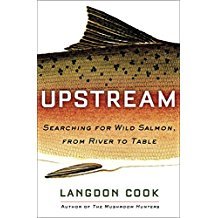
From the award-winning author of The Mushroom Hunters comes the story of an iconic fish, perhaps the last great wild food: salmon. For some, a salmon evokes the distant wild--thrashing in the jaws of a hungry grizzly bear on TV, perhaps. For others, it's the catch of the day on a restaurant menu, or a deep red fillet at the market. For others still, it's the jolt of adrenaline on a successful fishing trip. Our fascination with these superlative fish is as old as humanity itself. Long a source of sustenance among native peoples, salmon is now more popular than ever. Fish hatcheries and farms serve modern appetites with a domesticated "product"--while wild runs of salmon dwindle across the globe. How has this once-abundant resource reached this point, and what can we do to safeguard wild populations for future generations? Langdon Cook goes in search of the salmon in Upstream, his timely and in-depth look at how these beloved fish have nourished humankind through the ages and why their destiny is so closely tied to our own. Cook journeys up and down salmon country, from the glacial rivers of Alaska to the rainforests of the Pacific Northwest to California's drought-stricken Central Valley and a wealth of places in between. Reporting from remote coastlines and busy city streets, he follows today's commercial pipeline from fisherman's net to corporate seafood vendor to boutique marketplace. At stake is nothing less than an ancient livelihood. But salmon are more than food. They are game fish, wildlife spectacle, sacred totem, and inspiration--and their fate is largely in our hands. Cook introduces us to tribal fishermen handing down an age-old tradition, sport anglers seeking adventure and a renewed connection to the wild, and scientists and activists working tirelessly to restore salmon runs. In sharing their stories, Cook covers all sides of the debate: the legacy of overfishing and industrial development; the conflicts between fishermen, environmentalists, and Native Americans; the modern proliferation of fish hatcheries and farms; and the longstanding battle lines of science versus politics, wilderness versus civilization. This firsthand account--reminiscent of the work of John McPhee and Mark Kurlansky--is filled with the keen insights and observations of the best narrative writing. Cook offers an absorbing portrait of a remarkable fish and the many obstacles it faces, while taking readers on a fast-paced fishing trip through salmon country. Upstream is an essential look at the intersection of man, food, and nature.
Langdon Cook is the author of The Mushroom Hunters: On the Trail of an Underground America (Ballantine, 2013), which Publishers Weekly called "intrepid and inspired," and Fat of the Land: Adventures of a 21st Century Forager (Mountaineers, 2009), which The Seattle Times called "lyrical, practical and quixotic." His writing has appeared in numerous publications, including Terrain, Gray’s Sporting Journal, Outside, and The Stranger, and he has been profiled in USA Today, Bon Appetit, Salon.com, and WSJ magazine. Cook lives in Seattle with his wife and two children.
So I did that thing again where I just picked up this book without any idea what it was about, this is one of the many galley's I still have pilled up from when I first got on netgalley and requested everything, and so I was pretty confused while reading the book. It is narrative so I was expecting some kind of storyline but then he kept talking about salmon and I was pretty confused for like a third of the book. Now after reading the summary and other reviews I realize that's what the book is supposed to be so that one's on me.
Still though it's quite hard to read over 300 pages about salmon when you're not really that interested in salmon. The book is well written and I actually learnt a lot about conservation efforts and differences in salmon populations. I wasn't necessarily looking to do so however and so it was kind of a pain in the ass to make self finish this one. So mostly the rating just reflects the fact that I shouldn't randomly pick up books I know nothing about because no matter how good they might be, if I'm not necessarily interested in what they're about it'll be a pain to get through them.
This very enjoyable look at wild salmon, the people who profit from them and threats to them, is a fine reminder that clean environment and wealth go hand in hand.
From restaurant owners to native fishermen, the men who decided to market fresh salmon as opposed to canned, and the legislations they all have to follow, we get a comprehensive view of the topic. We also get recipes, adventure and travel down the west coast of America. What more could you ask? The book is a nice length to be packed without being padded and I found it an easy and absorbing read.
I downloaded an ARC from Net Galley. This is an unbiased review.
More than a natural or political history of the five West Coast salmon species, this beautifully written book introduces you to engaging people--players in the fields of fishing, fish conservation, and salmon-as-food--and places where the salmon are still found. As with his previous book THE MUSHROOM HUNTERS, Cook portrays the characters he encounters in his research as thoroughly and as well as he does the landscapes he moves through. You don't need to be a fisherman to appreciate this thoughtful book.
An excellent read on the history, biology, and current struggles to survive of salmon. Cook offers views of the fish through the eyes of fishermen, fish biologists, and everyday people. It left me surprised that there are any salmon left in the world. Very interesting!
Really enjoyed this book. I like salmon, so this brought me much further down the rabbit hole to really understand salmon and where they come from. It makes you think long and hard about farm salmon or hatcheries. Underlying it all is the sad truth that given the opportunity, humans will tap their resources into complete exhaustion without any thought to sustainability. I hope people can start to see how important nature of is and how mindful of It we need to be. Also the discussions on fly fishing made me wish I was a better fly fishermen.
I love that this takes place in the Pacific Northwest and focuses on salmon, an iconic species, and one that has been central to my work.
Langdon Cook is a good writer, but not a great one, hence 4 stars and not 5. I still find him worth reading because I am interested in wild foods and I’m interested in understanding the impacts of my diet choices. This is his most recent book, published in 2017.
Below, I summarize and share passages of the book that helped me process what I learned and the main messages of the book, at least from my perspective.
Salmon are in trouble. On the east coast, there are no reasons for hope. Atlantic Salmon are all farmed. “Other than a stream or two in Maine, New England is no longer home to wild Atlantic salmon in any sort of meaningful way, and very few people alive today have ever even tasted one”(3%).
Yet there are some reasons for hope for west coast populations, which we learn about in this book, like Yuba River Chinook and Snake River sockeye migration to Redfish Lake, “the terminus of the longest salmon migration in the contiguous United States”(58%). You can also still catch wild salmon in Canada and Alaska. Unlikely in the US, though not impossible, where they are “pestered by fish ladders, tanker trucks, hypodermics, and hatchery complexes”(59%).
On the Yuba, our intervention is critical. “Natural processes have been so thoroughly manipulated by human beings, from mountains to coast, that it’s hard to tell where the human-engineered landscape ends and the wild—if it still exists—begins. Ditto the so-called wildlife. Herds of elk, once nearly exterminated, now roam campgrounds. Most Golden State salmon begin their lives in a temperature-controlled egg tray”(59%).
Wild salmon is too iconic to let go extinct. “…more than any other fish, the salmon occupies a singular, mythic place in human cultures around the globe. Two salmon bedeck the Glasgow coat of arms. Loki, the trickster of Norse mythology, transforms himself into a salmon to elude capture. In Native American art, the salmon is a symbol of abundance and renewal”(4%).
Salmon like fish have been around for 50 million years, around the time the of the first primates. How have to my survived numerous large scale environmental catastrophes (flood, fire, ice) yet they can’t survive the Anthropocene? The same could be asked for numerous species.
Cook talks about the racism between Tribes and non-Tribal fisherman, particularly where I live, which I have experienced first hand. “These days, many anglers in salmon country don’t think kindly toward the Native American fishery. They see the Indians as competitors for a dwindling resource and decry the nets that catch endangered runs of wild fish. Tensions run high on a place like the Olympic Peninsula… The peninsula was once thought to be sheltered from the forces of civilization that have decimated salmon populations elsewhere, but its famous fish runs are in steady decline. Many blame the Indian nets, none more so than hook-and-line anglers hoping to put a fat salmon in the freezer”(12-13%). Here’s another example, but from the Columbia River. “Brigham remembered meeting a sport angler who said he’d rather have zero fish than share the catch with Indians. The comment made me think of white anglers I’ve met through the years who think nothing of maligning Indians for their fishing rights, anglers who would never utter disparaging words about African Americans or Asian Americans—“That’s racist”—yet somehow feel that the first Americans do not deserve the same consideration”(20%).
We learn about the impact of the dams on the Columbia River, which have reduced salmon runs to a fraction of what they once were. The dams have also desecrated sacred sites for native Tribes. The Dalles Dam is one example. “…the former Celilo Falls. Called Wy-am, which means “the echo of water upon the rocks,” the sound of these falls hasn’t been heard since March 10, 1957, when the Dalles Dam closed its gates for the first time and flooded the most sacred of all fishing sites in North America”(14%).
The tribes managed salmon populations much better than white settlers. The author hears it referred to as “Spiritual game management”(14%). “Evidence shows that many tribes had developed sophisticated fishing cultures using a variety of tools and techniques, from spears and weirs to dip nets and gill nets, and through a process of trial and error over the course of centuries had learned to exploit salmon runs to the fullest extent possible without depleting the resource”(15%).
Instead, white settlers overfished and constructed dams, among other land uses that lead to the crash of salmon populations. I love this eloquent but tragic summary of what white settlers and their non-native descendants have wrought: “TUMBLING RIVERS TURNED INTO reservoirs; spawning grounds replaced by hatcheries; the deep blue sea scaled down to a salmon farm”(17%).
He talks quite a bit about hatcheries. It’s such a complicated issue, but I feel like I have a greater appreciation for it now.
- [ ] “In a landscape that’s been homogenized, we’ve populated a tamed river with a domesticated run of salmon. But without them, the argument goes, there would hardly be any springers at all”(17%).
- [ ] “… hatchery salmon are an illusion. An illusion that everything is okay. The missing adipose is all too obvious. It signifies loss”(17%).
- [ ] Salmon and hatcheries that support those populations are critical to native tribe’s culture. “The fish have a higher purpose…The commercial part comes later, when enough salmon have been put away for the year and the many spiritual rites performed, like the First Foods ceremony in April”(18%). This is according to Kathryn Brigham, a well-known figure in the Confederated Tribes of the Umatilla, a union of the Cayuse, Walla Walla, and Umatilla tribes. Hatcheries help keep that culture alive. “In recent years, to ensure an adequate supply of ceremonial and subsistence fish, the four main treaty tribes along the Columbia—the Yakama, Umatilla, Warm Springs, and Nez Perce—have actively pursued a strategy of building salmon hatcheries, much to the chagrin of environmentalists. This is one of the central ironies on the Columbia River. One might think the tribes and environmentalists would be natural allies, but it hasn’t turned out that way. “We work with the environmentalists, but at the same time we’re not environmentalists,” Brigham told me. “Because of the dams, these hatcheries have to mitigate for the losses. There will always be a need for hatcheries. As tribal leaders we’re willing to sit down and talk, but always in the back pocket is that treaty right. We stand on our treaty right. If we don’t, our kids’ children and their children won’t be able to fish.” “(20%)
- [ ] If there’s a commercial market for wild fish, hatcheries are necessary supplements to the wild populations.
- [ ] Hatcheries are weakening the genetic diversity that has helped salmon survive for 50 million years. “A chinook from a coastal rainforest isn’t the same as a chinook from the high-desert plateau. Though the same species, each possesses a site-specific set of adaptive genes that make it more fit for a certain sort of habitat or run timing. Even in the same river system, stocks from different tributaries have genetic makeups that give them an advantage in their particular niche. Hatcheries can’t possibly address all this genetic variation… with the advent and proliferation of hatcheries, the hereditary diversity that has made salmon such vigorous survivors up and down the Pacific Rim—through volcano, earthquake, and Ice Age, through drought and disease—is now dwindling, as stocks go extinct in little tributary after tributary, victims of dams, overfishing, and development”(25%).
- [ ] Hatchery fish compete with wild fish, and they sometimes breed with them too, which dilutes the genetics of wild stocks. Are there truly wild populations of salmon left? Yes, but it’s complicated. “Guido Rahr once told me that pinks and chums were Alaska’s “dirty little secret.” While most of the country’s so-called wild salmon harvest comes from Alaska, the word wild is slippery… a large percentage of Alaska’s salmon harvest is actually hatchery fish, with most of those fish being pinks and chums”(38%).
- [ ] According to Guido Rahr with the Wild Salmon Center, “the success of wild salmon in this part of the world depends on limiting the influence of hatcheries and promoting the influence of healthy forests”(23%). “He views the hatchery system as the most pernicious obstacle in the way of restoring wild fish runs”(27%).
- [ ] Most people believe the hatchery system is a problem. “Today, just about everyone committed to the idea of wild fish wants to see the hatchery system overhauled. The exceptions are commercial fishermen, who can’t make a living without the hatcheries, sport-fishing guides (same reason), and Native Americans, who depend on salmon for ceremonial and subsistence purposes… The hatchery system, at its heart, was designed to give people fish to catch, not to save or enhance native fish populations”(26%).
- [ ] Not all hatcheries have the same purpose. Some are mitigation hatcheries, created to allow environmental destruction like a dam, and some are for conservation, also called captive brood stock hatcheries. One example of a conservation hatchery is Eagle Fish Hatchery, which is the lifeline for Redfish Lake sockeye. “To be clear, the Eagle Fish Hatchery is not a mitigation hatchery, like the majority of hatcheries on the Columbia system and elsewhere. Rather than mass-producing fish to be caught in a net or on a hook, its mandate is to keep the genetics of the Redfish Lake sockeye alive, with as much variation and diversity as possible… In all, nearly fifteen hundred sockeye salmon will be trapped and sorted this year. These are wild fish making the full trip upriver, and this population will be supplemented, in turn, with Redfish Lake sockeye raised in the hatchery from a parentage of previously trapped wild fish. This is what is meant by the term “captive brood stock.” … these Redfish Lake sockeye, as the southernmost population in North America and with the longest, steepest migration, offer a suite of genetics that makes them special. To lose them would be a blow to the species”(60%). But the author isn’t so sure there’s a real distinction between the two. “Put a new label on it—conservation hatchery or captive brood-stock hatchery—and you’re still left with a hatchery, a man-made environment that can never reproduce the myriad life histories of wild salmon”(60%). And these brood stock/conservation hatcheries are not enough. “Similar brood-stock hatcheries are up and running for Russian River coho in California, North Puget Sound chinook, and Elwha River pink salmon. [Jim] Lichatowich still worries that these conservation-hatchery plans have neither end dates nor criteria for evaluating success. Furthermore, the reasons for the decline—habitat loss and so on—need to be addressed in tandem with the restoration efforts. Conservation hatcheries treat a symptom, not a cause… He paraphrased the philosopher and nature writer Gary Nabhan: Animals don’t go extinct because we shoot them all. They go extinct because of an unraveling ecosystem. They lose ecological companionship. Fish hatched from brood stock, though derived from wild parents, aren’t the same as those from the previous generation. “When you take a fish out of the river and put it in a hatchery, then release it, you’re depriving the fish of ecological relationships.” I turned the question around for Lichatowich: Is humanity busy depriving itself of those same ecological relationships? He sighed. The world is indeed becoming a lonelier place”(60%).
What is being done and what can be done?
- [ ] The Wild Salmon Center is focusing on strongholds, where wild populations are still healthy and viable.
- [ ] In California, there is a collaboration with rice farmers to “intentionally flood their fields in winter… It’s a process that’s good for rice production and good for salmon. Studies are revealing that young fish in these managed floods grow much faster than those confined to the river proper. Katz calls them “floodplain fatties,” and the program was christened “The Nigiri Project,” for a variety of rice used in sushi”(44%).
- [ ] Reef netting is the most sustainable and the only truly selective fishery. We learn a lot about this rare fishing technique, visiting Lummi Island. “This ancient way of catching salmon numbered less than a hundred devotees in its ranks globally. Here on Lummi Island there were a total of eight gears, which made Lummi the center of the reef-net universe. Half of those eight gears were owned and operated by a single entity, Lummi Island Wild, the co-op”(65%). If it’s possible for consumers to buy reef net caught fish, they should. Bycatch is hard to avoid with any other fishing technique.
- [ ] Sustainable sushi restaurants like Carson Trennor’s in San Francisco, the first of its kind. Instead of serving unagi, they serve “fauxnagi”, which is black cod, still a sustainable fishery. Eel is now severely threatened throughout its range, partly because of the sushi market.
- [ ] Don’t eat farmed salmon. “Unlike livestock, which eat grass, salmon are carnivores. To produce a pound of farmed salmon requires a minimum—even at the most efficient farms—of a pound and a half of fish down the food chain, fish that otherwise might be eaten by humans or other predators in the wild… In simple terms, you’re taking a potential food source away from poorer people to produce a luxury food item”(79-80%).
- [ ] An effort Rene Henery is calling “Fins, feathers, and floods forever” or “F/X” on the San Joaquin River, working with private landowners to change their management techniques and help them see that “Floodwaters provide seasonal habitat, fertilize soils, and allow groundwater recharge for badly depleted aquifers—the definition of a win–win… Programs like the Nigiri Project and F/X are using innovative approaches to reintegrate a semblance of the wild into an engineered landscape”(85%).
Parts of the book are reminiscent of Braiding Sweetgrass, which I finished recently.
- [ ] The support by the Tribes of hatcheries has upset a lot of environmentalists, but Rene Henery, the author’s ecologist friend in California, understands it. He says, “ “Well, something that conservationists need to wrap their heads around,” Rene continued, “is the connection between salmon and people. For thousands of years, Native Americans were the ultimate stewards of salmon populations. It may well be that we can’t have salmon recovery without the recovery of indigenous cultures.” “(20%)
- [ ] Here’s one particularly poignant example of this clash between science and traditional ecological knowledge. “The early years of co-management were difficult. The tribes didn’t have any scientists. The white technicians laughed, Kat Brigham recalled, when a tribal elder said the salmon were coming because the dogwoods were blooming. “How tribal people saw the world was not technical. It was based on Mother Nature’s signs. The non-Indians didn’t see it that way. Rather than try to understand it, they made fun of it.” “(20%)
- [ ] Rene Henery expresses the following, ““Let’s come into a new balance in which we’re part of the system, not fighting it. But first we have to change our relationship to place or we’re just continuing the invasive-species experience, which is essentially what colonialism is”(57). It’s all about the relationship to the land and those that call it home, human and non-human.
- [ ] Rene also refers to salmon carcasses as gifts. ““The whole point of these high-desert creeks is that they green up with a gift from the sea,” Rene said. Salmon and steelhead infuse these otherwise sterile places with ocean isotopes—nutrients from the cradle of existence—allowing life to thrive in a hard environment. The loss of these nutrients is bad for the fish and, ultimately, bad for the farmer”(57%).
- [ ] “Neither Rene nor Katz likes the word restoration. They prefer reconciliation, with its subtext of resolving long-simmering feuds. “The idea of restoration for most people is to put something back the way it was,” Rene said. “There’s a growing consensus that the land will never be as it was. We live in a dynamic space; things are always changing. The future is unknown. It’s not a fixed point.” In other words, the landscape isn’t a rusted ’65 Mustang waiting under a tarp for a new owner with deep pockets. The best we can do to heal old wounds is to reconcile the land with new uses that help to bring it into some sort of balance” (82%). Using the term reconciliation is another reference to needing to heal the relationship with the land.
Langdon takes transitions from dirt-to-water in this book, examining salmon and the communities built around. Up and down the Pacific Northwest - and even down to California - Langdon enmeshes himself in the local places and conflicts that surround the complexity of the different breeds of salmon, narrating his travels and reporting histories. I found the book to be very revealing, shedding light on local issues that would never likely become national news, and which have broad and long-term consequences. His work is detailed and well researched, and ropes in a wide variety of perspectives on the relevant issues, from restauranteurs to fish conservationists. While I would have liked to hear more from the perspective of Native Americans, as well as from the grousing sports fisherman, I understand why the focus was elsewhere. While the book is a depressing read from an ecological viewpoint, Langdon shows where hope is manifest, ending on a somewhat upbeat note, but still cautioning in tone. I definitely have a much deeper appreciation for those salmon filets that hit my plate, and for those glistening fish flying through the air from way back when I lived in Seattle.
I have been fishing most of my life, but live on the east coast, so I've only been able to fish Lake Ontario during the king salmon run there. This made me interested in reading this book once I saw it.
I really enjoyed most of the book. The start of it was great, learning more about the details of the life of the Pacific salmon and all of the trials it goes through to return to its home, most of which are becoming more and more inaccessible. The book covers many other topics including hatcheries, different fishing techniques, and stories about fishermen and their lives. I lost a little interest during some of these stories since I'd probably like to read more about the fish instead.
Overall if you enjoy fish and fishing, you will enjoy this book. Thanks to NetGalley for offering an early copy to review!
I just finished my masters studying Lake Sturgeon in Alberta, and learned a quite a few things about fish and fish conservation from this book. Wish it had been around before I wrote my thesis! The reef net technique and the impact of "mitigation" hatcheries are two big ones. He also discusses fragmentation, which I can confirm from my own research to be one of the biggest drivers of species loss. I was surprised that Cook never noted research by Burkhead showing that in the twentieth century, freshwater fishes had the highest extinction rate worldwide among vertebrates. Would be a 5 if it had a little more Burkhead and a little less boytime type towel snapping, BUT THAT'S JUST ME. I'm a science geek. The personal stories were mostly fun and interesting. Definitely worth reading.
I had no idea there were so many different kinds of salmon! Less surprising is the dire circumstances that they are all in thanks to over-fishing, dams, farmed salmon etc. This was a really entertaining roam through several states into different types of salmon, fishermen, chefs etc. I really enjoyed the conversational style of it but it has substance.
An excellent book about the destruction of the 5 species of Pacific salmon, the endless ways that humans contribute and the meaningful ways that a few are trying to reverse that destruction. I'm way more preachy than this book. This book is fascinating and an ode to these wonderful fish through the eyes of an angler. Don't eat farmed fish. Support indigenous fishing rights. Get rid of dams!
This book had a lot of potential. I actually really enjoyed the first part of the book, because it dives right into some major contentious issues in the subject area of salmon. It also provides some good education. Ultimately though, the book failed to deliver on a few fronts.
First, way too much of the book is taken up by conversations and anecdotes and the author finding the perfect fishing hole. I appreciate turning nonfiction into a readable narrative, but it seemed the author lost sight of the point of the book a few times. Or maybe I wanted it to have a point. He describes his own fishing trips and personal journeys up and down about 25-50 rivers across the Pacific Northwest, Alaska, and California. I got bored of that pretty quickly. There were whole chapters where the only point was something like, "Reef fishing is an old practice that some people use today, and we would be better off if more people practiced reef fishing." Instead of focusing on that point, we took a few tours of the one island that is home to this type of fishing, and learned in great detail what the home and boat looked like of the guy heading up this effort.
Second, the organization of information made things really confusing. I wish there had been more straightforward chapters, like "Alaska runs and challenges," "Building and taking down dams," "Hatcheries and their impacts," "The influence of restaurants on salmon," "Public perception," etc. Instead the same points would be batted around chapter after chapter with no takeaway at the end. We met the same set of ecologists and scientists in almost every chapter, and he laboriously reintroduced them in great detail, as if we hadn't just spent 10 pages with them 5 minutes ago. He also doesn't do a great job sticking to one term for each type of Pacific salmon. Turns out there's a cheat sheet at the back of the book laying out the types, but it felt so confusing while reading. There's like 5 types of Pacific salmon, but they each go by at least two names, and fish that are labeled trout are sometimes trout but are other times salmon. Gah. I have no idea how to organize all this information in my head, because there was no organizing principle to the book (at least that I could see).
Finally, I understand this is a super complicated topic, but he doesn't even try to lay out conclusions based on his research and experiences. When trying to come up with a takeaway, the only thing I could think was, "Buy wild salmon, not farmed, and dams are bad." Although seeing as how the grocery stores are flooded with farmed salmon and wild salmon is very tricky to find, I'm not even confident I'll be able to implement that advice. It made me want to stick to trout and avoid salmon altogether. (Also, if you like to fish then you will LOVE this book, which probably should have been called: Upriver, My personal journey to find which ties and color attracted each type of salmon and the best methods/tricks/techniques to (non-barbed) hook the fish you're looking for, plus bonus tips on what times of day are best for fishing and what types of locations, and a friendly cheat sheet on which fish you are allowed to eat (and how many) and which fish you legally must throw back into the river/ocean.)
Ever since the mid-1960s, when I became aware of what anadromous fish were, salmon and steelhead have fascinated me. Their protection and enhancement has always been something I have hoped for. Most of the damage done to them occurred before my interest in them began whether it was gillnets, dams, watershed degradation, or simply overfishing. Billions of dollars have been spent trying to preserve and restore these fish. “Upstream Searching for Wild Salmon, From River to Table” is a recounting of these efforts. The author covers the geography from the Copper River of Alaska southeast to Redfish Lake in the Sawtooth Mountains of Idaho to the San Joaquin Valley of California and everything in between. The overriding theme is the concept of the “wild salmon” vs. the hatchery raised salmon but he also touches on the salmon most of us encounter in our restaurants and Costco, farm raised Atlantic salmon and Steelhead. The author takes you on fishing trips deep into the Canadian wilderness, scuba diving in a Sierra stream, gillnetting on a “bow picker” and what I perceive to be his harvester of choice a reef net fishing”. The book touches on dam removal highlighting the Elwha River restoration, the “breaching “of the four lower Snake River dams. This is a well-researched book and will open the eyes to what we who live in the Pacific Northwest see around us every day. I thank the author for the map early in the book and fault him for the absence of an index.
20 years ago Mark Kurlansky's "Cod" came out, a book about the ruining of a once great Atlantic food source from overfishing. Although well-written, Cod was phenomenally depressing, if only because there's recipes throughout on how to cook the once abundant fish. Cod serves as a good contrast to the far more optimistic work Langdon Cook has done with Upstream, a study of Pacific Salmon.
Upstream is filled with territory, rivers, fishing tales, people- both native and not- going about their business and recreation. It's not misty-eyed or preachy. And yet in the chapter Cook chooses to end with, a study of Washington State's spectacular Elwha River and its two dam removals and the subsequent free drainage of pristine habitat, you know that has to be a fundamental part of how we talk about improving the viability of the Pacific Salmon.
Cook's prose is as clean as Jon Krakouer's (or Kurlansky's or even John Hersey). And like most of Cook's prior works, meals are central to move his narrative. But it's never the meal so much as how the food was sourced, that serve as his most unique style. Upstream is an extraordinarily good read, the recipes within it aren't for meals, instead they're how to help save Salmon.
This is my second Langdon Cook book (other book was about mushroom foraging in PNW). I really enjoy his topics and writing. I describe his books as foodie meets Timothy Egan. He digs into the history and culture (and sub culture) of the food, the players in getting from farm or stream to table, and the environmental ramifications of policy on the natural resource, our food supply, our legacy, and our myriad cultures. Any self respecting Pacific Northwesterner who approaches their salmon consumption with the airs of a wine connoisseur or tingles like a kid on Christmas day when Copper River Salmon season starts, must read this book.
Another book about salmon that carelessly dismisses Atlantic salmon: "Other than a stream or two in Maine, New England is no longer home to wild Atlantic salmon in any sort of meaningful way..."
"A stream or two" includes the Penobscot River, the second largest river in New England with a watershed larger than all of Connecticut and Rhode Island combined. To say that wild Atlantic salmon aren't "meaningful" denies the cultural significance of the fish to the Wabanaki people, and disrespects the years of hard and dedicated work by many to sustain and restore wild Atlantic salmon, which at this very moment are returning again from the sea to the "streams" of Maine.
Enjoyed learning more about Pacific salmon and the state of the different rivers on the west coast of America. I was particularly fascinated by the discussion of the work in California particularly along the Sacramento bypass. I know very little about the five different Pacific salmon so this book helped give me a better overview. The author is a angler so I found the discussion of fly fishing for salmon very familiar. I had not come across the technique of reef net fishing before so this was a interesting concept. The book is a nice smorgasbord of science, angling, people and cooking.
Kind of a messy read but much of it kept my interest. The book is a mish mash of science and passion for the joys of fishing. The author is realistic about the possibility of blending the needs of various interest groups that are impacted by decisions that can help some populations of wild salmon survive. We are not going to ever see what once was in the way of massive runs of wild fish. Hatcheries are not going away but they also aren't a singular solution. There will have to be room for both in our future.
I really enjoyed "The Mushroom Hunters" and had high hopes for this book (I gave "The Mushroom Hunters" five stars when I read it a few years ago, and still regularly think about it and relate stories from it to people). Unfortunately, "Upstream" was nothing like Cook's previous book - I made it into the fourth chapter, got sick and tired of hearing about people who I was either indifferent to or actively disliked, and decided I was done with it. Life's too short to read bad books.
This was more about an attempt at creative writing than an adapt to inform. It would be difficult, for example, to create a chart of properties of the main types of salmon from this book. There is also no mention of the current program of reintroducing steelhead into the great lakes. Overall the book is unbalanced toward ephemera liberal notions and against those of commerce.
This is a personal look at the story of Pacific salmon. It is inclusive and historical, with stories of the rivers and the people who love salmon. It includes all sorts of fisherman, scientists, restauranteurs and others involved in the life of salmon from how they are spawned to the table. These people come to life in Cook's writing. His descriptions of the locations are beautiful and thoughtful.
While the subject matter is interesting and Langdon Cook's narrative style is engaging, I still found the book to be somewhat disorganized. I appreciated the stories centered around the people in the industry as well as the people who are working to conserve these species. However, I would have appreciated a bit more scientific discussion regarding the salmon themselves. There's some in there, but just not enough for my taste.
I thought it was a slow start as someone who doesn't have the joy of fishing for Salmon, but the more I read the better it got. I enjoyed the aspect of the different types of fishing, and the different ways it was cooked as well, but I really enjoyed when the environmental aspects and finally toward the end when he talked about what had been done and well it was turning things around. Good book
Langoon Cook wrote a great story. I don’t know if I want to dine on the Copper River King or help the environmentalist save the salmon. I loved the American Native history of the Northwest. This was a great read on many levels. Well, I decided if I ever have the opportunity to put a big fat Chinook filet on my plate, I’ll do so.
Well written, fact filled look at Salmon's place in the history, ecosystem and culture of America and particularly the Northwest.
Be forewarned, the author has a decidedly liberal, Sierra Club, Greenpeace, Trout Unlimited point of view. I would've preferred a little more balance, but despite that bias it's a fascinating and informative read. Highly recommended.
I got most of the way through on audio. I didn't see the path this book was taking for the most part. There were some interesting anecdotes about salmon but it wasn't what I was expecting so I think I zoned out too much on the audio to really grasp the contents.
When should one give up and go with the flow? Save our rivers is not working against the corporate behemoths and people who love cheap electricity. So, what to do in the meantime waiting for a breach in the culture of me-anness.