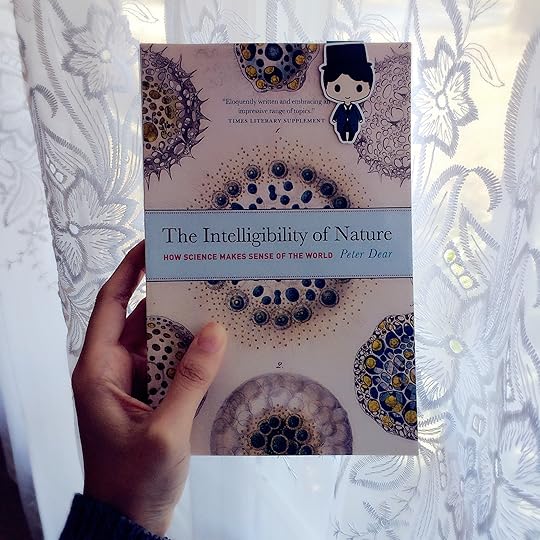
Throughout the history of the Western world, science has possessed an extraordinary amount of authority and prestige. And while its pedestal has been jostled by numerous evolutions and revolutions, science has always managed to maintain its stronghold as the knowing enterprise that explains how the natural world we treat such legendary scientists as Galileo, Newton, Darwin, and Einstein with admiration and reverence because they offer profound and sustaining insight into the meaning of the universe.
In The Intelligibility of Nature , Peter Dear considers how science as such has evolved and how it has marshaled itself to make sense of the world. His intellectual journey begins with a crucial that the enterprise of science is, and has been, directed toward two distinct but frequently conflated ends—doing and knowing. The ancient Greeks developed this distinction of value between craft on the one hand and understanding on the other, and according to Dear, that distinction has survived to shape attitudes toward science ever since.
Teasing out this tension between doing and knowing during key episodes in the history of science—mechanical philosophy and Newtonian gravitation, elective affinities and the chemical revolution, enlightened natural history and taxonomy, evolutionary biology, the dynamical theory of electromagnetism, and quantum theory—Dear reveals how the two principles became formalized into a single enterprise, science, that would be carried out by a new kind of person, the scientist.
Finely nuanced and elegantly conceived, The Intelligibility of Nature will be essential reading for aficionados and historians of science alike.
I really wanted to give Intelligibility of Nature a higher rating to be able to say I gained "scholar" points from reading it, but I just cannot. I was pretty excited and optimistic every time before I would start a chapter but as I read them they started to become more dull and disinteresting.
Despite not enjoying this personally, I still have to praise Intelligibility of Nature for its merits. Peter Dear does an excellent job with creating an intelligible and relatively easy to understand crash course of the history of science. He covers a lot without info dumping the material onto readers. Dear explores universally known ideas such as evolution, the atomic model, quantum mechanics, and other popular concepts and theories on a basic and general level. And I have to admit I did learn a lot about the history of science (with ideas like intelligibility, instrumentality, and the battle between applied and pure science).
For those reasons, I can see why this is a significant read for STEM students. However, I also believe that they will benefit just as sufficiently from only reading Dear's introduction, which is roughly about fifteen pages. In the introduction, Dear explains why he created The Intelligibility of Nature for students, discusses what he hopes readers will get out of the book, and outlines the general main points that'll be explored in more detail later on. Readers can read the entire book if they're interested. However, for those wanting the main points of discussion reading the introduction and skimming the chapters will give readers adequate understanding to do well in whatever course they're in because many of the ideas (instrumentality, science as an entity that can only expand by means of a community, etc) are repetitive.
Seeing as I'm one the the people that fall under the latter group and didn't seem as interested in the readings, that is the only reason why I'm rating this low. The Intelligibility of Nature serves its purpose for being comprehensible and remaining informative throughout. But on an enjoyment standpoint, personally, it was rather tedious. (I didn't seem to be the only one in my class that thought this way. After a brief discussion with some of my other fellow classmates from the course, we all came to the consensus it was the most dreaded reading of the course.) However, keep in mind, I also think that my opinion is influenced by the pacing of the course I was in. Because the chapters for The Intelligibility of Nature were often times coupled with so many other assigned readings that shined compared to it throughout the course, I couldn't appreciate The Intelligibility of Nature as much. On its own, where a reader can focus solely on it, maybe it'll prove to be a better read.
Dear traces the two faces of science, its intelligibility and its efficacy in several historical examples. The virtue of this approach is showing how attitudes towards each has changed at different times and places. I think that reading this book provides a helpful point of reference for thinking more clearly about what we mean when we talk about science.
The discussion of how natural philosophy became the empirical science we know today was interesting, especially the debates of the Victorian era over what constitutes an adequate explanation of physical phenomena. This gave me some insights into the limits of purely quantitative modeling, and further convinced me of the importance of understanding the casual mechanisms at play when developing theories in physics, chemistry, and biology (and social science, for that matter).
I don't share Dear's keen interest in the minute details of the history of science and technology, but I admire the dedication and careful scholarship shown in his presentation of the scientific worldview since Newton. This could be a helpful resource for specialists in the history of ideas and the philosophy of perception.
Great book, very readable! It argues for science as an ideology as it combines two things as two sides of a single coin: natural philosophy and instrumentality. The latter being practical applications and the former being the understanding why nature is that way. It does so through six case studies that treat huge debates in the history of western science: the mechanical world view of Galilei and Newton, taxonomy of life in the seventeenth century; the existence of phlogiston or atoms and the quantitative methods of Lavoisier in the nineteenth century; Darwin's natural selection and its effect on natural theology; Einstein's top-down Vs Lorentz' bottom-up theory of relativity; and the debate about the notion of reality in quantum physics that is still very much alive.
This entire review has been hidden because of spoilers.
Mr. Dear begins strong with some great chapters on natural philosophy versus natural history and natural theology. He really brings out the distinction, and its importance to scholars over time. Briefly, natural philosophy is theory, natural history is usefulness, experiment and observation, and natural theology is understanding the mind of God through observation of the world around us. He brings out a basic dichotomy of science; are the experiments and observations important because they confirm the theory, or is theory important because it makes sense of the experiments and observations? That the utility of science has been used politically to obtain public funding is well know. Mr. Dear notes that scientists have exploited utility arguments to obtain backing for theoretical (natural philosophical) investigation.
He continues with some very interesting chapters on how many scholars regarded as unintelligible any natural philosophy that required action at a distance. The book weakens somewhat as it quickly covers Darwin and Wallace, and advances to Maxwell and the aether, Heisenberg and quantum mechanics, and (bizarrely to this reader) some aspects of mathematics, such as the meaning of proof when no one mathematician can be expected to understand it at once, as with the four color theorem.
This is a really great book for science students. I'm not sure why the other reviewers are considering it high school-level reading. Its not. Its short, yes, but very academic in nature. The book has definitely made me more aware of how I think about science, the scientific process, and the history of science. Its well written and organized. It is pretty dry at times, but I also never found it to be dense or overly expounding details. Its concise, just the subject matter is a little subtle for popular reading. I'm not sure I would recommend this for those who are not seriously interested in science, but I would recommend it to anyone studying sciences or interested in a more meta-analysis of scientific history.
I found this a little dry, but loved it nonetheless. Someone more versed in the history of science might offer a more valuable critique, but for me at least this was an eye opener! I can definitely say my perspective on current scientific endeavor has changed. This sort of background study isn't just for the sake of interest; it really puts the whole of our modern understanding of the world into context. For instance, it had never previously occurred to me that there were trends in our interpretations of reality. Apparently, it's not all "standing on the shoulders of giants" after all!
Have ambiguous feelings about this one: by all means it is written for high school teenagers and it is an encouraging invitation into the captivating world of scientific research. But level of details makes it an adult read and evidently overwhelming for teenagers. Thus I'm confused to what audience did the author address it. Those factoids were sometimes curious to me (a grown up), but the overall narrative was of course far too familiar to keep me (and other adults I'm sure) engrossed.
If you are any type of scientist, you owe it to yourself to read this book. This should be required reading for high school because it gives you a much healthier attitude toward learning and toward the acceptance of new ideas.
A good intellectual examination of the progress of science in defining the world, the hindrances of the feat, and the motivation of key thinkers in history.