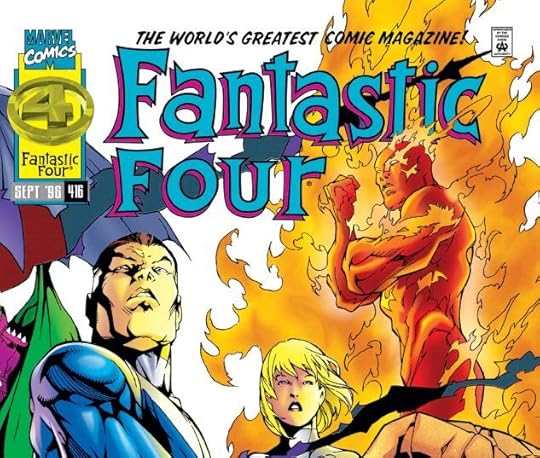
Professor X hasn't been himself lately - moody, inscrutable - but the psionic armor and army of Sentinels are the real tip-offs! It'll take every super hero New York has to face the onslaught.
Collects X-Men (1991) #55, Uncanny X-Men #336, Cable (1993) #35, X-Force #58, X-Man #19, Incredible Hulk #445, Iron Man #332, Avengers #402, Thor #502, Wolverine #105.
Mark Waid is an American comic book writer widely known for shaping modern superhero storytelling through influential runs on major characters at both DC Comics and Marvel Comics. Raised in Alabama, he developed an early fascination with comic books, particularly classic stories featuring the Legion of Super-Heroes, whose imaginative scope and sense of legacy would later inform his own writing. He first entered the comics industry during the mid 1980s as an editor and writer for the fan magazine Amazing Heroes, before publishing his first professional comic story in Action Comics. Soon afterward he joined DC Comics as an editor, contributing to numerous titles and helping shape projects across the company. After leaving editorial work to focus on writing, Waid gained widespread recognition with his long run on The Flash, where he expanded the mythology of the character and co-created the youthful speedster Impulse. His reputation grew further with the celebrated graphic novel Kingdom Come, created with artist Alex Ross, which imagined a future DC Universe shaped by generational conflict among superheroes. Over the years he has written many prominent series, including Captain America, Fantastic Four, Daredevil, and Superman: Birthright, bringing a balance of optimism, character depth, and respect for comic book history to each project. Waid has also collaborated with notable artists and writers on major ensemble titles such as Justice League and Avengers, while contributing ideas that helped clarify complex continuity within shared superhero universes. Beyond mainstream superhero work, he has supported creator owned projects and experimental publishing models, including the acclaimed series Irredeemable and Incorruptible, which explored moral ambiguity within the superhero genre. He later took on editorial leadership roles at Boom Studios, guiding creative direction while continuing to write extensively. In subsequent years he expanded his involvement in publishing and digital storytelling, helping launch online comics initiatives and advocating for new distribution methods for creators. His work has earned numerous industry awards, including Eisner and Harvey honors, reflecting both critical acclaim and enduring popularity among readers. Throughout his career Waid has remained a passionate student of comic book history, drawing on decades of storytelling tradition while continually encouraging innovation within the medium. His influence extends across generations of readers and creators, and his stories continue to shape the evolving language of superhero comics around the world today through enduring characters imaginative narratives and thoughtful reinventions of familiar myths within popular culture and modern graphic storytelling traditions.
2018 read: At the time of first publication this was was cray cray (in a good way); Onslaught leads to the end of the Fantastic Four, Avengers, Iron Man, Spider-Man etc, as those comic books in this volume were at the time, to be the last to be printed! As for the actual stories nothing can really touch the wonderful Fantastic Four finale with great painted art by Carlos Pacheco. Some of the other books however were very average. 5 out of 12 overall. Covering Hulk #445, Iron Man #332, Avengers #402, Punisher #11, X-Man #19, Amazing Spider-Man #415, Green Goblin #12, Spider-Man #72, Fantastic Four #416 and Wolverine #105.
finished this one much faster cause i had already read half of it or more there was issues that i didn't like iron man and thor are them. and there the x force and hulk and wolverine were good all others i had read as singles before this. either way a nice experience and only 1 more book is left to read now.
Even more tie-in issues are included in this third installment in Onslaught's crazy ongoing story. Spider-Man, Punisher, Iron Man, and Hulk all do their part to try to deal with the mess associated with the psychic powerhouse created as a combined form of the darkest portions of Professor X's and Magneto's psyches. Meanwhile, Onslaught targets two of the most powerful young people to add to his mental might -- Franklin Richards and Nate Grey, the X-Man. Also, Wolverine finally gets to the root of Onslaught's creation, and the Avengers duke it out with two of the main bad guy's toughest cronies, Post and Holocaust.
The story of Onslaught was well done but the amount of extra stories kept delaying progress. Having it so long and drawn out was a bit annoying. The extra stories were not that bad but they really didn't add to the experience.
The third volume advances the main storyline (though not much, for all of the page count) and also includes more loosely connected tie-ins, most notably a just-OK trilogy of "end of an era" Avengers stories. The best tie-in of the set, however, is probably the (second) Hulk issue. Overall, somewhere between the first and second collections in quality. (B)
I read the core X-titles back when this event was happening, I was a massive X-Men and X-Factor fan at the time and quite liked X-Force and Generation-X. I had no real interest in the traditional superhero teams, aside from an early childhood love of Spider-Man I thought they were all a bit too twee and rather camp for my tastes. I felt the X-Men and the spinoffs were a slight bit more mature in their storytelling.
I stopped reading Marvel comics around '98 and didn't get back to reading comics/graphic novels at all until around '06 thanks to being reintroduced to classic 2000AD stories. I was aware of the criticism surrounding Marvel and DC's big event cashcows but remembered enjoying Apocalypse, Onslaught and Operation: Zero Tolerance at the time and felt the latter's political analogues were on-point, if memory serves then they're just as valid regarding the current political climate. So I was quite keen to come back to this series as a more cynical 40-something.
Well, the first book was nearly as good as I remembered, forgiving the contemporary art style and attitudes of the 90s, it's a bit too 'superhero' for my tastes now but reasonably solid, the second book was also quite good. The third though, ugh, it's pretty poor. I can see why Marvel took the opportunity to reboot the rest of the universe. I don't know if the likes of the Avengers, Hulk and Fantastic Four are made worse for their vague connections to the Onslaught story or whether they were at the end of their rope and it was the only hope they had but it's all dull, nothing content. At the time of buying the comics I only bought those that were a direct continuation, the "Phase" books, not the "Impact" ones. This collected edition is largely filler, with little if anything of major significance to the overall story. I won't pretend to be knowledgeable about the various contributers' finest work, I'm merely taking the content at face value. The writing and art is a mixed bag, I do like my namesake's art across some of the titles within but some of the other contributions are pretty poor.
After having spent the best part of the last decade reading indies current and classic as well as subscribing to 2000AD and the Megazine I can see that the criticism of Marvel's content back then is entirely justified. I'm a fan of the core content of this series, even if its and my age has taken the sheen off it but the cash-in content is dross.
Marvel sucked during the '90s. Not only did they suck, but they tried really hard at it! You cannot tell me that these guys were not trying to outdo each other in trying to make crappy comic books. The dialogue is overly written, littered with those annoying* boxes that serve as footnotes, as if you are supposed to stop where you're at, sift through dozens of long boxes, and peruse the point of reference. Just awful.
The artwork is a train wreck of Liefeld influenced dreck. The Richard Strakings/ ComiCraft computerized fonts look gimmicky, as does the severely dated computer coloring enhancements by Malibu Studios. I guess that these were breakthroughs at the time and precursors to modern day techniques, but they have not aged well. The artwork by Andy Kubert, Joe Madureira, and Angela Medina are all varying degrees of suckiness.
Every single costume is changed except for Captain America. Thor's enchanted Uru Hammer now has a chain attached to the handle instead of the stirrup that used to be at the end. Every hero has long hair that seems to "float" in the air like it's underwater...thanks for pioneering that look, Liefeld. Thor's hair is past his ass, and even the Sub-Mariner has long hair. Why? He never did before. The devolved Wolverine was a horrendous idea.
What were comic book creators on in the '90s? The dialogue by Mark Waid, Scott Lobodell, and Peter David are all laughable, being unintentionally funny. Actually, all of the writing is bad, but I am too lazy to list everyone's name, ditto all of the terrible "artists". Anthony Castrillo's pencils in X-Force #58 were so Byrne-esque that I had to do dome research online to see if this was some Byrne pseudonym. He really has the look and feel down, almost coming off as a tracing of Byrne's pencils at times. He was the only bright spot, aside from the teaming of a neophyte Mike Deodato, Jr. and veteran Tom Palmer. Deodato's early style was very much of the era, and he was also busy drawing every single hero as an overly musclebound, long hair floating in the air like it were underwater, character as the rest of these hacks. I feel sorry for you kids who grew up on this decade's comics, and I am glad that I sat it out.
The heroes begin to lose hope, as they realize that Onslaught may be a foe that is beyond them.
This one is another volume of showing us the individual heroes and also the teams, and how they are dealing with and reacting to the attack from Onslaught. Things are pretty dire as they have had to retreat to New Jersey, as Onslaught now claims and for all intents and purposes, owns New York. I think this was the biggest blow to the heroes as New York has been the main Marvel city of heroes for some time.
The stories themselves are hit and miss. There is good and bad here but to be honest, it would've been better to stream line this event a bit more. Don't get me wrong, its interesting to see the tie ins, but the overall narrative seems bogged down by the extra details that are explored. Onslaught is a great villain, but I get the feeling that he is being ignored for the most part of this volume. The issues where we deal with Onslaught directly are still really good, and provide a good sense of drama, but I just wanted more of that.
The next volume is the final one, so we will see how the heroes deal with Onslaught once and for all.
A slight improvement over Volume 2, this collection mainly treads water until the concluding volume. The X-Men, Fantastic Four, Hulk, and the Avengers all battle Onslaught in different scenarios, Cable goes through the usual Cable drama. There's an X-Force issue but it's the worst offender of Treading Water, as it basically retells each character's origin. Wolverine saves a kid in his effort to be less feral. And Thor does something boring related to Asgard.
A lot happens in this volume, and yet, the story doesn't really advance much. It's still just squads of intermingled heroes fighting Onslaught while Apocalypse and Uatu watch on.
If you've liked the Onslaught series so far, I think this is better than the previous volumes but I don't think that it's so much better that it will convert anyone who hasn't enjoyed the series thusfar. You certainly wouldn't want to start reading X-Men here.
This third volume is a bit more action-packed than the last one, and the issues here deal a bit more directly with the actual Onslaught story, which I appreciated. One thing that did bother me, though, was a great deal of rather heavy-handed foreshadowing that the Avengers and the Fantastic Four would not survive the confrontation with Onslaught. Decades later, of course, I already knew about that, but I would have hoped it would be a bit subtler or maybe even not mentioned at all until it happened. Despite going a bit against my expectations, and having some rather horrendously designed costumes in a few cases, this was a good read, and I'm looking forward to finishing out this event.
This is a continuation of the Onslaught story line. Art isn’t bad and the stories themselves not horrible. The Onslaught piece is kind of interesting. I had wandered away from comics for a bit when this came out. So hadn’t read it before. It isn’t as bad as the hype, but it isn’t Chris Claremont era X-Men either.
This volume continues to be well-crafted, with individual stories being important to the overall plot. There's a particularly nice focus in the X-comics that lead off this volume, that then fades in the latter half of the book. Beyond a few stand-out issues however (like Thor #502), this is more average fare, but probably a hair better than the volumes that preceded it.
I thought it was better than previous volumes because the stories focused on individual characters and things they needed to do to get ready for onslaught. The action was tight paced and meaningful. Let's hope the payoff is worth it!
The real action is starting, finally! Nevertheless some pointless issues to the major plot are still present in the volume. So far this volumes seem to be more expensive that they needed to be. Nevertheless, the major plot is great and is evolving in a very interesting manner.