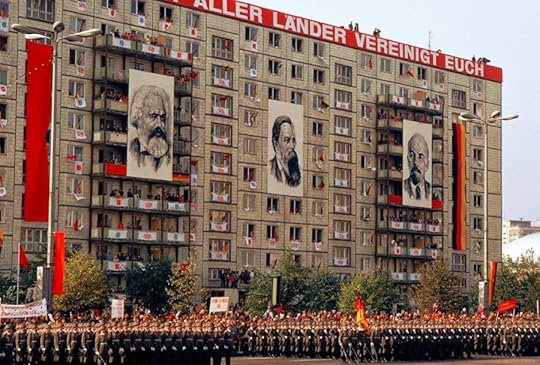
The forty-year existence of East Germany was a difficult time for most East Germans. The “German Democratic Republic,” as a number of historians have pointed out, was neither democratic, nor a republic, nor even particularly German – as it was an authoritarian Communist dictatorship, with the real power emanating from the U.S.S.R. The big policy decisions that were made in government buildings in Moscow and East Berlin had devastating consequences for ordinary Germans on both sides of the Inner German Border and later the Berlin Wall, as Nina Willner makes clear in her 2016 memoir Forty Autumns.
Willner, who served as an intelligence officer in Germany during the Cold War, keeps her focus squarely on her own family’s experience in setting forth A Family’s Story of Courage and Survival on Both Sides of the Berlin Wall (the book's subtitle). The book begins near the conclusion of the Second World War, as the Nazi regime is collapsing, while forces of the four victorious Allied Powers – the United States, Great Britain, France, and the Soviet Union – are moving in to occupy different parts of defeated Germany. Fatefully, for Willner’s family, their part of Germany, around the town of Schwaneberg, was in the part of central Germany that would, in post-World War II times, fall just within the Soviet zone of occupied Germany, and later within the German Democratic Republic.
Willner’s grandmother and grandfather – her Oma and Opa – had managed to survive the cruelty and malice of the Nazi regime, and the horrors of war; but as the Soviets moved in and began to impose a communist regime upon their sector of occupied Germany, Oma and Opa and their family faced a new set of challenges. Unquestioning obedience to the new order was expected, and those expectations posed serious challenges for Opa in his work as an educator. And the children of Oma and Opa responded in different ways to the strictures imposed by the East German government; one of them, Hanna (author Nina Willner’s mother), eventually made a risky escape to the West, at a time when the innerdeutsche Grenze, the Inner German Border, was not as completely sealed and fortified as it later became.
To say that the D.D.R. regime was unhappy with Hanna’s decision to leave would be an understatement. Many East Germans were escaping the country for the freedom of the new Bundesrepublik Deutschland (Federal Republic of Germany) that had been established in what were once the British, French, and U.S. sectors of occupied Germany, and West Germany was gaining many of the D.D.R.’s most accomplished and creative citizens. Therefore, the East German government did everything it could to reclaim, or establish some control of, defectors.
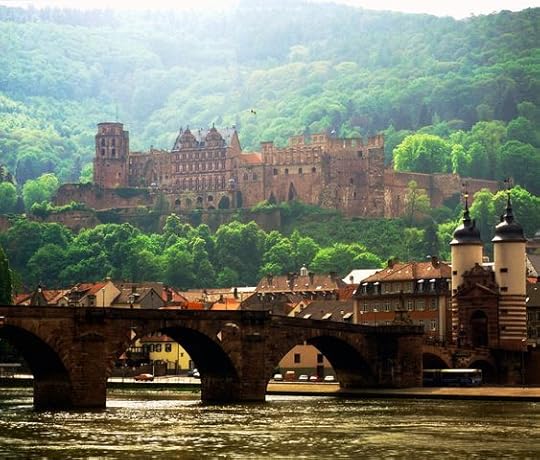
In 1954, Oma and Hanna’s sister Heidi were allowed to travel to West Germany to visit Hanna, who was then working for the U.S. Government in Heidelberg. But East German police officials in Schwaneberg told Oma that a condition of her visiting her daughter Hanna in the West was that she must try “to bring Hanna back or, barring that, convince her to ‘do a few special things for her country’ in her work with the Americans” (p. 98). The visit to Heidelberg was joyful, but when Oma and Heidi boarded the train for their return to the D.D.R., “Like birds that had been set free for a short, beautiful time, it was as if they were being put back into the confinement of their cold metal cage” (p. 103).
After Oma and Heidi returned to the D.D.R., “The Schwaneberg police did not even call Oma in. Perhaps they already knew that she had not been successful in her task of convincing Hanna to come back or become a spy. Perhaps they figured she hadn’t even tried. But one thing was certain: they chalked it up as one more failure of the family to comply. Because Oma did not hold up her end of the bargain with the authorities, they made it clear that subsequent applications to travel to the West would be rejected” (p. 105).
Forty Autumns provides a vivid sense of how dreary and joyless life was under the hardline Communist regime of the German Democratic Republic. Absolute obedience was expected by a system that often failed to provide even the most basic measure of life’s comforts for its citizens. The Ministerium für Staatssicherheit or Ministry for State Security – more simply, the Stasi – used both its official agents and a large network of unofficial collaborators to monitor every aspect of the lives of ordinary East Germans. “The Stasi devoted an untold number of man-hours to keeping track of dissidents like Ulrike Poppe and Bärbel Bohley. Agents were posted around the clock to spy on them” (p. 205), with telephone tapping, video monitoring, and surveillance from cars and on foot.
Stasi surveillance soon got personal for Willner’s family. Opa, tired of keeping his mouth shut, had begun publicly criticizing the East German government, stating that he was 77 years old and asking what the D.D.R. could possibly do to him. The answer came all too quickly:
The authorities came to Klein Apenburg. At his door, they handed Opa a document. It was an official order committing him to a ‘special program’ at Uchtspringe, a hospital located fifty miles away. Everyone knew of the place, recognized more commonly as the insane asylum. The hospital in fact was a state psychiatric facility, and the special program was intensive re-education training. Opa was directed to go, as the order read, “to get your thoughts straight.” (p. 208)
Opa was eventually released and permitted to return home, but he never told his family a word about what had happened to him at Uchtspringe.
With the fullness of historical context available to us, we now know that by 1987, the German Democratic Republic was near the end of its existence. Mikhail Gorbachev sought to bring glasnost (openness) and perestroika to the Soviet Union, and reform efforts were underway in other Eastern European nations like Hungary and Poland. But East German leader Erich Honecker adopted a hard-line approach to maintaining his Communist dictatorship. Even elite citizens like East Germany’s participants in international-sports competition were always under suspicion as potential defectors. When Heidi’s daughter Cordula, a talented athlete, was being considered for a spot on an East German bicycling team, she was first interrogated about her loyalty to the D.D.R.
The security official called her in.
“How often is your family in contact with your mother’s sister or any relatives in the West?” the official asked, no doubt already knowing the answer.
“My mother doesn’t communicate with her sister anymore.”
“How would you like to live in another country?”
“I can’t imagine living in another country,” Cordula answered truthfully. “I have everything here. My family is here. My life is here. Why should I want to go to the West when I have everything here?”
“That’s right,” he said. “You family is here and they are very important to you, aren’t they?” (p. 309)
One senses immediately the threat implicit in the official's final words.
The German Democratic Republic fell not too long after that, and the Willner family on both sides of the Inner German Border and the Berlin Wall – or, at least, those who were still alive – were reunited as shared citizens of a united Germany that actually was a republic and actually was democratic. Yet one finishes Forty Autumns with a strong sense of sadness at knowing how an entire generation of people lived under a cold grey tyranny.
My great-grandfather, Wilhelm Max Felix Albert Haspel, left Berlin and came to the U.S.A. in 1903, in search of freedom and opportunity. I was born in 1961, in the year in which the Berlin Wall was constructed, and I grew up in the Cold War years. For most of that time, East Germany was a mystery, a place of undefined but unmistakable menace. Since the fall of the Wall, works like Wolfgang Becker's film Good Bye, Lenin! (2003) have provided a sense of what life was actually like for people living in East Germany, and Nina Willner's Forty Autumns is particularly informative and helpful in that regard.