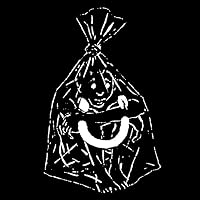
The last piece of Adrian Tomine's work that I read before moving to Japan was issue nine of Optic Nerve, the issue that began the serialization of the work that would later be collected as Shortcomings. While that was a fine issue on its own, it didn't work quite as well on its own as some of Tomine's other single-issue stories. However, Shortcomings as a whole is one of Tomine's best works, and it's far more complex and subtle than it may appear on the surface. The story deals with Ben Tanaka, his girlfriend Miko Hayashi, and the role that racial identity and personal shortcomings play in the dissolution of their tumultuous and argumentative relationship.
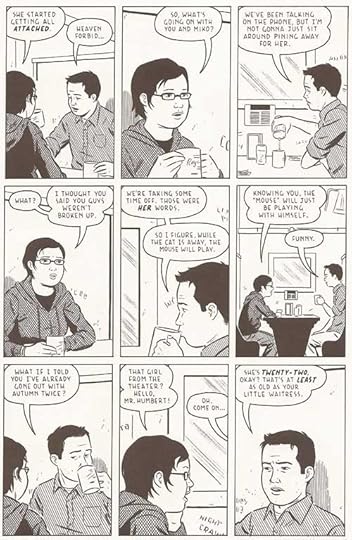
What Tomine is so good at here is showing the way in which discourses of race infiltrate relational and psychic space despite the desires or best intentions of the characters involved. On the one hand we have Ben, who constantly snipes against the notion that Asian-Americans suffer from discrimination and who despises Asian-American identity politics, but who can't avoid viewing Miko's affair with the 'white' Leon Christopher in terms of race. On the other hand Miko seems heavily invested in the politics of Asian/Asian-American identity, and yet let's herself be objectified and photographed by Leon, who seems to have a deep and obvious Asian fetish.
There are a couple of great moments of dialogue that illustrate how Tomine manages to work with this subject. In one scene Ben meets up with Leon and Mikako on the street in New York (where he's basically stalking them). Leon, ridiculously, keeps speaking Japanese to Mikako even though everyone else is speaking English, and when Ben gets angry he tries to "protect" Mikako by striking a martial arts pose. At this point Ben says, "What? Are gonna do some tai chi on me?" and then turns to Mikako to say "Jesus, Mikako ... you're cheating on me with this Steven Seagal dipshit?" This scene exactly exposes Ben's inability to get beyond race, even though that's what he's so often claiming doesn't matter much at all. In the heat of the moment, when he busts out with an emotionally driven insult, he turns automatically to race. Never mind the fact that Ben's own propensity to be an absolute raging jerk is probably the key factor in the breakup between he and Mikako, rather than Leon's 'whiteness.'
On the other hand, Mikako attempts to, almost ridiculously, move Leon outside of the category of whiteness, clearly in an attempt to make herself feel better about the fact that, on the surface at least, he has all the characteristics of the classic Asian fetishist. Speaking with Ben later she says, "And if it really matters to you, he's not white." So if he's not white, then what is he? "He's half Jewish, half Native American." This may be true (although it seems unlikely, given the storyline), but this categorization is clearly an evasion on Mikako's part, a way for her to look away from the racial dynamics of the relationship that she's found herself in.
Tomine doesn't seem to want to ultimately judge any of these characters, but instead tries to show the way in which desire and the discourse of race create layers of pain and entrapment that end up screwing everybody in the end. What's most impressive about the way he does this in Shortcomings is his reversal of the usual function of caricature in comic art. Comic art is famous for reducing human features to simplistic forms in order to create certain exaggerated effects. Some of the most famous, damaging, and persistent cartoon caricatures are those having to do with race — the depictions of African-Americans that stem from minstrelsy, and the wartime depictions of buck-toothed Japanese are only two obvious examples. Caricature, then, has been a key component in the focusing and dissemination of racist discourse and ideas. However, Tomine's own characters are so well drawn and he pays so much attention to everyday details of expression, that the cartoon depictions he presents us with here in fact turn out to be more complicated and richly shaped than the language of race that circulates in their dialogue. In other words, Tomine has ended up using the detailed possibilities of comic art to undermine the discursive caricatures of racial identity that so often circulate in language, and to show the limitations that linguistic categories run up against when used as overly simplistic explanatory devices for human action and emotion.
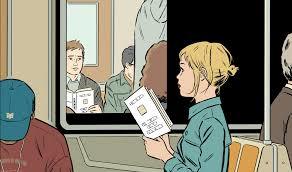
Tomine is at his absolute best in those sequences that use the graphic possibility of the comic panel to create emotional and cognitive effects. The comic opens with what seems to be a first-person voiceover, conveying a saccharine (and stereotypical) story about the narrator's grandfather: "For most of my life I had felt distant from my grandfather. Perhaps mistaking the language barrier for coldness. But as I stood beside him in his aging fortune cookie factory, my perception of him began to change. I realized that he was very much like the thing he's spent his life making: a hard, protective shell containing haiku-like wisdom." For the first page of the comic, this is the story you're in, inside the fortune cookie factory, but then the scene shifts and you realize that the panels have been depicting a movie screen and that you are now watching the audience reaction to this screen. By framing the opening in this way, Tomine not only makes an ironic commentary about the kinds of depictions of Asian-American identity that have become popular, safe, and acceptable, he also shows how difficult it is to get outside of that frame of reference once it has been introduced as a central mode of representation and understanding. If the comic begins with a stereotypical (and limiting) discursive frame then it ends by doing away with language all together. The closing panels show Ben Tanaka looking out of an airplane window while the city of New York diminishes beneath his view, finally leaving nothing but a blankness above the clouds. It's as if the confusion inherent in human relations and linguistic limitation can only be elided by moving into a space of nothingness where there's no possibility of meaning at all, only silence.
Finally, since Tomine used to live in Berkeley, I'd like to praise him for providing some of the most detailed and lifelike renderings of Berkeley landmarks — The Crepevine, etc. (not to mention a glorious depiction of a dyke party at Mills) — but also for paying homage to the UC Theater, one of the best movie houses ever to grace the planet, but now sadly closed due to a combination of seismic unreadiness and the unwillingness of the parent company and the city of Berkeley to shell out the money needed to preserve such a worthy landmark.