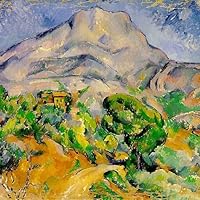
The two great polar tendencies of Gerhard Richter's art -- pure abstraction and photo-realism -- have never been at odds with one another, and are in fact complementary aspects of Richter's total vision. Nowhere is this more in evidence than in his landscape work -- work which stretches the boundaries of one of painting's most cliche-ridden traditions. Since the late 1960s Richter's landscape paintings have formed an integral part of the artist's overall body of work, and one which this book documents in depth. Presented here in lush reproductions, these works are given the separate consideration they have always warranted, and the result is a book that can be counted among the most important on this seminal artist.
German visual artist. Richter has produced abstract as well as photorealistic paintings, and also photographs and glass pieces. He is widely regarded as one of the most important contemporary German artists and several of his works have set record prices at auction.
Gerhard Richter du Mysterium, malst Bilder von Landschaften und sprichst über die reine Schönheit. Doch eigentlich drücken deine Gemälde etwas anderes aus, das Konträre, die Verschiebung der Realität. Umso beeindruckender ist es darum, die gesammelten Werke zum diesem Thema betrachten und geniessen zu können. Begleitet von drei Essays erhält man eine beeindruckende Facette des Künstlers zum Genuss - nur wünscht man sich, die Abbildungen wäre noch grosser, noch intensiver. Denn diese Bilder müssen erlebt werden.
Gerhard Richter (born 1932) can best be described as 'visual artist'. It would be misleading to label him a painter as his output has not only included photography but also utilizes photography in an unusual manner. He defies classification except to be labeled as and Artist of the highest magnitude. His works include both abstraction and realism and the viewer is at times challenged to recognize the mode of expression or even the hand of the artist of creation!
For those who see Richter as the master of the panoramic views of mysterious subjects viewing the works in this fine volume may at first seem strange. But Gerhard Richter has long been a proponent of landscape painting in the influence of the great landscape artists such as the German Caspar David Friedrich, the Swiss Arnold Böcklin, and the British J.M.W. Turner and John Constable: his own comments include "my landscapes are not only beautiful or nostalgic, with a Romantic or classical suggestion of lost Paradises, but above all 'untruthful'... by untruthful I mean the glorifying way we look at Nature--Nature, which in all its forms is against us, because it knows no meaning, no pity, no sympathy..."
At times Richter paints his landscapes purely from gessoed canvas to brush while at other times his technique is to overpaint photographs with either light washes or with added created commentary that gives the finished image an entirely different meaning. He has painted both black and white townscapes inspired by newspaper articles or photographs as well as lush impastos of heavy paint creating vast seascapes or vistas of mountains or ledges with impossibly visualized distances. He at times seems to be contradictory in his view of nature: the images can vary form Romantic, hazy, foggy atmospheres to raw abstraction strokes that seem at odds with the tranquility of the landscape. His artistic drive seems to respond to the need to show the viewer the rawness of nature uncontrolled by man.
The accompanying essays in the book are brief and pointed and add that necessary aspect of coming closer tot he strange work of Gerhard Richter. This is a powerful collection of images, well worth adding to the library of contemporary art.
In these paintings I am looking into a series of transitions: between photograph and painting, between the edges of where the eye can reach, of color as an energized substance versus shade as a pallid one, between air and earth, symbol and referent, certainty and uncertainty. This painter "got" that place in a warm and encompassing way. It is a weird space, like a dangerous cul-de-sac, a back alley, a cold cave. It has something to do with "the blurring." It is the essence of a transition. Thinking about what painting is not: it's not really useful. It's not a building, or a tool, or something to share, really, or something to consume. This is a kind of utility failure, and part of what the painting means. There is something helpless about it. It is beauty in the process of being erased from the dictionary. There is also something dubious and dangerous about the ease with which a painting can be viewed, and ignored. The blurring as a kind of ruse through which the artist fools you into a game of trying to decide what reality is. You are being lulled to sleep, in which you think that the artist is actually "letting a thing come, rather than creating it."