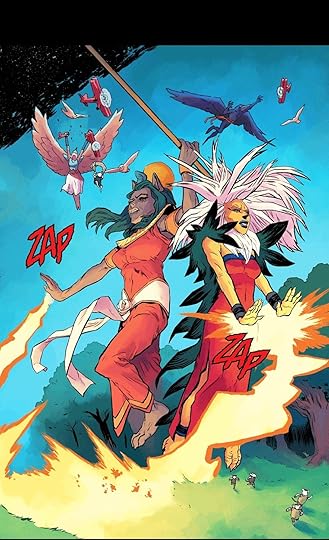
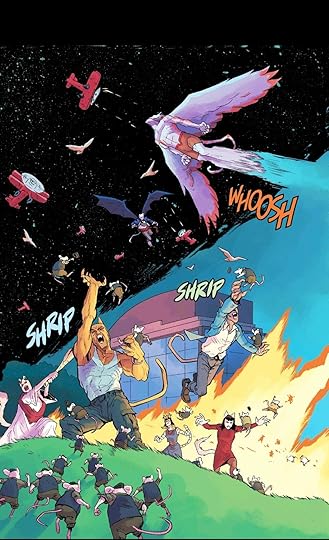
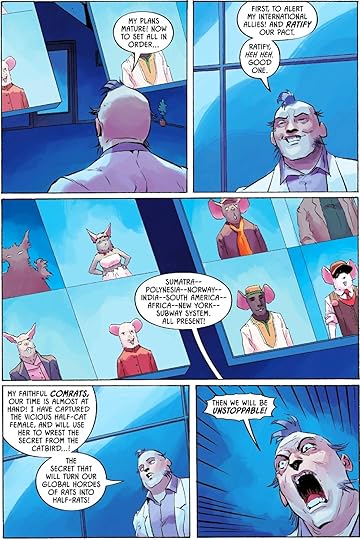
It’s all-out war in the madcap conclusion to Angel Catbird’s superhero saga. The evil Rat army is aiming for world domination, and only a ragtag gang of half-cats stands in their way. Internationally best-selling novelist and animal lover Margaret Atwood pens a conclusion to the dramatic, hilarious, and heartwarming trilogy.
Series Overview: This is the final volume of Margaret Atwood’s graphic novel debut series Angel Catbird
Margaret Atwood was born in 1939 in Ottawa and grew up in northern Ontario, Quebec, and Toronto. She received her undergraduate degree from Victoria College at the University of Toronto and her master's degree from Radcliffe College.
Throughout her writing career, Margaret Atwood has received numerous awards and honourary degrees. She is the author of more than thirty-five volumes of poetry, children’s literature, fiction, and non-fiction and is perhaps best known for her novels, which include The Edible Woman (1970), The Handmaid's Tale (1983), The Robber Bride (1994), Alias Grace (1996), and The Blind Assassin, which won the prestigious Booker Prize in 2000. Atwood's dystopic novel, Oryx and Crake, was published in 2003. The Tent (mini-fictions) and Moral Disorder (short stories) both appeared in 2006. Her most recent volume of poetry, The Door, was published in 2007. Her non-fiction book, Payback: Debt and the Shadow Side of Wealth in the Massey series, appeared in 2008, and her most recent novel, The Year of the Flood, in the autumn of 2009. Ms. Atwood's work has been published in more than forty languages, including Farsi, Japanese, Turkish, Finnish, Korean, Icelandic and Estonian. In 2004 she co-invented the Long Pen TM.
Margaret Atwood currently lives in Toronto with writer Graeme Gibson.
Associations: Margaret Atwood was President of the Writers' Union of Canada from May 1981 to May 1982, and was President of International P.E.N., Canadian Centre (English Speaking) from 1984-1986. She and Graeme Gibson are the Joint Honourary Presidents of the Rare Bird Society within BirdLife International. Ms. Atwood is also a current Vice-President of PEN International.
And so this series comes to a close. It's been an interesting ride. In her introduction, Kelly Sue DeConnick characterizes this series as an homage to the Golden Age of comics, but was the average GA title really THIS corny? If anything, it recalls the writing style of the classic 1960's Batman TV series. Pow! It's decent campy fun, I suppose, but I still get the sense that Margaret Atwood is capable of writing better comics than this. Interesting series, but it never quite manages more than novelty value.
Angel Catbird has never been more than a light, fun likely-vanity project of Margaret Atwood's, and it didn't suddenly transform to something more profound in its final volume. The Catbird Roars has the same deliciously silly verbal puns and visual gags that characterized the first two volumes, the same occasional side-barred cat facts encouraging readers to keep their pets indoors, and the same fast-paced absurdist plot that has our heroes dealing with the evil rat army once and for all. The biggest thing that sets this volume apart from the rest is the excellent foreword by Kelly Sue DeConnick, which tells us more of the inspirations and thought process behind Angel Catbird and to put it into a historical context that explains some of its quirks. As someone who is only lately getting into reading comics and doesn't have a wide knowledge of the longer and broader history of the form, this information really helped me to understand and enjoy the book more fully.
Whether you’d love them or hate them depends on how you choose to see these comics. They are full of awful cliches, puns about cats, rats, bats, and birds, and the humor feels forced.
You could think that is deliberate on the author’s part, which will make the comic fun for you. However, you might think otherwise and that Ms. Atwood has no business writing a comic. In the preface, the author described herself as an award-winning author, which kinda pissed me off. Other than that, my reaction was somewhere in the middle of the two extremes mentioned above. I’m not sure if I’ll be continuing the series either.
I read this quickly because it was due to the library, so I kinda broke my rule about reading consecutive books in a series one after another and this seemed tired. In addition, I was most likely reading this too seriously. There were too many gender and species-related stereotypes that I got distracted (like Angel and the Drat, haha). The helpful hints about how to responsibly care for cats - basically have indoor cats - also disrupted the acton of the book.
I love it when a series, be it in books or television, start off with a "Previously On" segment. I can be a fan but still need some help remembering what happened last, especially if there has been a substantial break between volumes. That said, if the whole story thus far can be summarized in one to two pages and have me feeling like I haven't missed anything crucial or complex that is relevant to the rest of the story, then the series really isn't all that great, and to put it plainly, is forgettable. And that is the issue I take with this concluding volume of Angel Catbird.
It does well wrapping up the storyline but because of how linear and simplistic it is, there really isn't any excitement left in the plot and the climax to have me be taken aback. I think because of the high regard I have for Margaret Atwood, and because I had expected the story of Angel Catbird to be shoulder to shoulder amongst its peers of other works by Atwood, this story that comes from a good place and passion didn't live up to my expectations. It might have been better off being targeted to a much younger demographic in the first place.
I still want to see Johnnie Christmas' future works as his illustrations are solid, and more so, would love for Atwood to continue with comics... but perhaps with something of the more mature tone and visual style of the speculative fiction she's the master of.
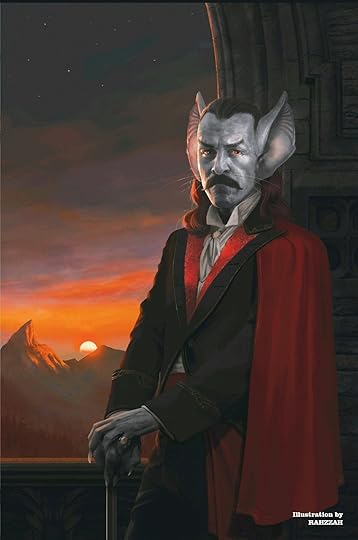
Well, this is another look at the continuing war between Angel Catbird and Muroid, the leader of the Rats. This war is now fully engaged and we are about to see the conclusion and see who comes out on top. Angel Catbird has been taken prisoner by Muroid and he has set a trap to snare the enemy into his net. The Rats are all formed in units(squadrons) and are just waiting for the attack code. Once again, Margaret Atwood has woven an interesting tale and a unique way of looking at cats, rats, birds and our real environment. The drama continues and you can chose a side to cheer for and hope that your side wins this war. Besides the continuing sage, there are interesting little definitions about what specific cat types are. Not being a cat person, I was thrilled to learn just what a "alley cat" is compared to just a indoor/outdoor cat. At the end of a new introduction of character, there is a little aside at the bottom of the page. As you read the story, you want Angel Catbird and Atheen-Owl to be reunited and Muroid (Rat King) to be destroyed. This is a conclusion to the sage but like with all books or stories, will this really be the end and will life return to normal for the count, Angel, Atheen, the Egyptian empress and their companions. What really will happen in the end and who will survive?
Sinceramente non adoro dare voti così bassi, ma è il voto che si merita la parabola discendente che ha disegnato la saga di Angel Catbird.
Fiduciosamente ho letto dal primo numero questa serie e purtroppo ho assistito a un declino sempre più repentino unito a un approccio che diventava sempre più semplicistico in favore di un pubblico meno maturo.
Tutta la storia non si rivela che una lettura a mio parere inutile, senza alcuna morale a parte quella del "si può collaborare insieme contro un nemico comune anche se ci sono differenze" unita al "bisogna accettare il ciclo naturale per quello che è e non snaturarlo" (cosa quasi più importante che passa molto in sordina).
I personaggi non hanno spessore, sono poco "plausibili" e talmente poco veritieri da non stimolare alcun tipo di empatia e neanche simpatia, persino la comicità che si tenta di usare non ottiene altro effetto che renderli più ottusi e antipatici.
Il finale, vacuo, corona "perfettamente" la quasi inutilità di una lettura del genere poiché non si fa latore di alcuna morale e insegnamento. Il fumetto si sminuisce da solo, tanto che il finale, furbescamente lasciato aperto, non ha trovato alcuna spinta per un seguito.
Angel Catbird has been taken! At Castle Catula the crew must make a plan to break him out before Muroid tortures the formula out of him, as powerful rats are a threat to cats and birds alike. The pair of rats who switched sides make contact with the hacktivist group Anonymouse (yes they're mice), to help them get through the security at Muroids Lab. Neferkitti helps them providing backup from a ancient token that will summon Sekhmet and Nekhbet in their time of need, who also give us a lesson on the human impact to lion and vulture populations. The varied crew, with the aid of Count Catula's many vampire-cat concubines, fly back to the lab to rescue Angel Catbird.
I read this only because I read the first two. It is only a triology so I may as well finish it. This time it was mouse puns
Wikisqeaks Squeakerphone Anonomouse
Yeesh, make it stop. This one also felt far more preachy than the others. The other two books had cat facts on the bottom of your page and how to protect your cat, and this book has that too, however this book also has several mentions of poaching, Cecil the lion, and how people are horrible to wildlife. It is a bit heavy-handed an a little on the nose.
As with volume two, I wanted more Angel Catbird and less of the numerous secondary characters. I like him as a hero, even though he's often placed in the position of having to be rescued, and I hope future volumes spend more time with him. This volume was perhaps the punniest of the three. It was very cute but not quite as great as volume one set things up to be. I was hoping for something more like TMNT -- something a bit darker.
This last installment is a good solid 3 stars. The characters are still funny, lots of puns that are very clever and a good conclusion to the story. In the end I did like the overall message to help keep cats indoors and protect the environment. I'd say Atwood fans will enjoy this light hearted graphic novel series while others might find it lacking. For me it was enjoyable and really quite punny 🤣
Volume 3 did not disappoint. There were a lot of moving pieces to work with and it didn’t feel awkward. I want to read the next one - because I’m sure there will be one. Buy, it did take a long time to get to the action and then it was over so quickly. I wanted more detail. Also, I wish we heard more from the owls - to their presence was so much talked about but they were overshadowed by the bats a bit.
In Angel Catbird's not quite final finale the half-cats mount a daring rescue operation. Just as soon as they can make up their minds, with a little help from some surprising allies. It has beautiful artwork, a great story, and an ending that makes you want to bribe the artist to continue the story. There are so many directions this creative team could go if they decide to continue the series, which I hope they will!
Didn't enjoy this volume as much as the second volume. Not sure why.
Probably the Santa rat. Hate him. And I'm disappointed the female rats didn't get a chance to confront Muroid. The Anonymice are cool characters, but I hate the masks. That's a completely subjective reaction, so don't base your own decision on it. Got more Ray, so that's good. Happy ending, which I'm in favour of.
This was a great end to a fun series! Despite Atwood being a serious literary genius this series was campy and silly and I love to think of the fun she had in writing it. I especially loved the mice of Anonymouse in their tiny Guy Fawkes masks. Hilarious and adorable! The conclusion was satisfying and didn't completely close the door on future episodes. Maybe the Catbird will roar again!
The trilogy ended much the way I had imagined it would and left the possibility for a sequel open. I don't think that I would go back for more, however. It did remind me a bit about Classic Comics, which Atwood mentioned in the introduction to the first volume, with not only the lessons about cat and bird safety, but also the mythological references as well.
An enjoyable series, great fun to read. Good characters and artwork, although a little too moralising at times, I prefer my do-good messages to be slightly more subtle within the wider story. A good conclusion to the series though.
I enjoyed this volume although not as much as the first. I like the cat facts that pepper the book in little footnotes. I also love the way that not all of the relationships are expected or happen in clearly friend/foe ways.
Kelly Sue DeConnick nailed it in the introduction of this volume. This is a golden age story from the puns to the campy action and I'm thrilled that this is a story Margaret Atwood wanted to tell even if it has a bit of a yesteryear feel.
I honestly didn’t even know that this was the end of the series. It seemed to have an open end to me. I did love the random cat and bird facts littered (no pun intended) throughout the series. And the silliness added to the fun and quirky style of the story itself.
Underwhelming "conclusion" to a lackluster series; guessing/hoping they won't bother to write more. There's no sense of drama or immediacy, no characters of interest, just a bunch of facts about history, science, and nature that slow rather than propel the narrative.
I really wanted to give this less than 3 stars because the puns in this are over-the-top, but the art and colors are SO GOOD, I felt bad giving it a lower rating. Johnnie Christmas and Tamra Bonvillain, you are DEFINITELY the MVPs of this series!
Story peters out by this instalment. Some violence for violence sake; some characters never developed (including Angel Catbird). Still images by Christmas vibrant and classic graphic novel. Read the books introductions as they have some of the strongest pieces of the story.
I feel like nothing really happened in this concluding volume and the ending was very lacklustre. Overall an interesting series in concept, but not the best execution unfortunately. I liked the art, but felt like the story fell flat.
In scrolling through the graphic novels shelf on here, I realized I never read this book in the series. It probably doesn't help that it's been four years since I read the second one, even with the brief synopsis at the front. Ah, well.