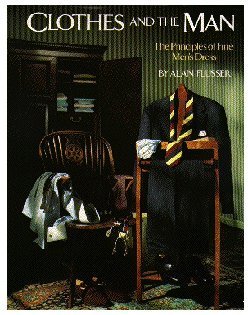
From the front flap: "Coty Award winner Alan Flusser is convinced that any man can learn how to dress with style and good taste - all that is needed is the proper education. In 'Clothes and the Man', Flusser sets out - through the use of detailed illustrations, both black and white and full-color photographs, and a comprehensive text - the basic principles involved in fine men's dress. According to Flusser, American men all too often confuse dressing 'fashionably' with dressing well. This is unfortunate, for as Flusser makes clear, fashions come and go, but cultivated style endures. Furthermore, given the high price of clothing, it is certainly far wiser to buy clothes that will stand the test of time, leaving you in good stead regardless of the whims of fashion. 'Clothes and the Man' is the first book to actually show you how to select the clothes that are the most personally flattering in a way that encourages both practicality and individuality. Flusser begins by tracing the major changes in men's fashion from the 1930s to the present. He discusses the styles of the thirties in great detail, for, in his informed view, these years represent the height of elegance on both the American and European continents. He addresses such issues as the longevity of the business suit - a uniform that 'appears' to stifle individuality - and explains why collars, cuffs, vents, and many other items of men's clothing have evolved the way that they have." Chapters include: Sportswear, Neckties, Dress Shirts, Footwear and Hosiery, Accessories such as belts, suspenders, handkerchiefs and jewelry, Formal Wear, Headwear, Wardrobes for the different seasons of the year, and more. "In addition, 'Clothes and the Man' contains a unique gatefold, consisting of over 60 fine-quality shirt samples, from luxurious prima and end-on-end cottons to the more casual tattersalls.
I received this book as a Christmas gift from my friend when I lived in New York City about 30 years ago. At that time, I worked for a travel agency in NYC. I wore a business suit every working day. She must have thought I seriously needed fashion advice :-) But I didn't read it for another 30 years. What a mistake! I should have read it immediately.
Although some of the content is a little dated, much of it is still relevant for people who work in formal business environments where suits and ties are expected. The book contains photographs of outfits assembled by the author, Alan Flusser. The captions of the pictures say where these suits, shirts, and ties are from. Many of them are from Brooks Brothers, Paul Stuart, and J. Press. It reminds me of the first suit I bought from Brooks Brothers on Madison Avenue.
The book looks gorgeous. It's the kind of book you might find on a coffee table.
Collar types, straight point, English Spread, cut away collar, club collar. Four main types of tie knots, four in hand, half windsor, Windsor, bow tie Shoe types, plain cap toe, cap toe with medallion, wing tip with brogues, monk strap, tassel loafer, Contrasting tonality in layers. Pocket square folds, materials of ties and fabrics, gabardine, challis, etc Dinner jackets, pique finish, satin finished lapel, shawl collar, peaked lapel. Never letting waistband show. Suspenders, wider trouser waist.
A weaker book, but also very similar, to "Dressing the Man" by the same author.
Most noteworthy here is the edition on Kindle, which is pretty bad. It looks as if someone thoughtlessly converted the PDF (new paragraphs every 1 sentence, non-functioning table of contents, etc.). Hardly readable, with only a few illustrations (which, in my opinion, in this type of book is crucial).
Beautifully constructed, well written, and full of fascinating and functional information. Flusser gave me a serious hangover, and I refuse to apologize for the work taking over my personality for the two weeks after reading it.
If you can only read one book (alas, do not buy it~it is out of print and runs 80.00 or more for a used copy), this is it.
The diagrams on how to tie the three basic necktie knots and the bow tie, pocket square folding diagrams, instruction on dressing for large, small and tall body sizes, the four seasons, and how to amass stylish sportswear that will never go out of style makes this book worth the effort of inter-library loan.
Flusser is not stodgy. His timeless list contains cowboy boots and H Bar C embroidered western shirts for the fall/winter.