Jump to ratings and reviews
Rate this book

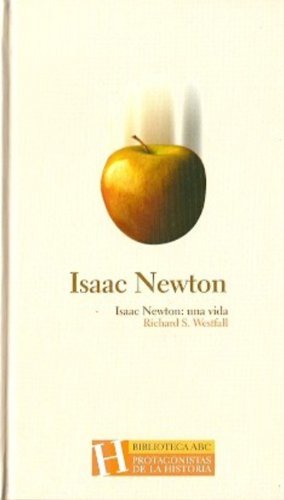
Isaac Newton, una vida

Rate this book
Ένας από τους μεγαλύτερους επιστήμονες όλων των εποχών, ο Ισαάκ Νεύτων άφησε ένα έργο που αποτέλεσε την κορύφωση της Επιστημονικής Επανάστασης και εγκαινίασε την εποχή της σύγχρονης επιστήμης. Στη "Ζωή του Ισαάκ Νεύτωνα", ο συγγραφέας παρακολουθεί τον Νεύτωνα από την εφηβεία του στο Lincolnshire μέχρι την καριέρα του στο Cambridge, όπου ουσιαστικά πραγματοποίησε όλα τα επιστημονικά του επιτεύγματα. Σε αυτήν την πλούσια και αναλυτική βιογραφία, ο Westfall εξετάζει και την προσωπική ζωή και την επιστημονική καριέρα του Νεύτωνα, δίδοντάς μας μια σφαιρική εικόνα του ως ανθρώπου, ως επιστήμονα, ως φιλοσόφου, θεολόγου και δημόσιου προσώπου.

Hardcover

First published March 26, 1993

37 people are currently reading
544 people want to read

About the author

Richard S. Westfall

17 books20 followers
Richard S. Westfall was an American academic, biographer and historian of science. He is best known for his biography of Isaac Newton and his work on the scientific revolution of the 17th century.

Ratings & Reviews

What do you think?
Rate this book

Friends & Following

Create a free account to discover what your friends think of this book!

Community Reviews

5 stars
46 (23%)
4 stars
87 (43%)
3 stars
53 (26%)
2 stars
11 (5%)
1 star
1 (<1%)
Displaying 1 - 19 of 19 reviews
20 reviews10 followers
August 4, 2010
The most important thing I learned from this book is that no apple ever fell on Newton's head. Instead, it is written that he was 'occasioned by the fall of an apple, as he sat in contemplative mood.' One might say that if a pie graph mapping human achievement were created, there's a good chance that Newton would be given a pretty big slice. From a historical perspective, he is responsible for more than one paradigm shift in our understanding of the world around us, and if you haven't memorized his three laws of motion, then you fail.

In contrast to the glory of his later discoveries, Newton's early childhood was marked by rejection and hatred. Three months before he was born in 1643, his father died, and his birth was premature. Hannah Ayscough (Newton's mother) claimed that he could fit into a 1.1 L mug, and she did not expect him to live very long. Following that, his mother remarried when he was two years of age, and his stepfather refused to incorporate the child into the new family. Isaac was forced to live with his grandmother, where he developed resentment towards his stepfather. When he was 19, Newton recorded in his list of sins: "Threatening my father and mother Smith to burn them and the house over them."

During his school years he endured harsh, vindictive attacks from opponents as well as friends and family. In isolation, he would spend hours tinkering with mechanical models and making detailed drawings. His natural curiosity for such things aided in his scientific endeavours later on in life. However, during his early school years, he was considered one of the worst students. According to his teachers, this was due to his inattentiveness.

Throughout school, he was considered somewhat of a dunce, and was far from achieving academic success, and he was also bullied at times. On the plus side, when Newton was challenged to fight a schoolyard bully (who, compared to Newton, was a 'building with feet'), he actually won. Unfortunately, his capacity to remain spaced-out and idle in his studies caused him to be removed from school in October, 1659, and he was put him to work on the family farm, which he detested very much.

Newton's uncle William decided that it would be best for him to return to school, and Henry Stokes, the master at the King's School, convinced Hannah to let Newton complete his education. Here, Newton sought revenge against a bully by getting superior grades, and it was not long before he became a top-ranking student. It was here that some flicker of intellectual aptitude began to develop.

In 1661 he got accepted to Cambridge, where his Uncle William had gone. He joined the school as a subsizer, so he had to basically do janitorial work to cover his tuition. Luckily, he was granted scholar status in 1664, which freed him of financial burdens. But a year later, everything changed. He left school in August 1665 to avoid the Bubonic Plague- a virulent, flea-borne disease which killed about 100,000 people (20% of London's population at the time). Hannah, who was again widowed, allowed Newton to stay with her at this time. The next 18 months were among the most significant in Newton's life. "I was in the prime of my age for invention... and minded Mathematicks and Philosophy more than at any time since" he would say later on in life. It was here that he devoted himself gravitation, mathematics, mechanics, and optics- studies which would eventually allow him to push back nearly every boundary of scientific knowledge.

Upon returning to school, Newton's newfound interest could not be blocked. He immersed himself in the works of Aristotle, Descartes, Hobbes, Boyle, Copernicus, Galileo, Euclid, and Kepler. Since Galileo's work explained that the earth is not the center of the universe (geocentric model < heliocentric model), astronomy was a very controversial and exciting topic, and it is interesting to note that he died only 4 days after Newton was born.

And as an afterthought he invented calculus and the theory of gravitation, and wrote the Principia Mathematica. He had a huge feud with Robert Hooke, another English scientist, and refused to publish work that Hooke had helped him with until after Hooke had died. He also had a dispute with German mathematician Gottfried Leibniz with regard to the priority on the invention of calculus. Leibniz wrote to the Royal Society and explained that he had invented calculus first. Unfortunately for him, Newton was the president of the Royal Society. Strangely enough, anonymous letters mocking Leibniz began to appear in Royal Society publications, and Leibniz was left disgraced and impoverished (and in reality Newton had invented calculus first, but waited many years before publishing his work).

A few years after his prime, Newton was given a comfortable job at the Royal mint, where one of his duties was to prosecute counterfeiters. He performed his job with much enthusiasm, and sent many a counterfeiter to the gallows to be executed. Newton died in March 31, 1727.

This is Isaac Newton's official coat of arms:


Profile Image for Tony Cinque.
65 reviews
June 27, 2025
Reading the biography of, reputedly, the greatest scientist that ever graced the earth is a humbling endeavour. Particularly if you have a humanities leaning brain instead of a mathematical/scientific one.

This abridged version of Richard Westfall’s tome “Never at Rest” is still, in many places, a difficult read when espousing some of Newton’s scientific pursuits. By necessity, the jargon and quotes fall heavily on science terms and material, and may leave the reader behind occasionally. This was certainly my experience. A result of my inferiority and mortality versus the genius and studies of Newton. However, this biography is certainly for general readers and gives us many opportunities to discern the man from the backdrop of the scientist. This was a man who was a genius on the one hand and on the other hand was not without errors and faults, endured personal breakdowns and isolation, as well as fought off accusations of plagiarism.

Newton, the scientist and philosopher, often projecting an eccentric nature to his peers and correspondents, threw himself totally, completely and rigorously into the field he was considering at that moment. He made great strides, rigorous in his approach, often committed totally and solely in his own conscience: in the studies of calculus, mechanics and the laws of motion, universal gravitation, optics, chemistry and theology/philosophy. (Including an unshakable belief in one God, with an even more strident denial of the Holy Trinity!)

We look up to the most broad shoulders that future generations can rise to and stand upon.

Thank God the apple only landed adjacent to Newton, and didn’t donk him on the head! Or, did it?
Profile Image for Lydia.
1,102 reviews49 followers
February 6, 2017
I did not finish this book. That is because it is the type of biography I loath, being small on information about the biographed life situation of the intended person and big on what interested them. That being calculus (sorry, we're not on good terms), three chapters in and I was out. I would say this is intended more for the math lover that wants to know more about Newton's thought processes working through his various theories (as his paperwork on those is intact while not many of his personal papers are) than for some one curious about Newton's actual life (making this title a bit of a misnomer, but the horrifying part is the author's note at the beginning says this is his math trimmed down version!).

Content notes (for the first three chapters): No language issues. The age difference between Newton's parents and their whole marriage is a bit disturbing (if I remember his dad was in his 40's or 50's and his mom was maybe in her 20's); a lot implied, not much known. For awhile, Newton was fascinated with how the eye works, which prompted him to do experiments on himself of poking things in his eye to change the shape of the lens so he could note how that changed his vision. Super disturbing, but it does note he almost blinded himself so finally stopped.

7 reviews2 followers
April 21, 2013
A masterful biography. I had previously read James Gleick's book on Newton which encouraged me to purchase Westfall's biography. The depth with which Westfall covers Newton's lineage, early childhood, time at Cambridge is in a different league to Gleick's work. Some of the analytical detail of Newton's theories can definitely be heavy going at times, but the book still remained thoroughly enjoyable. Will take the next leap and read Westfall's Never at Rest: A biography of Isaac Newton
Profile Image for Kristine.
212 reviews
March 31, 2021
I’m a physicist, Isaac Newton is a hero in my line of work. I was excited to find a copy of this book at a secondhand store and started to read it the same day I brought it home. Unfortunately, the book is so very dry, and it took a very long time for me to get through it. There are other biographies of Mr. Newton out there, and I plan to pursue those for a more colorful account of his life.
339 reviews3 followers
October 19, 2020
Picked this up instead of the better-known bio by James Gleick, after reading the mixed reviews on Goodreads as to whether the Gleick book was too basic and superficial.

Despite this one being an abridgement of the thousand-page “Never at Rest”, it certainly doesn’t coddle you. You’ll be better placed to read this if you already have some understanding of the nature, significance, and historical context of Newton’s major discoveries. With that caveat in mind, I found this to be an excellent survey of Newton’s life and work.

What struck me reading this was how much variation there was in Newton’s effort to results ratio in the different fields he was interested in. Newton struck gold early in his explorations of mechanics, optics, and mathematics, but these occupied less than half of his working life as a scientist (before he moved on to the administration of the Mint). He spent an equal or greater part of his life working just as intensely on chemistry/alchemy, with no discernible accomplishment, quite surprising given the discoveries made by his contemporary Robert Boyle. He also spent many, many hours working on theology, although it’s perhaps less surprising that he made no breakthroughs in that field. But what Newton did accomplish in physics and math is certainly enough to place him atop the pantheon of all-time scientific greats.
Profile Image for Madelynp.
404 reviews1 follower
February 15, 2021
Wowowowow. I learned a lot, and the physics itself is very approachable, but the organization of this book is TOUGH. In the final chapter, Newton's death is discussed several times, with a view to the effect on various groups. However, I just found it confusing. I am happy to have read this book, and will definitely use what I learned about his life to improve my teaching, but this book was a slog.
387 reviews30 followers
March 26, 2011
A very clear short biography of Newton. I was especially interested in how well read he was and how some of his best ideas came from confronting ideas of others, not simply from an apple falling on his head. I was also very struck at how his creative period ended after his mental breakdown. At the end I wanted to know more.
Profile Image for Bethany.
1,178 reviews20 followers
June 17, 2024
This was very interesting. The author explains in the preface that this is a shortened, more digestible version of a longer chronicle of Isaac Newton's life and accomplishments and I imagine that larger version is harder to get through. Definitely "smart people" level vocabulary here, but the science is manageable by any layperson. Someone told me that Sir Isaac was an a-hole... and he may have come off that way I'm sure, but for me, it gave vibes of Sheldon Cooper Asperger's and not as much a-hole. I think a-hole should be reserved for people who genuinely attack other people. He just wanted to avoid people and avoid getting attacked... which that said, he did have like a 40 year long debate with Leibniz over who invented calculus... just think what these two could have accomplished had they just let that feud go. We all know Newton for the bs apple on head discovering gravity story, which Westfall discusses but believes to be an exaggeration. But, truly, Newton did way more. He should really be much more famous and recognizable than Einstein. Decimals, prisms and light waves, how our eyes see color, calculus, gravity, laws of motion, fundamentally HOW THE DANG WORLD WORKS. And I appreciate that he held true to his religious beliefs even though it could have gotten him killed.. he was just subtle about it. I don't know if I have the mental capacity to digest his original works, but I may some day give it a try. Pretty amazing dude.
Profile Image for David Schlack.
307 reviews3 followers
May 29, 2020
3.75 - Isaac Newton was a reclusive genius with a voracious curiosity and focus. England’s Cambridge university was a perfect environment for Newton. He had few responsibilities and could focus on projects simply driven by his curious mind. His greatest achievements were the proposition of universal gravitation, this study of color and light, Opticks, and Principia, his examination Motion of Bodies in Orbit, and the invention of calculus.
Newton approached his projects with “experimental enquiry animated by a powerful imagination and controlled by rigorous logic.
Read On.
90 reviews
April 2, 2024
For a man as prolific and important as Sir Isaac, the author certainly did his best to make this biography as long and boring as possible. Honestly, just words for the sake of word count. If you're looking for a book on Newton that goes into further depth or background into his theories (a la 'A Beautiful Mind') then this book isn't for you.

Big ups to Newton tho, mad lad would be chuffed if he were alive today 💪
Profile Image for David Álvaro Martínez.
19 reviews7 followers
January 17, 2022
De las mejores biografías que he leído. Merece la pena no solo para adentrarse en la obra y el pensamiento del mayor genio probablemente de la historia, sino para conocer la vida de quien sin duda fue uno de los personajes más peculiares y enigmáticos de la sociedad inglesa del siglo XVII-XVIII.
Profile Image for Mykyta Kuzmenko.
288 reviews18 followers
May 3, 2019
It is an ok book. I would not call it exciting or a must read but it is full of facts and life of one of the pivotal figures have been carefully studied.
Profile Image for Pedro Menchén.
Author 17 books7 followers
October 6, 2015
Un libro de difícil lectura, pero apasionante, escrito con la precisión, el rigor y la calidad literaria que el personaje se merece. Me he quedado muy sorprendido al descubrir que Newton era gay. No es que el autor de la biografía lo diga expresamente, pero lo deja caer y es imposible no darse cuenta a juzgar por el interés apasionado que mostró el personaje por algunos hombres y la indiferencia que mostró por casi todas las mujeres (ninguna de las cuales formó parte de su vida, salvo una sobrina en su ancianidad). El tipo es fascinante por su misantropía, sus rarezas y sus manías, síntomas inequívocos de su genialidad. Lo admiras como persona y como científico, hasta que llegas al caso Flamsteed y descubres que Newton también podía ser mezquino y un poco malvado. Pero ¿acaso hay alguien perfecto? Me ha sorprendido también saber que Newton era un apasionado creyente y un lector obsesivo de la Biblia (ya había ateos en aquella época, ¿no?), pero a fin de cuentas era un arriano; o sea, un hereje. Aunque nadie se enteró de ello hasta doscientos años después, cuando se desvelaron algunos escritos suyos. Otra de las curiosidades que aporta este libro es la afición de Newton por la alquimia, aunque no era oro lo que pretendía hallar con sus experimentos, sino acaso ¿la partícula de Dios?
Profile Image for Barry.
19 reviews9 followers
August 12, 2008
When trawling through bookstores, there are some publishers whose books I will tend to buy regardless of editor/author/subject. O'Reilly technical books are the prototypical example -- I probably own well over fifty of them now -- and most of what Dover puts out is worth having at a used-bookstore price. But for leisure reading, nothing beats finding a Canto (an imprint of Cambridge UP). I'm sure they've published some uninteresting books, I've just never run across one. _The Life of Isaac Newton_ is no exception.

This is not a mathematical biography. It's tone puts me in mind of Blake's _Disraeli_ and that was written well enough that I've read it three times. I don't think this book will have quite the same impact -- Newton was far more important to Western Civ., but I suspect Disraeli will remain a far more interesting character.

Purchased at Jackson Street Books, Athens, GA. $9.00. Fair.
Profile Image for Leanne.
306 reviews
September 21, 2010
I was so hoping to find in one of these scientist reviews of this man's life some factual dirt on all the "mysterious" stars aligning to push Isaac Newton to the forefront of his industry. This man started out with no means and no pedigree and no credentials. Yet, along the way, mysteriously, opportunities and accolades opened up to further push him along his way. I think this guy is, in reality, a spooky, creepy scientist--and maybe even a murderer of his colleagues! Any ways, I am searching for some dirt on the background of this man. It doesn't change his accomplishments--but you gotta separate the man from his muse!
Profile Image for Ben.
427 reviews44 followers
December 18, 2012
The stories that Stukeley collected in Grantham in the 1720s stressed the fact that Newton preferred the company of girls. For Miss Storer, who was several years his junior, and her friends he made doll furniture, delighting in his skill with tools. Indeed, as the two grew older, something of a romance apparently developed between Newton and Miss Storer. It was the first and last romantic connection with a woman in his life. The romance of an adolescent boy who prefers the company of girls is not likely to endure.
Profile Image for Ariel Amadio.
3 reviews
February 13, 2011
Exhaustive biography of one of my most admired characters in science history. Newton was not only a genius, buy also a very difficult person, which is vividly portrayed on this book
Profile Image for Sergio Uribe.
79 reviews6 followers
October 12, 2018
 Este es el resumen del texto completo de Westfall. Definitiivamente Newton era un tipo de otra esfera. El último mago y no el primer científico. Asimismo, es el tipo de persona con quien definitivamente no saldría a tomar una cerveza.
Displaying 1 - 19 of 19 reviews

Can't find what you're looking for?

Get help and learn more about the design.