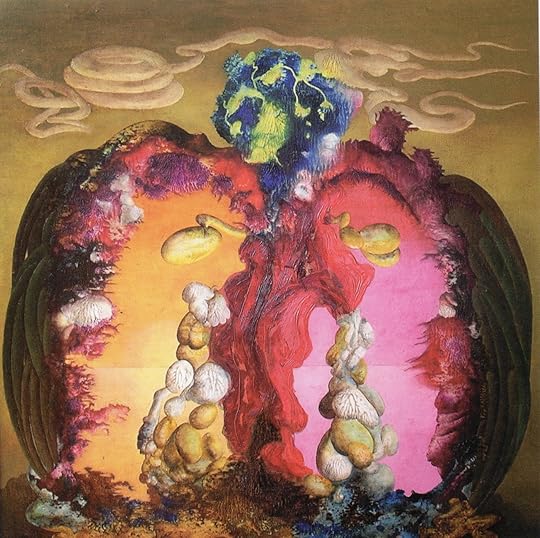
In The Living Stones , the British surrealist painter and writer Ithell Colquhoun drifts through Cornwall in search of an artist’s studio and sanctuary from the modern world. Her finely wrought and learned observations of festivals, fairs and druidic rituals, quickly establish her as the reader’s gnostic guide to the county. She paints a land of ghosts, pedlars, borrowed saints and holy sites, charmed wells and crumbling megaliths, and finds in the city emigrants a prefiguring of hippie culture. Above all, Colquhoun connects us with the eerie, numinous beauty of the Cornish countryside, quietly insisting that we see the Cornwall she an ancient land of myth and legend.
Stalking the wooded hills and fog-bound parklands that make up the interior of Staten Island, between cracked cement foundations shorn of dwelling and old stone walls now demarcating only thicket from thicket, this is exactly my mindset: to be, like Colquhoun acutely aware of surroundings -- natural, post-human, and of whatever less obvious categories of presence may exist. If only the Clovis and Lenape had left standing stones. As it is, traces are of newer categories. But fundamentally, any place may have endless lore and history waiting to be unearthed or stumble upon by the alert. Colquhoun's record of observation and diligent wandering is often a joy just for its in-the-moment sense of place and mystery, moreso for her measured overlaying of occult resonance. Perhaps this would seem a more erratic and rambling travelogue did I not have an earlier love of Colquhoun, but I do, and this becomes a wonderful diary, and handbook on being utterly in a place and open to one's surroundings.
Interest in Colquhuon seems to be undergoing something of a resurgence with many with her previous books coming back into print and new ones nearing completion. I must confess I'm not a big fan of her surrealistic work, (I'm not a big fan of the British surrealists en masse), and the only novel of hers I have read 'Goose of Hermogenes' I found to be typical surrealistic heavy-going; dense, impenetrable and definitely not my cup of tea.
This book is (thankfully) of an entirely different order accessible, erudite and hugely evocative.
Part biography, part folklore collection but mainly 'deep topography', the author detailing her exploration of the Cornish countryside attending events such as the 'Assemby of the Bards' , Helson Fair and the Padstow 'Obba 'Oss and seeking, stone circles, hill forts and (especially) ancient wells and springs.
This is not done in an anthropological manner. The author is also an occultist and clearly has a deep love and respect for the territory she traverses, using her intuition to locate virtually forgotten sites and when she arriving attempting to commune with its Genius Loci.
Whilst this might seem somewhat airy-fairy, this is also coupled with a (frighteningly) deep knowledge of classical mythology and Celtic legend and within the book she speculates on the etymology of the place names and Cornish language linking the locations and names to pagan practices of classical and Celtic antiquity.
All this is done effortlessly and while reading Colquhuon's accounts I really identified with her quest and found myself wishing to retrace her steps. I almost (but didnt want to divert myself) pulled up a map online to 'see' where she was, its that strong a sense she evokes.
Sadly, Colquhuon's book, now over sixty years old means that we as readers are also looking into a past that might as well be 1,000 years ago. She regularly writes of customs or folklore only barely remembered and, more importantly, performed, by those she speaks to. She laments the increase in the background noise of civilization such as the motor car, the electrical fields of domestic electricity and the destruction of the woodlands. The villages that she describes are now probably either over-'developed' or, on the other hand, denuded of their population, the old properties becoming quaint holiday/second homes for the city dwellers. Even the photos seem to be of an antique landscape that we will probably rarely see.
I found this book so evocative that I had to immediately begin re-reading it again in the hope of savouring its richness once again. This is certainly my 'book of 2019' and I cannot recommend it highly enough.
Bought in the Tate St Ives bookshop! Diaristic and rambling, this felt like a time capsule of cornish landscape, customs, language, and beliefs, and a love letter to place - in this case lamorna and west Penwith (a granite landscape, Colquhoun writes ‘if there is that about a granite boulder hung with grey and golden lichen which ‘sends’ you, you will feel at home’)
Earlier this year I enjoyed reading Ithell Colquhoun’s The Crying of the Wind, an account of the author’s travels around Ireland, so I decided to read her other travel book, The Living Stones, published two years later in 1957. This one is inspired by her visits to Cornwall in the late 1940s, where she came in search of escape from post-war London. As an artist, she wanted a suitable property to use as an occasional refuge where she could paint in peace and in 1949 she purchased Vow Cave, a small wooden studio with very basic living facilities.
Vow Cave (Colquhoun tells us that Vow is derived from vugha, the Cornish word for cave) is in the village of Lamorna on the Penwith peninsula a few miles from Penzance. Although she writes about the landscape, the surrounding countryside and some local places of interest, this book isn’t really a travelogue in the same sense as The Crying of the Wind, where the author described trips and excursions to different areas of Ireland. Instead, she explores the culture and history of Cornwall in general, with chapters devoted to separate topics, giving it almost the feel of a collection of short essays.
Lots of Cornish customs and rituals are discussed, ranging from the Gorsedh of Cornwall, or gathering of the bards, and the ‘Obby ‘Oss (hobby horse) festival in Padstow to the Furry Day celebrations which mark the arrival of spring (the name likely has nothing to do with fur and comes from the Cornish word for ‘fair’ or ‘feast’). There’s a chapter on traditional Cornish foods such as potato cakes, Cornish cream and the Cornish pasty, and another on folk medicine and witchcraft – Colquhoun has a particular interest in the occult. Some sections are fascinating, although there were others where I found my attention wandering.
Both books I’ve read by this author feel random and meandering, lacking in focus. I found that the best way to read them was in small doses, a few short chapters at a time alternating with other books, rather than straight through from beginning to end. As a pair, they’re definitely worth reading if you have any interest in Ireland or Cornwall, and I did learn a lot from them. Colquhoun has also written a novel, Goose of Hermogenes, which sounds intriguing!
Reprinted with a new introduction by Edward Parnell, deservedly becoming a go-to guy for the rum and uncanny, this is a guide to England's oddest county (which, of course, doesn't think of itself as odd, a county, or even England) that I would have liked to read on a trip there, but frankly could only have rendered the reality disappointing; even in 1957, Colquhoun was lamenting the summer overcrowding, the disenchanting noise and bustle of modern technology, the attempts at giving solid form to the land's legends of little folk and Arthur which serve only to demonstrate how thoroughly the makers have missed the point. There's one particularly poignant moment in the quiet, forgotten harbour of Padstow, "gazing across the water to the conifer-shaded hamlet of Rock on the opposite side of the estuary". But it's not as if Cornwall is the only place churned up by the intervening decades, and at least we have this record of how it was, from old customs to proto-hippy communes, and above all of the vibes, Colquhoun recording how her sensitive surrealist antennae respond to each spot within the territory, and then extrapolating from that to grand currents of world-spanning energy, syncretism and 'Michael-force'. As ever, it would be easy to come a cropper by believing all this (she can be entertainingly acerbic about cranks herself), but supposing is a different matter, and I'm very taken with her line "the aim of superstition is to achieve a working compromise with the unknown." Elsewhere, interesting avenues lead to material only loosely connected to Cornwall, but no less readable for that, as when she asks why society finds ritual human sacrifice so outrageous but is happy to accept equivalent losses on the roads, or, having proven herself utterly fearless in the face of isolation, nettles and bulls, finally cavils at ducks, who "might have sidled from the pages of Audubon, whose drawings epitomise all that is sinister and repugnant in bird morphology, celebrating its reluctance to make even that half-choice against primordial slime and reviving its latent nostalgia for the reptilian state." Whatever else might be wrong with the present, and that really isn't a short list, I love that someone this idiosyncratic is undergoing a significant revival.
Ithell Colquhoun’s The Living Stones: Cornwall is one of those rare books that seems to breathe as you read it. She walks the hedge between documentary and enchantment with the poise of a painter who knows how light behaves at the edge of a storm, listening for the old names of fields and coves until they answer back. Page by page, she restores a Cornwall that is lived in rather than merely looked at, where fishing families, farmhands, and shopkeepers move through weather and work as undoubtedly as tides, and where the landscape itself feels sentient, attentive, and just slightly withheld. It is classic travel writing in the literal sense —a journey through space that is also a descent through time and folklore —but it carries the charge of psychogeography long before that word became fashionable.
Colquhoun’s eye is ferociously alert. She finds human contours in granite and tree fork, reads a menhir as patiently as a parish register, and refuses to separate geology from myth or craft from devotion. The result is a chorus of textures and voices. You hear wind threading a hill path, but you also hear gossip in a harbour pub and the quickened quiet around a holy well. Her sentences never flash for the sake of it. They carry you into places where the ordinary deepens into omen, and they do so with a steady intimacy that makes the uncanny feel domestic and the domestic faintly numinous. That balance is her signature, and it is why the book feels contemporary in every new edition.
It helps that Colquhoun wrote as both surrealist and occultist, comfortable with the notion that matter has moods and that a coastline remembers its dead. The painter’s training gives her descriptive precision, while the esoteric imagination gives her the courage to say that a standing stone can be a person you meet again and again under different weather. At no point does she slip into vague mysticism. Instead, she lets craft, folklore, and topography braid themselves into a credible spell, one built from detail, humour, and quiet stubbornness.
When you close the book, you keep hearing it —a hum at the edge of audibility, as if the county had decided to speak and had chosen her as its voice.
A great read, really interesting reflections, theories, characters, stories and cultural insight as well as a fantastic tribute to the natural world and Cornwall in particular. And although Colquhoun is not a focal point within her own book, it was great to find out more about such a fantastic and underrated artist. Also fascinating look at druidic and occult beliefs of ancient Britain and their modern revivals.
Some highlights: Loved the women stealing each other's ghost stories. Very interesting hearing about the conscientious objectors who were forced into forestry and developed a happy alternative lifestyle in the woods. Had never considered that the hatred of even marginally longer hair on men was due to its deviation from military style. The very matter of fact discussion of topics such as spirits and ritual sacrifice. Reading this over 60 years after initial publication, the attacks on modernity are both strange in some ways and resonate in other ways, such as the mourning of nature as it is destroyed or even the discussion of the modern desire to have some background of noise and electricity no matter what you are doing... Talking about young people who move to Cornwall who "jettison their prospects and come down here to find not only a living but a life worth living". "Anyone who resists the forces of standardization is a public benefactor"
De surrealistische schilderes (La cathédrale engloutie is een van mijn favoriete schilderijen) met de mysterieuze naam schreef ook boeken, waaronder deze curieuze memoires van de tijd die ze in Cornwall leefde. Op zoek naar een atelier buiten de stad vindt ze rust in de prachtige omgeving vol natuur, rotsen en legendes. Colquhoun schreeft in hoogstaand Engels (in tijden niet zoveel woorden moeten opzoeken) over verschillende thema's: flora, fauna, het weer, gebruiken, ruïnes en heel veel oude verhalen. Ze houdt van esoterie, maar op een prettig nieuwsgierige manier, en ze is heel erg gevoelig voor de energie van plekken. Er is een intrigerend hoofdstuk over de Woodcutters, een soort proto-hippies die rond de Tweede Wereldoorlog een alternatieve levensstijl propageerde. Ze sympathiseert wel met zulke buitenstaanders en klaagt ook regelmatig over de komst van toeristen in de zomer en de opkomende herrie van de auto. Als het boek 50 jaar later was gepubliceerd had er een hoofdstuk over Aphex Twin in gestaan in plaats van Aleister Crowley. Sowieso voor de liefhebber een interessant boek want er komen een aantal namen langs die in titels zijn verwerkt en het maakt de Cornwall-vibe van zijn muziek invoelbaar. Geillustreerd met stemmige zwart-wit tekeningen.
My stubborn trailing of Pushkin's push through this author's output of major books published in her lifetime takes us both to Cornwall, and the travelogue (of sorts) she created about the place. It's basically mini-essays, of roughly ten pages, taking us through her time there in something like some kind of chronological order. There are chapters on the birds, the flowers, the ghosts of the place – and the Gorsedd, a passing on of appreciation for people doing things the Cornish way that is still going strong today.
Throughout she finds the esoteric landscape, all ley lines, stone rings and key hills, matches her outlook on life, with a similar old-fashioned (sorry, atavistic) vocab. One page alone has her mention a fylfot, decussations, and haruspex – none of which I've ever played at Scrabble, to say the least. This is high-falutin' stuff, and not for the average reader, but it is more amenable than her novel. I see Stewart Lee appreciated it – well, he would, wouldn't he, is all I say to that. Me? I didn't mind my time with these pages, but they wouldn't really be something I'd deem memorable. And the subject of many of her artworks evades me completely.
An inspirational and personal travelogue — Like the best travelogues, the author comes through indelibly in this strongly flavoured account. Very much a product of her times, Colquhoun was an aesthete and a polymath, not entirely liberated but definitely not inhibited. This book is equal parts Colquhoun’s memoir of a familiar part of Cornwall to a love letter to the landscape itself, the people there and the myths and stories that permeate to the stones themselves, as the title suggests. Richly evocative language draws the reader in to Colquhoun’s world, a wistful, yearning world that seeks but doesn’t quite know what for. It feels almost timeless, certainly not of today, and most of all a portal to a world that has always been and always will be unknowable. A book to savour and perhaps to inspire a trip to the wildest part of England.
I wasn't familiar with her paintings, I guess the Amazon algorithm served this up because I'd recently bought another book by a female British surrealist from the fifties. I wonder if she and Leonora Carrington knew each other?
This is about her time living in Cornwall, in a shack blissfully lacking in the modern evils of electricity, plumbing and roofs that bats can't fly through. But it's not much about that, it's more about druidic ceremonies, her opinions on cars (too noisy), radio (a drug for the ears) humour ("fundamentally an appeal for sympathy, and if it were frankly that it could be met; but it has to pretend to give you something instead of admitting that it is asking something from you. .. others among the crowd tittered dutifully from time to time. I must be the kind of audience against whom comedians provide themselves with a lucky charm before a performance.") Lol.
She's a new age type, though they weren't known by that term then. While very intelligent, articulate, knowledgeable and at times, a scathingly sharp intellectual, she also is very much interested in piskies, stone circles, ritual magic, mystical magnetic energies, curses and folk remedies. How could someone so bright believe in such flim flam? In part this book is a document of those old ways, just as they were being forgotten. She seems to know as much about them as about the Christian myths, or modern literature or psychological theory and seems throughout to try to link them all. A holistic thinker. Dwelling upon St. Michael for example as not only a Christian saint but also a stand in for older pagan gods and also, a Jungian archetype.
She captures Cornwall of that time, both the notable sites, but also, just in the general. The abundant vegetation, that she could name, but I could not. The atmosphere of the place.
There was a whole chapter on wells. Hunting for ancient wells. Places now overgrown, some dried up after underground works had diverted their supply. Once the lifeblood of an area. Calm, quiet old places. Unnecessary now. Mostly forgotten. Far from the hum of the road and the warping yells of modernity.
The first I heard about the author, Ithell Colquhoun, was when I was involved in transcribing Artists documents for Ann0-tate - Tate Gallery and became interested in her work. I decided to look further into her writing and downloaded a sample section of the @The Living Stones: A travelogue of her beloved Cornwall and how she decided to buy a home and settle there and leaving post-war London behind. The sample only contained an introduction by Stewart Lee and the first two chapters. I have awarded her work as 4* and intend to obtain an unabridged copy in order to complete.
This book really struggles to have a direction. It’s not a focused historical or geographical exploration of the area, nor is it a personal memoir. It fails to characterise either Colquhoun or the area particularly well and I spent a lot of time feeling like I was trapped in the corner at a party with someone who just wanted to talk.
There were a few moments that captured the rural nature of Cornwall in the early 20th century that I did enjoy (maybe we don’t need to put tarmac everywhere) but that gets a bit lost in her personal affectations without delving far enough in that direction.
a whimsical book that is part history of hauntings, travellouge and history of a time past. Ithell Colquhoun was a surealist artist in mid century Britain. Definetely not a normal memoir but enjoyable. the writing is archaic and a bit meandering at times. i belive this would be enjoyed more by someonce with an interest with the occult. i found this too be not my taste, completely with some chapters being very interesting and some that just dragged.
thanks net galley and pushkin press for this early release.
This was not quite as interesting as her travel guide to Ireland, which I attribute to Colquhoun's familiarity with Cornwall, having spent most of her life there. She writes of Ireland as a visitor, but of Cornwall as a resident, so the book is less hypnotized by landscape and nature, and more concerned with intimate matters of culture. Some interesting descriptions of local holidays + their pagan origins, and an odd chapter recounting Crowley's visit to Cornwall.
2.5 stars rounded up. I'm not quite sure what to make of this book, whether to call it a memoir, a collection of essays on Cornwall's history and culture, or a travel guide. I had a hard time getting into this one as I felt pulled in too many directions. Some descriptions were lovely and vivid, other times they continued on for so long that it was hard to follow.
Thank you to NetGalley and the publisher for an ARC in exchange for an honest review.
*I received an ARC via Netgalley in exchange for an honest review. Thanks for the free book.*
I spent all my childhood summers in Cornwall and found Colquhoun's approach to Cornwall fascinating. I knew many of the places she talked about but would love to revisit some with her accounts in my head. Despite its age "The Living Stones" can be easily read and the quiet lyricism in some descriptions was quite wonderful too.
I primarily knew of Colquhoun as an artist prior to reading this lovely little book on Cornwall. If I wasn’t already itching to go back to the Lamorna area, this would have gotten me there no problem. As is, I’m desperate to return to Cornwall (maybe when the witch museum is open). Likewise, the chapter on Crowley is fucking hilarious.
A very readable paean to Cornwall - its scenery, people, and traditions! I liked the rambling quality of the travelogue and as ever Colquhoun has a very impressive vocabulary! (Tatterdemalion is my favourite take away from this book)
Bit disappointing, after the rave reviews and the introduction from Stewart Lee. I did enjoy the section about chasing after the fox hunt, but the rest seemed quite vague and I didn't feel engaged.
A beautifully written travel memoir about how the author, a surrealist painter, bought a cabin in rural Cornwell, and by the 1950s was being driven out by tourism, which she describes as destroying the attractions people go places to find. So, nothing new under the sun. It's not a linear narrative, but wanders through subjects, visiting standing stones and summer fairs in small villages, discussing proto-hippie neighbors, and rumors of occultism, spurred partly by a visit to the area by Aleister Crowley (she goes to his generally candid diaries to show he just did normal tourist things). The author expresses a real sense of wonder with nature, and the importance of getting some peaceful respite from the increasingly hectic, technology-heavy human society.