For some he was the philosopher of existentialism, for others the constant provocateur, the politically engaged author, the uncertain militant, the repenting bourgeois, the life companion of Simone de Beauvoir… From his first readings in the Luxembourg Garden to his refusal of the Nobel Prize for Literature, Jean Paul Sartre was all of this at the same time. In his biographic piece, the life and thoughts that made Sartre a known name are brought to print in rich color.
Sartre is a really crappy biographical comic on the major twentieth century French philosopher, Jean-Paul Sartre. Writer Mathilde Ramadier does a remarkably substandard job of explaining the philosophy of existentialism, which Sartre was most famous for, as well as failing to highlight what made him notable to the wider public in the first place. We just get a truncated overview of his (seemingly) uneventful life from bookish youth to teacher to - suddenly! - intellectual celebrity.
The love of his life and fellow intellectual, Simone de Beauvoir, figures heavily as expected but the bio spends a bit too much time on her when that time should’ve been spent on the actual subject of the book, Sartre. Like, how about exploring the ideas and themes of his books instead of just mentioning their titles? Near the end he clutches his chest but it’s never explained - what illnesses did he suffer from? And then he suddenly dies and there’s a state funeral - why? What major impact did he make on French society? It’s such an uninformative pseudo-biography.
Albert Camus cameos but all we learn about him was that he was a bit of a horndog and that he didn’t believe he was an Existentialist. If you didn’t already know he was a famous writer and thinker himself, you’d never get it from this book! That surface-level overview fits in with the rest of this crap. Anais Depommier’s art is ok but very plain and unremarkable.
Sartre is a dull, weak and unimpressive look at Jean-Paul’s life. There’s bound to be better bios out there on this chap’s life but, whatever you do, don’t bother with this boring, unenlightening rubbish.
There's a kind of long term fascination with all those expatriates living in Paris for a time, and writing: Hemingway, Fitzgerald, Gertrude Stein, and so on. But we also have a fascination for actual Parisian existentialists and their friends, Camus, Sartre, de Beauvoir. I think this graphic "biography" may really be intended for people who already know Sartre's life and work.
The author and artist seem not so much to try to convey his life and ideas as to kind of distill how the ideas emerged out of Sartre's life and relationships over time, with specific focus on his long open relationship with Simone de Beauvoir, whom Sartre nicknamed "Beaver." Their idea was to emphasize freedom in their own personal relationship and thus the idea emerged in his/their writings. The idea is to get the feel of the conversations they may have had, and the conversations he and she had with others, though much of it isn't all that revealing and surely not philosophically substantive. You don't learn very much about existentialism in this volume. It's meant to evoke a time and place and series of relationships. You don't come to "like" or admire Sartre from this volume, but the community of people make for a pretty interesting picture.
I liked the beautiful production and I like the art work very much, though it isn't really formally challenging so much as romantically framed and colored. So I think you might look at this if you love Sartre or de Beauvoir and want a fictional glimpse into them. But if you don't know them at all, you would likely just be annoyed by these people. I liked it pretty well once I gave up on the idea of its being an actual biography.
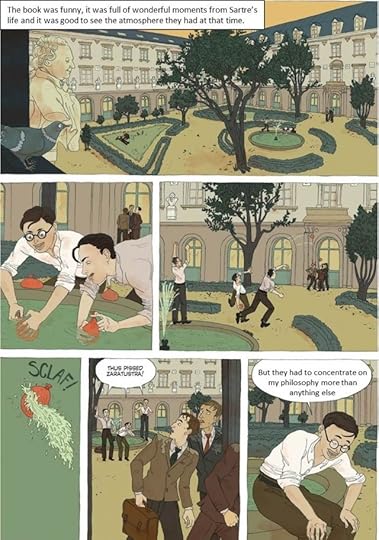
The book was funny, it was full of wonderful moments from Sartre's life and it was good to see the atmosphere they had at that time. But they had to concentrate on Sartre's philosophy more than anything else.
The "Star Ratings" on Goodreads for this book look exactly like a standard Bell Curve -- the Apex is at 3 Stars, with the low end tapering (as Bell Curves do) off to 1 Star, and the high end tapering off to a 5 Star review.
I totally understand the 1, 2 and 3 Star reviews. Do not ask me why on earth the 4 and 5 Star reviewers were so generous -- I hope their reviews speak for themselves and tell us "why."
If a reader expects this book to spell out exactly what the philosophy of Existentialism entails, that reader will be sadly disappointed and will favor a 1 or 2 Star review. Likewise, if a reader expected a primer on what precursor philosophical movements inspired Existentialism, nope. Again -- either a 1 or 2 Star rating.
If a reader expected a biographical tale explaining how the events of the lives of Jean-Paul Sartre and Simone de Beauvoir intersected and became an intertwined love affair; and how this intertwined relationship proved to be the birthplace of the tenets of Existentialism, and how their shared experience influenced their very different writings grounded in Existentialism, well . . . forget that too. 1 Star.
So, why give this maddening little book 3 Stars? If one simply views it as a superficial slice of life of a group of intelligent French writers living in Paris, and gathering in cafés to smoke, write, drink, eat and discuss -- often argue about -- politics, WWI, WWII, music, cultural trends (and the philosophical approach to making sense of it all), it holds together nicely and serves as a sociological study of the Parisian café life of the 1930s and 1940s and a fragmentary biographical sketch of some of the main writers in the group (primarily Sarte, de Beauvoir, and Camus, etc).
This book is the Existential 1930-40s version of the 1920s "slice of life story" recounted by Hemingway's "A Moveable Feast" (Hemingway's recollections of the life and times of the American "Lost Generation" of writers (namely, the expats Gertrude Stein, F. Scott Fitzgerald, and Hemingway)) who lived in Paris to write and think. If a reader approaches the book within this framework, then the reader should be somewhat pleased by the graphic novel's approach and content.
In fact, this reviewer recommends the reader to broaden the experience of this graphic novel by reading it in connection with author Sarah Bakewell's fantastic non-fiction introduction to existentialism, Sartre, and de Beauvoir, "At the Existentialist Café: Freedom, Being, and Apricot Cocktails." Bakewell provides all the things that a reader could have reasonably anticipated to be included in the graphic novel, but were clearly left out -- for a reason. The graphic novel is a carefree, fictionalized overview of the daily life and times of Sartre and his colleagues. It is a period piece. In contrast, Bakewell's "At the Existentialist Café" is a factual biographical portrait of Sartre, de Beauvoir, Heidegger, Husserl (and the others) AND a great primer on Existentialism as a philosophical school of thought.
I usually refrain from negative reviews but this one was such a disappointment, it warrants commentary.
First of all, this book breaks the number one rule of graphic novels & nonfiction: its visual style is astoundingly boring. Panel after panel depicts talking heads looking at one another. The colors are too subtle and bland for a medium whose primary purpose is to inject the dynamism of comic books into subjects often thought to be too dry for most general audiences. Compare this to Maus by Art Spiegelman or even Nietzsche for Beginners by Marc Sautet and illustrated by Patrick Boussignac and you’ll see what I mean. Furthermore, some of the characters are drawn so similarly that it can be confusing which is which and there is too much time spent on either peripheral characters or characters like Beauvoir, who deserves her own graphic nonfiction, at the expense of Sartre’s life and thinking. Additionally, although the illustrations attempt to capture Paris at that time, it does so generically with bland cityscapes that fail to convey the zeitgeist of a country living under Nazi occupation.
Second, the text is boring. One would never know that Sartre enjoyed an exciting and varied life during a pivotal moment in history. It was the life of a passionate intellectual during a time of passionate intellectualism. Depicting characters smoking and talking does little to convey that. In addition, the timeline is muddled, the transitions between scenes (& time periods) too abrupt.
Finally, the author does an exceedingly poor job of explaining Sartre’s philosophy and how he attempted to live it. Again, graphic books like this have two types of consumers: those with some familiarity with the subject and those with none. This book arguably fails to appeal to either. Moreover, the dialogue is, quite frankly, terrible. Conversations are stilted, unnatural, and unrealistic. Even Sartre’s own internal dialogue is unconvincing and unilluminating.
Ironically, the most interesting part of the book was the end where it lists the biographical information of each of the characters that appear (although, interestingly enough, not Beauvoir). All in all, I am sorry to say that this graphic biography was an epic fail.
Spotlight events in the lives of Jean-Paul Sartre and Simone de Beauvoir (she probably should have been included in on the title, because this book spends a lot of time on her too!) and their relationship and co-mingling philosophies. Ramadier's storytelling jumps around quite a bit in time and space, and there is a lot of assumed knowledge of each of Sartre and de Beauvoir's opinions and great and lesser works. Towards the end, there was some political notes that were a bit hard to follow not being as familiar with intricacies of French decolonization, etc.
The artwork was fantastic, so visually appealing and was the best experience of the book. The landscapes, the characters - Sartre, de Beauvoir, Camus, and many others in their orbit - are wonderfully detailed, and beautifully colored in the graphic novel.
I have only read one thing by Satre, and that was Huis Clos (No Exit), back in high school, but it stuck with me, I still remember that idea that we only see into the living world as long as someone remembers us there, as well as people are hell.
This biography touches very lightly on the man, but it does help to understand a little bit about where his thoughts came from.
This is very much not a children's book, or even YA, unless they are well versed in history.
What is very cool here is that Simone de Beauvoir is represented here, as a whole person, having adventures on her own, going to her own book signings, and even getting annoyed when someone presumes that Satre is her husband, in her very open, non-marriage.
Well written, well researched, with quotes called out in color, so you know when a line is coming directly from Satre, or Beauvoir (also known as The Beaver).
Not easy to read, but very informative.
Thanks to Netgalley for making this book available for an honest review.
I had thought, going in, that this comic would be an overview of Sartre's life and work. Unfortunately, without a prior understanding of this man's legacy, you're not going to come out understanding anything about him, other than he was a frustrating white dude with an attitude that was not at all endearing... (at least this interpretation of him). The narrative barrels through his life, touching on milestones, but seemingly dwelling on the less important bits. His works are mentioned via title, but rarely explored. The author seemed to be chasing too many threads.
In werkelijk alles ondermaats: vertelling, structuur, afbeeldingen... slaapverwekkend en als biografie errug mager. Alsof de samenvatting van wikipedia is gepakt en daar plaatjes bij gemaakt zijn.
Esta es más una semblanza que una biografía, y no se detiene demasiado en cada momento de la vida de Sartre. Tiene sus positivos y podría funcionar una vez que uno conoce al personaje por sus obras, pero para quien no lo ha leído resultará la lectura de una vida interesante, pero más común de lo que uno espera. El arte es hermoso y retrata con mucho amor a un personaje con rasgos faciales muy feos. Los personajes se distinguen de manera hermosa y muestran el profundo amor que tiene la autora por todas sus historias, pero este positivo se ve enterrado por una historia mal armada. Simone De Beauvoir ("Beaver") es un personaje central en la biografía y casi se la roba, pero como con el resto de la historia se pierde la significancia de la misma. El cómic interactúa muy superficialmente con los pensamientos de grandes como Camus, Sartre y De Beauvior y no logra mostrar por qué eligió momentos tan mundanos en sus vidas. Casi pareciera que el cómic dice "estos son humanos, tuvieron vidas normales". Eso podrá ser cierto, pero resulta en una biografía muy poco interesante. La conclusión es hermosa, eso sí, y casi me hace darle una estrella más.
Novela gráfica de la biografía de Sartre, muy resumida con lindas ilustraciones. Muy buena edición en castellano de ediciones godot, aunque suene raro leer argentinismos.
Sartre si apre ad una nuova scienza di pura coscienza, che non è né scienza naturale né psicologia; è più un modo sperimentale di approcciarsi alla filosofia, basato sui fenomeni anziché sui concetti. Lo scopo è quello di fare della filosofia del 20esimo secolo una filosofia semplice e violenta, cartesiana e innovativa. Creando concetti, Jean Paul svela necessità.
Sartre parla di un tempo dove tutto esiste in una volta, e chi legge (e vive) ha una propria temporalità. L'impossibilità di togliersi dalla soggettività del momento, e pure la presenza simultanea di più momenti presenti e passati, ci blocca. La coscienza è il punto di partenza, è quello che per i fisici rappresenta l'atomo (per i fisici che non sono ancora arrivati al capitolo sulle particelle subatomiche almeno). La coscienza non è definita dall'IO ma dall'intenzionalità. Se Newton aveva la mela, nel fumetto ad aprire gli occhi a Sartre sull'accidentalità delle cose è la grossa radice di un albero su cui sta facendo pipì un cane.
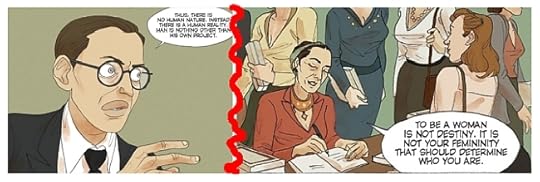
Non c'è nessuna natura umana, c'è invece la costruzione umana della realtà. L'uomo nasce che è niente e poi diventa il suo stesso progetto. La somma delle azioni di un uomo ne dà come risultato la vita, oltre questi atti lui non è nulla. Sartre è un umanista perché fa presente che l'uomo è l'unico legislatore di se stesso, e quando questo ha difficoltà a trovare una morale che gli è affine sul menù cinese del takeaway, lo incoraggia ad inventarsene una nuova.
Non so se sia una gag ispirata ad un aneddoto realmente accaduto e riportato da Jean-Paul in una delle sue numerose interviste (quando persino "Jesus the crank" è ispirato a fatti reali tutto può essere...), ma durante una corsa in tram c'è una signora che sbircia il giornaletto che sta leggendo JPS e fa una faccia scandalizzata (il libretto è "I nutrimenti terrestri", di André Gide); la donna poi scende ed è Sartre a scoprire quale fosse la lettura della dama: rimedi in supposte per le emorroidi, lol. Il fatto mi sembra in effetti più probabile delle vignette in cui Sartre è a capo di una gang di studenti di filosofia bulli e risparmia a Merleau-Pointy un pestaggio restituendogli magnanimo i soldi del pranzo.
I disegni sono ben eseguiti ma mediocri (ce ne vuole di pelo sullo stomaco per disegnare a Sartre un fisico aitante - Sartre che sta a dieta persino quando fa il soldato!, e per dare a Simone de Beauvoir nuda le stesse curve di Belen Rodriguez). Le tavole in cui JP addenta un pomodoro disquisendo sull'immaginazione e sui contorni confusi del sé allo specchio però sono carine (la sua immagine si disfa e si confonde; lui nuota nel liquido rosso che ne scaturisce). C'è della poesia anche nel momento in cui Sartre è prigioniero dei soldati e vede tra i suoi commilitoni Nizan, morto sul fronte: la faccia di lui viene "sfogliata" come se fosse la pagina di un libro, ma sotto non c'è nulla ("Non è rimasto altro a cui pensare...l'oblio, l'oblio..."). Sartre sarà liberato grazie ad un documento falso che preme per la sua scarcerazione millantando l'imminente cecità dell'occhio destro (non conoscevo questo dettaglio!). Più in là (si parla della mancata censura delle sue opere durante il regime fascista) dirà che un uomo non può essere davvero libero quando gli altri sono costretti invece dalle catene. Una frase molto bella è: As soon the nazis poison slid into our thoughts, every accurate thought was a conquest. Questa è insomma la giustificazione fornita per la sua conninvenza col potere in alcuni particolari momenti storici, per la l'affollata "corte" di intellettuali che lo circonda e che non sempre ha la fedina penale twitter immacolata (glielo rinfaccia Camus). Tempo prima degli artisti che non si schieravano politicamente, o filonazisti (di Brasillach in particolare), veniva detto: non c'è letteratura innocente, si è responsabili delle proprie azioni e delle parole che si scrivono.
Onestamente? Non ho ritrovato né il Sartre dei suoi libri né quello studiato sui manuali di filosofia. Allo stesso modo mi è parsa dissonante la rappresentazione delle sue cerchie di frequentazione (siamo nell'Europa degli anni 20, se lanci un freesbe in un parco becchi Hussell o Fernando Gerassi in un occhio). Sartre addirittura si vanta delle sue capacità di seduttore (la sua vena comica e la sua capacità di narrazione "work every time", apparentemente. Fa bagnare le mutandine così).
There seems to be some confusion over Sartre’s full name. Some sources give it as Jean-Paul Charles Aymard Sartre, others as Jean-Paul Charles-Eymard Sartre. I’ve even seen Jean-Paul-Baptiste-Eymard Sartre.
Mathilde Ramadier, the author of the ‘Sartre’ comic book, which is illustrated by Anaïs Depommier, opts for Jean-Paul-Charles-Eymard Sartre, although happily this formulation only occurs in the rather sketchy family tree at the start of the book, which chiefly serves to establish that Sartre was Albert Schweitzer’s first cousin once removed and that his forebears included engineers and eccentrics.
The book is almost as much about ‘Beaver’ - Simone de Beauvoir - as about Sartre and provides an outline of their lives, times and thought. The latter is too compressed and too cryptic to make much, if any, sense (“by creating concepts. I revealed necessities”; “the ‘I’ is nevertheless the producer of interiority, from a layer that you need to solve the problem of self-consciousness”).
The text also combines clumsy exposition (“You yourself forbade them from staging your play in Austrian theaters, because suddenly you found it to be too critical of the party” “Yes, yes and you approved of my decision”) with risibly inauthentic expressions (“My Grandfather had a gift for exalting any situation”; “my pride rears me back as soon as I feel accused”), made worse by the fact that the author’s vocabulary sometimes appears to run ahead of their understanding (“I can make out your wisdom, the wisdom that knows when to remove itself from neligeable [sic] epiphenomena”; “I believe that it is by the intermediary[sic] of others that we know ourselves best!”).
It would be nice to able to say that the text is at least offset by beautiful artwork but one really can’t, added to which Sartre’s exotropic eye condition is not portrayed consistently.
It is a great pity that the wit and the economy on display on the book’s cover are not replicated, pictorially or textually, within. Those approaching Sartre with little or no prior knowledge will pick up a few interesting tidbits of information (such as his producing a screenplay for John Huston’s film on Freud and his rejection of the Nobel Prize for Literature) but I fear that their understanding of existentialism will not have been enhanced.
Sartre is one of those names that vaguely flashes through one's life if you were exposed to it and it is one of those names, like Dostoevsky, that we know we must read at some point in our lives. I've read a few of Dostoevsky's novels and even recall the movie, 'The Brothers Karamazov' where William Shatner and Yul Brenner appeared. Of course, the movie appeared in 1958 so Shatner hadn't yet made his name until Star Trek came out in 1966. I did not realize that I was being exposed to philosophical ideals as they were just stories. To me, philosophers were long dead people from centuries ago and it surprised me to find that Sartre died in 1980. In reading Sartre, I knew that I was reading about a philosopher and his existentialism ideals. This book, itself, dipped briefly into Sartre's life from childhood to death, and as a graphic novel, the first that I've read, and even more briefly on his experiences and philosophical ideas. Perhaps, the most interesting things in this book were the pictures with their portrayal of Sartre smoking endlessly, his amorous liaisons with the Beaver, his height and his dark black glasses. Yet, there were gleans of information, like a timeline, that touched on events from Hitler, Stalin, and the French Resistance particularly the underground newspapers and the roles that writers like Sartre had in historical events. Did this book inspire me to hunt for a more in-depth explanation to Sartre and his Existentialism or run out and buy the first book of philosophy I found, no. Did it make me more aware of the events and timeline of Sartre's existence, yes. Perhaps, I will seek out one of the books or plays that Sartre wrote and change my mind about philosophy. Or perhaps, I will seek out more information on those historical events that occurred during Sartre's time like his visit with Fidel Castro or Ernesto "Che" Guevara. Either choice would be educational. We are what we do.
As book its pretty good, but as a biography, this isn't really a good place to start. Unless you already have a good sense of Sartre and who he was and was about then you'll probably be lost. But as a brief introduction, especially for an intro into his life with "The Beaver" as she's often called here its not bad. I think it paints Sartre a little too sympathetically, but its definitely a good portrait of him from his own point of view and will make you want to take a closer look at some of his work. And while the bio is brief, its absolutely readable despite all the direct quotes, which given Sartre less than transparent prose its a minor miracle. The art on the other hand is absolutely fantastic and I'm not just saying that because the artist complemented my French and wrote a nice note when I met her. For a book that's almost entirely French people talking with each other over coffee or drinks, its an absolute visual treat full of lively expressions and great characters. The visual aspect really helps overcome some of the issues with plot described above. The entire book done on a wonderful grid system and the muted by diverse colors fit the book to a tee.
'Sartre' by Mathilde Ramadier with art by Anais Depmmier is a subpar biographical graphic novel. If you decide to read it, you'd best know something about the subject at hand.
The philosopher of existentialism is the subject of this graphic novel. There are some facts about his life, like how he met his life companion Simone de Beauvoir. His history of publications is mentioned, as well as some of the notable people in his life, like Albert Camus and Jean Genet.
What is missing is a basic understanding of why he is important. There is some talk about what he was fighting for, and his on and off relationship with the group of people in his life, but missing is an overarching sense of why he might be considered important. Which is a shame.
The art is quite good, and I enjoyed the range of facial expression of Sartre, Beauvoir and other characters. It's too bad you have to have a better understanding of this character to get much out of this graphic novel.
I received a review copy of this graphic novel from NBM Publishing, Papercutz, and NetGalley in exchange for an honest review. Thank you for allowing me to review this graphic novel.
This is a confused work. It's not biographical, as it skips around without providing much explanation to keep each jump connected. It's not a philosophical explanation, since it assumes knowledge of the topics at hand. Nor is it a philosophical exploration, as it doesn't try to add anything nor connect anything.
It just… jumps around. Here's a scene at a cafe. Here's a scene in a house. Are they related? Are they the same month or five years apart? Here's another scene at a cafe.
What I'd like is to see the scenes better connected, set up with explanations (especially on who people are, the men all start to look the same) and conclusions. Otherwise this is just a collection of moments, which I suppose one can argue is very Sartre-esque but it feels, overall, like the work is trying to be instead of being.
Unless you're familiar with most of the main players, their lives, their philosophies, and world history during their lives, this is going to be so confusing that you won't understand what's happening. And even if you are familiar with those things, it's still very confusing.
Sartre by Mathilde Ramadie is a graphic novel biography. Ramadie trained as a Graphic Designer with professional experiences in several agencies and studios, she went on to study philosophy and psychoanalysis at the University Paris 8, obtaining a Masters Degree in Contemporary Philosophy at the École Normale Supérieure in Paris.
This graphic novel presents an introduction to one of the most famous postwar existentialists. Although some of the philosophy is discussed or dropped into a discussion, it is more of a person look at the man and his relationships. Simone de Beauvoir, Beaver, plays a key role in this book. She was an existentialist philosopher, political activist, feminist leader, and life long partner. Also mentioned is his friendship and break with Albert Camus.
I did enjoy this short, illustrated biography and it covered the high points of Sartre's life. My only other experience with Sartre comes from the reading of Camus and Sartre's Nausea. This did fill in a few gaps and was an enjoyable read. Very well done.
For me this was a book that was much clearer and interesting on the basic biographic detail than on the, er, "producers of interiority" and all such claptrap. I liked the clear, classical line of the artwork, beyond making every student look the same near the beginning, and on the whole it's a decent book - just not as reader-on-the-Clapham-omnibus friendly as it could be. In other words, I guess, it's very French...
Look, the artwork was stunning, I was super impressed.
However, the story was way too impressionistic and I felt like I needed to have already read and internalized all of the biographic facts about Sartre / de Beauvoir's lives before reading this. I was kind of hoping to learn about these people's lives, not feel stupid for not already knowing about all the details. It's still a pretty charming book and I admire the craftsmanship of it, it was just not for me, apparently.
BD biographique sur Sartre, son engagement politique, ses relations amicales et intimes. Loin d'etre exhaustif mais parfait pour commencer à le connaître en tant qu'homme et pas seulement comme philosophe. Par contre, il y a des passages historiques compliqués si on connaît pas bien ce qui s'est passe en France aprés la IIGM.
Une magnifique BD, qui comprend à la fois la vie de Sartre, sa philosophie et sa littérature. Elle s'attarde beaucoup sur la vie de Beauvoir ce qui rajoute pas mal au livre.
La BD finit, par contre, assez abruptement avec la nomination de Sartre pour le Nobel. Rien ne mène vraiment à finir là et le choix paraît un peu étrange à la lecture.
An interesting overview on Sarte’s life but a bit too disconnected and vague. I would have enjoyed this much more if I’d already known everything about Sarte so I could fill in the narrative gaps. While the art was beautiful, I’m not sure it did much to advance the story or my understanding of his life.
This is a book about the life and work of Sartre and de Beauvoir. It delves deeply and uncompromisingly into both, so is possibly best suited to those who already know something of the two writers. The text can verge on the didactic but the details of the lives are interesting and the drawing quality is very fine.
Don't know much about Sartre but after page 88 I started doubting the facts of this book. On page 88 Sartre flies to the US on a jet airliner DC-8 in January 1945. DC-8 entered service only in 1959. Also, its represenation was closer to modern jet airliners than to the DC-8 itself. Don't really know why the name of the aircraft is mentioned in the book in the first place. It's not essential to the story, and it's factually wrong.
Couldn't really trust all the other, more intricate and personal, facts of this biography after that. Really sad when writers don't make a thorough research before publishing.
Η εικονογράφηση και η αισθητική τού τόμου με κέρδισαν, το κείμενο όμως κατά την ταπεινή μου γνώμη ήθελε λίγη δουλειά ακόμη. Αν δεν είσαι εξοικειωμένος με τον Σαρτρ, την ιστορία και το φιλοσοφικό του σύστημα, δεν είναι εύκολο να το παρακολουθήσεις.