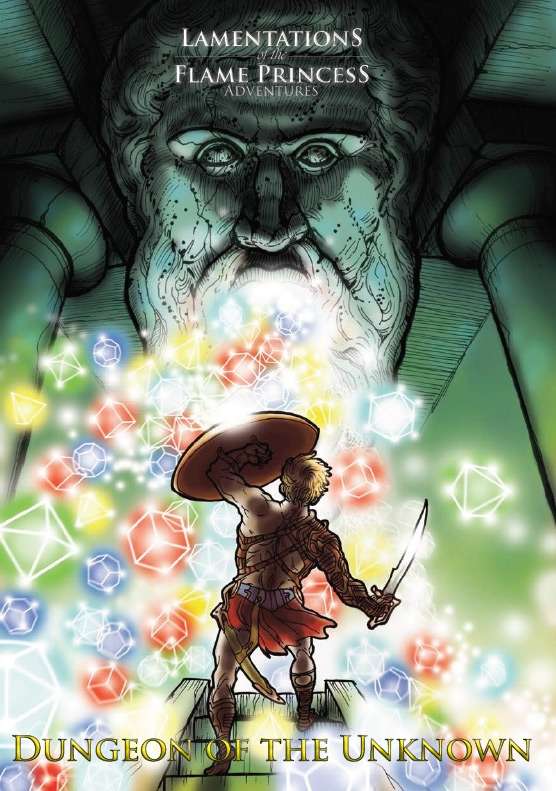
Located near the coast of hex 2214 of the Isle of the Unknown, this dungeon enshrines the mysteries of the Isle’s lost Minoan past. The module includes scaling information that allows it to be immediately and effortlessly used to challenge characters from 1st through 10th level. It features:
2 Dungeon Levels 20 Legends 2 Wandering Monster Tables 6 Sample Goop Monsters and a Random Generator to Make Countless More 12 Treasures 12 Weird Locations 19 New Monsters 7 Human Encounters
Along with the dungeon maps printed are keys that give an evocative appellation for each of the maps’ 75 encounter areas. The Referee can place the above 50 treasures, weird locations, new monsters, and human encounters in the blank spaces provided as he sees fit. Or, if he would rather, he can use the optional placements already given in the keys.
In any and all cases, the pontifical Referee is encouraged to add to, subtract from, and otherwise alter all within to suit his sovereign whims.
64th and 65th books of 2019: DEEP CARBON OBSERVATORY by Patrick Stuart and DUNGEON OF THE UNKNOWN by Geoffrey McKinney - two adventure scenarios from the Old School Renaissance scene: I’m combining the blurbs for them not only because I read them back-to-back, but because my reaction to them differed in a way that was interesting (at least to me). Both authors do a great job with presenting vivid, idiosyncratic, original Weird Horror elements: the dedication to and love of the material is evident in both works. Simply in terms of content, both are inspirational, in the sense that reading them made me want to put these concepts and ideas into motion. However, in terms of procedures and orientation to actual use, I think there is a significant difference between the two adventures. While both take the same kind of Old School-inspired (or, perhaps “Old School”-inspired) position of leaving lacunae in their procedures, one of the adventures (DUNGEON) seemed to me to be immediately playable and, more importantly, to be written towards the purpose of being played, while the other (OBSERVATORY) seemed unplayable as written, and to be written towards the purpose of being appreciated by people who write blogs and social media posts about “Old School” games. DUNGEON gives you the ingredients to set up a dynamic situation, whereas OBSERVATORY reads like an odd kind of novel (the tell, to me, is the group of powerful NPCs who are meant to be rivals to the PCs, and the way the adventure concludes with their story): and trying to imagine running the adventure for players made me think that it would end up being like taking them through a tour of a museum (where most of the exhibits could kill you). Perhaps uncharitably, it got me thinking of the way for some filmmakers the “mumblecore” idiom works as a set of constraints that productively leads to something expressive/evocative, whereas, for others, it appears to be a way to dodge doing something that’s hard to do. Here, with OBSERVATORY, there’s an implied, almost defensive sense that the scenario doesn’t need to be oriented to play because it’s “Old School” and that doing that work is the responsibility of the DM and not the scenario’s author. But I’d argue that that argument is also a dodge: the McKinney adventure also requires work, but it is designed to more thoughtfully support and reward that work.