Carol Birch is the author of eleven previous novels, including Turn Again Home, which was long-listed for the Man Booker Prize, and Jamrach’s Menagerie, which was a Man Booker Prize finalist and long-listed for the Orange Prize for Fiction and the London Book Award.
About a third of the way into this book, I realised it was based on a true story. And what an incredible story it is! Suddenly this novel warped form being a tale about a circus freak to one about a real woman and that totally changed my relationship with the characters.
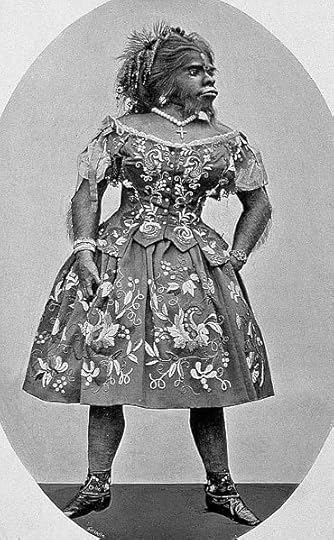
Julia Pastrana was born with hair all over her face and body, a large thrusting jaw and a double set of teeth. Born in Mexico in the 19th century, she was protected by her family and lived in the Governor's household where she was educated and learnt to sing, play the guitar and dance. Spotted by a carnival owner one day she takes up his offer to join his menagerie of circus freaks and sing and dance her way around the world. Julia wants only to be loved and respected for herself and eventually after being sold to many different managers, ends up with a husband/manager who tours her around the theatres of Europe.
This is a very sad story, made more so be knowing the events described really occurred even though this is a fictionalised account. What happened to Julia after her death is truly horrific and unbelievable. A second story thread set in current times about a woman who collects old, broken things that people throw away, is interwoven through Julia's story and appears totally unrelated until you make the horrendous connection near the end of the book.
This is definitely an interesting book to read. It will take you out of your comfort zone as you realise that even though we no longer parade unusual looking people as circus freaks these days, we are still learning to accept people for who they are and not be biased about how they look.
With thanks to Netgalley and the publisher Canongate for a digital copy to read and review
I received this in exchange for an honest review from NetGalley. Thank you the author, Carol Birch, and the publisher, Canongate Books, for this opportunity.
First of all, can I just address how beautiful this cover is! That, alongside the intriguing title, immediately engaged my shallow attention. The allusion to this being a story along the vein of The Night Circus also had me hooked! I would say the latter is a weak connection, as the only real similarity is the carnival/circus setting that takes place in both.
This is the fictional account of the life of Julia Pastrana. Born with a rare defect that is better summarized in her Wikipedia page, than I could begin describe it:
she was born with a genetic condition, hypertrichosis terminalis (or generalized hypertrichosis lanuginosa); her face and body were covered with straight black hair. Her ears and nose were unusually large, and her teeth were irregular. The latter condition was caused by a rare disease, undiagnosed in her lifetime, Gingival hyperplasia, which thickened her lips and gums.
Her different appearance made her the source of horror and ridicule during her entire life and led to her becoming a world-renowned 'circus freak'. Please note that I use this term with disgust and empathy.
This book narrates her from adolescence up until her death in a raw and honest portrayal of her character, society and the time period.
Her treatment, and the judgement cast upon her character just because of her outward appearance, saddened and appalled me and it made this a difficult read. It was, also, an important one, chronicling the darkness of societal opinion and judgement, that used Pastrana as the figurehead of unveiling the reader's awareness of the horrific treatment of anyone termed 'other' in the nineteenth century.
What saddened me the most, whilst reading this, was how simple Pastrana's wishes for happiness where. Her self-deprecation meant she accepted her treatment, and never blamed others for their hatred or was angered by it. She utilized what she was born with and her only wish was to earn enough money to buy a small house in the countryside and live happily and peacefully.
In the novel, there are small segments from the present day that seemed almost surplus and disunifed with the rest of the story. The link is explained, however, in a shocking grand reveal towards the close of the novel. Despite this, I thought the contemporary characters were surplus and a few chapters were wasted on their character, when only a small part of their story needed to be told to create the link.
Whilst difficult, this novel relays an important story that should not be lost to time. Julia Pastrana continues to have a voice in these words and I encourage everyone to hear her sing.
Having just read the non-fiction book Truevine: Two Brothers, a Kidnapping, and a Mother's Quest: A True Story of the Jim Crow South about two young albino boys stolen and displayed as freaks in the circus, I was hesitant to read this book right away. However, knowing that this story was fiction - based on fact - made it a book that was so close in story that I wanted to compare the two. I am happy that I did. Julia Pastrana and her son Theo Jr. both led tragic lives, which became much more so after their deaths. Born with a genetic anomaly, both were covered in hair - "ape-like" as people of that day said. They spent their lives, and many years in the after life, being shuttled from town to town, country to country, being put on display. If you look further down in the reviews of this book - another reviewer Sonja Arlow - has added a picture of Julia. Once you have read her story, her heart and enduring ways will over ride any ugliness you may see in her picture. Carol Birch, the author, was exceptional. It is not hard to understand why her books make the Man Booker Prize list or the London Book Awards.
There are 2 reasons I have decided to round off this rating to 3 stars although I found a lot I didn’t like in the story.
Firstly, I have been going through a bad reading phase and at this point I am not sure if I can trust my own judgement anymore and secondly, I was so shocked to learn that the main character in this story, Julia, actually did exist in the mid 18’hundreds I had to go dig out a picture of her and that changed my view of the story slightly.
What can be more fascinating than a book about carnival freaks with our protagonist Julia obviously being one of them. The story starts off so strong, with Julia leaving her protective childhood home to venture out on her own in the world. She settles with a carnival troupe with its own set of strange characters. A girl with no arms, one with no legs, a rubber man just to name a few and of course Julia fits right in.
The trouble for me started when she left this troupe to venture out on her own with only one manager to help her along.
In time she gets bought handed from one manager to the next traveling as a solo show until she meets Theodore Lent. At this point the story slowed down markedly, the richness of the story fell away as the other characters fell away. With only Julia and Theo the story had a repetitive feeling to it. All their interactions with other people circled around the same dialogue, the same answers the same scenes. I could convince myself that this is exactly the feeling the author wanted to create but I think she dragged it out for too long which made me a very fidgety reader.
Also interspersed throughout the novel is another timeline, set in 1984, with Rose an eccentric collector of junk – her story may have been intriguing to me in the beginning but I am sorry to say it added absolutely nothing to the overall story and could have been omitted in its entirety. I never felt as if I got to know any of the characters very well
I really wish I had enjoyed this more but perhaps it’s just my bad book juju influencing my experience so don’t use my review as a definitive decision maker on whether to get this book or not.
I do not know what I expected of this book, but this wasn't it. It is not necessarily a bad book, it just wasn't one I enjoyed at all.
This books tells the story Julia Patrana's life - a woman living in the 19th century whose whole body was covered in hair and who performed on various stages (singing and dancing - but to be fair most people came to gawk). I figured reading about her life will be fascinating but somehow it really wasn't. The reason why I found it hard to care was that the story felt disjointed and the snippets we saw of her life were somehow always too short. We only follow her for a few years but somehow she never felt like a fleshed-out person in her own right - especially because by the half point the narrative shifts mostly to Theo and how he sees her (and let me tell you - Theo is not half as interesting as Julia and about the biggest jackass you can imagine).
Another problem for me was the way Carol Birch structures her sentences, for me most of them sounded odd (to be fair, this might be because I am not a native speaker) and it took me right out of the narrative.
Other reviewers commented on the second story-line and how it did not add anything to the book. I have to agree here, while I understand how the two stories were in theory connected, I didn't think it worked at all. The themes discussed in the present were very different from the themes in the past, thus adding to the disjointed feeling of the book.
The book only got two stars from me because it wasn't predictable at all. When I commented while reading that there now is love at first sight? I was wrong and that person was never talked about again (see? Disjointed).
So, overall, just not a book for me.
--- I received an ebook curtesy of NetGalley and the Publisher in exchange for an honest review.
Orphans of the carnival is a novel about 'the ugliest woman in the world'. Julia is covered in hair from head to toe and has a monstrous face. She can play guitar, dance and sing. She teams up with Theo and they tour Europe. There's not much dramatic tension in this novel and neither does the author take any great pains to evoke 19th century Europe. It's often dialogue which is deployed to create motion and sometimes this can be seen as little more than irrelevant chit chat. That said it's a very vivid cinematic novel and the writing is very good.
Orphans of the Carnival is a fascinating work of historical fiction based on the life of Julia Pastrana who lived from 1834-1860 and was the great curiosity of her time. She was born in the mountains of Culiacan, Mexico, where she was abandoned by her mother and eventually adopted into the home of Don Pedro where she worked as a servant.
The woman we meet in these poignant pages is quite smart and talented--she speaks three languages, can sing, dance and play guitar and often performs for the guests of Don Pedro in costumes she has designed and made herself. It is at one such performance that she is 'discovered' by a promoter who offers her the opportunity to perform with his company in the United States. Julia jumps at the opportunity to be independent and see more of the world and soon finds herself in New Orleans where she becomes part of a carnival of 'freaks.'
For Julia was born covered in 'hair': she is petite in stature with small hands and feet, tiny waist, voluptuous bosom, but with a large head that is shockingly ape-like, with large, dark, shining eyes, protruding upper lip and massive teeth. She goes out in public veiled to avoid shocking the citizenry. She is a wonder to behold.
But inside, Julia is a warm, generous, compassionate woman, a sweet soul who is so painfully wounded by thoughtless looks and nasty comments, who desperately wants to live a normal life and find love. Is that possible, given how she looks?
Interspersed with Julia's story are a couple of modern-day threads: one, about an island of lost and damaged toys, and another about Rose, a young hoarder who pushes love away but collects things that speak to her, with the centerpiece of her collection being a blackened 'doll' she finds one day while dumpster-diving. Be patient...these somewhat jarring threads are nicely tied together with exquisite irony in the end.
Carol Birch is a fine writer who vividly brings the persona that was Julia to life in these pages. I will not soon forget her bravery and determination, nor her quest for a normal life. Her sad and painful experiences serve as a reminder that people are so often judged by externals when real beauty lies within.
I received a copy of this unique new book, hot off the presses, from Doubleday through a giveaway in the Keep Turning Pages group and want to express my thanks for their generosity.
I think everyone who reads this book should go into it knowing that it’s a novel with its feet firmly based on facts. I did, and it gave me a huge empathy with the main character Julia Pastrana, a woman who really existed, the notorious ape woman of Mexico who toured the world with Victorian freak shows. Just Google her name and you’ll find the original playbills for the carnivals she starred in and her photograph which haunted me throughout the book. Oh my Gosh, did people really ostracise and revere “freaks” of nature, people with deformities and disabilities to such an extent that they became the celebrities of the day? Pointed at, poked and prodded and oohed and ahhed over, screamed and shrieked at for their horrifying appearance and all the time making a living the only way available to them by making a public display of their otherness, their difference? Yes, you better believe it, they did! Julia was born in a small mountain village, brought up by friends and relatives after the mother she barely remembers, dies and leaves her orphaned and alone. Bad enough to live in poverty and be orphaned but Julia is an oddity, an ugly ape like countenance, covered almost entirely in fur or hair, with an extended jaw. But she is also a lively child, quick to learn, she is an accomplished dressmaker and eager to please others, she masters the art of languages, singing and dancing to keep people entertained. A teenager she dances at a local wedding when she is spotted by a showman who offers her the chance of escape and soon she veils her face (the only way she can go out in public without creating a furore) and sets off by train to join a carnival troupe. The people she meets, fellow freaks and monsters accept her for what she is, there are the armless and legless girls, a rubber man, an enormously fat lady and not least, Cato a pinhead, with a tiny egg shaped skull, a huge wide grin, little bent legs that make him always remain childlike, an irrepressible boundless energy and the inability to speak but to constantly vocalise his feelings in loud shrieks. Between little Cato and Julia grows a firm bond, and she mothers him to the extent that she feels a deep affection for him like a sibling or the son she longs for. She soon becomes well known and is approached by Theo, an enterprising and ambitious young man who nevertheless proves to be feckless and impulsive. She allows herself to be coerced by him into allowing him to manage her and he takes her off on a whirlwind tour of first the US, then Europe, Russia and worldwide. This book follows her life, as in the spotlight as a life can possibly be yet she can never walk alone outdoors for fear of exposure and ridicule and the one time she sets off to have a little adventure ends dreadfully in discovery and disaster. The medical profession long to examine her origins but are unable to concur why or how she is quite so very different to the norm. All Julia wants is a normal family life, loving friends who aren’t using her and she daren’t even voice the thought that she longs for a loving relationship with a man., as she knows this is as unlikely as the hope that one day she will wake up and have a smooth fair skin with no coarse hair covering it. I followed her life and relationships in this book as intimately as if I was there, I felt hurt on her behalf when she is used and abused by others, It is brutal, honest and frank, I found parts disturbing and some of the practises, so distasteful I balked. Meanwhile there is a modern thread running alongside Julia’s story. We are introduced to Rose in the 1980’s she is a modern woman and seemingly completely unconnected to Julia’s story in any way at all. Rose is a hoarder of junk, she is hard to warm to, she has an erratic lifestyle, various failed relationships and in her own way is as much of a misfit to society as Julia was. There seems no point to this thread, at times wondering why has the author included it? But that does become clear and provides a poignant and harrowing finale. There is an island of broken dolls which Rose dreams of visiting and amongst her hoarded junk is a broken and ugly damaged doll she rescues from a skip. She calls it Tattoo and won’t be parted from it. When I discovered the secret of Tattoo, it broke my heart and I urge anyone reading it to remember that this is also based around fact. Crikey, parts of this book did upset me, I cried bucketloads and am shedding a tear now as I write my review. I have used terms which are anathema to me, freak and monster, as they are used in the book as they were used to Julia’s face in real life, but don’t think this comes easy to me – it really doesn’t because what Julia is, is NOT a monster but a charming, astute and lonely young woman crying out to be loved and I just wanted to give her a big hug and tell her the one thing that nobody ever seemed capable of doing during her life “You’re not a monster, you’re lovely” I have read a few books by Carol Birch, The wonderful Jamrach’s menagerie, the compelling Scapegallows and more. She has the knack of searching out the unusual, embroidering it with her own unique style, embellishing fact by turning it into fiction and peopling it with larger than life rumbustious characters so you are sucked into a world which is far removed from everyday life yet ethereally authentic and satisfying. Orphans of the Carnival is a wonderful atmospheric read portraying what it’s like to be truly different and chronicling a life spent making the best of what you’ve got.
I am having a very hard time writing this review. I think that the writing here is very good, descriptive, thought provoking and showing exhaustive research. I had previously read “The Autobiography of Mrs. Tom Thumb” and had enjoyed that book. That book was also about a real person but had a much broader time range and there were more characters surrounding the protaganist.
I have some problems with the novel however. I think the first person narrative by Julia Pastrana was wonderful and perhaps should have been left at that.
The voice of her manager and then husband Mr. Lind was somewhat insightful particularly when describing the places where they toured and people that they were introduced to. It did exemplify to me how Julia was used as a way to make money and the marriage was made to insure that she would stay with him. He is a difficult man to understand, at some times seeming to care for Julia and at other times just seems to enjoy the fanfare and all of the societal perks and money that come with it. He had failed at other attempts at making a name for himself and fame with other “freaks” which was the term used at that time and he views Julia as a gold mine. The later years when he traveled with the mummified remains were just repulsive to me.
I also felt that the middle of the book dragged for me, maybe just too many repetitious details from city to city, all of the clothing that she wore, the meals that they ate.
The third voice of Rita in the present was told in very short chapters which I found somewhat confusing and then of course there is a big reveal at the end and we understand the connection.
I won’t go into the body of the novel as you can read that in the blurb and from other reviews. What I liked about the book is that it brought this wonderful, tortured person to life and made me venture onto the internet to find out more about her. You can just google her name and there is lots of info including sketches of her and playbills.
What I didn’t like was that it just made me feel sad, and angry and disgusted at how flawed human beings were treated at that time, but that is just response. It also gave thought to just how much better are we at treating those imperfect people now? Maybe they aren’t classified as “freaks” but how easy is it for them to function in society now? Do they get the help that they need to learn skills so that they can provide for themselves? I don’t know the answer to these questions. We are definitely still very much a society that treats “beautiful” people differently and still displays beautiful, thin women as a role model for young girls.
Ms. Birch is a remarkable writer and I am glad that I was able to read and review this book which was provided to me by the publisher and NetGalley.
I would have read this book knowing nothing about the author, though being short listed for Man Booker prize (albeit for a different novel) is certainly a strong recommendation. I would have read this book even if I hadn't known it was actually based on real individuals. I would have read this book because I'm absolutely enamored by circuses, sideshows, freaks and all that. Not to mention my love for historical fiction. Not to mention my love for a good story well told. This book was all I expected it to be, a fascinating story set in the middle to late 1800s about a singular woman, who became a well celebrated much traveled performer. Being different has always been frowned upon (and still is and about to become more so certainly the way the world is spinning), but Miss Pastrana wore her difference outwardly, so striking was her hirsute appearance that there were scientific opinions at the time about whether she can actually be considered a person and not some sort of an humanoid/animal composite. And yet, Birch has endowed her heroine with such grace, intellect and composure that her humanity is never in question, only those around her, the gawkers, the admirers and most importantly her manager/spouse, a complicated man of dubious and morally ambiguous nature, though essentially all too self serving, especially as the time goes on. Very interesting, very memorable story, told with a certain aloofness maybe...or at any rate for some reason I didn't completely connect with it emotionally, but it thoroughly engaged me intellectually. One sitting read, one afternoon, one terrific journey. The book has a parallel, although much lesser both in significance and page count, storyline set a century later, dealing with a emotionally complicated woman who collects discarded objects. While completely justifiable from a plot perspective in the very end, throughout the book I found it distracting and unnecessary. Yes, I can see it was used to draw parallels between relative value of persons and possessions, disposable society/disposable individuals and such and it is relevant and poignant, but structurally it interrupted the main story and took the reader out of it too abruptly. Anyway, so maybe no perfect, but so very good. Such a vivid striking story. All too appropriate for its vivid striking protagonist. Behold (gotta say not quite as dramatic as expected after reading the book, but then again when does real life lives up to its literary counterpart) Mrs. Pastrana. And yes, great book. Enthusiastically recommended.
Oh my heart! My heart is still healing from this novel. Julia Pastrana was a born ‘freak’, but an accomplished very talented one who was a dancer, a performer, could speak several languages and could both charm and horrify people. But like many women, all she wanted was to be loved for who she was beneath her ‘animal countenance’. Everyone knows no man could ever look upon such ugliness and find love, it is unheard of, surely. She feels cursed, could her mother have gone out under a full moon and her punishment was this monster infant? Julia finds a shaman and what she wants to know is as human a question as any other warm-blooded girl’s, will she be loved? Incredibly the shaman informs her she will be loved within a year. Sure enough, as soon as Theodore Lent enters her life her and offers her the chance to see the world it doesn’t take much convincing but getting over her fear. They become more than business partners but Theo is both disturbed by and hungry for Julia. She is a money-maker for these strange times, when curiousities were all the rage. But this story takes readers past her stage persona and finds a lonely woman that suffers the cruelties of her face. Walking the streets veiled in generally a must, and when she is ‘uncovered’ the cruelty and meanness of others exposes the ugliness in the hearts of the average person, begging the question ‘who is the real monster?’ Theo himself is often suspect, and is this love? Is this a love worthy of Julia? I can’t go into detail about what fortunes come to light, or how it broke my heart except to say maybe preserving curiosities can be a monstrous perversity. Theo finds Julia to be a marvel, a rare exotic gift but he struggles too with his feelings.
I don’t want to give anything away, but this story is about humanity and inhumanity at the same time. It’s about our perceptions, and how true beauty is sometimes hidden in the least likely places. I felt shame for the abuse of Julia and people like her (yes this is fictionalized account but she did exist). On the one hand people think ‘well at least she was able to make a career of her ‘misfortune of birth’, but on the other why must someone deemed flawed become a side-show for the rest of the world? How horrifying, the hungry eyes paying to see the ‘oddity’, how heart-wrenching to read of one’s own shocking ‘ugliness’. How terrible to love a man who is also an opportunist, even depriving you of your final rest… well without giving much away, by the end my heart was carrying such heaviness that I am still thinking about her today. Not often fiction stays with me, but it’s beautiful when it does.
I loved the ‘little doll’ story that goes along present day alongside Julia’s tale, the woman who collects things and how it all tied together in the end. What a gorgeously told story! Darn you Carol Birch for making me care! When Theo needs another money maker (the stink of opportunity never escapes him) he will find another like Julia. But there is a fight in Marie! Marie isn’t Julia though she looks similar. Theo grows older, and the things Julia was told so long ago do come true, just not quite the way one would have imagined. It ends as it should, and it clings to the reader. This book is haunting, and it’s good to have your heart haunted once in a great book. Excuse me while I go and have a cry.
(2.5) A historical novel about real-life 1850s Mexican circus “freak” Julia Pastrana, who had congenital conditions that caused her face and body to be covered in thick hair and her jaw and lips to protrude. Cruel contemporaries called her the world’s ugliest woman and warned that pregnant women should not be allowed to see her on tour lest the shock cause them to miscarry. Medical doctors posited, in all seriousness, that she was a link between humans and orangutans.
My copy of Birch’s novel was a remainder, and it is certainly a minor work compared to the Booker Prize-shortlisted Jamrach’s Menagerie. Facts about Julia’s travel itinerary and fellow oddballs quickly grow tedious, and while one of course sympathizes when children throw rocks at her, she never becomes a fully realized character rather than a curiosity.
There is also a bizarre secondary storyline set in 1983, in which Rose fills her London apartment with hoarded objects, including a doll she rescues from a skip and names Tattoo. She becomes obsessed with the idea of visiting a doll museum in Mexico. I thought that Tattoo would turn out to be Julia’s childhood doll Yatzi (similar to in A Council of Dolls by Mona Susan Power, where dolls have sentimental and magical power across the centuries), but the connection, though literal, was not as I expected. It’s more grotesque than that. And stranger than fiction, frankly.
Birch sticks to the known details of Julia’s life. She had various agents, the final one being Theo Lent, who .
There are two Bookshop Band songs about the novel: “Doll” and “Waggons and Wheels.” “Doll” is one of the few more lighthearted numbers on their new album Emerge, Return. It ended up being a surprise favourite track for me because of its jaunty music-hall tempo; the pattern of repeating most nouns three times; and the hand claps, “deedily” vocal fills, unhinged recorder playing, and springy sound effects. The lyrics are almost a riddle: “When’s a doll (doll doll) not a doll (doll doll)?” They somehow avoid all spoilers while conveying something of the mental instability of a couple of characters.
The gorgeous “Waggons and Wheels” picks up on the melancholy tone and parental worries of earlier tracks from the album. The chorus has a wistful air as Julia ponders the passage of time and her constant isolation: “old friends, new deals / Winter or spring, I am hiding … Winter or spring, I’ll be travelling.” Porter’s mellow soprano tempers Julia’s outrage at mistreatment: “who are you to shout / Indecency and shame? / Shocking, I shock, so lock me out / I’m locked into this face.” She fears, too, what will happen to her child, “a beast or a boy, a monster or joy”. Listening to the song, I feel that the band saw past the specifics to plumb the universal feelings that get readers empathizing with Julia as a protagonist. They’ve gotten to the essence of the story in a way that Birch perhaps never did. Mediocre book; lovely songs.
Originally published on my blog, Bookish Beck, with more about The Bookshop Band and my experience seeing them in concert.
I entered the Goodreads giveaway for this book because the description reminded me of Geek Love, one of my favorite novels. Happily I won the giveaway, and started reading, the book initially reminding me more of the HBO series Carnivale. But even that comparison faded as I read deeper into the novel. I loved this book. First of all, the prose is absolutely gorgeous. I was unfamiliar with Carol Birch, though she's written many previous novels. I will seek those out, as she is an amazing writer. As one of the characters herein says to himself, "Good god, man, you've got a way with words," a phrase that I would apply to Ms. Birch herself. Just one example of another sentence that just jumped out and slapped me across the face: "He heard the sound of her smiling." (The characters are in the dark in this scene.) So, the writing is great, but the story itself is fascinating as well. The novel chronicles the life of Julia Pastrana, a mid-19th century woman who was born with a couple grotesque conditions, and made her way through life as a circus sideshow freak. I had heard of, and seen pictures of, her before, but this book made me do some research and find out more about her. Historic fiction is not a common genre for me, and I was impressed and amazed with how Birch took the basic facts of Julia's life (all true) and created this amazing portrait of her and her life (fictionalized). One of the more challenging aspects of the book (for me) is that there are sections that take the reader out of Julia's story and deal with a woman named Rose in the present day. These sections are always very short and appear only infrequently. They are a bit jarring in the narrative (which, I imagine, was part of the intent), and often left me wondering as to their purpose. I did figure out the (rather gruesome) connection before it was finally revealed, making those sections more satisfying for me. I would encourage anyone interested to look up some information on Julia Pastrana; the book takes some time to reveal who or what she really is. Julia's life (and what happened after) was tragic, but Carol Birch has created a heartwarming and endearing portrait of her. I loved this book, one of the best I've read in awhile.
Firstly, thanks to the publisher for a free copy via the Goodreads Keep Turning Pages discussion group. I think I might have enjoyed this even more if I had been aware it is a work of historical fiction--Julia was real. Honestly, it took almost half the book before I was truly vested in reading it. However, in all fairness my life has been rather hectic these past few weeks, and I suspect that had more to do with my reading experience than the book/writing style itself. It is a fascinating premise. I was thinking of Sonny and Cher, and Celine Dion and her late husband. Who can truly know how much of a partner's attraction is due to actual "true love" vs. "ecomonic rewards"? I believe Theo did love Julia, but certainly not Marie. His second "marriage" was purely one of convenience and continued showmanship.
In addition, there is the question of death and not only preservation, but also display of a dead body. I realize there are cultures where the dead remain in the household and are dressed up, etc., and still considered part of the family's daily living routine. Honestly, I feel that is a bit too creepy for me. I believe a body is just a container for a soul. I also believe in reincarnation, so a soul can and does inhabit many different physical bodies. I must admit Theo's display of the mummified bodies was way over the top, in my opinion, but I am someone who never has and never intends to patronize such "sideshows."
Though this book certainly left me seriously pondering whether such relationships which appear to most others to be spurely exploitative, are a real-life service to such "freaks of nature." I guess I've never really considered that aspect before, and am always just appalled that we humans refuse to just accept each other, regardless of how odd we may seem to others...we are all odd, just in different ways and to varying degrees in specific aspects. :)
Julia Pastrana is mistaken for a werewolf or the Missing Link. Though she can speak three languages, strangers think she can't speak at all. Julia Pastrana was actually a living woman with hypertrichosis, an abnormal amount of hair grows on the body. Having two rows of teeth and bigger mouth didn't help her being confused for a monster in the mid 19th century. Julia's obvious path was to join circus life, and other things in her life made her story stranger than fiction. Here, Carol Birch reimagines Julia's story. The book follows the basic story of Julia's real life -- of course, any writer can't know any historical figure completely. (Even family doesn't know every detail of their own family members lives.) But this is not a biography, it's a novel that can take liberties with Julia's story. Birch writes this "monster" with so much humanity, that most of the others in the book lack. Julia's journey is a strange one, going from fearing for her life around a gang of children (though she is such a beautiful person, she is more worried about scaring a child with her appearance), then a few pages later, being invited to a ball and dancing the night away. The quick changes from lows to highs reminded me of Alexander Chee's 'The Queen of the Night' and circus life can't help but remind me of Katherine Dunn's 'Geek Love'. There is also another story winding within the book, only a couple pages at a time, taking place in 1980's London, a woman who loves common objects that others would find useless almost more than she loves people. At first, I was questioning the purpose of this story line, but in the end, I loved how it intertwined. There is so much tragic irony here but to explain it would spoil the story. The only minor complaint I would have of the book would be that I wanted to read more of Theo's back story. I'm very happy I found this book, as I didn't know Julia Pastrana existed. Her actual story seems like something too bizarre to think up, but here Birch brings Julia to vivid full life with her beautiful writing. Even if there are liberties with Julia's Pastrana's story, I'm grateful to Carol Birch for writing a book about Julia at all. I love this book. I'll definitely have Birch's eleven other novels on my to-be-read list, and 'Jamrach's Menagerie' her almost-winner of both the Booker and Orange Prize is already waiting on the shelf. This copy was received as part of the GoodReads Giveaways.
Wow! What a fascinating story!! Although I'm familiar with hypertrichosis, I'd never before heard of Julia Pastrana, the woman who's life Carol Birch based this story on. Pastrana lived a sad yet remarkable life. I say sad because of the way she was treated as a freak of nature and put on display to perform day after day, year after year in front of gawking crowds. However, Julia Pastrana was immensely popular and famous. She was paid handsomely for each performance and turned her misfortunes into gold. This story breaks my heart. The cruelty of human beings never ceases to amaze me. While I realize Birch's story is a historical tale, the facts are there in black and white. Pastrana was used as a circus act because she was uniquely different. Hypertrichosis was not common. Science knew little of the disease. One can only imagine the cruel and vulgar treatment Pastrana endured because of her characteristics.
Carol Birch does an excellent job of telling a story that will long remain in my memory. It's a book I won't soon forget. Took my time reading because it's just one of those extraordinary tales that has you Googling the real characters, wanting to know all the facts and fiction. There's a side story going on here, too. It takes place in present day and the way the storyline ties together in the end is just brilliant. Absolute brilliance. You can bet I'll be reading more novels written by Birch, a fabulous storyteller. If you've been considering this book, don't waste another moment. Read it already.
* I won a copy of this book through the Goodreads group KEEP TURNING PAGES.
Although I had no idea until after I read it that this was based on a real woman, I certainly found many things about this fictionalized version of her life believable. Julia Pastrana was born in Mexico, abandoned by her mother and raise by a governor. As a young woman she left for the US where she began her performing career, being views as a monster and a freak by many, although she spoke three languages fluently, was literate, could sing, dance and play both the harmonica and guitar. Birch has done a compelling novel of her life including the more disturbing aspects of her time. She worked for more than one manager, but ended up marrying the last one, Theo Lent.
In this novel, Birch has woven in a more contemporary story, but it is deftly and lightly interspersed. It wasn't quite a five star read for me. However, I read it for a reading challenge and was quite happy I found it.
Julia Pastrana has an exceptional story. A Mexican orphan who was taken in by a family who raised her, taught her to sing, dance and play instruments. When the elderly lady she was tasked with looking after passes away, Julia decides to go on the road, using her talents and irregular appearance to make money and see the world. Meeting others like herself, misfits and the wonderfully different, she travels America, doing shows, appearing in carnivals and participating in high profile events.
The story is filled with uncertainty and insecurity, Julia has no idea how the world will react to her appearance, the hair, the beard, her facial structure her talents and her personality. Being called ape-woman, bear-woman, inhuman and a creature causes her to doubt her place in the world, but those around her who care about her (or the money she can make) encourage her to carry on and fulfil her dreams. It may sound a bit harsh, but I was a little surprised about how upbeat and positive Orphans of the Carnival was! And I loved it! There are some horrific, unpleasant and hurtful themes and scenarios, but overall I would say it was about 70% adventure and fortitude and about 30% sadness and pain.
The events told in the book were based on her life and Carol Birch had creative freedom to narrate her life, through a third person perspective, and I think she did a great job. The story was emotional, positive, adventurous, respectful and honest. While I thought the Julia Pastrana element was outstanding and readable, I wasn't too sure about the Rose sections of this book. They served well to break up the Julia sections, but in my opinion, they didn't really add much my enjoyment or appreciation of the story.
Rose's story is brief, focusing on her life in the present day. Surrounding herself with all the lost/unwanted items that she comes across in her life. One day, she finds a doll and takes it home and over the course of the book, her life seems to dissolve away and everything becomes about the doll. I understand why it was included, it acts to answer some questions and add another dimension to the story, but I could have read and enjoyed the book without it.
There are several elements in this book that made it both easy to read and difficult to digest. The characters Julia comes across in her travels were a stand out element to the book, Cato, Ezra, Myrtle and Delia among others are individuals who teach Julia the ways of the world and how to survive in it. I also appreciated Julia's narrative, her rise from tents and abuse to almost royalty. For those who know the story or have read this already, you may agree with me that Theo Lent is probably the most detestable part to this book, though he did make Julia happy in her life so that accounts for something.
Julia's life was difficult but she made the best of a rough situation. The themes and tone in this book reflect this idea really well. The tone and atmosphere was one of both nervous anxiety but also adventure, wonder and delight. I felt the Carol Birch was aiming for themes like, anything is possible and it is heart and personality that truly matter, if that is true then she nailed it and I thoroughly enjoyed my time in Julia's company.
Overall, I have given this book 4/5 stars because it was a well written and respectful narrative, but even though the Rose element added another dimension to the story, it still felt unnecessary. I do recommend this book to you all, it is a perfect piece of historical fiction with true elements threaded throughout that focuses on a wonderful and brave woman who beat the odds to become famous and fall in love. Thank you for reading this review and check out Always Trust In Books for more reviews, posts and other bookish fun.
[I received a copy of this novel through NetGalley.]
This novel is based on the story of Julia Pastrana, a perforrmer and "freak" who lived in the 19th century; more than the typical "woman with a beard", Julia was covered in hair, and had a facial condition that made her look like an ape. Throughout the story, we get to see here leave her hometown and the house where she had lived, to perform with a troupe, then with independent managers. More than a mere attraction, Julia sang and danced beautifully, something other characters find both fascinating and troubling: after all, is she really a human being, or merely an animal?
I found this attraction mixed with revulsion fascinating, for all the questions it raised. Most of the story is told from Julia's point of view, and there's no doubt she's a human being, period, with her own thoughts, feelings, dignity, and desires in life. She may appear as a little passive at first (her fellow performers have to remind her to get a contract, not just take everything her manager send her way, and she let herself be prodded by doctors and scientists), but she reveals herself quickly as full of willpower: leaving the people she's always known for the big unknown, and especially accepting her condition as something normal, something that's part of her, while making use of skills that, in about everybody, would certainly garner admiration (singing, dancing, playing the guitar, acting). There's some contradiction in her character, true; on the other hand, this is just part of the human condition—so many of us are creatures of contradiction.
But the world isn't so kind to her, and while a lot of people are ready to pay just to see her, or are her friends (Ezra, Friederike...), some others don't hesitate to criticise her, judge her as amoral, or as an abnormality that should be kept under lock and not shown to people. This definitely raises the matter of the "freaks" (Victorian period) and how they were perceived, not to mention what may easily be forgotten: that those people were, well, people first. In this way, the novel can be shocking—thus reflecting a very Victorian feeling, with "well-thinking people" judging those who're different, while at the same time never judging themselves for gawking. (Also, there's the matter of Theo's decision later.)
This highlighted the tragedy of Julia's life: people came to see her, but less for her skills than for her appearance. She was invited to social gatherings, but less for her personality than for others to "see the freak". People talked about her relationship, but less out of happiness for the couple than to whisper in their backs about "does he does it with -that-?" It was all very sad, all the more because Julia can never free herself from her appearance, which in turns is limiting (she can't go out without a veil, for instance, and in spite of travelling a lot, she doesn't get to really see that many places).
Theo, well... Theo was less interesting. Mostly his character was of a mercantile quality (and at least he's honest about that), and there was never any mystery about the part money/fame played in their relationship. Still, when things were told from his point of view, they never seemed as rich and interesting as when they were from Julia's.
Julia's story would have been a 3/4 stars. However, a few things prevented me from really enjoying it. First, Theo's voice (as said, not very enthralling, especially when it dealt with his ambiguous feelings for her); I kept thinking that I would've wanted to see this relationship told only through Julia's eyes, perhaps because there would've been more than a seed of wondering whether he truly loved her or just took advantage of the situation? Hard to tell. Also, the fact that Julia doesn't stay that long with other performers, and apart from a couple of encounters with Ezra, Berniece and Cato later, mostly everything revolves around Julia and Theo, therefore: not much potential for various interactions.
Finally, the Rose narrative: I disliked that one, none of the characters were particularly appealing, and that story was only connected by a lose thread to Julia's. I had expected something more... intense? More closely related? The way it was, it brought nothing to Julia's story, and in the end my only feeling was "why did I bother reading those parts?"
Conclusion: 2.5 stars. Julia's narrative didn't need to be bogged down by Rose's.
It is rare for me not to finish a book. Even if I find something boring or silly, I'll usually slog through it while reading something else. But no matter how hard I tried, I just could not get further than page 210 of Carol Birch's Orphan's of the Carnival - about halfway. I'm a fast reader but it took me months to reach the point where I decided to throw in the towel. I simply have too many unread books scattered across my flat and publishers keep sending me more.
I had never read any of Birch's novels before but was seduced by the words "Man Booker Prize-shortlisted", and the Financial Times' claim that "Her words sing on the page." Yes, yes perhaps that was a little snobby of me.
Julia is a freak. Or at least, that's how the world sees her. Born covered in hair, from head to toe, she is compared to apes. When people see her they scream or faint. But in the carnival where she dances, she feels at home among others who are strange and look different. Travelling in this 19th-century circus allows her to see the world.
Julia is a character that is meant to engender compassion, to highlight the way the world treats anyone it considers 'different'. But I struggled to connect with her. I also found the sub-plot that takes place in contemporary times, about a woman who collects and hoards 'lost treasures' (mostly broken toys that people have thrown out), distracting and a bit dull. The two stories are obviously meant to connect at some point but I did not feel compelled to find out.
This book definitely has its ups and downs. The story is interesting in itself. It starts with Julia, a hairy female, leaving her home to join circus and perform for money. She lives with other performers like tiny human, girl without arms, girl without legs, etc. I loved learning about the issue of her walking into the city, having to cover up, her dealing with contracts, the circus setting and the whole new world. Then she is sold to another manager and goes on solo tour. This is where the story gets a bit lengthy and it drags on. Once she starts touring Europe with Theo, many of the situations seem repetitive or not interesting enough and I wasn´t as drawn into it as I would wish. What happenes at the end of the book, however, got me hooked again and I kept thinking this is well creepy. I must admit I was shocked when I learned this was a true story (maybe I would enjoy the book more if I knew this before I started reading it). The whole Rose story - I am not sure about this. It was too short for me to get attached and it didn´t give any more value to the story except for the fact of how her story is related to Julia´s and let me tell you I found it kind of gross. Overall it wasn´t a bad book and I am glad I read it but it is not one of those I would re-read.
I have to stop buying these Victorian Era carnival/freak show/circus books. I'm fascinated by the subject and the time period, but it doesn't seem to make for good fiction very often. I've read a ton of novels focused on this stuff, and they're basically all the same general story and almost never any good.
Sadly, this book was no exception, and below average even among a sub-genre that is already below average collectively.
Birch writes prettily, but the book is repetitive, irritating, and dull. Worse still, it's just unlikeable. Most of the characters are either extremely unappealing or unmemorable. And the modern-era perspective switch is the worst part. Rose's entire narrative served absolutely no purpose and contributed nothing to the book.
This is a one-star story, but I gave it a bonus star because I did enjoy the description of daily life in various European cities during this era.
I enjoyed this book but felt it was overlong. It's well-written and the exploration of the characters at the start is very good; and the denouement is good too, if a little rushed. But there is a lengthy middle section where it meanders quite a bit, to the extent I was tempted to abandon, and I have some sympathy for a great many of the reviewers who did just that, right in the middle of that section. The more novels I read the more I appreciate novellas and short stories.
BTW - I did NOT receive a free copy of this book, and certainly not in exchange for an honest review. The policy seems to be to declare you received a free copy, but there is no requirement I can see to say 'in exchange for an honest review' - in actual fact, though not stated as policy, one of the moderators indicates that nobody can require a review of a Goodreads reader, honest or otherwise.
Thank you Goodreads for sending me an ARC of this book. Perhaps I'm not sophisticated enough to appreciate this book. It started out well but quickly became a long drawn out dither. When Julia is with her first troupe there are plenty of interesting characters, when she hooks up with Theo life becomes humdrum and so does the story. We move to Prague. Will Theo lose Julia? We move to Vienna. Will Theo lose Julia? You get the idea. And I have no idea what Rose's modern day storyline was supposed to mean.
*Received a free copy of this book from NetGalley in exchange for a review* This book is so poorly written that it is almost unreadable. The premise is quite interesting but the long-winded descriptions and uneventful storyline had me losing interest very quickly. Cannot say more because I couldn't read more than half before I gave up.
I really enjoy books that revolve around a circus, I have no idea why I enjoy these so much but I always love them, so when I saw this book I was intrigued and excited.
The book follows Julia Pastrana, a woman born in Mexico in 1834 with two severe genetic malformations that resulted in her body being covered in hair and in her having a protruding mouth and lips with two rows of teeth. After being spotted by someone in the circus industry, Julia ended up joining the circus and travelled the world doing ‘shows’ where she would sing and dance for the paying audience. It would be easy to believe that Julia was some kind of uneducated ‘freak’ but we soon learn that she is fluent in three languages, is a delightful singer and dancer and is also a warm and generous person. It is the world at large that is Julia’s enemy and her struggle to succeed is what gives this story its distinct appeal.
Interwoven chapters running alongside Julia’s extraordinary story is that of Rose, a modern day hoarder who lives in a flat in London surrounded by tat and with a life filled with regrets and indecision. We have no understand as to what can link these two women as they could not be any more different and yet, as the book progresses, we see how their connection plays out within the wider context of the story.
I was enjoying this book as an interesting read and was about halfway through when I discovered that this is based on a true story! I found images of Julia and this discovery turn the whole meaning of the book upside down for me. My feelings towards Julia changed when I realised that she was real and this was her real life. I felt sympathetic, angry, frustrated and upset for her. I don’t want to give the storyline away but Julia lead an interesting life, even after her death!
This is a book that will interest people who enjoy Victoriana and historical fiction of the era, and anybody who likes to read a well-written novel with great characters, especially if they enjoy circus tales. Although this is not really your normal circus story, it is very sad and not at all glamourous, it deserves to be told and read as it is probably a much more realistic look at circus life.
This was a good read, it’s skillfully written and although many of the characters are ‘freaks’ or ‘curiosities’ we get to see their humanity over and above anything else and it’s a nice twist that the most bizarre character in this story is the one who appears physically to be the most ‘normal’. The descriptions of the carnival, theatre’s and locations are terrific but they don’t take centre-stage at any time and the characters that we meet are warm and loving. I did find myself wanting to skip forward a bit at some times that were slow and I wanted to understand the relevance of Rose’s chapters a bit earlier than I did but overall I felt it was an interesting read but not one I would recommend to someone who specifically wants a good circus story.