

What do you think?

The Indifferent World
A childhood home haunted by the past, a farm-animal veterinarian’s bloody operations in the field, an unemployed cousin stranded by time and hope—Ken Craft explores the indifferent world in all its manifestations. He chronicles the stories of others who have faced indifference with grace, too—the bus driver reading Irish literature for night school, the old Mainer preparing his homestead for winter, even Leo Tolstoy’s last dash from death, which caught up with him at a train station in Astapova. In turns contemplative, humorous, and quixotic, this debut collection is a quiet celebration of everyday life in our preoccupied world.
- GenresPoetry
132 pages, Kindle Edition
First published April 4, 2016
About the author
Ken Craft
3 books1,302 followersKen Craft, a Pushcart Prize recipient, is the author of three collections, most recently Reincarnation & Other Stimulants.
Ratings & Reviews
Friends & Following
Create a free account to discover what your friends think of this book!
Community Reviews
Displaying 1 - 30 of 32 reviews

July 21, 2018
If Ken Craft is one of your Goodreads buddies, you're very lucky.
He's a good guy.
But if you've ever read his poetry, you're exponentially LUCKIER.
What a rare treat it is to read for the first time.
He writes SO well, with that same good-natured, fine-tuned dry wit you'll find very much at play in his reviews. And the fancy paces he puts his beloved English language through?
Superb!
Try THIS on for size...
Stepping the sleeping world
Is such splendid isolation.
Walk on the rise of others’ breaths,
toe the center soul of hallways,
pry open dark’s screen door.
Outside, the kneeling night grows heavy.
Such evocative images are surely what our language is made for. Stéphane Mallarme did say the whole world exists to end up in a book, after all...
And you can tell he's a teacher - his poetic vision is so clearly defined - and now we know he must be a darned fine one, too, to know so well what words can do.
But don't ask Ken if all this praise is merited.
He’ll just sidestep the question (humorously, of course)!
Every bit as humorously as he remedies our (frequent for me) alienation from our inner child:
Reach
back, grasp
your younger
hand, squeeze
And hold
until your
palms'
warmth
mingles.
Further, natural surroundings humorously AWAKEN his zest:
When you're
broken,
find your
Henry David
and simplify.
His deep love of nature SHINES through these wonderful poems, many of them set in the unspoiled outdoors.
And now, after having read them, I'm going to treat them like an expensive box of chocolates and tuck them away on my Kindle for very special occasions.
Beautiful stuff, Ken.
Thanks so very much!
He's a good guy.
But if you've ever read his poetry, you're exponentially LUCKIER.
What a rare treat it is to read for the first time.
He writes SO well, with that same good-natured, fine-tuned dry wit you'll find very much at play in his reviews. And the fancy paces he puts his beloved English language through?
Superb!
Try THIS on for size...
Stepping the sleeping world
Is such splendid isolation.
Walk on the rise of others’ breaths,
toe the center soul of hallways,
pry open dark’s screen door.
Outside, the kneeling night grows heavy.
Such evocative images are surely what our language is made for. Stéphane Mallarme did say the whole world exists to end up in a book, after all...
And you can tell he's a teacher - his poetic vision is so clearly defined - and now we know he must be a darned fine one, too, to know so well what words can do.
But don't ask Ken if all this praise is merited.
He’ll just sidestep the question (humorously, of course)!
Every bit as humorously as he remedies our (frequent for me) alienation from our inner child:
Reach
back, grasp
your younger
hand, squeeze
And hold
until your
palms'
warmth
mingles.
Further, natural surroundings humorously AWAKEN his zest:
When you're
broken,
find your
Henry David
and simplify.
His deep love of nature SHINES through these wonderful poems, many of them set in the unspoiled outdoors.
And now, after having read them, I'm going to treat them like an expensive box of chocolates and tuck them away on my Kindle for very special occasions.
Beautiful stuff, Ken.
Thanks so very much!

October 25, 2016
I’d promised myself to read more “new” (well, new to me) poetry early in 2016. I had one other book of poetry picked out, but I really had wanted to read Ken Craft’s “The Indifferent World,” which was released in April. I sat down with the other one, but “The Indifferent World” was calling me instead. I’m so glad I changed course, because I loved this collection of poetry. I had my favourites. Eighteen of them, more or less. Some are shorter than others, none are overly long. These are lovely, thoughtful poems, some are even thought provoking.
Barnstorming the Universe
Halves
Meditations for November
Provide, Provide
3:30
Sitting in the Dark
Momentary
Making Gazpacho
Idyll
Snapper
** Waking to Rain
Hunting the Unwritten Poem
Tonsillectomy
**Dog Religion
**Crows & The Reaper
Black Dogs Redux
Mrs. Galway Goes to Night School
Mortality
One tiny snippet of the poem, Mortality:
Mortality
“It waits
outside the house,
stoic as a crouched cat
tensed in tall grass.”
Ken Craft’s collection of poems touched so many emotions for me, “Barnstorming” had me think of all the ramshackle barns I’d seen while driving roads less travelled. “3:30” had me smiling in recognition, “Waking to Rain” was read first as the rain played musical notes on my roof, “Idyll” had me reminiscing, and well before “Dog Religion” I was hooked.
Still, for me, I wanted to take my time with this and fit it in a little at a time, so I did my best to pace it out a bit.
For those of you interested, there is also a giveaway for ONE copy of this book of poems (US, CA, GB and AU only).
I absolutely loved this!

Read
April 9, 2016Cheating, I suppose, but I read this book as I wrote it. And rewrote it. And rewrote it. Which means I reread it. And reread it. And reread it. You get the idea...
Representative poems:
Trigger
This is where I held
my breath--
a stand of red pine,
needles and snowdust
scribed about my boot,
cold crescent
resisting a swollen
finger itchy-numb
with November.
This is where a buck
held its breath--
mouth mid-meal
amid the mast,
a single line
of berry drool
spiking the fur
of his white and
wild-cherried chin.
Note: I wanted to write a deer hunting poem that worked both as a before-pulling-the-trigger piece and a before-NOT-pulling-the-trigger piece (the decision being the reader's). The word "mast" is hunter talk for nuts and fruits found on trees.
Idyll
Each day brings the wedding closer:
clapboard and trim painters,
window washers, florists, a house
under siege.
I wish
I were a Bruegel peasant
far away, under a sky pricked and paled
by August sun:
Scythes whistle. Sweat-soaked muslin
kisses our backs. Kerchiefed
maidens swing in rhythm, while a rick
wagon with wheat-strained ribs
waits in back, swaddling its shade,
its cool, corked jugs.
Let us stop here
and rest, limbs splayed
with the sweetness
of fatigue. Let us drink this wine.
Open these wicker baskets.
Find the airy white hearts
of crust-cased loaves with our thumbs.
Note: We decided to use our home as the site of a large celebration. In theory, it sounded simple, but it only made me YEARN for the simple.
Representative poems:
Trigger
This is where I held
my breath--
a stand of red pine,
needles and snowdust
scribed about my boot,
cold crescent
resisting a swollen
finger itchy-numb
with November.
This is where a buck
held its breath--
mouth mid-meal
amid the mast,
a single line
of berry drool
spiking the fur
of his white and
wild-cherried chin.
Note: I wanted to write a deer hunting poem that worked both as a before-pulling-the-trigger piece and a before-NOT-pulling-the-trigger piece (the decision being the reader's). The word "mast" is hunter talk for nuts and fruits found on trees.
Idyll
Each day brings the wedding closer:
clapboard and trim painters,
window washers, florists, a house
under siege.
I wish
I were a Bruegel peasant
far away, under a sky pricked and paled
by August sun:
Scythes whistle. Sweat-soaked muslin
kisses our backs. Kerchiefed
maidens swing in rhythm, while a rick
wagon with wheat-strained ribs
waits in back, swaddling its shade,
its cool, corked jugs.
Let us stop here
and rest, limbs splayed
with the sweetness
of fatigue. Let us drink this wine.
Open these wicker baskets.
Find the airy white hearts
of crust-cased loaves with our thumbs.
Note: We decided to use our home as the site of a large celebration. In theory, it sounded simple, but it only made me YEARN for the simple.

January 1, 2022
It is New Year’s day. Rainy. Quiet. Restful. No better time than to gather my thoughts on a collection of poems I read slowly at the close of 2021. I savored each one and spaced out the enjoyment over ten days just to be sure I have treats enough to end the year on a sweet note.
The Indifferent World by Ken Craft is a lyrical contemplation of the natural world and life as it is shared with loved ones, and much more. I was struck by his keen observation of nature, which was vividly captured. Below are samples of my favorite lines.
Trigger
In this opening poem, Craft distilled a moment of quiet communion he shared with a feasting buck in the woods on a winter’s day. I bet you can picture this, too:
'This is where I held
my breath -
a stand of red pine...
This is where a buck held its breath -
mouth mid-meal...
a single line
of berry drool
spiking the fur
of his white and
wild-cherried chin.’
The poet and the buck held their breath, and so did I.
Summer’s End
‘… the first maple leaves ripen
and curl to red fists…’
Sometimes, nature takes on human traits.
Crows
‘I’ve seen them, too,
the caw-bob of heads,
guttural mocks…
the way brothers show love through shove and insult.’
I appreciated the contrasts built into a poetic line:
Meditations for November
‘Frost-fire on the field…’
‘The pressed pine needles
the ghostly essence
of deer.’
Then there are poems that celebrate what is lovely in everyday life.
Waking to Rain
‘Waking to rain
is a lovely sadness
for ears to sip
under sheets of darkness…’
These lines engaged all the senses: hearing, sight, taste and touch. Wowza!
I read this next poem while sipping a cup of Arabica coffee at a cafe on a day off work. I could not bear to read it alone, so I whipped out my iPhone, took pictures of the lines to share with a friend:
Making Gazpacho
‘Lemon juice, salt, pepper. Pump
of the processor. Then, just before we
share, olive oil
in promiscuous swirls and loops,
a stream of gold garland
celebrating the soup’s surface.
I take out the white ceramic
bowls. You smile, stray green flesh
at the corners of your mouth
like a soft shoot of summer grass.’
My friend replied almost instantaneously, “A slice-of-life poem that encapsulates a communal moment.” Spot on! There are so many delectable poems in this collection, but this is likely the one I love the most.
There are others that offered glimpses of family. Tonsillectomy carried memories of the poet as a nine-year-old watching a vet remove tonsils from a horse and shuddering at the prospect of similar trauma when his turn comes. Unemployed Cousin described a gritty day trip with a cousin who had fallen on hard times.
There are many poems with a still center that resonated with the part of me that likes being alone.
3.30
‘In the dark
from over the water, a rooster
celebrates my insomnia.’
Sitting in the Dark
‘In the dark
before dawn, …
I like to sit
and stare at black
glass glaring back
beady with reflection
runny with rumination
and the slip of sadness.’
In the final section titled The Indifferent World, this next poem evoked the indifference of time’s claim on our lives. Again, very visual writing. Sobering. Powerful.
Mortality
‘It waits
outside the house,
stoic as a crouched cat
tensed in tall grass.
It bides the familiar: morning
smoke from the flue,
night windows - lozenges
of light with a head
passing by inside…’
It has been years since I was last taught ‘practical criticism’ in a literature class. This is my feeble attempt at bringing forth the beauty in Ken Craft’s poetry. I know I will return to The Indifferent World at a future time, and these poems will speak again and offer flashes of new insight.
Highly recommended for poetry lovers and even readers who do not typically read poetry. Thank you, Ken.
The Indifferent World by Ken Craft is a lyrical contemplation of the natural world and life as it is shared with loved ones, and much more. I was struck by his keen observation of nature, which was vividly captured. Below are samples of my favorite lines.
Trigger
In this opening poem, Craft distilled a moment of quiet communion he shared with a feasting buck in the woods on a winter’s day. I bet you can picture this, too:
'This is where I held
my breath -
a stand of red pine...
This is where a buck held its breath -
mouth mid-meal...
a single line
of berry drool
spiking the fur
of his white and
wild-cherried chin.’
The poet and the buck held their breath, and so did I.
Summer’s End
‘… the first maple leaves ripen
and curl to red fists…’
Sometimes, nature takes on human traits.
Crows
‘I’ve seen them, too,
the caw-bob of heads,
guttural mocks…
the way brothers show love through shove and insult.’
I appreciated the contrasts built into a poetic line:
Meditations for November
‘Frost-fire on the field…’
‘The pressed pine needles
the ghostly essence
of deer.’
Then there are poems that celebrate what is lovely in everyday life.
Waking to Rain
‘Waking to rain
is a lovely sadness
for ears to sip
under sheets of darkness…’
These lines engaged all the senses: hearing, sight, taste and touch. Wowza!
I read this next poem while sipping a cup of Arabica coffee at a cafe on a day off work. I could not bear to read it alone, so I whipped out my iPhone, took pictures of the lines to share with a friend:
Making Gazpacho
‘Lemon juice, salt, pepper. Pump
of the processor. Then, just before we
share, olive oil
in promiscuous swirls and loops,
a stream of gold garland
celebrating the soup’s surface.
I take out the white ceramic
bowls. You smile, stray green flesh
at the corners of your mouth
like a soft shoot of summer grass.’
My friend replied almost instantaneously, “A slice-of-life poem that encapsulates a communal moment.” Spot on! There are so many delectable poems in this collection, but this is likely the one I love the most.
There are others that offered glimpses of family. Tonsillectomy carried memories of the poet as a nine-year-old watching a vet remove tonsils from a horse and shuddering at the prospect of similar trauma when his turn comes. Unemployed Cousin described a gritty day trip with a cousin who had fallen on hard times.
There are many poems with a still center that resonated with the part of me that likes being alone.
3.30
‘In the dark
from over the water, a rooster
celebrates my insomnia.’
Sitting in the Dark
‘In the dark
before dawn, …
I like to sit
and stare at black
glass glaring back
beady with reflection
runny with rumination
and the slip of sadness.’
In the final section titled The Indifferent World, this next poem evoked the indifference of time’s claim on our lives. Again, very visual writing. Sobering. Powerful.
Mortality
‘It waits
outside the house,
stoic as a crouched cat
tensed in tall grass.
It bides the familiar: morning
smoke from the flue,
night windows - lozenges
of light with a head
passing by inside…’
It has been years since I was last taught ‘practical criticism’ in a literature class. This is my feeble attempt at bringing forth the beauty in Ken Craft’s poetry. I know I will return to The Indifferent World at a future time, and these poems will speak again and offer flashes of new insight.
Highly recommended for poetry lovers and even readers who do not typically read poetry. Thank you, Ken.

August 16, 2022
Hello quiet…
middle of the night reading poetry here ….
note to self:
….I don’t have to do this perfectly.
….”poetry is to be read aloud… interpretation is regarded as re-creating the thoughts and emotions of the poet in the mind of ME 😊
note to self:
….I needed to look up a few (cough cough) - more than a few words I didn’t know.
….and…
everyone ends up feeling stupid at least once in their life …
….and…
Ken Craft —(Goodreads author and community friend to many), is smart as a whip! Wow!
…..he has a brilliant mind! also a very kind soul.
He writes some ‘slam-bam-oh-man’ amazingly intelligent, perceptive, insightful, meditative poetry!
….and…
(cough cough) — I’m pretty proud of myself! I’m not nearly as smart — but I did okay. I enjoyed the experience of some heavy complicated poetry here!
I didn’t understand every poem—(boy, reading a poem is very different than reading a novel).
I had to read most poems a couple of times, look up those few unfamiliar words, and read them aloud ….
For a measly $2.99 … the collection of these (how many?) > MANY > poems …. are ridiculously under-priced!
I liked the ones I liked. I took away at least a little something in every poem of those (about 30 -? poems)— I didn’t count. So I’m not sure.
Here are a few partial words taken from ‘some’ poems:
Crows
…..”inside jokes. “The way brothers show love through shove and insult”.
…..”and what great drinking buddies my night-glossed friends would be, the way they slide along peaks, betting on granules, whiling their raucous lives away”.
A Sound Unanswered
…..”When you wake up early, you make the best of it…”
…..”If he only understood: This is why a man can be married to being alone, why a man can’t forget the great “out there….”
The Sleeping World
…..”such splendid isolation…”
…..”it’s the fur of loneliness….”
3:30
…..”In the dark from over the water, a rooster celebrates my insomnia”
Return of the Native
…..”yesterday’s heat”
…..”lonely sounds”…
…..”Someone who didn’t die here is sailing home wearing salt and sweat, wool and regret”.
….and
here are a couple of complete poems that I read about three times each.
After the Storm
…..”Wind fans the puddles
on the walk and the dark fabric of clouds has torn apart, bleeding blue and white coagulate, spraying the earth with light”.
…..”Why do I look to the shifting sky and think of time
punctures? Why am I sure the airy hollows lead to a hidden self—younger, healthier, ignorant with muscle and grace? That me is no acolyte to answers. This me sees pools of repeating selves and steps through them”.
Somniphonia
…..”She says it’s always been the way, how she embraces sleep
like some sweet narcotic.
As cold crawls up the sheets between us, she quips,
‘Sleep—it’s the new sex,’
and I wonder which daytime show she heard it on
instead of laughing like I’m supposed to
and would have when I was fun.
Then comes the mockery of her breathing—so soon, so deep, I think pretend.
I’m left alone—me and consciousness again.
Clock sounds.
ferment in the dark.
Second-ticks wall in the silence,
tongue and groove
They sow brain fissures,
percussion’s plate sprouts pushing into the ear
till I lift head from pillow
only to sense them again, dislodged from arterial net, beating the bars of my
ribcage, bottom-feeding on bone.
I wish the dark gone. I wish to surprise dawn stealing inside this room, quiet and lovely,
like sand threading the night’s hourglass,
like her hand when it cupped the curve of my shoulder and squeezed
warmth into my fear”.
Water Music
…..”Sounds fish make in their aquariums are like the lazy whir of ceiling fans
churning soft lacunas on humid Florida nights. In the more perfectly pellucid orbs of goldfish, it’s the fat-lipped do-wop, the cupped trumpet, mouths keeping quarter time. The lake trout’s silver-spotted song slides in madly modulation beneath the eel’s long note, the large-mouth’s deep bass.
For cacophony, consider the ocean at high tide, it’s wind-scalloped dome reverberating with acoustics of rising scales below. A mute music box,
the nautilus circles round the sound of it’s own secret, the unheard dirge of drowned chords. For counterpoint, and shadowy orchestral pits, muffled evensong of sailors, ribs like pale reeds
chanting largo in depth’s dulcet dusk”.
….and …..
reasons every active reader should include some poetry in their repertoire occasionally:
….you’ll feel proud! I promise you! You’ll be smarter.
….it’s calorie-free
…. sciatic pain disappears ( no joke)
….and getting real: putting ourselves in uncomfortable situations — as in how poetry can make some of us feel (inferior)….is phenomenal brain nourishment.
AWESOME EXPERIENCE!!
BEST POETY I’ve read in decades!!
middle of the night reading poetry here ….
note to self:
….I don’t have to do this perfectly.
….”poetry is to be read aloud… interpretation is regarded as re-creating the thoughts and emotions of the poet in the mind of ME 😊
note to self:
….I needed to look up a few (cough cough) - more than a few words I didn’t know.
….and…
everyone ends up feeling stupid at least once in their life …
….and…
Ken Craft —(Goodreads author and community friend to many), is smart as a whip! Wow!
…..he has a brilliant mind! also a very kind soul.
He writes some ‘slam-bam-oh-man’ amazingly intelligent, perceptive, insightful, meditative poetry!
….and…
(cough cough) — I’m pretty proud of myself! I’m not nearly as smart — but I did okay. I enjoyed the experience of some heavy complicated poetry here!
I didn’t understand every poem—(boy, reading a poem is very different than reading a novel).
I had to read most poems a couple of times, look up those few unfamiliar words, and read them aloud ….
For a measly $2.99 … the collection of these (how many?) > MANY > poems …. are ridiculously under-priced!
I liked the ones I liked. I took away at least a little something in every poem of those (about 30 -? poems)— I didn’t count. So I’m not sure.
Here are a few partial words taken from ‘some’ poems:
Crows
…..”inside jokes. “The way brothers show love through shove and insult”.
…..”and what great drinking buddies my night-glossed friends would be, the way they slide along peaks, betting on granules, whiling their raucous lives away”.
A Sound Unanswered
…..”When you wake up early, you make the best of it…”
…..”If he only understood: This is why a man can be married to being alone, why a man can’t forget the great “out there….”
The Sleeping World
…..”such splendid isolation…”
…..”it’s the fur of loneliness….”
3:30
…..”In the dark from over the water, a rooster celebrates my insomnia”
Return of the Native
…..”yesterday’s heat”
…..”lonely sounds”…
…..”Someone who didn’t die here is sailing home wearing salt and sweat, wool and regret”.
….and
here are a couple of complete poems that I read about three times each.
After the Storm
…..”Wind fans the puddles
on the walk and the dark fabric of clouds has torn apart, bleeding blue and white coagulate, spraying the earth with light”.
…..”Why do I look to the shifting sky and think of time
punctures? Why am I sure the airy hollows lead to a hidden self—younger, healthier, ignorant with muscle and grace? That me is no acolyte to answers. This me sees pools of repeating selves and steps through them”.
Somniphonia
…..”She says it’s always been the way, how she embraces sleep
like some sweet narcotic.
As cold crawls up the sheets between us, she quips,
‘Sleep—it’s the new sex,’
and I wonder which daytime show she heard it on
instead of laughing like I’m supposed to
and would have when I was fun.
Then comes the mockery of her breathing—so soon, so deep, I think pretend.
I’m left alone—me and consciousness again.
Clock sounds.
ferment in the dark.
Second-ticks wall in the silence,
tongue and groove
They sow brain fissures,
percussion’s plate sprouts pushing into the ear
till I lift head from pillow
only to sense them again, dislodged from arterial net, beating the bars of my
ribcage, bottom-feeding on bone.
I wish the dark gone. I wish to surprise dawn stealing inside this room, quiet and lovely,
like sand threading the night’s hourglass,
like her hand when it cupped the curve of my shoulder and squeezed
warmth into my fear”.
Water Music
…..”Sounds fish make in their aquariums are like the lazy whir of ceiling fans
churning soft lacunas on humid Florida nights. In the more perfectly pellucid orbs of goldfish, it’s the fat-lipped do-wop, the cupped trumpet, mouths keeping quarter time. The lake trout’s silver-spotted song slides in madly modulation beneath the eel’s long note, the large-mouth’s deep bass.
For cacophony, consider the ocean at high tide, it’s wind-scalloped dome reverberating with acoustics of rising scales below. A mute music box,
the nautilus circles round the sound of it’s own secret, the unheard dirge of drowned chords. For counterpoint, and shadowy orchestral pits, muffled evensong of sailors, ribs like pale reeds
chanting largo in depth’s dulcet dusk”.
….and …..
reasons every active reader should include some poetry in their repertoire occasionally:
….you’ll feel proud! I promise you! You’ll be smarter.
….it’s calorie-free
…. sciatic pain disappears ( no joke)
….and getting real: putting ourselves in uncomfortable situations — as in how poetry can make some of us feel (inferior)….is phenomenal brain nourishment.
AWESOME EXPERIENCE!!
BEST POETY I’ve read in decades!!

Read
April 8, 20208.5/10
This is a fine collection that I've read a couple of times in the past month: perhaps several times over, as I retraced my steps to find favourite phrases again, and connect with thoughts that make you smile, that make you say, "I recognize that." Thoughts that give you pleasure of recognition: my favourite kind of poetry, and there are plenty of those in here.
Trigger
There is where I held
my breath --
a stand of red pine,
needles and snowdust
scribed about my boot,
cold crescent
resisting a swollen
finger itchy-numb with November.
This is where a buck
held its breath --
mouth mid-meal
amid the mast,
a single line
of berry drool
spiking the fur
of his white
and wild-cherried chin.
I've lived this moment, through the lens of a camera, and it came back to me so potently, I could smell the November decay in the fallen leaves, sitting here in April sunshine.
3:30
In the dark
from over the water, a rooster
celebrates my insomnia.
From gentle humour, to poignant loss; recaptured memories and tender moments that surprise you; avocado smudges, and bug love all make a desirable patchwork of homespun memories.
It's difficult to write this, for it's a bit like the teacher looking over my shoulder: Ken Craft has been a goodreads buddy for some time now -- so the words of praise come more haltingly. Not because he doesn't deserve them, but more because I lack the words. He's the poet, after all! But they do come.
A superb collection that I will dip into again and again.
Excerpt from Brevity and the Beetle
Outside, I set him free and he withdrew,
an unhurried undertaker
off to reclaim the Earth's own
reseeding her womb, bedding her dead
easing us into eternity.
~~~~~~~~~~~
Reading Poetry at 4 a.m.
Poetry is best read
in the thin hours,
when words and light
explore as if for the first time
when eyes scan the bright and shadow
of syntax, walk the diction primeval,
find font's canyons on day's struck page.
It's mornings when lines break
under the rhythm of crow call
their gentle rocking of sky, black and forth,
black and forth.
A line, too, can be lifted by a cardinal's
match-head strike of pine
when it sings the lonely,
the reddest tassel in the wood.
Lines can be herded by the green memory
of hemlocked stanzas too; sometimes
they are scraped smooth by a cricket's
night legs still hot with song.
That a poem prefers readings
from dawn's breviary
is a metaphor halved, its soft flesh
opened and musky, redolent
of a certain ripeness search the koan
of its other half, enjambment
still hard on the vine.
While others sleep, you can listen
for a poem's metered pulse. You can breathe,
smells its incense, but only
in the nave of the morning.
It was indeed at 4 in the morning that I stumbled across this first -- and it made quite a difference in an otherwise indifferent world. Well done, Ken.
This is a fine collection that I've read a couple of times in the past month: perhaps several times over, as I retraced my steps to find favourite phrases again, and connect with thoughts that make you smile, that make you say, "I recognize that." Thoughts that give you pleasure of recognition: my favourite kind of poetry, and there are plenty of those in here.
Trigger
There is where I held
my breath --
a stand of red pine,
needles and snowdust
scribed about my boot,
cold crescent
resisting a swollen
finger itchy-numb with November.
This is where a buck
held its breath --
mouth mid-meal
amid the mast,
a single line
of berry drool
spiking the fur
of his white
and wild-cherried chin.
I've lived this moment, through the lens of a camera, and it came back to me so potently, I could smell the November decay in the fallen leaves, sitting here in April sunshine.
3:30
In the dark
from over the water, a rooster
celebrates my insomnia.
From gentle humour, to poignant loss; recaptured memories and tender moments that surprise you; avocado smudges, and bug love all make a desirable patchwork of homespun memories.
It's difficult to write this, for it's a bit like the teacher looking over my shoulder: Ken Craft has been a goodreads buddy for some time now -- so the words of praise come more haltingly. Not because he doesn't deserve them, but more because I lack the words. He's the poet, after all! But they do come.
A superb collection that I will dip into again and again.
Excerpt from Brevity and the Beetle
Outside, I set him free and he withdrew,
an unhurried undertaker
off to reclaim the Earth's own
reseeding her womb, bedding her dead
easing us into eternity.
~~~~~~~~~~~
Reading Poetry at 4 a.m.
Poetry is best read
in the thin hours,
when words and light
explore as if for the first time
when eyes scan the bright and shadow
of syntax, walk the diction primeval,
find font's canyons on day's struck page.
It's mornings when lines break
under the rhythm of crow call
their gentle rocking of sky, black and forth,
black and forth.
A line, too, can be lifted by a cardinal's
match-head strike of pine
when it sings the lonely,
the reddest tassel in the wood.
Lines can be herded by the green memory
of hemlocked stanzas too; sometimes
they are scraped smooth by a cricket's
night legs still hot with song.
That a poem prefers readings
from dawn's breviary
is a metaphor halved, its soft flesh
opened and musky, redolent
of a certain ripeness search the koan
of its other half, enjambment
still hard on the vine.
While others sleep, you can listen
for a poem's metered pulse. You can breathe,
smells its incense, but only
in the nave of the morning.
It was indeed at 4 in the morning that I stumbled across this first -- and it made quite a difference in an otherwise indifferent world. Well done, Ken.

August 10, 2021
After reading this collection it's good to understand that I am too a part of this indifferent world, that somebody thinks like me and is able to express it in a nostalgically beautiful way. I look at the morning sun still "pregnant with possibility" and feel almost happy...
Is fog
the bottom of a raven's cry?
*
There’s something to be said for a newborn sun,
how cheerful and innocent,
how pregnant with possibility,
nothing like your more forward suns of noon
or your jaded disks of dusk.
Today the sky is streaked with stratus
and the dusky lake shows a watery
black eye, purplish and pink.
Rain, maybe, or humidity lying in ambush
at the noon pass of approaching day.
*
Slowly
the current of time carries the days.
They spin downstream
in dreamy swirls and eddies,
leagues away toward the closing shores,
toward the rising roots of July.
*
Waking to rain
is a lovely sadness
for ears to sip
under sheets of darkness.
*
Three is the loneliest number on a clock
when the night can’t save you.
Outside in the subzero sun,
ice glints on black branches.
Look, a single cardinal—
small drop of blood
high in the tree
God warned us off.
*
You cannot harvest what will not be rescued.
Is fog
the bottom of a raven's cry?
*
There’s something to be said for a newborn sun,
how cheerful and innocent,
how pregnant with possibility,
nothing like your more forward suns of noon
or your jaded disks of dusk.
Today the sky is streaked with stratus
and the dusky lake shows a watery
black eye, purplish and pink.
Rain, maybe, or humidity lying in ambush
at the noon pass of approaching day.
*
Slowly
the current of time carries the days.
They spin downstream
in dreamy swirls and eddies,
leagues away toward the closing shores,
toward the rising roots of July.
*
Waking to rain
is a lovely sadness
for ears to sip
under sheets of darkness.
*
Three is the loneliest number on a clock
when the night can’t save you.
Outside in the subzero sun,
ice glints on black branches.
Look, a single cardinal—
small drop of blood
high in the tree
God warned us off.
*
You cannot harvest what will not be rescued.

March 6, 2022
When I like a painting at a museum, I like to look at it for half an hour (in case I am on my own and not with a friend). When I like a poem, I stay with the poem for half an hour and I read it out loud to myself, I read it to people and also memorize the verses and can say them by heart. And I revisit the poem.
I was reading Ken's poems aloud and I was spinning around at lunch break joyfully on my office chair reading this and quoting verses to people. Ken Craft is a poet with deep insight and skill. This is 5 stars high quality poetry. But I rated this 4 stars right after reading. Because I am friends with Ken on Goodreads. (Ebba Logic). I am changing the rating to 5. Because I keep thinking about the poems and am revisiting them on a regularly basis.
I recommend this to my poetry loving friends and also to those that usually do not connect with poetry.
"Is
fog
the bottom of a
raven's
cry?"
I was reading Ken's poems aloud and I was spinning around at lunch break joyfully on my office chair reading this and quoting verses to people. Ken Craft is a poet with deep insight and skill. This is 5 stars high quality poetry. But I rated this 4 stars right after reading. Because I am friends with Ken on Goodreads. (Ebba Logic). I am changing the rating to 5. Because I keep thinking about the poems and am revisiting them on a regularly basis.
I recommend this to my poetry loving friends and also to those that usually do not connect with poetry.
"Is
fog
the bottom of a
raven's
cry?"

November 9, 2017
Insomnia
Three is the loneliest number on the clock
when the night can’t save you.
No doubt it is the constellated tug,
a conspiracy of start, the silent, primal
voice that whispers the uselessness,
that grinds great gears,
that mocks the hubris of careful plans,
set alarms. Every blanketed life around you
sleeps safe and happy and secure
like nothing can touch them, like change
has made its exception, named it you,
and passed finally over the frosted roof.
This was a meaningful poem for those of us that can’t sleep. Last night I left my kindle in the bedroom, closed but not turned off, and at 3:26 exactly, two Goodreads emails found their way into my mail box: Kerplunk, kerplunk. One was from my friend Ted Morgan, liking my update; the other one was updates from my friends.
I want to tell Ken that three a.m. is the best time to write, because it is the creative hour.
“Return of the Native
In the beach house you don’t own you walk
barefoot
over knotted slats of wood, soles scrimmed gray
with dust. The door, left ajar by yesterday’s heat,
has let the lonely sounds of a conch inside.
It hides somewhere and nowhere, inner walls
scoured smooth and hard from its narrow breath…
Someone who doesn’t live here is in the kitchen
baking jonny cake in iron skillets.
Someone who doesn’t read here has left the book open,
red silk marker bleeding at the crease…
I remember a rented beach house, my friends, their family, seagulls flying down to catch the bread that you have tossed in the air to them. I tried my first and only buttered oyster there. And last of all, I remember the sea shells, that are hard to find now, lining the window sills.
Jiggety-jig
“They say you can’t go home again,
So I did,” are the opening words of one of Ken Craft’s poems. How many of us have done just that and learned the hard way? And so his memories of his grandpa come flooding back to him as he stands in the yard, but I won’t write of his grandpa because that is for him to tell.
“The corner garden?
A garden of gone now.
All those house and days as a juvenile
inmate pulling weeds by the hair,
shaking dirt from the legs…
‘I used to live in this house,’ I smile
with all the confidence of the condemned
‘That’s nice,’ he says. ‘but maybe you should
be going now instead of standing other people’s back yard.’”
I thought of the farm house where my husband and I first lived. I had to see it again, but as we approached I saw that my herb garden was gone, as were the fruit trees, and in their place were cages with roosters used for cock fighting. The screened-in porch that my husband built was now enclosed, gone were the summer days when we slept outside and listened to the coyotes, the red-tailed hawks, and the owl in the tree. My stenciling of the walls, too, was gone. All that was left that I could and could not see were the ashes of my father that I had scattered on the land. Maybe he will haunt them for what they have done.
And then there was my grandmother’s house in Inglewood, CA. I went to see it. Its new owner was out in the yard. We talked. I remembered the laundry shoot, and he said that it was still there. Entering the house, I began telling him about my grandmother’s hutch, and how she made homemade cookies that I would try to sneak out of the cookie jar, but my great grandmother would always catch me, well, almost always. And how my grandmother bought bread from the bread man that went by the house. Her bread box was always full of bread and pasties. Yum! This nice young man and his wife took us in the kitchen and there it was, just as it always was, Grandmother’s hutch. I took photos. But my grandmother’s garden was gone, no fig tree, no carnations that smelled so good. Sometimes you can go home again, because the people you knew are gone now, and it is only you that remains with the memories.
Three is the loneliest number on the clock
when the night can’t save you.
No doubt it is the constellated tug,
a conspiracy of start, the silent, primal
voice that whispers the uselessness,
that grinds great gears,
that mocks the hubris of careful plans,
set alarms. Every blanketed life around you
sleeps safe and happy and secure
like nothing can touch them, like change
has made its exception, named it you,
and passed finally over the frosted roof.
This was a meaningful poem for those of us that can’t sleep. Last night I left my kindle in the bedroom, closed but not turned off, and at 3:26 exactly, two Goodreads emails found their way into my mail box: Kerplunk, kerplunk. One was from my friend Ted Morgan, liking my update; the other one was updates from my friends.
I want to tell Ken that three a.m. is the best time to write, because it is the creative hour.
“Return of the Native
In the beach house you don’t own you walk
barefoot
over knotted slats of wood, soles scrimmed gray
with dust. The door, left ajar by yesterday’s heat,
has let the lonely sounds of a conch inside.
It hides somewhere and nowhere, inner walls
scoured smooth and hard from its narrow breath…
Someone who doesn’t live here is in the kitchen
baking jonny cake in iron skillets.
Someone who doesn’t read here has left the book open,
red silk marker bleeding at the crease…
I remember a rented beach house, my friends, their family, seagulls flying down to catch the bread that you have tossed in the air to them. I tried my first and only buttered oyster there. And last of all, I remember the sea shells, that are hard to find now, lining the window sills.
Jiggety-jig
“They say you can’t go home again,
So I did,” are the opening words of one of Ken Craft’s poems. How many of us have done just that and learned the hard way? And so his memories of his grandpa come flooding back to him as he stands in the yard, but I won’t write of his grandpa because that is for him to tell.
“The corner garden?
A garden of gone now.
All those house and days as a juvenile
inmate pulling weeds by the hair,
shaking dirt from the legs…
‘I used to live in this house,’ I smile
with all the confidence of the condemned
‘That’s nice,’ he says. ‘but maybe you should
be going now instead of standing other people’s back yard.’”
I thought of the farm house where my husband and I first lived. I had to see it again, but as we approached I saw that my herb garden was gone, as were the fruit trees, and in their place were cages with roosters used for cock fighting. The screened-in porch that my husband built was now enclosed, gone were the summer days when we slept outside and listened to the coyotes, the red-tailed hawks, and the owl in the tree. My stenciling of the walls, too, was gone. All that was left that I could and could not see were the ashes of my father that I had scattered on the land. Maybe he will haunt them for what they have done.
And then there was my grandmother’s house in Inglewood, CA. I went to see it. Its new owner was out in the yard. We talked. I remembered the laundry shoot, and he said that it was still there. Entering the house, I began telling him about my grandmother’s hutch, and how she made homemade cookies that I would try to sneak out of the cookie jar, but my great grandmother would always catch me, well, almost always. And how my grandmother bought bread from the bread man that went by the house. Her bread box was always full of bread and pasties. Yum! This nice young man and his wife took us in the kitchen and there it was, just as it always was, Grandmother’s hutch. I took photos. But my grandmother’s garden was gone, no fig tree, no carnations that smelled so good. Sometimes you can go home again, because the people you knew are gone now, and it is only you that remains with the memories.
October 26, 2020
She says it’s always been the way, how she embraces sleep
like some sweet narcotic. . . .
Then comes the mockery of her breathing—so soon,
so deep, I think pretend.
I’m left alone—me and consciousness again.
Clock sounds ferment in the dark. . . .
. . . .I wish the dark gone. I wish to surprise
dawn stealing inside this room, quiet and lovely,
like sand threading the night’s hourglass,
like her hand when it cupped
the curve of my shoulder and squeezed
warmth into my fear.
-- excerpts from Somniphobia
.
This is a collection to relish and linger with, as the poet catches and holds not so much indifference as difference in the intersecting worlds of natural and human; memory and making; the misery of sleeplessness and the inner and outer worlds of night, and the grace and devotion of a life lived in married love.
Halves
Shelling the green tongues of pistachios
in September—the steady tick, the fine
nut papyrus riding my lips
before I blow it off — reminds me
of the lake, July, hands scooping, fingers
cracking them open, eating
over wooden salad bowls, kissing,
mouths tender with salt, what
you whispered, the kitchen floor—gray
paint on the wide boards—how our soles
held the gloss briefly, sticking.
But the press of shucked bodies
tells a different story, skin smooth,
sheets wrinkled, intersecting lifelines
loath to diverge, to give each other up
to the cool touch of night.
.
I don’t know Ken Craft but he is now my Goodreads friend and I thank him the new discoveries and rediscoveries I make every time I open this book, which I’ve been reading and re-reading in spring, summer, now fall — perfect since many poems are set in the woods of the northeastern United States.
And because, like Ken Craft, I’m a lifelong insomniac, and because down here in Texas fall has just barely begun with the first week of cool nighttime (and daytime) rain, I leave you with this soft rhythm-song.
Waking to Rain
Waking to rain
is a lovely sadness
for ears to sip
under sheets of darkness.
Fat pats keep a muffled beat
in shingle-crazed beads; watery
timpani drone meditations
through guttural tunnels.
Downstairs, the dog whimpers.
Push back the spell, pull feet
from their cottony folds
and rills, and thud down the flights.
After, he’ll drag his wet
wolf smell through the house,
musk tethered tight. After,
his fur-spiked shake
will measle the wall
by the door, blessing it
like holy water cast by bishops
from the archdiocese of rain.
*********************************
For more truly spectacular poems, please read Julie of Canada's review here: https://www.goodreads.com/review/show...
(Some of these I had planned to include but she beat me to them, so I focused my review on a different dimension.)
**********************************
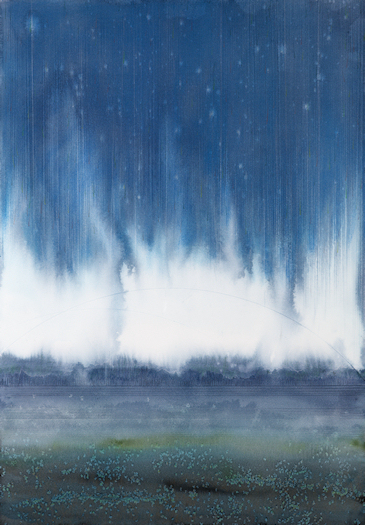
Image Credit: Judith Brandon: “Awakening Earth” https://jmbrandon.com/portfolio-home/...
.
Personal note: I met the artist Judith Brandon, and saw some of her breathtaking work at the National Weather Center Biennale.
like some sweet narcotic. . . .
Then comes the mockery of her breathing—so soon,
so deep, I think pretend.
I’m left alone—me and consciousness again.
Clock sounds ferment in the dark. . . .
. . . .I wish the dark gone. I wish to surprise
dawn stealing inside this room, quiet and lovely,
like sand threading the night’s hourglass,
like her hand when it cupped
the curve of my shoulder and squeezed
warmth into my fear.
-- excerpts from Somniphobia
.
This is a collection to relish and linger with, as the poet catches and holds not so much indifference as difference in the intersecting worlds of natural and human; memory and making; the misery of sleeplessness and the inner and outer worlds of night, and the grace and devotion of a life lived in married love.
Halves
Shelling the green tongues of pistachios
in September—the steady tick, the fine
nut papyrus riding my lips
before I blow it off — reminds me
of the lake, July, hands scooping, fingers
cracking them open, eating
over wooden salad bowls, kissing,
mouths tender with salt, what
you whispered, the kitchen floor—gray
paint on the wide boards—how our soles
held the gloss briefly, sticking.
But the press of shucked bodies
tells a different story, skin smooth,
sheets wrinkled, intersecting lifelines
loath to diverge, to give each other up
to the cool touch of night.
.
I don’t know Ken Craft but he is now my Goodreads friend and I thank him the new discoveries and rediscoveries I make every time I open this book, which I’ve been reading and re-reading in spring, summer, now fall — perfect since many poems are set in the woods of the northeastern United States.
And because, like Ken Craft, I’m a lifelong insomniac, and because down here in Texas fall has just barely begun with the first week of cool nighttime (and daytime) rain, I leave you with this soft rhythm-song.
Waking to Rain
Waking to rain
is a lovely sadness
for ears to sip
under sheets of darkness.
Fat pats keep a muffled beat
in shingle-crazed beads; watery
timpani drone meditations
through guttural tunnels.
Downstairs, the dog whimpers.
Push back the spell, pull feet
from their cottony folds
and rills, and thud down the flights.
After, he’ll drag his wet
wolf smell through the house,
musk tethered tight. After,
his fur-spiked shake
will measle the wall
by the door, blessing it
like holy water cast by bishops
from the archdiocese of rain.
*********************************
For more truly spectacular poems, please read Julie of Canada's review here: https://www.goodreads.com/review/show...
(Some of these I had planned to include but she beat me to them, so I focused my review on a different dimension.)
**********************************
Image Credit: Judith Brandon: “Awakening Earth” https://jmbrandon.com/portfolio-home/...
.
Personal note: I met the artist Judith Brandon, and saw some of her breathtaking work at the National Weather Center Biennale.

Want to Read
November 20, 2016Insomnia
Three is the loneliest number on a clock
when the night can't save you.
No doubt it is the constellated tug,
a conspiracy of stars, the silent, primal
voice that whispers the uselessness,
that grinds greater gears,
that mocks the hubris of careful plans,
set alarms. Every blanketed life around you
sleeps safe and happy and secure
like nothing can touch them, like change
has made its exception, named it you,
and passed finally over the frosted roof.
Three is the loneliest number on a clock
when the night can't save you.
No doubt it is the constellated tug,
a conspiracy of stars, the silent, primal
voice that whispers the uselessness,
that grinds greater gears,
that mocks the hubris of careful plans,
set alarms. Every blanketed life around you
sleeps safe and happy and secure
like nothing can touch them, like change
has made its exception, named it you,
and passed finally over the frosted roof.

October 16, 2016
Ken Craft is a consummate wordmeister, a singer of sweet sentences, a connoisseur of consonance, a dab hand for metaphor. But don’t be misled, all this verbal high wire work does not deflect attention from the contemplative musing of these poems, it heightens the experience.
Craft takes us on a leisurely stroll through his neighborhood and the way his mind works, through the paths of insomnia and the ways of dogs, observations on crows, beetles, a fantasy of a flying barn.
New England is a common thread, running through most of these poems. Oh, summer, oh summer.
In late June
the days yawn
and sleep
like dusty hounds.
The “blue light” of depression, the whiff of nostalgia, alone before dawn in the kitchen he stares at black glass
beady with reflection,
runny with reflection
and the slip of sadness.
The ritual Easter morning photograph from the past makes us wonder what is not being told.
Our shoes pin long shadows to dead
grass.
The carrion beetle released from the prison of a paper cup.
…he withdrew
like an unhurried undertaker
...easing us into eternity.
The humble things of life are Ken Craft’s territory; join him on one of his walks. You won’t regret it.
Craft takes us on a leisurely stroll through his neighborhood and the way his mind works, through the paths of insomnia and the ways of dogs, observations on crows, beetles, a fantasy of a flying barn.
New England is a common thread, running through most of these poems. Oh, summer, oh summer.
In late June
the days yawn
and sleep
like dusty hounds.
The “blue light” of depression, the whiff of nostalgia, alone before dawn in the kitchen he stares at black glass
beady with reflection,
runny with reflection
and the slip of sadness.
The ritual Easter morning photograph from the past makes us wonder what is not being told.
Our shoes pin long shadows to dead
grass.
The carrion beetle released from the prison of a paper cup.
…he withdrew
like an unhurried undertaker
...easing us into eternity.
The humble things of life are Ken Craft’s territory; join him on one of his walks. You won’t regret it.

April 11, 2016
Look, yes, as a general rule I think poetry is a silly invention.
Things we would have been fine without
- Poetry
- Painting
- Sports
That said, I find myself reading it all the time. I don't have to be consistent, man, you don't even know me. Here's the debut collection by a guy I've known and looked up to here on Goodreads for years and years, since back when he was known as NewEngland, and so I thought he was a place instead of a person, so when it turned out he had written a bunch of poetry I was somewhat surprised. I didn't know places wrote poetry. I thought they would have more serious artistic pursuits. Like sculpture. Sculptures are great, I like how they're not paintings. Ken's poetry is very grounded, you can feel the place it's in. You will call it pastoral, because barns are involved. I feel like that's a little bit misleading because it makes everyone think about Robert Frost, and I felt more of a Beat kind of thing going on here. Maybe that's not what NE was going for. I'm not really a poetry expert. It's just that it keeps being around.
It was around my kid, too; this was his first book of poetry, because it arrived and then it was sitting there and then I read it to him and then that all kept happening for several months. I hope this makes him a more thoughtful person, but not such a thoughtful person that he goes and becomes a poet, because that can't end well.
Things we would have been fine without
- Poetry
- Painting
- Sports
That said, I find myself reading it all the time. I don't have to be consistent, man, you don't even know me. Here's the debut collection by a guy I've known and looked up to here on Goodreads for years and years, since back when he was known as NewEngland, and so I thought he was a place instead of a person, so when it turned out he had written a bunch of poetry I was somewhat surprised. I didn't know places wrote poetry. I thought they would have more serious artistic pursuits. Like sculpture. Sculptures are great, I like how they're not paintings. Ken's poetry is very grounded, you can feel the place it's in. You will call it pastoral, because barns are involved. I feel like that's a little bit misleading because it makes everyone think about Robert Frost, and I felt more of a Beat kind of thing going on here. Maybe that's not what NE was going for. I'm not really a poetry expert. It's just that it keeps being around.
It was around my kid, too; this was his first book of poetry, because it arrived and then it was sitting there and then I read it to him and then that all kept happening for several months. I hope this makes him a more thoughtful person, but not such a thoughtful person that he goes and becomes a poet, because that can't end well.

May 11, 2022
Not So Indifferent Poetry
follow the exhaling water
rings when a smallmouth
kisses the surface simply
because it exists, waiting
to be marred with life
The thing about poetry is that you can bite into it in small chunks of time. You think the commitment is small. But it leaves big sensations that occupy far more time than you thought it would when you began. Good poems should ripple, starting with one, then two and so on. See, reading poetry makes me think in metaphors. There’s a long lasting effect. But if I go on I’ll mix my metaphors and start thinking of words echoing through time.
My friend who is much older than me, reads poetry, rarely prose. He prefers the brief precision of a poem to the often swollen prose he encounters. He reads no modern prose at all. I think he’s right. I think as time passes I will follow his path and think poetry.
The thing about time is that it is indifferent to us. It makes us think about it, and then well, we figure it out it’s our own construction. Here is what I think the title is about. Nature is indifferent to us too. It cares nothing about our pre-occupation with time. It goes on. Time features often in Ken Craft’s poetry.
Though being human constructs, poems have to reckon with time. Because in months like November, which features here, things happen with us or without us, whether we notice them or not. We can routinely understand nature through what we know and when we experience it. Its best to tune in and know. Even if nature can’t reciprocate. In November Meditations we have this question:
Is fog
the bottom of a Raven’s
cry?
And then
November’s flint
strikes boot soles.
Frost fire on the field.
On the next page we have this:
That old man stacks his wood into a cord,
builds a square meal for his winter stove,
and doesn’t glance up once into the leaden
bottoms of November’s indifferent clouds.
We can’t escape the way we measure everything even when we give ourselves over to meditating on nature. It’s the curse of civilising ourselves. And nature, no matter how much we plead with her, won’t help us when we fail.
*
Nature crackles all around you in a Ken Craft poem. It’s as though we, us, the poet, cannot be indifferent to it. It is the fabric that makes us, regardless of whether we notice. But as I said earlier, it’s better to notice.
*
I was looking to start reading poetry again and bought this book and the collection of Gluck’s first four books. I look forward to full immersion into lots of well-constructed words from now on. If anyone can recommend some high quality thoughtful poets, be happy to hear from them.
*
Curious aside, I mentioned November. Here in the Southern Hemisphere it’s opposite month, May, gets dark quickly. Today the clouds were low and dimmed the day I walked through. I got home from a long walk to find this book in the doorstep.
follow the exhaling water
rings when a smallmouth
kisses the surface simply
because it exists, waiting
to be marred with life
The thing about poetry is that you can bite into it in small chunks of time. You think the commitment is small. But it leaves big sensations that occupy far more time than you thought it would when you began. Good poems should ripple, starting with one, then two and so on. See, reading poetry makes me think in metaphors. There’s a long lasting effect. But if I go on I’ll mix my metaphors and start thinking of words echoing through time.
My friend who is much older than me, reads poetry, rarely prose. He prefers the brief precision of a poem to the often swollen prose he encounters. He reads no modern prose at all. I think he’s right. I think as time passes I will follow his path and think poetry.
The thing about time is that it is indifferent to us. It makes us think about it, and then well, we figure it out it’s our own construction. Here is what I think the title is about. Nature is indifferent to us too. It cares nothing about our pre-occupation with time. It goes on. Time features often in Ken Craft’s poetry.
Though being human constructs, poems have to reckon with time. Because in months like November, which features here, things happen with us or without us, whether we notice them or not. We can routinely understand nature through what we know and when we experience it. Its best to tune in and know. Even if nature can’t reciprocate. In November Meditations we have this question:
Is fog
the bottom of a Raven’s
cry?
And then
November’s flint
strikes boot soles.
Frost fire on the field.
On the next page we have this:
That old man stacks his wood into a cord,
builds a square meal for his winter stove,
and doesn’t glance up once into the leaden
bottoms of November’s indifferent clouds.
We can’t escape the way we measure everything even when we give ourselves over to meditating on nature. It’s the curse of civilising ourselves. And nature, no matter how much we plead with her, won’t help us when we fail.
*
Nature crackles all around you in a Ken Craft poem. It’s as though we, us, the poet, cannot be indifferent to it. It is the fabric that makes us, regardless of whether we notice. But as I said earlier, it’s better to notice.
*
I was looking to start reading poetry again and bought this book and the collection of Gluck’s first four books. I look forward to full immersion into lots of well-constructed words from now on. If anyone can recommend some high quality thoughtful poets, be happy to hear from them.
*
Curious aside, I mentioned November. Here in the Southern Hemisphere it’s opposite month, May, gets dark quickly. Today the clouds were low and dimmed the day I walked through. I got home from a long walk to find this book in the doorstep.
July 8, 2023
Ethereal, nostalgic, beautiful, witty, thought-provoking…
Those were the adjectives popped up in my bead when I read Ken’s poems late in the evenings for the past few months.
Yes, late in the evening, when I was troubled by insomnia and other ailments, that was when I read Ken’s poems, they made things better.
( I should’ve tried reading them at 4:00 AM though :
“While others sleep, you can listen
for a poem’s metered pulse. You
can breathe,
smell its incense, but only
in the nave of morning.”)
I took me a very long time to read this collection, because this was my first genuine attempt to read a poetry collection in English, and it involved a lot of consulting the dictionary and reading the poems out loud, several times in a lot of cases.
But I am so glad that I put in the effort, because the reward is enormous.
When you feel a poem and its beauty, it’s a truly magical experience.
There are so many poems that I love in this collection, but the one that I have been thinking about and kept returning to is Hunting the Unwritten Poem.
We have all probably experienced that moment of being profoundly touched by something fleetingly beautiful : a ray a light gleaming through tree leaves or a smile from someone you deeply love , and the burning desire to capture the moment and eternize it while also realizing our inability to do so.
I am not a poet or a writer, but I do have the longing to capture the ephemeral, and sometimes , to crystallize the vague shapeless ideas and emotions that keep eluding me.
So this poem really resonates with me.
Hunting the Unwritten Poem
You see them in the mercury
light of water, the expanding
orbs of silver where trout
breathe. You hear
them in the sleepy kiss
of rainfall on pine
needles, smell them
as if they were snow
to the west.
Like a dead bird’s eye,
they lose luster
the moment you kill them
to glean their mysteries. They
close mute membranes,
hide. From across the field,
a crow’s dark instincts
distinguish men with sticks
from men with .22s.
Poems are world-wary, too.
Hear the whistle of wing lift
as they take flight.
The Muse keeps time
with Dali’s clocks of melt.
Look again—an
unwritten poem shifting
in the wind, an open wound
of torn air.
This is a wonderful collection of poems, please, everyone who loves poetry, go read The Indifferent World.
(I am so sorry Ken,if you happen to see this review , for lacking the skills to write the review your poems truly deserve.
And thank you 😊 )
Those were the adjectives popped up in my bead when I read Ken’s poems late in the evenings for the past few months.
Yes, late in the evening, when I was troubled by insomnia and other ailments, that was when I read Ken’s poems, they made things better.
( I should’ve tried reading them at 4:00 AM though :
“While others sleep, you can listen
for a poem’s metered pulse. You
can breathe,
smell its incense, but only
in the nave of morning.”)
I took me a very long time to read this collection, because this was my first genuine attempt to read a poetry collection in English, and it involved a lot of consulting the dictionary and reading the poems out loud, several times in a lot of cases.
But I am so glad that I put in the effort, because the reward is enormous.
When you feel a poem and its beauty, it’s a truly magical experience.
There are so many poems that I love in this collection, but the one that I have been thinking about and kept returning to is Hunting the Unwritten Poem.
We have all probably experienced that moment of being profoundly touched by something fleetingly beautiful : a ray a light gleaming through tree leaves or a smile from someone you deeply love , and the burning desire to capture the moment and eternize it while also realizing our inability to do so.
I am not a poet or a writer, but I do have the longing to capture the ephemeral, and sometimes , to crystallize the vague shapeless ideas and emotions that keep eluding me.
So this poem really resonates with me.
Hunting the Unwritten Poem
You see them in the mercury
light of water, the expanding
orbs of silver where trout
breathe. You hear
them in the sleepy kiss
of rainfall on pine
needles, smell them
as if they were snow
to the west.
Like a dead bird’s eye,
they lose luster
the moment you kill them
to glean their mysteries. They
close mute membranes,
hide. From across the field,
a crow’s dark instincts
distinguish men with sticks
from men with .22s.
Poems are world-wary, too.
Hear the whistle of wing lift
as they take flight.
The Muse keeps time
with Dali’s clocks of melt.
Look again—an
unwritten poem shifting
in the wind, an open wound
of torn air.
This is a wonderful collection of poems, please, everyone who loves poetry, go read The Indifferent World.
(I am so sorry Ken,if you happen to see this review , for lacking the skills to write the review your poems truly deserve.
And thank you 😊 )
June 26, 2023
It is a singular experience to read the published poetry of someone you know. In this case, I feel like I've come to know a little bit of Ken Craft by reading his exceptional book reviews and witty blog posts. After reading his poetry, I feel like I have been allowed access to an even more intimate space. Despite whatever inclination the world may or may not have, there was nothing indifferent about these poems.
I was enticed by Ken's acute attention to minutest detail in his descriptions and reminisces. He feels like a reader's writer with his love of literature shining through in many verses. Ken has an uncommon gaze and gifts the reader with greater language with which to describe the world: dark crows are "night-glossed friends," dying gnats have glory in a moment, bats fly in "insect-dizzy circles," and ravens sear parabolas against a mountain skyline. He manifests a naturalist's power in naming things--flora, fauna, insect, tree, root, flower, star, and constellation. Ken's poems exemplify Pasternak's dictum that art "is composed of organs of perception. It's proper task is to be always among the spectators and to look more purely, receptively, and faithfully than all others."
"June Days After School" is so full of expressive imagery and so perfect for right now that I have to quote it entirely:
In late June
the days yawn
and sleep
like dusty hounds.
Mornings, limber
and lazy as
Huck Finn rafting
under shifting pipe
smoke, induce
their pleasant dirge
of distance: the lawn mower,
the chainsaw and cicada song.
Slowly
the current of time carries the days.
They spin downstream
in dreamy swirls and eddies,
leagues away toward the closing shores,
toward the rising roots of July.
At night, remains
of afternoon haze
drift skyward. They etch
a shadow river, plow
the heavenly fabric with
a milky blade, ever flowing
south where an estuary of stars
snags on sandbars of
possibility.
I was enticed by Ken's acute attention to minutest detail in his descriptions and reminisces. He feels like a reader's writer with his love of literature shining through in many verses. Ken has an uncommon gaze and gifts the reader with greater language with which to describe the world: dark crows are "night-glossed friends," dying gnats have glory in a moment, bats fly in "insect-dizzy circles," and ravens sear parabolas against a mountain skyline. He manifests a naturalist's power in naming things--flora, fauna, insect, tree, root, flower, star, and constellation. Ken's poems exemplify Pasternak's dictum that art "is composed of organs of perception. It's proper task is to be always among the spectators and to look more purely, receptively, and faithfully than all others."
"June Days After School" is so full of expressive imagery and so perfect for right now that I have to quote it entirely:
In late June
the days yawn
and sleep
like dusty hounds.
Mornings, limber
and lazy as
Huck Finn rafting
under shifting pipe
smoke, induce
their pleasant dirge
of distance: the lawn mower,
the chainsaw and cicada song.
Slowly
the current of time carries the days.
They spin downstream
in dreamy swirls and eddies,
leagues away toward the closing shores,
toward the rising roots of July.
At night, remains
of afternoon haze
drift skyward. They etch
a shadow river, plow
the heavenly fabric with
a milky blade, ever flowing
south where an estuary of stars
snags on sandbars of
possibility.

April 7, 2016
Ken Craft is anything but indifferent to the world around him. He observes and absorbs, then shares with his readers. Serious lines and subjects are lightened by a wry sense of humor. A theme of darkness, sadness, runs through many of these poems. In a nod to Winston Churchill, who referred to depression as his “black dog,” Craft refers to the gloomy period many people experience after the winter holidays.
Maybe it’s the “is that all there is?” of the holidays
where boxing ornaments, burning dried holly, and recycling
wrapping paper feels like picking up
after the dogs. The black dogs. Who heel all too well.
(Black Dogs Redux)
There are poems about aging and death, which “waits/outside the house.” Several poems bemoan insomnia.
In the dark,
from over the water, a rooster
celebrates my insomnia.
(3:30)
Farming, nature, animals, constellations, and literary references are prominent. Two of my favorites are rich, detailed persona poems. A bus driver reads Irish literature for night school, “convinced/there is some stop she missed.” (Mrs. Galway Goes to Night School) Then we travel to Russia, where Tolstoy is
stealing into night,
steam from the engine of his lungs
twisting gaunt and ghostly
through the air, rising, dwindling, clinging
to sky: the breaths of a lifetime.
(Astapova Station)
Craft’s book is one to read slowly, a few poems at a time. With each reading I discover something else that impresses me, perhaps a line, or the perfect word, or an image that shimmers in my mind’s eye. Craft never goes for the easy turn, the easy end line, even in his poems where humor is injected. This is a book to read when all is quiet, when there is time to think and digest and re-read. The poems simmer slowly, like a warm winter stew.
You hear
them in the sleepy kiss
of rainfall on pine
needles, smell them
as if they were snow
to the west.
(Hunting the Unwritten Poem)
I am so glad Ken Craft’s poems are not unwritten!
Maybe it’s the “is that all there is?” of the holidays
where boxing ornaments, burning dried holly, and recycling
wrapping paper feels like picking up
after the dogs. The black dogs. Who heel all too well.
(Black Dogs Redux)
There are poems about aging and death, which “waits/outside the house.” Several poems bemoan insomnia.
In the dark,
from over the water, a rooster
celebrates my insomnia.
(3:30)
Farming, nature, animals, constellations, and literary references are prominent. Two of my favorites are rich, detailed persona poems. A bus driver reads Irish literature for night school, “convinced/there is some stop she missed.” (Mrs. Galway Goes to Night School) Then we travel to Russia, where Tolstoy is
stealing into night,
steam from the engine of his lungs
twisting gaunt and ghostly
through the air, rising, dwindling, clinging
to sky: the breaths of a lifetime.
(Astapova Station)
Craft’s book is one to read slowly, a few poems at a time. With each reading I discover something else that impresses me, perhaps a line, or the perfect word, or an image that shimmers in my mind’s eye. Craft never goes for the easy turn, the easy end line, even in his poems where humor is injected. This is a book to read when all is quiet, when there is time to think and digest and re-read. The poems simmer slowly, like a warm winter stew.
You hear
them in the sleepy kiss
of rainfall on pine
needles, smell them
as if they were snow
to the west.
(Hunting the Unwritten Poem)
I am so glad Ken Craft’s poems are not unwritten!

April 28, 2016
The world may be indifferent, but Ken Craft is not. He sees the beauty, wonder, sorrow, ugliness, tenderness, and humor no matter what scene or memory stirs him, sometimes all within a single poem. Take insomnia. He’s obviously not happy about being awake at 3:00 a.m., which does not fit a teacher’s schedule. We can understand why he’d complain a bit, but he also takes the dog out into the woods and notes, “But now, in stillness as holy as this,/even the dog stops and listens.” In “Reading Poetry at 4:00 A.M.,” he says,
“Poetry is best read
in the thin hours,
when words and light
explore as if for the first time…”
I was sick this week, so I especially appreciated having the universe delivered to my arm chair. “The F-Bomb Held Hostage” and “Kitchen Sirens” held memories of my own childhood, but Craft introduced me to physics lessons I didn’t know, took this city girl into the barn for veterinary visits, remembered favorite authors like Turgenev and Tolstoy, and almost made me want to get a dog. He is a versatile, insightful poet and a master of metaphor.
My favorite poem in this collection also turns out to be Craft’s favorite, as I discovered from his blog. “Brainstorming the Universe” is his most fanciful poem, in which he reports a ramshackle barn dropped out of the sky from a trip to far galaxies:
“The big barn must have landed
overnight, the jolt of its descent
crippling one side so the whole
structure leans south. The white
paint, curly from reentry, looks
foolish as a washed cat.”
“Poetry is best read
in the thin hours,
when words and light
explore as if for the first time…”
I was sick this week, so I especially appreciated having the universe delivered to my arm chair. “The F-Bomb Held Hostage” and “Kitchen Sirens” held memories of my own childhood, but Craft introduced me to physics lessons I didn’t know, took this city girl into the barn for veterinary visits, remembered favorite authors like Turgenev and Tolstoy, and almost made me want to get a dog. He is a versatile, insightful poet and a master of metaphor.
My favorite poem in this collection also turns out to be Craft’s favorite, as I discovered from his blog. “Brainstorming the Universe” is his most fanciful poem, in which he reports a ramshackle barn dropped out of the sky from a trip to far galaxies:
“The big barn must have landed
overnight, the jolt of its descent
crippling one side so the whole
structure leans south. The white
paint, curly from reentry, looks
foolish as a washed cat.”

February 15, 2017
I had the honor of setting up Mr. Craft's first reading at a public venue in Concord NH. This is a wonderful book of poetry. I will always treasure it.
Here is one of his most famous poems from The Writer's Almanac:
http://writersalmanac.org/episodes/20...
Here is one of his most famous poems from The Writer's Almanac:
http://writersalmanac.org/episodes/20...

July 27, 2017
Humpf. [Review placeholder]. The book will get five stars.
The font gets one star. I thought it a travesty to read poetry on a Kindle, so I bought the book. However, due to my wonky eyesight, I needed a lighted magnifying glass to read the poems. There wasn't much ambiance to that, either. Consequently, I also purchased the book in the Kindle edition. But, to Amazon's credit, they only charged me 99 cents, as I'd already bought the hard copy.
Is it me or are the fonts in most books getting even smaller?
Review to follow when I'm less exhausted. Had a major health scare re my husband, he invited a snarky friend from out of town to stay with us this weekend (...this is an agoraphobic's nightmare), and if I have to speak to the DMV or Honda one more time, I'm shooting myself.
The font gets one star. I thought it a travesty to read poetry on a Kindle, so I bought the book. However, due to my wonky eyesight, I needed a lighted magnifying glass to read the poems. There wasn't much ambiance to that, either. Consequently, I also purchased the book in the Kindle edition. But, to Amazon's credit, they only charged me 99 cents, as I'd already bought the hard copy.
Is it me or are the fonts in most books getting even smaller?
Review to follow when I'm less exhausted. Had a major health scare re my husband, he invited a snarky friend from out of town to stay with us this weekend (...this is an agoraphobic's nightmare), and if I have to speak to the DMV or Honda one more time, I'm shooting myself.

Read
April 8, 2016In preparation for my upcoming move to the northernmost reaches of New England, I thought it'd be both fun and edifying to sample some debut poetry titles emanating from that storied region. (There is no shortage of these, even more so when one includes forthcoming titles such as Connecticut-born Austin Allen's much-anticipated The Pleasures of the Game, forthcoming from The Waywiser Press this October.) First, I gulped down
Field Guide A Tempo
, the luminous 2014 debut poetry book from New Hampshire falconer-bard Henry Walters. Then I devoured
Night Sky With Exit Wounds
by Saigon-born-but-Connecticut-raised Ocean Vuong, a volume whose recent release was a watershed literary event. To the list of recent first verse collections by New-England-linked writers worth a look, now add The Indifferent World by upstate Massachusetts schoolteacher Ken Craft.
Craft writes in a diffusely expansive, long-legged, loping free-verse style whose hallmarks include a soft spot for alliteration and a dry, sometimes-bordering-on-silly sense of humor. Consider, for example, "Black Dogs Redux," a poetic meditation on the deflation of spirits that people commonly experience in late winter, after the holiday season has come and gone. The poem begins on a serious-enough note -- "The blue sad light is on again" is the first line -- but, despite the depression that the poet professes to feel, the poem soon loosens its belt to make room for Craft's never-totally-absent sense of fun, his nudge-nudge-wink-wink relish for puns and other wordplay:
"It's easier to eat ice cream that never judges.
Scoop of here in a cone of now.
Didn't Ben Franklin say we should be well-rounded, after all?
He said a lot. And never once owned a dog.
Ben just donned beaver caps
and attracted lovely French ladies, who earlied-to-bed
when he was early to rise...."
The Indifferent World begins with a suite of sweetly lyrical nature poems, many of them set in the pre-dawn hours, when the insomniac poet often finds himself to be the only person awake for miles around. In several of these poems, Craft alludes to the companionship of a trusty dog, that, in its own way, shares Craft's affinity for the lonely hours before dawn. This pet is not the only fauna Craft describes with dignifying respect and tender affection: like a modern-day, less terse and less formalistically inclined reincarnation of Issa (not too outlandish a forebear to claim for this poet who often turns and returns to Buddhist themes), Craft frequently celebrates the humbler citizens of the animal kingdom, including crows, cats, deer, spiders, moths, beetles, even earthworms.
There are some delectable turns of phrase here: fingerprints, for example, are described as "the Zen garden groove of fingertips." Occasionally, Craft's lyricism is ballasted by a melancholy profundity that lifts it into transcendence, as when, in a narrative poem about a middle-aged female school-bus driver who regrets never having acquired a higher education, he intones, "Up ahead, time / runs a stop sign." The best poems in this collection are those that, like this one, offer something that runs deeper than just a lovely surface: say, poems like "Momentary" and "Return of the Native" that slow-dance with the supernatural, the ghostly singularities that pock the space-time continuum, or poems like the collection's penultimate, "Star Sailor," which creates an original myth to gently and subtly impart wisdom about what it means to be an artist:
"There is dignity, even in losing a comet,
pride, even in watching it flop
against the firmament's hull and leap
into the bearded current of Capricorn.
"And what of meteors that get away?
You cannot harvest what will not be rescued."
Craft writes in a diffusely expansive, long-legged, loping free-verse style whose hallmarks include a soft spot for alliteration and a dry, sometimes-bordering-on-silly sense of humor. Consider, for example, "Black Dogs Redux," a poetic meditation on the deflation of spirits that people commonly experience in late winter, after the holiday season has come and gone. The poem begins on a serious-enough note -- "The blue sad light is on again" is the first line -- but, despite the depression that the poet professes to feel, the poem soon loosens its belt to make room for Craft's never-totally-absent sense of fun, his nudge-nudge-wink-wink relish for puns and other wordplay:
"It's easier to eat ice cream that never judges.
Scoop of here in a cone of now.
Didn't Ben Franklin say we should be well-rounded, after all?
He said a lot. And never once owned a dog.
Ben just donned beaver caps
and attracted lovely French ladies, who earlied-to-bed
when he was early to rise...."
The Indifferent World begins with a suite of sweetly lyrical nature poems, many of them set in the pre-dawn hours, when the insomniac poet often finds himself to be the only person awake for miles around. In several of these poems, Craft alludes to the companionship of a trusty dog, that, in its own way, shares Craft's affinity for the lonely hours before dawn. This pet is not the only fauna Craft describes with dignifying respect and tender affection: like a modern-day, less terse and less formalistically inclined reincarnation of Issa (not too outlandish a forebear to claim for this poet who often turns and returns to Buddhist themes), Craft frequently celebrates the humbler citizens of the animal kingdom, including crows, cats, deer, spiders, moths, beetles, even earthworms.
There are some delectable turns of phrase here: fingerprints, for example, are described as "the Zen garden groove of fingertips." Occasionally, Craft's lyricism is ballasted by a melancholy profundity that lifts it into transcendence, as when, in a narrative poem about a middle-aged female school-bus driver who regrets never having acquired a higher education, he intones, "Up ahead, time / runs a stop sign." The best poems in this collection are those that, like this one, offer something that runs deeper than just a lovely surface: say, poems like "Momentary" and "Return of the Native" that slow-dance with the supernatural, the ghostly singularities that pock the space-time continuum, or poems like the collection's penultimate, "Star Sailor," which creates an original myth to gently and subtly impart wisdom about what it means to be an artist:
"There is dignity, even in losing a comet,
pride, even in watching it flop
against the firmament's hull and leap
into the bearded current of Capricorn.
"And what of meteors that get away?
You cannot harvest what will not be rescued."

July 19, 2016
DARK AND DEPRESSING.
“Just another manure morning in Vermont…”
—Young Brain in a Dairy Barn (Kindle Locations 607-608).
Poetry has never been one of my ‘go-to’ reading choices, in large measure because I am admittedly a poetry moron. Mix in the poisoning ennui of despair and I’m ready to look for the nearest bridge to jump off.
I’d turned to Ken Craft’s collection of poetry, The Indifferent World, to try something different and to find respite from the darkness of the of the WWII domestic concentration camps of my previous read. Boy, was I looking for respite in all the wrong places. After reading Ken’s poems I might be ready to seek out Chekhov or Camus for comic relief.
Recommendation: Though we take a different view of the indifferent world; Ken Craft is a whiz at the wickedly awesome turn of phase, and should be read widely. Just avoid reading in the vicinity of bridges.
“Four-letter words, healthy as mongrels,
climb etymological trees like monkeys”
—The F-Bomb Held Hostage (Kindle Locations 358-361)
“For I have yet to forge a separate peace
with the f-bomb, fearing it like
Alzheimer’s, convinced if I let fly
like the movies or soldiers on leave,
all that I have learned will begin to leak
from my brain like flatulent helium
from some politely sagging balloon.”
—The F-Bomb Held Hostage (Kindle Locations 351-352).
FutureCycle Press. Kindle Edition. 1,036 Kindle Locations.
“Just another manure morning in Vermont…”
—Young Brain in a Dairy Barn (Kindle Locations 607-608).
Poetry has never been one of my ‘go-to’ reading choices, in large measure because I am admittedly a poetry moron. Mix in the poisoning ennui of despair and I’m ready to look for the nearest bridge to jump off.
I’d turned to Ken Craft’s collection of poetry, The Indifferent World, to try something different and to find respite from the darkness of the of the WWII domestic concentration camps of my previous read. Boy, was I looking for respite in all the wrong places. After reading Ken’s poems I might be ready to seek out Chekhov or Camus for comic relief.
Recommendation: Though we take a different view of the indifferent world; Ken Craft is a whiz at the wickedly awesome turn of phase, and should be read widely. Just avoid reading in the vicinity of bridges.
“Four-letter words, healthy as mongrels,
climb etymological trees like monkeys”
—The F-Bomb Held Hostage (Kindle Locations 358-361)
“For I have yet to forge a separate peace
with the f-bomb, fearing it like
Alzheimer’s, convinced if I let fly
like the movies or soldiers on leave,
all that I have learned will begin to leak
from my brain like flatulent helium
from some politely sagging balloon.”
—The F-Bomb Held Hostage (Kindle Locations 351-352).
FutureCycle Press. Kindle Edition. 1,036 Kindle Locations.

October 28, 2016
Ken Craft is a crafty wordsmith!
THE INDIFFERENT WORLD holds so many varied gifted gems.
One may have to be an invertebrate logophile to really “get” the skill of this seemingly modest and prolific poetic voice!
I especially loved “DOG RELIGION”….simple, lovely and artfully painted with poetic affinity.
Mr. Craft tackles darkness with a lighter touch than poets akin to (for example) Edgar Allan Poe.
I hope Mr. Craft continues to surprise us with his inborn talents!
THE INDIFFERENT WORLD holds so many varied gifted gems.
One may have to be an invertebrate logophile to really “get” the skill of this seemingly modest and prolific poetic voice!
I especially loved “DOG RELIGION”….simple, lovely and artfully painted with poetic affinity.
Mr. Craft tackles darkness with a lighter touch than poets akin to (for example) Edgar Allan Poe.
I hope Mr. Craft continues to surprise us with his inborn talents!

July 16, 2021
Ken Craft's poetry helped get me through the pandemic. The lyrical quality, moments of recognition and glimpses of what I've never seen took me away from myself in the very best way.

March 19, 2020
Ken Craft opens his book of poems The Indifferent World with a quotation from Henry David Thoreau: “The mass of men lead lives of quiet desperation.”
Yes, Craft observes the harsh reality of nature, for example when in “A Moth’s Digression” the speaker discovers a lunate zale moth in his study and sets it free only to watch as it is devoured by a barn swallow, “leaving a brief hole in the air.”
And many of his poems lament the passing of time (“ Slowly/ the current of time carries the days.”) and record haunting memories of youth, as in “June Days After School” when the “days yawn like dusty hounds.”
But we also find allies in nature. The “still lake speak(s) in slurps.” And “what great drinking buddies my night-glossed friends (crows) would be.”
Throughout The Indifferent World, Ken Craft reminds us of the “bog, mud/ and indifference.” And yet somehow he celebrates the very rawness of life and youth. “As a boy I sat atop that world/ down a long hall I no longer walk.” His poem “Explorer” captures exactly what I felt as a child when hanging upside down from the top bunk bed, wanting “to go/ the manly way of all explorers/ remembered as unsolved/ mysteries, burial site unknown.”
It seems legitimate that the third section of poems is titled “Mysteries.” And of course the last section is “The Indifferent World.” But we discover that, after all, perhaps there is a deep connection between us and the earth. In “Dirt Shy,” one of my favorite poems, “The earth remembers us, though....” and Craft tells how as a boy playing hide and go seek, he “Crouched at the house corner under the mountain/ laurel..../so busy with the wonderful/ invincibility of it all.”
I was lucky to receive this book of poetry as a gift. It’s a book I shall treasure. I recommend it to anyone who has lived long enough to look at youthful days as a gift from a not-so-indifferent world.
Yes, Craft observes the harsh reality of nature, for example when in “A Moth’s Digression” the speaker discovers a lunate zale moth in his study and sets it free only to watch as it is devoured by a barn swallow, “leaving a brief hole in the air.”
And many of his poems lament the passing of time (“ Slowly/ the current of time carries the days.”) and record haunting memories of youth, as in “June Days After School” when the “days yawn like dusty hounds.”
But we also find allies in nature. The “still lake speak(s) in slurps.” And “what great drinking buddies my night-glossed friends (crows) would be.”
Throughout The Indifferent World, Ken Craft reminds us of the “bog, mud/ and indifference.” And yet somehow he celebrates the very rawness of life and youth. “As a boy I sat atop that world/ down a long hall I no longer walk.” His poem “Explorer” captures exactly what I felt as a child when hanging upside down from the top bunk bed, wanting “to go/ the manly way of all explorers/ remembered as unsolved/ mysteries, burial site unknown.”
It seems legitimate that the third section of poems is titled “Mysteries.” And of course the last section is “The Indifferent World.” But we discover that, after all, perhaps there is a deep connection between us and the earth. In “Dirt Shy,” one of my favorite poems, “The earth remembers us, though....” and Craft tells how as a boy playing hide and go seek, he “Crouched at the house corner under the mountain/ laurel..../so busy with the wonderful/ invincibility of it all.”
I was lucky to receive this book of poetry as a gift. It’s a book I shall treasure. I recommend it to anyone who has lived long enough to look at youthful days as a gift from a not-so-indifferent world.

April 6, 2016
This is an excellent collection of poems that in my book is every bit of good as Tomas Transtromer's latest. "Hunting the Unwritten Poem" was the perfect way to kick off poetry club. Other favorites include the very funny "Young Brain in a Dairy Barn", " Unemployed Cousin", "Dirt Shy", and any of the many poems involving bugs, because that is cool. Seriously, I could read a whole book of bug poetry. I will be revisiting this later to hunt for possible other layers of meaning missed from the first go-around.

August 14, 2021
Ken Craft surprised me with this terrific collection of his poetry. In fact, he surprised me often, Craft constructs many poems that seem to be simple narratives about simple and ordinary occurrences. However, since good poetry operates at a surface or literal level first and then dives a little deeper into broader and frequently more profound meanings, Craft's poems become much richer, much more meaningful and much more impactful in each re-reading. They abound in symbolism. The simple stories represent deeper stories, universal feelings and concepts accessible only upon re-readings of every poem. The simple often becomes profound. The emotional punch often only occurs during these second and more thoughtful re-readings of these seemingly simple poems.
To be fully appreciated and understood, all poetry must be read more than once. It is this requirement that causes so many to say, "I don't 'get' poetry," or "I don't like poetry." Poetry cannot be read like other literature. While all literature depends upon transmitting a meaningful message from its author to its audience, comprehending and understanding poetry depends upon allowing the meaning in the written word to become the feelings behand the meaning and the feelings the poems arouse in the reader.
Of course, every poem risks transmitting nothing of the feeling first experienced by the poet and few poems will ever impact the reader with the same verve the poet experienced, but every poem--if it is good--will trransmit to the reader something much more than the simple lietral meaning of its words. Craft's poems did not always stir my emotions and sometimes I wondered what, exactly, the poet was trying to say, but overall, I found the poems full of meaning and, more importantly, emotionally impactful.
It is a good collection, worthy of a thorough reading. It is a collection that will make readers want to experience more of Craft's work.
To be fully appreciated and understood, all poetry must be read more than once. It is this requirement that causes so many to say, "I don't 'get' poetry," or "I don't like poetry." Poetry cannot be read like other literature. While all literature depends upon transmitting a meaningful message from its author to its audience, comprehending and understanding poetry depends upon allowing the meaning in the written word to become the feelings behand the meaning and the feelings the poems arouse in the reader.
Of course, every poem risks transmitting nothing of the feeling first experienced by the poet and few poems will ever impact the reader with the same verve the poet experienced, but every poem--if it is good--will trransmit to the reader something much more than the simple lietral meaning of its words. Craft's poems did not always stir my emotions and sometimes I wondered what, exactly, the poet was trying to say, but overall, I found the poems full of meaning and, more importantly, emotionally impactful.
It is a good collection, worthy of a thorough reading. It is a collection that will make readers want to experience more of Craft's work.

December 22, 2017
It was just stunning. This is a poet's poet.

Read
January 22, 2018Wow, I’m delighted to have discovered the work of Ken Craft. He’s a wonderful poet, equally at home in the worlds of nature, emotions, and words. It’s easy to see that he’s a lover of beautiful language and, through it, he makes the smallest moments shimmer, enlarging their significance or portent. I marked so many poems as favorites that the category doesn’t make sense anymore.
I decided at the beginning of 2018 not to assign star ratings to poetry books. But if I were still doing it, I’d give this one 5 stars without hesitation.
Craft’s poems hit the right note for me every time — just the right blend of gravity, lucidity, introspection, self-deprecation, humor, science, and wisdom — all with a gentle eloquence that made me reread, highlight, and copy out favorite passages.
Please see this: Goodreads member Jenna has written a beautiful review, with which I wholeheartedly agree and couldn’t have said it better.
Note that this collection, Craft’s first (as far as I know) is available via Kindle Unlimited (or $2.99 to buy). Grab it!! His second collection, Lost Sherpa of Happiness (October, 2017), is available in paperback on Amazon. I’m waiting for a Kindle edition, but might not be able to hold out for long.
I decided at the beginning of 2018 not to assign star ratings to poetry books. But if I were still doing it, I’d give this one 5 stars without hesitation.
Craft’s poems hit the right note for me every time — just the right blend of gravity, lucidity, introspection, self-deprecation, humor, science, and wisdom — all with a gentle eloquence that made me reread, highlight, and copy out favorite passages.
Please see this: Goodreads member Jenna has written a beautiful review, with which I wholeheartedly agree and couldn’t have said it better.
Note that this collection, Craft’s first (as far as I know) is available via Kindle Unlimited (or $2.99 to buy). Grab it!! His second collection, Lost Sherpa of Happiness (October, 2017), is available in paperback on Amazon. I’m waiting for a Kindle edition, but might not be able to hold out for long.

April 4, 2016
We are the publisher, so all of our authors get five stars from us. Excerpts:
YOUNG BRAIN IN A DAIRY BARN
At the fault line of my brain,
toeing the tectonic plates
of memory: that vet, that farmer,
and that cow, its calf nearby but separated.
“I’m going for the afterbirth,” the vet
explained. “Sometimes, after a calf is born,
the placenta stays behind
and that’s not good
for the mother, understand?”
I nodded. Just another manure
morning in Vermont, me a 9-year-old
in the cool marrow of bone-colored barn.
I inhaled the smell of iodine, hydrogen
peroxide, and rubber as the vet rolled
a python-sized glove past his elbow.
His arm dull as brown laundry
soap, his fingers doing a few calisthenics,
he squirted a solution along his
bound hand and arm, lifted the cow’s tail,
and eased his hand inside the fleshy
hole. The cow and I, equally surprised,
jumped together. Then the vet set
his boots, his legs a wishbone
of dried mud. A puff of air broke his lips
as he pushed and the cow rocked
and the head-gate rattled. It was like the cow’s
puckered mouth had migrated back, bit down
on a man’s arm, swallowing
it in steady sips. The vet was up to his
shoulder, his eyes on a high, dimly lit
window gauzed in spider webs.
He seemed to think with his hidden
hand; his eyes moved as if interpreting a foreign
tongue. When the eruption came, his arm
shot out before a shower of cow turd
splattering the floor. “Shit!” he shouted,
as if 9 years made me some damned fool.
The farmer, wearing buffalo plaid shirt,
suspenders and, until that moment,
no expression, grinned. “Friend or enema?”
he drawled. “Enemy,” I corrected. With
more than a little pride, too.
SCHOOL FOR EARTHWORMS
In nature, everything is mouth:
the jaws of a boy’s pinch fingers,
the barbed tongue of starved
hooks—their sharp appetites.
Hooks are not sated by silent
twisting and writhing, either.
Worms bleed soil
and blood like some Saint
Segmented Sebastian, but pain
only hardens things; pain whets
cruelty’s appetite for martyrs.
One whoosh of breath
and boy casts worm deep
into the wind’s esophagus—
paralysis, peristalsis,
the involuntary descent
through air toward the lake’s
waiting mouth.
Water: hunger
achy and deep; the surface
speaks, salivates,
swallows. Down line
and lead. The worm
suspends under a white-
hulled bobber, skin
gasping for dirt and stone,
skin crying for air
and earth until slowly,
slowly its impaled life curls
and twists and grows wan
with the waiting—
waiting for a final mouth.
YOUNG BRAIN IN A DAIRY BARN
At the fault line of my brain,
toeing the tectonic plates
of memory: that vet, that farmer,
and that cow, its calf nearby but separated.
“I’m going for the afterbirth,” the vet
explained. “Sometimes, after a calf is born,
the placenta stays behind
and that’s not good
for the mother, understand?”
I nodded. Just another manure
morning in Vermont, me a 9-year-old
in the cool marrow of bone-colored barn.
I inhaled the smell of iodine, hydrogen
peroxide, and rubber as the vet rolled
a python-sized glove past his elbow.
His arm dull as brown laundry
soap, his fingers doing a few calisthenics,
he squirted a solution along his
bound hand and arm, lifted the cow’s tail,
and eased his hand inside the fleshy
hole. The cow and I, equally surprised,
jumped together. Then the vet set
his boots, his legs a wishbone
of dried mud. A puff of air broke his lips
as he pushed and the cow rocked
and the head-gate rattled. It was like the cow’s
puckered mouth had migrated back, bit down
on a man’s arm, swallowing
it in steady sips. The vet was up to his
shoulder, his eyes on a high, dimly lit
window gauzed in spider webs.
He seemed to think with his hidden
hand; his eyes moved as if interpreting a foreign
tongue. When the eruption came, his arm
shot out before a shower of cow turd
splattering the floor. “Shit!” he shouted,
as if 9 years made me some damned fool.
The farmer, wearing buffalo plaid shirt,
suspenders and, until that moment,
no expression, grinned. “Friend or enema?”
he drawled. “Enemy,” I corrected. With
more than a little pride, too.
SCHOOL FOR EARTHWORMS
In nature, everything is mouth:
the jaws of a boy’s pinch fingers,
the barbed tongue of starved
hooks—their sharp appetites.
Hooks are not sated by silent
twisting and writhing, either.
Worms bleed soil
and blood like some Saint
Segmented Sebastian, but pain
only hardens things; pain whets
cruelty’s appetite for martyrs.
One whoosh of breath
and boy casts worm deep
into the wind’s esophagus—
paralysis, peristalsis,
the involuntary descent
through air toward the lake’s
waiting mouth.
Water: hunger
achy and deep; the surface
speaks, salivates,
swallows. Down line
and lead. The worm
suspends under a white-
hulled bobber, skin
gasping for dirt and stone,
skin crying for air
and earth until slowly,
slowly its impaled life curls
and twists and grows wan
with the waiting—
waiting for a final mouth.
Displaying 1 - 30 of 32 reviews