The great detective writer George Simenon escaped France at the end of World War Two, and arrived in the USA to start again. With his American wife, he settled at Shadow Rock Farm in Lakeville. Years later, he wrote La Main, a psychological thriller set in a New England farmhouse. David Hare has taken this novel and forged from it a startling new play.
Sir David Hare (born 5 June 1947) is an English playwright, screenwriter and theatre and film director. Most notable for his stage work, Hare has also enjoyed great success with films, receiving two Academy Award nominations for Best Adapted Screenplay for writing The Hours in 2002, based on the novel written by Michael Cunningham, and The Reader in 2008, based on the novel of the same name written by Bernhard Schlink.
On West End, he had his greatest success with the plays Plenty, which he adapted into a film starring Meryl Streep in 1985, Racing Demon (1990), Skylight (1997), and Amy's View (1998). The four plays ran on Broadway in 1982–83, 1996, 1998 and 1999 respectively, earning Hare three Tony Award nominations for Best Play for the first three and two Laurence Olivier Award for Best New Play. Other notable projects on stage include A Map of the World, Pravda, Murmuring Judges, The Absence of War and The Vertical Hour. He wrote screenplays for the film Wetherby and the BBC drama Page Eight (2011).
As of 2013, Hare has received two Academy Award nominations, three Golden Globe Award nominations, three Tony Award nominations and has won a BAFTA Award, a Writers Guild of America Award for Best Adapted Screenplay and two Laurence Olivier Awards. He has also been awarded several critics' awards such as the New York Drama Critics Circle Award, and received the Golden Bear in 1985. He was knighted in 1998.
I was intrigued by the pairing of Hare and Simenon, and it does somewhat make sense. But the play seems to be all exposition, with little in the way of tension or 'gotcha' moments. The ending not only comes out of nowhere, but would also seem to be difficult to stage effectively. Not to mention I doubt it will be staged often anyway, since it requires 6 fairly detailed stage settings. Still, held my interest and has some terrific dialogue exchanges.
Simenon on Stage Review of the Faber & Faber paperback edition (October 2016) adapted from the first* English language translation The Man on the Bench in the Barn (1970) by Moura Budberg of the Georges Simenon novel La Main (1968)
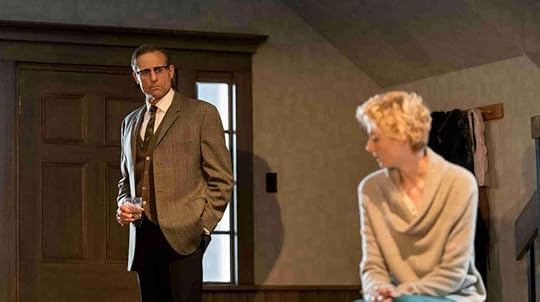
Actors Mark Strong as Donald Dodd and Elizabeth Debicki as Mona Sanders in the National Theatre's 2016 staging of "The Red Barn". Photograph sourced from a review at Panoptic UK.
I was not very enthusiastic in my recent review of the latest translation of The Hand in my ongoing 2022 reading of Georges Simenon's romans durs (hard novels) alongside his Chief Inspector Maigrets. That was partly due to overexposure to too many of the Simenon protagonists seeking to escape their mundane lives. The lunatic ending was an extra downer which left no room for empathy.
David Hare's adaptation distills the novel's essence into three acts of several scenes each and adds more mystery and suspense to the situation. Various early events are seen as later interspersed flashbacks for instance, rather than as part of the exposition. The manipulation of events by Ingrid Dodd (for some reason she is re-named from the Isabel Dodd in the novel) was also made more overt. You don't get the inner thoughts of the Donald Dodd character, so the actor has to make an increased effort in mannerisms to convey the descent into the final madness, which is still a shock but certainly makes for a gut punch finale.
Trivia and Links Playwright David Hare's September 25, 2016 article in the Observer/Guardian to promote the National Theatre's staging of The Red Barn is the same as his Introduction to the play in the Faber & Faber paperback and you can read it here.
The National Theatre filmed a "Behind the Scene Changes" video which reveals the huge amount of backstage work for its 2016 production of The Red Barn and you can watch it here. I could not find a trailer for the actual show itself.
* The book was later translated by Linda Coverdale in 2016 for the Penguin Modern Classics series of Georges Simenon reissues.
I read this play in one sitting and I think it's the first time I did that. It's quick and dynamic and it keeps on moving you forward so you can't just stop reading. Quite tragic, that too.
I thought this play was just fine. I think the cover and the synopsis sets up the reader for a isolated murder mystery, which it isn't really. I spent the whole play trying to figure out what mystery we were trying to solve, so by the end it felt very unsatisfying. I don't think I'd have felt any different if I had seen it performed.