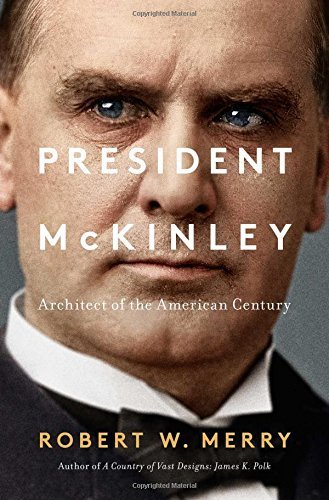
This is a good solid and well-researched biography on William McKinley, a President who is often overshadowed by his successor, Teddy Roosevelt.
Even though he is from Northeast Ohio, I knew very little about McKinley when I started this book. Although not always easy to read, I did learn a lot about this man and all he accomplished during his lifetime. Much of this information is interwoven throughout this book, so this is what I have pieced together:
McKinley was born on January 29, 1843 and when he was nine years old his parents moved to Poland, Ohio (near Youngstown). His parents held education as sacred and really respected the school and the teacher where McKinley and his siblings attended school.
While Ohio was against slavery at the start of the Civil War, it also proved inhospitable to freed blacks desiring to settle here. However, due to Ohio’s abhorrence of slavery AND its devotion to the union, Ohio sent more recruits per capita into the Northern Army than any other state, placing 320,000 men in blue uniforms during this struggle. One of these men was William McKinley, Jr. – barely 18 at the time, he had worked as a schoolteacher and summertime postal clerk in Poland.
McKinley fought with the 23rd Ohio. As the war progressed, McKinley moved up through the ranks and for the rest of his life, was often called Major, from this period of his life. During the Civil War, McKinley’s commanding officer and later, political mentor was [future President] Rutherford B. Hayes.
From Soldier, McKinley set his sights on a legal career and from here [what seems today a natural progression] a political career. The information surrounding the Ohio Republicans, especially with regards to the state’s industrial development, was fascinating! Further, the information, about the people who lived and worked in Ohio during this time, was equally engaging.
The time period is the 1870’s and guess what? At this time the Ohio Republicans were headed towards a political rift – not due to political ideology, but of personal temperament and the political ambition of four large figures – three rising politicians and one old salt of a politician. Have we learned nothing in almost 150 years?!?!?
FYI! The old salt was John Sherman, brother of Civil War General, William Tecumseh Sherman, He figures prominently throughout most of this book, eventually becoming a member of McKinley’s Cabinet (Secretary of State).
Back in 1877, at the beginning of McKinley’s career as an Ohio Congressman, he received a bit of advice from the man he admired most. “To achieve success,” Rutherford B. Hayes said, “you must not make a speech on every motion offered or every bill introduced. You must confine yourself to one thing in particular. Become a specialist.” This was great advice at this time, but would be extremely hard to do in this day and age, with all of our technological advances.
The election process for this time was engrossing. Things worked so much differently back then! Better? Perhaps.
The chapter on building the cabinet was intriguing, especially in regards to the
“political-ness” tied to Mark Hannah and his desire to be a senator and not a member of McKinley’s cabinet. It is situations such as this that leave a sour taste in voters’ mouths (today). However, the final assemblage (the geographic area covered was impressive (p.157).
The whole discussion about Teddy Roosevelt was interesting. I sincerely believe that if McKinley had been able to choose his VP (in the way we do today), Teddy never would have been McKinley’s choice, thus TR would not have been McKinley’s successor after his assassination, thus altering the course of history, forever. Note: Garret Hobart was McKinley’s VP during his first time. Unfortunately, he passed away. Thus opening the door for TR. Also interesting, according to a member of the press, no president and vice president have ever been as close as McKinley and Hobart.
McKinley’s sincere utter devotion to his wife, Ida, was just plain weird. I have not seen a politician since (including George and Barbara Bush) this devoted.
The Civil War reunion of the 23rd Ohio in Fremont, Ohio in September 1897 was a poignant one. It said a lot about McKinley, the man. “Today, instead of having sectional divisions beneath this flag, we have none … and the men who fought for this fag and the men who opposed it … are now forever united in faith and friendship for its defense.”
On an interesting note (because of the war that was fought), although he was quick to offer praise for efforts by individuals and groups to improve the lot of African Americans, McKinley considered North-South harmony a higher priority. During his presidency, he accepted the racial status quo, but did nothing to further the advancement of black people. This, in my opinion, may have been one of only a couple of black marks (the handling of Mark Hannah (political cronyism) being another) on his presidency.
After the resignation of Alger as Secretary of War, McKinley’s selection of a successor in Elihu Root, was an intriguing one. The fact that he did not require someone with war experience was extraordinary for this time period and what was occurring around the world.
The story behind McKinley’s re-election, including his continuous study of Ohio politics, was riveting. His continued focus on the matters important to the country, instead of primarily on his re-election … You will never see this happen again!
Just as with Garfield, the events that immediately followed the shooting of McKinley are sad. If we only had the medical advancements that we have in place today …
During his presidency, America rose (significantly) as a global power. American economic and diplomatic power also surged. The whole discussion on the Gold Standard was most interesting, but there was more.
America’s annexation of Hawaii in 1898 extended US territory into the Pacific and highlighted resulted from economic integration and the rise of the US as a Pacific power. Hawaii was made a territory in 1900 and a state in 1959.
The Spanish-American War which started in Cuba, changed the history of the Philippines. Faced with defeat, the Philippines was ceded to the US by Spain in 1898 after a payment of $20 million (US) to Spain, in accordance with the Treaty of Paris, ending the Spanish-American War. On June 12, 1898, Filipinos declared independence. The declaration was actually opposed by the US who had plans to take over the colony. This led to a guerrilla war against America. In 1901, William Howard Taft (and his is another interesting story) was appointed as the 1st US Governor of the Philippines.
After Columbus’ arrival, Cuba became a Spanish colony, ruled by a Spanish governor in Havana. However, the Spanish-American War resulted in a Spanish withdrawal from the island in 1898, and following 3 ½ years of subsequent US military rule, Cuba gained formal independence in 1902.
In 1899, Secretary of State, John Hay (one-time secretary for Abraham Lincoln) created the Open Door policy where the US asked China to make it so that all nations would be able to trade equally in China. However, in June 1900, the Boxer Rebellion occurred in China which targeted Western missionaries and foreign communities. The Americans joined forces with Great Britain, France, Germany, Russia, and Japan to stop the rebellion.
The "Isthmian Canal Commission aka the Walker Commission, issued a 17,000-word report stating its unanimous opinion that the most practicable and feasible route for an isthmian canal, under the control, management, and ownership of the US, is that known as the Nicaragua route." The price tag was $200,540,000, more than $50 million more than the Panama route.
The discussion about “free trade” of goods with Puerto Rico was most fascinating. Asa territory, was Puerto Rico on equal footing with US citizens? Did the Constitution follow the flag? Thus conferring US citizenship upon Puerto Ricans now under American jurisdiction? OR, Could Congress govern the new possession as a domestic territory, conferring what rights it saw fit under its own constitutional authority? The US Supreme Court ruled for the latter (which was McKinley’s belief). Powerful stuff!
Fun Fact: Every president who has been assassinated has had his face on a piece of our currency. McKinley was on the $500 bill, which is no longer in circulation.
So, where does McKinley stand today? Was he a successful president? Check out this book to learn more!