Name: Green, Joseph Lee, Birthplace: Compass Lake, Florida, USA, 14 January 1931.
"Conscience Interplanetary" consists of four stories padded out with new material to comprise a full-length novel.
Green's protagonist, Conscience Odegaard, is a member of the Practical Philosopher Corps, whose job it is to assess the intelligence of native species on newly discovered worlds. If the species is deemed intelligent, or has the potential of intelligence, the planet is designated protected; if not, the planet is open to the full horrors of colonization, mining and general corporate mayhem. Of course, it is in the interests of business that as many planets as possible are open for exploitation, so the Practical Philosopher Corps face every kind of sabotage and subterfuge at the hands of the New Roman Party, which represents corporate interests. Odegaard must ensure that his professional judgments are also secure against unpicking by the New Romans, and this involves much politics back on Earth.
The stories that makw up this 'novel' are:
"The Decision Makers" "The Shamblers of Misery" "The Butterflys of Beauty" "The Cryer of Crystal".
Many works of now-"classic" sci fi are actually collections of short stories, edited together to novel-length. I, Robot is probably the best-known example. In that example, Isaac Asimov allowed his stories to retain their autonomy, weaving them together with a simple wraparound story that connected them to a common character without getting in the way of the original narrative. Joseph Green would have been well-advised to follow such a model, but unfortunately, even had he done so, this would still be an inferior book in comparison.
What Green has done here instead is try to camouflage the individual stories and pretend to be presenting a unified narrative. It probably helps that the hero of each story is the same person, satisfying the fans of single-point-of-view novels, but in fact the stories decidedly do not work together well as a novel. There is no building of a single over-arching quest for the hero to work through, and when Green tries to tie it all together in the concluding chapters (which I believe were never published as a single story), it simply comes across as contrived. It also appears to me that he loses the thread of what he was interested in to begin with.
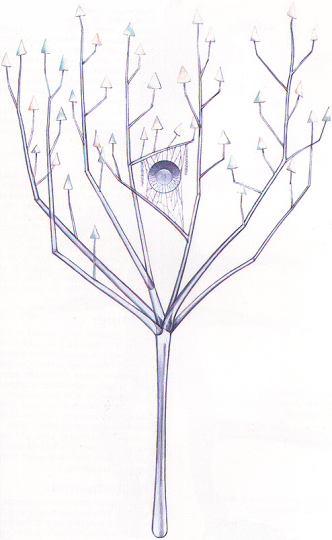
Looked at as separate stories, the writing is still not up to Asimov’s level, but some of the stories are still pretty good. What seems to have interested Green at the outset (and what he’s best at) is contemplating the exobiological possibilities of life on other planets, and how they might demonstrate intelligence in ways very different to human beings. The main character is a “Conscience,” which is to say a human being who examines worlds under consideration for colonization, declaring them off-limits if any intelligent life is discovered, so there’s good opportunity for Green to imagine extraterrestrial ecologies. He does this unevenly, but when he’s good, he’s very good, as in the case of the silicon-based lifeform whose underground roots span an entire planet. I was generally able to figure out within a couple of pages whether a given lifeform would be declared intelligent, but I still enjoyed watching the narrator work it out for himself.
Green had formerly worked at NASA, so had been exposed to scientific activity, though so far as I can tell he wasn’t a scientist himself (wikipedia says he was in charge of writing brochures for the public). I was a bit disappointed in his willingness to stray from science in order to move his narrative: for example it turns out, in his Universe, that Einstein was wrong about the speed of light and people can travel as fast as they want without lurching forward in time or “mucking about in hyperspace” (as Douglas Adams put it). I was hoping for something a bit closer to “hard” s-f, but alas that was not to be.
The other thing that annoyed me was the very Cold War-feeling division of humanity between two factions, one obviously “Wrong” and one obviously “Right.” In fairness, the “Right” side (the Consciences and their allies) are basically liberals and believers in the brotherhood of sentient life, but again this came across as contrived. It seemed to me that where Green was very good at thinking about alien life, he was decidedly unimaginative when thinking about the Earth, and that only got worse as the stories progressed to the final climax. I think Green, who was writing during the days of Watergate, was responding to the extreme partisanship of his age, which unfortunately may be a part of the book that will ring true for future generations.
Second, I'm struck by the vagueness of the designation "fix-up". It ranges from fix-ups like Starwarm which barely try to disguise themselves as "novels", to fix-ups where the component stories have been seriously mutilated like (reportedly) several of van Vogt's, to this book, which is a group of short stories so little altered I would say there is no reason to read the originals if you read this first. It helps that the four component stories were always linked by character and setting, rather than merely being thematically related.
The first two are relatively more edited. The opening of "The Decision Makers" is rearranged, a segment where Allan expresses bitterness about leaving Earth is removed, and reference to the "polyandrous condition" of women on remote research stations is added to accord with another story. Most crucially, "The Decision Makers" originally ended with the conflict unresolved. An entirely new chapter transitions "The Decision Makers" and "The Shamblers of Misery". "Shamblers" has a moment where Allan admonishes himself for being defended by a woman removed, and a paragraph in the middle is greatly extended to allow Allan to reflect on his motivations, and includes a reference to "Decision Makers". The final few paragraphs are extended to segue into "The Cryer of Crystal", which changes Allan being "a little plump" into being tired by a circadian dissociation pill. "Cryer" is given two new chapters to close it out. "The Butterflys of Beauty" is given an additional page at the very beginning to link it to the new material of "Cryer". Chapter 18 on is all new material, which combined with the earlier inserted chapters is about half of the book. Finally, redundant exposition was removed from the latter stories, meaning repeated explanations of Allan's job or what the political situation is.
Onto the actual story. It follows Allan, a "Conscience", who is responsible for investigating claims of intelligent life on colonized planets, and determining whether they have merit, and thus whether colonization should go forward or the planet be closed. His work is scientific, but as the New Roman party on Earth completely opposes the closing of planets, his work gets more fraught as the story goes on. As he becomes prominent in politics, he's a target for kidnapping and assassination, and the story shifts to something of a spy adventure. Allan himself is something of a captain Kirk, visiting various planets and investigating their life forms, as athletic as he is intelligent, and a ladies' man.
The investigations aren't terribly interesting. They're so short that any element of mystery disperses quickly, and the life forms themselves aren't that strange if you've read much science fiction. There's a hivemind, an intelligent plant, etc. He does add some stranger material in the later chapters as he encounters
The political element is not especially deep either. The Conservationist party that created Allan's office is opposed by the New Roman party, and various elements associated with that party seek to both discredit the Consciences and to kill Allan himself. There is a fairly good progression of Allan's understanding of his place in the struggle, as he initially thinks of himself purely as a scientist, but as he comes to understand just how dedicated the New Romans are to expansion at all costs, he realizes that continuing his investigations may not be the most important thing he can do. At no point do we see any kind of positive element to the New Romans or their agents, who are either sleazy and greedy or extremely violent.
However, I wouldn't call this a bad book. It has the bare minimum I need to say I enjoyed rather than regret reading it. Nothing in it was boring or cringeworthy enough to seriously pain me, and most importantly, it was short. I can forgive quite a lot if a book doesn't egregiously waste my time. Damning with faint praise, I know.
Finally, Barlowe's Guide.
I was disappointed in how little the Cryer featured. It does get a serious extension with its two extra chapters, but that wasn't enough to elevate it beyond a pretty bland intelligent plant. Barlowe's drawing is so ethereal and mysterious, it looks like an abstracted glass sculpture of a tree, and it really fired up my imagination as a kid. What might such a being think? What might it want, and do? Nothing much according to the book.
Catching up on my old enthusiasm for science-fiction. This book is by now a classic. It portrays the professional life of an evaluator of societies for that thing called 'intelligence'. Speculative exobiology has always been of interest to me. While I've never been interested in vast conspiracy theories, I'll have to admit that many small-scale conpiracies seem to be common. I recommend beginning this book to get a flavor of the plot; then, if you don't like it, put it down.
I agree with some of the comments here who noted that this is really more like a collection of connected short stories than an "actual" novel. But at least that means that bad situations don't tend to linger for long periods of time, like they do in some novels -- which is good for an ADHD reader like me! One thing for certain, the best part of this book is the variety of alien species, morphologies, and cultures that Green outlines in these short chapters. That part is really fascinating.
Some distinctly 1970's-feeling parts of the story may not have aged very well. Our hero has a habit of making snap decisions about every female character he meets, based completely on how physically attractive he finds them. Also, it's hard to miss that every single useful action or idea in the book comes from a male.
Un romanzo con un eroe tutto d'un pezzo come si usava una volta. Ci sono idee chiaramente d'atmosfera Campbelliana, e alla base c'è anche lo spirito di Star trek degli anni '60. L'dea di un corpo di Filosofi Ambientali in giro per le stelle a salvare specie protointelligenti dallo sfruttamento dell'umanità non è male. C'è una buona componente scientifica di tipo biologico, e ovviamente il complotto sotterraneo che porta il protagonista a sfide sempre maggiori. Nel complesso è una lettura divertente anche se non eccezionale.
I think the issue with a lot of pulp/juvenile science fiction of the 60s-80s is the obsession with the framing of anti corporations and anti authoritarianism - it can work when done right but often can just all blur into one when it’s a bit too obvious. Interesting as a concept and I think removing the rise of the right wing element and instead focussing on the role of the Conscience’s and Allan’s adventure would have made this far more engaging
I have mainly read non-fiction once I started getting back into reading, and I want to see if I can mix in some science fiction to mix things up a bit. This was a great book, I found all of the descriptions of the alien worlds quite fascinating. I was a bit disappointed that the intelligent seals never came back into the story after the first section, I had assumed that that planet would be an essential part of the storyline. Clearly a lot of thought was put into these alien worlds and crafting them to make logical and scientific sense, even if they can each really be thought of as independent short stories. The pace of the book sped up quite a bit once Allan returned to Earth for the last ~quarter of the novel. I enjoyed this mix of cool sci-fi alien worlds for the first half, and then more action-packed human-centered story for the end. The politics weaving through all of the book helped maintain a common thread and goal for Allan, and it all seemed far to reasonable when looked at through a modern lens. Overall, this was a great book, really enjoyed it. It is a good launching point for me to start reading some more classic sci-fi and to really dig into the genre.
Very dated work of juvenile science fiction. I disliked the loosely jointed, episodic stories that make up the novel proper, and the occasional bouts of late 60s, early 70s, slang were particularly jarring and bounced me out of the narrative every time.
The story concept wasn't terribly bad, but there are a lot better works of this sort of exploratory SF available. Recommend James Alan Gardner, Ursula Le Guin, Sylvia Louise Engdahl instead.