A mathematical tour of some of the greatest unsolved ciphers of all time
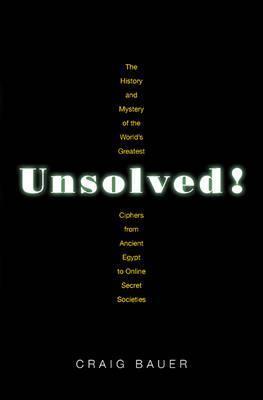
In 1953, a man was found dead from cyanide poisoning near the Philadelphia airport with a picture of a Nazi aircraft in his wallet. Taped to his abdomen was an enciphered message. In 1912, a book dealer named Wilfrid Voynich came into possession of an illuminated cipher manuscript once belonging to Emperor Rudolf II, who was obsessed with alchemy and the occult. Wartime codebreakers tried--and failed--to unlock the book's secrets, and it remains an enigma to this day. In this lively and entertaining book, Craig Bauer examines these and other vexing ciphers yet to be cracked. Some may reveal the identity of a spy or serial killer, provide the location of buried treasure, or expose a secret society--while others may be elaborate hoaxes.
Unsolved! begins by explaining the basics of cryptology, and then explores the history behind an array of unsolved ciphers. It looks at ancient ciphers, ciphers created by artists and composers, ciphers left by killers and victims, Cold War ciphers, and many others. Some are infamous, like the ciphers in the Zodiac letters, while others were created purely as intellectual challenges by figures such as Nobel Prize-winning physicist Richard P. Feynman. Bauer lays out the evidence surrounding each cipher, describes the efforts of geniuses and eccentrics--in some cases both--to decipher it, and invites readers to try their hand at puzzles that have stymied so many others.
Unsolved! takes readers from the ancient world to the digital age, providing an amazing tour of many of history's greatest unsolved ciphers.
The book's subtitle summarises its contents: this is the tale of some of the unsolved ciphers that have baffled experts, sometimes for centuries, and the efforts that have been made to find solutions.
I'm going to start by saying that my relatively low rating is a reflection of the fact that the author's chosen style drove me nuts, and is therefore entirely subjective. In fact, I think the book is very good – just not for me. Let me start by explaining why and then I can get onto the more positive aspects.
I admit – the clue is in the title, so I should have known the book would annoy me. I really don't like unsolved mysteries and this book reminded me forcibly of that fact. Part of the ostensible reason for the book is to encourage a wider pool of people to try their hand at solving these ciphers, and I think that's a fun and interesting idea. However, while I can make a stab at something like the dancing men cipher in Sherlock Holmes – a simple letter substitution – I fear that when higher maths, massive computer power, or knowledge of ancient Greek is required, then it's well beyond my capacity and my interest flags. From the first chapters, I found I was reading the stories of the ciphers and then skipping most of the stuff about the methodologies of attempts to solve them. I suspect Bauer has explained all the mechanics of it very well for people who are interested and have enough mathematical aptitude to follow along, but sadly that's not me. Even with the simpler stuff at the beginning, Bauer frequently sets a challenge – say, to solve a group of anagrams – and then doesn't provide solutions. I found this intensely irritating.
However, what annoyed me much more was Bauer's decision not to include all the information in the book, but instead to refer the reader frequently to websites. If I wanted to look up unsolved ciphers on the internet, then I would simply google – but if I'm reading a book on the subject, then all relevant information should be on the page. I'm not even an enthusiast for being referred to the notes at the back of books much less being sent off to fire up the laptop. One example was where he tells a story, tells us that the cipher in this case has been solved, doesn't give the solution but instead gives a web address a zillion characters long. Having carefully keyed it all in, I was taken to a website... in German! OK, so Google translate... nope, still no solution in the body of the post. Presumably it was hidden somewhere in the vast stream of comments on the post, but frankly I had lost the will to live by then. It felt like Bauer was playing games with his readers – fine if you like that sort of thing. I don't.
On the plus side, a lot of the stories Bauer tells are interesting in their own right even when the ciphers remain unsolved. From ancient Greece to modern murders, ciphers have appeared in the oddest of circumstances – medieval manuscripts, tombstones, personal letters, even taped to the stomach of a murder victim. Sometimes there is doubt whether a piece of gibberish is actually a cipher or simply a piece of gibberish, and Bauer details how experts go about the task of trying to decide.
Spy stories feature, of course, but there are other circumstances when ciphers have been used that I found just as interesting. There are a couple of hidden treasure stories, where the ciphers remain unsolved and the treasure unfound so you might want to grab a spade and start digging. Many people have used ciphers as a means to test whether it's possible to communicate from beyond the grave, by leaving behind a code that requires a keyword to solve, intending to see if they can then transmit this keyword from the great beyond (so far with no success). Bauer also tells of the way ciphers have been used to send messages out into space as a means of alerting passing aliens to the existence of intelligent life on earth. One has to hope the aliens are better at solving codes than I am... or perhaps we should hope they're worse since, as Bauer points out, they might have bigger guns and worse attitudes than we do.
So there's plenty of good stuff in here, and I'm certain it would work very well for someone who is more interested in the maths side of it and less annoyed by being sent off to websites than I. But for me, there were too many aspects that irritated me to make it an altogether successful read despite finding some of the stories interesting.
NB This book was provided for review by the publisher, Princeton University Press.
This chunky book proved to be an unexpected pleasure. Craig Bauer introduces the reader to a host of mostly unsolved ciphers, from historical greats to the latest computer-derived puzzles. Although he tells the complete story of each cipher he deals with before moving onto the next, the chapters are cleverly structured so he is able to introduce us to increasingly sophisticated mechanisms for hiding messages - and techniques for attempting to break them.
We start with the Voynich manuscript, a whole book, probably from the fifteenth or sixteenth century in cipher form - though as Bauer points out, some believe it's a meaningless hoax. After a dabble with ancient ciphers, we next discover that Elgar was a cipher fan. I'd heard about his playful concealment in the Enigma Variations, but wasn't aware of the Dorabella cipher, which remains unsolved to this day. (Bauer also takes us through Elgar's own workings to solve a public cipher challenge, which is fascinating.) Then we zoom forward to the infamous Zodiac killings and their associated ciphers (the inspiration of the Dirty Harry movie), plus a number of other true crime stories with an unsolved cipher involved.
I was a bit wary about this section, as I'm no fan of true crime, but the cipher element made the whole thing much more of an intriguing mystery, where the details of the crimes were necessary for cipher's context. We then go on to a whole host of other ciphers, from attempts to use them to prove communication from beyond the grave to a whole world of 'challenge ciphers' I wasn't aware of. Here, the public is challenged to deal with a cipher, some via convoluted communications such as the enigmatic Cicada 3301 challenges which spanned websites and physical locations. And, of course, there is the CIA's famous Kryptos sculpture, still partially unsolved.
The book does have some minor irritations. Bauer can't resist exclamation marks - it's not just in the title, but almost every page seems to have them. (I can't help but wonder if there's a cipher involved, there are so many.) He also does tend to give us just a bit too much detail in the background information. So, for example, when tracing the early years of the Voynich manuscript, we are told too much dull detail, transcribing letters about it that don't add much to the narrative.
There's also an inherent difficulty in the topic, in that most of the ciphers covered are still unsolved, as the title suggests. This means that many of the stories in the book don't have an ending - or rather they all have the same ending 'We don't know yet...' which gets wearing after a while. It's fine that some of these can be seen as challenges for the reader, if so inclined - but it makes the book work a little less well. Many of the best bits of Unsolved! were where at least a partial solution was reached. The book might have worked better if Bauer had gone for more of a mix of solved and unsolved ciphers, so we could have had regular 'aha' moments during the journey.
Despite the many mysteries left hanging, though, this was a thoroughly engaging read. Whether you have the patience and fortitude to have a go at cracking ciphers yourself, or, like me, are happy to be impressed with the ingenuity but would never put the time and effort in, there are some cracking (sorry) stories and surprises here. What else can I say, but TIEL TKIA CEOB HSXL B!SN ENOC
Bauer presents a tour of unsolved ciphers, examining each and looking at the approaches that various people have used attempting to decode them. It is fascinating how nuances in the English language can be used to tease out solutions. As the various ciphers use different techniques, the book provides an overview of the types of ciphers.
The book starts with the Voynich manuscript, a manuscript brought to light by the rare book seller Wilfrid Voynich. The document has a long history and Bauer surveys the various approaches that been used to attempt decryption.
The author describes ciphers that were used in ancient Egypt and Greece. Interestingly, prior to their being recognized as ciphers archaeologists believed that the inscriptions were just gibberish. Some text on Greek vases turned out to be phonetic spellings of Scythian warrior names.
The composer Edward Elgar was very interested in ciphers. The decryption of his work has been difficult due to the odd way he would use English, even before it was coded. His Dorabella cipher is still unsolved.
A number of past murders have yet-to-be decrypted ciphers associated with them that would lead to knowing the identity of the murderer. Perhaps the most famous is Zodiac and his 340 cipher. Surprisingly, it was not recognized that the cipher was presenting a bearing and a distance to a location.
In the last century, a number of cryptographers have left ciphers as challenges. Sanborn's Kryptos sculpture for the CIA headquarters has four panels, of which three have been decrypted. The final panel is yet unsolved, as is the overall puzzle that Sanborn built into it.
The Cicada 3301 cipher was a series of complex ciphers using a wide variety of techniques that started in 2012. It was apparently created as a test by a group that was looking for persons to aid in fighting restrictions on freedom.
Some ciphers potentially lead to treasure. The adventurer Forest Fenn hid a treasure that was only found this year.
As someone genuinely fascinated by codes, ciphers, and unsolved mysteries, I was really looking forward to Unsolved!: The History and Mystery of the World's Greatest Ciphers from Ancient Egypt to Online Secret Societies. On paper, it has everything I love—an exploration of real-life cryptographic puzzles, from the ancient world to the digital age, written by an expert in the field. And in many ways, the book delivered exactly what it promised: it’s packed with intriguing historical anecdotes, obscure codes, famous unsolved cases, and a broad survey of the field of cryptography that’s both ambitious and impressively researched.
Craig P. Bauer’s writing is strong—clear, intelligent, and often engaging. He doesn’t dumb things down, and he gives his readers credit for being curious and willing to think deeply. The way he breaks down complex ideas and explains historical context is commendable, and I appreciated the fact that he brought lesser-known examples into the spotlight alongside more famous ones like the Voynich Manuscript, Zodiac ciphers, and Kryptos.
But despite all that, I found myself struggling to stay fully engaged. This wasn’t because the content lacked substance or that the writing was poor—it’s more that the experience of reading it didn’t match my expectations or reading style. I expected to be completely immersed, maybe even turning pages like I would in a gripping mystery or historical thriller. Instead, I found myself reading in fits and starts, and occasionally feeling like I was more admiring the book than enjoying it.
I think part of the disconnect came from the tone and pacing. While the book has plenty of intriguing material, it leans more toward an academic or reference style than narrative-driven nonfiction. There were moments where I felt pulled in—stories that sparked my imagination or made me want to go down a rabbit hole of research—but then it would pivot into a more technical or meticulous breakdown that, while interesting in theory, slowed the momentum for me.
It’s also a book that assumes a good deal of interest in both cryptography and the deeper technical or historical frameworks surrounding it. That’s not a flaw—if anything, it’s part of what makes the book high-quality—but it did contribute to my feeling of detachment. I was intrigued by the topics and curious about the stories, but I didn’t feel the kind of narrative tension or emotional pull that might have made the material come alive for me on a more visceral level.
In the end, I respect this book more than I enjoyed it. I’m glad I read it, and I learned quite a bit—but it didn’t quite deliver the experience I was hoping for, even though the subject matter was right up my alley. For readers with a deep and patient interest in cryptography, history, and unsolved puzzles, this will likely be a rewarding read. But for those looking for something with more storytelling energy or momentum, it might feel more like a thoughtful stroll than a gripping ride.
David got this book somewhat randomly at Barnes and Noble and, honestly, I didn't have very high hopes. But the author actually worked at the National Cryptologic Museum, so he definitely knows his stuff!
If anything the book is a bit too detailed, but if you're into reading about, say, the whole history of the Voynich manuscript it's very good. Another minor irritation is that, well, most of the ciphers he talks about are unsolved! That can get kind of unsatisfying.
But he does a good job of listing what we do know, using various statistical techniques. Another nicety is that he actually goes through the exercise of decoding some simple ciphers, which is much more instructive than the usual "well, just look at the letter frequencies, and voila!"
One of the crazier things he talks about is that there are a lot of ancient writings that don't make any sense - we know what language they're using, but the words don't make any sense. Apparently people who study such things used to think "well, this doesn't make any sense, so obviously it's gibberish - maybe illiterate sellers of goods would write stuff that looked like words to fool illiterate buyers?" Which is such a weird first option, as opposed to "maybe these things are in codes that we don't understand". Hey scholars - just because you don't know what it is doesn't mean it's gibberish, ya bums!
This book is very ‘off brand’ for me, with my reading list mainly well trodden mystery or romance novels however this book really tickled my interests. It was a interesting blend of ancient civilisations, secret societies, crime and espionage- all of which I am fascinated by. While the maths was way over my head and I had no interest in actually attempting to understand the development of ciphers I devoured this book in just a few days. I feel just a little smarter having read it even without the slightest mathematical prowess to understand the technical sections, the history was wonderful.
The subject matter was absolutely fascinating and the book got off to a good start. Unfortunately, the material was not presented well. Some chapters were chock full of examples and thus each example was not given sufficient coverage and some chapters delved too extensively into the mathematics involved and were boring. The very last chapter about ET and RSA, in particular, was a prime (no pun intended) example and a disappointing way to end.
Great introduction and survey of many of the most perplexing cryptographic puzzles humanity faces. Some have been solved since the book was published, but many of these mysteries endure. If you've ever been curious about cryptography, and you've got a bit of mathematics background, give this a read. If you shudder at the thought of the cryptograms in puzzle magazines and you're "not a math person" this may not be for you.
A very cool, but long book about ciphers. The narration style is actually really engaging for a non-fiction book and I thought it was neat he covers all kinds of ciphers from almost all moments in history.
Definitely a must read for those interested in unsolved mysteries, true crime, or cryptology and ciphers.
At first there was some great narrative with interesting ciphers to go along with it but then there was fifty uninterrupted lines of ciphertext with exposition very clearly initially intended for the author’s journal. Which, for you, may be just what you’re looking for.
Interesting book, but could use more pictures. It's also one of those books you need to stop and start several times to get thorugh, but overall good for the subject matter.
Thorough and enthusiastic work about things cryptographic. Sometimes the author inserts himself unnecessarily but great fun if you like codes and puzzles.