Jump to ratings and reviews
Rate this book

Té de Manzanilla y Otros Poemas

Rate this book
All our books are brand new. We ship worldwide

100 pages, Paperback

First published May 1, 1922

10 people are currently reading
337 people want to read

About the author

Katherine Mansfield

983 books1,211 followers
Kathleen Mansfield Murry (née Beauchamp) was a prominent New Zealand modernist writer of short fiction who wrote under the pen name of Katherine Mansfield.

Katherine Mansfield is widely considered one of the best short story writers of her period. A number of her works, including "Miss Brill", "Prelude", "The Garden Party", "The Doll's House", and later works such as "The Fly", are frequently collected in short story anthologies. Mansfield also proved ahead of her time in her adoration of Russian playwright and short story writer Anton Chekhov, and incorporated some of his themes and techniques into her writing.

Katherine Mansfield was part of a "new dawn" in English literature with T.S. Eliot, James Joyce and Virginia Woolf. She was associated with the brilliant group of writers who made the London of the period the centre of the literary world.

Nevertheless, Mansfield was a New Zealand writer - she could not have written as she did had she not gone to live in England and France, but she could not have done her best work if she had not had firm roots in her native land. She used her memories in her writing from the beginning, people, the places, even the colloquial speech of the country form the fabric of much of her best work.

Mansfield's stories were the first of significance in English to be written without a conventional plot. Supplanting the strictly structured plots of her predecessors in the genre (Edgar Allan Poe, Rudyard Kipling, H. G. Wells), Mansfield concentrated on one moment, a crisis or a turning point, rather than on a sequence of events. The plot is secondary to mood and characters. The stories are innovative in many other ways. They feature simple things - a doll's house or a charwoman. Her imagery, frequently from nature, flowers, wind and colours, set the scene with which readers can identify easily.

Themes too are universal: human isolation, the questioning of traditional roles of men and women in society, the conflict between love and disillusionment, idealism and reality, beauty and ugliness, joy and suffering, and the inevitability of these paradoxes. Oblique narration (influenced by Chekhov but certainly developed by Mansfield) includes the use of symbolism - the doll's house lamp, the fly, the pear tree - hinting at the hidden layers of meaning. Suggestion and implication replace direct detail.

Ratings & Reviews

What do you think?
Rate this book

Friends & Following

Create a free account to discover what your friends think of this book!

Community Reviews

5 stars
93 (24%)
4 stars
157 (42%)
3 stars
95 (25%)
2 stars
25 (6%)
1 star
3 (<1%)
Displaying 1 - 30 of 74 reviews
Profile Image for Ilse.
553 reviews4,464 followers
January 22, 2022
Poor little rich girl

Rosemary Fell is ‘young, brilliant, extremely modern, exquisitely well-dressed, amazingly well read in the newest of the new books, but not exactly beautiful…’ and extremely privileged and well-off. Filling her days with shopping for fripperies, slightly despondent by boredom and the weather, she bumps into a girl begging for the price of a cup of tea. Rosemary jumps on this meeting in the dusk with the destitute girl as a unique chance on adventure, imagining it an occasion ‘like something out of a novel by Dostoevsky’. She takes the girl to her home to treat her on a cup of tea like one would pick up a stray cat, so pleased with her own kindness that she even forgets to offer the girl drink and food, astonished at the meek composure of the girl: ‘if people wanted helping they must respond a little’! Rosemary indulges in fantasy, imagining painting a colourful picture of the thrilling event to her rich friends. Until Rosemary’s husband Philip enters the idyllic scene, spoiling her day-dreams and conspicuous benevolence with a thoughtless remark, freezing Rosemary when the girl turns out gifted with the one thing Rosemary does not and cannot possess - beauty in the eye of the significant beholder.


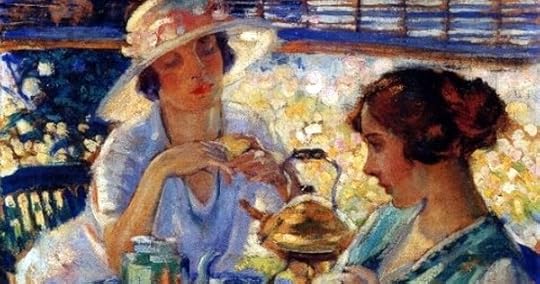
(Illustration: Yelena Sidorova)

In elegant, lucid prose and with a slight sarcastic tone, Katherine Mansfield decries the pompous display of charitable noblesse oblige which the upper classes bestow upon the less fortunate, whether the latter like it or not: the subjects of charity are no more than objects to trifle with and to dump at one’s fancy, mere props to glorify oneself. Can acts of sharing, or helping be genuinely altruistic, or are they, like Mansfield suggests, mainly motivated by self-interest? At once mercilessly exposing human weakness and vanity, Mansfield subtly touches on the basic instincts at stake when the fragile ego yelps in the complex dynamics of romantic relationships and fear, dependency, abandonment issues and hankering for exclusivity are churning up.

Her heart beats like a heavy bell.Granted, shallow people have feelings too, however self-centred these emotions might be.

The story can be found here.
Profile Image for Gaurav Sagar.
203 reviews1,720 followers
June 9, 2024

Human character is so complex to define, it has got so many layers that you need a keen and observant eye and deft hands to understand and explain it properly. Perhaps that’s how various fields of study such as psychology, philosophy, anthropology, life science and various others have been developed over the years and have enabled us to comprehend it in a better way; not only that, the study of other species also gave us valuable insights about ours too.


Having said that, the role of literature can’t be belittled in the sacred sojourn of comprehending humanity, the characters who have been developed through the deft pens of various authors, and the way literature has evolved over the years have played an essential role in portrayal of humanity. It takes a deft pen of an artist of highest calibre to draft characters close to the people we come across in real life and the astute observant eyes of an author to make us reflect upon the literature, to realize that our own lives are no different from those of who belong to the mysterious universe, like our own, of an author. There are a few authors who come close to Katherine Mansfield in understanding and depicting human emotions with finesse of a true artist.


Many times, it happens that the sympathetic attitude of people conceals an underlying pompous personality which inspires a person to help others because it would put them in a good light. Rosemary Fell belongs to wealthy family wherein to kill boredom, materialistic comforts arising out of shopping from upscale stores are sought to assuage the anxious mind. She comes across a destitute girl, Ms. Smith during one of her routine expeditions of rapacious desires, her mind suddenly gets trigged on this once-in-a lifetime opportunity rising from the dungeons of obscurity and nothingness on stumbling across the poor girl, Ms. Smith. Rosemary Fell’s eyes sparkle with optimistic ray of light and her soul brims with joy on coming across the great chance to show her kindness to the world. It is like a scene torn off from the great novel of Dostoyevsky she might be reading, wherein she would be become the great saviour.


Ms. Smith, the girl devoid of basic means and amenities of life, asks for ‘just a cup of tea’, however, Rosemary Fell reduces her existence to just a mere opportunity and throw the poor girl into hell of nothingness. The eyes of Rosemary Fell become so blind with pompousness and self-gratification that when she takes Ms. Smith to her home, the basic etiquettes slip her mind, and she becomes oblivious to the misery of Ms. Smith’s life, as if the essence of her existence is to show herself in good light in the eyes of others, to please others. The propensity of the protagonist to yielding to the external undue pressures of the society by adopting grandiose and pretentious show of kindness underlines the ‘bad faith’ of humanity, which forces her to live inauthentically and not realizing our innate freedom.


The tale paints a stark portrayal of distinctions among various classes and attitudes of people from different social strata to each other, the attitude may be domineering and crushing towards those belong to underprivileged classes, which are just reduced to mere subjects of the opulent expeditions of those belong to the privileged ones. The author goes beyond the surface to question our emotions in a subtle manner as to what actually lies beneath the human acts of altruism. The author also forces readers to ponder upon the fate of woman, in a way that how a woman would try to make up for what she is perceived to lack in terms of looks; she tries to appear generous, but when she is encountered with her own insecurities, they rob her characters off the veneer of compassionate demeanour, by showing the vulnerable and envious self of a woman.


The tale is told in a third person narrative in which an unknown narrator takes us through the story in a conversational style. Mansfield paints a contrasting satire on hypocrisy prevalent in our society wherein she shows how our benevolent mask is torn off to show our ulterior motives. The husband of Rosemary, Philip Fell is introduced as an element of anticlimax by the author, the character who subvert the narrative of story, though his role may be interpreted in multiple ways, one of which could that he knowingly plays a trick to unveil the real emotions of Rosemary who fails to pay the price it demands of her to accept Ms. Smith as an object of her fancy, like so many other materialistic objects she has got for nominal prices. The other interpretation could be that Philip gets smitten by a trait of Ms. Smith that Rosemary lacks and it exposes her insecurity through jealousy arising out of her own self- doubt and vulnerability of her personality, which doesn't enable her to help Ms. Smith despite her true and pure intentions. Whatever may be the case, Rosemary eventually appears to be a victim herself with the obvious and seemingly only victim, Ms. Smith, perhaps a victim of her emotions or a victim of her weakness which forces her altruistic attitude to give away itself on the mere test of authenticity.


The question we need to ask ourselves is that what lies below all these tempting and provocative possibilities, the answer may not be the simple one but invariably it deals with the loneliness of our existence. The tale exposes the profound emptiness of privileged lives, shallowness and grand vacuum which mark the loneliness of materialistic existence.

Profile Image for Nika.
253 reviews315 followers
May 15, 2024
This story raises some interesting questions. What is selflessness? Does pure selflessness exist? What motivates people to be charitable?
Can we embrace altruism without having secondary considerations and side motives?
Can selflessness and selfishness go hand in hand?

It seems that the line between selflessness, a genuine desire to help others, on the one hand, and selfishness and self-conceit, on the other, can often be thin, not to say blurry. And I must admit that I do not see a problem here. I think in many cases that's okay. It is okay if a self-centered person is able to do the right thing and sympathize with others.

A Cup of Tea can be read here.
Profile Image for Mark  Porton.
609 reviews816 followers
May 19, 2024
A Cup of Tea, a short story written by Katherine Mansfield in 1921 is a story about charity. More specifically, a story about, the motivations of people who provide charity, or kindness to those less fortunate than themselves.

Do we do it solely for the benefit of the recipient, or solely for the benefit of our own feeling of self-worth, or self-importance – to enhance our own ego - or a mixture of these motivations? I am sure most of us have thought about this in the past when donating something. I have – and I still haven’t figured it out.

This story involved a super-wealthy woman called Rosemary Fell, a woman who can buy anything she wants. Anyway, at the conclusion of a shopping trip she comes across a poor girl, the weather is terrible, and the girl asks for money for a cup of tea.

I won’t say any more about this six-page beauty only to say – it made me reflect on ‘why we help others in need’ in a very clever way. This story made me feel happy, uncomfortable, and ashamed – all in a matter of six pages.

No mean feat.

5 Stars

Thanks to Nika for bringing this little beauty to my attention. You can snaffle it via this link https://www.katherinemansfieldsociety...
Profile Image for Celeste   Corrêa .
381 reviews326 followers
May 20, 2024
[Paula, este conto não faz parte da colectânea que me ofereceste mas como tenho lido muitas resenhas, resolvi atacá-lo; já li o Bliss (Felicidade) e procuro os títulos originais para ler os restantes isoladamente).

Katherine Mansfield é exímia em contos curtos: recria ambientes e constrói personagens de grande profundidade psicológica.
Nunca se recusa um copo de água a ninguém, dizemos com frequência: algo tão simples e barato pode fazer a diferença na vida de alguém sedento e o assunto acaba aí.

A chávena de chá neste conto tem um simbolismo mais profundo como preconceito social e luta de classes.
Rosemary Fell não é exactamente bonita mas é riquíssima, casada e com um filho chamado Michael - um nome clássico e atemporal - gosta de receber convidados e é consumista.
Um dia, à saída de um antiquário onde era bajulada, uma jovem de apelido Smith pede-lhe dinheiro para um chá.

- Uma xícara de chá? – Havia algo simples e sincero naquela voz; não era a voz de um
mendigo. – Então você não tem dinheiro? – perguntou Rosemary.
– Nenhum, madame – foi a resposta.
– Isso é extraordinário! – Rosemary perscrutou através da penumbra, e a garota a fitava. Bem mais que extraordinário! E, de repente, aquilo parecia a Rosemary uma aventura. Era como algo tirado de um romance de Dostoiévski, o encontro na penumbra. E se ela levasse a garota para casa? E se fizesse uma daquelas coisas sobre as quais sempre lia e via nos palcos, o que aconteceria? Seria emocionante. E depois ela se ouviu dizendo para a perplexidade dos amigos:
"Eu simplesmente a levei para casa comigo”, enquanto se virava e dizia à obscura pessoa ao seu
lado.".


Leva-a para a casa, mostra-lhe o ambiente em que vive e aprensenta-a ao marido; cada leitor concluirá a seu modo.
Foi generosa? Em minha opinião, foi uma ruptura pontual ao quotidiano de uma ricaça.

Não sei bem a razão mas lembrei-me de um elemento de um dos clãs mais ricos do nosso país ter dito que passar férias na Comporta, um dos locais mais luxuosos de Portugal, «era como brincar aos pobrezinhos.»

(lido numa tradução PT/BR)
Profile Image for Antoinette.
1,055 reviews240 followers
April 30, 2024
A very compelling story, especially knowing that Katherine Mansfield wrote this with her cousin, Elizabeth von Arnim, in mind.

We meet Rosemary Fell, not exactly beautiful “ She was young, brilliant, extremely modern, exquisitely well dressed, amazingly well read in the newest of the new books ….” She was rich and snobbish. One day when out, a young lady ( about her age) asked for money for a cup of tea. She decides, impulsively, to take her to her home for Tewa. Her facade of being self assured starts to crumble once her husband, Phillip, comes on the scene.

Mansfield seems to be skewering the rich and their lack of awareness. But in the same breath, she is showing that appearances are deceiving!

I reread this one twice just to let it all sink in and then I thought about it for a long time afterwards. This is only the second story I have read by Mansfield and I am very impressed. Will definitely be reading more by her!

Published: 1922
Profile Image for Praveen.
193 reviews376 followers
January 18, 2022
Ah ! what a delicious cup of tea I just consumed this morning.
A ravishing beverage offered to me by the pen of captivating Katherine Mansfield!
It's chilly winter outside. Fog. My windowpanes are still soaked in early morning dew. And this cup of tea! Delicious!
My decision to pick up one short story in the early morning hour pays well.
I must thank Ms.Rosemary for such a treat.

"Ms.Rosemary is young, brilliant, extremely modern, exquisitely well dressed, amazingly well-read in the newest of the new books and her parties were the most delicious mixture of the really important people"

She had been married 2 years and she had a duck of a boy. One winter afternoon she had been buying something in an antique shop in Curzon Street. While coming back she met a small girl with enormous eyes, who pinched her in the elbow from behind and begged her, in a stammering voice, like a sigh,
"M-madam, Would you let me have the price of a cup of tea?"

And a thought comes in her mind, like something out of a novel of Dostoevsky. Supposing she took her home? Supposing she did do the things she has read in the novels?

It would be thrilling. She thought and she took the little girl home. Allowing her to sit in her car then treating her like the most respectable of the guests at home, and so on. The little girl was startled by whatever was happening with her as she had never experienced such a privilege.

While all this was happening, there turns the knob of the door and comes in Philip.
He objects to Ms. Rosemary for bringing the little girl home. "Are you mad ?" he asks.
And Rosemary says, be nice to her, treat her well, look how pretty is she. We will take care of her.

And the story takes turns, it finishes in style.

I have read Katherine Mansfield and she has always impressed me. This story too is written in a very enchanting language. The emotions of the characters are so much visible and she sets the seal on the story in her remarkable style.

Playing with the emotions of sympathy, compassion, and feminine jealousy in her exotic short story skills. I loved this story. Thanks, Katherine once again!
Profile Image for Daniel Shindler.
320 reviews214 followers
February 18, 2022
Katherine Mansfield is an elegant artist who employs her verbal palette to assemble a portrait of delicate images and jarring irony. In this well crafted short story, an everyday cup of tea is the fulcrum that unfolds larger thematic concerns.

Rosemary Fell is a pampered wealthy young married woman who revels in her sense of superiority and entitlement. While whiling away her day on a shopping trip designed to divert her ennui, she encounters a waif like girl who begs for a cup of tea. In an instant, Rosemary has an epiphany that would elevate her social benevolence into a well related adventure reflecting positively on her largesse. Instead of giving the girl a coin, Rosemary takes the waif to her home for a cup of tea.

Once installed in Rosemary’s home, the women’s interactions reveal much about the perceptions and emotions governing the rigidly stratified society in which they live. When Rosemary’s husband Philip enters the room, the encounter takes a decidedly unanticipated turn.

Katherine Mansfield’s spare, penetrating prose creates a portrait of sanctimoniousness, false philanthropy and unanticipated emotional longings. With an economy of brushstrokes, she raises questions about social stratification, self perception and the delusions that drive human behavior. This brief story is laced with subtle wit and moves from simple to complex with astonishing ease. The emotional heft of this story extends well beyond its brief content.

Many thanks to my GR friend Ilse, whose superb review provides a link to this masterful story.
Profile Image for Brenda.
233 reviews41 followers
May 7, 2024
A short story that is not short on meaning. Nice introduction to Katherine Mansfield.
Profile Image for Adan.
72 reviews63 followers
January 22, 2022
'tis a simple tale akin to a cup of tea for the readers. And, not some ordinary one... no. Nah, it's the one that sheds some light on materialism and class consciousness, forever present and recurring ailments— never treated properly. Oh, maybe money cannot buy everything, as it can't for our protagonist of the story.

There are moments, horrible moments in life, when one emerges from shelter and looks out, and it's awful. One oughtn't to give way to them. One ought to go home and have an extra-special tea.

She was going to prove to this girl that— wonderful things did happen in life, that— fairy godmothers were real, that— rich people had hearts, and that women were sisters.

But that was not really what Rosemary wanted to say. "Philip," she whispered, and she pressed his head against her bosom, "am I pretty?"


Link to the story: https://courses.lumenlearning.com/eng...
Profile Image for Ileana.
158 reviews42 followers
January 28, 2022
"M-madam, stammered the voice. Would you let me have the price of a cup of tea?"
"A cup of tea?" There was something simple, sincere in that voice; it wasn't in the least the voice of a beggar. "Then have you no money at all?" asked Rosemary.
"None, madam," came the answer.
"How extraordinary!" Rosemary peered through the dusk and the girl gazed back at her.
How more than extraordinary! And suddenly it seemed to Rosemary such an adventure. It was like something out of a novel by Dostoevsky, this meeting in the dusk.


I am glad to have discovered Katherine Mansfield with this splendid short story, thanks to my GR friend Ilse. :)
The story can be found here.
Profile Image for Ray.
704 reviews154 followers
February 21, 2022
A delightful little tale.

Upper class lady goes shopping and comes back with a gel that she found begging in the street. Doing her bit for chariddy and all that. Then hubby comes back - he can't but notice the beggar girl is very pretty. Suddenly the atmosphere changes, is it cold in here all of a sudden?
Profile Image for Emily.
384 reviews
September 4, 2017
I read way more short stories than I track on Goodreads, but sometimes I'm pleasantly surprised and want to remember my enjoyment of them. A Cup of Tea was like that for me. I loved Katherine Mansfield's prose, and the overall story was also very self-aware and even a little heart-wrenching.

In the first paragraph, you hear that Rosemary isn't pretty. She's smart, young, rich, well-read, and liked, but not quite beautiful. She lives in a world of illusion--which always tends to be looked down upon in literature, and I don't really understand why exactly, but whatever. Rosemary, like me, wants to live the kind of life only fictional characters really get to experience--where extraordinary things happen and conflicts are resolved. She takes in a young woman who asks her for money for tea, trying to play the Miss Havisham to the girl's Pip. Rosemary takes her home, feeds her, warms her. Maybe her intentions aim more towards personal purpose than selfless giving, but the act is still good. Then Rosemary's husband Philip sees Miss Smith, and calls her beautiful. Rosemary is living in a time where she can excel at literally everything, but her external beauty is what really matters. It's incredibly sad to read her reaction. In the first paragraph, we hear that her husband "adores" her, and that she had multiple boyfriends before getting married, and that's she brilliant and successful in all that she does, but Rosemary is still insecure and detached, despite not exactly wanting to be. Her character was really relatable to me. That plus the beautiful writing made me really enjoy this short story.
Profile Image for Richard.
188 reviews34 followers
July 28, 2022
Set in London’s Mayfair, the story tells of a chance encounter and how something so mundane, ordinary, and everyday as a good cup of tea can become a lifesaver. And even a life-changer.

A woman whose wealth can barely be measured, who is used to getting what she wants, and to people acting deferentially, picks up a waif and stray in the street and takes pity on her. Since she finds it “extraordinary” that the girl could be penniless, this uniquely altruistic act may have ulterior motives. Aside from her having ‘acquired’ another ‘ornament’, this kindly gesture, she believes, will provide a talking point amongst friends at high-society dinner parties. Guests will be impressed at her having daringly crossed the social class divide.

The modest girl, meanwhile, is dumbstruck by the elegance and finery she encounters. Yet she declines the offer of expensive brandy in favour of a humble cuppa.

Of course, the wealthy lady’s husband has no intention of indulging his wife’s fantasies and adroitly plays the jealousy card. Since envy is second nature to them both, the wife cannot help but immediately fall into the trap. Despite their enormous wealth, she is insecure and terrified of no longer being a possession like the so many trinkets she acquires while out shopping each day. A street urchin has, in effect, upstaged her.

The normal order is resumed, however, and both the wife’s sanity and the couple’s marriage are saved. The husband (who refers to his young wife as “my child”) returns to his role of being the sugar daddy to a dutiful wife, and our waif and stray departs with more money than she has ever dreamt of.

It’s a morality tale of exploitation, avarice and greed. There’s a charitable sentiment, but it’s not well-intentioned, and the girl from the street might just as well have been a stray animal, enjoying a brief respite from the “beastly” and “vile” weather.

Another brilliant portrayal of the class divide that is right up there with Mansfield’s other stunning work The Garden Party.

It is often said that life is stranger than fiction and the sad truth is that the essence of this story still resonates to this day. The fabulously well-off have no idea how the other half must live (I recently overheard two people speaking where one exclaimed, “But how is it possible you don’t have any money at the end of the month?”), and people tend to judge by appearances and equate looks/social status with a person’s worth.
Profile Image for Mariana Orantes.
Author 16 books121 followers
July 17, 2012
La poesía de Katherine Mansfield es sencilla y luminosa. No sé qué opinen los demás pero a mi me pareció triste. Lo luminoso también puede ser triste. Más bien es la dicotomía en la que la misma Mansfield vivía: sabía que estaba enferma, sabía que no se iba a curar, pero (igual que Chéjov) amaba la vida. Estos tintes aparecen en sus poemas: por un lado, un tono triste, melancólico y por el otro, un amor a las pequeñas cosas y a las cosas importantes. Me gustó mucho. Además se nota el oficio de cuentista e incluso hay algún poema que (como pasa con el cuaderno de notas de Chéjov)describe el núcleo narrativo de uno de sus cuentos.
La edición es hermosa. Da gusto tener este libro tan bien hecho entre las manos. Es bilingüe y el papel entre los dedos, una delicia sensorial. Pero eso no lo es todo en esta vida. Por desgracia creo que son dos los traductores y uno hace buenas traducciones, el otro no. Se notan muchísimo. Uno traduce bien y el otro hasta cambia algunas palabras por otras sólo porque intenta mantener un ritmo espantoso o una rima chafa. Ojalá sólo uno de los dos traductores hubiera hecho el trabajo y se tendría una delicia completa. Lo bueno es que no se pierde nada porque el lenguaje de Mansfield es tan sencillo y todo está trabajado de una manera tan compleja, que no se pierde tanto en la traducción. Me recordó un poquito a William Carlos Williams, aunque no tanto porque el segundo es mejor, pero bueno, saben a qué me refiero... o no. En fin, no tiene desperdicio este libro, lo recomiendo muchísimo y no es nada caro. Lo he visto en el FCE Rosario Castellanos. Aunque este me lo prestó mi querida Ada Pantoja y ya le traía ganas desde hace unos meses.
Profile Image for Molly.
194 reviews54 followers
December 1, 2024
Nobody can have everything. 🙂
Profile Image for Laura.
7,135 reviews607 followers
May 27, 2024
This short-story is available at Project Gutenberg

This is a short story by Katherine Mansfield, first published in 1922. It explores themes of class disparity, generosity, and the complexities of human nature through the interactions between its main characters.
Profile Image for Stephanie B.
175 reviews32 followers
February 3, 2022
A little gem of a story, and you can read the whole thing right here:
www.allenisd.org/cms/lib/TX01001197/C...

This is one of those stories that’s a delight to read, the language flows very easily and sets the scene perfectly. Full of wonderful little metaphors and even an allusion to “Dostoevsky” as the main character “helps” the poor character for seemingly less than truly noble reasons.

It’s a very short, impactful read about class consciousness, power of the upper class, materialism and the great inequalities of wealth in a society, along with a critique on what can drive the wealthy to perform philanthropy. All of this topped off with an intriguing little peek into the problems and complexities behind a woman's innate desire for the pleasure of being the most exclusively attractive.

All wrapped up beautifully in just 10 pages!
Profile Image for bianca *‧.₊˚*੭*ˊᵕˋ੭.*.
496 reviews293 followers
March 19, 2024
Pero ella es feliz. Acurrucada junto al fuego
todos los recuerdos del día gris y penumbroso
se reducen a nada, y ella olvida
que afuera en la calle la lluvia que cae
embarra la vereda hasta un grasoso pardo.
Que, en la mañana, debe empezar de nuevo
y otra vez buscar lo que no vendrá –
Profile Image for Anatoly.
336 reviews4 followers
September 24, 2017
The short story "A Cup of Tea" was written by a prominent New Zealand writer Katherine Mansfield. Before reading I listened to the audio of the story from Youtube (the link is posted in the ending of this review). The tone of voice in the recording was quite ironical, even flippant, obviously, it was made for purpose because of the similarity of literary style of the story. That was a right method indeed, how else can we read this passage: "Rosemary Fell was not exactly beautiful. No, you couldn't have called her beautiful. Pretty? Well, if you took her to pieces... But why be so cruel as to take anyone to pieces?".

The story tells us about one episode in the life of a very rich woman Rosemary Fell. She was used to spending money for any whims of hers. Katherine Mansfield described the scene how the shopkeeper flattered her taste of beauty: "You see, madam," he would explain in his low respectful tones, "I love my things. I would rather not part with them than sell them to someone who does not appreciate them, who has not that fine feeling which is so rare...". The seller asked for the thing (animated composition in the box) at a very high price and Rosemary espoused that the price didn’t shock her, she was able to buy everything that she wanted. Let's look at the text:

"Charming!" Rosemary admired the flowers. But what was the price? For a moment the shopman did not seem to hear. Then a murmur reached her. "Twenty-eight guineas, madam." "Twenty-eight guineas." Rosemary gave no sign. She laid the little box down; she buttoned her gloves again. Twenty-eight guineas. Even if one is rich...

She looked vague. She stared at a plump tea-kettle like a plump hen above the shopman's head, and her voice was dreamy as she answered: "Well, keep it for me - will you? I'll..."

This was a long introduction which was necessary for understanding the moral of the story. The key moment of the story occurred when Rosemary went out of the shop and a young girl asked her some money for a cup of tea. In response Rosemary acted unpredictably, she invited the girl to her home for a cup of tea.

While I was reading this part of Katherine Mansfield's story, another story appeared in my mind. It is a satirical story written by one of the most well-known and recognizable Russian writers Fyodor Dostoyevsky. "A Nasty Story". The story told how one very high-level person, the general, decided to visit the wedding of one of his subordinate and how bad it turned: the tension of awareness having so high boss ruined the celebration. The true intention of the participating in the wedding for the boss was probably the attempt to increase his self-appraisal. I think that Rosemary had the same motivation.

After Rosemary brought the girl to her house, Philip, the husband of Rosemary, came home. He was very surprised, even shocked by the fact of seeing such an unusual visitor. Rosemary insisted that it is not her whim, that she would care about the future of that stranger - the young girl, who introduced herself as Ms.Smith. But the attitude of Rosemary in terms of Ms. Smith was changed dramatically when Philip said that Ms. Smith is pretty.

Rosemary went to her writing-room. "She opened a drawer and took out five-pound notes, looked at them, put two back, and holding the three squeezed in her hand, she went back to her bedroom."After Rosemary removed the threat of having a pretty girl in her house giving three-pound notes and returned back to Philip, she asked: "Do you like me?". He answered, "I like you awfully". "Then Rosemary said dreamily: "I saw a fascinating little box today. It cost twenty-eight guineas. May I have it?" Philip jumped her on his knee. "You may, little wasteful one," said he. But that was not really what Rosemary wanted to say. "Philip," she whispered, and she pressed his head against her bosom, "am I pretty?".

The last question in the story raised doubts about self-confidence of Rosemary. She depended on the money of her husband she wasn't sure about her attractiveness. The last question reminded the humorous episode mentioned in the beginning of the story: "Rosemary Fell was not exactly beautiful. .. Pretty? Well, if you took her to pieces...". One conclusion may be that the theme of insecurity, even for so extremely rich person, was highlighted in the story.

The story may give a lot of subjects for discussing: about relationships in society, about the definition of good and bad, about begging and so on. It is why this story is used as a class material for literary classes and why the name of the author is well known. Katherine Mansfield drew a picture of life in society and made it very well.

A Cup of Tea by Katherine Mansfield links:
Text:
http://tvtolstova.narod.ru/olderfiles...
Audio:
https://www.youtube.com/watch?v=tgBvz...
3,483 reviews46 followers
December 3, 2024
4.25⭐

A Cup of Tea is a short story by Katherine Mansfield published in 1922 The story is set in the 1920s and is written from the third person point of view about the class differences of 20th century New Zealand under British colonial rule. The tone of the short story is conversational and amiable but turns sullen towards the end.

Rosemary Fell is a wealthy woman, but she doesn't think of herself as beautiful she's married to a rich devoted man named Philip for two years and enjoys a life of luxury. While shopping one rainy day at a fancy antique dealer shop on Curzon Street in London she is taken aback by the price of an exquisite little enamel box and asks the shopkeeper to save it for her. After leaving the shop a young nervous girl asks her for money for a cup of tea. Instead of just handing her some money Rosemary decides to take the girl home to show her that rich people care and to find an opportunity of adventure and experience simulating a page out of a Fyodor Dostoevsky novel.

However, as the story progresses the reality of her intentions is full of hypocrisy. She helps her not out of kindness but rather for her own interests. She thought by helping this girl it would give her a chance of upgrading her status. Except when her insecurities are threatened (when the husband, Phillip finds the girl very attractive), she gets rid of the girl by simply handing her some money.
Profile Image for Javier Fernandez.
384 reviews14 followers
May 20, 2024
I was enticed to read this story by my friend Mark Porton's excellent review of it. I'm currently reading the novel James by Percival Everett. It's a retelling of Huckleberry Finn from the point of view of Jim, the runaway slave. What struck me most about Mansfield's story was how the wealthy Rosemary's reaction to finding in the poor girl something superior to her is exactly the same reaction that Jim has come to expect and fear from white people. Thus, with much effort, Jim has learned to act inferior to his white "superiors". Sadly, our poor girl here might have an even harder task than Jim. She must remember to somehow always look homelier than her homely "superiors".
78 reviews1 follower
October 2, 2022
Började lite tråkigt, men det är för att jag inte va så fokuserad, men it quickly took a turn om man säger så. En intressant kort novell om man vill läsa nåt snabbt.
Profile Image for Ravina P.
215 reviews29 followers
May 31, 2023
How a sophisticated kind person's sympathy works...
Profile Image for Luz.
19 reviews5 followers
January 5, 2026
“Now I want to shatter it with our laughter”.

Te amo cada día más, Katherine.
Profile Image for Gonzalo Arzuaga.
13 reviews
July 24, 2022
Los poemas de Mansfield denotan una sensibilidad enorme hacia los momentos de la vida y las relaciones humanas: el contacto con la naturaleza, una niña (ahora adulta) que recuerda el lazo con su abuela, la vida amorosa, la enfermedad, la muerte de un ser querido... Todo ello en estos treinta poemas con el toque singular de Mansfield.
Profile Image for Gabrielle.
12 reviews38 followers
February 20, 2021
It bewilders me that women always take each other as rivals, while men deem other men fellowmen. This is somehow illustrated by the very thought of mine in the middle of the story that Rosemary may be grooming this poor little girl. Yes, I recalled the one true crime that a pregnant woman groomed a young woman for her husband and killed her afterward. From a feminist point of view, men are competing with each other for money, power, and social resources, while women are killing to win over men. To me, this is pathetic and yet so deeply rooted. When Rosemary wanted something, she had to ask her lover for it. It didn’t occur to her that she could earn it by herself, or maybe the very act of woman making a living on her own disgraced her. It grows more ironic that, after Philip said that girl was pretty and lovely, Rosemary’s attitude turned upside down. She managed not to show it, but jealousy and a sense of crisis certainly crawled onto her mind. It’s highly likely that she could enjoy a fancy life only at the mercy of her father and husband. She must secure it, by being prettier than other women. She soon gave up all her intention and send the girl away. I think, as long as women are attached to men, women can never truly be sisters.
Profile Image for Razan Ghanim.
12 reviews
January 30, 2023
The protagonist is Rosemary Fell, a wealthy woman who lives a luxurious life. However, the narrator says that she’s not the kind to be considered beautiful. In a rainy day, when Rosemary came out of a shop, she met a timid girl, Miss Smith, who asks her for money for a cup of tea. Rosemary thinks this is what happens in books and sounds like an adventure, so she decided to take the girl home with her for which the girl agreed. This was just a way to show ‘the poor little thing” that rich people feel empathy for her kind and to improve her status among her friends. This reflects how the upper class society only act for their own benefit. Rosemary luxurious life made her unaware of the hardships people like Miss Smith go through.
It reflects how people value appearance more than personality and values.
Displaying 1 - 30 of 74 reviews

Can't find what you're looking for?

Get help and learn more about the design.