

What do you think?
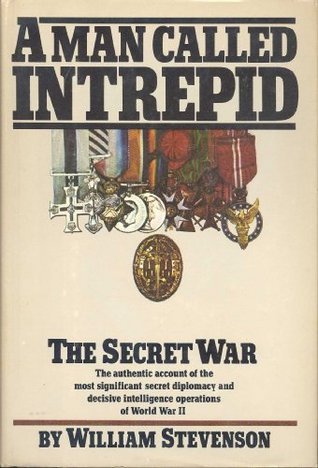
A Man Called Intrepid: The Secret War
He masterminded the international intelligence network that halted the Nazi juggernaut. Sir Wm Stephenson, the man called Intrepid, & his activities are this book's subject. Because he sought anonymity, held no military rank & wore no uniform after 1918, he never publicly displayed the decorations & medals awarded him. He holds the (UK) Military Cross, Distinguished Flying Cross, '14-15 Star, General Service Medal, WWI Victory Medal, Badge of Knighthood; (French) Commander of the Legion of Honor, (Belgian) Croix de Guerre with Palms; (USA) Presidential Medal for Merit--the 1st non-American to receive it.
Stevenson, no relative of Sir William despite the similarity of their names, is a Canadian, tho born in England. He's a journalist, having been a foreign correspondent & bureau chief for British & Canadian papers. He's been a tv writer & producer & author of seven previous books. His most recent journalistic achievement was 90 Minutes at Entebbe, the account of Israel's rescue mission. He was a naval flyer during WWII & met Sir William on special assignment to intelligence. They've remained friends ever since. Sir William entrusted his files to Stevenson with authority & discretion to write this selective narrative.
Stevenson, no relative of Sir William despite the similarity of their names, is a Canadian, tho born in England. He's a journalist, having been a foreign correspondent & bureau chief for British & Canadian papers. He's been a tv writer & producer & author of seven previous books. His most recent journalistic achievement was 90 Minutes at Entebbe, the account of Israel's rescue mission. He was a naval flyer during WWII & met Sir William on special assignment to intelligence. They've remained friends ever since. Sir William entrusted his files to Stevenson with authority & discretion to write this selective narrative.
512 pages, Hardcover
First published January 1, 1976
About the author
William Stevenson
199 books74 followersLibrarian Note: There is more than one author in the Goodreads database with this name.
William Stevenson was a British-born Canadian author and journalist. His 1976 book "A Man Called Intrepid" was about William Stephenson (no relation) and was a best-seller. It was made into a 1979 mini-series starring David Niven and Stevenson followed it up with a 1983 book titled "Intrepid's Last Case."
Stevenson set a record with another 1976 book, "90 Minutes at Entebbe." The book was about Operation Entebbe, an operation where Israeli commandos secretly landed at night at Entebbe Airport in Uganda and succeeded in rescuing the passengers of an airliner hi-jacked by Palestinian militants, while incurring very few casualties. The remarkable record in that pre-internet age is that Stevenson's "instant book" was written, edited, printed and available for sale within weeks of the event it described.
William Stevenson was a British-born Canadian author and journalist. His 1976 book "A Man Called Intrepid" was about William Stephenson (no relation) and was a best-seller. It was made into a 1979 mini-series starring David Niven and Stevenson followed it up with a 1983 book titled "Intrepid's Last Case."
Stevenson set a record with another 1976 book, "90 Minutes at Entebbe." The book was about Operation Entebbe, an operation where Israeli commandos secretly landed at night at Entebbe Airport in Uganda and succeeded in rescuing the passengers of an airliner hi-jacked by Palestinian militants, while incurring very few casualties. The remarkable record in that pre-internet age is that Stevenson's "instant book" was written, edited, printed and available for sale within weeks of the event it described.
Ratings & Reviews
Friends & Following
Create a free account to discover what your friends think of this book!
Community Reviews
Displaying 1 - 30 of 405 reviews

July 13, 2023
Very much enjoyed reading the history and personal stories of the people who helped defend Britian through impossible odds. The book is about 50 years old so other information may be available. I personally tend to enjoy the individual episodes of patriots, spies and everyday people doing extraordinary things. I had no idea what a huge role Canada played in the war effort. As a big fan of Churchill this book added a bit more info as I had just finished a biography of him. Even J Edgar Hoover participation is described. The sections I didn't care for and skimmed was reading about the bureaucracy. My favorite part of the book would be the first 1/3 of the book. The rest was entertaining.

August 11, 2016
4.5 stars - highly recommended
I was seven months old when HMAS Sydney II was sunk by the German raider Kormoran in November 1941 killing all 645 Australian naval personnel on board including my father. I read this book when it was first published in the mid 70's and it was probably even better second time around. For anyone interested in WW II it has everything: politics, intrigue, heroism, espionage, all on an almost unworldly scale, but for sheer doggedness and dedication to his country and his cause, Bill Stephenson, known as Intrepid, stands like a colossus astride the deadly conflict imposed by Adolf Hitler on Europe and the free world (plus Russia which, while an ally, was hardly "free"). The writer, William Stevenson, is not related to "Intrepid"
I was seven months old when HMAS Sydney II was sunk by the German raider Kormoran in November 1941 killing all 645 Australian naval personnel on board including my father. I read this book when it was first published in the mid 70's and it was probably even better second time around. For anyone interested in WW II it has everything: politics, intrigue, heroism, espionage, all on an almost unworldly scale, but for sheer doggedness and dedication to his country and his cause, Bill Stephenson, known as Intrepid, stands like a colossus astride the deadly conflict imposed by Adolf Hitler on Europe and the free world (plus Russia which, while an ally, was hardly "free"). The writer, William Stevenson, is not related to "Intrepid"

June 4, 2015
A real-life W2 thriller you won't forget, from the sinking of the Bismarck, the development of the A bomb, the Isolationism of America prior to Pearl Harbor, the assassination of Reinhard Heydrich ("the butcher of Prague"), the exploits of a beautiful Allied spy code-named CYNTHIA and the perfidy of monstrous Stalin, to the double-crossing-defeatist US Ambassador Joseph P. Kennedy. Minor heroic roles by Ian Fleming, Leslie Howard and good deeds by Garbo.

March 14, 2019
Outstanding true story of espionage and sabotage during WWII ... many of the episodes are exciting to read even from this distance in time ... I found many examples of information my fictional character Berthold Becker might get to MI6 ... the only confusion: William Stevenson the author is not related to the William Stephenson whose exploits the book relates

January 25, 2017
"A Man Called Intrepid" is partly an account of Canadian-born spymaster William Stephenson's central role in the development of the British-American intelligence system during WW2; and partly a revelation of the absolutely critical role that intelligence services (e.g. code-breaking, espionage, and sabotage) played in the defeat of the Axis powers in WW2. I use the term "revelation" because at the time of it's publication in 1976, the secrets of Bletchley Park (the British code-breaking center disguised as a radio factory) and ULTRA (code name for British intelligence information) had only recently been declassified.
WW2 is often discussed as a conflict decided by sheer military might. While it is true that the combined power of the Russian, British and American armies was essential to Allied victory, this book proves that the war would have been lost before the Americans formally intervened if it were not for the actions of Stephenson's clandestine intelligence agency operating in Bletchley, Canada, and the US. A prominent example of this is the role that ULTRA played in anticipating German strategy during the Battle of Britain. More intriguing, though, are the lesser-known examples of Stephenson's network's direct influence on Allied victories and overall strategy throughout the war - e.g. the coordination of Yugoslav resistance to the Nazis under "Tito" (which fatally delayed the German invasion of Russia); the disruption of the Norsk Hydro plant in Norway to prevent German nuclear armament; and the "disastrous" raid on Dieppe intended to confuse the Germans about the planned location of the D-Day invasion.
Moreover, the author's examination of heretofore concealed intelligence that influenced Allied decision making adds valuable perspective to the debate over certain morally questionable acts of violence carried out by the British and the Americans during the the war, including the planned assault on a Gestapo center in Copenhagen that resulted in predictable civilian deaths. The author provides detailed context - unknown to the public for years - for some of the wartime decisions that likely tortured Stephenson, Churchill and others involved in the highest levels of intelligence gathering and war planning. However, at one point the author unnecessarily tips the scale in favor of his subject by quoting the family member of a civilian killed in an Allied bombing raid. The anonymous family member forgives the planners of the raid and retrospectively acknowledges the strategic value of the attack.
Even those uninspired by military history will find appeal in the accounts of tremendous individual cunning and sacrifice shown by the members of Stephenson's vast spy network. The author highlights in thrilling detail the exploits of regular men and women transformed into spies and saboteurs, such as the infamous code name CYNTHIA, an American socialite who engaged with married foreign diplomats to among other objectives pilfer French naval codes and obtain other details of the Vichy French strategy. A quick internet search reveals that some of these stories are refuted or dismissed as exaggeration, but to the extent that the author's descriptions are regarded as truthful they evince the extremely personal nature of warfare during WW2, as well as the extent to which large-scale military operations depended on the secretive actions of civilians turned spies.
I would characterize this book as essential reading for military historians. It is likely the first, and probably the most comprehensive, account of William Stephenson's role in building the vast and indispensable intelligence network that kept Great Britain in the fight long enough to compel American intervention, and which eventually formed the backbone of intelligence gathering and strategic operations on the Allied side throughout WW2. More importantly, though, the book conveys, and supports with intricate detail, the reality that the most massive and consequential conflict of our time was decided by the ingenuity of code-breakers, civilian spies, and unassuming men like William Stephenson, who to a great extent remain absent from the history books.
WW2 is often discussed as a conflict decided by sheer military might. While it is true that the combined power of the Russian, British and American armies was essential to Allied victory, this book proves that the war would have been lost before the Americans formally intervened if it were not for the actions of Stephenson's clandestine intelligence agency operating in Bletchley, Canada, and the US. A prominent example of this is the role that ULTRA played in anticipating German strategy during the Battle of Britain. More intriguing, though, are the lesser-known examples of Stephenson's network's direct influence on Allied victories and overall strategy throughout the war - e.g. the coordination of Yugoslav resistance to the Nazis under "Tito" (which fatally delayed the German invasion of Russia); the disruption of the Norsk Hydro plant in Norway to prevent German nuclear armament; and the "disastrous" raid on Dieppe intended to confuse the Germans about the planned location of the D-Day invasion.
Moreover, the author's examination of heretofore concealed intelligence that influenced Allied decision making adds valuable perspective to the debate over certain morally questionable acts of violence carried out by the British and the Americans during the the war, including the planned assault on a Gestapo center in Copenhagen that resulted in predictable civilian deaths. The author provides detailed context - unknown to the public for years - for some of the wartime decisions that likely tortured Stephenson, Churchill and others involved in the highest levels of intelligence gathering and war planning. However, at one point the author unnecessarily tips the scale in favor of his subject by quoting the family member of a civilian killed in an Allied bombing raid. The anonymous family member forgives the planners of the raid and retrospectively acknowledges the strategic value of the attack.
Even those uninspired by military history will find appeal in the accounts of tremendous individual cunning and sacrifice shown by the members of Stephenson's vast spy network. The author highlights in thrilling detail the exploits of regular men and women transformed into spies and saboteurs, such as the infamous code name CYNTHIA, an American socialite who engaged with married foreign diplomats to among other objectives pilfer French naval codes and obtain other details of the Vichy French strategy. A quick internet search reveals that some of these stories are refuted or dismissed as exaggeration, but to the extent that the author's descriptions are regarded as truthful they evince the extremely personal nature of warfare during WW2, as well as the extent to which large-scale military operations depended on the secretive actions of civilians turned spies.
I would characterize this book as essential reading for military historians. It is likely the first, and probably the most comprehensive, account of William Stephenson's role in building the vast and indispensable intelligence network that kept Great Britain in the fight long enough to compel American intervention, and which eventually formed the backbone of intelligence gathering and strategic operations on the Allied side throughout WW2. More importantly, though, the book conveys, and supports with intricate detail, the reality that the most massive and consequential conflict of our time was decided by the ingenuity of code-breakers, civilian spies, and unassuming men like William Stephenson, who to a great extent remain absent from the history books.
December 27, 2023
My parents got me A MAN CALLED INTREPID back in the Seventies when it became a huge best-seller in the U.S. The publishers sold it on the spurious grounds that "Intrepid was the real James Bond", a claim since withdrawn. The book is great fun in detailing the adventures in Occupied Europe of a loyal Canadian agent whom Churchill dubbed "Intrepid" for his boldness and courage. Whether any of this tale is true, Intrepid's British agents blowing up Nazi trains or laying the groundwork for D-Day by tying down whole Nazi divisions is left up to the reader. A delightful read for a teenage boy in Southern California during a hot summer.

September 9, 2015
A Man Called Intrepid: The Secret War should be assigned to every high school student in the United States. Not only does it detail how World War II could not have been won without intelligence work and precisely directed underground armies, it is a warning regarding the world today. Author William Stevenson makes clear that Hitler’s Third Reich was the first modern terroristic state and it used the latest technology to subdue—or annihilate—the will of others to defend themselves.
It would be impossible to write the entire story of how Nazi totalitarianism was defeated through espionage and resistance movements; therefore, Stevenson concentrates on British Security Coordination (BSC) and its leader, William Stephenson. (Yes, it’s an ironic twist of names!) Canadian Stephenson was the direct link between Churchill and Roosevelt and directed the actors, forgers, thugs, professors, artists, magicians, businessmen, and eccentrics who comprised BSC. Among others who played a role in BSC’s operations were Greta Garbo, Noel Coward, Vincent Astor, Nelson Rockefeller, Roald Dahl, and Ian Fleming, the creator of James Bond. No daring bit of intrigue that ever appeared in one of Fleming’s novels has ever topped the actual operations that BSC routinely ran from 1938 through the end of the war.
Author Stevenson makes very clear the difficult moral decisions that had to be made. For example, Churchill and BSC knew that the Germans were going to bomb the town of Coventry, but made the decision not to issue warnings. To do so would reveal to the Nazis that their codes had been broken and that revelation could not be risked.
The most chilling aspect of A Man Called Intrepid is not the window that it opens to the past, but the light that it sheds on the terroristic states that are alive and well today. We tend to think that the past was pre-ordained, but Stevenson makes it all too clear that Britain survived because of the vision of a few—and a lot of luck. He makes it clear that terrorists can never be appeased no matter how many concessions are made to them, and that most people the world over are complacent as long as evil is happening to someone else. The book, written in 1976 is not only history, but prophecy. I cannot recommend it highly enough for any concerned citizen of the world.
It would be impossible to write the entire story of how Nazi totalitarianism was defeated through espionage and resistance movements; therefore, Stevenson concentrates on British Security Coordination (BSC) and its leader, William Stephenson. (Yes, it’s an ironic twist of names!) Canadian Stephenson was the direct link between Churchill and Roosevelt and directed the actors, forgers, thugs, professors, artists, magicians, businessmen, and eccentrics who comprised BSC. Among others who played a role in BSC’s operations were Greta Garbo, Noel Coward, Vincent Astor, Nelson Rockefeller, Roald Dahl, and Ian Fleming, the creator of James Bond. No daring bit of intrigue that ever appeared in one of Fleming’s novels has ever topped the actual operations that BSC routinely ran from 1938 through the end of the war.
Author Stevenson makes very clear the difficult moral decisions that had to be made. For example, Churchill and BSC knew that the Germans were going to bomb the town of Coventry, but made the decision not to issue warnings. To do so would reveal to the Nazis that their codes had been broken and that revelation could not be risked.
The most chilling aspect of A Man Called Intrepid is not the window that it opens to the past, but the light that it sheds on the terroristic states that are alive and well today. We tend to think that the past was pre-ordained, but Stevenson makes it all too clear that Britain survived because of the vision of a few—and a lot of luck. He makes it clear that terrorists can never be appeased no matter how many concessions are made to them, and that most people the world over are complacent as long as evil is happening to someone else. The book, written in 1976 is not only history, but prophecy. I cannot recommend it highly enough for any concerned citizen of the world.

February 2, 2012
This is only in part a biography of Sir William Stephenson (1/23/1897–1/31/1989) through the war. It is primarily a history of the coordination of the intelligence services of the British Commonwealth and the U.S.A. during WWII with which he was involved and for which he was substantially responsible.
A thoughtful page-turner, Stevenson's text deals seriously with the problematics of modern statecraft, intelligence capabilities and warfare and how it might be possible to preserve some degree of openness, accountability and humanity. Many of the examples presented from the war in Europe highlight such conflicts poignantly.
The greatest flaw of this book is that it focuses almost entirely on the years 1939 through 1942 in Europe and the Americas. The Pacific campaigns are barely touched upon and events in the war and in intelligence after 1942 are sketched very lightly. Presumably this reflects a more limited involvement--or greater reticence--in these affairs by his subject. In any case, this is not a general survey of Allied intelligence coordination during the second world war. It is, however, within its limits, a fine book.
A thoughtful page-turner, Stevenson's text deals seriously with the problematics of modern statecraft, intelligence capabilities and warfare and how it might be possible to preserve some degree of openness, accountability and humanity. Many of the examples presented from the war in Europe highlight such conflicts poignantly.
The greatest flaw of this book is that it focuses almost entirely on the years 1939 through 1942 in Europe and the Americas. The Pacific campaigns are barely touched upon and events in the war and in intelligence after 1942 are sketched very lightly. Presumably this reflects a more limited involvement--or greater reticence--in these affairs by his subject. In any case, this is not a general survey of Allied intelligence coordination during the second world war. It is, however, within its limits, a fine book.
March 28, 2024
Audible sale (#29 of 40) 21 hours 27 min. Narrated by David McAlister (C)
This is such an important history of the secret war leading up to the entrance of U.S. into WW2. It is so much more than a biography of William Stephenson. If you find the book, at least read the last chapter. Then you want to read the entire book!
Paperback Used, Very good condion Available at Better World Books under $7.00 free shipping.
This is such an important history of the secret war leading up to the entrance of U.S. into WW2. It is so much more than a biography of William Stephenson. If you find the book, at least read the last chapter. Then you want to read the entire book!
Paperback Used, Very good condion Available at Better World Books under $7.00 free shipping.

September 28, 2014
Very interesting book. It's not a biography of a James Bond-like superspy, like I was expecting (and like the dust jacket leads you to expect). It's more of a view of espionage and intelligence in Britain and the US during World War II, with particular emphasis on the contributions of one man, William Stephenson. It was very interesting: I definitely learned a lot that I hadn't known before, and I consider myself pretty knowledgeable about World War II.
Sometimes I was getting lost in where we were and what was happening in the rest of the world at this time. The book abruptly ends for no apparent reason, not at the end of the war, but after the bombing of the Gestapo headquarters in Copenhagen in 1945. Why? No idea. A perfect example of my primary complaint about the book: The book is rather chaotic, bouncing back and forth between subjects and time periods without clear direction, at least it seemed to me.
Positive aspects: It was interesting to read the importance of personalities, especially in the areas of intelligence and politics: the personalities of Churchill, Roosevelt and Hoover are central to the storyline. That was fascinating reading. It's easy to forget how close we really were to Hitler conquering the world: the US was reluctant to join the war, in most cases not because we weren't sure that Hitler was a megalomanic or would attack us eventually, but because it was felt that England was already a lost cause and we might as well not waste any more effort in keeping them out of Hitler's clutches. Defeating Hitler really was a close-run thing, and was never a sure bet, even up until the last year of the war. This book illustrates that well. I was also very interested to read the hard decisions that had to be made, having to let people die or reputations be tarnished rather than betray the secrets that had to be kept. Very tough choices.
Sometimes I was getting lost in where we were and what was happening in the rest of the world at this time. The book abruptly ends for no apparent reason, not at the end of the war, but after the bombing of the Gestapo headquarters in Copenhagen in 1945. Why? No idea. A perfect example of my primary complaint about the book: The book is rather chaotic, bouncing back and forth between subjects and time periods without clear direction, at least it seemed to me.
Positive aspects: It was interesting to read the importance of personalities, especially in the areas of intelligence and politics: the personalities of Churchill, Roosevelt and Hoover are central to the storyline. That was fascinating reading. It's easy to forget how close we really were to Hitler conquering the world: the US was reluctant to join the war, in most cases not because we weren't sure that Hitler was a megalomanic or would attack us eventually, but because it was felt that England was already a lost cause and we might as well not waste any more effort in keeping them out of Hitler's clutches. Defeating Hitler really was a close-run thing, and was never a sure bet, even up until the last year of the war. This book illustrates that well. I was also very interested to read the hard decisions that had to be made, having to let people die or reputations be tarnished rather than betray the secrets that had to be kept. Very tough choices.

September 13, 2014
Came across a mention of this book on Goodreads and remembered reading it years ago. Its about the birth of the British Secret Service during the second world war - what was to later become MI6. And about two men's determination not to lose a lost war: Winston Churchill, and William Stephenson. It offers fascinating insights into how individual events change the course of history, and how easily everything could have been otherwise. Also, it's difficult to forget because of a quirky little detail -- it's the biography of William Stephenson, written by William Stevenson, no relation.

August 15, 2012
Not a bad novel although the author is naive to think Stephenson, Roosevelt or Churchill were any better than their enemies. They were willing to sacrifice innocent victims (Coventry) and naval divisions (Dieppe) as part of their "end justifies the means" philosophy. That intel is of critical importance in war is obvious and the allies were fortunate that the Third Reich were more concerned with mass exterminations.

January 5, 2022
I couldn't finish this. I usually love books about WWII and espionage buy this book was just a drag. I couldn't stay focused for the life of me. I listened to it, so it could be partially the narrator's fault. His style of reading was extremely flat and disjointed. But I also got to the point where I felt the writing itself was also extremely disjointed and disorganized. The author kept going back and forth in the timeline without actually saying he was doing so, he would hop from topic to topic without drawing them together in any coherent manner. It was often very hard to understand who was actually talking when he quoted someone. The writing was just very hard to follow. I understand espionage can be complicated but it seemed like this author just info-dumped his research without trying to organize it at all.

November 8, 2016
มีการเล่าเรื่องที่เหมือนจังหวะการเต้นรำ
ที่เดินหน้าถอยหลังหมุนวนอยู่รอบสถานการณ์จนแจ่มแจ้ง
แล้วจึงขยับไปเล่าเรื่องต่อๆ ไปด้วยวิธีเดียวกัน
การดำเนินเรื่องจึงเป็นไปอย่างช้าๆ
ไม่ได้เน้นที่ความตื่นเต้นในยุทธการศึก
ไม่ได้ออกแนวนิยายสายลับอย่างที่เข้าใจในคราแรก
แต่เน้นความครอบคลุมรอบด้านของข้อมูลที่ต้องการจะเล่า
เน้นที่การวางชั้นเชิงทางสงครามมากกว่า
ผู้อ่านที่ชอบในเรื่องของประวัติศาสตร์สงคราม
ทำนองแฟนพันธุ์แท้สงครามโลก น่าจะอ่านสนุก
มีอะไรอีกหลายอย่างที่อยากพูดถึงหนังสือเล่มนี้
เราเล่าเอาไว้ละเอียดกว่านี้ที่นี่ค่ะ
http://www.sosotopia.com/%E0%B8%99%E0...
ที่เดินหน้าถอยหลังหมุนวนอยู่รอบสถานการณ์จนแจ่มแจ้ง
แล้วจึงขยับไปเล่าเรื่องต่อๆ ไปด้วยวิธีเดียวกัน
การดำเนินเรื่องจึงเป็นไปอย่างช้าๆ
ไม่ได้เน้นที่ความตื่นเต้นในยุทธการศึก
ไม่ได้ออกแนวนิยายสายลับอย่างที่เข้าใจในคราแรก
แต่เน้นความครอบคลุมรอบด้านของข้อมูลที่ต้องการจะเล่า
เน้นที่การวางชั้นเชิงทางสงครามมากกว่า
ผู้อ่านที่ชอบในเรื่องของประวัติศาสตร์สงคราม
ทำนองแฟนพันธุ์แท้สงครามโลก น่าจะอ่านสนุก
มีอะไรอีกหลายอย่างที่อยากพูดถึงหนังสือเล่มนี้
เราเล่าเอาไว้ละเอียดกว่านี้ที่นี่ค่ะ
http://www.sosotopia.com/%E0%B8%99%E0...

November 25, 2010
Fantastic book, loved the writing, it's a great page turner too.

August 5, 2017
Alternate title: The Man Who Saved the World.
As a Canadian I was well aware that there was an important WWII fella called "Intrepid". When this book and prior classified material was released in the 70's it caused a lot of excitement in this country.
Here was a Canadian who'd played an integral part in WWII.
However my impression gleaned through the media of the time was that Bill Stephenson (Intrepid). Was some guy who ran a spy training camp (Camp X) in Ontario.
And when the only picture you ever see of him is the one on the book cover you can't help but think of a typical bland Canadian bureaucrat (we have a surplus of them in this country).
However the story is far more interesting than that.
Stephenson was a war hero (WW I) a multi-milionaire businessman and a champion boxer. He foresaw (and wrote about) something he called "tele-vision", was partially the impetus for the BBC and was the driving force between the creation of both the British and US secret services during WWII. It was Stephenson who essentially hand-picked Bill Donovan to be the US liaison with the British secret service (incredible as it might seem the US didn't have any spy capability at the beginning of the war short of some FBI stuff) and Donovan went on to head the OSS which evolved into what is now known as CIA.
And Stephenson was a critical conduit between Roosevelt and Churchill during the early years of the war when the US was (supposedly) neutral.
Reading this book is I think essential for anyone who thinks they know the full story of WWII. The problem is that most of us know how the war ends. So we tend to think in a very linear arc: Hitler invades Europe, Allies have a couple of rough years early on, Hitler goes into Russia (big mistake) Japan bombs Pearl Harbour (big mistake). America rides to the rescue and blah blah blah Stalingrad, Normandy, Hiroshima and we all live happily ever after, roll credits.
But we tend to forget (or a lot of books about the war minimize) just how bad the situation was up until 1942.
After Dunkirk the British essentially had no Army. Everyone thought they were done for. And Stephenson's (Intrepid) early role wasn't about setting up an intelligence network to help military operations against the Nazis' but to prepare for operations during the German occupation of Britain.
In fact the good chunk of his organization was based in New York not Britain for that very reason.
Also it surprised me how many people in both the US and UK were openly advocating making a deal with Hitler because the British empire was done for and the "German empire" was looking invincible.
Not only that but there were actual peace negotiations going on between Britain and Germany through Mussolini....
And during the years before America entered the war both German and Vichy France representatives flocked to the US to act as propagandists and to add fuel to the already simmering American "isolationist" fire.
Even if Stephenson wasn't as big a figure as the book portrays (there is some debate about this). This book is worth a read to learn about the "secret armies" that toiled in obscurity and often died in anonymity (some of their stories including that of three remarkable women) are told here.
And also because we tend to forget how close we came to losing WWII.
If you are interested in the beginning of modern Spycraft - read this book. If you want to know more about WWII beyond military operations read this book. If you need to be reminded how easily totalitarianism can lure people into thinking appeasement can work, read this book....
As a Canadian I was well aware that there was an important WWII fella called "Intrepid". When this book and prior classified material was released in the 70's it caused a lot of excitement in this country.
Here was a Canadian who'd played an integral part in WWII.
However my impression gleaned through the media of the time was that Bill Stephenson (Intrepid). Was some guy who ran a spy training camp (Camp X) in Ontario.
And when the only picture you ever see of him is the one on the book cover you can't help but think of a typical bland Canadian bureaucrat (we have a surplus of them in this country).
However the story is far more interesting than that.
Stephenson was a war hero (WW I) a multi-milionaire businessman and a champion boxer. He foresaw (and wrote about) something he called "tele-vision", was partially the impetus for the BBC and was the driving force between the creation of both the British and US secret services during WWII. It was Stephenson who essentially hand-picked Bill Donovan to be the US liaison with the British secret service (incredible as it might seem the US didn't have any spy capability at the beginning of the war short of some FBI stuff) and Donovan went on to head the OSS which evolved into what is now known as CIA.
And Stephenson was a critical conduit between Roosevelt and Churchill during the early years of the war when the US was (supposedly) neutral.
Reading this book is I think essential for anyone who thinks they know the full story of WWII. The problem is that most of us know how the war ends. So we tend to think in a very linear arc: Hitler invades Europe, Allies have a couple of rough years early on, Hitler goes into Russia (big mistake) Japan bombs Pearl Harbour (big mistake). America rides to the rescue and blah blah blah Stalingrad, Normandy, Hiroshima and we all live happily ever after, roll credits.
But we tend to forget (or a lot of books about the war minimize) just how bad the situation was up until 1942.
After Dunkirk the British essentially had no Army. Everyone thought they were done for. And Stephenson's (Intrepid) early role wasn't about setting up an intelligence network to help military operations against the Nazis' but to prepare for operations during the German occupation of Britain.
In fact the good chunk of his organization was based in New York not Britain for that very reason.
Also it surprised me how many people in both the US and UK were openly advocating making a deal with Hitler because the British empire was done for and the "German empire" was looking invincible.
Not only that but there were actual peace negotiations going on between Britain and Germany through Mussolini....
And during the years before America entered the war both German and Vichy France representatives flocked to the US to act as propagandists and to add fuel to the already simmering American "isolationist" fire.
Even if Stephenson wasn't as big a figure as the book portrays (there is some debate about this). This book is worth a read to learn about the "secret armies" that toiled in obscurity and often died in anonymity (some of their stories including that of three remarkable women) are told here.
And also because we tend to forget how close we came to losing WWII.
If you are interested in the beginning of modern Spycraft - read this book. If you want to know more about WWII beyond military operations read this book. If you need to be reminded how easily totalitarianism can lure people into thinking appeasement can work, read this book....

February 9, 2016
It has been said that TIMING IS EVERYTHING. Had I finished this book a few days earlier, I would have given it 4 stars, although recommending it highly. But yesterday I heard an interview on NPR with Pat Buchanan and upon reflection changed my rating to 5 stars.
Buchanan defended his choice to support Donald Trump as the Republican nominee for President while at the same time lauding his own proclamations and predictions which he believes to have come true. One of the key areas Trump and Buchanan have in common is foreign policy, particularly an isolationist view.
In the final chapter of the book, William Stephenson the author visits William Stephenson, the man called INTREPID. The latter is quoted,
“At the worst moment in Britain’s resistance in 1940 John Buchan wrote, ‘The United States is actually and potentially the most powerful State on the globe. She has much, I believe, to give the world; indeed, to her hands is chiefly entrusted the shaping of the future. If democracy in the broadest sense is to survive, it will be mainly because of her guardianship. For, with all her imperfections, she has a clearer view than any other people of the democratic fundamentals.’ “Every word is true today. Which is why our enemies would like to isolate the United States and see her retreat from the confusion and the chaos as she did during the rise of the Third Reich.”
A MAN CALLED INTREPID tells the story of Britain’s spy network during World War II and her collaboration (not always friendly) with the US, Canada, and European Resistance to help defeat Hitler. It is written here: THERE ARE MANY KINDS OF MANEUVERS IN WAR, SOME ONLY OF WHICH TAKE PLACE UPON THE BATTLEFIELD. We learn through this book of the behind the scenes intrigue that helped win battles and of the agonizing decisions that sacrificed thousands of lives for the greater good.
Not a page-turner, but a book that tells a largely unknown story of still nameless men and women who fought for their countries and for freedom.
Buchanan defended his choice to support Donald Trump as the Republican nominee for President while at the same time lauding his own proclamations and predictions which he believes to have come true. One of the key areas Trump and Buchanan have in common is foreign policy, particularly an isolationist view.
In the final chapter of the book, William Stephenson the author visits William Stephenson, the man called INTREPID. The latter is quoted,
“At the worst moment in Britain’s resistance in 1940 John Buchan wrote, ‘The United States is actually and potentially the most powerful State on the globe. She has much, I believe, to give the world; indeed, to her hands is chiefly entrusted the shaping of the future. If democracy in the broadest sense is to survive, it will be mainly because of her guardianship. For, with all her imperfections, she has a clearer view than any other people of the democratic fundamentals.’ “Every word is true today. Which is why our enemies would like to isolate the United States and see her retreat from the confusion and the chaos as she did during the rise of the Third Reich.”
A MAN CALLED INTREPID tells the story of Britain’s spy network during World War II and her collaboration (not always friendly) with the US, Canada, and European Resistance to help defeat Hitler. It is written here: THERE ARE MANY KINDS OF MANEUVERS IN WAR, SOME ONLY OF WHICH TAKE PLACE UPON THE BATTLEFIELD. We learn through this book of the behind the scenes intrigue that helped win battles and of the agonizing decisions that sacrificed thousands of lives for the greater good.
Not a page-turner, but a book that tells a largely unknown story of still nameless men and women who fought for their countries and for freedom.

January 24, 2017
William Stevenson’s book about Sir William Stephenson (the likeness in names is entirely coincidental), the real life inspiration behind Ian Fleming’s James Bond, makes less sense than the average James Bond film, unfortunately. While the facts reported in the book are intriguing and there are occasional glimpses into the nascent world of modern spycraft around the beginning of the second World War, Stevenson seems more often than not to fumble the delivery of said facts.
There is, for instance, a few great references to a man named Colin Gubbins in the first section of the book - a man who snuck into Poland immediately prior to its invasion by Germany to snatch a copy of the Enigma coding machine, and then resurfaces in Norway shortly afterwards to disrupt a heavy water production center (vital to the research and development of nuclear weapons) shortly before it, too, fell into Nazi hands. His activity is the stuff of great spy novels, but is delivered in bare snippets, unconnected from the main through line.
Perhaps the best example of this dissonance - great content delivered poorly - is in the fact that Sir William Stephenson was friends and colleagues with people as wide-ranging as H.G. Wells, George Orwell, Greta Garbo, Wild Bill Donovan, and Ian Fleming, but the book remains stilted and, dare I say it, boring.
I don’t know how you turn the life of a remarkable man like Stephenson into such an off-putting book, but Stevenson managed it. The one upside to the book, though, is that while it frustrated me, it made me really want to read more about the spycraft of World War II.
There is, for instance, a few great references to a man named Colin Gubbins in the first section of the book - a man who snuck into Poland immediately prior to its invasion by Germany to snatch a copy of the Enigma coding machine, and then resurfaces in Norway shortly afterwards to disrupt a heavy water production center (vital to the research and development of nuclear weapons) shortly before it, too, fell into Nazi hands. His activity is the stuff of great spy novels, but is delivered in bare snippets, unconnected from the main through line.
Perhaps the best example of this dissonance - great content delivered poorly - is in the fact that Sir William Stephenson was friends and colleagues with people as wide-ranging as H.G. Wells, George Orwell, Greta Garbo, Wild Bill Donovan, and Ian Fleming, but the book remains stilted and, dare I say it, boring.
I don’t know how you turn the life of a remarkable man like Stephenson into such an off-putting book, but Stevenson managed it. The one upside to the book, though, is that while it frustrated me, it made me really want to read more about the spycraft of World War II.
March 10, 2024
Read this many years ago when I was more naive.
I would have given it 5 stars then.
I am more cynical now...4 stars.
I would have given it 5 stars then.
I am more cynical now...4 stars.

November 21, 2020
Many find this book a bit dry, but I was fascinated by it.

December 25, 2020
This book is 4.5 stars for me, rounded up because it’s Christmas! This book is incredible. A non-fiction that reveals the official and unofficial heroes of WW2. It reveals the heroism and bravery of everyday people. It discusses the back room discussions and decisions by incredibly wise and strategic leaders, who regularly had to make mind bending choices through years of being between a rock and a hard place. Finally, it was an interesting and informative reveal of the ULTRA system that decoded the Nazi’s enigma machine. I found this book incredibly fast paced, interesting, and deeply humbling and inspiring.
It puts the discomforts of isolation in sharp relief to the horrors of WW2.
“Sometimes you have to lose a battle to save the secret that will win the war”.
Bravo!
It puts the discomforts of isolation in sharp relief to the horrors of WW2.
“Sometimes you have to lose a battle to save the secret that will win the war”.
Bravo!

May 22, 2018
Loved this! Not the easiest or quickest book to read but so so so interesting. This is a book I'll go back to a few more times to remind myself of an amazing man called Intrepid.

October 15, 2012
A fascinating look into the secret war waged by British and American intelligence against Nazi Germany. The book is at its best when it relates the stories of the little people: the young woman parachuted into France to transmit wireless messages to Britain only to immediately see her entire section rounded up by the Germans, the pilot sent to pick up physicists in Sweden and smuggle them back. The human costs of secret warfare is grimly recounted. Is it possible today for us to imagine a government deciding to allow a German bombing raid to succeed, resulting in the deaths of thousands, in order to keep its knowledge of the enemy's secret codes undetected?
There are limitations though. As a book written in the 1970s, when classified material was finally startnig to be released, you can tell that a lot is being held back. Most likely because some secrets still needed to be hidden from the Soviets.
The book also cuts off sharply in 1943, presumably because the British intelligence agency that INTREPID was heading was shut down in the U.S. and the atomic program was also taken over in the main by the U.S. government. But this is all glossed over.
Some of the ideas elucidated in this history are relevant today. That in order to be a free and open society may require more secrecy and subterfuge than we in our modern era are comfortable with. Is it right to break laws, even to the point of murdering spies without trial or official state sanction, in order to combat even greater evils?
There are limitations though. As a book written in the 1970s, when classified material was finally startnig to be released, you can tell that a lot is being held back. Most likely because some secrets still needed to be hidden from the Soviets.
The book also cuts off sharply in 1943, presumably because the British intelligence agency that INTREPID was heading was shut down in the U.S. and the atomic program was also taken over in the main by the U.S. government. But this is all glossed over.
Some of the ideas elucidated in this history are relevant today. That in order to be a free and open society may require more secrecy and subterfuge than we in our modern era are comfortable with. Is it right to break laws, even to the point of murdering spies without trial or official state sanction, in order to combat even greater evils?

December 17, 2019
I had trouble deciding on a rating. Since this was nonfiction, I dont think I should rate it/react to it in the same way as a fictional book.... even though I often did. There were parts that were exciting, intense, and interesting. And there were parts that I wish had more details/been written better... and then I would remember that these stories are real events, real lives... so that was sobering as well as stressful. Just trying to imagine some of the decisions that secret warfare forces you to make...
This book was recommended to me after my response to reading "When I was a German". That book described some of the resistance inside Germany, and I felt their desire to be helped... "Man called Intrepid" described some of the help given by America/Canada/Brittain, while also explaining why the help given was so secretive. "Intrepid" helped illustrate how the secret warfare depended on the individual.. a very lonely and brave task, one in which most people never really knew the full impact of their own missions.
This book was recommended to me after my response to reading "When I was a German". That book described some of the resistance inside Germany, and I felt their desire to be helped... "Man called Intrepid" described some of the help given by America/Canada/Brittain, while also explaining why the help given was so secretive. "Intrepid" helped illustrate how the secret warfare depended on the individual.. a very lonely and brave task, one in which most people never really knew the full impact of their own missions.

November 10, 2015
This is the best book on William Stephenson, head of British Security Coordination and one of the key players in encouraging FDR to: a) create a separate agency for foreign intelligence (and thus replace the FBI's role); and b) appoint William Donovan as the director of the new agency (OSS, forerunner to the CIA).
It is a resource book, and one of the sources I cite in my own book (Into the Lion's Mouth, Berkley, June 14, 2016) for details of how the BSC was involved in counter-espionage in New York in WWII. It's not a narrative story, however, and thus there is no pace, but it is a terrific biography.
It is a resource book, and one of the sources I cite in my own book (Into the Lion's Mouth, Berkley, June 14, 2016) for details of how the BSC was involved in counter-espionage in New York in WWII. It's not a narrative story, however, and thus there is no pace, but it is a terrific biography.

February 22, 2016
A consummate intelligence officer's survey of WWII from a British perspective.
The 5-Star rating was earned because of the exhaustive telling of the story of WWII intelligence gathering and resistance by a wide variety of people of many nations. This was my first exploration into the covert operations ranging from guerrilla action to atomic research. The story of cooperation and concern between the western allies is eye-opening.
I recommend to anyone deeply interested in this focused telling of history's most cataclysmic disaster.
The 5-Star rating was earned because of the exhaustive telling of the story of WWII intelligence gathering and resistance by a wide variety of people of many nations. This was my first exploration into the covert operations ranging from guerrilla action to atomic research. The story of cooperation and concern between the western allies is eye-opening.
I recommend to anyone deeply interested in this focused telling of history's most cataclysmic disaster.

March 4, 2017
Very intriguing read
I learned a lot while reading this book all of which was not taught in schools because of the secrecy invoked by the government's at the time and even to this day is a lot of knowledge of what went on and happened still is unknown and or may never be known
I learned a lot while reading this book all of which was not taught in schools because of the secrecy invoked by the government's at the time and even to this day is a lot of knowledge of what went on and happened still is unknown and or may never be known
October 30, 2008
This is the second time I've read this book. I enjoyed it very much again and thirty years of experience gave me new insights into the challenges "Intrepid" faced and overcame.

September 6, 2010
Ian Fleming himself once wrote, "James Bond is a highly romanticized version of a true spy. The real thing is ... William Stephenson."
March 13, 2016
Read 3 times,...
Displaying 1 - 30 of 405 reviews