

What do you think?

The Girl in the Picture: The Story of Kim Phuc, the Photograph, and the Vietnam War
Finalist for the 2000 Governor General’s Award By the author of the award-winning memoir The Concubine’s Children On June 8, 1972, a nine-year-old girl, severely burned by napalm, ran from a misplaced air strike over her village in South Vietnam and into the eye of history. Her photograph—one of the most unforgettable images of the war and of the twentieth century—was seen around the world. The Girl in the Picture is at once a riveting personal story about Kim Phuc, a victim of war and later, under the Communist regime, a tool of propaganda, and a groundbreaking social history that offers a rare view of everyday life in Vietnam both during and after the war.
376 pages, Paperback
First published September 1, 1999
About the author
Denise Chong
10 books42 followersDenise Chong is an award-winning author whose work portrays the lives of ordinary people caught in the eye of history. Best known for her family memoir, The Concubine’s Children; The Girl in the Picture about the napalm girl of the Vietnam War; and Egg on Mao, a story of love and defiance in China of 1989, she lives in Ottawa.
Ratings & Reviews
Friends & Following
Create a free account to discover what your friends think of this book!
Community Reviews
Displaying 1 - 30 of 231 reviews

December 14, 2017
Denise Chong's The Girl In The Picture looks at the life of Kim Phuc, the Vietnamese woman whose terrified, naked, nine-year-old self was immortalized in a famous war photograph taken in June of 1972.
You've seen the photograph. Badly burned after her village was bombed with napalm, the girl runs toward the camera, her mouth open in pain, her arms held loose at her sides.
To some, the photograph – taken by Vietnamese photographer Nick Ut – represents the destruction and senselessness of war.
But the picture has also contributed to the enduring myth of the helpless Asian refugee, one reinforced by images as diverse as the Vietnamese boat people, the musical Miss Saigon and even the recent arrests of illegal, stowed-away Chinese immigrants to Canada.
Chong doesn't address the sexual and cultural politics inherent in the photograph, but she does work hard to fill out the life, pre- and post-photograph, of Phuc, who now lives in Ajax, Ontario.
She also shows how, years after the bombing, Phuc and her image were exploited by Vietnamese authorities, who prevented her from fulfilling her dream of becoming a doctor by forcing her to travel and represent the Communist regime.
Chong, whose background is in economics, writes prose that is clear yet seldom rises above the utilitarian. Here, you can see her struggling to make her facts – which range from the history of the Vietnam war to the intricacies of making and selling noodle soup – fit into the confines of a book. Her inexperience shows. She's not helped by the fact that Phuc herself isn't a very active or vivid presence.
But in telling Kim Phuc's story, however gracelessly, Chong does manage to humanize history and stop us from sentimentalizing an image we all thought we knew.

September 15, 2012
At first glance, The Girl in the Picture is the incredible and inspiring account of a young girl; a victim of war. Look a little closer, though, and you will find a powerful deconstruction of wartime politics and moving commentary about humanity itself. For the world to see a child running in terror from an earth-shaking explosion; to see her body and clothes burned away from the excruciatingly painful napalm boiling into her bones; to look straight into her eyes and identify with her humanity… this is a picture to end a war.
Aside from the picture itself and the amazing story of Kim Phuc’s life, what I found most interesting about this book was the author’s commentary about the United State’s reaction to international conflict. She mentioned that once the Americans pulled out of Vietnam altogether, “In the United States, war reporting fell from the front pages of newspapers and from nightly television newscasts: Vietnamese killing other Vietnamese evidently did not interest the American public.”
That was in 1971. Today we can claim no legitimate progress. Over 40 years have come and gone and yet our response to war seems no different. It is too often the case that brutal deaths are publicly mourned by Americans only when the victims were “of our own.” This is the ethnocentrism of war— death doesn’t matter unless it’s American.
Kim Phuc is a strong human being with a wonderful heart. She has suffered through a lifetime of pain and poverty only to overcome her suffering and harden her resolve to forgive, to promote peace, to offer help in whatever ways she is able. That is true humanity. But Kim Phuc is not the only one, she is not the only victim. Her picture has changed the world, but we have found ourselves in a new war, with new horrors and new victims.
I want to know— Where is the picture that will end this war? Where is the picture that will end all war?
Aside from the picture itself and the amazing story of Kim Phuc’s life, what I found most interesting about this book was the author’s commentary about the United State’s reaction to international conflict. She mentioned that once the Americans pulled out of Vietnam altogether, “In the United States, war reporting fell from the front pages of newspapers and from nightly television newscasts: Vietnamese killing other Vietnamese evidently did not interest the American public.”
That was in 1971. Today we can claim no legitimate progress. Over 40 years have come and gone and yet our response to war seems no different. It is too often the case that brutal deaths are publicly mourned by Americans only when the victims were “of our own.” This is the ethnocentrism of war— death doesn’t matter unless it’s American.
Kim Phuc is a strong human being with a wonderful heart. She has suffered through a lifetime of pain and poverty only to overcome her suffering and harden her resolve to forgive, to promote peace, to offer help in whatever ways she is able. That is true humanity. But Kim Phuc is not the only one, she is not the only victim. Her picture has changed the world, but we have found ourselves in a new war, with new horrors and new victims.
I want to know— Where is the picture that will end this war? Where is the picture that will end all war?

December 31, 2015
“War is what happens when language fails” – Margaret Atwood
Almost everyone agrees that war is futile. However, despite this, generations upon generations are involved in this madness to the extent that peace, today, has become a luxury and not a right. Writing about the different wars that humans have fought from the beginning of time is a popular genre and to be honest, is also a genre that I love a lot. Similarly, memoirs of individuals who have lived through strife and conflict and have emerged victorious is another huge fascination and inspiration for me. So, it is obvious that I would both read and like this current book, which talks about the Vietnam war and about a survivor from that war, where she survived despite the odds being against her.
This is the story of a nine year old girl, who was the victim of napalm burning during the Vietnam war and who survived to tell the tale of her sufferings and the horrors of war that she had witnessed as a child. It is a tale of struggle, pain, redemption, forgiveness and finally love. A tale that will move the hearts of even those who claim to be hardened. An account that is both stark and pragmatic in its narration whilst also being a tale of inspiration to many.
Someone once said and I quote “War is not about who is right; but about who is left” . Truer words have yet to be spoken, especially when you read this book, you feel that being a survivor has its own set of issues, which can be quite morbid at times. If one were to really look at the experiences of survivors of war, one would see and accept that maybe death is the better deal. Nevertheless, those that do survive, live with such a strength that it is truly awe inspiring.
This book deals with a lot of things, including the horrors of the war itself, the world wide political situation during and maybe even after the war; the economic difficulties faced by the Vietnamese as well as certain allied nations; the cruelty of the communist regime; the dichotomy of socialism as seen and experienced by the people; the beauty and strength as well as the love of certain individuals, which help in making living a better deal and finally the divide between the North and the South and the reason for an existing underlying animosity and guilt.
Kim, the protagonist of this book and the girl in the picture, had it really easy in the early years of her life. South Vietnam was bountiful and the smaller towns and villages in that area had always known richness in terms of food and basic necessities. Also, the landscape of South Vietnam was truly beautiful. The North, on the other hand, were not so lucky. Having been invaded by the Japanese and the French, the northern parts were not allowed to grow rich as those in the south were. The war between the two halves of a country for its unification can be termed as being inevitable, especially given the contrast between the two regions in terms of their individual growth. Additionally, the north would have otherwise lived in the constant fear of being taken over by another country, which would mean losing their independence. Whatever the reason, war happened and left in its wake a country that was totally ruined in terms of loss of life but more importantly in terms of loss of stability. It was in this unstable country that Kim would have to recover and survive, which was obviously a tough task for her and others with her.
This book through its beautiful yet simple prose leads us to the various actions by the American army, the guerilla warfare as indulged in by the Viet Cong and the apathy of the civilians in the South due to this incessant yet unnecessary firings and deaths. It also shows the responsibility of the press during such situations, of course, like with most wars the press is neither consistent nor always fulfilling its responsibilities diligently.
The book also deals with the beliefs and faith of the people in the South. Religion, especially the Caodai religion, was still prominent in the South, which was another major difference it had with the Communist North, where religion is nothing but following your leader or comrade. There are situations where this faith and belief is questioned by the protagonist and the pain that she goes through for asking such questions. In fact, the book is written realistically in that no experience is honey coated or exaggerated. It flows naturally and the reader never thinks of questioning the veracity of the events that the books talk about. Of course, it could also be because I have been to Vietnam and have looked at all the places that this book mentions, so I know something of the war and its effect and impact on the people both in the North and the South.
The book talks of people living in tunnels during the course of this war. I have personally visited the tunnels both in Cu-Chi in the south as well as those near the Demilitarized Zone in the North and I have just one word to say – Horrible! Although both the north and the south made sure that people could live in the tunnels, the tunnels by themselves are so narrow and short and dark that one feels claustrophobic to enter them. While some areas a person can go with just a bend of a head (if that person is 5ft tall) there are other places when you have to crawl to move ahead and those are not the worst part of these tunnels. The Cu-Chi tunnels as well as those in the north had fitted some of the entrances with curious yet fatal sharp steel rods, which led to instant death of the enemy. Gory was the picture that one got from visiting these tunnels and let me tell you that I personally baulked from going through those tunnels where you had to crawl. I wondered then and still wonder as to how the people of those regions actually managed to live and survive a war in those times. Truly awe inspiring indeed.
Plato once said and I quote, “only the dead have seen the end of war” and that is true of Vietnam. During my visit there, as curious as I was to see the war museums and other places, including the tunnels; there was a film of quiet that fell on the locals. The North are somehow still ashamed or rather repentant of the war in some ways as they act as if it never took place or are silent to any talk about it, although they do have their own casualties and other problems. In the South, according to one guide who took us through Cu-Chi tunnels, the people hated those from the north for ruining their growth. He said, “But for the north, we would have been a country to reckon, high in stature like South Korea”. Whether this is true or not, we can’t say; but what it leaves us with is a country that may have merely swept under the carpet the remains of the war and is forging a life ahead that is different and yet beautiful; at least that is what I felt when I visited that place.
Both this book and a trip to Vietnam is recommended. I had a ball of a time there with the locals, who became very good friends of mine. I have traveled extensively in that country from north to south and felt a sense of belonging that I have never ever felt before.
I will end this review with these beautiful words by Shel Silverstein, which echoes my feelings exactly;
“I will not play at tug o' war.
I'd rather play at hug o' war,
Where everyone hugs
Instead of tugs,
Where everyone giggles
And rolls on the rug,
Where everyone kisses,
And everyone grins,
And everyone cuddles,
And everyone wins.”

July 27, 2017
I’m more than sure that most people have seen the following image
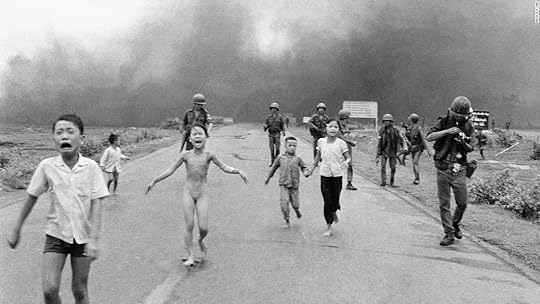
The naked girl running, two children from the left, is a girl named Kim Phuc. This was a photo taken by Nick Ut. Nick Ut, a Korean photographer, lectured “passionately about the senselessness of war and spoke of how pictures that showed its horrors could help end it.”. Ut’s photo of Phuc, shown above, helped to change the public opinion on the Vietnam War, and helped it ultimately to begin to find it’s end.
This book is the story of Kim Phuc, her family, before and during the war, and her life afterwards, and how it affected those around her, and those closest to her.
When I first ordered this book, I knew it was going to be heart wrenching, and hard to read. But what I didn’t expect was to feel my heart actually break, and to tear up countless times whilst reading this. Denise Chong has written in such a way that it’s almost like you’re there. Although the writing seems professional, distant and almost surgical, there’s still something about it that really wrenches your heart, slowly cuts the heart strings one by one, and makes you ache. I’ve read books about war before, but never a non fiction one like this. Reading this has really changed my perspective on a lot of things, and it’s scary to think that this revelation came only about 18% into the book.
The more I read of this book, a chapter at a time, the more I feel sick to my stomach. To see how everything happened throughout Vietnam, and how the war affected them, and their own government, makes this a really hard read. Continuing to read how the injustice in Vietnam continued to affect Kim Phuc throughout the years, continuing into her adult life was just unfair. So many tears came to my eyes reading the words on the page, and it was heart breaking. It was heart breaking to see her own government use her for their own selfish gain, because of this horrible thing that happened to her. I just couldn’t believe it; I couldn’t believe it at all. What I was reading was just. Unbelievable. Heart wrenching. But also awe-inspiring. Phuc went through so much, and yet she still stood so strong, and did what she could to be her own person, and I just. Felt so inspired reading this.
There was so much in this that I want to talk about from this book, but I want to keep my review relatively short because there’s no way I could ever do this beautiful book justice. This book is going to haunt my nightmares; the way that this was written merely puts into perspective the victim and survivor’s view of the war. The images painted in my mind through this was horrifying. But also, Kim Phuc’s story is one of hope. Inspiration. One that shows the true amount of forgiveness, and how forgiveness and hope can be healing.
Kim Phuc’s story is not one that should be thought of in a bad light. It should not be thought of with pity, or as just the girl in the photo. Kim Phuc should be remembered for the work she has done, for the hope and forgiveness she has inspired within thousands, maybe millions of people. She should be thought of with hope. Her name should be synonymous with inspiration and hope.
The naked girl running, two children from the left, is a girl named Kim Phuc. This was a photo taken by Nick Ut. Nick Ut, a Korean photographer, lectured “passionately about the senselessness of war and spoke of how pictures that showed its horrors could help end it.”. Ut’s photo of Phuc, shown above, helped to change the public opinion on the Vietnam War, and helped it ultimately to begin to find it’s end.
This book is the story of Kim Phuc, her family, before and during the war, and her life afterwards, and how it affected those around her, and those closest to her.
When I first ordered this book, I knew it was going to be heart wrenching, and hard to read. But what I didn’t expect was to feel my heart actually break, and to tear up countless times whilst reading this. Denise Chong has written in such a way that it’s almost like you’re there. Although the writing seems professional, distant and almost surgical, there’s still something about it that really wrenches your heart, slowly cuts the heart strings one by one, and makes you ache. I’ve read books about war before, but never a non fiction one like this. Reading this has really changed my perspective on a lot of things, and it’s scary to think that this revelation came only about 18% into the book.
The more I read of this book, a chapter at a time, the more I feel sick to my stomach. To see how everything happened throughout Vietnam, and how the war affected them, and their own government, makes this a really hard read. Continuing to read how the injustice in Vietnam continued to affect Kim Phuc throughout the years, continuing into her adult life was just unfair. So many tears came to my eyes reading the words on the page, and it was heart breaking. It was heart breaking to see her own government use her for their own selfish gain, because of this horrible thing that happened to her. I just couldn’t believe it; I couldn’t believe it at all. What I was reading was just. Unbelievable. Heart wrenching. But also awe-inspiring. Phuc went through so much, and yet she still stood so strong, and did what she could to be her own person, and I just. Felt so inspired reading this.
There was so much in this that I want to talk about from this book, but I want to keep my review relatively short because there’s no way I could ever do this beautiful book justice. This book is going to haunt my nightmares; the way that this was written merely puts into perspective the victim and survivor’s view of the war. The images painted in my mind through this was horrifying. But also, Kim Phuc’s story is one of hope. Inspiration. One that shows the true amount of forgiveness, and how forgiveness and hope can be healing.
Kim Phuc’s story is not one that should be thought of in a bad light. It should not be thought of with pity, or as just the girl in the photo. Kim Phuc should be remembered for the work she has done, for the hope and forgiveness she has inspired within thousands, maybe millions of people. She should be thought of with hope. Her name should be synonymous with inspiration and hope.

November 18, 2011
Ugh, just lost my big long review mid-type. Short version here now that I am ticked off:
-Liked this book a lot. Well written book about an interesting topic and person.
-Enjoyed learning more about Vietnam war in this manner; much more sticky in my brain from this story than what I may have been "taught" about it in school.
-Touched by Kim's personal journey. Innocence, pain, strength, struggle, forgiveness.
-Really made me think about the difference of the experience of "life" for people in different places and times. A view of the world that only includes your own experience is woefully inadequate.
-As a parent, was horrified to think about having to try to protect and provide from my kids in the war/poverty/political situation this family had. The feeling of helplessness when Kim was so badly burned. Knowing you can't do a lot and having to still try anyway. Inspiring.
-Also inspiring, the sprinkling throughout Kim's life of people in other countries who wanted to help her, and were able to make a difference.
-This book made me realize even more the need to be critical of what you read. Kim was frequently interviewed, but her Communist-placed "minders" made her say things that weren't even remotely true, like she was in school when they really had not allowed her back to her schooling. Also some misinformation about her got published early (that her brothers died too but really it was her cousins) and then kept being repeated in media.
-Finally, Kim's story was a reminder to me to DO. I struggle with action, and saw in Kim's life that there were several times she formulated a plan and carried it off and it had huge impact on the course of her life. Plus for her, it was usually some action in the midst of war or oppression, where the consequences could be huge and bad, and she still did it... in comparison, if she can take action as she has, I think I can bring myself to decide if I need to get a new job, and/or drag myself into the bathroom to wash my face at night.
-Liked this book a lot. Well written book about an interesting topic and person.
-Enjoyed learning more about Vietnam war in this manner; much more sticky in my brain from this story than what I may have been "taught" about it in school.
-Touched by Kim's personal journey. Innocence, pain, strength, struggle, forgiveness.
-Really made me think about the difference of the experience of "life" for people in different places and times. A view of the world that only includes your own experience is woefully inadequate.
-As a parent, was horrified to think about having to try to protect and provide from my kids in the war/poverty/political situation this family had. The feeling of helplessness when Kim was so badly burned. Knowing you can't do a lot and having to still try anyway. Inspiring.
-Also inspiring, the sprinkling throughout Kim's life of people in other countries who wanted to help her, and were able to make a difference.
-This book made me realize even more the need to be critical of what you read. Kim was frequently interviewed, but her Communist-placed "minders" made her say things that weren't even remotely true, like she was in school when they really had not allowed her back to her schooling. Also some misinformation about her got published early (that her brothers died too but really it was her cousins) and then kept being repeated in media.
-Finally, Kim's story was a reminder to me to DO. I struggle with action, and saw in Kim's life that there were several times she formulated a plan and carried it off and it had huge impact on the course of her life. Plus for her, it was usually some action in the midst of war or oppression, where the consequences could be huge and bad, and she still did it... in comparison, if she can take action as she has, I think I can bring myself to decide if I need to get a new job, and/or drag myself into the bathroom to wash my face at night.

August 16, 2011
I'm torn between 2.5 and 3 stars.
I enjoyed some of the novel, Phuc's story is engrossing at times. The timeline of her family's history is used as a vehicle to narrate an historical novel detailing the Vietnam war and the tumultuous unrest that preceded and followed. In turns enthralling as a character tale and as a history lesson, I felt that there were times when one aspect would take away from the other. The balance was not there, for me. I am not partial to 'historical' novels; I need a character or two to attach myself to, and, while some parts offered a great dose of this, others went for pages feeling like a social studies textbook.
That being said, there were times when I was swallowed up by Chong's descriptions of the war. There is much about this time in the world of which I was uninformed. I would tend to find myself swept up in these parts that show the human aspect of history. The effects of war, terror and struggle on the people of Vietnam.
I would find it an easy read for a time, but with large portions that I would find myself skimming, rereading and becoming distracted through.
I enjoyed some of the novel, Phuc's story is engrossing at times. The timeline of her family's history is used as a vehicle to narrate an historical novel detailing the Vietnam war and the tumultuous unrest that preceded and followed. In turns enthralling as a character tale and as a history lesson, I felt that there were times when one aspect would take away from the other. The balance was not there, for me. I am not partial to 'historical' novels; I need a character or two to attach myself to, and, while some parts offered a great dose of this, others went for pages feeling like a social studies textbook.
That being said, there were times when I was swallowed up by Chong's descriptions of the war. There is much about this time in the world of which I was uninformed. I would tend to find myself swept up in these parts that show the human aspect of history. The effects of war, terror and struggle on the people of Vietnam.
I would find it an easy read for a time, but with large portions that I would find myself skimming, rereading and becoming distracted through.

March 13, 2012
This biographical work follows the life of Kim Phuc from the time she was badly burned in a napalm strike during the Vietnam war. If I learned anything from reading this, it's that the war in Vietnam was really a pointless struggle; it would have been better to have let the soldiers from the north take over the corrupt Saigon regime from the outset. Once securely in possession of the country, the communist regime could have started to implode through graft, corruption, and incompetence much sooner than it did.
Kim's struggle with her injuries was the easiest part of her ordeal; in subsequent years she would be hounded and oppressed by a corrupt and totalitarian regime that used her fame as "the girl in the picture" as propaganda and a bargaining tool in subsequent normalization negotiations.
I have to read a book like this once in a while. For a little while, at least, I'll be grateful that my children were fortunate enough not to have been raised in a country where fire dropped indiscriminately from the sky, and that my family didn't have to huddle together over a few ounces of rice in a single-room dwelling.
Kim's struggle with her injuries was the easiest part of her ordeal; in subsequent years she would be hounded and oppressed by a corrupt and totalitarian regime that used her fame as "the girl in the picture" as propaganda and a bargaining tool in subsequent normalization negotiations.
I have to read a book like this once in a while. For a little while, at least, I'll be grateful that my children were fortunate enough not to have been raised in a country where fire dropped indiscriminately from the sky, and that my family didn't have to huddle together over a few ounces of rice in a single-room dwelling.

September 14, 2016
An amazing work by Denise Chong, just to think about all the research work...
I learned so much, not only about live in Vietnam and about the war, but also how this young women was (ab)used from the regimes, her disabilities, after an almost deadly Napalm bomb hit nearby, used for propaganda. Until she finally could flee to Canada where she resides now and where Denise Chong the author lives too. Thank you to Kim Phuc for being so brave and thanks also to the author to let the world know about the real story behind "The Girl in the Picture". A MUST-READ for everyone!
I learned so much, not only about live in Vietnam and about the war, but also how this young women was (ab)used from the regimes, her disabilities, after an almost deadly Napalm bomb hit nearby, used for propaganda. Until she finally could flee to Canada where she resides now and where Denise Chong the author lives too. Thank you to Kim Phuc for being so brave and thanks also to the author to let the world know about the real story behind "The Girl in the Picture". A MUST-READ for everyone!

March 24, 2022
Pretty much a horror story. An affecting tale of how the well known image came to be.
Many of us have never been involved in war and we can never truly know what occurs as the media and government lie and keep the truth hidden from the public. Though I think Denise Chong did an excellent job chronicling Kim Phuc’s story and her viewpoint of the war. Politics and bureaucracy play a big part in Kim’s life, she had to face many challenges and struggles because of it.
Kim Phuc lived most of her young life under a communist regime then she was sent to Cuba and life was ok until the regime took over then life was a living hell, again.
Happy to report there is a beautiful ending to this heartbreaking story.
Recommended.
Many of us have never been involved in war and we can never truly know what occurs as the media and government lie and keep the truth hidden from the public. Though I think Denise Chong did an excellent job chronicling Kim Phuc’s story and her viewpoint of the war. Politics and bureaucracy play a big part in Kim’s life, she had to face many challenges and struggles because of it.
Kim Phuc lived most of her young life under a communist regime then she was sent to Cuba and life was ok until the regime took over then life was a living hell, again.
Happy to report there is a beautiful ending to this heartbreaking story.
Recommended.

February 4, 2018
of course this is the first book that i grabbed on the street of Ho Chin Minh. A recollection of Vietnam and her story. How she was used as a tool of Vietnamese propaganda... She is a victim of war. Bitteness, anger and so many obstacles... until she defected to Canada after detouring from Cuba with her husband Duan. Seeking for freedom.
After roaming modern Ho Chinh Minh, Da Nang, Nha Trang with so many modern facilities, you can imagine how new it is to new generations after almost 40 years. This book which i believed a sincere storytelling will make you feel very lucky.
After roaming modern Ho Chinh Minh, Da Nang, Nha Trang with so many modern facilities, you can imagine how new it is to new generations after almost 40 years. This book which i believed a sincere storytelling will make you feel very lucky.
September 16, 2009
This was particularly interesting just having come from Vietnam. While Vietnam was a very moving experience of the first-hand effects of war, the propaganda information leaves a bit to be desired in terms of historical accuracy. Though I'm not defending American involvement in the war, I don't think it's quite fair to say that the US just came in and started bombing a peaceful, unified country (as the propaganda claims). They also claim, of course, that the Communist takeover left everyone happy and hunky-dory, no one was harmed, and any and all deaths that occurred were at the hands of Americans, because no Vietnamese would ever kill a fellow countryman.
It left me wondering about a lot of points and wanting to speak to someone who had been on the losing side of the war. Were they as happy with the outcome as they appeared on the surface? With only two weeks and no Vietnamese skills, this was impossible, not that I think anyone would have been willing to openly criticize the government to me even if I knew the language anyway. That's where the book was very valuable to me. Besides providing a few more balanced details of the history (the author is Canadian), what I found most interesting was the family's struggle during the aftermath of war.
I found the last third of the book a bit harder to read, largely because it takes a very religious turn. I was disappointed at feeling that I was being preached at for large sections at a time. Still, overall, I'm glad I found the book, as it provided the more objective view of Vietnam I was searching for.
It left me wondering about a lot of points and wanting to speak to someone who had been on the losing side of the war. Were they as happy with the outcome as they appeared on the surface? With only two weeks and no Vietnamese skills, this was impossible, not that I think anyone would have been willing to openly criticize the government to me even if I knew the language anyway. That's where the book was very valuable to me. Besides providing a few more balanced details of the history (the author is Canadian), what I found most interesting was the family's struggle during the aftermath of war.
I found the last third of the book a bit harder to read, largely because it takes a very religious turn. I was disappointed at feeling that I was being preached at for large sections at a time. Still, overall, I'm glad I found the book, as it provided the more objective view of Vietnam I was searching for.

March 10, 2017
Outstanding book that chronicles Kim Phuc's life before and after the napalm incident. Demonstrates what life was like in Vietnam before, during and after the Vietnam War.
March 24, 2025
The story of Kim Phuc, her life between 1972 and 1995. The Vietnam and Indochina wars , about people and country . Faith ( Caodai and Christian) endurance and strength.
Forgiveness a strong theme.
The book also told of the Cambodian genocides 1975-1979. Cuba under Castro rule, and Moscow where Kim spent time. I now understand better American involvement in the Vietnam war.
Quynh hoa flower buds open in darkness usually after midnight found in a forest near Tay Ninh. “ Large snow-white flowers, super fragrant petals like two open palms, it’s tall stamens like ancient sailing ships”
A saying her mother told her came to mind” If you love a man even his shit smells good”
“ If you kneel down, life is a mountain; if you stand up life is at your feet”
As told by Denise Chong who had met everyone who had been important in Kim’s life. I look forward to reading Kim’s own story ‘Fire road’ that was published in 2017.
Forgiveness a strong theme.
The book also told of the Cambodian genocides 1975-1979. Cuba under Castro rule, and Moscow where Kim spent time. I now understand better American involvement in the Vietnam war.
Quynh hoa flower buds open in darkness usually after midnight found in a forest near Tay Ninh. “ Large snow-white flowers, super fragrant petals like two open palms, it’s tall stamens like ancient sailing ships”
A saying her mother told her came to mind” If you love a man even his shit smells good”
“ If you kneel down, life is a mountain; if you stand up life is at your feet”
As told by Denise Chong who had met everyone who had been important in Kim’s life. I look forward to reading Kim’s own story ‘Fire road’ that was published in 2017.

August 26, 2025
Denise Chong’s The Girl in the Picture tells the story of Kim Phúc, the young girl captured in the infamous photograph fleeing a napalm attack during the Vietnam War. Chong not only recounts Kim’s personal journey, from the trauma of her injuries to her later life as a symbol of peace, but also provides an expansive portrait of the war, its political context, and its lasting human costs. This book is incredibly well researched and filled with context that situates Kim’s story within the broader sweep of history. The level of detail makes it a dense read at times. I came away with a greater curiosity about the lives of people whose stories are identifiable by on snapshot. I also gained a better understanding of the way the Vietnam War reverberated through individual lives long after the conflict ended.
Recommended for: readers with a strong interest in the Vietnam War and those who want to go beyond surface-level accounts.
Recommended for: readers with a strong interest in the Vietnam War and those who want to go beyond surface-level accounts.
November 14, 2012
I am glad that I read this book, but not necessarily because the writing was fantastic but more because it was interesting to know the story of the girl in the photo, to hear the perspective of a South Vietnamese girl living during the Vietnam War, and because we are getting ready to travel to Vietnam in a couple of weeks.
I was familiar with this photo before I read the book and remember being horrified by the faces of the children. This photo is haunting as it captures such a vivid moment of human suffering and despair. I admit that I never knew much about the circumstances around the photo but it would bring up emotions of sadness, disgust and guilt. It was interesting to learn the story of the girl/women behind this photo. This book is not only a story of the girl but also the story of the Vietnam War, Vietnam history, Communism, Suffering, Perseverance, Kindness, Cruelty, Culture (etc. etc.). I was amazed to discover how much the photo affected the subject's life and how (according to the author) she spent much of her life being controlled by the Vietnamese government and being subjected to countless interviews. It leads you to wonder was her life better or worse off because of the photo (of course taking into consideration that she probably would have died from her burns if she had not been famous in the photo). Also, interesting to consider how she became an object of propaganda of the Vietnamese government.
There were stories I found interesting - such as the differences between North and South Vietnam (both before and after the War). How different parts of Vietnam were affected during the war (some did not witness fighting and others did). Kim Phuc went to Cuba for education and I found this very interesting. My interest and perspective of Cuba changed a bit after reading the book.
I did enjoy some of the stories the author told (it is not an autobiography, the author did interview Kim Phuc and her parents) but several of the stories seemed to drag on. It seems that the author did not find the right balance between telling you a story to demonstrate a point versus keeping the reader engaged. As the book continued on I found it harder and harder to stay focused on some of the stories. Also, I would have liked to have learned more about Kim Phuc's life once she moved to Toronto. The book opens up with her in Toronto but then in the end quickly does a summary. Finally, I did not really ever connect to Kim Phuc as a subject. I am not sure why. Of course I sympathized with her suffering from napalm burns but for some reason could not connect with her character.
Basically I am glad that I read the point and it made me think alot about Communism, Vietnam and U.S. relations, Cuba, Asia, etc. However, I am not sure I would necessarily read this author again.
I was familiar with this photo before I read the book and remember being horrified by the faces of the children. This photo is haunting as it captures such a vivid moment of human suffering and despair. I admit that I never knew much about the circumstances around the photo but it would bring up emotions of sadness, disgust and guilt. It was interesting to learn the story of the girl/women behind this photo. This book is not only a story of the girl but also the story of the Vietnam War, Vietnam history, Communism, Suffering, Perseverance, Kindness, Cruelty, Culture (etc. etc.). I was amazed to discover how much the photo affected the subject's life and how (according to the author) she spent much of her life being controlled by the Vietnamese government and being subjected to countless interviews. It leads you to wonder was her life better or worse off because of the photo (of course taking into consideration that she probably would have died from her burns if she had not been famous in the photo). Also, interesting to consider how she became an object of propaganda of the Vietnamese government.
There were stories I found interesting - such as the differences between North and South Vietnam (both before and after the War). How different parts of Vietnam were affected during the war (some did not witness fighting and others did). Kim Phuc went to Cuba for education and I found this very interesting. My interest and perspective of Cuba changed a bit after reading the book.
I did enjoy some of the stories the author told (it is not an autobiography, the author did interview Kim Phuc and her parents) but several of the stories seemed to drag on. It seems that the author did not find the right balance between telling you a story to demonstrate a point versus keeping the reader engaged. As the book continued on I found it harder and harder to stay focused on some of the stories. Also, I would have liked to have learned more about Kim Phuc's life once she moved to Toronto. The book opens up with her in Toronto but then in the end quickly does a summary. Finally, I did not really ever connect to Kim Phuc as a subject. I am not sure why. Of course I sympathized with her suffering from napalm burns but for some reason could not connect with her character.
Basically I am glad that I read the point and it made me think alot about Communism, Vietnam and U.S. relations, Cuba, Asia, etc. However, I am not sure I would necessarily read this author again.

May 11, 2022
This story is one of the things I've always wondered about without really knowing I was consciously wondering about it, if that makes sense. We've likely all seen this photograph, and I know that I would wonder about the girl in the picture when I saw it, about what happened to her, if she had lived, what her life was like afterwards. For some reason it didn't occur to me to just, you know, look it up. So this book was a very thoughtful gift; I suppose I'm not all that discrete about my tendency to wonder.
The book is an absolutely remarkable chronical, focusing on the life of Kim Phuc and her family and using their story as a way to connect in the context and history of Vietnam at the time. There is a lot of rich historical and political context in this, weaved in wonderfully in a way that illuminates the text and never becomes more like a history lecture than a biography. Through it all, we get to learn a lot about Kim Phuc and her family, their lives before and after the war, their struggles and their personalities. The journey that this woman has taken through life is wholly unique, and it's absolutely fascinating to learn about. Even more impressive is her strength of personality, because the life that she endured was at times horrific. Used as a pawn for the regime, kept under strict control, often living in poverty, suffering from long-term health effects, every decision or choice at the mercy of people who did not have her best interests in mind, it's remarkable that she managed to come out of the other side with even a shred of decency for the world. The unfairness of this being thrust upon her by some horrific, freak event -- she was just a child in the wrong place at just the wrong moment, immortalised on camera simply by chance -- and then trying to dominate her entire life thereafter is almost too much to comprehend, and even more impressive is how Kim Phuc managed to navigate it and come out the other side not only with a life of her own and her personality in tact, but also that she managed to come out the other side at all.
If you've ever even remotely wondered about the girl in that one famous Vietnam photograph, pick up this book. It's an incredible piece of work, not just as a biography, but also as a snapshot of a very peculiar time in history.
The book is an absolutely remarkable chronical, focusing on the life of Kim Phuc and her family and using their story as a way to connect in the context and history of Vietnam at the time. There is a lot of rich historical and political context in this, weaved in wonderfully in a way that illuminates the text and never becomes more like a history lecture than a biography. Through it all, we get to learn a lot about Kim Phuc and her family, their lives before and after the war, their struggles and their personalities. The journey that this woman has taken through life is wholly unique, and it's absolutely fascinating to learn about. Even more impressive is her strength of personality, because the life that she endured was at times horrific. Used as a pawn for the regime, kept under strict control, often living in poverty, suffering from long-term health effects, every decision or choice at the mercy of people who did not have her best interests in mind, it's remarkable that she managed to come out of the other side with even a shred of decency for the world. The unfairness of this being thrust upon her by some horrific, freak event -- she was just a child in the wrong place at just the wrong moment, immortalised on camera simply by chance -- and then trying to dominate her entire life thereafter is almost too much to comprehend, and even more impressive is how Kim Phuc managed to navigate it and come out the other side not only with a life of her own and her personality in tact, but also that she managed to come out the other side at all.
If you've ever even remotely wondered about the girl in that one famous Vietnam photograph, pick up this book. It's an incredible piece of work, not just as a biography, but also as a snapshot of a very peculiar time in history.
August 29, 2009
Difficult in some parts to read as a Vietnam Vet's kid. There is a decent brief history of the Vietnam conflict and Kim's life is fascinating. The writing itself is not very good. The author's most irritating tactic is to hit the reader over the head, many times with the author's point of view. So, in reading this book, there is not an unbiased history or biography. Mostly, the story compensates. It is definitely worth knowing about Kim's life. Wish this had been in the hands of a better writer.

Currently Reading
February 25, 2010An incredible insight not only of a girl, Kim Phuc, who was at the wrong place at really the wrong time; but an incredible and personal look at the Vietnamese culture and climate.
For a historical novel it is written with depth and understanding and really is a book that is difficult to put down.
For a historical novel it is written with depth and understanding and really is a book that is difficult to put down.
December 27, 2025
3.75 ⭐
The Girl in the Picture by Denise Chong was an educational and interesting read and I learned a lot about the Vietnam war from the perspective of the civilians caught up in the fighting.
I have always been drawn to photographs that have changed the world and the "Terror of War" (AKA Napalm Girl) photo depicting 9 year old Kim Phuc running, naked and screaming after being caught in a napalm attack is a massively important one. It is credited as initiating, in part, the embracing of the anti-war movement around the world which ultimately led to the eventual ending of the Vietnam war after America pulled out in 1973. One quote especially stood out for me regarding this shot and photos like it and it's attributed to Horst Faas, the AP editor that encouraged the use of the Napalm Girl photograph in international publication despite Phuc's nudity: "Photographs are the seeds that prepare the ground for truth."
I enjoyed learning about Phuc and her family before and after the tragedy that changed the course of her life irrevocably. I didn't know much about her except that she lives in Canada now. Knowing her story adds a certain depth to the famous photo for me. The book is outdated in that it credits Nick Ut with taking the iconic photo but the information about it's ambiguous origin is brand new so of course it would be.
The writing is detailed but not super expressive or compelling. I wanted it to be more engaging—a book I couldn't put down. Still, it was educational and I appreciated that aspect. Reading about the Vietnam war has created an interest in me to learn more about it. For that reason, I would recommend this book.
The Girl in the Picture by Denise Chong was an educational and interesting read and I learned a lot about the Vietnam war from the perspective of the civilians caught up in the fighting.
I have always been drawn to photographs that have changed the world and the "Terror of War" (AKA Napalm Girl) photo depicting 9 year old Kim Phuc running, naked and screaming after being caught in a napalm attack is a massively important one. It is credited as initiating, in part, the embracing of the anti-war movement around the world which ultimately led to the eventual ending of the Vietnam war after America pulled out in 1973. One quote especially stood out for me regarding this shot and photos like it and it's attributed to Horst Faas, the AP editor that encouraged the use of the Napalm Girl photograph in international publication despite Phuc's nudity: "Photographs are the seeds that prepare the ground for truth."
I enjoyed learning about Phuc and her family before and after the tragedy that changed the course of her life irrevocably. I didn't know much about her except that she lives in Canada now. Knowing her story adds a certain depth to the famous photo for me. The book is outdated in that it credits Nick Ut with taking the iconic photo but the information about it's ambiguous origin is brand new so of course it would be.
The writing is detailed but not super expressive or compelling. I wanted it to be more engaging—a book I couldn't put down. Still, it was educational and I appreciated that aspect. Reading about the Vietnam war has created an interest in me to learn more about it. For that reason, I would recommend this book.
February 12, 2026
Having lived in Cambodia for 18 months recently, I found this book particularly interesting and enlightening. It clarified many things I didn’t understand about the Vietnam War. Many of the traditions and ways of the Vietnamese are similar to the Cambodian people. This book emphasizes and reveals the power of media. A single picture or a single article can move people profoundly, and this can cause meaningful change. In this case, a war was effected by a single photograph. But this book focused even more on how the lives of those pictured can be impacted. This young girl spent the rest of her life dealing with the impact of this single photograph, first as a puppet or pawn for her communist government, then later as a warrior for peace on the world stage. She is a heroine. But what a life she had to live before achieving freedom to wield the power of that photograph in a way she determined was best.

July 23, 2025
Kim Phuc became known to the world as the girl in the picture running naked from a napalm attack. She had torn off her burning clothes but the napalm left her back and arm badly burned. After surviving her burns, she became a propaganda tool for the communist government. She became a Christian and turned to her faith to help her through the deprivations and to guide her. She eventually got asylum in Canada but continued to advocate for child victims of war. Her message to the soldiers responsible for so much suffering was to leave the past behind and look towards a better world. She offered forgiveness even to the soldier who claimed responsibility for the napalm attack that had scarred her and shaped her life

June 14, 2022
This was a rich, sensitive, and empathetic tribute to a woman who has undergone a profound degree of physical and emotional trauma. Kim Phuc was nine years old when a napalm bomb was dropped on her hometown of Trảng Bàng in 1972, severely burning her and killing two of her cousins. The tragedy was depicted in a Pulitzer prize-winning photograph that has since become an enduring symbol of the horrors of war.
It is not lost on me that Kim's story is told by another Asian woman, reversing a centuries-old stereotype painting people of colour, and especially women of colour, as "voiceless" and reliant on white men to tell their stories. Chong is an admirably capable biographer, deftly switching between concise, clear historical recounting and beautiful prose. Biographical works are the most difficult genre for me to read--this 340-page book, for instance, took me over a month to finish--and I am grateful to Chong for keeping me engaged with this story. Yet it was not primarily the biography's author that kept me reading, but its subject.
June 6 was the 50th anniversary of the taking of the titular photograph. I had already started this book at that time, but an op-ed Kim wrote for the New York Times that was published on that date pushed me to finish it. I harbour distaste towards the glorification of resilience mainly because I've seen that narrative play out in current-day news stories too often as a license for those in positions of power to shake their heads, say "that's so sad," and move on with their lives. I was refreshed--almost startled--to find that such a narrative did not appear in this book. Kim is a vibrantly human heroine, not a victim to be pitied and objectified as another "teachable moment" for the West. Yes, her injuries, depression, and abuse are discussed with honesty. But much more is made of her love for her family and friends, her courage, and her strength of character.
It is not lost on me that Kim's story is told by another Asian woman, reversing a centuries-old stereotype painting people of colour, and especially women of colour, as "voiceless" and reliant on white men to tell their stories. Chong is an admirably capable biographer, deftly switching between concise, clear historical recounting and beautiful prose. Biographical works are the most difficult genre for me to read--this 340-page book, for instance, took me over a month to finish--and I am grateful to Chong for keeping me engaged with this story. Yet it was not primarily the biography's author that kept me reading, but its subject.
June 6 was the 50th anniversary of the taking of the titular photograph. I had already started this book at that time, but an op-ed Kim wrote for the New York Times that was published on that date pushed me to finish it. I harbour distaste towards the glorification of resilience mainly because I've seen that narrative play out in current-day news stories too often as a license for those in positions of power to shake their heads, say "that's so sad," and move on with their lives. I was refreshed--almost startled--to find that such a narrative did not appear in this book. Kim is a vibrantly human heroine, not a victim to be pitied and objectified as another "teachable moment" for the West. Yes, her injuries, depression, and abuse are discussed with honesty. But much more is made of her love for her family and friends, her courage, and her strength of character.

January 2, 2023
Kim's experiences throughout her life were inspiring and put in the context of two different ideologies clashing at that time. Her story was an eye-opener on what war can do to people's ordinary lives.

July 7, 2025
Incredible book - a must read.

May 1, 2019
This book was first published in 2000 but the edition I read was published slightly later in 2001. The price label at the back of the book is shown in Thai Baht, and presumably it was first purchased in Thailand. The book eventually found its way to Hong Kong, as I bought this book from a book recycling campaign in 2016 at a bargaining price of HK$10 (less than US$1.50). In fact, I had initially forgotten the specific date in which I had purchased the book until I found a time stamp provided by the campaign organiser. The book sat on my bookshelf for several years, until 2019, when I finally picked the book up and read it for the first time. Ironically, while many may know of Nick Ut’s Pulitzer Prize-winning photograph taken at Trảng Bàng during the Vietnam War in 1972, which depicts a naked nine-year-old girl running down the road, the girl’s name and the story of her life is somehow not so well-known.
The story begins in 1963 in Vietnam. Phan Thi Kim Phuc (“Kim”) was born that year, and her life had been relatively uneventful. Kim may even be considered well-off, as her family runs a fairly successful noodle shop in the Trảng Bàng village. This all changed in 1972, when, in the midst of a minor battle in the Vietnam War a South Vietnamese plane dropped a napalm bomb on Trảng Bàng by mistake. Kim’s clothing was burned by the napalm fire and she was permanently scarred. Kim ran for her life. The horrific scene was captured by Ut in his iconic photograph “The Girl in the Picture” and it soon become an eponymous picture of the Vietnam War. As Denise Chong has shown in her book, the sudden fame brought by Ut’s photograph proved to be a mixed blessing for Kim.
Kim’s newfound fame as a victim of the war helped to secure her the vital medical aid from the US that saved her life. The level of attention and care she received was tragically unavailable to many other war victims who were suffering from napalm burns and injuries of the same (if not greater) extent. As such, Kim’s life was saved as a result of the extensive medical care she received. She vowed to study medicine so that she can become a doctor to save people in need.
However, an ensuing nightmare began when the Communist Party of Vietnam (the “CPV”) took over Vietnam. According to Chong, Kim actually remained in low-profile until a well-meaning journalist from Germany came over to Vietnam to see her. It was through this encounter with the journalist that the CPV was reminded of Kim’s existence. Kim’s fame as “The Girl in the Picture” was, to the CPV, a valuable propaganda tool to the newly established regime. For this reason, the CPV ordered the university in Ho Chi Minh City to withdraw Kim’s placement at the university so that she would, upon demand by the CPV, be interviewed by foreign journalists. It was therefore very ironic when Kim was asked to pose as a medical student to foreign journalists in order to show she was quite happy under the new CPV regime.
Kim surmised that the only way out of her suffering was to appeal to someone powerful. To that end, Kim’s fame helped as she found the opportunity to appeal to the Prime Minister at the time — Pham Van Dong. Dong lent his sympathetic ears to Kim’s sufferings and, in due course, sent her to Cuba to further her studies, as Cuba, at the time, was a communist comrade to Vietnam and a country well-known for its university education. Unfortunately for Kim, when she arrived in Cuba in the 1980s, the country was at the end of her communist golden age and has since then undergone gradual economic decline. According to Chong, this meant that there was a period of time for Kim where there was absolutely no supply of food, water and electricity available to her. In short, for Kim, the move to Cuba was almost akin to going from one hell to another.
“The Girl in the Picture” is a book that contextualises Kim’s life. “The Girl in the Photo” is very famous but her story is not so well-known. In addition to the key events in Kim’s life, Chong also documents the lives of Kim’s family. For example, we learn of the aftermath of the noodle shop run by Kim’s parents: the shop was first taken over by the CPV and later restored to Kim’s mother, but was ultimately lost to family disputes.The book serves as a good reminder that every war victim has a story to tell.
The story begins in 1963 in Vietnam. Phan Thi Kim Phuc (“Kim”) was born that year, and her life had been relatively uneventful. Kim may even be considered well-off, as her family runs a fairly successful noodle shop in the Trảng Bàng village. This all changed in 1972, when, in the midst of a minor battle in the Vietnam War a South Vietnamese plane dropped a napalm bomb on Trảng Bàng by mistake. Kim’s clothing was burned by the napalm fire and she was permanently scarred. Kim ran for her life. The horrific scene was captured by Ut in his iconic photograph “The Girl in the Picture” and it soon become an eponymous picture of the Vietnam War. As Denise Chong has shown in her book, the sudden fame brought by Ut’s photograph proved to be a mixed blessing for Kim.
Kim’s newfound fame as a victim of the war helped to secure her the vital medical aid from the US that saved her life. The level of attention and care she received was tragically unavailable to many other war victims who were suffering from napalm burns and injuries of the same (if not greater) extent. As such, Kim’s life was saved as a result of the extensive medical care she received. She vowed to study medicine so that she can become a doctor to save people in need.
However, an ensuing nightmare began when the Communist Party of Vietnam (the “CPV”) took over Vietnam. According to Chong, Kim actually remained in low-profile until a well-meaning journalist from Germany came over to Vietnam to see her. It was through this encounter with the journalist that the CPV was reminded of Kim’s existence. Kim’s fame as “The Girl in the Picture” was, to the CPV, a valuable propaganda tool to the newly established regime. For this reason, the CPV ordered the university in Ho Chi Minh City to withdraw Kim’s placement at the university so that she would, upon demand by the CPV, be interviewed by foreign journalists. It was therefore very ironic when Kim was asked to pose as a medical student to foreign journalists in order to show she was quite happy under the new CPV regime.
Kim surmised that the only way out of her suffering was to appeal to someone powerful. To that end, Kim’s fame helped as she found the opportunity to appeal to the Prime Minister at the time — Pham Van Dong. Dong lent his sympathetic ears to Kim’s sufferings and, in due course, sent her to Cuba to further her studies, as Cuba, at the time, was a communist comrade to Vietnam and a country well-known for its university education. Unfortunately for Kim, when she arrived in Cuba in the 1980s, the country was at the end of her communist golden age and has since then undergone gradual economic decline. According to Chong, this meant that there was a period of time for Kim where there was absolutely no supply of food, water and electricity available to her. In short, for Kim, the move to Cuba was almost akin to going from one hell to another.
“The Girl in the Picture” is a book that contextualises Kim’s life. “The Girl in the Photo” is very famous but her story is not so well-known. In addition to the key events in Kim’s life, Chong also documents the lives of Kim’s family. For example, we learn of the aftermath of the noodle shop run by Kim’s parents: the shop was first taken over by the CPV and later restored to Kim’s mother, but was ultimately lost to family disputes.The book serves as a good reminder that every war victim has a story to tell.
May 18, 2025
The atmosphere of the 32 pages in this book made me so scary and painful. The family member's death at the time when the war still happening. Painful and unforgettable!

February 5, 2012
Well researched, interesting story about Kim Phuc, a Vietnamese girl badly burned by napalm who's photo by Nick Ut of her running towards the viewer arms spread wide helped turn the American public against the war.
I sure knew this photo seeing it as a teenager at the time and many times since. It along with photos a Vietnamese officer shooting a Viet Cong in the head, and the last helicopter leaving the US embassy in Saigon are the classic photo's from the Vietnam War. It was prominently displayed in the War Remnants Museum in Hanoi.
Kim was raised in a fairly well off village family, the family owned land, and the mother ran a successful noodle shop. During a Viet Cong assault a napalm attack by a South Vietnamese plane (with a US air controller)went awry. She was terribly burned and only through the determined intervention of her family was she plucked for the "untreatable-left-to-die" ward and delivered to a western MD and saved. Her family had lost everything either destroyed in the battle or taken by powerful people. She had wanted to be a physician but after Nick Phuc photo came out she was used by the Vietnamese for propaganda purposes. With minders always around she gave endless interviews about the cruelty of the Americans and the wonderful life in VN. She traveled abroad to the USSR and eventually ends up studying in Cuba. She is again always under the eyes of minders until on a trip abroad she finally escapes to Canada where she remains working as a Unesco peace ambassador.
A great detailed extensively researched story of a famous photo and life in Vietnam during and after the war.
I sure knew this photo seeing it as a teenager at the time and many times since. It along with photos a Vietnamese officer shooting a Viet Cong in the head, and the last helicopter leaving the US embassy in Saigon are the classic photo's from the Vietnam War. It was prominently displayed in the War Remnants Museum in Hanoi.
Kim was raised in a fairly well off village family, the family owned land, and the mother ran a successful noodle shop. During a Viet Cong assault a napalm attack by a South Vietnamese plane (with a US air controller)went awry. She was terribly burned and only through the determined intervention of her family was she plucked for the "untreatable-left-to-die" ward and delivered to a western MD and saved. Her family had lost everything either destroyed in the battle or taken by powerful people. She had wanted to be a physician but after Nick Phuc photo came out she was used by the Vietnamese for propaganda purposes. With minders always around she gave endless interviews about the cruelty of the Americans and the wonderful life in VN. She traveled abroad to the USSR and eventually ends up studying in Cuba. She is again always under the eyes of minders until on a trip abroad she finally escapes to Canada where she remains working as a Unesco peace ambassador.
A great detailed extensively researched story of a famous photo and life in Vietnam during and after the war.

January 30, 2011
Every American should read this book. Denise Chong has a way of telling a story that transcends barriers of race, nationality and religion and touches the human heart. It was very informative to me also to learn the history of Vietnam after the Americans left from the Vietnamese point of view.
Kim Phuc is an inspiration for us all. Reading her story can only make us more human and better at being a human. I don't see how anyone could not be touched by this story.
Everyone should read Denise. She is interested in humanity love and forgiveness. Plus she's witty, funny, honest, intelligent and unpredictable. And she writes one hell of a story.
This one just like her first book touches your heart.
What I like about her is that she doesn't preach. I learned a lot about history and myself by reading this.
thank you Denise
Kim Phuc is an inspiration for us all. Reading her story can only make us more human and better at being a human. I don't see how anyone could not be touched by this story.
Everyone should read Denise. She is interested in humanity love and forgiveness. Plus she's witty, funny, honest, intelligent and unpredictable. And she writes one hell of a story.
This one just like her first book touches your heart.
What I like about her is that she doesn't preach. I learned a lot about history and myself by reading this.
thank you Denise
January 21, 2020
An account of the Vietnam war that goes between the wide-angled lens of the war and its aftermath and the story of “the girl in the picture” who was exploited by the Vietnamese government and suffered as an icon of war. The story tells of her and her family and what they endured, but also admits that many had it worse, but considering her fame, she should have received some compensation from the government and some care for her family, since they were using her and forcing her to go on speaking tours rather than studying or working for money. It’s depressing but ends on a high note for the family. This was written more than 20 years ago, and I would be curious to know what they are up to now, but at the same time I hope they finally get to live normal quiet lives.

July 13, 2013
The tragic true story of the girl which was photographed running towards a journalist cameraman after the US Military dropped Napalm in South Vietnam during the Vietnam War. This is her story after that photograph was taken. Shame, shame to the US government as they have left a large devastating legacy which continues to affect citizens of Vietnam. Dioxin poisoning still causes major birth defect in children born in this area. No excuse should be used for using these chemical weapons on humans, animals and mother nature. America still has a lot of work to do to clean up the mess they made in Vietnam.
Displaying 1 - 30 of 231 reviews