
What do you think?
Rate this book

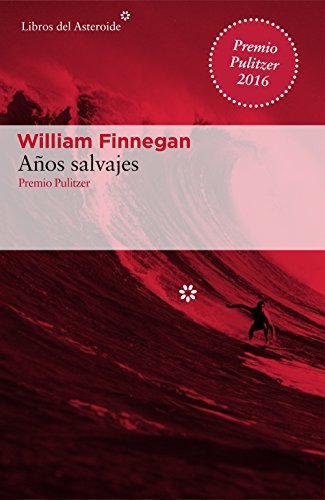
Años salvajes nos habla de una obsesión, la de William Finnegan con el surf. Finnegan comenzó a hacer surf de pequeño en Hawái y California. En los años setenta, tras finalizar sus estudios universitarios, su pasión le llevó a dejarlo todo y emprender un viaje iniciático por Samoa, Indonesia, Fiyi, Java, Australia y Sudáfrica.
Este precario y singular viaje, por tierras cada vez más salvajes, y en el que varias veces estuvo al borde de la muerte, terminó llevándolo de vuelta a su país, donde se convertiría en un reconocido escritor y corresponsal de guerra. En Estados Unidos, pese a su nuevo trabajo, su pasión por las olas se mantiene intacta: continúa su búsqueda de la ola perfecta —la más grande, la más rápida, la más peligrosa— en San Francisco, la Costa Este o Madeira. Una búsqueda incesante que es, también, la del sentido de su existencia.
Galardonado con el Premio Pulitzer 2016, Años salvajes es una fascinante historia de aventuras y una autobiografía literaria de primerísimo nivel. Es, además, y sin ningún género de dudas, el mejor libro sobre surf que se haya escrito nunca.
581 pages, Kindle Edition
First published July 21, 2015


Surfing, to begin with, was not a "sport." It was a "path."
"Waves were the playing field. They were the goal. They were the object of your deepest desire and adoration. At the same time, they were your adversary, your nemesis, even your mortal enemy."
The shortboard revolution was inseparable to the zeitgeist: hippie culture, acid rock, hallucinogens, Neo-Eastern mysticism, the psychedelic aesthetic. "
Surfing is a secret garden, not easily entered. My memory of learning a spot, of coming to know and understand a wave, is usually inseparable from the friend with whom I tried to climb its walls.
The rule of thumb is that it will break when the wave height reaches 80 percent of the water's depth. A eight-foot wave will break in ten feet of water.
Waves are not stationary objects in nature like roses or diamonds. They're quick, violent events at the end of a long chain of storm action and ocean reaction. Even the most symmetrical breaks have quirks and a totally specific, local character changing with every shift in the tide and wind and swell. The best days at the best days have a Platonic aspect--they begin to embody a model of what surfers want waves to be.
Frustration is a big part of surfing. It's the part we all tend to forget--stupid sessions, waves missed, waves blown, endless-seeming lulls.
Buzzy Trent, an old-time big-wave rider, allegedly said, "Big wavs are not measured in feet, but in increments of fear. [...] The power of a breaking wave does not increase fractionally with height, but as the square of its height. Thus a ten-foot wave is not slightly more powerful than an eight-foot wave---because the leap is not eight to ten but from sixty-four to a hundred, making it over 50 percent more powerful.
From the water's edge, looking out across a stepladder of six or seven walls of cold, growling, onrushing whitewater, the idea of paddling out actually carried with it the whiff of lunacy. The project looked impossible, like trying to swim up a waterfall. It took a literal leap of faith to start.
In fact, this was why most surfers didn't own a board over eight feet; it might raise the question of someday actually going out in conditions that require that much surfboard. Once, in Wise's shop, I heard a surfer mutter as he and his friends studied a 10'0" gun on display, "This one comes with a free pine box."
Surf spots are created and destroyed, both naturally and by human enterprise.


