Jump to ratings and reviews
Rate this book

Berlin-Hamlet

Rate this book
Shortlisted for the 2017 National Translation Award in Poetry and the 2017 Best Translated Book Award in Poetry

Before his tragic death, Szilárd Borbély had gained a name as one of Europe's most searching new poets. Berlin-Hamlet—one of his major works—evokes a stroll through the phantasmagoric shopping arcades described in Walter Benjamin’s Arcades Project, but instead of the delirious image fragments of nineteenth-century European culture, we pass by disembodied scraps of written text, remnants as ghostly as their primarily Franz Kafka but also Benjamin himself or the Hungarian poets Attila József or Ernő Szép. Paraphrases and reworked quotations, drawing upon the vanished prewar legacy, particularly its German Jewish aspects, appear in sharp juxtaposition with images of post-1989 Berlin frantically rebuilding itself in the wake of German reunification.

113 pages, Kindle Edition

First published January 1, 2003

5 people are currently reading
159 people want to read

About the author

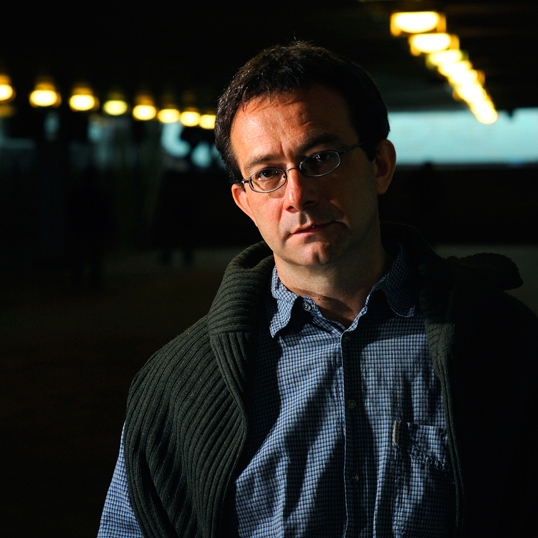
Szilárd Borbély

20 books34 followers
Szilárd Borbély is widely acknowledged as one of the most important poets to emerge in post-1989 Hungary. He worked in a wide variety of genres, including essay, drama, and short fiction, usually dealing with issues of trauma, memory, and loss. His poems appeared in English translation in The American Reader, Asymptote, and Poetry. Borbély received many awards for his work, including the Attila József Prize. He died in 2014.

Ratings & Reviews

What do you think?
Rate this book

Friends & Following

Create a free account to discover what your friends think of this book!

Community Reviews

5 stars
50 (54%)
4 stars
22 (24%)
3 stars
17 (18%)
2 stars
2 (2%)
1 star
0 (0%)
Displaying 1 - 13 of 13 reviews
Profile Image for Steve.
441 reviews582 followers
Read
April 30, 2017


Szilárd Borbély (1963-2014)

I annihilate the similes, before my time
was to come. The entanglements of speech, like
nooses hanging before the watering-hole,
where the feral come to drink. There are those
who writhe for days afterwards in the snares,
and their cries, like Christmas-tree ornaments
stored away between layers of cotton in the mothball-scented
cupboard, will be enervated, rent through
with fractures. They disintegrate
at a single touch. Somewhere else, the wild pear, the rose-
hips fallen amongst the dead leaves, the cranberry
and the rare Cornelian cherry.


An author totally new to me, the poet, essayist, and historian of East European literature of the Age of Baroque, Szilárd Borbély was born in an impoverished village in easternmost Hungary, whose crude brutality served as the stuff out of which he wove his only novel, The Dispossessed. But when I saw that he was primarily a poet, I first read Berlin/Hamlet, Ottilie Mulzet's translation of Borbély's book of the same name finally published in 2003. Borbély actually finished this book in the fall of 2000, but on Christmas Eve (!) his mother was beaten to death during a home invasion; his severely injured father survived as a crippled and broken man for a few more years. Such events can distract one's attention from publishing problems.(*)

Berlin/Hamlet is a very complex work in which five different kinds of voice and subject are interlaced together into a whole that is distinctly more than the sum of its parts. One of the strands comprises reworked excerpts from Franz Kafka's letters to his would-be love, Felice, when she was living in Berlin; another consists of moments of experience associated with various locations in a Berlin in the midst of upheaval during the reunification 90's;(**) yet another is made of meditations on the role of the survivor and the means of expressing real human tragedy literarily.(***) I recommend reading Mulzet's Afterword before reading the poetry, for she helps orient the reader to the book's unusual construction.

The synergy of the different strands and voices, the mixture of beggars and vagrants, of mythology, history and cityscape, of Kafka's painful tentativeness and the profound melancholy of one of the voices - the voice that invites one to identify it with the author - make this a remarkably original text, one I shall definitely keep and re-read. Unhappily, Borbély threw himself in front of a train in his fifty-first year and little has been translated yet.


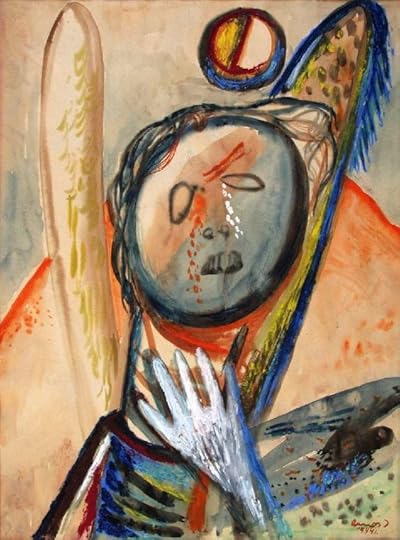
Imre Amos,
Weeping Angel - 1941


(*) The trauma was compounded by a trial that ended in an acquittal. These experiences profoundly changed Borbély's view of life, as suggested in an interview:

If I had not experienced that our firmly upheld rights are simply illusions; that it is futile to trust the law or ethics, and to believe in the victory of good over evil. Because when the killer breaks into your living room, all of that means nothing. The killer can be a person, but it can also be an organization, or the executive organ of the state. And God remains silent. Since God can only speak through human words, and since only we can give Him a language and a voice. Without us humans, without our help, God is powerless and frail on Earth, just like his angels.

But, as this affected only his later works, I won't go into it any further here.

(**) The eleven weeks I spent in Berlin in '92 and '93 afforded an additional resonance to these passages.

(***) Even before the horrific events of that Christmas Borbély viewed himself as a survivor: a survivor of his brutal upbringing, of the Stalinist regime running his country up till his early manhood, but also in the extended sense, for one of his grandfathers died in Auschwitz. And there may well be other biographical links I am not yet familiar with.

************************
Profile Image for Hendrik.
440 reviews110 followers
March 15, 2022
Szilárd Borbély ist im deutschsprachigen Raum mit seinem Roman Die Mittelosen bekannt geworden. Der ungarische Schriftsteller gehörte aber auch zu den bedeutendsten Lyrikern seiner Generation. Mit diesem Band liegt erstmals eine umfassende Auswahl seiner Gedichte in deutscher Übersetzung vor.

Im Zyklus Berlin Hamlet streift ein einsamer Flaneur durch das Berlin um die Jahrtausendwende. Eine Atmosphäre der Unbestimmtheit umgibt ihn auf seinen Wegen durch eine Stadt im Wandel. Direkte Bezüge zu Walter Benjamins Berliner Kindheit um neunzehnhundert schlagen eine Brücke in das historische Berlin vor den Kriegen. Bei Benjamin ist das Flanieren ein Prozess des Erinnerns. Gleiches trifft auf das lyrische Ich bei Borbély zu, dass sich in einer Zone des Übergangs zu befinden scheint. In einer Art Schwebezustand, in dem sich Vergangenes mit Zukünftigem verknüpft. Vermutlich eine Anspielung auf Benjamins Engel der Geschichte, der sein Antlitz der Vergangenheit zugewendet hat, aber vom Sturm unaufhaltsam Richtung Zukunft getrieben wird. Die darin zum Ausdruck kommende innere Zerrissenheit verweist auf zwei weitere wichtige literarische Bezüge. Flankiert werden die Berliner Szenen nämlich von Gedichten mit Motiven aus William Shakespeares Hamlet und Zitaten aus Franz Kafkas Briefen an Felice Bauer. Vorbilder, welche das Ringen nach Freiheit und Selbstbehauptung verkörpern, aber auch existenzieller Qual ausgesetzt sind. Vor dem Hintergrund von Szilárd Borbélys Freitod lesen sich seine Verse zum Teil als düstere Omen:
Als ich nach Berlin kam, wollte ich nicht mehr
leben. Warum ist es nicht möglich, dachte ich, wenn
einer nicht mehr weiterleben will, dass er verschwindet.

Dadurch allein, dass er es beschließt und unbedingt will.
Der zweite Zyklus Leichenprunk ist der Versuch einer persönlichen Traumabewältigung. Während seiner Zeit in Berlin, fielen die Eltern von Szilárd Borbély einem brutalen Überfall zum Opfer. Die Mutter wurde von den Tätern mit einer Axt erschlagen, der Vater überlebte schwer verletzt. Um für die Trauer einen Ausdruck zu finden, der sich nicht in persönlicher Betroffenheit und Pathos erschöpft, bedient sich Borbély verschiedener literarischer und geistiger Traditionen. Das umfasst zum Beispiel die Lyrik des Barock oder auch christlich-jüdische Heilsgeschichten. Einerseits ermöglicht der Rückgriff auf diese alten Formen Distanz zum Geschehenen zu entwickeln. Andererseits verweist das auf eine Leerstelle der Gegenwart, in der es keine passende Form bzw. Sprache mehr für den Umgang mit Tod und Leid gibt.
Die Ewigkeit ist spurlos
wie der Stoff
den der Tod
ins Blut dir tropft
Im Anhang gibt es noch einen weiteren Text, der vom Verbrechen an den Eltern handelt. In protokollartigen Notizen wird darin der gesamte Tathergang geschildert. Auffällig ist wiederum der nüchterne Ton und die distanzierte Haltung des Erzählers in der Darstellung der Ereignisse. In ihrem Nachwort gibt die Übersetzerin Heike Flemming den Hinweis, dass Leichenprunk insgesamt hundertzwanzig Texte umfasst. Für den vorliegenden Band musste daher eine Auswahl getroffen werden. Auch weil einige Sequenzen aufgrund ihrer Dichte als nicht übersetzbar gelten. Eine weitere Ebene, die deutschen Lesern leider verschlossen bleibt, sind die Verweise auf die ungarische Literatur der Zwischenkriegszeit. So finden in Berlin Hamlet u.a. Bilder und Zeilen von Attila Jószef und Ernő Szép Verwendung. Gleichwohl nimmt das den Gedichten kaum etwas von ihrer Qualität. Um so betrüblicher ist dagegen der Gedanke, dass Szilárd Borbély keine neuen mehr schreiben wird.
Profile Image for maria bojan (bucșea).
75 reviews21 followers
April 3, 2021
[Fragment I]

Da, aș putea să afirm că
discuția noastră a lăsat în urmă
un vid imposibil de umplut. De atunci,
fiecare zi conține acest vid.

Necesitatea formulării,
de a spune ce e acel lucru care
mă însoțește zi de zi. De când nu
ne-am văzut, aducerea aminte

a înlocuit discuțiile noastre.
De atunci nu există zi
care să nu conțină ceva
și inversul e valabil. În ultimul timp

îmi interpretez și tăcerile.
Și simt că sunt zile
care se lărgesc. Fiecare
clipă o adâncime crescândă care

le ascunde în ea însăși. Totul
este cuprins în altceva
care-l ia apoi în stăpânire. Un cuvânt
pe un altul. Iar cuvântul e stăpânit

de o noțiune. Ceea ce am numit vid
e de asemenea parte din ceva. Poate
din discuția noastră care continuă
încă într-un fel sau altul. Cred.


superb volum.
Profile Image for Nuno Miguel.
74 reviews4 followers
January 19, 2024
"Our conversation was more of a remembering, a revocation of all
That had happened earlier. Like a film being played in reverse".
Profile Image for K..
1,144 reviews75 followers
June 23, 2017
3.5 stars, truly.

I do not believe I have enough background in poetry to adequately rate this collection, unfamiliar as I am in the history and of how it is created. I'm gonna do it anyway.

Research into this author has told me that he was one of the most important contemporary poets in the post-1989 Eastern European world, where much of his focus was on grief, memory and trauma. It's why I chose this collection to fulfill what I thought would be the most difficult challenge of 2017: "Read a collection of poetry in translation on a theme other than love."

The choppy breakdown of the lines is jarring, but once you get a rhythm going in your head they have their own flow. I suppose this is probably a concept habitual poetry readers just know, but for me it made for a difficult start. Borbély seems to reference other authors (Kafka, Walter Benjamin, etc.) as well as classical mythology quite often, which turned this more into an academic exercise rather than something that was strictly reading for pleasure. Still, I never turn down learning new things and now I am very Hip to history of the flâneur; that is, to stroll and observe as a modern urban spectator.

This is a ghostly, and occasionally ghastly, work that is interspersed with Letters I-XIII that speak searchingly of one penpal desperate to meet up with the his friend, to create a greater intimacy between them. It becomes obvious by Letter IX that she is entirely uninterested:
"She would never marry anyone
else, she said.
She would never throw away my letters. She would not
ask for her photographs back.
She was willing to correspond with me, but wouldn't mind
if she didn't have to any more."
Ouch, dude. Further terrible things happen to this letter writer, as seems to be a theme of this work; it is stuffed to the brim with ennui and harsh emotional Feelings with a capital F. Upon reading the translation notes, I find it unsurprising that the Letter cycle is based directly of Franz Kafka's missives to his on-again, off-again fiancee, Felice Bauer. The tone of emotional suffocation was there.

Some of my favorite pieces from this collection, in no particular order and for no reason that I can put into words:

"Fragment I"
Yes, I could express it simply by saying
that our conversation left in me
a vacant space. Since then, every
day contains this space.

"Schöneweide"
[iii]
He was
a mangy, lost soul. I pitied him. And I thought of my
relatives,
the ones whom I could never meet. Who'
hovered for a while above the German-Polish lowlands, as
dust and ashes. Perhaps that is why I wanted to look,
simply
to observe, for months on end, what the sky was like over
Berlin.

"Letter IV"
And after
I got your address, I was still unsure, was it the right one?
For there is nothing sadder than sending a letter
to an uncertain address. For that is no longer a letter,
but instead a sigh.

My favorite in its entirety is "Naturhistorisches Museum", one of the longer pieces in Berlin-Hamlet. It's an odd blend of skepticism of science, of faith and humanity.

"In the Natural History Museum, from ten until six,
the past is an open book. The domain of minerals and
stones
is seemingly without motion. In a series of
rooms, animals stuffed and preserved
in compliance with the inferred order
of creation. Desiccated bodies, dehydrated plumes,

down, hides. Glass eyes, lifelike.
Movement slowed down to infinity, fixed
but dead creations. Although their legs
are in the air, heads daintily averted.
If seen from the front, the half-profile is preferred.
Representatives of the great species, blind objects

in the darkness. But after closing time, life
doesn't stop. In the ancient oak casements of the vitrines,
tiny parasites continue their labour with
that indifferent monotonous background noise,
as the narrator of a nature film
speaks. Microscopic fungi,

various life-forms of simple constitution
battle for survival. Then the fine tension
of the dramatic tremulo penetrating the
mechanical voice: And the viruses in the air.
When, in the year sixteen hundred and seventy-nine,
after the last occurrence of the Black Death, a memorial

was erected to the devastation, new explanations
were sought. In addition to belief
in providence, there was faith in mathematics,
then statistics. When belief was thrust aside,
the mythology of freedom replaced the cult
of the death. The result was the rapturous

veneration of life, then of course
wars, revolutions. But the watchword
of bliss displaced all else. In time
evolution became the modern metaphor
of death. And all the while humanity
still knew nothing of bacteria.

In front of the display of the great carnivores a quiet
child next to his mother steps back and takes
her hand. And points to one of the creatures: it looks
like daddy.
And truly, one could arrange the material
according to the sequence of likenesses.
Through the associative and metaphorical correlations

in a language that knows no history.
On the glass of vitrines the bacteria flourish, but then
comes the great cleansing, fine de capo. A meteor
striking the earth, or a straight of virus now
dormant in the Amazon. Supposedly the beginning of life
was an infection that arrived on a meteorite."
Profile Image for Raluca Anghel.
Author 3 books17 followers
June 15, 2019
I loved it, loved it, loved it.
I will return to him.
Profile Image for Melissa.
289 reviews131 followers
November 22, 2016
I was debating whether or not to even attempt any type of review of this collection of poetry. The layers of imagery, references and allusions to great figures like Kafka, Walter Benjamin, Attila József and Erno Szép could never be unpacked or fully explained in one short review. But I found the language and images of Borbély’s poetry so moving that I decided I had to at least attempt to put some thoughts together in order to bring more attention to this Hungarian poet and his tragic end.

The collection of free verse poems is divided into five interwoven themes and each poem in a cycle is given a sequential number. The cycle of poems entitled “Letter” are based upon quotations extracted from diaries and letters of Kafka. Borbély puts his own unique touch on each of Kafka’s quotations by rewriting and reworking them. Kafka is the perfect figure through which to mix images of Berlin, with city he had a connection through Felice, and Hamlet, whose indecision is reminiscent of Kafka’s own hesitancy about his relationship. The first in the series of “Letter” poems is the perfect blend of elements that include Kafka, Berlin, and reticence:

[Letter I]

At last I have a picture of you as I
once saw you. Of course not as when
I glimpsed you
for the first time, without your
jacket, bareheaded,
your face unframed by a hat. but
when
you disappeared before my eyes into
the entrance of the hotel,

as I walked beside you, and nothing
as of yet
connected me to you. Although I
longed only
for the strongest tie to bind me to
you. Tell me,
don’t your relatives pursue you
altogether too much? You shouldn’t
have had time for me, even if I had
come
to Berlin. But what am I saying? Is
this how I want
to bring my self-reproaches to an
end? And finally,
wasn’t I right not to have come to
Berlin? But
when shall I see you? In the
summer? But why
precisely in the summer, if I shan’t
see you at Christmas?

The second cycle of poems specifically deals with the city of Berlin and Berbely’s visit there in the mid-1990’s. Each poem in this series is given the name of a specific place or a district in Berlin. Poem titles include, “Naturhistorisches Museum,” Herrmann Strasse,” and Heidelberger Platz.” The translator, in his afterword, points out that it is in this series of poems where Benjamin’s Arcades Project is heavily alluded to. The poems are a blend of Borbély’s personal experience of Berlin with that city’s complicated history. In “Krumme Lanke” he opens with a memory of the “last days of the Reich” and proceeds to tell a story of two soldiers who ignore their superior’s orders and have a clandestine meeting. The poem then shifts without a transition to the poet’s own memory of walking next to Krumme Lanke: “Our conversation/ was more of a remember, a/revocation of all that had happened earlier. Like a/ film being played in reverse.” There is a deep sense of wandering that pervades these poems as he visits train stations, various seedy parts of the city and the natural history museum and uses these places as starting point with which to reflect on Berlin’s past and the poet’s present.

The series of poems entitle “Epilogue” do not appear to have any specific references to famous authors and are the most deeply personal and reflective. These poems only appear at the beginning and end of the collection and show us a writer who is battling many emotional demons:

[Epilogue II]

For the dead are expected to know the
path
above the precipice of the everyday.
When
they leave the lands of despair, and
depart
towards a kingdom far away and
unknown,
which is like music. Swelling, a solitary
expectation everywhere present. this
music
does not break through the walls. It
taps gently.
It steals across the crevices. Silently it
creeps,
and cracks open the nut hidden deep
within the coffer.

Next, are a series of poems entitled “Fragment” which are all addressed to an unnamed receiver. There is a deep sense of not only hesitation but also loneliness in these poems. He begins the first “Fragment” poem:

Yes, I could express it simply by
saying
that our conversation left in me a vacant space. Since then, every
day contains this space.

Of the five different categories of poetry, the “Fragments” are my favorite because Borbély’s own voice, pain, and struggle come through most clearly. I found a line from “Fragment III” especially chilling and laden with foreshadowing: “My need is for those who will know/how/all of this will end.” Borbély tragically takes his own life in 2014at the age of fifty and there are hints throughout his poems that allude to his melancholy.

The final category of poems are called “Allegory” and are a mixture of philosophical observations which still maintain obvious references to Kafka. The first poem in the collection especially evokes images of Kafka and his complicated relationship with his father:

[Allegory I]

The pierced heart, in which lovers
believe, recalls me to
my task. Always have I desired

to be led. My father’s spirit instruc-
ted me
in ruthlessness. what he missed in
life, he now
in death wished to supplant. I did
not

find my upbringing to be a comfort.
the spirit of our age is for me
excessively
libertine. My scorn is reserved for
the weak.

Finally, a word must be said about the afterward which was beautifully written by the translator. It serves as a thorough introduction to Borbély’s life, literary influences, and style of writing but is also a fitting eulogy for this gifted poem whom the world lost too soon.


Profile Image for Yurii.
45 reviews2 followers
Read
December 8, 2025
I picked up this book at the library almost randomly — the title caught my eye, but I knew nothing about the author or the collection. In a way, that made the choice feel like its own small poetic gesture, the kind of serendipity that suits poetry best.

I ended up liking these poems, especially the way they map specific corners of Berlin — a city I’ve visited more than any other. Each time I’m there, I try to explore it much like Borbély does (and like Walter Benjamin before him): drifting through districts, letting the city reveal itself in fragments. The only difference is that I tend to connect these neighborhoods by running, stitching them together mile by mile.

A quiet, thoughtful collection that turns wandering into a way of seeing.
Profile Image for Joe Milazzo.
Author 11 books51 followers
December 25, 2017
"The escalator / rises into the heights, and creates correspondences, / like a metaphor degraded in the course of time / into a simile."
Profile Image for Paddyspub.
249 reviews
July 21, 2025
Rest in peace, Szilárd Borbély. Poems that evoke a time and place I have never known but can picture clearly in my mind's eye.
Profile Image for Anna Wolfová.
137 reviews
August 26, 2019
When I came to Budapest I no longer wanted to live...

This was probably the longest time I've ever spent with a book of poetry, read it once, then once again, always coming back to it, always carrying it with me wherever I went, always reading at least a few lines.
Sitting on the Szabadság híd or waiting for the tram, while watching the Danube or the rose garden of Margit sziget. It kept haunting me. If I didn't bring the book with me every time I left the house I would feel uneasy and distressed. Even now when I'm writing this I have am urging need to come back to it. To try to remember everything Szilárd composed as if forgetting meant certain damnation.

Is it that good? I don't know since I can no longer bear the agressivness of poetry, and I do not wish my deeds to be investigated.
Displaying 1 - 13 of 13 reviews

Can't find what you're looking for?

Get help and learn more about the design.