

What do you think?
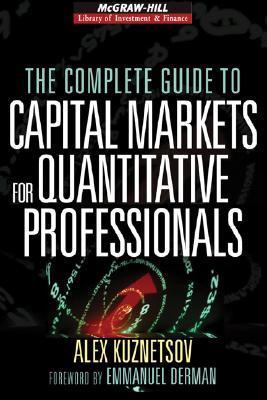
The Complete Guide to Capital Markets for Quantitative Professionals
The Complete Guide to Capital Markets for Quantitative Professionals is a comprehensive resource for readers with a background in science and technology who want to transfer their skills to the financial industry. It is written in a clear, conversational style and requires no prior knowledge of either finance or financial analytics. The book begins by discussing the operation of the financial industry and the business models of different types of Wall Street firms, as well as the job roles those with technical backgrounds can fill in those firms. Then it describes the mechanics of how these firms make money trading the main financial markets (focusing on fixed income, but also covering equity, options and derivatives markets), and highlights the ways in which quantitative professionals can participate in this money-making process. The second half focuses on the main areas of Wall Street technology and explains how financial models and systems are created, implemented, and used in real life. This is one of the few books that offers a review of relevant literature and Internet resources.
576 pages, Hardcover
First published November 1, 2006
Ratings & Reviews
Friends & Following
Create a free account to discover what your friends think of this book!
Community Reviews
Displaying 1 - 13 of 13 reviews
January 5, 2025
The book provides an in-depth overview of how modern financial markets came to be, the different markets, players, and technologies at play, and clarification of what both sell-side and buy-side professionals do daily (with a far greater emphasis on the sell-side); all of this, from the perspective of someone who entered the field as a technical/quantitative professional. It's written with so much depth and care as if to serve as a guide for what he had wished to have had when he first entered the finance industry.
The author (Alex) was a Physics PhD who had entered the financial industry with no prior experience. By his admission, he got in during a time when the financial industry was just looking for anyone with an advanced degree to create advanced financial models.
Today that landscape has completely changed. At the time of writing which I presume to be in the mid-2000s, he realized the influx of gifted individuals with great technical aptitude who didn't quite understand the industry they were entering.
He starts the book on an expository note detailing the formation of modern equity and debt markets, the various players and institutions, and a day-to-day look at what the financial industry looked like at the time. So in-depth is this intro he describes the major financial hubs (at the time of writing) and their reason for being.
I found myself thinking "Billions wasn't too far off".
He goes on to write about the various economic factors and institutions that affect the markets and subsequently the various security markets. While I did read over these chapters of the second part I found the first few on the macroeconomic factors, yield curve, and interest rates to be by far the most important. Readers can skip to chapters and subsections they find relevant, and the book is structured to account for this reading style.
Finally, he talks about the various "technical" aspects a technical individual might be brought into a firm to solve as well as an in-depth look at what it looks like in practice(Mostly software and systems plumbing).
If the next few years are as uncertain as they are likely to be due to the increasing generality of proficiency of AI systems, I think Alex generally (indirectly) provides an enlightening case for why that might be a profession of choice for those trying to hedge against the future. It's pretty close to the core of what drives a lot of modern society and quite obviously, the one thing that keeps it all moving. Money.
The author (Alex) was a Physics PhD who had entered the financial industry with no prior experience. By his admission, he got in during a time when the financial industry was just looking for anyone with an advanced degree to create advanced financial models.
Today that landscape has completely changed. At the time of writing which I presume to be in the mid-2000s, he realized the influx of gifted individuals with great technical aptitude who didn't quite understand the industry they were entering.
He starts the book on an expository note detailing the formation of modern equity and debt markets, the various players and institutions, and a day-to-day look at what the financial industry looked like at the time. So in-depth is this intro he describes the major financial hubs (at the time of writing) and their reason for being.
I found myself thinking "Billions wasn't too far off".
He goes on to write about the various economic factors and institutions that affect the markets and subsequently the various security markets. While I did read over these chapters of the second part I found the first few on the macroeconomic factors, yield curve, and interest rates to be by far the most important. Readers can skip to chapters and subsections they find relevant, and the book is structured to account for this reading style.
Finally, he talks about the various "technical" aspects a technical individual might be brought into a firm to solve as well as an in-depth look at what it looks like in practice(Mostly software and systems plumbing).
If the next few years are as uncertain as they are likely to be due to the increasing generality of proficiency of AI systems, I think Alex generally (indirectly) provides an enlightening case for why that might be a profession of choice for those trying to hedge against the future. It's pretty close to the core of what drives a lot of modern society and quite obviously, the one thing that keeps it all moving. Money.
April 23, 2024
The book contains two major sections (part 1&2 is the business side of capital markets and part 3&4 is the technology side). I've only read part 3&4 since the business side is relatively outdated and I chose to read other alternatives. However, the technology part alone is worth a 5-star rating. As an IT guy new to an investment bank, I found various tech functions too abstract to understand. At work, there are people to ask questions to of course but in most cases, technology people only understand a specific area where they've worked on previously. This book provides a comprehensive guide to technologies within an investment bank, from handling reference data to trading systems, modelling, research etc. Although it was written in the 2000s, the concepts still remain relevant. Strongly recommend this to any technologist who is new to investment banks.

February 1, 2021
In depth but clear, intended primarily for someone with a strong quantitative background getting in to the finance industry. I read it out of more general interest. I skipped a few chapters I wasn't particularly interested in.
About the only general criticism I would lodge is that the content is somewhat outdated, having been written mostly in 2006. It's somewhat surreal to see the discussion of mortgage securitization and credit default swaps two years before the financial crisis...
For a less in depth book on this topic, I'd probably recommend "Guide to Financial Markets" by Marc Levinson (The Economist series) instead.
About the only general criticism I would lodge is that the content is somewhat outdated, having been written mostly in 2006. It's somewhat surreal to see the discussion of mortgage securitization and credit default swaps two years before the financial crisis...
For a less in depth book on this topic, I'd probably recommend "Guide to Financial Markets" by Marc Levinson (The Economist series) instead.
October 13, 2018
One of the best introductory books and guides for getting started in the financial industry.
January 5, 2020
Best overview on finance for people with technical background
January 6, 2025
wish the book didn’t stick to not having formulas at the expense of convoluted wordy explanations . Good high level overview of markets concepts, though software and trading stuff fairly dated by now

July 4, 2020
the book should be renamed: how does wall st work from a tech point of view.
September 21, 2014
Professional, well written position giving introduction to the financial markets. There were moments, where Author went little bit too much into details, which could be left as reference to follow-up material. Deserved 4 stars.
February 23, 2015
gives a basic intro of financial market tools, but extremely low on technology side. if you are an programming engineer, you know already all the technical stuff this book will talk about, and the financial information is better discussed on wikipedia. Money wasted buying this book.

January 15, 2008
i don't know why it's so hard to come across books as good as this without going to school. maybe looking in the wrong places
August 24, 2010
Good if you know nothing about finance. Otherwise skip.
Want to Read
August 23, 2013This entire review has been hidden because of spoilers.
October 30, 2013
Every Googler should read this book.
Displaying 1 - 13 of 13 reviews