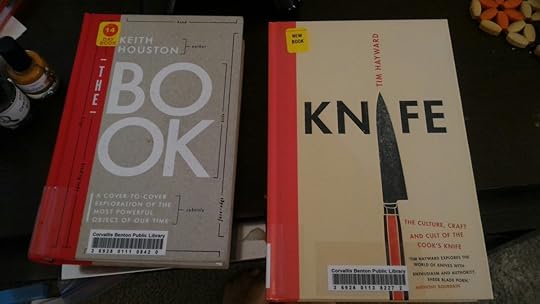
'Hayward, one of the... best food writers alive, every page a different blade, glintingly pictured and lovingly described. Kitchen porn but not A cook’s gotta chop, a cook’s gotta mince.' – Simon Schama in New York Times
'Both essential and informative, useful information and sheer blade porn. Tim Hayward explores the world of knives with enthusiasm and authority.' – Anthony Bourdain
'This is possibly the coolest book I have ever seen. Glorious in content, geeky in text and engaging in photography. This is every cook's must-have reference book! I love it.' – Tom Kerridge
'Tim Hayward is the most serious cookery writer I know. Whatever he says, I will listen. Whatever he writes, I will buy.' – Len Deighton
'A gleaming, razor-sharp paean to the chef s greatest weapon in Knife by Tim Hayward. Both eloquent and encyclopaedic, Knife is the ultimate book of blades'' – Tom Parker Bowles, Mail on Sunday
Knife is a love-letter to this essential culinary tool – its form, history and creation. The knife can be the most functional utensil or the most exquisite piece of design – avid collectors pay jaw-dropping sums for a piece of Japanese hand-crafted steel, made according to traditions that date back thousands of years.
Through interviews with knife-makers, chefs and collectors, acclaimed food writer Tim Hayward explores how the relationship between cook and blade has shaped the both the knife itself, and the ways we prepare and eat food all over the world. From Damascus blades to Chinese cleavers and sushi knives, at the heart of Knife is a fascinating guide to 40 different types of knife, each with its own unique story, detailed description and stunning photographs.
Lavishly illustrated and designed, and as cool, personal and desirable as the most intricately crafted deba, Knife opens up the world of this most covetable of culinary implements.
Beautifully designed, this book is a homage to that most important piece of culinary equipment – the knife. It is not so much the technique of using the knife that the author is interested in (although that is covered, along with making knives, how best to grip them and more), but it looks at the different knives used throughout the world – Chinese Knives, Japanese Knives, Western Knives, Specialised Knives – knives in every shape, size and form.
As an example, the Santoku is a Japanese knife. There is a picture on the left page – the photographs in this book are beautifully done. The opposite page includes such details as blade length, the material, why and when you would use this and more. At first, I must admit, I wondered whether I would be a little bored by this, but now I am just thinking of all of those specialist knives which I really, really, need to buy. Plus, this is a very readable book, full of fascinating facts and great fun to dip into. If you are interested in the use, culture and craft of knives in the kitchen then you will love this.
Tim Hayward clearly has a passion for Cook's knives and by the time you finish his book, you will too. He explores the different cook's knives from different culinary cultures (French/Western, Chinese and Japanese) along with working knives, special knives, knife making processes, knife collectors, knife related objects....you get the idea. And all of it is done with a sense of love, knowledge and humour that the book doesn't get dry for even one knife-related page.
The book also features some beautiful photographs and, for some reason, a mini-manga.
If I could ask for something more, it would be more illustrations (particularly for cutting motions and process described in some details), and more of personal perspectives of knife-related people than the simple knife-related facts.
I became mildly obsessed with knives since I bought my first Wüsthof in 2015 and naturally gravitated towards this book by Tim Hayward. It not just details the different types of knives used in Western, Chinese and Japanese kitchens, but also explains how each knife is used specific to the types of ingredients/knife strokes commonly used in that specific cuisine, shaping the way each blade and handle is made.
There is extensive documentation of Japanese knives, and a manga showing the knife-making process in Sakai by shokunins — ultimate artisans that dedicate their whole lives to perfecting just one step out of many in making a knife.
I thoroughly reading about all the specialty knives as well and found them all so fascinating!!! This is definitely a book for the Forever Shelf.
Wow! What a book. It is worth owning this book just because it is such an exceptional production! So if you love books, you should have this book. If you love good design, you should buy this book. Certainly if you love knives or cooking, this book is a joy to have around. But if you did not love knives before you bought this book, you will after reading it.
I can only say that ever since I started getting more deeply into plant-based cooking, I began to focus more on what knives work best for me. It has led to the discovery of Japanese knives and with it more and more interest in all the different kinds of knives. I am hooked, and this book just adds to the fun. As the book points out, you will know that your knives are sharp when you don't cry while you are cutting up an onion.
The truth is that many kitchen gadgets are useless. The endless garlic presses, and other such implements are a disaster when cleaning, and their only justification for existing is that people don't keep their knives sharp. The book certainly offers some insight there as well. In the end, you will throw out all those silly gadgets, and just have a better collection of knives. It is a joy to work with a good knife, and they are easy to clean.
I would have liked this more if I'd read it as intended: as a physical book with full-color art. As it was, I found it difficult to follow what he was talking about because I wasn't sure which illustration he was referring to. He just said things like "in this photo" but on an ebook that phrase is meaningless. Take note, editors!
That aside, I thought this was lovely. I was expecting something more along the lines of Consider the Fork: A History of How We Cook and Eat for knives, and instead I got a love letter to knives, with enough history to keep me interested and enough snark to keep me entertained.
Took me a little longer to get into this one than it did the Modern Kitchen. But about 20% into it or so I really started to enjoy it. I learned a lot too. About sharpening, technique, and the name of the type of knife I want to use (cai dao). I also ended up watching a bunch of knife technique videos after reading this and I looked at all these knife accessory things on Amazon (*cough* the knife roll, for instance).
Overall this is an informative, and beautiful book (lots of pretty pictures of knives on every page) that you could knock out in a few days if you had the time.
Honestly I borrowed this book from the library because of the pictures. Beautiful photography. Weirdly personal prose, considering the nonfiction genre. But an awesome adult picture book that I would recommend to anyone interested in kitchen lore.
An in-depth perspective on all things knives. From the usage, to the different types, to the practicalities. There's a lot more to knives than you'd realise!
Gorgeous book- fully in color, this functions as a field guide to knife types (with specific examples used for photographs, lovingly detailed with length, materials its made of, manufacturer, uses, etc.) There are relevant asides about knife culture in Western civilization, China, and Japan, as well as what goes into knife manufacturing and useful skills like how to sharpen and ways to store knives.