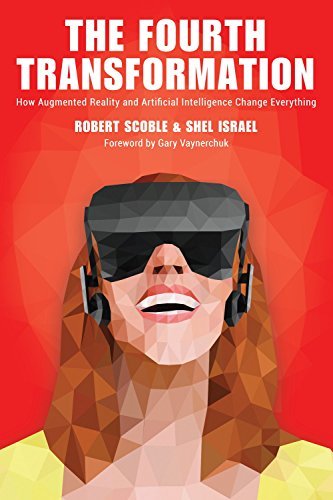
Prior to collaborating on and self-publishing The fourth transformation: How augmented reality and artificial intelligence change everything (2017), Robert Scoble and Shel Israel both wrote and researched about the short-term impact of technology since 2005. Robert Scoble has been a contributor at Upload VR and has been very influential at spotting up and coming tech. In addition to writing six previous books, Shel Israel has also contributed to Businessweek and Forbes.
Before I can begin a review of The Fourth Transformation, it would help to outline the three transformations that preceded it. The first transformation began in the 70’s when humans began using text characters to communicate with computers. The second transformation was the invention of the graphic user interface or GUI which advanced the way people interacted with computers by incorporating a mouse as an input device. The third transformation was the introduction of Apple’s iPhone and later the Android operating system which elevated the human experience with computers to touch almost exclusively. The fourth transformation, which this book describes, comes with the introduction of virtual reality, augmented reality, and mixed reality or VR, AR, and MR. All three are similar versions of humans interacting with computers within either a real or virtual environment.
The book is a review of current VR/AR/MR technology capabilities and various channel implementations as well as which direction the authors predict it heading. Although the book touches on education occasionally, it mainly focuses on business applications and how the technology should be implemented if businesses want to stay current. The authors predict that, by 2025, most consumers will be spending a majority of their time with VR glasses rather than using their phones. This will bring about a sea-change in the way people will interact with each other as well as their environments. Which brings into the discussion how businesses will need to keep pace with the technology. The authors argue that successful businesses will need to stay ahead of the curve by creating advertising that is reactive to the likes and interests of the individual as well as their current location. This means custom, interactive advertising based on geolocation of each consumer. If businesses are unable to keep up, they will become extinct.
The book also gives a global perspective of how VR technology can become a communication device across all languages. One example given by the authors is that there are probably 200 ways to say bicycle or bracelet but one picture can convey an exact meaning across all languages. There is an interesting observation made by the authors that brings VR into international focus that can somewhat be connected to the bicycle idea. Countries that conduct trade are very unlikely to go to war with one another. VR will allow people to search by image rather than words which reduces one more obstacle to worldwide trade.
Two other observations by the authors bring about the idea of a possible future world utopia. They state that children are able to learn two or more languages and speak them like a native as long as they learn them before puberty. They feel that the VR technology will make learning foreign languages much easier in the near future. Based on this, the authors posit that mutli-lingual children will be better able to ignore the boudaries of borders, religion, and politics. While I would like to believe that world peace via virtual reality is possible, in looking at social media today, I don’t necessarily share their optimism. I do hope that VR will allow future generations to better experience the lives of others and keep from becoming judgmental about their peers personal feelings and situations.
If you are a business owner looking for some ideas on future direction for your market and how to connect with your customers, this book is exactly what you’re looking for. If you are marginally interested in the future of virtual reality, this will be an interesting read for you, too. The only issue I have with this book is that it’s two years old. Unfortunately, when you write about future technology, Moore’s law still applies. Even a book written this recently is going to be a little behind the times. Good read, it just needs to be updated yearly but I won’t fault the authors for this.