Jump to ratings and reviews
Rate this book

Thomas Hardy

Rate this book
The novels of Thomas Hardy have a permanent place on every booklover's shelf, yet little is known about the interior life of the man who wrote them. A believer and an unbeliever, a socialist and a snob, an unhappy husband and a desolate widower, Hardy challenged the sexual and religious conventions of his time in his novels and then abandoned fiction to reestablish himself as a great twentieth-century lyric poet. In this acclaimed new biography, Claire Tomalin, one of today's preeminent literary biographers, investigates this beloved writer and reveals a figure as rich and complex as his tremendous legacy.

486 pages, Hardcover

First published January 1, 2006

103 people are currently reading
1875 people want to read

About the author

Claire Tomalin

31 books411 followers
Born Claire Delavenay in London, she was educated at Newnham College, Cambridge.

She became literary editor of the 'New Statesman' and also the 'Sunday Times'. She has written several noted biographies and her work has been recognised with the award of the 1990 James Tait Black Memorial Prize and the 1991 Hawthornden Prize for 'The Invisible Woman The Story of Nelly Ternan and Charles Dickens'.

In addition, her biography of Samuel Pepys won the Whitbread Book Award in 2002, the Rose Mary Crawshay Prize in 2003, the Latham Prize of the Samuel Pepys Club in 2003, and was also shortlisted for the Samuel Johnson Prize in 2003.

She married her first husband, Nicholas Tomalin, who was a prominent journalist but who was killed in the Arab-Israeli Yom Kippur War in 1973. Her second husband is the novelist and playwright Michael Frayn.

She is Vice-President of the Royal Society of Literature and of the English PEN (International PEN).

Ratings & Reviews

What do you think?
Rate this book

Friends & Following

Create a free account to discover what your friends think of this book!

Community Reviews

5 stars
680 (38%)
4 stars
713 (39%)
3 stars
293 (16%)
2 stars
74 (4%)
1 star
29 (1%)
Displaying 1 - 30 of 170 reviews
Profile Image for karen.
4,012 reviews172k followers
April 7, 2019
when thomas hardy died, he wanted to be buried in stinsford. pretty much everyone else wanted him to be buried in westminster abbey. so a compromise - they take out his heart and put it in a tin and bury that in stinsford and the rest of him is to be cremated and buried in westminster abbey. but then a cat comes along and eats the heart so they have to kill the cat and bury that instead.

that, my friends, is a 'pastoral legend' which i grew up believing and which this book killed for me. the whole cat part is untrue, the dual-burial is very true. but i think that the story emerged because thomas hardy's life was pretty...boring. his creative life and output is amazing, but to achieve that he mostly had to sit around, writing. no complicated entanglements, no flipping over the christmas table, no drugged-out suicide attempts. thomas hardy stayed in an unsuitable marriage for years upon years, quietly writing and grasping for fame and social betterment. staid and english. tea and dogs. the best hardy quote from the book is his own:

There is not that regular gradation among womankind that there is among men. You may meet with 999 exactly alike, and then the thousandth - not a little better, but far above them. Practically therefore, it is useless for a man to seek after this thousandth to make her his.

sheesh. this concept of settling for average rather than going out and chasing that mythical thousandth woman may have been what led to his unhappy marriage. but it did lead him to create some of the more memorable women in fiction. (although i will never care about tess, and she was apparently his favorite) as for the rest of it, i didn't really know that much about hardy, having only read his poems and novels. it is a good book to get the chronology straight, it explains some of the thematic progressions. and ms. tomalin has this great quote (which i know alfonso will disagree with): reading jude is like being hit in the face over and over again. i could not have said it any better myself. it is truly unfortunate that the critical reaction to jude made him give up writing novels, because i would have loved to have seen what would have been his next stage in envelope-pushing. but this bio is a pretty good book, just not the most exciting thing i have ever read.

and yes, i am one of those thousandth women...

come to my blog!
Profile Image for Connie  G.
2,144 reviews710 followers
February 19, 2023
Claire Tomalin's biography of Thomas Hardy, the novelist and poet, deserves its excellent reviews. While she discusses his novels in the context of when they were written, it's Tomalin's wide use of quotes from many poems that gives the book its sparkle.

Born in 1840, Hardy had a lower middle-class childhood as the son of a builder in his beloved Dorset. He was a good student and an avid reader who was trained to be an architect, mainly involved in church restoration. He achieved his dream of becoming a novelist and poet, and used the beautiful Dorset countryside as the setting for much of his work. He usually spent the spring and early summer months in London for the social season, or traveled in the Continent.

Hardy was often a neglectful husband in both of his marriages, and Tomalin devotes many pages to his first marriage to Emma Gifford. She begins the biography:

"In November of 1912 an aging writer lost his wife. He was not expecting her to die, but then he had not been taking much notice of her for some time. . . This is the moment when Thomas Hardy became a great poet."

Hardy felt remorseful after Emma's death and wrote many love poems remembering their happy courtship in northern Cornwall and their early married life. Of course, his second wife, Florence, was offended that the deceased Emma was his Muse.

While Hardy had lacked the resources to attend university as a young man, he received honorary degrees from many universities that recognized his genius. He was a man who was caught between two worlds - the simple life in Dorset and the intellectual life of London. His poetry often reflected his experiences in both places, his love of nature, his social awareness of the plight of women, his ambivalence about religion, and a world shaken by wars.

This is a very readable biography that gives insight into Thomas Hardy, the man, as well as Thomas Hardy, the writer. Highly recommended!
Profile Image for Lloyd.
223 reviews8 followers
December 22, 2009
Being a Hardy enthusiast, it maddens me to hear people turn their noses up when he's mentioned before churning out the cheap and hackneyed 'well, he's depressing' line. It was refreshing, then, to finally get around to reading Claire Tomalin's well-reviewed biography which, in part, discusses why Hardy was so often at pains to deny the characters of his Great Novels a certain happily-ever-afterness.

Many of Hardy's denigrators would, though, concede that he writes beautifully, and his oft-neglected verse is dispersed throughout this account. Read alongside Tomalin's biographical narrative, it makes for a cracking read which reminds you of old lines and acquaints you with as yet unexplored material. When discussing a particular novel, Tomalin weaves a précis of the story with the backdrop to when it was written, which covers the format in which it was published and its reception. All this invests these stories, published I don't know how many times in Classic editions and reimagined on the television time and time again, with a reality and allows you to see beyond all the noise and appreciate the circumstances surrounding their creation.

As well as its overriding qualities, Tomalin's biography introduces a few real gems. I loved Hardy's evocative descriptions of North Cornwall, where I happened to buy this book, and his acknowledgment that there is a gulf between its summer and winter self -- something that I recently experienced in two holidays in these two different seasons. Also, Hardy's quote regarding the process of writing should be a lesson to all aspiring writers, bloggers and critics:

"I never let a day go without using a pen. Just holding it sets me off; in fact I can't think without it. It's important not to wait for the right mood. If you do it will become less and less".

A 5 star book if ever there was one. My book of 2009.
Profile Image for Karen·.
682 reviews902 followers
December 27, 2012
You love not me,
And love alone can lend you loyalty;
-I know and knew it. But, unto the store
Of human deeds divine in all but name,
Was it not worth a little hour or more
To add yet this: Once you, a woman, came
To soothe a time-torn man; even though it be
You love not me.


In one of the BBC's Book Club programmes Claire Tomalin disarmingly tells how she was more or less forced by her publisher to come up with a decent by-line to her biography of Thomas Hardy, which she had hoped to call, in all simplicity, Thomas Hardy. And how she scoured, once more, the poems, desperately hoping for an idea, any idea. 'Time-torn', taken from his poem A Broken Appointment, how about that? Float that with the editor, does he like it? He did indeed, and by one of those felicitous fancies of fate, it resonates beautifully with her wonderfully nuanced portrayal of this figure.

Time torn: a man who was born at the beginning of the Victorian age, in 1840, just three years after Victoria became queen, and who lived on until the roaring twenties, friend of Virginia Woolf and T.E. Lawrence. Torn, too, by the vagaries of rigid class lines, by his own sense of guilt over his treatment of Emma, by the contrasting demands of solid country gentility and the glamour of London literary life, by the commercial necessity of writing novels in order to finance his life as a poet. This was a man who travelled an even longer, stonier path than Dickens, despite the latter's stint in the blacking factory. Dickens at least was born into a fairly genteel, lower middle class family, even if they had their financial ups and downs. Hardy, on the other hand, was the son of a builder, at a time when the divide between labourer and even the lowest middle class gentility was as wide as it ever had been at any time before or since. Small and weak when born, his very survival on earth seems a miracle. What he went on to achieve is more miraculous still, but Tomalin holds a steady tiller. She is no dewy-eyed breathless enthusiast, even if she obviously loves Hardy's work and very much likes the man too. She keeps her ship on an even keel by a cautious layering of differing views, carefully flagging her speculative conclusions with phrases like 'It makes you wonder if...'
Does that make Tomalin sound finicky and over-zealous in her attention to detail? I hope not, for even if, as she freely admits herself, the early chapters contain rather too many names and facts, she has written an amazingly compelling account of what on the outside looks like a rather dull and ordinary existence, living with his wife and his dog and writing novels that grew more and more bleak, and then, when he had earned enough money and opprobrium, turning to poetry. And Tomalin's warmth and generosity are not reserved only for the man himself: she is, if anything, even more generous towards the women who tried to soothe that time-torn man. You have to feel sorry for Emma: headstrong and lively and spirited. And damn it, she had to be. She had to defy her parents, break with her family forever in order to marry this builder's son, and yet at the same time bear the humiliating dismay of his family too, who considered that she brought nothing to the marriage at all; not youth, nor beauty, nor money and not enough intellect. And what could a headstrong, spirited young woman do with herself in a Victorian marriage? What role for her? She must have hoped to share in Thomas's creative life, for she was denied any field of action of her own. No wonder she turned a little odd and eccentric, cooped up at home, in a social no-man's land, with a husband who shut himself away in order to write them out of poverty.
For once, the puff on the back can be wholeheartedly endorsed: 'Another triumph..' '..an object lesson in how to write a life...' 'It is a moving story and Tomalin tells it as vividly, with as great a fund of sympathy and sense, as can be imagined.' Who am I to disagree with James Wood? Nor would I want to.
Profile Image for Janelle.
1,626 reviews345 followers
January 27, 2022
Claire Tomalin writes great biographies! This is a very readable look at the life and work of Thomas Hardy. It makes me want to read all his novels that I haven’t got to yet and re-read Jude the Obscure!
Profile Image for Haaze.
187 reviews54 followers
September 21, 2018


I very much enjoyed Claire Tomalin's biography of Thomas Hardy. She did a solid job describing the times and circumstances surrounding Hardy's life. The first two thirds of the book made me both curious and interested about Hardy as a developing author as well as his many novels. It was interesting to learn about his ancestry, early life and difficulties in terms of becoming a writer. The landscape and surroundings are wonderfully depicted as well as his romance and marriage to Emma Hardy.
Be warned that there are numerous spoilers (for the novels) in this biography as Tomalin happily analyzes plot lines and speculates around their association with people in Hardy's life. A surprise were the numerous references to Hardy's poetry. It is eloquent and powerful often focusing on nature and aspects of time and memory. The last third of the biography focused on minute details, Florence Hardy (his second wife) and was a bit overblown (where was the editor?). It dragged on a bit. However, Tomalin eloquently installs a foundation for exploring Hardy's work in more detail. The biography breathes new life and meaning into Hardy's numerous novels and stories. Highly recommended as a gateway to exploring one of England's greatest authors. It definitely filled me with an urge to rediscover and explore more of his works and in particular his poetry. It's lovely! As an example:

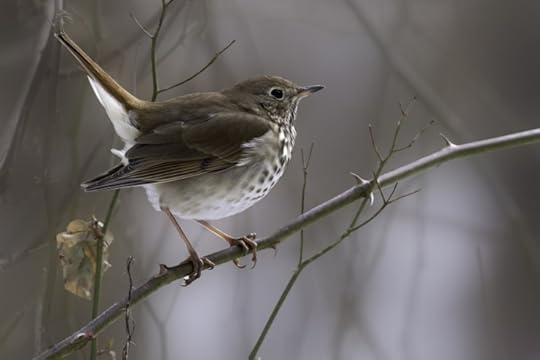
The Darkling Thrush by Thomas Hardy

I leant upon a coppice gate
When Frost was spectre-grey,
And Winter's dregs made desolate
The weakening eye of day.
The tangled bine-stems scored the sky
Like strings of broken lyres,
And all mankind that haunted nigh
Had sought their household fires.

The land's sharp features seemed to be
The Century's corpse outleant,
His crypt the cloudy canopy,
The wind his death-lament.
The ancient pulse of germ and birth
Was shrunken hard and dry,
And every spirit upon earth
Seemed fervourless as I.

At once a voice arose among
The bleak twigs overhead
In a full-hearted evensong
Of joy illimited;
An aged thrush, frail, gaunt, and small,
In blast-beruffled plume,
Had chosen thus to fling his soul
Upon the growing gloom.

So little cause for carolings
Of such ecstatic sound
Was written on terrestrial things
Afar or nigh around,
That I could think there trembled through
His happy good-night air
Some blessed Hope, whereof he knew
And I was unaware.

1,165 reviews35 followers
September 8, 2011
Let's get the niggles out of the way....there is a little too much speculation: whether Hardy's mother could write, assuming he was disappointed at not visiting the Great Exhibition when there is no evidence, discoursing on what sort of parents Tom and Emma would have been, describing the wedding despite admitting there is no record, and then straying too far into marriage guidance.
There are a few horrible infelicities of language which suggest that maybe her editor is a little in awe of her reputation; reference to Emma "time-travelling inside her grave", sentences without verbs, and this jarring comment on the marriage:
"some of the tenderness they failed to give one another went to the pets, providing an alternative form of bonding." Oh dear!
And yet, and yet....Thomas Hardy lives in this book, as do a host of friends and relations, I felt I knew him as well as anyone could by the time I finished. Tomalin's ability to sum up character is exemplified in this: “Hardy never willingly missed a funeral” and a slightly longer and utterly beautiful comment on his personality:
"something in his constitution made him extraordinarily sensitive to humiliations, griefs and disappointments, and .... the wounds they inflicted never healed but went on hurting him throughout his life." The book is worth it for that sentence alone.
It's great to have the poetry scattered through the book, she quotes several of my favourites, though I think she had to be very selective in the extract to find greatness in his excruciating poem on the Titanic...
And the best thing any biography can do - it's sent me back to re-read the novels.


Profile Image for Bridget.
252 reviews17 followers
April 21, 2025
Tomalin writes an excellent biography of Thomas Hardy. It is fair and balanced, and well researched. There are lots of spoilers in it, which didn't bother me as I'm just not retaining them. But if that is a problem for you, you may want to avoid this until you've read more of Hardy's work.

The thousand or so poems Hardy wrote are very connected to his own life, particularly the "Emma Poems", and I find this biography makes reading that poetry much richer.

If you want to know more about Hardy's life, you could safely look through this thread where I discuss the book one chapter at a time with some of my friends form the "Works of Thomas Hardy" book group. There are no spoilers there! Here is a link

https://www.goodreads.com/topic/show/...
Profile Image for Caren.
493 reviews116 followers
May 17, 2015
As I have said before, I am woefully poorly read in the classics, so when one of my favorite librarians chose "Jude the Obscure" by Thomas Hardy for his May book discussion, I determined to read it all the way through, even though one of my much better-read friends said he remembered his reading of it, when he was a teen, as being a "depressing slog". Depressing? Oh, yes. I'd say that is even an understatement. There is one point in the book (and those who have read it will surely know the part I mean) when I was so shocked, I just closed up my heart to the rest of the story. It was too painful to be very closely involved with the characters after that. "Jude" had intrigued me though because there are two chief themes in the book: one, a questioning of Victorian religious, and in particular, marriage customs; the other, a harsh look at the impossibility of social mobility in a class conscious society, as Victorian England was. I think marriage customs have become more open, but social mobility still seems to be an issue. The discussion from our reading of "Jude" was animated and thought-provoking, so our librarian had chosen well. This reading made me wonder about Thomas Hardy himself and when I was casting about for a biography, I saw that the wonderful Claire Tomalin had written one, so my next book was at once chosen. (I had read Tomalin's bio of Samuel Pepys and found it fascinating.)
This biography gives great insight into the aspects of Hardy's life (he lived from 1840 to 1928) that influenced his writing. He came from a humble, village background. His mother had been in service and advanced to being a cook. Her dream was to move to London to be a cook in a men's club. Alas, she got pregnant with Thomas and quickly married, never leaving her village. Hardy's father was a builder and much more mild-mannered than his strong-willed wife. She advised all of her children against marriage. Thomas's brother and two sisters did not, in fact, ever marry. Thomas, however, disappointed her by marrying, and marrying a woman of whom she disapproved (although one wonders if she would have found any woman acceptable). Thomas had become an architect's assistant, which was a step above his father, who was a builder. His mother saw that her daughters had teacher training, so they would not have to go into service as she had. Thomas's brother became a builder with his father. All of the family other than Thomas stayed in the area in which they'd been born, and even Thomas moved back to the area later in life. After his architectural training, Thomas worked in London for five years, but had already determined to leave London when he was sent to evaluate a small church in Cornwall for restoration work. While there, he met his future wife, the sister of the the rector's wife, who was living at the vicarage with her sister and brother-in-law. Thomas courted her for four years. Both families disapproved of the match and when they finally married, none of their parents attended the wedding. Thomas had been writing for some years while still working as an architect's assistant. Emma, his new wife, strongly encouraged his writing and made good copies of his manuscripts to send to publishers. Most of his books ran as serials in magazines in England (and later in America, as well) before appearing in book form. Soon enough, he was making enough money to give up his architectural work. Still, he preferred writing poetry and later said he had written novels only to make a living.
Returning to "Jude the Obscure", I found out that it was his last novel, published in 1895. The critics panned the book, calling it "Jude the Obscene". Yet, it sold well. After "Jude", Hardy abandoned novel writing and spent the rest of his life writing poetry. He actually became very rich and famous by the end of his life and , against the express written wishes in his will, was buried in Westminster Abbey, although his heart was removed from the body before cremation and buried with his first wife, Emma, in the village parish graveyard. It was kind of gossipy fun to read of all the literary connections he made through his long life (he lived into his late eighties.) His marriage to Emma was successful at first, but gradually devolved into her moving into a room in the attic of the home they had built and the two living rather separate lives. Hardy, in his later years, had an eye for young women and attempted liaisons, only to find the women involved were interested in his literary persona, not his sexual one. (Well, the women he chose were usually young enough to be his daughter, and later his granddaughter). He and Emma never had children, a great disappointment to both of them. Even before Emma had died, he had formed a close relationship with a very young admirer, Florence Dugdale, nearly 40 years his junior. They married after Emma's death, even though the death brought many overwhelming memories of his early love back to Hardy and spurred him to write a series of poems about those memories (much to the dismay of his new wife). Hardy was apparently a quiet, polite, introspective man, one who was pleasant to meet and who abided by societal rules, which is not what you might expect when you consider the themes of his novels. Tomalin's account of Hardy's life was engrossing and well-written. Now I feel ready to tackle "Far From the Madding Crowd" before seeing the new film!
Profile Image for Kirsty.
2,792 reviews190 followers
October 9, 2019
Tomalin is a fantastic biographer, and I was therefore keen to pick up another of her impeccably researched books. I knew relatively little about Thomas Hardy, despite having read quite a few of his books, and thus decided to order a copy of Thomas Hardy: The Time Torn Man.

As ever with Tomalin's work, I found this a real treat to read. The author focuses in detail upon so many different aspects of Hardy's life and work, and also offers wonderful critiques of his prose. Tomalin has spurred me on to read both more of her own work, and more of Hardy's.
Profile Image for Kelly.
149 reviews
November 9, 2020
I’ve read eight Hardy books now and have realized that I’m beginning to idolize him, the person, a bit too much; so I thought it was a good time to read a biography to remind myself that he was a mere mortal. It worked and I am pleased with the outcome.

I have to start by saying how annoyed I am at the author’s portrayal and descriptions of Emma. She fell into the same societal traps that Hardy always wrote about (which really is irony itself). I think it’s quite clear that Hardy was a sh*t husband. And who gets the blame and called mad? The wife, of course! Hardy had a wandering eye, an overly romantic notion of love, and was truly married to his work. That, plus the fact that she had no child to mother was a set up for misery for Emma. If anything, I think she deserves sympathy. However, I would go as far as saying that Tomalin was disgusted by her after reading this portrayal. A sentiment I did not appreciate.

On that note, I also didn’t appreciate Tomalin’s suppositions of Hardy’s motives. She took the liberty of doing this many times. This is one aspect of biographies that I will always struggle with - author opinions. I’ll list one in particular when I get a moment to go back and quote it.

Anyway; there really was a lot I did like about this biography aside from the Emma stuff. It was fascinating reading about the intricacies of Hardy’s childhood and what a strong woman his mother was. {Side note: I was hoping to come out of reading this biography thinking that Hardy and I would have been pals (friend zone only), buuuuuut I don’t think that would have been the case. However, his mother and I would have besties for life. } So much of his family life and upbringing are represented in his novels. I nerded out in reading about the background stories and reviews of all his works too.

Overall, great factual info and a look into the life of Hardy. Planning a trip to Max Gate ASAP. I still think Hardy is a literary genius and worship his works. However, I have to scratch him off my list of “dead people I wish I could talk to,” which is a relief as the list is already too long.

PS- Florence actually might have been bat sh*t cray though. Yikes.
Profile Image for Cathleen.
177 reviews66 followers
October 6, 2018
Another completely engrossing biography by Claire Tomalin. Anyone with a slight interest in Hardy would likely enjoy this book; for fans of Hardy, this biography weaves in how Hardy’s background never left him or his work, and how his idealized views of women: Tess, Bathsheba, Eustacia, Sue—may have left him somewhat ill-prepared to live, day by day, with the very real Emma and then Florence. Thoroughly enjoyable and informative biography.
Profile Image for Cherise Wolas.
Author 2 books301 followers
June 20, 2023
I'm discovering how much I enjoy reading biographies, or at least those written by Claire Tomalin who brings her subjects to life. I've read several of Hardy's novels, and did not realize that poetry was his first love. Fascinating. And heartbreaking too, for a man eager for love, his marriages were not successful.
Profile Image for iosephvs bibliothecarivs.
197 reviews35 followers
July 20, 2025
A wonderfully informative and readable biography of one of my favourite writers. It was so well-done that I didn't want the book to end and I am today in mourning for Hardy, though he died nearly a century ago. This American edition was beautifully designed by The Penguin Press, including a reference map of the area around Dorchester by Andrew Farmer.
Profile Image for Ali.
1,241 reviews393 followers
February 6, 2011
I loved this biography of one of my favourite writers. Claire Tomalin has done a marvelous job of showing us both Hardy the man and Hardy the writer. It appears she appreciates him slightly more as a poet than a novelist - but her insight into both his novels and his poetry is affectionate and fascinating and may help me better understand his work from now on.
I found the story of the young Hardy growing up in quite poor and difficult circumstances in Bockhampton really fascinating - I suppose I had assumed he had come from a more middle class background but within a rural community - I was wrong. Tomalin gives great insight into Hardy's relationship with his friend Horace Moule and his first wife Emma. Moule was his only real great friend, and died by suicide trgically young. His wife Emma came from a higher social standing, he courted her over more than 4 years and they were both well into their thirties when they married. Tomalin's recreation of the Hardy's marriage feels accurate - and is all the sadder for that. The book opens with Emma's death in 1912 and Hardy's great grief for the loss of his wife - whom he knew he hadn't treated well, and who had slept in the attic for sometime. Her death serving to remind Hardy of their beginning and how he had felt then, and which inspired some wonderful poetry about her.
I also found the picture of the "old man of letters" that Hardy had become by the time of the first world war - terribly poignant. His marriage to Florence, their life togther in the house he shared for so long with Emma, and the strange friendship with Cockerell who became joint literary executor with Florence Hardy.
This is definitely a book for anyone with a liking for Thomas Hardy - and it is likely to reawaken a love of his work.
Profile Image for Captain Sir Roddy, R.N. (Ret.).
471 reviews359 followers
September 25, 2015
Claire Tomalin's biography of Thomas Hardy is simply superb! I believe that I enjoyed the book even more because I recently read (or re-read) all of his major novels, many of his short stories, and much of his poetry. It was simply delightful to be able to immediately relate to the points she made. It was also fascinating to see how much of Hardy's own personal life, as well as that of his Dorset family and friends, influenced his fiction and poetry.

As Tomalin points out and discusses in some detail, one of the great paradoxes is that while Hardy was certainly one of the great Victorian novelists, he was also one of the great poets of the 20th century! I cannot emphasize enough the importance of reading Hardy's poetry if you are truly looking to fully understand this brilliant man. Tomalin's biography makes a point of lacing the text liberally with hundreds of examples of Hardy's poetry illuminating the various points and events of his 87 years of life. And what a life it was!

This very well-written and very readable biography should be on every Hardy enthusiast's bookshelf. Could it have been longer, and even more detailed? Sure, it probably could have, but then Tomalin would have been plowing ground already planted by Michael Millgate in his scholarly works of 1985 and 2004. In my opinion, this is a perfect addition for the general reader and scholar if you are looking to learn more about the man that gave the world some of its greatest novels and beautiful, soulful poetry.
Profile Image for Benjamin Fasching-Gray.
852 reviews61 followers
January 14, 2015
I'm one of those freaks who likes the novels better than the poetry. I like him better when he is crapping on Victorian hypocrisy, classism and gender strait jackets then when he is delightfully delineating a country scene. It is also that I like the younger Hardy. When he gets old and starts churning out the poems he is quite comfortable and rich and the Prince even visits him forgetting being "clubbable" ... the "Lady" he married is another mad woman literally in the attic and he just isn't that sympathetic anymore. I enjoyed reading this book but it kind of took Hardy down a notch for me. Not that I dislike the poems. I can get into rhymes about a snow covered tree as much as the next guy. Just don't forget there would have been no "Winter Words" without "Jude."

Emma Hardy is an interesting character here, and Tomalin is not unsympathetic. She frames the book with TH's love poems to Emma, and strives to remind us that TH cared for her somehow even when he wasn't caring for her really and she was pretty much hating on him. By contrast the other TH love interests including the second wife all seem like gold diggers. I guess there just is more documentation ... letters, diaries, etc... of the late, famous, stuffy TH so we get to glimpse dinner parties with Laurence of Arabia and the gang, but it's the child of country tradesmen and servants who interests me.

I wouldn't recommend this unless you are a hardcore fan, which I think I am.
Profile Image for Zulfiya.
648 reviews100 followers
February 13, 2022
This is my second Tomalin's book, and I should not have been taken by surprise how easy it is to read or listen to her biographies. There are no elements of fiction in her non-fiction, nothing that would have made you stop and catch your breath, but yet the book flows with easy and smoothness of a good narration.

Of course, I have read some of Hardy's novels, but I was not aware how many he wrote and difficult his literary path was - through rejections, financial struggles, crisis of faith, difficult courtship, the chains of his class. All these are explored in the Tomalin's book and bring a new perspective on the classics of Tess and Jude.
I remember having the very dark aftertaste after reading Jude the Obscure, but I think after reading about it now, I can only appreciate it more as the book was so powerful in its exposing facets of class, social institutions, and norms, and religion.

I mean the book pissed the religious folks. Can there be anything better than that?

Overall, this is a worthy read with interesting insights into Hardy's life, politics, morality, and literature.


Profile Image for Elena Sala.
496 reviews93 followers
December 19, 2019
Claire Tomalin has brought Thomas Hardy admirably to life in this brilliant biography (2007). She looks at his literary career and his personal life in depth and with considerable insight.

Hardy married Emma Gifford in 1874, but they had no children. Eventually the couple eventually drifted apart though they remained together throughout nearly forty years of marriage. Hardy was devastated when Emma died in 1912, and much of his poetry was inspired by or dedicated to her. It was a situation with which young Florence Dugdale, his former secretary who became the second Mrs Hardy in 1914, was not quite comfortable, unsurprisingly.

Tomalin builds a good, readable story about this mild-mannered provincial architect from Dorchester who created turbulent novels about inequity and thwarted ambition. Tomalin also writes thoughtful analyses of all his fiction as well as of several poems. A well researched book which rekindled my interest in this writer.
Profile Image for Brian E Reynolds.
560 reviews75 followers
April 25, 2025
This is a comprehensive, well-structured biography of the distinguished Victorian author Thomas Hardy, whose descriptive and poetic stories of dramatic and tragic events, such as Tess of the D’Urbervilles, make them staples of high school and college curricula, movies and TV series. While many high school students dread reading Hardy, finding the style turgid and stories too tragic, when I first came upon Hardy at age 25, I found his poetic descriptive prose to be beautiful and engaging and his storytelling to be heartfelt and moving. After reading several of his novels, I viewed Hardy as my favorite author.

I tell this to confess my subjective stance as a Hardy fan. As such, I was satisfied with Tomalin’s approach to the storytelling, doing it mainly chronologically rather by themes or subjects. It was important to be able to see Hardy’s growth or lack thereof over time and how certain factors wore on him over time.

Tomalin divides the book into 24 chapters and an epilogue, each with a title depicting what Tom (as Hardy liked to be called) was going through during that time period. Each chapter is of a comfortable 15 page or so length and filled with vignettes and tales from others both about Tom’s personal life and his writing and publishing life during that time. I think Tomalin hit the right professional life/personal life balance as I never felt either aspect was lacking. It is very well-researched with numerous cited sources and information galore in the footnotes. I especially liked the comments and vignettes involving fellow authors such as J.M. Barrie and T. E. Lawrence, two authors that became two of Tom’s better friends. The only negative I had on the subject matter was that I did think that Tomalin spent too much time describing the plots of each of Hardy’s novels.

I thought Tomalin’s presentation of Hardy himself was fair and balanced yet still subjective. She wasn’t afraid to offer her views and assessments of Tom’s behaviors and attitudes. This was especially true with Tom’s troubled marriages with Emma and Florence. While Tomalin portrays the odd behaviors of both women that caused such troubles, she also cites Hardy’s attitudes and actions that contributed to the marital difficulties.

Tomalin presents Hardy as a normal man with a gift for storytelling but not a larger than life figure. Hardy comes off as a complex man who could exhibit conflicting traits depending on the issue, person or time period involved. He could be confident yet insecure, stubborn yet easily led; welcoming yet stand-offish. Overall, Hardy comes off as a common man rather than as an above-the-crowd lion of literature as a Dickens, Tolstoy, Balzac or Zola held themselves to be.

A dominating personality trait of Hardy is his oversensitivity to slights and need for reassurance. This trait helped cause difficulties in his marriages and affected his decision-making on writing and publishing. Tomalin cites his upbringing, background and failure to get a university education as responsible for this oversensitivity.

I thought this biography was well-structured, thorough, and informative but, while of high quality, did not feel quite like a 5-star book to me. As I enjoyed the information provided, I can only attribute this to a feeling that Tomalin’s writing and depiction was not sufficiently elegant and smoothly descriptive to captivate me at a 5 star level.
I rate this as 4+ stars.
Profile Image for Bill Tress.
279 reviews13 followers
October 16, 2020
This is a tour De force of the splendor of the Victorian era, the mighty English empire of the nineteenth century with a look at the golden age of English literature. In addition, stories about the great writers of the era and how they interacted, influenced, and competed. Thomas Hardy (TH) is the star of this show, yet our author includes philosophical exploration of the relationship between TH, his mother Jemima and his wife Emma and the many other females he loved and admired.
Tomalin’s writing style flows nicely making this an enjoyable experience. She gives us an authentic and unbiased look at one of the greats of English literature while providing an expert analysis of his body of work.
This insight into TH raised a question with this reviewer. To maximize the enjoyment of reading the works of great authors is it necessary to study the individual to the depth that provides an understanding of the author’s thoughts and why the author gave characters certain traits? Tomalin analyzes TH’s fiction and poems for us, she points out why TH writes a poem and what he endeavors to convey in his prose. Tomalin does not take exclusive credit for this insight and she credits the diaries and writings of many others who scrutinize TH; she supplies extensive footnotes that add to the narrative. I did enjoy all the perspectives, yet could I have enjoyed the works of TH without exploring his motivations? Marcel Proust is quoted as saying, “biography was the most important tool for understanding an artist's work.” I think so, and to see the authors philosophy of life expressed in his characters does heighten the pleasure.
TH’s philosophy is not unique or strange, yet it contrasts with the way he lives his life. His realist view of the world makes it strange; for instance, he is an atheist, and one would expect a lover of the natural world to see the hand of God in its grandeur. He speaks of the immanent will, that seems to translate into a person’s life is ruled by fate. His picture of man’s powerlessness against the malign working of fate in his characters gave him a reputation for pessimism, yet he saw himself as a realist with an eye for the irony elements in life. Those who knew him saw him as spruce, lively, cheerful, and vigorous. He saw the funny side of old age and remained very human not “The great man” a mantel he could have assumed, as many others have presumed. When his genius was recognized and he achieved greatness in his art, he was accepted into the highest ranks of English society. Yet, the characters he wrote about were usually the common man or woman who were usually victims of fate and not in control of their lives, why?
The other dichotomy was the relationship with Emma his first wife and great love. He married her against the wishes of his mother who advocated for him not to marry, and she may have been right! Early in the marriage Emma was his Watson, she reviewed his work and was his full partner. As their life went on, they both emotionally withdrew from the marriage and she became a recluse in the attic of their home at Max Gate. Our author seemed to favor Emma, she for the most part was provided with some empathy, TH had a wondering eye for the ladies and Emma was aware and this could be the reason for such compassion. At the time of Emma’s death, her mental health was questioned. The contradiction arises with TH’s reaction to his wife’s death. He writes loving poetry to her and about her, he sees her when he walks in the garden. He grieves and acknowledges his part in the failure of their marriage. So many times, the reader see’s TH in somewhat contradictory terms. A negligent husband throughout her life and a man who deeply loved her, after her death.
This was a very entertaining book for me. The author, Claire Tomalin is terrific, and I sense that this book was a labor of love for her. She is very thorough in her research and the depth of understanding of Thomas Hardy is great. In addition to her explanations of the great man’s work, I enjoyed reading about the approximate 100-year journey of TH that we travelled together. His maturation from a small-town country boy to the man who would reside in the pantheon of English literature was of great fascination. The journey takes us from the beauty of southwestern England with images of its peace and tranquility, its flora and fauna that is described in most of TH’s writing, to busy and dirty London. In London, TH enters the intellectual and literary circles and salons of the great and near great. The lifestyle is so appealing, seeing the Victorians migrate between each other’s estates for summer outings and the celebration of holidays. The summer season in London just appears to be a great party attended by the rich and famous. In TH’s circle, the Prince of Wales comes for lunch at Max Gate, T.E. Lawrence rides his bike over for tea, and Mrs. Winston Churchill sit beside Hardy at a luncheon, it is just thrilling to imagine!
TH’s comments on the Boer War and England’s entrance into the great war anticipates the end of the Victorian age and its creative artists and the great civility and he recognizes the world is changing and not for the better.
Who would not want a friend like Sidney Cockerel to assist with life’s challenges? He enters TH’s life late yet becomes a force that serves TH well. He becomes the friend and counselor to Florence, the second wife. His decision to have TH vested into Westminster Abbey’s poets’ corner was and is controversial and was explained well by Tomalin in her epilogue. The surgical removal of TH’s heart to be placed in a church yard to satisfy TH’s wishes for his burial was not a good solution and was a bit macabre.
The epilogue written by our author was a brilliant summation of a life well lived by a man who lived primarily in an inner world with his mind focused on his art. But his soul lived in the real world because he loved his life, and everyone described him as a joy to be around, a quiet gentleman with a good sense of humor. The book encourages me to take that deep dive and read his books and study his poems. I must put Thomas Hardy on my ever-growing list of people I would have liked to know, hung out with, and had tea on occasion.
35 reviews1 follower
February 22, 2022
Claire Tomalin once again shows her talent as a biographer. The research is impressive. I am not a big reader of Hardy and didn’t know much about his back story so this was an interesting historical journey through his life. Can’t say I warmed to Hardy he seemingly did not treat either of his wives very well, always seem to be looking for other female options and whilst professing to understand the plight of the rural poor enjoyed the trappings of the elite far too much. Prefer some of Tomalin’s other subjects but still an interesting read.
Profile Image for Prima Seadiva.
458 reviews4 followers
April 5, 2019
Audiobook reader pretty good.
I have read a number of Hardy's books though many were years ago they made along time impression on me. I knew next to nothing about his poetry or life prior this book.

The author spent a lot of time analyzing the books and in particular the poetry. I am not a regular reader of poetry have read little of Hardy's. From what was included here I doubt I will track much down. It was interesting to see how he wrote about his first wife Emma who he was married to for 38 years, estranged toward the end.
Wrapped around all the analysis of his work is the author's biography of his life. For his times he seemed somewhat of a non-conformist in his choices of career and marriages. He started out as an architect while writing in his spare time. His career as a writer made him well to do though he saw himself as a poet first. His 2 marriages were complicated. While still part of it he was highly critical of Victorian culture especially in regard to class differences.
Overall it was an interesting read. I learned something about why he wrote as he did.
I don't know how popular Hardy is with contemporary readers but I think he could still be relevant.
Profile Image for Lara.
131 reviews14 followers
March 3, 2022
This is the first biography by Claire Tomlin that i have read and a very detailed historical account of his life which was interesting to read as i have not read all the books but mostly his poetic works.
Unfortunately as a character Hardy is not very likeable as a person and seems to mistreat his loved ones dreadfully i would however read her other biographies about other people of interest.
Profile Image for Mimi Wolske.
293 reviews32 followers
October 22, 2015
As we know, writing an interesting biography is difficult.

Why?

Because there are some basic facts (life, death, mother, father, siblings, lovers, spouse(s), children, work, etc.) that readers expect to learn more about. For example, how did their subject die? Was is a typical death? Did he die of some disease or was he murdered? It’s these facts that engage the author in a blow by blow record in such a way it keeps the facts lively enough to hold the reader’s attention and interest us in reading more. But, it is also so much more.

They spend such an inordinate amount of time recounting events in their subject’s life that other biographers have provided dozens of time before. Then, even though biographers interpret facts and edit them, unlike historical novelists, they can’t alter the facts. They cannot do all that much creative maneuvering of what they learned to keep our interest.

But, that is precisely what Tomalin has done with her biographical book Thomas Hardy. For example: Tomalin shows us how Hardy and his wife, Emma, steadily grew more and more miserable in their lives together; that Emma was uppity, dismissed Hardy’s family as peasants, and joined the women’s suffrage movement; that Hardy himself was attracted to girls young enough to be his granddaughters and chased them around the country. One of these young girls became the second Mrs. Hardy after Emma died.

She also shares not just facts about his life but also about his writings.

However, there are a couple of items where she falls short. One is on the question of fatalism. IMHO, looking at what are considered his “great novels”, I’d say they’re not resigned but tragic... that’s a very different state of affairs; right? So, that would make him the first genuinely tragic novelist of English lit.

Also, while she does a nice job of writing about reading the notebook of a young Hardy, she barely touches on the audacious way he mixes genres; seem almost blithely unconcerned unity— that great fetish of literary art. Hardy’s works have been noted to be “deliberately loose and capacious”, and readers of his books know he certainly doesn’t mind holding up the narrative so he can stage a bit of self-conscious set pieces.

I want to add that I really enjoyed this biography and do recommend it for those interested in Thomas Hardy.

Profile Image for Peter.
564 reviews50 followers
June 2, 2014
Thomas Hardy commented that what keep him writing was the simple daily habit of picking up his pen. He is recorded as saying "I never let a day go without using a pen. Just holding it sets me off." These words must be true of Claire Tomalin, author of Thomas Hardy The Time-Torn Man as well. Tomalin is one of the most productive and successful of biographers. In this biography she chronicles the life, times, loves and words of Hardy's life, and manages to do so with perception, energy and appropriate speculation.

One of the greatest strengths of this biography is the success Tomalin manages to create in presenting the reader with the intricacies of Hardy's writing career and personal life without excessive speculation. Tomalin aptly weaves Hardy's poetic output within his arch of writing his great novels. Hardy's personal life is examined in detail, but Tomalin walks a careful line and her commentary remains incisive, but not intrusive.

This biography relies heavily on letters and assorted ephemera to establish and enhance the text, but unlike most other recent biographies, this material is handled effectively and only infrequently disrupts the rhythm of the writing.

I would recommend anyone who enjoys and appreciates the work of Hardy to read this book. If you are like me, your understanding of Hardy, his life and his work will all be enhanced.
Profile Image for Judy.
444 reviews117 followers
January 1, 2008
A good biography, and beautifully written as always with Tomalin, though I didn't really learn much that was new after reading other Hardy biographies in the past.
Profile Image for Robin.
80 reviews
January 31, 2021
I started reading this on the Nook, where it didn’t have such a pointless subtitle ("The Time-Torn Man"). He’s presented as much more class-torn than time-torn. Previously I’ve argued that Hardy came from a higher-level background than is usually represented; I based this on the condition of his parents’ home and the success of their business. I neglected to consider the class dynamics of Victorian England, and the very large gap between “peasant” and gentry. Tomalin presents young Tom as always trying to connect to more educated and upper-class people, but being between classes was always awkward for him. She tells the story of him going to some Dorchester middle-class home to dine and the butler being the father of someone he had dated. Awkward. Throughout much of his life, middle- and upper-class people would comment on his quaintness.

She also emphasizes his fear of failure. He had the manuscript of The Poor Man and the Lady sent to the Dorchester Station instead of home because he didn’t want the family to see his failure again (91).

On his marriage: “Temperamentally, he was given to self-doubt after achieving long-cherished ambitions . . . . Hardy was an anxious man and easily cast down” (142). Tomalin wonders if the sex was a disappointment. She mentions a lot of things that “make you wonder,” thereby suggesting her interpretation has grounds. On the other hand, the line between fact and hypothesis is usually pretty clear.

Tomalin is sympathetic to his first wife and doubts the rumors of her insanity. An early description of Emma makes you see what drew him to her, her free spirit and energy as she rode her horse. She is less kind to Florence, his second wife, whom she views as a schemer.

Displaying 1 - 30 of 170 reviews

Can't find what you're looking for?

Get help and learn more about the design.