

What do you think?

The Seven Kennings #1
A Plague of Giants
MOTHER AND WARRIOR
Tallynd is a soldier who has already survived her toughest battle: losing her husband. But now she finds herself on the front lines of an invasion of giants, intent on wiping out the entire kingdom, including Tallynd's two sons—all that she has left. The stakes have never been higher. If Tallynd fails, her boys may never become men.
SCHOLAR AND SPY
Dervan is a historian who longs for a simple, quiet life. But he's drawn into intrigue when he's hired to record the tales of a mysterious bard who may be a spy or even an assassin for a rival kingdom. As the bard shares his fantastical stories, Dervan makes a shocking discovery: He may have a connection to the tales, one that will bring his own secrets to light.
REBEL AND HERO
Abhi's family have always been hunters, but Abhi wants to choose a different life for himself. Embarking on a journey of self-discovery, Abhi soon learns that his destiny is far greater than he imagined: a powerful new magic thrust upon him may hold the key to defeating the giants once and for all—if it doesn't destroy him first.
Set in a magical world of terror and wonder, this novel is a deeply felt epic of courage and war, in which the fates of these characters intertwine—and where ordinary people become heroes, and their lives become legend.
Tallynd is a soldier who has already survived her toughest battle: losing her husband. But now she finds herself on the front lines of an invasion of giants, intent on wiping out the entire kingdom, including Tallynd's two sons—all that she has left. The stakes have never been higher. If Tallynd fails, her boys may never become men.
SCHOLAR AND SPY
Dervan is a historian who longs for a simple, quiet life. But he's drawn into intrigue when he's hired to record the tales of a mysterious bard who may be a spy or even an assassin for a rival kingdom. As the bard shares his fantastical stories, Dervan makes a shocking discovery: He may have a connection to the tales, one that will bring his own secrets to light.
REBEL AND HERO
Abhi's family have always been hunters, but Abhi wants to choose a different life for himself. Embarking on a journey of self-discovery, Abhi soon learns that his destiny is far greater than he imagined: a powerful new magic thrust upon him may hold the key to defeating the giants once and for all—if it doesn't destroy him first.
Set in a magical world of terror and wonder, this novel is a deeply felt epic of courage and war, in which the fates of these characters intertwine—and where ordinary people become heroes, and their lives become legend.
624 pages, ebook
First published October 17, 2017
About the author
Kevin Hearne
74 books12.9k followersKevin is the NYT bestselling author of the Iron Druid Chronicles, as well as The Seven Kennings, an epic fantasy trilogy, and the Tales of Pell, a humorous fantasy series co-authored with Delilah S. Dawson. INK & SIGIL, a new urban fantasy series set in the Iron Druid universe, will be out in 2020.
Ratings & Reviews
Friends & Following
Create a free account to discover what your friends think of this book!
Community Reviews
Displaying 1 - 30 of 1,038 reviews

July 27, 2017
I thought this book was really good. And you know I'm going to say it: I was confused here and there but it's all okay because it's high fantasy and my tiny brain doesn't compute all things.
I loved the idea of the tidal mariner's, although I don't think I would want to be one because of certain reasons you can read about in the book.
There be giants! Where did they come from? They are ravaging everything, at least the giants that are not killed quickly by other magical beings.
There are multiple POV's in the book. It took me a bit to figure "almost" everyone out. There is also a cute little drawing in the beginning telling of who the characters are in the book.
Overall, I think it was pretty awesome with a few ick parts involved. I look forward to what is in store for these people in the next book.
*I would like to thank Netgalley and the publisher for a copy of this book.*
I loved the idea of the tidal mariner's, although I don't think I would want to be one because of certain reasons you can read about in the book.
There be giants! Where did they come from? They are ravaging everything, at least the giants that are not killed quickly by other magical beings.
There are multiple POV's in the book. It took me a bit to figure "almost" everyone out. There is also a cute little drawing in the beginning telling of who the characters are in the book.
Overall, I think it was pretty awesome with a few ick parts involved. I look forward to what is in store for these people in the next book.
*I would like to thank Netgalley and the publisher for a copy of this book.*

October 12, 2017
2 of 5 stars at The BiblioSanctum https://bibliosanctum.com/2017/10/17/...
Of all the things I expected to feel when I picked up Kevin Hearne’s new epic fantasy, boredom was not one of them. Unfortunately though, there it was, creeping up on me despite my immense efforts to give this book a chance. It actually pains me to admit this, because I love Hearne and he’s an awesomely funny guy who normally writes great stories, but as much as I tried and tried to like this, something about A Plague of Giants just did not work for me.
Granted, the book opened with a promising and energetic introduction, setting the scene for a charismatic bard to take the stage before a crowd of weary but optimistic survivors who have all gathered in the public square to hear him recount the history of the Giants’ War. By using his magic, a particular kind of kenning that allows the bard to take on the forms of different people, he begins adopting the physical appearances and voices of the book’s many characters, each of whom have a unique story to tell related to their experiences during the giants’ invasion. Subsequently, we are treated to a parade of these narratives presented to us one after another, letting us see a different character’s perspective each time.
The pattern is sometimes broken, however, with glimpses into the present as the bard, Fintan, becomes embroiled in drama resulting from his storytelling. His sections with Master Dervan, a scribe who has been tasked to record everything Fintan recounts, act like interludes to show the day-to-day happenings between each cycle of performances in the square.
Speaking as someone who believes that time jumps and multiple timelines should be employed both practically and sensibly, trying to navigate my way through this novel was a convoluted nightmare. The first few character POVs intrigued me, but as they gradually began to stack up with nary a sign how everything might be related, my interest swiftly plummeted. Even when the bigger picture started to come together, it was too late and my enthusiasm failed to come back. That said, it’s important to note that in his acknowledgements, Hearne mentions that serial storytelling was something he’s always wanted to try and I applaud him for his efforts. It’s only my bad luck that I happen to be antipathetic towards this particular format, and later I also felt that it was completely wrong for what the author was trying to accomplish.
I hate to say it, but characterization was probably one of the first casualties of this approach. Quite simply, I was inundated and overwhelmed by the sea of names and cultures which were all just given perfunctory nods before being swept aside in favor of frenzied action sequences, and as a result, nothing managed to stick. More authors need to realize that while including diversity is wonderful and important, if your characters are weak and underdeveloped, then the gesture itself loses a lot of its meaning and intent. Incredibly, out of the dozen or so character POVs, there was not a single person in this story I truly cared about. Not. A. Single. One. Usually, when it comes to me and books, that’s the kiss of death.
Still, it wasn’t all bad. For one, I was really impressed with the world of this novel, which consists of six different nations each with their own unique customs and cultures. Among those traditions is the magical gift of the kenning, of which there are five when this story begins, though later on a sixth is discovered by a character from Ghurana Nent, making it one kenning specific to the peoples of each nation. Rooted in natural magic, kennings can manifest as different powers depending on the element upon which they are based. While not everyone has a kenning, those who are blessed with it must be cautious not to use too much of their power, because the more they draw on it the more it robs them of their life span. Those who are not careful and who stretch the limits of their power can find themselves aging years in the blink of an eye.
Bottom line: A Plague of Giants is certainly an ambitious novel, which must have required a lot of planning and forethought. The incredible world-building is a testament to this, and also why it greatly pained me to have to write this negative review. When all is said and done though, I still maintain that priority should have been on characterization first, and the novel’s failure to do this in my eyes made it a tough read, one that I had to grudgingly force myself to finish even if it meant skimming through some sections. Maybe it was the format that completely ruined it for me, but I doubt I’ll be continuing the series even if the next book is presented in a more traditional and linear manner; I just can’t muster the interest to keep on going.
Looking at other reviews though, it appears readers either loved this book or didn’t, and as disappointed as I am to be in the latter camp, I would not discourage anyone from giving A Plague of Giants a try—especially if you’re a fan of the author’s Iron Druid Chronicles and would be curious to see what it’s like for him write something completely different. Here’s hoping you’ll have better luck with it than I did, but I’m sticking with his urban fantasy for now.
Of all the things I expected to feel when I picked up Kevin Hearne’s new epic fantasy, boredom was not one of them. Unfortunately though, there it was, creeping up on me despite my immense efforts to give this book a chance. It actually pains me to admit this, because I love Hearne and he’s an awesomely funny guy who normally writes great stories, but as much as I tried and tried to like this, something about A Plague of Giants just did not work for me.
Granted, the book opened with a promising and energetic introduction, setting the scene for a charismatic bard to take the stage before a crowd of weary but optimistic survivors who have all gathered in the public square to hear him recount the history of the Giants’ War. By using his magic, a particular kind of kenning that allows the bard to take on the forms of different people, he begins adopting the physical appearances and voices of the book’s many characters, each of whom have a unique story to tell related to their experiences during the giants’ invasion. Subsequently, we are treated to a parade of these narratives presented to us one after another, letting us see a different character’s perspective each time.
The pattern is sometimes broken, however, with glimpses into the present as the bard, Fintan, becomes embroiled in drama resulting from his storytelling. His sections with Master Dervan, a scribe who has been tasked to record everything Fintan recounts, act like interludes to show the day-to-day happenings between each cycle of performances in the square.
Speaking as someone who believes that time jumps and multiple timelines should be employed both practically and sensibly, trying to navigate my way through this novel was a convoluted nightmare. The first few character POVs intrigued me, but as they gradually began to stack up with nary a sign how everything might be related, my interest swiftly plummeted. Even when the bigger picture started to come together, it was too late and my enthusiasm failed to come back. That said, it’s important to note that in his acknowledgements, Hearne mentions that serial storytelling was something he’s always wanted to try and I applaud him for his efforts. It’s only my bad luck that I happen to be antipathetic towards this particular format, and later I also felt that it was completely wrong for what the author was trying to accomplish.
I hate to say it, but characterization was probably one of the first casualties of this approach. Quite simply, I was inundated and overwhelmed by the sea of names and cultures which were all just given perfunctory nods before being swept aside in favor of frenzied action sequences, and as a result, nothing managed to stick. More authors need to realize that while including diversity is wonderful and important, if your characters are weak and underdeveloped, then the gesture itself loses a lot of its meaning and intent. Incredibly, out of the dozen or so character POVs, there was not a single person in this story I truly cared about. Not. A. Single. One. Usually, when it comes to me and books, that’s the kiss of death.
Still, it wasn’t all bad. For one, I was really impressed with the world of this novel, which consists of six different nations each with their own unique customs and cultures. Among those traditions is the magical gift of the kenning, of which there are five when this story begins, though later on a sixth is discovered by a character from Ghurana Nent, making it one kenning specific to the peoples of each nation. Rooted in natural magic, kennings can manifest as different powers depending on the element upon which they are based. While not everyone has a kenning, those who are blessed with it must be cautious not to use too much of their power, because the more they draw on it the more it robs them of their life span. Those who are not careful and who stretch the limits of their power can find themselves aging years in the blink of an eye.
Bottom line: A Plague of Giants is certainly an ambitious novel, which must have required a lot of planning and forethought. The incredible world-building is a testament to this, and also why it greatly pained me to have to write this negative review. When all is said and done though, I still maintain that priority should have been on characterization first, and the novel’s failure to do this in my eyes made it a tough read, one that I had to grudgingly force myself to finish even if it meant skimming through some sections. Maybe it was the format that completely ruined it for me, but I doubt I’ll be continuing the series even if the next book is presented in a more traditional and linear manner; I just can’t muster the interest to keep on going.
Looking at other reviews though, it appears readers either loved this book or didn’t, and as disappointed as I am to be in the latter camp, I would not discourage anyone from giving A Plague of Giants a try—especially if you’re a fan of the author’s Iron Druid Chronicles and would be curious to see what it’s like for him write something completely different. Here’s hoping you’ll have better luck with it than I did, but I’m sticking with his urban fantasy for now.

January 31, 2018
Very cool.
Urban fantasy master Kevin Hearne demonstrates that he can do High Fantasy too.
Fans of Hearne’s fabulously well to do urban fantasy Iron Druid series featuring his 2,000-year-old Celtic druid Atticus O’Sullivan and his wise cracking hound Oberon will want to read this adventure set in a new universe of Hearne’s making.
Truth be told, Hearne’s world building is the real treat here. Told in a bard fashion, with our narrator’s ability to take on the illusory guise of any character to better tell his story, we are introduced to Hearne’s creation of a land of several realms and peoples and all recovering from a series of invasions by groups of giants (of about 7 to 12 feet tall). The bard, Fintan, while stretching his performance out over a couple weeks or more, also gets involved in a present time scandal that further develops Hearne’s epic.
Hearne does take a while to get where he is going and the first half is confusing as the reader is presented with a panoply of characters (including the giants) before during and after the invasions. Fintan’s presentation of each point of view storyline provides little introduction to what is happening and where and when and how. By the second half I was ready to either DNF or catch on. Happily, I did finally pick up what he was throwing down and came to not only enjoy the book, but am interested in reading more from him in this series.
The magic rules of the book are also cool as a twenty-dollar bill found in the laundry. The Kennings are magic abilities related to natural or elemental sources like water, fire, arboreal or animal empathy. Each Kenning’s ability can then be subdivided into various manifestations within the class. People must take a great risk to get “blessed” with the kenning and then pay heavily for its use.
Reminiscent of Poul Anderson, Hearne spends time with the invading giants as well and we get to know both sides of the conflict, providing for a more well-rounded story. Also intriguing is Hearne’s portrayal of how the two opposing groups get to know one another and there are hints of grudging respect between antagonists.
All in all, a very pleasing first book in a series that promises to entertain.
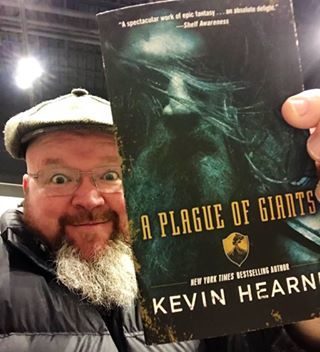
Urban fantasy master Kevin Hearne demonstrates that he can do High Fantasy too.
Fans of Hearne’s fabulously well to do urban fantasy Iron Druid series featuring his 2,000-year-old Celtic druid Atticus O’Sullivan and his wise cracking hound Oberon will want to read this adventure set in a new universe of Hearne’s making.
Truth be told, Hearne’s world building is the real treat here. Told in a bard fashion, with our narrator’s ability to take on the illusory guise of any character to better tell his story, we are introduced to Hearne’s creation of a land of several realms and peoples and all recovering from a series of invasions by groups of giants (of about 7 to 12 feet tall). The bard, Fintan, while stretching his performance out over a couple weeks or more, also gets involved in a present time scandal that further develops Hearne’s epic.
Hearne does take a while to get where he is going and the first half is confusing as the reader is presented with a panoply of characters (including the giants) before during and after the invasions. Fintan’s presentation of each point of view storyline provides little introduction to what is happening and where and when and how. By the second half I was ready to either DNF or catch on. Happily, I did finally pick up what he was throwing down and came to not only enjoy the book, but am interested in reading more from him in this series.
The magic rules of the book are also cool as a twenty-dollar bill found in the laundry. The Kennings are magic abilities related to natural or elemental sources like water, fire, arboreal or animal empathy. Each Kenning’s ability can then be subdivided into various manifestations within the class. People must take a great risk to get “blessed” with the kenning and then pay heavily for its use.
Reminiscent of Poul Anderson, Hearne spends time with the invading giants as well and we get to know both sides of the conflict, providing for a more well-rounded story. Also intriguing is Hearne’s portrayal of how the two opposing groups get to know one another and there are hints of grudging respect between antagonists.
All in all, a very pleasing first book in a series that promises to entertain.

December 26, 2017
I'm actually rather impressed by the first Seven Kennings novel and I'm certain I'm going to be anxious to read the rest... but why?
That's pretty easy, actually. Seven nations and several races of giants and regular humans trying to get along in a pretty close approximation of Vikings and Druids, with light magic, no gods, and many peoples just trying to do their damn best with the whole survival thing and understanding their world.
We get PoVs from the peoples of both the Giants and the Humans and it's the normal kind of thing that makes them go to war. Population migration, settlements without permission, misunderstandings, pride, and a whole gamut of impressive and realistic reasons that are often skimmed or just plain ignored in Epic Fantasies of this caliber.
The magic is certainly not overpowered, either, but even so, big things can be accomplished with it. Unfortunately, the old idea (and disadvantage) of using magic means that it drains your life. Fast. It's a good balance and it even feels real. A few of the more interesting Kennings (types of magic) range from water, fire, illusion, animal calling, and arbor magic.
Just imagine Bards and Skalds and a mix of Icelandic and Germanic peoples, with Dirges, bonfires, and the whole feel of Vinland mixed with the Druidic order, Volcanic peoples, and the drive to find and understand the missing Kennings, the far-off lands, the Abyss that separates nations... and you'll get a very nice feel for this book. :)
I really had a good time. Hearne has always stood out in my mind for his quicksilver grasp of mythology and history and his ability to weave such into pretty awesome stories. His Iron Druid novels are some of my favorite UFs. He turns around his knowledge and weaves a tapestry of many cool cultures and lands rather than anchoring them all in individuals like he did in the UF. He's building a broad mythology here from scratch and the hints that all the Kennings will become ONE is scary.
It almost feels like it could either be a combining, a synthesis, or the complete eradication of all but one or the complete death of magic across the board. The way that these nations rely so heavily on the Kennings, however, means that we can probably expect genocides and shifting alliances, a complicated battle royale of races and peoples as interesting as you please.
This author has my trust. I'm really looking forward to how this will pan out. :)
That's pretty easy, actually. Seven nations and several races of giants and regular humans trying to get along in a pretty close approximation of Vikings and Druids, with light magic, no gods, and many peoples just trying to do their damn best with the whole survival thing and understanding their world.
We get PoVs from the peoples of both the Giants and the Humans and it's the normal kind of thing that makes them go to war. Population migration, settlements without permission, misunderstandings, pride, and a whole gamut of impressive and realistic reasons that are often skimmed or just plain ignored in Epic Fantasies of this caliber.
The magic is certainly not overpowered, either, but even so, big things can be accomplished with it. Unfortunately, the old idea (and disadvantage) of using magic means that it drains your life. Fast. It's a good balance and it even feels real. A few of the more interesting Kennings (types of magic) range from water, fire, illusion, animal calling, and arbor magic.
Just imagine Bards and Skalds and a mix of Icelandic and Germanic peoples, with Dirges, bonfires, and the whole feel of Vinland mixed with the Druidic order, Volcanic peoples, and the drive to find and understand the missing Kennings, the far-off lands, the Abyss that separates nations... and you'll get a very nice feel for this book. :)
I really had a good time. Hearne has always stood out in my mind for his quicksilver grasp of mythology and history and his ability to weave such into pretty awesome stories. His Iron Druid novels are some of my favorite UFs. He turns around his knowledge and weaves a tapestry of many cool cultures and lands rather than anchoring them all in individuals like he did in the UF. He's building a broad mythology here from scratch and the hints that all the Kennings will become ONE is scary.
It almost feels like it could either be a combining, a synthesis, or the complete eradication of all but one or the complete death of magic across the board. The way that these nations rely so heavily on the Kennings, however, means that we can probably expect genocides and shifting alliances, a complicated battle royale of races and peoples as interesting as you please.
This author has my trust. I'm really looking forward to how this will pan out. :)

December 5, 2017
Told in the style most recently popularised by Rothfuss, but harking back to Homer, these stories, performed by a bard to an audience harrowed by war, are impactful and moving. In focusing on a range of individuals relating their own experiences, the book allows the forward movement of the plot to be gradually parcelled out, each story adding to the developing knowledge of both the reader and the audience, while fleshing out elements of this new-to-us world. Instead of the broad mechanics of war between the invading Bone Giants and the various peoples of Teldwen, we have vibrantly personal recollections of lives lived and lost. Some are more powerful than others, but the opportunity to follow certain characters right through to the end of the book means the reader still has the opportunity to build strong ties; their difficulties and bravery are felt, deeply.
The world itself is magical, detailed and rich. The system of the Seven Kennings (based largely upon elemental and natural powers) is thrillingly appealing, and I, for one, know exactly which i'd risk my life to achieve. On top of that, the people are diverse in every way you could possibly hope, it is this especially that makes this book feel so genuinely full of life, and so welcome in the broader range of fantasy publishing.
I have to say that it's hard to believe that the author of the Iron Druid stories wrote this- that series tailed off so much by the end that I gave up on it entirely, whereas this promises to be something original and positively great. There is some unevenness in the
narrative but overall a beginning full of potential.
ARC via Netgalley
The world itself is magical, detailed and rich. The system of the Seven Kennings (based largely upon elemental and natural powers) is thrillingly appealing, and I, for one, know exactly which i'd risk my life to achieve. On top of that, the people are diverse in every way you could possibly hope, it is this especially that makes this book feel so genuinely full of life, and so welcome in the broader range of fantasy publishing.
I have to say that it's hard to believe that the author of the Iron Druid stories wrote this- that series tailed off so much by the end that I gave up on it entirely, whereas this promises to be something original and positively great. There is some unevenness in the
narrative but overall a beginning full of potential.
ARC via Netgalley

October 12, 2017
A Plague of Giants (Seven Kennings #1) by Kevin Hearne is a book I requested from NetGalley and the review is voluntary. I adore Hearne's Druid series! I couldn't wait to read this but it is nothing like what I was expecting. It started out with about ten characters each telling something in their own chapter apiece, then a kind of summary chapter putting some of this together. Then another round of several characters each having their own chapters then a summary chapter and repeating. Lots of strange names for characters that was hard to keep straight. The way it was told was not appealing to me at all. I am a big fan of his but I won't be following this series, which this book...wait for it...has to be continued! Yes, I hate books that don't finish! ugh! I love you Mr Hearne but I will stick with the Iron Druid. I can't keep up with the many levels of color codes and all of that. Thanks for letting me try the book NetGalley. I do adore the book cover, super awesome!
January 22, 2018
I am giving this book four stars not five but only because it did not have that wow factor to capture me right from the start. It was a long and detailed book which grew on me slowly and of course by the end I was totally engrossed - just when it finished!!! And now I have that long wait until the next one:(
I very much enjoyed the way the author told the story using a Bard who told a little bit of it every night to crowds of townspeople. Each chapter was in the POV of one of the many characters and it took a while for me to become familiar with each character and sort out who I liked and who I did not. Once I had my head wrapped around the who and the where I was totally engaged and unlikely to respond to anyone who talked to me.
Of course Hearne delivered great magic. He has had lots of practice after all with Druids. I loved the idea of the Seven Kennings and could not decide if I would rather have water ( which I think may be the author's own favourite) or animals.
All in all a great book for those people who love a really good epic fantasy. And roll on the next book please!
I very much enjoyed the way the author told the story using a Bard who told a little bit of it every night to crowds of townspeople. Each chapter was in the POV of one of the many characters and it took a while for me to become familiar with each character and sort out who I liked and who I did not. Once I had my head wrapped around the who and the where I was totally engaged and unlikely to respond to anyone who talked to me.
Of course Hearne delivered great magic. He has had lots of practice after all with Druids. I loved the idea of the Seven Kennings and could not decide if I would rather have water ( which I think may be the author's own favourite) or animals.
All in all a great book for those people who love a really good epic fantasy. And roll on the next book please!

April 3, 2018
1.5*'s
This started out good and I had high hopes for it. The world itself is vast and well thought out. The magic system interesting and with great potential. From there we start with the issues.
The characters don't stand out at all. I had zero connection to any of them and most were indistinct. I think in trying to be so epic Hearne spread things too thin. Without that identity of character it made the story seem as if it was being told by distracted bystanders or even secondhand.
For me, without great characters this was never going to be more than mediocre. As it was I was bored and disinterested. I won't be continuing.
This started out good and I had high hopes for it. The world itself is vast and well thought out. The magic system interesting and with great potential. From there we start with the issues.
The characters don't stand out at all. I had zero connection to any of them and most were indistinct. I think in trying to be so epic Hearne spread things too thin. Without that identity of character it made the story seem as if it was being told by distracted bystanders or even secondhand.
For me, without great characters this was never going to be more than mediocre. As it was I was bored and disinterested. I won't be continuing.

October 8, 2017
A Plague of Characters.
Very wordy beginning. 10% into this I am utterly uninterested in the story telling part. Some bits are nicely done, but I would quite like to have some plot. I had looked forward to something similar to his Druid Chronicles, but with a classic fantasy setting. This is not it.
At 18% I am calling it a day. Probably the most boring war I had every the misfortune to read about. Maybe because there was no war, just a never ending row of interchangeable, flat characters, introducing their race, culture, magic system and specific kenning. It felt like reading endless prologues. Why should I care, if I never get to know any of them well enough?
DNF at 18%, which should equal about 118 pages.
Very wordy beginning. 10% into this I am utterly uninterested in the story telling part. Some bits are nicely done, but I would quite like to have some plot. I had looked forward to something similar to his Druid Chronicles, but with a classic fantasy setting. This is not it.
At 18% I am calling it a day. Probably the most boring war I had every the misfortune to read about. Maybe because there was no war, just a never ending row of interchangeable, flat characters, introducing their race, culture, magic system and specific kenning. It felt like reading endless prologues. Why should I care, if I never get to know any of them well enough?
DNF at 18%, which should equal about 118 pages.

April 2, 2020
This review can also be found at Carole's Random Life in Books.
I ended up really enjoying this book. I have had the book for a while but was a bit intimidated by its size. Since I am spending almost all of my time at home with the current health crisis, I decided that this was the perfect time to finally tackle this story. This is a very different book than Kevin Hearne's Iron Druid Chronicles and I enjoyed seeing him take on high fantasy. It did feel like a very dense story and I felt like it took me longer to read than a lighter story of the same length might have. I had a good time with the book in the end.
I liked the way the story came together. There are a lot of points of view in this book but they are all shared through the tales from a bard. The bard, Fintan, takes on the persona of each individual as he shares their story. I will admit that it was a lot to keep track of at the start of the book but as I continued to read, I got to know each character and started looking forward to learning more of their story. I did like the way that all of the different points of view came together to tell a story that stretched across more than one group of people.
This story is set in a very interesting world. We actually get the opportunity to see more than one realm in this story and I found it interesting to see what each group shared and how they differed. The different lands had individuals with special abilities. Those abilities changed from place to place but each required anyone seeking the power, or kenning, to risk their lives. If they survived, they would be blessed with a special ability. Each land had its own kennings which were often closely related to the terrain in which they lived.
I found this book to be quite exciting at times. There was quite a bit of action spread throughout the story. I also enjoyed getting the chance to see the political workings of each of the groups. I found the personal journeys of some of the characters to be the highlight of the book. I really wanted to see things work out for these characters as they faced incredibly difficult challenges.
I would recommend this book to fans of high fantasy. This book transported me to a world of unique people with extraordinary abilities. I grew to care for many of the characters as they worked to keep their people safe. I cannot wait to read more of this exciting series!
I received a digital review copy of this book from Random House Publishing - Del Rey via NetGalley.
Initial Thoughts
I am so glad that I finally got around to read this book. It is very different from The Iron Druid Chronicles and I enjoyed getting to see this author tackle a bit of more serious fantasy. This story is told through the stories shared by a bard. This bard takes on the persona of each individual as he shares their story. There are a lot of different points of view to juggle in this story and I have to admit that it was slow going for me at the start. Once I felt a little more settled in this world and knew each character a little better, I found that I was enjoying the story a lot more. I did enjoy the magic and world-building in this book and loved the way everything came together in the end. I do look forward to reading the next book in the series very soon.
I ended up really enjoying this book. I have had the book for a while but was a bit intimidated by its size. Since I am spending almost all of my time at home with the current health crisis, I decided that this was the perfect time to finally tackle this story. This is a very different book than Kevin Hearne's Iron Druid Chronicles and I enjoyed seeing him take on high fantasy. It did feel like a very dense story and I felt like it took me longer to read than a lighter story of the same length might have. I had a good time with the book in the end.
I liked the way the story came together. There are a lot of points of view in this book but they are all shared through the tales from a bard. The bard, Fintan, takes on the persona of each individual as he shares their story. I will admit that it was a lot to keep track of at the start of the book but as I continued to read, I got to know each character and started looking forward to learning more of their story. I did like the way that all of the different points of view came together to tell a story that stretched across more than one group of people.
This story is set in a very interesting world. We actually get the opportunity to see more than one realm in this story and I found it interesting to see what each group shared and how they differed. The different lands had individuals with special abilities. Those abilities changed from place to place but each required anyone seeking the power, or kenning, to risk their lives. If they survived, they would be blessed with a special ability. Each land had its own kennings which were often closely related to the terrain in which they lived.
I found this book to be quite exciting at times. There was quite a bit of action spread throughout the story. I also enjoyed getting the chance to see the political workings of each of the groups. I found the personal journeys of some of the characters to be the highlight of the book. I really wanted to see things work out for these characters as they faced incredibly difficult challenges.
I would recommend this book to fans of high fantasy. This book transported me to a world of unique people with extraordinary abilities. I grew to care for many of the characters as they worked to keep their people safe. I cannot wait to read more of this exciting series!
I received a digital review copy of this book from Random House Publishing - Del Rey via NetGalley.
Initial Thoughts
I am so glad that I finally got around to read this book. It is very different from The Iron Druid Chronicles and I enjoyed getting to see this author tackle a bit of more serious fantasy. This story is told through the stories shared by a bard. This bard takes on the persona of each individual as he shares their story. There are a lot of different points of view to juggle in this story and I have to admit that it was slow going for me at the start. Once I felt a little more settled in this world and knew each character a little better, I found that I was enjoying the story a lot more. I did enjoy the magic and world-building in this book and loved the way everything came together in the end. I do look forward to reading the next book in the series very soon.

January 9, 2018
*Edit 2020*
I'm adjusting my rating. As you can see below I gave this 4 stars originally and even said I wanted to give it 3.5. I've now switched it to 5 STARS. Why the rating change? Did I re-read it and enjoy it more the 2nd time? Did I meet the author and enjoy him so much that I felt guilty? No. I haven't re-read and I've had no interaction with the author. The truth is, all through 2018 and 2019 I HAVEN'T BEEN ABLE TO STOP THINKING ABOUT THIS BOOK. It's been in the back of my head for 2 years. The story is complex and has refused to let go of me. Now in 2020 I'm sitting here with the sequel (Blight of Blackwings) in my hands and I am so fucking excited to read more in this world that I knew I had to come back here and switch this review. Everything I originally said still stands - I just feel I wasn't being fair with my rating. A Plague of Giants is so unlike anything in the fantasy genre...the world in particular and the Kennings found within it...its been 2 friggen years that this story has occupied my thoughts and I can't really think of another book that has stuck with me like that for so long. That alone deserves 5 stars in my book.
*End Edit 2020*
I gave this 4 stars, but if Goodreads would allow it would probably be 3.5 stars instead. I rounded up though cuz I really did enjoy it.
Firstly, this wasn't an easy book to read at first. In fact, during the first 100-150 pages, I wasn't even sure if I was going to make it through at all. There are a shit ton of POV characters in this book; Add to that some really heavy world-building lore, sophisticated magic systems, a lot of unpronounceable names, and a narrative framework that you don't really see used that often...well...it leads to a lot of work on the readers part.
Now don't be fooled, I consider myself a very advanced fantasy reader, but this book was tough.
I'll tell ya what though, after those 150 pages or so I found my footing and started to really enjoy myself. Kevin Hearne is an author that I have never read before. I'm aware of his Iron Druid series and its been on my TBR for a long ass time now. I've just yet to feel inspired to pick it up and give it a go. This one, however, with the cover art, and the chance to jump onboard something brand new, it called out to me.
So here we are.
Once I got a grasp of all the characters you follow in this story I started to really enjoy traveling with them. They are a very diverse cast and there wasn't really anyone of them I didn't enjoy spending time with. The actual narrative frame...the in-between bits that tie everything together was also a lot of fun.
The author has put a lot of work into the history and lore of his world. Something that I always really appreciate. A good world-building story is always a lot of fun - and it is here that Kevin Hearne definitely excelled. From the foods - the clothing - the daily ways of life - and the varied walks of existence, be it the peoples or the floral and the fauna, it all felt very real and alive. I really, really enjoyed being a part of this world.
I also appreciated that not everyone gets a happy ending in this story. Nobody is safe and danger lurks around every corner.
All in all, I had a helluva good time (except for the training wheels period of the first part of the book), and I am now very excited to see where the story goes in book 2.
If you like fire-wielding giants, territorial invasions, flying meat-eating squirrels, unique magics, well-written action scenes, and a colorful cast of characters peppered with some light political intrigue, then you could do worse then Plague Of Giants.
Cheers, Kevin Hearne! Well met and thanks for the story! Looking forward to the sequel!
I'm adjusting my rating. As you can see below I gave this 4 stars originally and even said I wanted to give it 3.5. I've now switched it to 5 STARS. Why the rating change? Did I re-read it and enjoy it more the 2nd time? Did I meet the author and enjoy him so much that I felt guilty? No. I haven't re-read and I've had no interaction with the author. The truth is, all through 2018 and 2019 I HAVEN'T BEEN ABLE TO STOP THINKING ABOUT THIS BOOK. It's been in the back of my head for 2 years. The story is complex and has refused to let go of me. Now in 2020 I'm sitting here with the sequel (Blight of Blackwings) in my hands and I am so fucking excited to read more in this world that I knew I had to come back here and switch this review. Everything I originally said still stands - I just feel I wasn't being fair with my rating. A Plague of Giants is so unlike anything in the fantasy genre...the world in particular and the Kennings found within it...its been 2 friggen years that this story has occupied my thoughts and I can't really think of another book that has stuck with me like that for so long. That alone deserves 5 stars in my book.
*End Edit 2020*
I gave this 4 stars, but if Goodreads would allow it would probably be 3.5 stars instead. I rounded up though cuz I really did enjoy it.
Firstly, this wasn't an easy book to read at first. In fact, during the first 100-150 pages, I wasn't even sure if I was going to make it through at all. There are a shit ton of POV characters in this book; Add to that some really heavy world-building lore, sophisticated magic systems, a lot of unpronounceable names, and a narrative framework that you don't really see used that often...well...it leads to a lot of work on the readers part.
Now don't be fooled, I consider myself a very advanced fantasy reader, but this book was tough.
I'll tell ya what though, after those 150 pages or so I found my footing and started to really enjoy myself. Kevin Hearne is an author that I have never read before. I'm aware of his Iron Druid series and its been on my TBR for a long ass time now. I've just yet to feel inspired to pick it up and give it a go. This one, however, with the cover art, and the chance to jump onboard something brand new, it called out to me.
So here we are.
Once I got a grasp of all the characters you follow in this story I started to really enjoy traveling with them. They are a very diverse cast and there wasn't really anyone of them I didn't enjoy spending time with. The actual narrative frame...the in-between bits that tie everything together was also a lot of fun.
The author has put a lot of work into the history and lore of his world. Something that I always really appreciate. A good world-building story is always a lot of fun - and it is here that Kevin Hearne definitely excelled. From the foods - the clothing - the daily ways of life - and the varied walks of existence, be it the peoples or the floral and the fauna, it all felt very real and alive. I really, really enjoyed being a part of this world.
I also appreciated that not everyone gets a happy ending in this story. Nobody is safe and danger lurks around every corner.
All in all, I had a helluva good time (except for the training wheels period of the first part of the book), and I am now very excited to see where the story goes in book 2.
If you like fire-wielding giants, territorial invasions, flying meat-eating squirrels, unique magics, well-written action scenes, and a colorful cast of characters peppered with some light political intrigue, then you could do worse then Plague Of Giants.
Cheers, Kevin Hearne! Well met and thanks for the story! Looking forward to the sequel!
September 27, 2017
Hearne writes a complex and masterfully detailed plot of a world where you risk your life to gain magic, and you use your life up to use it. Diverse and original, with intense world building, A Plague of Giants is definitely one of a kind read.
I loved how the storyteller took the form of each character, transferring the dictation to a semi- “semi-first-person” point of view. I loved the entire concept, but in the end, I struggled with this one. 3.5 stars for me.
It took me a while to find myself intrigued and even longer to find myself drawn in. I'm chalking it up to it being the first in a new series with lots of world-building. The overall concept is there and makes you want to go on. But even the conclusion left a lot open-ended, which I'm assuming is for the next installment, but still left me feeling there was just not enough.
I received this ARC copy from Random House Publishing Group - Ballantine - Del Rey. This is my honest and voluntary review.
I loved how the storyteller took the form of each character, transferring the dictation to a semi- “semi-first-person” point of view. I loved the entire concept, but in the end, I struggled with this one. 3.5 stars for me.
It took me a while to find myself intrigued and even longer to find myself drawn in. I'm chalking it up to it being the first in a new series with lots of world-building. The overall concept is there and makes you want to go on. But even the conclusion left a lot open-ended, which I'm assuming is for the next installment, but still left me feeling there was just not enough.
I received this ARC copy from Random House Publishing Group - Ballantine - Del Rey. This is my honest and voluntary review.

Read
March 22, 2018DNF @25% which is about 156 pages considering this is 624 pages long.
I LOVE The Iron Druid Chronicles and I eagerly await each new installment, but this book suffered from too many POVs each with a different world. I counted seven just in the amount of pages I've read. It bogged the plot down, made it difficult to focus or become invested in any one character, because just as you'd were getting to "know" the character and world it would jump back into the present and then onto another POV.
Not even buying the audio book with the excellent Luke Daniels as narrator could save this story for me. I think it was even worse to listen, because it was harder to keep track of each person when you were switched around. I kept having to rewind to get my barrings. I've decided to throw in the towel.
A copy was kindly provided by Del Rey Books via Netgalley in exchange for an honest review.
I LOVE The Iron Druid Chronicles and I eagerly await each new installment, but this book suffered from too many POVs each with a different world. I counted seven just in the amount of pages I've read. It bogged the plot down, made it difficult to focus or become invested in any one character, because just as you'd were getting to "know" the character and world it would jump back into the present and then onto another POV.
Not even buying the audio book with the excellent Luke Daniels as narrator could save this story for me. I think it was even worse to listen, because it was harder to keep track of each person when you were switched around. I kept having to rewind to get my barrings. I've decided to throw in the towel.
A copy was kindly provided by Del Rey Books via Netgalley in exchange for an honest review.

January 22, 2018
Read more reviews or check out our podcast discussion at Book Geeks Uncompromised!
The story is told to the population of Pelemyn by Fintan the bard as the refugees from effected areas of giant attacks come seeking shelter. Every day he stands on a stage and uses his kenning (magic) to project his voice and alter his appearance to match that of the people whose stories he is telling. In between his stage-time the book is from the POV of the scholar Dervan who is transcribing the story being told for record-keeping.
Honestly, this method of story-telling is a little bit of a mess but it is an organized mess that for the most part is easy to adapt to. Occasionally there would be a chapter early on that didn’t seem to have any purpose, it was mostly just introducing a character but nothing would actually happen with that character until the next time Fintan talks about them. So it could feel a little disjointed at times. Once the story really got going though, this pretty much ceased to be a problem.
Also, because there is the time difference between the story and the storytelling, there is a unique aspect to this book in that it almost gives away spoilers for itself at times. It is mentioned that Fintan has to have met a person in order to appear as them. So remembering while reading that Fintan has had to have met all of these people at one point or another even though their stories can sometimes seem like the characters will never intersect helps make you wonder where the characters are going that will allow at least the one meeting with Fintan. Also there are things that Dervan hears or talks about that teases eventual happenings.
That said, the one thing that was a little difficult to keep up with was remembering that the story that Fintan is telling takes place roughly a year before Dervan’s POV. For some reason, it was just a little difficult to remember this while reading the book.
The shining light of this book though is the worldbuilding. The nations of Teldwen are divided both geographically and according to what magic each nation can use. All of the magic is elemental based and each nation only has one. So Bryn uses the water kenning, Rael uses earth kenning, Hathrim uses fire, etc. The cost of using large amounts of magic for any of the different types is that if the magic user pushes too hard, the magic will start to age them. The more powerful magic that is worked, the shorter the lifespan for the magic user.
Plus, it is unknown who exactly will be able to use the magic until they undergo a trial of sorts. Those seeking a kenning, called Seekers, will either die in the trial or emerge with the ability to manipulate their nation’s element.
The rules for this magic system are thus somewhat basic but really well balanced in their simplicity. There are not really any restrictions placed on what an element can accomplish beyond what is intuitive and how much the magic user is willing to age themselves to achieve something. While this seems kind of limitless it is, again, balanced out by the fact that all magic users abide by the same rules. No one nation is overpowered because all of the nations are overpowered.
For those that appreciate diversity in fantasy, this book is your book. Not only is the vast majority of Teldwen described as having very dark skin but there is also some LGBT representation as well. There is a little bit of the teenager stressing about coming out to his family but by and large, same sex couples seem to a perfectly normal aspect of life in these nations. This story doesn’t spend hardly any time at all on any sort of “coming out” plot line and instead just says “this is a thing” and the story doesn’t treat it like something “different” or “other.” It just is.
Futhermore, Hearne did a great job of describing the cultures of the various nations without lingering or focusing too much on any one. There are 6 nations to do that with in this book. The story is very much about all of them and they all get enough “screen time” to give the reader a good idea of who each people are and what their values are.
The only real gripe that I have about this story, and it is pretty minor, is the ending. That is to say, the sort of lack of one.
There are three plot lines in this story: the Hathrim giants invasion, the Bone Giants invasion, and some hinted internal division.
Only one of these plot lines is wrapped up in any sort of conclusion which made the book feel so open-ended as to make me feel like it wasn’t an ending at all.
Again, this is a pretty minor complaint as I went into this fully aware that there would be more books and I think that the open-ended nature of this first installation in the series will allow the next book to pick up right where it left off without having to pick up any momentum that would have been lost in pulling this book together into a huge climax at the end.
Finally, I found several quotes in this book that I just absolutely loved. I couldn’t find any place to put this in the rest of the review so I will leave it here at the ending.
“There is heroism to be found in great battles, it is true: warriors with stable knees who fight and know that they will die for an idea or for the safety of loved ones back home. But there are also people who spend their entire adulthood at a soulless job they despise to make sure their children have something to eat that night so that one day those kids may lead better, more fulfilling lives than their parents. The warrior and the worker both make sacrifices. Who, then, is more heroic? Can any of us judge? I don’t think I’m qualified. I’ll let history decide.”
The story is told to the population of Pelemyn by Fintan the bard as the refugees from effected areas of giant attacks come seeking shelter. Every day he stands on a stage and uses his kenning (magic) to project his voice and alter his appearance to match that of the people whose stories he is telling. In between his stage-time the book is from the POV of the scholar Dervan who is transcribing the story being told for record-keeping.
Honestly, this method of story-telling is a little bit of a mess but it is an organized mess that for the most part is easy to adapt to. Occasionally there would be a chapter early on that didn’t seem to have any purpose, it was mostly just introducing a character but nothing would actually happen with that character until the next time Fintan talks about them. So it could feel a little disjointed at times. Once the story really got going though, this pretty much ceased to be a problem.
Also, because there is the time difference between the story and the storytelling, there is a unique aspect to this book in that it almost gives away spoilers for itself at times. It is mentioned that Fintan has to have met a person in order to appear as them. So remembering while reading that Fintan has had to have met all of these people at one point or another even though their stories can sometimes seem like the characters will never intersect helps make you wonder where the characters are going that will allow at least the one meeting with Fintan. Also there are things that Dervan hears or talks about that teases eventual happenings.
That said, the one thing that was a little difficult to keep up with was remembering that the story that Fintan is telling takes place roughly a year before Dervan’s POV. For some reason, it was just a little difficult to remember this while reading the book.
The shining light of this book though is the worldbuilding. The nations of Teldwen are divided both geographically and according to what magic each nation can use. All of the magic is elemental based and each nation only has one. So Bryn uses the water kenning, Rael uses earth kenning, Hathrim uses fire, etc. The cost of using large amounts of magic for any of the different types is that if the magic user pushes too hard, the magic will start to age them. The more powerful magic that is worked, the shorter the lifespan for the magic user.
Plus, it is unknown who exactly will be able to use the magic until they undergo a trial of sorts. Those seeking a kenning, called Seekers, will either die in the trial or emerge with the ability to manipulate their nation’s element.
The rules for this magic system are thus somewhat basic but really well balanced in their simplicity. There are not really any restrictions placed on what an element can accomplish beyond what is intuitive and how much the magic user is willing to age themselves to achieve something. While this seems kind of limitless it is, again, balanced out by the fact that all magic users abide by the same rules. No one nation is overpowered because all of the nations are overpowered.
For those that appreciate diversity in fantasy, this book is your book. Not only is the vast majority of Teldwen described as having very dark skin but there is also some LGBT representation as well. There is a little bit of the teenager stressing about coming out to his family but by and large, same sex couples seem to a perfectly normal aspect of life in these nations. This story doesn’t spend hardly any time at all on any sort of “coming out” plot line and instead just says “this is a thing” and the story doesn’t treat it like something “different” or “other.” It just is.
Futhermore, Hearne did a great job of describing the cultures of the various nations without lingering or focusing too much on any one. There are 6 nations to do that with in this book. The story is very much about all of them and they all get enough “screen time” to give the reader a good idea of who each people are and what their values are.
The only real gripe that I have about this story, and it is pretty minor, is the ending. That is to say, the sort of lack of one.
There are three plot lines in this story: the Hathrim giants invasion, the Bone Giants invasion, and some hinted internal division.
Only one of these plot lines is wrapped up in any sort of conclusion which made the book feel so open-ended as to make me feel like it wasn’t an ending at all.
Again, this is a pretty minor complaint as I went into this fully aware that there would be more books and I think that the open-ended nature of this first installation in the series will allow the next book to pick up right where it left off without having to pick up any momentum that would have been lost in pulling this book together into a huge climax at the end.
Finally, I found several quotes in this book that I just absolutely loved. I couldn’t find any place to put this in the rest of the review so I will leave it here at the ending.
“There is heroism to be found in great battles, it is true: warriors with stable knees who fight and know that they will die for an idea or for the safety of loved ones back home. But there are also people who spend their entire adulthood at a soulless job they despise to make sure their children have something to eat that night so that one day those kids may lead better, more fulfilling lives than their parents. The warrior and the worker both make sacrifices. Who, then, is more heroic? Can any of us judge? I don’t think I’m qualified. I’ll let history decide.”

October 5, 2017
As always this review can also be found on my blog The Tattooed Book Geek: https://thetattooedbookgeek.wordpress...
I received a free copy of this book courtesy of the publisher in exchange for an honest review.
Now this right here, this is the good stuff!👌
After the invasion by the Eculans (the bone giants) and set in the aftermath of the subsequent Giants’ War the stories told in A Plague of Giants are recounted over a number of days (19) by one man, Fintan, the Raelech bard. Fintan can use his kenning (the magic system) and the power of a seeming stone to take on the guise of the person whose account he is currently retelling and orate across distance, in other words, folks, he’s loud. Raelech bards are also blessed with perfect recall and memory which makes them the ideal storytellers! Each day in Survivor Field Fintan tells the various tales of the Giants’ War to the people of Pelemyn and the various refugees who have sort safety there. When he speaks, they all listen, enraptured by him and the stories he tells. Likewise, you will be transfixed as you read about the characters lives, their exploits, the sacrifices that they make and the horrors that they endure.
Interspersed with the tales Fintan tells are the present day to day happens between himself and Master Dervan, a Brynt historian who has been tasked to both write down Fintan’s recounting of the Giants’ War and to also keep an eye on him (the best example that I can come up with is that these parts of the book are similar to the present day interludes featured in the Kingkiller Chronicles books by Patrick Rothfuss). These sections act as the buffer between when Fintan finishes his storytelling each day and when he starts again on the following day.
There’s a lot of different PoV characters (11 in total) and at the beginning, the narrative can feel disjointed and separate as you flit from character to character and location to location. It can be confusing at first and you might wonder how all the characters and locations tie in together. But trust me, they do! The origin stories are engaging, different and on the whole, they all add something to the story. As the book progresses, everything begins to fall into place and you find that the pieces start to merge, coming together and forming a coherent story told by Hearne. All in all, A Plague of Giants features an eclectic array of different characters that form a vast tapestry of perspectives woven together from their separate story arcs that feels both personal to the individual characters and epic in nature. If pushed and made to commit then without giving away any details about their storylines, I’d have to say that my favourite characters to read about were Gorin Mogen (a giant from Hathrir), Abhinava Khose (a young male from Ghurana Nent), Nel Kit Ben Sah (a Fornish greensleeve) and Gondel Vedd (an elderly linguist from Kauria) but quite surprisingly for such a large cast, I found each character arc to be enjoyable in their own way and I liked reading about all the characters.
I really liked Teldwen, the world that Hearne has created, consisting of six nations (Ghurana Nent, Brynlon, Rael, Forn, Hathrir and Kauria) it’s rich, full of different cultures and vast in scale and though we only visit certain areas and locations I’m sure that we’ll see the unexplored areas in future books.
The seven kennings of the book’s title refer to the magic system used by Hearne. Each nation of Teldwen is home to a single kenning, not everyone has a kenning but those that do can only possess one individual kenning. So far, there are only five known kennings (the elements air, water, earth, fire and then flora too) but there are rumours that six or even seven kennings could exist, meaning that there are as yet two kennings still to be discovered. With each kenning, there are different castes that manifest different abilities. The magic can be powerful but it also has a cost and the more you use and stretch the power and limits of your kenning the faster you age.
I found Hearnes writing style to be engaging, he easily draws you, making you want to continue reading even when life is calling and you, unfortunately, have to put the book down. He’s able to give individual voices to all his main characters (who are an eclectic and diverse mix of both young and old and male and female characters) also including plenty of emotion (to make you invested and care), humour (to make you chuckle) and action (we all love some sweet fighting scenes) in his story that all adds up to a terrific, well paced and time-devouring read.
A Plague of Giants is a big boy, it’s a 600 (a smidgen over) page tome and while not in the same 1,000+ page length as some other epic fantasy books out there it is still a big book. It’s the biggest I’ve read in quite a while and that dear readers make for a hefty sized book!
I’m not a professional, I’m just a normal guy who is a reader and a lover of fantasy. I’ve read enough books in the genre to know what I like and what I dislike in fantasy and apart from a couple of very minor slight grievances (I found the large amount of PoV characters to be confusing at the beginning – which I already mentioned at the start of the review. And due to that large cast of characters it also takes a good while for all of the players to be introduced into the story) overall I really couldn’t fault A Plague of Giants. I found it to be an outstanding read and I look forward to continuing the series.👌
A Plague of Giants is fantastic giant-sized epic fantasy.
I received a free copy of this book courtesy of the publisher in exchange for an honest review.
Now this right here, this is the good stuff!👌
After the invasion by the Eculans (the bone giants) and set in the aftermath of the subsequent Giants’ War the stories told in A Plague of Giants are recounted over a number of days (19) by one man, Fintan, the Raelech bard. Fintan can use his kenning (the magic system) and the power of a seeming stone to take on the guise of the person whose account he is currently retelling and orate across distance, in other words, folks, he’s loud. Raelech bards are also blessed with perfect recall and memory which makes them the ideal storytellers! Each day in Survivor Field Fintan tells the various tales of the Giants’ War to the people of Pelemyn and the various refugees who have sort safety there. When he speaks, they all listen, enraptured by him and the stories he tells. Likewise, you will be transfixed as you read about the characters lives, their exploits, the sacrifices that they make and the horrors that they endure.
Interspersed with the tales Fintan tells are the present day to day happens between himself and Master Dervan, a Brynt historian who has been tasked to both write down Fintan’s recounting of the Giants’ War and to also keep an eye on him (the best example that I can come up with is that these parts of the book are similar to the present day interludes featured in the Kingkiller Chronicles books by Patrick Rothfuss). These sections act as the buffer between when Fintan finishes his storytelling each day and when he starts again on the following day.
There’s a lot of different PoV characters (11 in total) and at the beginning, the narrative can feel disjointed and separate as you flit from character to character and location to location. It can be confusing at first and you might wonder how all the characters and locations tie in together. But trust me, they do! The origin stories are engaging, different and on the whole, they all add something to the story. As the book progresses, everything begins to fall into place and you find that the pieces start to merge, coming together and forming a coherent story told by Hearne. All in all, A Plague of Giants features an eclectic array of different characters that form a vast tapestry of perspectives woven together from their separate story arcs that feels both personal to the individual characters and epic in nature. If pushed and made to commit then without giving away any details about their storylines, I’d have to say that my favourite characters to read about were Gorin Mogen (a giant from Hathrir), Abhinava Khose (a young male from Ghurana Nent), Nel Kit Ben Sah (a Fornish greensleeve) and Gondel Vedd (an elderly linguist from Kauria) but quite surprisingly for such a large cast, I found each character arc to be enjoyable in their own way and I liked reading about all the characters.
I really liked Teldwen, the world that Hearne has created, consisting of six nations (Ghurana Nent, Brynlon, Rael, Forn, Hathrir and Kauria) it’s rich, full of different cultures and vast in scale and though we only visit certain areas and locations I’m sure that we’ll see the unexplored areas in future books.
The seven kennings of the book’s title refer to the magic system used by Hearne. Each nation of Teldwen is home to a single kenning, not everyone has a kenning but those that do can only possess one individual kenning. So far, there are only five known kennings (the elements air, water, earth, fire and then flora too) but there are rumours that six or even seven kennings could exist, meaning that there are as yet two kennings still to be discovered. With each kenning, there are different castes that manifest different abilities. The magic can be powerful but it also has a cost and the more you use and stretch the power and limits of your kenning the faster you age.
I found Hearnes writing style to be engaging, he easily draws you, making you want to continue reading even when life is calling and you, unfortunately, have to put the book down. He’s able to give individual voices to all his main characters (who are an eclectic and diverse mix of both young and old and male and female characters) also including plenty of emotion (to make you invested and care), humour (to make you chuckle) and action (we all love some sweet fighting scenes) in his story that all adds up to a terrific, well paced and time-devouring read.
A Plague of Giants is a big boy, it’s a 600 (a smidgen over) page tome and while not in the same 1,000+ page length as some other epic fantasy books out there it is still a big book. It’s the biggest I’ve read in quite a while and that dear readers make for a hefty sized book!
I’m not a professional, I’m just a normal guy who is a reader and a lover of fantasy. I’ve read enough books in the genre to know what I like and what I dislike in fantasy and apart from a couple of very minor slight grievances (I found the large amount of PoV characters to be confusing at the beginning – which I already mentioned at the start of the review. And due to that large cast of characters it also takes a good while for all of the players to be introduced into the story) overall I really couldn’t fault A Plague of Giants. I found it to be an outstanding read and I look forward to continuing the series.👌
A Plague of Giants is fantastic giant-sized epic fantasy.

August 31, 2018
Well, crap.
I'll not lean on this a lot. I am really, really disappointed. This book was written by Kevin Hearne the writer of the Iron Druid Urban Fantasy series. Now I don't care for those, not because I didn't like the writing but because I simply didn't like the character. I tried 2 or 3 of them (i frankly can't recall) and then laid them aside. Then I saw this and the synopsis sounded interesting.
AND the book opened in a promising way. I even told a friend here I thought I'd found a good new Epic Fantasy read.
BUT then it began to drag, primarily because of the manner of the story telling. It not only began to drag, it began to grind down...it ground me down.
The inital set up is very interesting and drew me in. We are beginning to get to know the world, how the magic works (another magic system where people may be gifted in different way). But a short way into the book we are introduced to THE BARD who has a certain type of magic gift. Another of our protagonists (a quiet historian who basically just wants a (again) quite life is assigned to copy down the tales told by this Bard (this is on the assumption that the Bard is a spy). From here on we launch into a long series of the bard using his illusion magic to become the image of the people who's tales he tells and his telling of all that led up to the story of the giants etc.
Look this could have been good and maybe a lot of it is me. I'm a little concerned at the number of books lately I just want to sling across the room because they SLOW DOWN AND DRAG. If you read the synopsis you will (I believe) find the description of a story you want to read. But I just found the book to be so slow and stultifying that I began to skim forward.
Many of you may...I'm sure many will love this book probably for the very reason I didn't like it. If so I'm happy for you, really. But I can't recommend it, sorry.
I'll not lean on this a lot. I am really, really disappointed. This book was written by Kevin Hearne the writer of the Iron Druid Urban Fantasy series. Now I don't care for those, not because I didn't like the writing but because I simply didn't like the character. I tried 2 or 3 of them (i frankly can't recall) and then laid them aside. Then I saw this and the synopsis sounded interesting.
AND the book opened in a promising way. I even told a friend here I thought I'd found a good new Epic Fantasy read.
BUT then it began to drag, primarily because of the manner of the story telling. It not only began to drag, it began to grind down...it ground me down.
The inital set up is very interesting and drew me in. We are beginning to get to know the world, how the magic works (another magic system where people may be gifted in different way). But a short way into the book we are introduced to THE BARD who has a certain type of magic gift. Another of our protagonists (a quiet historian who basically just wants a (again) quite life is assigned to copy down the tales told by this Bard (this is on the assumption that the Bard is a spy). From here on we launch into a long series of the bard using his illusion magic to become the image of the people who's tales he tells and his telling of all that led up to the story of the giants etc.
Look this could have been good and maybe a lot of it is me. I'm a little concerned at the number of books lately I just want to sling across the room because they SLOW DOWN AND DRAG. If you read the synopsis you will (I believe) find the description of a story you want to read. But I just found the book to be so slow and stultifying that I began to skim forward.
Many of you may...I'm sure many will love this book probably for the very reason I didn't like it. If so I'm happy for you, really. But I can't recommend it, sorry.

Read
July 11, 2018DNF @ 54%
After the nth time the narrative shifted to a new person and I struggled to remember who this person was and why I should care about them, I had an epiphany.
I don't care about any of them.
And I certainly don't want to read the other half of this huge chunkster, let alone however many more of these there's going to be.
After the nth time the narrative shifted to a new person and I struggled to remember who this person was and why I should care about them, I had an epiphany.
I don't care about any of them.
And I certainly don't want to read the other half of this huge chunkster, let alone however many more of these there's going to be.

October 19, 2017
A thrilling and completely original beginning to a new epic fantasy series!
What can I say about this book? I devoured it. It was making me come back to work from breaks and lunches late. It was making my family have to say my name four or five times to make me look up. It was making me dread when the book ended.
And now, the book has ended. (Cue 'sad trombone' sound)
Told in an addictingly engaging way as a serialized bardish tale, this novel hits all the right notes. The world-building is beautifully done, the magic-system well thought out and completely new, the characters instantly relatable.
War and intrigue, self-sacrifice and self-discovery, dangerous creatures and utter loss. This story of a surprise invasion by monstrous enemies is told from every possible angle and perspective.
I loved this book, and eagerly await the next.
What can I say about this book? I devoured it. It was making me come back to work from breaks and lunches late. It was making my family have to say my name four or five times to make me look up. It was making me dread when the book ended.
And now, the book has ended. (Cue 'sad trombone' sound)
Told in an addictingly engaging way as a serialized bardish tale, this novel hits all the right notes. The world-building is beautifully done, the magic-system well thought out and completely new, the characters instantly relatable.
War and intrigue, self-sacrifice and self-discovery, dangerous creatures and utter loss. This story of a surprise invasion by monstrous enemies is told from every possible angle and perspective.
I loved this book, and eagerly await the next.

July 28, 2021
If you love fantasy, you will love this book. I finished it this morning and immediately filmed a dedicated review video that can be watched here: https://youtu.be/oRDMcRDL_6U
In a nutshell:
Interesting way to have a multi-POV story - the characters' stories are told by a bard
We have one set of known giants invading and one set of giants called the Bone Giants that have never been seen before invading ALL over
Magic - the different races of people each have a special magic that is partial to where they live called a kenning or a blessing and is not available to all, just a select few...how they get it, well. That's something you need to read and discover!
Battles - lots of good fighting involved, but we're not overwhelmed with it. Lots of good political intrigue and spying going on that is super fun to see play out.
GUYS! READ THIS BOOK! I'm about to go get the second one right the heck now....lol
In a nutshell:
Interesting way to have a multi-POV story - the characters' stories are told by a bard
We have one set of known giants invading and one set of giants called the Bone Giants that have never been seen before invading ALL over
Magic - the different races of people each have a special magic that is partial to where they live called a kenning or a blessing and is not available to all, just a select few...how they get it, well. That's something you need to read and discover!
Battles - lots of good fighting involved, but we're not overwhelmed with it. Lots of good political intrigue and spying going on that is super fun to see play out.
GUYS! READ THIS BOOK! I'm about to go get the second one right the heck now....lol

October 22, 2017
Starting with a shameless plug: At this writing, Goodreads just opened up voting on its Goodreads Choice best books of the year award. Their exclusion of A Plague of Giants as a candidate for Best Fantasy is an egregious oversight on their part. This book definitely belongs in the running. Thank the Goddess Kaelin that they allow write-in votes.
Kevin Hearne, best known for his Iron Druid series featuring Atticus O’Sullivan, has decided to take a hiatus from urban fantasy and tackle the world of high fantasy and it promises to be epic. Readers may think that moving from a series that required knowledge of Earth gods and mythological characters and a familiarity with Phoenix’s best Irish watering holes to a trilogy requiring full-fledged world building with a multitude of characters from different backgrounds and cultures may be too much for some writers. Hearne makes it look easy.
In the first book of a proposed trilogy, Hearne has chosen a unique and imaginative way to tell the story of a continent invaded by a heretofore unknown race of giants. He employs a bard, Fintan, to tell the tale of the seven kennings. But this bard doesn’t speak with only one voice. As part of his kenning (a blessing with special abilities bestowed on a small number of people) he is able to assume the voice, the appearance, and even the size of a wide variety of characters and tell their stories in their own words. His stories are told from the viewpoints of giants, humans, scholars, spies, mothers, parents, children, warriors, tradesmen, politicians and heroes and more. Each character is lovingly crafted and imbued with a life of their own, including aspirations, fears, insecurities and guilts. When they fall, and some will, you will grieve for them, even for some that you considered enemies.
Be advised: This is by no means a book for younger readers. It includes language and sexually explicit conversation that some discerning parents may consider rude, crude, and socially unacceptable. My opinion is that not everyone is always polite and well-spoken and to expect readers to believe a world exists where giants and villains don’t curse is, at the very least, inauthentic.
Additionally, readers who are offended by the presence of sympathetic LGBT characters may wish to avoid this book. One such character is Abhinava “Abhi” Khose, who promises to play a significant role in the trilogy. We first meet this young man while struggling with how to tell his parents that the life of a hunter is not for him. Trust me, you will want to follow his story. It’s doozie.
*Quotations are cited from an advanced reading copy and may not be the same as appears in the final published edition. The review was based on an advanced reading copy obtained at no cost from the publisher in exchange for an unbiased review. While this does take any ‘not worth what I paid for it’ statements out of my review, it otherwise has no impact on the content of my review.
FYI: On a 5-point scale I assign stars based on my assessment of what the book needs in the way of improvements:
*5 Stars – Nothing at all. If it ain’t broke, don’t fix it.
*4 Stars – It could stand for a few tweaks here and there but it’s pretty good as it is.
*3 Stars – A solid C grade. Some serious rewriting would be needed in order for this book to be considered great or memorable.
*2 Stars – This book needs a lot of work. A good start would be to change the plot, the character development, the writing style and the ending.
*1 Star – The only thing that would improve this book is a good bonfire.
Kevin Hearne, best known for his Iron Druid series featuring Atticus O’Sullivan, has decided to take a hiatus from urban fantasy and tackle the world of high fantasy and it promises to be epic. Readers may think that moving from a series that required knowledge of Earth gods and mythological characters and a familiarity with Phoenix’s best Irish watering holes to a trilogy requiring full-fledged world building with a multitude of characters from different backgrounds and cultures may be too much for some writers. Hearne makes it look easy.
In the first book of a proposed trilogy, Hearne has chosen a unique and imaginative way to tell the story of a continent invaded by a heretofore unknown race of giants. He employs a bard, Fintan, to tell the tale of the seven kennings. But this bard doesn’t speak with only one voice. As part of his kenning (a blessing with special abilities bestowed on a small number of people) he is able to assume the voice, the appearance, and even the size of a wide variety of characters and tell their stories in their own words. His stories are told from the viewpoints of giants, humans, scholars, spies, mothers, parents, children, warriors, tradesmen, politicians and heroes and more. Each character is lovingly crafted and imbued with a life of their own, including aspirations, fears, insecurities and guilts. When they fall, and some will, you will grieve for them, even for some that you considered enemies.
Be advised: This is by no means a book for younger readers. It includes language and sexually explicit conversation that some discerning parents may consider rude, crude, and socially unacceptable. My opinion is that not everyone is always polite and well-spoken and to expect readers to believe a world exists where giants and villains don’t curse is, at the very least, inauthentic.
Additionally, readers who are offended by the presence of sympathetic LGBT characters may wish to avoid this book. One such character is Abhinava “Abhi” Khose, who promises to play a significant role in the trilogy. We first meet this young man while struggling with how to tell his parents that the life of a hunter is not for him. Trust me, you will want to follow his story. It’s doozie.
*Quotations are cited from an advanced reading copy and may not be the same as appears in the final published edition. The review was based on an advanced reading copy obtained at no cost from the publisher in exchange for an unbiased review. While this does take any ‘not worth what I paid for it’ statements out of my review, it otherwise has no impact on the content of my review.
FYI: On a 5-point scale I assign stars based on my assessment of what the book needs in the way of improvements:
*5 Stars – Nothing at all. If it ain’t broke, don’t fix it.
*4 Stars – It could stand for a few tweaks here and there but it’s pretty good as it is.
*3 Stars – A solid C grade. Some serious rewriting would be needed in order for this book to be considered great or memorable.
*2 Stars – This book needs a lot of work. A good start would be to change the plot, the character development, the writing style and the ending.
*1 Star – The only thing that would improve this book is a good bonfire.

October 27, 2017
While I love Hearne's Iron Druid Chronicles, this one somehow didn't work nearly as great for me.
For the actual book I'm giving 3,5 stars, for the audible version 2,5.
The story is interesting, but while with Kingkiller chronicles the idea of the story being told after it all happened worked well for me - with this book it didn't... It somehow lost suspense, and the jumps between now and the telling of what was before didn't feel as smooth. I don't like songs/poems in books much, and the one's in this one didn't interest me at all. In the book I would just skip them, in the audio it was annoying, especially as the poor narrator actually has to "sing" them, and for the life of me I can't see that engage a big mass of people, even in a time without TVs and such entertainment...
I did like the characters, so I still go for 3,5* and I especially liked how not everybody made it to the end. They were very different to each other and I liked the different cultures and personalities!
The worldbuilding was nice - but somehow just didn't 100% click with me at times... Good ideas, but somehow it just didn't really catch me.
The humor I so enjoyed in the Iron Druid Chronicles did seem a bit off in an epic fantasy. In those I do enjoy some sarcasm and witty banter, but not full on comedy. I did roll my eyes quite some times.
For the audible version - using the same narrator as for the IDC didn't work well, as the narrator used the same "voices" so I didn't see the new characters most of the times, but it was characters of the older series that sprang to my mind for most of the book. There's a second female narrator, and I had to concentrate really hard to understand her, and I often found myself rewinding, as I lost focus and had no idea what had happened.
All in all an entertaining read, but not one I'd miss if I read something else instead...
For the actual book I'm giving 3,5 stars, for the audible version 2,5.
The story is interesting, but while with Kingkiller chronicles the idea of the story being told after it all happened worked well for me - with this book it didn't... It somehow lost suspense, and the jumps between now and the telling of what was before didn't feel as smooth. I don't like songs/poems in books much, and the one's in this one didn't interest me at all. In the book I would just skip them, in the audio it was annoying, especially as the poor narrator actually has to "sing" them, and for the life of me I can't see that engage a big mass of people, even in a time without TVs and such entertainment...
I did like the characters, so I still go for 3,5* and I especially liked how not everybody made it to the end. They were very different to each other and I liked the different cultures and personalities!
The worldbuilding was nice - but somehow just didn't 100% click with me at times... Good ideas, but somehow it just didn't really catch me.
The humor I so enjoyed in the Iron Druid Chronicles did seem a bit off in an epic fantasy. In those I do enjoy some sarcasm and witty banter, but not full on comedy. I did roll my eyes quite some times.
For the audible version - using the same narrator as for the IDC didn't work well, as the narrator used the same "voices" so I didn't see the new characters most of the times, but it was characters of the older series that sprang to my mind for most of the book. There's a second female narrator, and I had to concentrate really hard to understand her, and I often found myself rewinding, as I lost focus and had no idea what had happened.
All in all an entertaining read, but not one I'd miss if I read something else instead...

January 28, 2018
This was epic in scope and ambition but it didnt work for me. Too many characters and places and names that overwhelmed me whilst reading. The plot was a solid standard fantasy, magical deitys or kennings which were different from each nation. However, its the characters and writing style that didnt work. The characters never really appealed to me. I also felt like as each tale was being told in 1st person it was hard to really distinguish any sense of change from character to character.
The idea and scope of the novel was great, with a bard retelling stories through multiple characters over time. I just found it didnt work for me. Ive never read any Hearne before so am not familiar with his work. But I guess and from what Ive heard the Druid series is 1st person. I guess thats his style, and hes attempted a muitlple 1st person POV fantasy epic which just didnt work for me.
The idea and scope of the novel was great, with a bard retelling stories through multiple characters over time. I just found it didnt work for me. Ive never read any Hearne before so am not familiar with his work. But I guess and from what Ive heard the Druid series is 1st person. I guess thats his style, and hes attempted a muitlple 1st person POV fantasy epic which just didnt work for me.

July 4, 2018
4.5 stars.
An enjoyable fantasy. It took me about 180ish pages to really start caring about the characters though, but once I did it made a lot of difference. It is very character driven so if you are not invested in what happens to them I'm not sure the plot is enough to keep a person reading. However I did care and I had tears in my eyes on several occasions.
My only regret is that book two isn't available so that I can continue with the story straight away.
An enjoyable fantasy. It took me about 180ish pages to really start caring about the characters though, but once I did it made a lot of difference. It is very character driven so if you are not invested in what happens to them I'm not sure the plot is enough to keep a person reading. However I did care and I had tears in my eyes on several occasions.
My only regret is that book two isn't available so that I can continue with the story straight away.

June 23, 2018
For fans of the Iron Druid series be forewarned the Seven Kennings series is pure fantasy, and the world is complex. While the writing style is different, I would recognize this as Hearne's work. He has an ease of storytelling that is ever present. Expect multiple POVS, although a great deal is shared through the bard, along with singing. The timeline itself goes from present to past as different voices share battles and tales.
Fintan, Bard of the Poet Goddess Kaelin, gathers folks in the town and retells stories and invites others to share those. The stories surround the folks of Teldwen, whose lives have been uprooted by armies of giants who invade their lands bent on conquest. I loved these stories, and I had to laugh because I began this audiobook on vacation. My thought process was that I'd listen over the 14 days we were away. Ha. I finished as the fourth day began. The four-hour flight had a lot to do with that.
Giants
Hathrims -They are masters of fire. They realize their land is in danger from a volcano and use the opportunity to move to resource rich lands. While they had good reason to leave, and chose lands in Teldwen that were unoccupied they upset the Fornish, who border its lands. They are masters of the forest, woodcraft and lore. The Hathrim use the trees the Fornish see as scared for fuel and thus the fighting beings.
Bone Giants- a fearsome bunch who make land in search of the seventh kenning. They lay waste to the cities and lands of Teldwen.
People of Teldwen
The people of Teldwen live where their kennings are most useful.
Fornish- reside in Forn and are masters of wood, forest, woodcraft and lore
Raelach- live in Rael and are masters of earth
Brynts- reside in Brynlon and are masters of water
Nentians- live in Ghurana Nent and are masters of air
Hathrim -reside in Hathria and are masters of fire
Pelemyn- this is where Fintan the bard shares the story of the "Giant Wars" to the people.
The Kennings are gifts or magic individuals hold. The magic comes from the elementals and mythology which quickly made me feel at home. Those who are gifted the kennings, use them with care as doing so drains their lifespan. When the story begins there are five known kennings, and they will soon discover a sixth. No one knows what the seventh kenning offers. I liked the magic and rules established within the world. We get to see a few characters come into their powers and witness them trying to master skills.
While the story contains multiple POVs and shares both present and past accounts, I felt the bard and scholar Dervan Du Alöbar who is transcribing the story being told, pulled all of it together. Kind of like a giant play with intermissions by Dervan. The stories surround the invasion of the Hathrims, the Bone Giants invasion and political unrest or indecision among those in Teldwen. I quickly became connected to the multiple characters and felt their happiness and loss.
Luke Daniels narrates much of the story and as always he is a masterful storyteller with a wide range of voices. He brings Hearnes charters to life, I even heard a little Oberon, and it made me grin. Xe Sands was a new-to-me narrator, but she compliments both Hearne and Daniels wonderfully. She typically took on the female roles and her pacing, tone and connection to the characters only enhanced Hearne's story. This review was originally posted at Caffeinated Reviewer
Fintan, Bard of the Poet Goddess Kaelin, gathers folks in the town and retells stories and invites others to share those. The stories surround the folks of Teldwen, whose lives have been uprooted by armies of giants who invade their lands bent on conquest. I loved these stories, and I had to laugh because I began this audiobook on vacation. My thought process was that I'd listen over the 14 days we were away. Ha. I finished as the fourth day began. The four-hour flight had a lot to do with that.
Giants
Hathrims -They are masters of fire. They realize their land is in danger from a volcano and use the opportunity to move to resource rich lands. While they had good reason to leave, and chose lands in Teldwen that were unoccupied they upset the Fornish, who border its lands. They are masters of the forest, woodcraft and lore. The Hathrim use the trees the Fornish see as scared for fuel and thus the fighting beings.
Bone Giants- a fearsome bunch who make land in search of the seventh kenning. They lay waste to the cities and lands of Teldwen.
People of Teldwen
The people of Teldwen live where their kennings are most useful.
Fornish- reside in Forn and are masters of wood, forest, woodcraft and lore
Raelach- live in Rael and are masters of earth
Brynts- reside in Brynlon and are masters of water
Nentians- live in Ghurana Nent and are masters of air
Hathrim -reside in Hathria and are masters of fire
Pelemyn- this is where Fintan the bard shares the story of the "Giant Wars" to the people.
The Kennings are gifts or magic individuals hold. The magic comes from the elementals and mythology which quickly made me feel at home. Those who are gifted the kennings, use them with care as doing so drains their lifespan. When the story begins there are five known kennings, and they will soon discover a sixth. No one knows what the seventh kenning offers. I liked the magic and rules established within the world. We get to see a few characters come into their powers and witness them trying to master skills.
While the story contains multiple POVs and shares both present and past accounts, I felt the bard and scholar Dervan Du Alöbar who is transcribing the story being told, pulled all of it together. Kind of like a giant play with intermissions by Dervan. The stories surround the invasion of the Hathrims, the Bone Giants invasion and political unrest or indecision among those in Teldwen. I quickly became connected to the multiple characters and felt their happiness and loss.
Luke Daniels narrates much of the story and as always he is a masterful storyteller with a wide range of voices. He brings Hearnes charters to life, I even heard a little Oberon, and it made me grin. Xe Sands was a new-to-me narrator, but she compliments both Hearne and Daniels wonderfully. She typically took on the female roles and her pacing, tone and connection to the characters only enhanced Hearne's story. This review was originally posted at Caffeinated Reviewer

November 16, 2017
So first off the usual. I will be reviewing this book for the podcast here shortly so here’s a short review. Quick recap of the plot. A mysterious race of giants invades the “known” continent and begins wiping out cities. Meanwhile a known race of Giants has their island wiped out by a volcano so their refugees invade another country in order to begin rebuilding. This is a story about how the non-giant races attempt to repel these invasions. This is mostly attempted with magic since giants have an obvious hand up in the physical department.
The world building in the book is absolutely amazing. Hearne has created a unique and uniquely dangerous magic system that requires a blessing from each group’s god, (who isn’t an active participant in the world), that is usually far more likely to end in a supplicant’s death than result in magical ability. Using too much of the power has its consequences as well.
He has fleshed out diverse and different cultures that includes normal sized and giant humans, each with their own cultures.
Hearne uses a really unique way to create a multiple POV character book. It’s not really a spoiler to say that a Bard, a magical class is actually telling everyone’s story. His POV is the only one usually in real time. This disconnect from the actual characters, along with some difficult names and a fairly large number of POV who don’t interact very often made for a story that could be disconnected and until the very end I was going to give this book a 4-4.5 rating because I didn’t think I cared all that much about what happened to the characters as their story was told. Then the grim nature of the story took hold and as happens hose characters began to die and I felt horrible about their deaths and I realized I cared quite a bit about them.
Once I’ve had some time to think about it, and I don’t have my toddler sitting on my lap telling me to sing along to Little Einsteins I will update this review a bit
The world building in the book is absolutely amazing. Hearne has created a unique and uniquely dangerous magic system that requires a blessing from each group’s god, (who isn’t an active participant in the world), that is usually far more likely to end in a supplicant’s death than result in magical ability. Using too much of the power has its consequences as well.
He has fleshed out diverse and different cultures that includes normal sized and giant humans, each with their own cultures.
Hearne uses a really unique way to create a multiple POV character book. It’s not really a spoiler to say that a Bard, a magical class is actually telling everyone’s story. His POV is the only one usually in real time. This disconnect from the actual characters, along with some difficult names and a fairly large number of POV who don’t interact very often made for a story that could be disconnected and until the very end I was going to give this book a 4-4.5 rating because I didn’t think I cared all that much about what happened to the characters as their story was told. Then the grim nature of the story took hold and as happens hose characters began to die and I felt horrible about their deaths and I realized I cared quite a bit about them.
Once I’ve had some time to think about it, and I don’t have my toddler sitting on my lap telling me to sing along to Little Einsteins I will update this review a bit

December 29, 2017
EDIT: I've finally returned to this world for a re-read so that I can continue and finish this trilogy. This book absolutely holds up and I didn't struggle as much this time with the jumping between characters. There's a sense of gravity to this tale which I really enjoy. You know that you are witnessing world altering events and that no-one in this world will ever be the same again. It adds another layer to the story for me.
-----------
This is very much an epic fantasy book. It spans the six nations of Teldwen,and has a very interesting magic system. It starts in a city where there are thousands of refugees from a war where they have been invaded by Giants. A bard takes to a stage and begins to tell the story of how the war began. He can take on the likeness of different people and so he tells the story from the point of view from about 11 different characters. Some are very important, such as leaders of the different countries, but then some are ordinary people going about their lives and end up having roles to play.
The one thing I found was that the Bard would jump around in the story or I would really be getting into one person's tale and then the Bard would stop and jump to another character which could be frustrating. Also it would jump to the present for a while,and though I liked the characters it would focus on, it took me a minute to re-orientate myself. Luckily there is a glossary of characters at the front to help remind you of who is who.
The magic system is based on what are called Kennings. I would liken it to Elemental magic but there is more to it than that. There are six official Kennings, however there is a mythical Seventh Kenning but no one knows what it is. It will go on to play a significant role however.
Though this tale is large in scale spanning six different territories, it feels more personal because of how it is told through the eyes of one person at a time and it could be very emotional at times. Well worth a read.
-----------
This is very much an epic fantasy book. It spans the six nations of Teldwen,and has a very interesting magic system. It starts in a city where there are thousands of refugees from a war where they have been invaded by Giants. A bard takes to a stage and begins to tell the story of how the war began. He can take on the likeness of different people and so he tells the story from the point of view from about 11 different characters. Some are very important, such as leaders of the different countries, but then some are ordinary people going about their lives and end up having roles to play.
The one thing I found was that the Bard would jump around in the story or I would really be getting into one person's tale and then the Bard would stop and jump to another character which could be frustrating. Also it would jump to the present for a while,and though I liked the characters it would focus on, it took me a minute to re-orientate myself. Luckily there is a glossary of characters at the front to help remind you of who is who.
The magic system is based on what are called Kennings. I would liken it to Elemental magic but there is more to it than that. There are six official Kennings, however there is a mythical Seventh Kenning but no one knows what it is. It will go on to play a significant role however.
Though this tale is large in scale spanning six different territories, it feels more personal because of how it is told through the eyes of one person at a time and it could be very emotional at times. Well worth a read.
August 15, 2017
I received this book through the Amazon Vine Voices Program and Del Rey.
I liked this book enough to give it a four star rating, but not enough to continue on with the series when the second book is released. One of the problems I have had with the Iron Druid series was that there were so many different points of view in each novel that it was sometimes hard to keep track of where I was supposed to be and with whom. This first book in the Seven Kennings series has that same issue in spades. There is Dervan the narrator who interacts with the bard and holds the story together. Then there is the bard, Fintan, who tells the story of the war which has just been waged to the survivors gathered in one city and uses a creative invention by the author which allows him to take on the physical appearance of the person who's story is being related. Each day Fintan and Dervan gather in the town square and the bard sings before he assumes the physical manifestation of the person telling their portion of the story. Some days there are more seemings (where the bard takes on the appearance of another) than others, but the action has always already taken place. There are nine more characters who have their part of the story told. Each chapter is divided into days, there are 19 days in all, and within each day there is a label with the character's name in it to tell you who is speaking. With a little over 600 pages in the book and with so many stories being told, you can bet I got my characters mixed up at times.
The world Hearne has developed here is complicated. There are many different nations and each has its own speech, religion, and main source of earning a livelihood. Within each nation there are people who have a 'kenning', a gift which sets them apart from others; they must specifically seek this kenning and few are chosen. Those who don't survive the attempt die. There are five kennings already known and the sixth kenning is discovered in this first book. The remaining books in the series will be the search for the seventh kenning. It is very obvious that Kevin Hearne has been in the process of planning and writing this saga for a long time because he has developed so many differences in the appearance of the people and almost all the plants and animals are new inventions. My main qualm with the story is that it is so large with so many circumstances and battles and discoveries and the author had to continue throughout the book to grow the abilities of each kenning and even added a character toward the end of the novel.
I gave this book four stars because I found it interesting. Notice I say that it was just *interesting* for me. I don't have any desire to know what the seventh kenning is. Because of the makeup of what cost a kenning can have for a person when they utilize it to its maximum potential some favorite characters were lost along the way. The next book following will be called A Blight of Blackwings and the descriptions of those birds in this book was enough to turn me off that book right there. However, I'm sure new characters are waiting in the wings to join this story and the search for the Seven-Year Ship and the seventh kenning will go on.
I liked this book enough to give it a four star rating, but not enough to continue on with the series when the second book is released. One of the problems I have had with the Iron Druid series was that there were so many different points of view in each novel that it was sometimes hard to keep track of where I was supposed to be and with whom. This first book in the Seven Kennings series has that same issue in spades. There is Dervan the narrator who interacts with the bard and holds the story together. Then there is the bard, Fintan, who tells the story of the war which has just been waged to the survivors gathered in one city and uses a creative invention by the author which allows him to take on the physical appearance of the person who's story is being related. Each day Fintan and Dervan gather in the town square and the bard sings before he assumes the physical manifestation of the person telling their portion of the story. Some days there are more seemings (where the bard takes on the appearance of another) than others, but the action has always already taken place. There are nine more characters who have their part of the story told. Each chapter is divided into days, there are 19 days in all, and within each day there is a label with the character's name in it to tell you who is speaking. With a little over 600 pages in the book and with so many stories being told, you can bet I got my characters mixed up at times.
The world Hearne has developed here is complicated. There are many different nations and each has its own speech, religion, and main source of earning a livelihood. Within each nation there are people who have a 'kenning', a gift which sets them apart from others; they must specifically seek this kenning and few are chosen. Those who don't survive the attempt die. There are five kennings already known and the sixth kenning is discovered in this first book. The remaining books in the series will be the search for the seventh kenning. It is very obvious that Kevin Hearne has been in the process of planning and writing this saga for a long time because he has developed so many differences in the appearance of the people and almost all the plants and animals are new inventions. My main qualm with the story is that it is so large with so many circumstances and battles and discoveries and the author had to continue throughout the book to grow the abilities of each kenning and even added a character toward the end of the novel.
I gave this book four stars because I found it interesting. Notice I say that it was just *interesting* for me. I don't have any desire to know what the seventh kenning is. Because of the makeup of what cost a kenning can have for a person when they utilize it to its maximum potential some favorite characters were lost along the way. The next book following will be called A Blight of Blackwings and the descriptions of those birds in this book was enough to turn me off that book right there. However, I'm sure new characters are waiting in the wings to join this story and the search for the Seven-Year Ship and the seventh kenning will go on.

October 6, 2023
DNF @ 21%
I really tried. I wanted to enjoy this series. But y'all, I'm so bored and haven't connected with any of the characters. They are all very one dimensional, flat, and seemingly interchangeable. The world building and magic system seem pretty interesting and well thought out, but the lack of depth to the characters is just killing it for me.
Maybe I'll come back to it another day. For now, moving on.
I really tried. I wanted to enjoy this series. But y'all, I'm so bored and haven't connected with any of the characters. They are all very one dimensional, flat, and seemingly interchangeable. The world building and magic system seem pretty interesting and well thought out, but the lack of depth to the characters is just killing it for me.
Maybe I'll come back to it another day. For now, moving on.
October 13, 2017
Full review is here, on my blog.
This story was told in a really, really interesting way. Similar to The Kingkiller Chronicles in a way, this story is told by a bard, but instead of telling his own story, he tells the stories of others to create one giant (#sorrynotsorry) narrative about a series of events. He tells the story not only of the characters but as the characters night by night. I really liked that. It was told in the first person, but actually told secondhand by someone with perfect memory who was told the story and is retelling it with the flair that only someone with his specific powers can do.
The book opens with a Dramatis Personae – a short description of most of the characters here – with drawings of each of them. I really liked that, because having a good idea of what they looked like was neat. It’s an awesome reference for using as you read.
This world has all of a sudden been invaded by giants. Seven or eight foot tall pale and extremely gaunt men and women that nobody has ever seen before and nobody can understand. They must have come from across the once-thought-uncrossable ocean, but nobody knows why. They’ve killed everyone they’ve come into contact with and gone on their way. So, where did they come from and why?
Characters in this book have ‘kennings,’ which is like a very specific magical power depending on where they live. Each land has a kenning. There are five so far that we know of: Fire, Wind, Water, Earth, and Plants. Some people in their respective lands choose to gain powers based on the kenning of the land. They risk their life for the chance. Their vocation is based on their kenning in most lands. For example, Tallynd is a tidal mariner. She can control water. She can more or less become water, allowing her to travel very quickly across long distances of ocean, change the currents of the ocean, and breathe underwater. It comes with a cost though, and the cost is years of life. The more she uses her power, the faster she ages. So, she’s a tidal mariner. The most powerful kind of water-kenning user. She guards the ocean from invaders, looks for things along the bottom, helps boats entering or exiting the port… that kind of thing. That’s her kenning, and that’s her job.
There’s so much more going on here than the invasion of the bone giants. There’s also the displacement of an entire nation of other giants (these ones being giants that everyone does know exist- they’re locals from the land of the first kenning). An entire nation has had to evacuate their land due to a volcano eruption. They move to a spot of land that seems perfect for them, but… well it’s kind of owned by someone else, and is on the borders of a land that protect their trees with religious zeal and who rather do not like the idea of a people known for their production of steel and glass cutting them all down to feed their forge fires.
So, the story all begins to come together as you see it from the POV of several people from several places around the world who have different reasons to be where they are, and different skins in the game. It’s a really interesting way to lay a story out. There are really neat little details abound too, like different idioms and slang used in different lands. People from Forn (plant kenning) use idioms about roots, growing, fertilizing, and things of that nature (#stillnotsorry) to reference or explain things in their everyday life. Characters in this book are men, women, gay, strait, and just about every skin color under the sun, and none of it mattered in the grand scheme of things. They were of course noticeably different races and genders, but aside from those noticeable differences, were all just people to everyone else. Not better or worse, but different, with a different story. That was pretty awesome.
And finally… what I thought of it, all told. I admittedly struggled to stay interested in this one in the beginning. It’s wonderfully written, and there was nothing in it that I found inherently off-putting, but I found that it didn’t immerse me as much as I hoped it would right out the gate. I ended up reading another book in between chapters 1 and 3. This is rare for me, as usually I try and power on through one book at a time. I found myself finding excuses to do other things, putting it down every few minutes, that sort of thing. However, this passed after I got used to the story, and became more immersed in it. Truth be told, I think this happened right around Abhi’s story’s beginning, as I really liked him as a character. I didn’t care quite as much for anyone else, though. I suppose this sort of thing is bound to happen to me every now and then. I liked the setting. I think it’s a really interesting world, with a really well thought out and well executed magic system. While it wasn’t my favorite Kevin Hearne book, I still think it was a really, really good book all round.
Thanks to Random House/Ballantine via NetGalley for the advance copy of this book.
This story was told in a really, really interesting way. Similar to The Kingkiller Chronicles in a way, this story is told by a bard, but instead of telling his own story, he tells the stories of others to create one giant (#sorrynotsorry) narrative about a series of events. He tells the story not only of the characters but as the characters night by night. I really liked that. It was told in the first person, but actually told secondhand by someone with perfect memory who was told the story and is retelling it with the flair that only someone with his specific powers can do.
The book opens with a Dramatis Personae – a short description of most of the characters here – with drawings of each of them. I really liked that, because having a good idea of what they looked like was neat. It’s an awesome reference for using as you read.
This world has all of a sudden been invaded by giants. Seven or eight foot tall pale and extremely gaunt men and women that nobody has ever seen before and nobody can understand. They must have come from across the once-thought-uncrossable ocean, but nobody knows why. They’ve killed everyone they’ve come into contact with and gone on their way. So, where did they come from and why?
Characters in this book have ‘kennings,’ which is like a very specific magical power depending on where they live. Each land has a kenning. There are five so far that we know of: Fire, Wind, Water, Earth, and Plants. Some people in their respective lands choose to gain powers based on the kenning of the land. They risk their life for the chance. Their vocation is based on their kenning in most lands. For example, Tallynd is a tidal mariner. She can control water. She can more or less become water, allowing her to travel very quickly across long distances of ocean, change the currents of the ocean, and breathe underwater. It comes with a cost though, and the cost is years of life. The more she uses her power, the faster she ages. So, she’s a tidal mariner. The most powerful kind of water-kenning user. She guards the ocean from invaders, looks for things along the bottom, helps boats entering or exiting the port… that kind of thing. That’s her kenning, and that’s her job.
There’s so much more going on here than the invasion of the bone giants. There’s also the displacement of an entire nation of other giants (these ones being giants that everyone does know exist- they’re locals from the land of the first kenning). An entire nation has had to evacuate their land due to a volcano eruption. They move to a spot of land that seems perfect for them, but… well it’s kind of owned by someone else, and is on the borders of a land that protect their trees with religious zeal and who rather do not like the idea of a people known for their production of steel and glass cutting them all down to feed their forge fires.
So, the story all begins to come together as you see it from the POV of several people from several places around the world who have different reasons to be where they are, and different skins in the game. It’s a really interesting way to lay a story out. There are really neat little details abound too, like different idioms and slang used in different lands. People from Forn (plant kenning) use idioms about roots, growing, fertilizing, and things of that nature (#stillnotsorry) to reference or explain things in their everyday life. Characters in this book are men, women, gay, strait, and just about every skin color under the sun, and none of it mattered in the grand scheme of things. They were of course noticeably different races and genders, but aside from those noticeable differences, were all just people to everyone else. Not better or worse, but different, with a different story. That was pretty awesome.
And finally… what I thought of it, all told. I admittedly struggled to stay interested in this one in the beginning. It’s wonderfully written, and there was nothing in it that I found inherently off-putting, but I found that it didn’t immerse me as much as I hoped it would right out the gate. I ended up reading another book in between chapters 1 and 3. This is rare for me, as usually I try and power on through one book at a time. I found myself finding excuses to do other things, putting it down every few minutes, that sort of thing. However, this passed after I got used to the story, and became more immersed in it. Truth be told, I think this happened right around Abhi’s story’s beginning, as I really liked him as a character. I didn’t care quite as much for anyone else, though. I suppose this sort of thing is bound to happen to me every now and then. I liked the setting. I think it’s a really interesting world, with a really well thought out and well executed magic system. While it wasn’t my favorite Kevin Hearne book, I still think it was a really, really good book all round.
Thanks to Random House/Ballantine via NetGalley for the advance copy of this book.

August 20, 2017
This is a review of an advanced reader copy I received via Edelweiss.
Had to give up 50% through this one, as I'm just not getting into it. Which sucks--I had been looking forward to reading Kevin Hearne. I'll still try his Iron Druid books, but if the writing is similar I may have to abandon those too.
Good ideas here: a continent of several societies, each dedicated to a particular deity, whose particular characteristics shape the culture as well as imparting specific types of powers to the local magic-wielders. Part of the action focuses on the discovery of a long-rumored additional set of powers. But the main event is twofold, a two-pronged invasion by two sets of giants--one a displaced people from within the larger society, the other a mystery race of pale savages. The political ramifications of the former, and the theological mysteries of the latter, drive the action.
The story is told in a series of chapters delivered by a bard recounting the events of the resultant war to a city full of refugees. What should be a dramatic narrative structure is blunted by a silly, pointless contemporary subplot and the laughable style of the storyteller. The delivery of transitions from one plotline to the next feel more like that of a TV variety show host than a bard steeped in the magic of storytelling. And the conceit that the bard uses some of his magic to take on the appearance and voice of the narrators of each chapter is contrived, a too-easy excuse for the author to sidestep the invention of a truly novel mode of oral storytelling, or to at least adapt one from our own history.
Hearne has also fallen into the trap common to Sanderson, Rothfuss, and, I suppose, other contemporary fantasists of using modern vocabulary and diction in his story, perhaps to signal a separation from the stylistic epoch of Tolkienesque pseudo-medievalism. This abandons the timeless quality that I personally prefer in my fantasy for something that feels too rooted in the twenty-first century. He also follows those authors in an unfortunate insistence upon attempting sitcom-style humor throughout the book. Thus we have repeated nonsense about mustard and gift baskets.
Characterization is weak here, to my mind. One example: the family of one character is wiped out, and the character's reaction is decidedly muted, flaring up when it suits the plot but otherwise oddly understated. Some of these stoic-seeming reactions could be put down to cultural differences, but the amount of loss experienced by characters in only 300 or so pages does not track with the overall sense that the emotional stakes are very low for these people.
There are too many characters across too many distinct cultures with too many divergent superpowers. I will give this book points for diversity, though. It takes place in a multicultural society whose overall population consists largely of people of color, and the author does a nice job of creating distinctions between and among them. Strong women make up a good proportion of the POV and supporting characters. LGBTQ characters and lifestyles are also represented as normal and accepted in most quarters. It's a good book for representation in general. I just wish it were of higher quality.
Had to give up 50% through this one, as I'm just not getting into it. Which sucks--I had been looking forward to reading Kevin Hearne. I'll still try his Iron Druid books, but if the writing is similar I may have to abandon those too.
Good ideas here: a continent of several societies, each dedicated to a particular deity, whose particular characteristics shape the culture as well as imparting specific types of powers to the local magic-wielders. Part of the action focuses on the discovery of a long-rumored additional set of powers. But the main event is twofold, a two-pronged invasion by two sets of giants--one a displaced people from within the larger society, the other a mystery race of pale savages. The political ramifications of the former, and the theological mysteries of the latter, drive the action.
The story is told in a series of chapters delivered by a bard recounting the events of the resultant war to a city full of refugees. What should be a dramatic narrative structure is blunted by a silly, pointless contemporary subplot and the laughable style of the storyteller. The delivery of transitions from one plotline to the next feel more like that of a TV variety show host than a bard steeped in the magic of storytelling. And the conceit that the bard uses some of his magic to take on the appearance and voice of the narrators of each chapter is contrived, a too-easy excuse for the author to sidestep the invention of a truly novel mode of oral storytelling, or to at least adapt one from our own history.
Hearne has also fallen into the trap common to Sanderson, Rothfuss, and, I suppose, other contemporary fantasists of using modern vocabulary and diction in his story, perhaps to signal a separation from the stylistic epoch of Tolkienesque pseudo-medievalism. This abandons the timeless quality that I personally prefer in my fantasy for something that feels too rooted in the twenty-first century. He also follows those authors in an unfortunate insistence upon attempting sitcom-style humor throughout the book. Thus we have repeated nonsense about mustard and gift baskets.
Characterization is weak here, to my mind. One example: the family of one character is wiped out, and the character's reaction is decidedly muted, flaring up when it suits the plot but otherwise oddly understated. Some of these stoic-seeming reactions could be put down to cultural differences, but the amount of loss experienced by characters in only 300 or so pages does not track with the overall sense that the emotional stakes are very low for these people.
There are too many characters across too many distinct cultures with too many divergent superpowers. I will give this book points for diversity, though. It takes place in a multicultural society whose overall population consists largely of people of color, and the author does a nice job of creating distinctions between and among them. Strong women make up a good proportion of the POV and supporting characters. LGBTQ characters and lifestyles are also represented as normal and accepted in most quarters. It's a good book for representation in general. I just wish it were of higher quality.
Displaying 1 - 30 of 1,038 reviews