Joseph Rudyard Kipling was a journalist, short-story writer, poet, and novelist.
Kipling's works of fiction include The Jungle Book (1894), Kim (1901), and many short stories, including The Man Who Would Be King (1888). His poems include Mandalay (1890), Gunga Din (1890), The Gods of the Copybook Headings (1919), The White Man's Burden (1899), and If— (1910). He is regarded as a major innovator in the art of the short story; his children's books are classics of children's literature; and one critic described his work as exhibiting "a versatile and luminous narrative gift".
Kipling was one of the most popular writers in the United Kingdom, in both prose and verse, in the late 19th and early 20th centuries. Henry James said: "Kipling strikes me personally as the most complete man of genius (as distinct from fine intelligence) that I have ever known." In 1907, at the age of 41, he was awarded the Nobel Prize in Literature, making him the first English-language writer to receive the prize, and its youngest recipient to date. He was also sounded out for the British Poet Laureateship and on several occasions for a knighthood, both of which he declined.
Awarded the Nobel Prize in Literature in 1907 "in consideration of the power of observation, originality of imagination, virility of ideas and remarkable talent for narration which characterize the creations of this world-famous author."
Kipling kept writing until the early 1930s, but at a slower pace and with much less success than before. On the night of 12 January 1936, Kipling suffered a haemorrhage in his small intestine. He underwent surgery, but died less than a week later on 18 January 1936 at the age of 70 of a perforated duodenal ulcer. Kipling's death had in fact previously been incorrectly announced in a magazine, to which he wrote, "I've just read that I am dead. Don't forget to delete me from your list of subscribers."
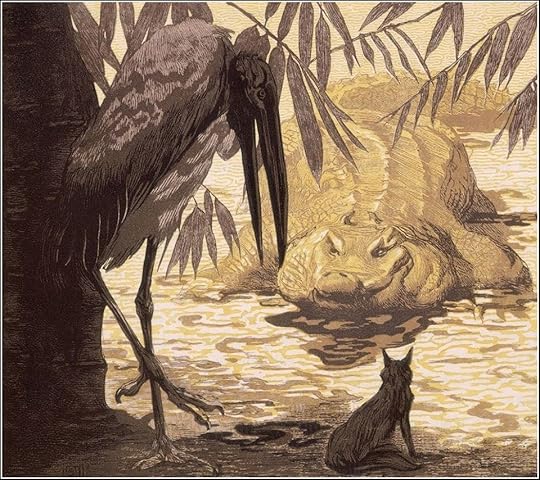
A crocodile, a jackal and an Adjutant bird meet on the sand bank of a river in India during the rule of the British.
They all moan about the lack of food available.
The crocodile retells his story of the good eating he had in the days of the Indian Mutiny. He mentions seeing a boat with a little boy who was trailing his fingers in the water. He attacked, but a lady shot at him and drove him off.
Many years later we hear the other side of the crocodile's story. The boy had grown up in India and was now building a bridge across the crocodile's river.
Beautifully written, but am I the only one seeing the white supremacy themes here? Maybe it’s just a reflection of the times Kipling lived in... there’s also the aspect of hunting down an animal for “revenge” as the white man clearly cared nothing for the coolies he lost (not even bothering to recover their remains), but rather coming from a place of ego - particularly in this case, as the animal in question was considered holy by the villagers. Sad, just sad.
Starting to really pick up the themes and strands of Kiplings works. This, part of his animal/ nature works, similar in them to The Jungle Book. It could also, in part, fit in with The Just So Stories.
Of flesh we are formed, and as flesh we shall be eaten.
As animals, the hunter or the prey: we shall be eaten. As man, white-face or Indian villager: we shall be eaten. As a god, or as a mortal servant: we shall be eaten.
Praise be this meat, this flesh, this protein. All shall, in the end.....be eaten.
It's too bad ol' Rud Kipling was such a racist, such a bigot, and such a misogynist. Fact is he sure knew how to produce some amazing writing.
Thing is, I was on the side of the old mugger crocodile. He lived a long and fullsome [sic] life. And we was a God to the local villagers who garlanded him with wreaths of marigolds. And he was just doing his job. That is, being a crocodile.
And then the Great White Eugenic Hunter has to go and blow him to bits with an elephant gun. The scumbag.
Part of The Jungle Book series and not a bad story in of itself. It's fun to see the natural processes of eat or be eaten playing out from the animals' point of view. It's just to bad that humans have to take it upon themselves to not fit into the natural rhythms of nature.
Godt fortalt og godt skrevet historie. Yderligere ret interessant for en historiker som et eksempel på hvordan at man kan skrive historie, i dette tilfælde om koloniseringen af Indien og det indiske mytteri og den første befrielseskrig, ud fra andre perspektiver end det gængse i historieskrivningen. Her er det hvordan begivenhederne opleves af de lokale dyr, men det kan også inspirerer til en mindre ekstrem og mere praktisk udgave, som at skrive historie set ud fra synsvinklen fra den almene befolkning, arbejderne, kvinderne eller andre grupper sat uden for den gængse historieskrivning.