A brilliant but arrogant scientist, Victor Von Doom conceals his scarred countenance beneath a metal faceplate. His body sheathed in nigh-impenetrable armor, he rules the small Eastern European country of Latveria with an iron hand. Not content with one nation, Dr. Doom's ultimate aspiration is world domination -- and the destruction of the fabled Fantastic Four, the greatest team of superhuman adventurers ever assembled! But technological trappings do not the man make, and enemies alone do not define Doom. Stripped of his awesome armor and lofty station, the Latverian despot now finds himself stranded on the alternate Earth dubbed Planet Doom -- a world he once delivered from certain destruction by cosmic forces. It's survival of the fittest in the tradition of Road Warrior and Gladiator as Doom is captured and consigned to the slave pits of the evil Al-Khalad ... from which the only escape is death! But one battle's end signals only a temporary respite for this stranger in a strange land, as Doom must dodge a revenge-seeking swarm of strangely familiar foes. And when a discovery regarding the very nature of Planet Doom's existence enables the armored autocrat to turn the tables on his tormentors, will he finally realize his dream of ruling and oppressing a world all his own?
Charles "Chuck" Dixon is an American comic book writer, perhaps best-known for long runs on Batman titles in the 1990s.
His earliest comics work was writing Evangeline first for Comico Comics in 1984 (then later for First Comics, who published the on-going series), on which he worked with his then-wife, the artist Judith Hunt. His big break came one year later, when editor Larry Hama hired him to write back-up stories for Marvel Comics' The Savage Sword of Conan.
In 1986, he began working for Eclipse Comics, writing Airboy with artist Tim Truman. Continuing to write for both Marvel and (mainly) Eclipse on these titles, as well as launching Strike! with artist Tom Lyle in August 1987 and Valkyrie with artist Paul Gulacy in October 1987, he began work on Carl Potts' Alien Legion series for Marvel's Epic Comics imprint, under editor Archie Goodwin. He also produced a three-issue adaptation of J. R. R. Tolkien's The Hobbit for Eclipse with artist David Wenzel between 1989 and 1990, and began writing Marc Spector: Moon Knight in June 1989.
His Punisher OGN Kingdom Gone (August, 1990) led to him working on the monthly The Punisher War Journal (and later, more monthly and occasional Punisher titles), and also brought him to the attention of DC Comics editor Denny O'Neil, who asked him to produce a Robin mini-series. The mini proved popular enough to spawn two sequels - The Joker's Wild (1991) and Cry of the Huntress (1992) - which led to both an ongoing monthly series (which Dixon wrote for 100 issues before leaving to work with CrossGen Comics), and to Dixon working on Detective Comics from #644-738 through the major Batman stories KnightFall & KnightsEnd (for which he helped create the key character of Bane), DC One Million , Contagion , Legacy , Cataclysm and No Man's Land . Much of his run was illustrated by Graham Nolan.
He was DC's most prolific Batman-writer in the mid-1990s (rivalled perhaps in history by Bill Finger and Dennis O'Neil) - in addition to writing Detective Comics he pioneered the individual series for Robin , Nightwing (which he wrote for 70 issues, and returned to briefly with 2005's #101) and Batgirl , as well as creating the team and book Birds of Prey .
While writing multiple Punisher and Batman comics (and October 1994's Punisher/Batman crossover), he also found time to launch Team 7 for Jim Lee's WildStorm/Image and Prophet for Rob Liefeld's Extreme Studios. He also wrote many issues of Catwoman and Green Arrow , regularly having about seven titles out each and every month between the years 1993 and 1998.
In March, 2002, Dixon turned his attention to CrossGen's output, salthough he co-wrote with Scott Beatty the origin of Barbara Gordon's Batgirl in 2003's Batgirl: Year One. For CrossGen he took over some of the comics of the out-going Mark Waid, taking over Sigil from #21, and Crux with #13. He launched Way of the Rat in June 2002, Brath (March '03), The Silken Ghost (June '03) and the pirate comic El Cazador (Oct '03), as well as editing Robert Rodi's non-Sigilverse The Crossovers. He also wrote the Ruse spin-off Archard's Agents one-shots in January and November '03 and April '04, the last released shortly before CrossGen's complete collapse forced the cancellation of all of its comics, before which Dixon wrote a single issue of Sojourn (May '04). Dixon's Way of the Rat #24, Brath #14 and El Cazador #6 were among the last comics released from the then-bankrupt publisher.
On June 10, 2008, Dixon announced on his forum that he was no longer "employed by DC Comics in any capacity."
**Buddy Read with the Shallow Comic Readers -- This week's theme: Eeevillll!"
This book collects two three-issue mini-series starring Dr Doom.
I have no idea what I just read.
I know some of my friends hate exposition in comics, but this book really could have used some. From what I can gather, in the first series, Dr Doom has been banished to Doom World, which is a figment of Franklin Richards's imagination. He fights some wild animals, then makes his way back to the Doom World's Baxter Building, which is under attack by Atlans. He kills lots of people along the way, but finally wins, and takes off for the real Marvel Earth.
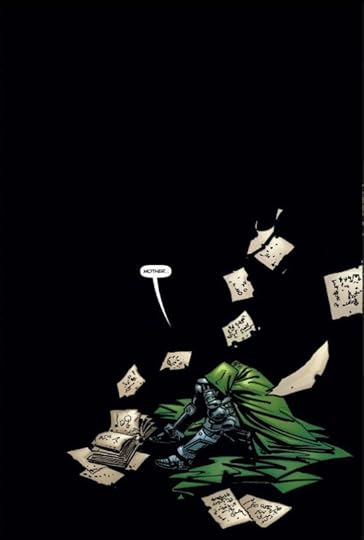
In the next series, which takes place in the real world the next year, Doom is back on this world (if he left -- it is unclear), and soon confronts Franklin Richard, who comes across as The Bad Seed here. Franklin lets Doom control the world, but Doom betrays Franklin, gets bored with this new world, leaves for the negative zone with his mother's corpse (what?) because he wants to bring her back to life, and then acts like a dick towards some pilgrims from the Mayflower or whatever who live in the Zone and still speak Elizabethan English. Whew.
I normally enjoy Chuck Dixon's comics. But this is a confusing mess, unless you're knee deep into the FF continuity of the day. Very little explanation is given, and by the end, I was really tired of reading Doom talking about himself in the third person. We are hit over the head continuously with his megalomania, and it's just old. Maybe this is why villains don't make good series leads.
The art by Leonardo Manco was great in the first series, only so-so in the second. In the first, he really had some Bissette/Totleben vibes going on.
This is so bad it's good. Chuck Dixon, the author of Marvel Knights (2000) # 1, the worst Marvel comic I've read to date, couldn't plot a coherent story even if his life depended on it.
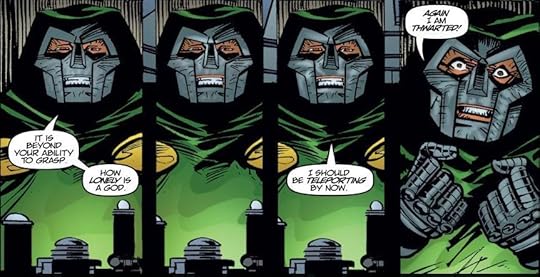
The story jumps from action-packed scene to action-packed scene and Dixon doesn't bother to flesh the characters nor even the world around them. It is terrible, but it is also unintentionally funny. Doom is not the supervillain you expect - he is an absurd and over-the-top grumpy man! I also ship him with Lancer. Poor Lancer.
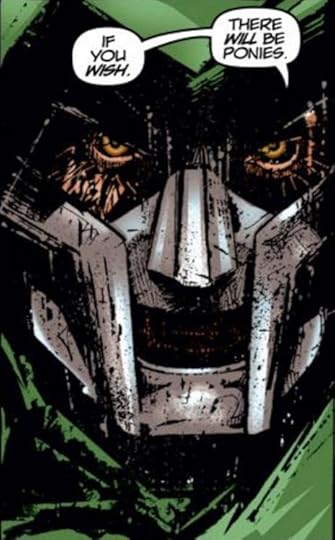
Doom will bring the utmost evil to Earth: ponies!
But the saddest part is his world domination fantasy. It's just sad. Not even scary. At the same time, I cannot but draw parallels with Dr. Doofenshmirtz from Phinneas & Ferb.
First issue of this miniseries was really good and reminded me "One nation under Doom" epic 2099 Doom saga. Sadly storyline went downfall for good after that and Dr Doom getting bored after conquering the world and looking to save his mother's soul from hell are storylines already developed for good in "Emperor Doom", "Dr Strange, Dr Doom: triumph and torment" and lots of other graphic novels.
Still better than all new/all different current Marvel Doom crap.
Wow. This was bad. If you don't have the background for the story about how Doom got exiled to "Planet Doom", then you won't have a clue what's going on. From the beginning, this book tries to emulate the worst action movies - throwing in panel after panel of mindless action shots and Doom one-liners rather than try to have a real story or real characters.
This book is crap, I won't be reading any more of this series.
The first book's art is pretty cool and that's pretty much the only good point. Dr Doom is completely one dimensional, doing not much more than just telling everyone he's great and they're stupid and then with such plot mechanics as Armish space people. Just plain bad.
Doom #1-3, ☆☆☆☆ Out of context I could see this mini-series being really strange/confusing but, when read after Fantastic Four #31, it provides you with some entertaining Mad Max esque context to where Doom has been. Doom: The Emperor Returns #1-3, ☆☆☆
The first 3 part mini-series was okay and had potential. The second 3 part mini-series was absolute trash. Decent art throughout but not enough to save this.
Born from the idea of, 'What if Doom had a taste of the Heroes Reborn (Franklin Richards created) Counter-Earth?', this is a collection of two miniseries...that I don't think ANYBODY wanted.
I don't think Chuck Dixon (yes, THAT guy) ever really got past his Cliff Notes on who Doom is. This is totally a pale imitation of a good Doom story.
The first half of the book is essentially an aftermath of Heroes Reborn. Doom flees the standard Marvel Universe and has to conquer Counter-Earth the old fashioned way. Fightin'! The last half of the book is Doom enjoying a pyrrhic victory. He then shrugs it off and decides to 'take his ball and go home'...fleeing 'Doomworld' (which might be close to blowing itself up??) ----------
Pretty much a waste of time. Dixon is a soild pro in the comic book industry, but I'm guessing some editor at Marvel gave Dixon this assignment which boils down to...
Write about Dr. Doom on Counter-Earth.
Except for readers who come in from the cold the entire Sleeping Celestial, Franklin Richards, Lancer aspects of the story mean nothing. Just ends up being one action sequence to the next. No character work.
Definitely don't read this unless you have read Chris Claremont's FF run where Doom gets thrown into the fake world Franklin Richards created that Doom calls Planet Doom, haha. He basically just Mad Max-es his way to get back to his own world. Very boring. Definitely don't read this in general.
Ambientata sulla Controterra di Heroes Reborn questa è una buona storia di Destino, e per quegli anni anche disegnata decentemente. Certo, nulla di eccezionale, ma si lascia leggere bene e non tradisce il personaggio. 2 stelle e mezza.
this reads like a play for play rendition of an evil 6 year old playing with a doctor doom action figure. doesn't lend itself to a plot that you can really follow though. pretty sure it's just a 6-issue isekai, but who knows man. not my favorite marvel trade
When done right Doom can get away with things like Deadpool, things that would be over-the-top or ridiculous for any other comic character. Chuck Dixon does Doom right.
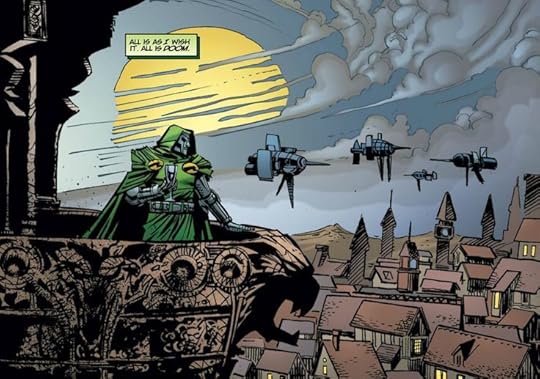
this collects the two Doctor Doom mini-series. The first is the best, as it shows Doom stranded, alone, stripped of his armor and surrounded by a planet full of people that want him dead. We then get to watch as he fights his way through it all to claim a kingdom and out plot everyone to get what he wants.
Both stories are good, as we get to root for Doom, who is one of comicdoms greatest villains.
The only problem with these stories, is they were spin offs of other comic stories and if you haven't read those you'll be a bit lost as to what happened before ( I know I was). I'd suggest you not worry about it, as you get enough info to enjoy watching Doom show us how he got a reputation as one of the biggest badasses in the comic history.
What could have been a really great graphic novel/comic that really explored the character of Doom turned out to be a disappointing use of a great character. It seemed very much like a ‘lets put a great character in a new situation to see what would happen’ idea, much like what a ‘What If?’ would have done. Perhaps it is because I don’t follow the Fantastic Four as much, but it seemed like nothing special.
He is the greatest comic book villain in history. He is a brilliant engineer. He is a powerful sorcerer. He knows the world would be better off under his iron fist. He is Doom.
Admittedly, this story lacks coherence, but if you're thirsting for more Doom, it's here.
I mean, it might have been the reading order I'm doing (this is the first time I've encountered Doom in the comics, along with Franklin Richards) but... zzzzzz. I was confused, and the payoff was zilch.
Dixon gives Doctor Doom the spotlight story he deserves here. Truly, Doom comes off as much more than a comic book villain. Manco's art for the book is as dark and moody as Doom himself.