Jump to ratings and reviews
Rate this book

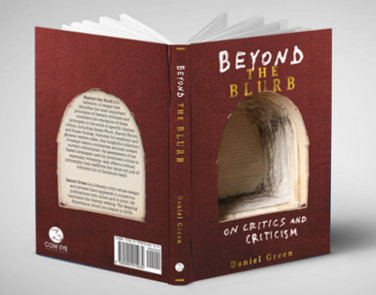
Beyond the Blurb: On Critics and Criticism

Rate this book
Beyond the Blurb is a selection of essays that identifies the most important principles of literary criticism and considers the relevance of those principles in the work of specific literary critics, including James Wood, Harold Bloom, and Susan Sontag. Intended for academic and general readers alike, this insightful collection of essays takes a contrarian attitude toward current orthodoxies--its assessment of the flawed strategies used by prominent critics is especially revealing--and offers a critical philosophy that reaffirms the value not just of criticism but of literature itself.

150 pages, Paperback

Published November 20, 2016

Loading...
Loading...

About the author

Daniel Green

9 books5 followers

Ratings & Reviews

What do you think?
Rate this book

Friends & Following

Create a free account to discover what your friends think of this book!

Community Reviews

5 stars
8 (53%)
4 stars
6 (40%)
3 stars
0 (0%)
2 stars
1 (6%)
1 star
0 (0%)
Displaying 1 - 6 of 6 reviews
Profile Image for W.D. Clarke.
Author 3 books360 followers
September 20, 2017
These days literary scholars are preoccupied with 'what you want to make of a text', mostly dismissing 'what it wants to make of itself' and ignoring 'what it wants to make of you'.

It's 1990 and I am in a Joyce seminar in grad school, and we students (there's about 15 of us) are supposed to run the class: the Prof regularly chimes in, but we are collectively in charge of conducting the two-hour seminar, and every other week we are expected to take on a chapter of Ulysses and teach it to the others. Usually this involves linking it up with is sources, chasing down its allusions, etc. etc., and then patiently taking the class through a "close reading" of the chapter. Our goal is to make our assigned chapter of the book come alive for the class, so that the other students leave the room having experienced it in a way that is richer than if they had just read it on their own. Most of us take the instructions to heart: we are supposed to try to crawl inside the text, be the best explicator of it that we can be (part midwife, part advocate, but always the most sensitive, most judicious and patient of readers), and to shepherd the book before the class in good faith, not because authors are gods or because the text is a timelessly perfect "well-wrought urn" or transcendent work of art, but simply because by signing up for the course we have signalled that we value what Joyce has to say, and because Ulysses is really the only thing in the room that we all have in common: after all, we have not come here to discuss Irish politics, James Joyce's upbringing, or continental modernism.

Of course, we are expected to bring up Irish politics, Joyce's biography or aesthetic theory IF that happens to serve the novel, if it does justice to Ulysses itself: the professor is training us to be university English teachers, and expects us to be conversant with and to be able to apply all manner of tools that will help our students understand the book that has been assigned for any given week. For the purposes of pedagogy, context is the handmaiden to the work at hand, and not the other way around.

Inevitably, however, one of our fellow apprentices ignores all of this advice and gives a 30 min talk about how Ulysses unconsciously represents something about what French philosopher Louis Althusser called the "Ideological State Apparatus". The upshot is that we leave the room not having learned or discussed anything about that particular chapter of Ulysses. We don't even learn all that much about Althusser's thinking, as our fellow student has assumed that we are as conversant with it as he is. He has written a paper on Althusser in modern culture and Ulysses was just one text among many that shows how these works of alleged "art" merely reflect the ideology of the time and place in which they are created.

Of course, there is nothing wrong with writing this kind of paper: texts signify far more than their authors intend, and it can be quite enlightening (as well as, in an academic kind of way, entertaining) to bring literary texts into collision with other discourses. In fact, today, most young grad students in English are expected to make explicit the theoretical "lens" that they will be applying to the authors that their dissertations will be dealing with: there is no easy way to "go back" to literary narratives in isolation from psychological, sociological, historical and political ones.

And yet this is exactly what Daniel Green's enlightening new book, Behind The Blurb: On Critics and Criticism, has come to tell us: literary criticism needs to be rescued, both from the confines of academic criticism (where literature is increasingly seen, by its more vulgar practitioners, as tertiary to this-or-that "ism", as an epiphenomenon of ideology), and from the book review industry (which, in its focus to shift bland, middle-of-the-road product—all too often the easily digested regurgitations of reheated, bland fare assembled from recipes for how to write a novel circa 1885—puts everything about the author except for his or her writing front-and-centre). Instead, it is time to bring the focus back to the literary work itself, and to the interpretive possibilities inherent in taking the formal dexterity of the text seriously for a change.

In this, Green harkens back to what was called "The New Criticism" of the 1940s, a loose collection of critics who rejected the philological, historical-biographical and moral approaches to literature that preceded them, and whose guiding tenet was "close reading" —paying careful attention to the formal elements of the literary text (especially poetry, which made New Criticism such an appealing pedagogical tool for the secondary and undergraduate classroom), with the aim of elucidating the thematic and linguistic ambiguities that were inseparable from the work's unique formal characteristics: style was inseparable from content, these critics felt, and it was time for historical and biographical criticism (which had relegated style to being little more than a 'purse carrier' for content) to be shown the door.

In this (to be clear), Green is not arguing that we merely retreat to some by-gone mode of interpretation (his PhD dissertation, after all, employed the theories of post-structuralist Jacques Derrida, so he definitely knows his way around "pure theory"). He is merely suggesting that it is perhaps time for a corrective, that we read a novel for the sake of reading the novel before we hammer away at it with our pet cultural theories, and that we don't get as quite so caught up in the biography and personality of the author as the publicity industry might have us do. If we return to consider the formal elements of the text with due seriousness, Greene maintains, then perhaps we might once again treat formally experimental fiction with more respect than it currently receives from the so-called "literary" fiction world. [My own pet theory (ok, hunch) about this involves both the move towards the upsized and relatively upscale "trade" paperback format and the industry's increasing reliance on literary prize culture from the late 1980s onwards: just look at the lists of prize-winners from the last 20 years and count how many books would qualify as formally "experimental"—but that's an argument for another day.]

Green's book is divided into three sections: one which sets out what he feels to be are the important (and perhaps underappreciated) critical issues of recent literary history, another where he focuses on individual critics who, in his eyes, largely fail (by reducing literature to some narrow confine or other) in their approaches to literature, and a final section on those critics whose work, as Green sees it, celebrates in one way or another the relative autonomy of the work of literature. The structure of this book seems appropriate to underline his main thesis: it is not that the literary work is wholly autonomous of all other influences, but that for various reasons criticism has come to dramatically underplay, undervalue or deprive it altogether of any autonomy that it might once have assumed to itself.

In the introduction to the book, Green makes a number of polemical points that, again, are meant to redress current critical failings:
• Literature "is worth taking seriously for its own sake"
• The experience of reading is hardly less important than its abstract "meaning"
• You can't criticize what you don't dive deeply into
• What you are diving into is a complex deployment of/structuring of language
• Experimental fiction's innovations with language constantly challenge the critic to play "catch-up"
These are important points, and Green takes pains to ensure that we understand him: he is not suggesting that we abandon scholarship, but that we understand that the critic and scholar serve different functions, and that we need to be reminded of the deep importance of the cultural function of the critic: while scholars connect our knowledge of the text to other discourses and contexts, critics discuss and analyse the text on its own terms, with the aim of explicating how it is put together and of evaluating how well it does what it is trying to do. Sometimes (as with the case of Harold Bloom) these two functions go hand-in-glove, sometimes not, but we should never forget why we read novels in the first place: because they give us an experience that only novels can give us. They are not histories or biographies or potted sociologies (though they can contain elements of all of those things). When they are done well they are, rather, tightly structured linguistic experiences that challenge our understanding of what language itself can do: it can tell a story, inquire about the nature of history, society and humanity itself, but it can do all of that while being something else again. Green does not go into detail, as it is criticism and not fiction that is the chief concern of his book, but I suspect he would agree with me in this: over the past while (20- 30-something years?), such formally innovative fiction has played an increasingly diminished role in our literary culture, and we are all the poorer for it.

The first section of the book Green is devoted to expanding upon the aforementioned points via discussions of a number of critics who have informed his own practice. Green is remarkably fair-minded in his assessment of what he perceives to be these writers' strengths and weaknesses: practicing the kind of critical-yet-sympathetic close reading that he preaches, he is indeed the ideal pedagogue that I mentioned in the first paragraph of this review: since many of the objects of his analysis in this section (Ron Silliman, Johanna Drucker and Richard Kostelantz) were new to me, I appreciated the many nuances Green teases out their bodies of work. For example, while he does not seem to share Silliman's Marxist view of literature (that it should ultimately be the "servant" of "social reform"), he appreciates how Silliman places language at the forefront of the literary experience, and does not reduce it to "crudely propagandistic […] polemic". The effect of Green's rather gracious, judicious approach makes this reader want to go out and pick up Silliman's, Drucker's and Kostelantz's books and read them myself—surely just the kind of thing the author intends that good criticism should always aim to do!

Read the rest of this piece (5,000 words) on my blog at: http://longform.wdclarke.org/daniel-g...
Profile Image for Chris Via.
487 reviews2,142 followers
Read
April 7, 2023
I asked Steve Moore for a recommendation of books on book reviewing/lit crit, and this was one of his recommendations. It was exactly what I was looking for: a book that examines the state and styles of lit crit and offers its own criticism of criticism. The bonus, for me, was that Green is speaking my language, virtually affirming a position of which I have been somewhat apprehensive.

Some notes from my reading:
1. Seeks to put the literary back in literary criticism.
2. For Green, literature does not primarily present us with characters (and characters' thoughts) and the world, but rather words artfully composed on the page. Its chief aim is to use language to create literary art.
3. Contrast of criticism and scholarship.
4. Green joins Eagleton (in How to Read Literature ) in the focus on how books say what they say.
5. Green joins Saunders (in A Swim in a Pond in the Rain: In Which Four Russians Give a Master Class on Writing, Reading, and Life ) in warning against pronouncing what literary art should be and thus closing ourselves off from new developments (in form, aesthetic, etc.).
6. Using Gorra's book Portrait of a Novel: Henry James and the Making of an American Masterpiece as an exemplar, Green asserts that we need more books that avoid (a) intellectual trendiness; (2) academic abstraction; and (3) undisciplined impressionistic pop crit.

This collection examines critics in practice and presents failures and successes:

Failures (making literature subsequent to some other field or practice):
- Wood (psychological)
- Hitchens (political)
- Dickstein (historical)
- Parker (scholarship)

Successes:
- Sontag (erotics; form over content)
- Bloom (poetic power)
- Poirier (facing the ineffable with the inadequacy of language)
- Gass (aesthetics of literary art)
- Gorra (academic crit done right; "critical eclecticism")
- Winters (book reviews done right)
- Chrostowska (aphoristic crit; writing over criticism)

Books this book compelled me to read:
1. Axel's Castle: A Study of the Imaginative Literature of 1870-1930
2. Portrait of a Novel: Henry James and the Making of an American Masterpiece
3. A World Elsewhere: The Place of Style in American Literature
4. RENEWAL OF LITERATURE

Bonus: Several pleasing Franzen jabs.
Profile Image for Jeff Bursey.
Author 13 books197 followers
May 16, 2022
Fine book on current and near-current critical approaches that works best, I feel, when Green is opposed to someone/something, as in his section on James Wood. His advocacy for Susan Sontag comes with qualifications that are presented in a reasonable way. Green is for aesthetic readings -the close reading of New Criticism, the emphasis on art - over literary theory with its preference for cultural or historical analysis. He has praise for S.D. Chrostowska (especially her Matches) and that counts for a lot, for me.
Profile Image for Max Nemtsov.
Author 188 books584 followers
May 21, 2017
Книжка Грина — мета-текст, критика критики, казалось бы — талмудизм высшего порядка, но нет. На самом деле это учебник чтения, книга в первую очередь о самом опыте чтения. Как и все вроде бы развитые навыки, чтение — навык у большинства недоразвитый, поэтому ни одно напоминание лишним тут не будет. Навык этот нужно поддерживать безустанно, а не принимать как должное, навсегда остановившись на уровне понимания букваря. Развитием этого навыка только прирастает наша осознанность — в т.ч. и осознанность при чтении (потому что это работа, ну да).
Кроме того, Грин буквально на пальцах, хоть и не впрямую, объясняет нам, почему в России нет критики (хоть и не говорит об этом ни слова), а также отчего некоторые «брамины» этого занятия — не критики, а, заимствуя определение у Хармса, «говно». Те несколько человек в русскоязычном пространстве, кто подлинно достоин наименования «критика», — по сути внимательные читатели, и в таком вот «пристальном чтении» и состоит, собственно, доблесть критика (в отличие от «книжного журналиста» или литературоведа). Кооптация массовым вкусом критику убивает — и вот этого некоторые наши околокнижные писаки никогда не поймут. Они даже не способны цитату из классики от контаминации отличить, как недавно тут выяснилось, и пользуются мемами как инструментом познания.
Грин — прекрасный и остроумный полемист (почему не стоит читать Франзена — у него отдельный аттракцион). Но созвучен он нам не потому, что «наша ведьма» (в силу некоторых экстралитературных обстоятельств), а потому что нормальный человек и идеальный читатель, каких всегда мало в любой культуре (я не примазываюсь, самому мне до идеальности чтения очень далеко, но стремиться на маяк никогда не вредно). Ну а процессы и явления, с которыми он полемизирует на англо-американском материале, одинаковы или похожи — что в американской, что в советской (какова нынешняя русская) литературной культуре.
Утешительно, конечно, понимать, что в Штатах — такой же пиздец в «литературно-промышленном комплексе», мозгах читателей и у «критиков» в головах. Сделать с этим в одиночку ничего невозможно, тут можно только держаться за собственный пистолет. А ситуация, понятно, и там, и тут — «морок прошлого»: публика читает одно и то же (и одинаковое) потому, что наши «торговцы воздухом» (учителя в школе либо эти самые критики) ей рассказывают, что это надо читать. И тем, и другим проще пережевывать старое, чем генерировать новые смыслы и ценности. Из этого порочного круга податься некуда, если не прилагать сознательных усилий, что везде делают считанные единицы.
Так что все запущенно.
Profile Image for Pandaduh.
288 reviews30 followers
September 6, 2021
When I first discovered this book I looked on it with skepticism, because it comes from the once-fake (or should I say spoof?) publisher Cow Eye Press which produced the (essentially self-published?) book Cow Country by the pseudonymous author Adrian Jones Pearson (who some thought might be Thomas Pynchon in disguise). But no, it was actually this guy. Like, they even made a fake website for the school mentioned in the book, so the rabbit hole ran pretty deep.

So, as you can see, I laughed upon seeing Beyond the Blurb. I love this sort of conspiracy-laden thing but something wasn't clicking. I never read  Cow Country  because, like others have said, the mystery is more entertaining. I thought Cow Eye Press was just as fake as the Community College, because they share the same namesake -- like Oxford University Press, University of Chicago Press, etc. But that's no longer the case. Cow Eye Press went through a website upgrade. Later, they were promoting a book on facebook that seemed...real. They were really going with this thing.

Their statement to authors (whom they are accepting submissions from apparently):
If you are planning to submit your work to Cow Eye Press for consideration it is most likely due to the recent attention given to our first release, Cow Country. In all honesty, the modest commercial success of this novel was a total fluke and in no way attributable to our professionalism and/or expertise in the area of promoting new works of literature to an indifferent reading public. We are certainly not experts in publishing, nor would we ever want to be. That said, we do love meaningful expressions of literature, respect the efforts of any independent author who has the courage to advocate for his/her work amid such a hostile publishing climate, and MAY be able to exploit our unexpected incursion onto the literary scene to help your work find its audience.

Please also keep in mind that Cow Eye Press is a very small publisher whose plans are to publish no more than ONE BOOK PER QUARTER. If you are seeking a large traditional publisher – with the numerous advantages that this brings – you will likely want to look elsewhere. Our modest publishing plans, coupled with the huge influx of submissions we've begun to receive, also means that we will, in all likelihood, become yet another boot upon your soul as you search for a home for your work. Please accept our sincere apologies for that in advance.
The complicated explanation of where this book comes from should show you why I was interested in it. Not that I purchased it right away. In fact, my fear of looking like a fool for "falling for it" kept me just angry enough to keep clicking -- to keep trying to expose the lie. Being the librarian that I am, I researched this "Daniel Green" to the fullest extent. He seemed like a real enough human. He has a hard-to-navigate blog called 'The Reading Experience' that seems genuine. He even got me to read this book  because of his paradigm-shifting critique of it. What made it all hard to judge, for me, is the jargon and theory and literary culture he uses in his online work -- I'm just not well versed in what he sometimes talks about. Honestly, it could be as fake as this blog saying that Virginia Woolf was E.V. Odle (just to be clear: she was not) and I would never know the difference. There was a confidence about him and the mysterious Cow Eye Press that was thrillingly untrustworthy. However, this didn't stop me from following them and accepting their truths that I did/do happen to understand or agree with.

I'm in my 20s. I don't have a PhD in Literature. Be nice to me.

When I saw he made it onto the Biblioklept blog, I started to take him a bit more seriously. I tried to interlibrary loan the book a million times before committing to purchasing it. I'm so scared of being taken. It's the librarian in me. My anti-fake news reputation is at stake. But no libraries had it. That's the fault of libraries -- never seeking out the indie publishers. But that's a rant for another day.

Read my full review: https://blackandwhitepandaduh.wordpre...
Profile Image for Antonio Gallo.
Author 6 books59 followers
December 30, 2016
La lettura di questo libro mi ha ispirato questo post che mi sembra del tutto pertinente all'argomento. "Blurb", in italiano sta per "soffietto" di tipo editoriale ... Temo che qui in Italia spesso questi "blurbs/soffietti" diventano dei veri e propri "soffioni". E qui su GoodReads abbondano ...

----

Lo sapevate che anche i libri hanno bisogno di "soffietti"? Non sapete cosa sono? In inglese si chiamano "blurbs" e sono comparsi per la prima volta nell'editoria di lingua inglese, agli inizi del secolo scorso, quando apparve per la prima volta l'immagine di una donna che urlava ad alta voce il titolo del libro, pubblicizzandolo come una volta facevano gli strilloni del giornali. Col tempo c'è stata poi una evoluzione del messaggio in versione pubblicitaria. L'editore si avvale di fascette intorno al volume con messaggi, oppure stampa sulla sovraccoperta dichiarazioni di critici, scrittori, giornali i quali esprimono il loro giudizio sul libro. Questo, è ovvio, ed è sempre più che positivo.

La domanda che ci si pone a questo punto è: quanto conta un messaggio del genere nella decisione del lettore di acquistare quel libro? Possiamo fidarci di questi soffietti chiaramente interessati? In una società contemporanea come la nostra sembra che la cosa sia del tutto accettabile, se non comprensibile. L'apparenza e l'urlo caratterizzano i nostri messaggi e sopratutto i libri sono portatori di messaggi. C'è chi sostiene che questi soffietti sono utili, chi li ritiene una vergogna, chi pensa che aiutano il lettore a capire e scegliere cosa compra, chi invece sostiene che sia una maniera sleale per fregarlo e condizionarlo.

Ma, allora, è utile chiedersi cosa spinge il lettore a leggere e comprare un libro. Se non il soffietto, la copertina, il nome dello scrittore, la recensione sul giornale, la discussione di salotto nel talk show, la clip video, la locandina del giornalaio, cosa fa decidere un lettore a leggere un libro? Chi sa cosa vuole, non ha problemi. L'editore del libro e il suo autore, ovviamente, vanno a caccia del lettore poco informato, scarsamente avveduto nelle sue scelte, indeciso ed influenzabile. Il libro è, oltre tante cose, sopratutto un "prodotto" da vendere. Chi vende meglio e di più può dirsi uno scrittore di fama e di successo, se rimane in vetta per diverse settimane nelle tante classifiche della vendite.

Saggistica, narrativa, varia, per giovani, per ragazzi, per adulti, in versione italiana e straniera, i media pilotano tendenze, scoperte, successi, ed anche bidoni ed illusioni. Tutti conosciamo ambienti e luoghi dove chi scrive libri gira nelle scuole, aiutato da amici e colleghi, si inventano corsi di aggiornamento, conferenze, inaugurazioni ed occasioni per parlare di libri scritti da amici e colleghi, momenti di cultura ideali per aggregare menti giovane nei luoghi istituzionali designati a promuovere anche la vendita di libri.

Il politico e l'assessore locale promuovono, presenziano, relazionano, insomma si fa cultura vera, almeno così dicono. Sono tante le occasioni che capitano ovunque. Intendiamoci, non affermo che queste siano cerimonie futili, nessuno potrà negare la loro utilità sociale. Stimolano la lettura, creano cultura, incrementano anche la produzione, educano cuori e menti di futuri cittadini responsabili. Sono "soffietti" diversi, ma restano tali. Spesso sono solo dei "soffioni" ...

https://goo.gl/88V60v
Displaying 1 - 6 of 6 reviews