In the sweltering summer of 1858 the stink of sewage from the polluted Thames was so offensive that it drove Members of Parliament from the chamber of the House of Commons. Sewage generated by a population of over two million Londoners was pouring into the river and was being carried to and fro by the tides. The Times called the crisis "The Great Stink". Parliament had to act - drastic measures were required to clean the Thames and to improve London's primitive system of sanitation. The great engineer entrusted by Parliament with this enormous task was Sir Joseph Bazalgette. This book is an account of his life and work.
What a great pleasure it was to learn about my hero, Joseph Bazalgette, and his astonishing achievements. The book was well set out and easy to read. I particularly liked the boxes giving short biographies of the various people involved with Bazalgette’s projects. They imparted a real flavour of the movers and shakers who peopled his incredibly able world.
Here follows a synopsis to remind me of what I read (I don’t expect anyone else to read it!) I just don’t want to forget all the wonderful things that Bazalgette achieved.....
At the start of the nineteenth century in London, ancient methods for the disposal of human waste were sufficient. This consisted of people using cesspits, which were emptied by nightsoil men. The waste was then taken out into the countryside around London, where it was sold to local market gardeners and farmers, who used it to fertilise their fields.
Then problems began to surface. • The population grew exponentially – from 959,999 in 1801, to 2,807,000 in 1861. The more people there were – the further away the countryside became, and the harder it became to take the waste out to the farmlands. • In 1810 the water closet was introduced. This used a lot of water, and the extra water caused the cesspits to overflow. • Until 1815 it was illegal to put sewage from the buildings into the sewers, they were kept specifically for the drainage of surface water. After 1815, they began putting sewage into the sewers, and from there it entered the various river tributaries leading through London to the Thames, and the river Thames itself. These were also sources of drinking water for the local population, so sewage was entering the drinking water. • In 1847 guano (bird droppings from South America) was introduced as a new fertilizer, and it was cheaper and much easier to handle than human fertilizer, so the market for the latter dropped sharply.
All these factors combined to make the old ways of sewage disposal no longer viable. Basically it was a combination of cesspits leaking into nearby watercourses, and later on sewage being emptied directly into the watercourses themselves, that created the really obvious problems. These problems took two forms. *disgusting smells (which many Victorians thought were the cause of sickness – many of them believed that the actual ‘miasma’ or smell was causing illnesses.) * Polluted water. The real cause of sicknesses.... Toxic infected water generated illnesses like cholera, typhoid and other water borne diseases..
In July 1958 London experienced 'The Great Stink’. A long hot summer, where the terrible toxicity and smell of the Thames virtually drove the MPs out of the Houses of Parliament. After years of debate about the state of London waste disposal, this stink to end all stinks created a turning point. Enough was enough. Disraeli’s government passed an act allowing Bazalgette to start work on his massive programme for a proper sewer system for London.
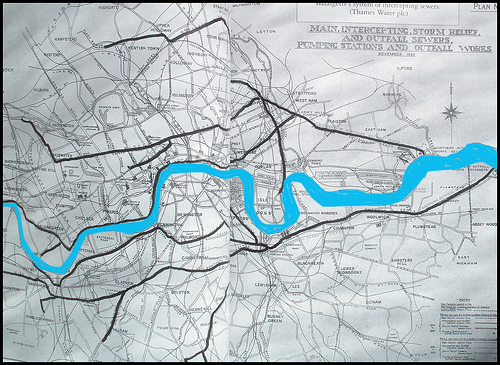
Bazelgette's system of intercepting sewers for London:
Bazalgett’s achievements were incredible, encompassing not only a sewage system for London, but the infrastructure needed for this, plus many other initiatives to enhance the quality of life in the city.
• He was in charge of designing and building a whole sewage system, with the unbelievable organisation that this entailed. • He organized that sludge from the sewage system be taken down the Thames in sludge boats - to be taken out to sea. This continued until 1998. • He built three great embankments along the Thames – the Victoria and the Chelsea embankments (both on the north side of the river, and the Albert embankment (on the south side of the river.) These embankments were to carry sewage pipes, plus the first London underground railway, plus gas and water pipes (& later electricity pipes)..... In doing this he reclaimed 52 acres of river land from the river Thames. On top of this land were built roads, walkways and parks. • He was the first person to use Portland cement on a large scale. It had to be made up within strict parameters, and he ensured high levels of quality control as the cement was mixed for usage. Portland cement was unique in that it gained strength when wet. • He also organized the creation of major roads leading to the new embankments. This involved the purchase and demolishing of rat-infested tenements, in order to make space for these new and improved roads, and the re-housing of 40,000 people. • He was put in charge of doing away with toll bridges – of which there were many in London. He was also asked to build new bridges, and repair existing ones. He designed the Hammersmith Bridge. • He was also involved in creating and extending various London parks.
I think his finest achievement is recorded in these statistics...
In the last set of figures – the cholera outbreak was confined to that part of the city where Bazalgette’s sewers had yet to be completed. “By 1896 cholera had become so rare it was declared one of a number of ‘exotic diseases’.” The work that Bazalgette did to improve the health of London is astonishing....
Another amazing fact is that Bazalgette’s sewers are still being used today. Okay, there have been some alterations, but even so ....... 150 years later and we are still benefiting from the man’s genius.
Hurrah hurrah for Bazalgette! I enjoyed this book a lot.
More about the bureaucratic and political challenges than the engineering ones. A lot of the engineering kind of gets glossed over, I wanted to see plans and sections and equations… but still good. I wish we still built sewage treatment plants like they did back in the day.
I was initially disappointed that this book actually spends very little time focusing on the ‘Great Stink’. Rather, the ‘Great Stink’ is a small piece of the overall story.
However, the story that is presented here is fascinating. I had never heard of Sir Joseph Bazalgette and now feel it’s an absolute crime that more people haven’t.
The construction of sewers could be an extremely dull topic but the author, Stephen Halliday, does an excellent job, for the most part, of bringing it to life. Occasionally his quest to cover every minor detail takes the book into slightly tedious territory but, on the whole, it’s an intriguing and entertaining read.
Halliday gives a clear historical account of what Thames looked like during the Victorian era--a river infested with waste and disease--and how one man changed it. The Thames river's transformation from one stinky river to one of the most admired rivers in Europe is something that the Philippines can replicate in its own water systems. Joseph Bazalgette, an engineer, put all the stops to clean Thames. His magnificent project is truly one for sustainability!
This is an odd book, but a worthy one. As the title suggests, it's part history of London's 19th-century sewage system, and part biography of Joseph Bazalgette, chief engineer of the sewage system. These two stories complement eachother, and the book felt loose but by no means padded. The book used to be a dissertation but is blessedly free of the usual defects of such. The author has many historical and biographical digressions, but minimal theoretical apparatus. The scholarly machinery of footnotes and explicit roadmapping is present, but unobtrusive. This is a highly readable book for a nonspecialist.
I liked the book; it brought a number of things into focus and was an easy and pleasant read. The author is especially good when it comes to explaining the problem that Bazalgette solved. Before 1815, the Thames was a remarkably clean river. Dumping sewage to the river was illegal, and mostly impossible -- there were no sewers and everybody had a cesspit. In the second quarter of the century, however, things changed. The city kept growing. Laws were amended, allowing sewers into the river. The popularization of flush toilets increased the amount of waste being discharged. Presently, the Pool of London became a giant communal cesspit.
This got smelly. Parliament appointed a series of commissions and boards to consider and take action; maps were made, plans were solicited, but no significant construction was started. By the summer of 1858, conditions were apocalyptic and parliament was considering relocating away from London. This was the "great stink" of the title. The smell made a bigger impression at the time even than it would for us. In 1858, the prevailing theory was that bad air caused disease; the Parliament wasn't merely uncomfortable, they were afraid there would be mass death.
The parliament responded by creating the Metropolitan Board of Works -- a local government with enough power to solve the problem. The Board hired Bazalgette as chief engineer, and put him to work building a system of "intercepting" sewers -- so called because they ran parallel to the river, intercepting the existing sewer mains and diverting their flow far downriver.
The system was an immediate and near-complete success; in 1866, when there was a cholera epidemic, most of the city was served by the new sewers and those parts were largely spared. There were some problems with pollution near the egress, but these were mostly manageable.
A few other points of interest --
Bazalgette was a hard-working professional, and a pioneer in the use of modern concrete for the sewers -- and a pioneer in systematic quality-control testing for it, too.
People kept saying "sewage is valuable as manure, don't just flush it away." Cities kept offering it for sale, discovering no buyers and saying "no, it isn't." This same debate played out over and over for decades, with a rotating cast of characters.
Bazalgette, in addition to the sewers, also presided over the Thames embankments. These did in fact have sewer pipes in them, but also subways and other infrastructure -- they were a big dramatic and highly effective civil engineering project.
A very interesting story of Victorian London plagued by recurring cholera epidemics and the engineering projects led by Sir Joseph Bazalgette that improved and saved the lives of countless Londoners.
Imagine living in a city where there are no sewers, human waste is disposed of in the streets, in the basements of homes, or in buried cesspools near homes. Your drinking water is taken from wells and the River Thames. Cholera epidemics come and go without warning and almost everyone believes that cholera is transmitted through foul smelling air.
The solution was to build sewers that took the human waste and dumped it into the River Thames. The Thames itself was quickly turned into a open sewer and drinking water was still drawn from it.
Parliament consistently was unable to agree on any plans to correct the problem until 1858. Parliament finally took action after a long summer heat wave made the smell of the river so unbearable that the members were literally driven from the building. That summer is now remembered as The Great Stink of London.
Enter Sir John Bazalgette. As the lead civil engineer on an enormous project to correct the problem and improve the daily lives of Londoners. That project rebuilt the sewers directing the raw sewage away from the city thereby cleaning the river; built the Victorian and Chelsea Embankments over those new sewers on the north side and the Albert Embankment on the south of the river; redesigned and rebuilt London streets improving traffic flow and built new toll-free bridges over the Thames.
A book recommended for those interested in 19th century London, the early history of the development of public health and civil engineering. Anyone that has visited London and walked along the north or south banks of the Thames has been able to do so as a result of The Great Stink and the word of Sir Joseph.
A beautiful book for sure.. Offers an enormous amount on information and some very nice drawings & illustrations. But. It has in fact quite little to do with Bazalgette and the 'cleansing' from the title in no way means that a real solution was attained during the engineers lifetime. It was merely a clever way of re-'placing' (literally ) the problem by means of transporting waste outside the centre of London. This is actually another prime example of over-feeding the reader with so much names and detail that one has to re-read every sentence (in complex prose) in order to understand what is being said. It provides for excellent information , but too little in the way of a comprehensive readable story. Even the day of the great stink itself is glossed over, and I would really like to have experienced that in its fullest detail. Bazalgette himself remains a vague and aloof character and it requires filling in a lot of dots to grasp why he made such a big contribution.
This entire review has been hidden because of spoilers.
Avoiding the temptation to utilise any 'toilet humour' in this review, I really enjoyed this book. It sets out in considerable detail the work and achievements of a man who should be more famous, particularly in London. He was responsible for much of the major transformation of the drainage system in the capital, bringing huge benefits to the health, housing, transport and amenities for the massively increasing population in Victorian times.
In his exhausting and complex work, Bazalgette faced many opponents and problems and these are covered in detail in the book. It is obviously not to be everybody's taste to read about intercepting drainage systems, sewage, cholera, engineering contracts, embankments and concrete. But I found this fascinating stuff and will be tempted to impart my new knowledge of London when ever I get the chance.
This isn't a topic most people think about, but Bazalgette really does deserve a place of honor amongst the greats of early-ish Science. This book has the potential to be a momentous modern epic, but the author's style is very scholarly and academic, a bit too dry to do the topic justice as a good human drama. As an informative text and compilation of resources and research, this is excellent, though.
I was surprised to find out that flush toilets were the cause of the problem. It makes sense when I think about it. Instead of carting off human waste to be used as fertilizer or whatever, as was the practice before flush toilets were invented, it was dumped into the rivers via “drains” of one type or another, leading to the great stink. An interesting read.
A book which gives credit where credit is due to a Great Man and Engineer, Joseph Bazalgette! He was very modest, but his work was heroic legend! He made London safe to live and work in plus improving the streets, bridges, and parks. The City of London owes a great debt to Bazalgette. A great history read!
A fantastically researched and produced book, with pictures and biographies. However, they seemed to have missed the lowest level - a basic map of the sewers, an explanation of what an embankment is and a map showing where they are, etc. Recommended only for professionals and London historians.
This is an excellent book. Books about growing food, cooking food, even eating food are proliferate. However, less interest is taken in what happens to your dinner after it has been masticated. This book takes it title from the failure of London's "great and good" to take any interest in what happened to the contents of their chamber pots once they had been sleuced into Thames tribuatories and how hot summers began to bring them nausea inducing reminders as a tidle wave of festering sludge slopped against the side of the Mother of Parliaments. It is presumably this reluctance to engage with human, and other, waste in polite society which has ensured that unlike many Victorian era engineers the name of Sir Joseph Bazalgette is relatively unknown. However, it was he who after the usual political footdragging, a reluctance to accept that the market wasn't going to sort it out (a lesson politicians seem eternally reluctant to learn) devised the magnificant London sewer system and its associated infrastructure. This is a story of extreme wealth in a sea of extreme poverty, of public health, of science and the struggle of those challenging recieved wisdom to be heard, of political foot dragging and of the development of innovative engineering techniques and the growth of bureaucracy capable of devising contracting systems and overseeing and quality controlling work (much of which is hidden below ground out of sight). Anyone who has been lucky enough to see behind the scenes and under the earth the tunnels, machinery and exquisite Victorian architecture of these places and their supporting infrastructure cannot fail but to be impressed. Without Bazalgettes strength and determination, and that of a few supporters who could think beyond penny pinching and to the greater good it is doubtful that such a system that has served London so well, and still does, would ever have been built on the scale it was. We also have Bazalgette to thank for the Thames embankments, many parks, streets and Thames bridges. Interestingly the London sewer was the proving ground for Portland cement and something of a project magic wand in handling the demands for effectiveness in wet conditions. This is an outstanding piece of research well illustrated with contemporary material.
El libro exalta la figura de Sir Joseph Bazalgette por su contribución al saneamiento de la ciudad de Londres en el siglo XIX mediante la planificación, diseño y construcción de un sistema de interceptores, además de otras obras de infraestructura que fueron construidas en esa época. Resulta también interesante la descripción de las controversias asociadas a la teoría miasmática de la enfermedad que era aceptada hasta ese momento. Como ingeniero resulta inevitable senstirse inspirado por este libro.
I've always been fascinated by anything concerning the history of London, including the very workings of the infrastructure. I already knew Joseph Bazalgette's story and was amazed at the task he had before him. This book added to my knowledge by giving details such as what he was up against with local authorities and the typical "not in my backyard" camp. It may be too much information for some people's taste, but people who are fascinated by the things that most take for granted- this will give you a fix.
Interesting; the photos and illustrations added greatly to my understanding and enjoyment.
For non-fiction books on this see: The Ghost Map: The Story of London's Most Terrifying Epidemic - and How It Changed Science, Cities, and the Modern World by Steven Johnson; The Blue Death: The Intriguing Past and Present Danger of the Water You Drink; and by Robert D. Morris
For Fiction See: The Great Trouble: A Mystery of London, the Blue Death, and a Boy Called Eel by Deborah Hopkinson
Just finished reading this despite planning to do so for quite some time. A fascinating investigation of politics, engineering and history behind the infrastructure of a great city. Interesting to see that modern engineers still have to go through the same travails as our forebears.
The book was not as intriguing as the concept. I think perhaps this might be a book that needs to be read. I listened to it as an audio book and something was lost in the translation from page to ear.
This must be the definitive book on England's greatest engineer. Packed with detail makes it hard going at times, but your persistence is amply rewarded.