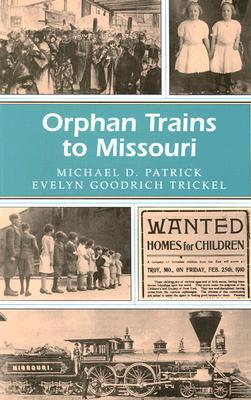
As an "orphan train" crossed the country, it left part of its cargo at each stop, a few children in one small town and a few in another. Even though farmers needed many hands for labor, most of the small farm communities could not or would not take all of the children on the train. As the train moved to its next stop, those children not taken feared no one would ever want them.
Early immigration laws encouraged the poor of Europe to find new hope with new lives in the United States. But sometimes the immigrants exchanged a bad situation in their native country for an even worse one on the streets of New York and other industrial cities. As a result, the streets were filled with crowds of abandoned children that the police called "street arabs." Many New York citizens blamed the street arabs for crime and violence in the city and wanted them placed in orphan homes or prisons.
In 1853 a man by the name of Charles Loring Brace, along with other well-to-do men in New York City, founded the Children's Aid Society. The society planned to give food, lodging, and clothing to homeless children and provide educational and trade opportunities for them. But the number of children needing help was so large that the Children's Aid Society was unable to care for them, and Brace developed a plan to send many of the children to the rural Midwest by train. He was convinced that the children of the streets would find many benefits in rural America. In 1854 he persuaded the board of the society to send the first trainload of orphans west. With this, the orphan trains were born.
Cheap fares, the central location of the state, and numerous small farming towns along the railroad tracks made Missouri the perfect hub for the orphan trains, even though many areas of the state were still largely unsettled. Researchers have estimated that from 150,000 to 400,000 children were sent out on orphan trains, with perhaps as many as 100,000 being placed in Missouri.
Orphan Trains to Missouri documents the history of the children on those Orphan Trains -- their struggles, their successes, and their failures. Touching stories of volunteers who oversaw the placement of the orphans as well as stories of the orphans themselves make this a rich record of American and midwestern history.
Several of my GRs friends have "liked" my review of this book I guess that is because of the four stars I gave it. But let me tell you a little about the book. "Orphan Train" by Christina Baker Kline has been a popular book, and I enjoyed reading it very much. I was amazed that I had never heard of the practice of moving children from the large eastern cities out west to less populated areas and placing them with families. Someone at my F2F book club told us about this book that specifically tells of the placement of children in Missouri. Michael Patrick and Evelyn Trickel have done a great job on not only telling the history of the origination of the orphan trains by the Children's Aid Society, but some stories of those who ended up in Missouri. This is one of a series of books published by University of Missouri Press, some of which sound very interesting, now that I am a resident of the state.
Rather disappointing. The writers have limited the scope of the book, and thereby limited its usefulness. The orphan trains ran from the mid 1850's until 1929. The book starts by explaining the reason for founding the Children's Aid Society in New York in the 1850's. But little evidence is presented about the actual orphan train riders and the results of this social experiment. Most of the stories are anecdotal and from later in the time period. There must have been thousands of children brought to Missouri, but from reading this book you would think they had been swallowed up by the earth, so completely did they disappear. Most of the stories seem to come from the descendants of orphan train riders and are thereby less valuable for evidence. Little exploration is done into the cases that did not work out. The pictures used to illustrate the story repeat exactly the same information that is on the page. I had the feeling that most of the anecdotes were collected without inquiry. A good researcher would have dug deeper and presented a fuller picture of this interesting period of history.
This book covers an interesting topic of the Industrial Revolution that I think is little-known. I am a history teacher, and I do not recall ever learning of this. Who knew that thousands of orphan children were sent from the East to the Midwest in order to place them in a home in the country, in large contrast to their former lives on the streets? While the organizers of the orphan trains and orphan placement had good intentions, things did not always turn out well for every child (separation from siblings, and parents in some cases; different native language; different religion). There was not nearly as much oversight over such proceedings as today. Still, the author's portrayal of the story generally suggests most children had a positive experience overall. This is a quick read for a topic I knew nothing about, and for readers like me who would like to know more, the authors included a short annotated bibliography at the end for further reading.
This is a poignant history of the "orphan trains" that took children from New York City to farms in the Midwest over a 75-year period. Thousands of children made the journey from the 1850s to the 1920s. Often the children were orphans, some who had been homeless "street Arabs," but others had parents who were unable to care for them due to poverty or illness. Many were taken in as members of farming families and eventually adopted. Sadly, others were mistreated and used primarily as laborers. The New York-based Children's Aid Society did make an effort to follow up and see that matches were satisfactory on both sides, and sometimes re-placed children in new homes or took them back to the orphanage if they were not receiving good care.
The book incorporates oral histories from former orphans and their families as well as letters and historic photographs. I do wish there were specific citations for those who would like to follow up with more research.
Interestingly, the program only transported white non-Jewish children, but didn't mind placing children in homes where a different language was spoken. State officials in Missouri tried to stop the trains numerous times due to suspicions about the children's heritages and the fact that they often grew up to marry locals, but ultimately these attempts to stop the transports failed. One child was sent back to the orphanage when her foster family suspected she was not 100% white, but they later missed her and requested her return.
My grandfather's mother was sent from England to Canada as a child indentured servant. This practice is mentioned in the book on page 19 as being common practice from 1867-1914. My great-grandmother was reportedly treated well, but some of her siblings were not as lucky. As was often the case on the orphan trains, her siblings were placed in separate homes but near the same community. Reading this book made me think about their journey and hardships and want to learn more.
Immigrants were pouring into New York City. They came with high hopes and found life was little better than where they came from. Jobs paid little. Disease and injury took their tolls. Children were left out on the streets to fend for themselves often turning to petty crime to survive. Charles Loring Brace wanted to get these children off the streets. His Children's Aid Society tried to do that by offering cheap beds, education and trade training. There were too many children stretching his resources too thin. When Brace started the orphan trains, he had the view that rural living was so much better than the city living. He believed rural people had the resources to offer these children good homes. The trains ran from 1854 to 1929 transporting up to 400,000 children, many of them to Missouri. The book is easy reading. It isn't like a textbook, but is very factual. Much of it is about the trains and the times. Some of it uses interviews and stories from and about those who rode the orphan trains. Not all of the children fared well. There were problems and families did get split up. But there were many success stories too. It's hard for modern people to comprehend the problems of that time and realize these trains did serve a good purpose and those running them did the best they could.
This really is more about the orphan trains in general. The last two chapters were about Missouri specifically. It talks about the start of the orphan trains, the whys and how's. Then near the end it talks about the orphans and not necessarily Orphans who came to Missouri how they did and stories about them. Then the reason they ended, more stringent adoption rules. Overall, I enjoyed the book.
An informational and quick read. I found these stories of particular interest as my hometown in Iowa had orphan trains come through with children as well.
Although it's a short book, a good background about the orphan train movement and the stories of many of the children who were brought to Missouri was included.