Two seeds can't wait to be pears, but growing takes time and patience in this funny and informative picture book from Miranda Paul, the author of Water is Water.
"When will we be pears?" —"After we find soil." "Hooray! We are going to be pears! Are we pears yet?" —"No! Just be patient and wait."
Written entirely in dialogue and staged as a play, Are We Pears Yet? is a clever and hilarious informational picture book that will make you look at growth cycles and fruit trees in a whole new way. Carin Berger's artfully composed collaged stage sets will delight and amaze you.
Miranda Paul has worked as a teacher, volunteer zookeeper, and freelance writer--among other things. She is passionate about creating stories for young readers that inspire, entertain, and broaden horizons. Miranda is also a thrill-seeker, and one of her bravest moments involved reciting poetry from inside a crocodile pit. (Yikes!)
In addition to being a picture book author, Miranda is a team member of We Need Diverse Books™ and a volunteer for the Society of Children's Book Writers and Illustrators (SCBWI). Learn more at www.mirandapaul.com.
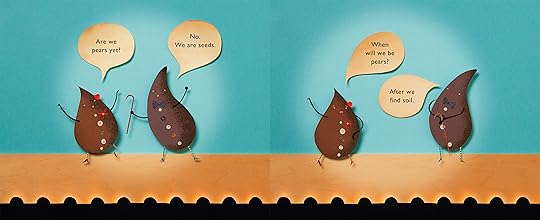
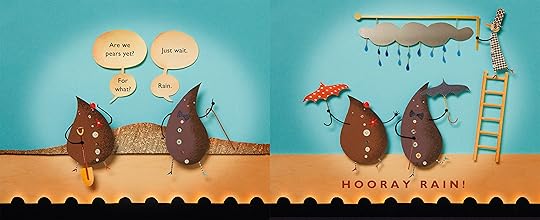
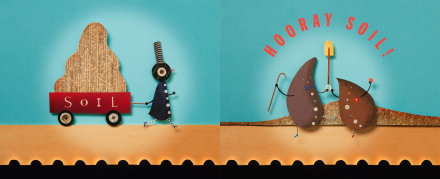
Are We Pears Yet? is a creative, cute, and informative (though a bit simplified) picturebook about a pear tree’s life cycle, which is literally acted out on a stage, props, stagehands, and costume change included.
Miranda Paul's dialogue is full of pear-y puns, and the back matter, in which the author further explains a pear tree’s life cycle, provides five "peary" smart facts, and a short bibliography, is informative and engaging. However, even though the pollination stage is mentioned in the author's note, it is omitted in the story itself.
Carin Berger's minimalist photographed mixed-media illustrations are expressive, clever, and humorous:
However, it bothered me a little that the two pear seeds in the belly of a new pear look exactly like the two original seeds, even though the author’s note explains that “If you plant pear seeds, the pears you’ll eventually get will be different than the ones they came from.”
Just was NOT a fan. I think it was because my expectations were completely different from what it ended up being. I expected this book to be something I could hand my middle school science teachers to help them teach the plant cycle and instead even I was confused as it went along. The science coupled with the element of it being a play got strange for me and by the end I didn't quite know what I was reading. I'm not sure what the intent of this book was, but it was a huge miss for me - and I really was hoping for a new picture book for my science department! Not recommended.
Two little seeds wait, patiently or not, as the case may be, to become pears in this entertaining picture-book examination of the life-cycle of one of the most popular fruit on the planet. As one seed continually asks the other whether they have become pears, the two slowly sprout, grow into trees, and bear fruit. It takes many years, but finally, they reach the desired state of being...
Miranda Paul's simple, humorous text, one which plays upon the classic early childhood question during any trip - "Are we there yet? - is paired with Carin Berger's lovely collage art in Are We Pears Yet? I appreciated the way that Paul, whose Water Is Water: A Book About the Water Cycle offers a similarly imaginative examination of a natural science topic, blends the informational and the entertaining here, and (as always) enjoyed Berger's creative and humorous illustrations. Recommended to anyone looking for a very basic (and also entertaining) introduction to the idea of a fruit tree's life cycle.
Miranda Paul, with her creative imagination, has written a story that’s both amusing and educational in Are We Pears Yet?
Spoiler alert: Two pear seeds are excited that they will become pears. They love pears. One seed keeps eagerly asking the other, “Are we pears yet?” The other seed seems to know much more about the whole process so explains patiently each time what has to occur first. Soil, rain, sun, cold, a long 2-year nap … 🙂 Then they have to grow into trees, which takes another year! The impatient seeds are getting tired of waiting.
The illustrations cleverly created by Carin Berger present the story in a stage setting. Each scene shows props, stage hands, scene changes ... whatever is required to make the story move along. It’s laugh-out-loud funny.
Eventually – after another two years! – the seeds get to where a final event is about to happen, but the reader’s view is of the two main characters hidden behind a sign that reads: COSTUME CHANGE. When they come out, well … it’s just been such a long wait that it takes some realizing.
Are We Pears Yet? written by Miranda Paul and illustrated by Carin Berger is for everyone to enjoy. It’s fun, entertaining, informative, and quite different, with a chuckle at the very end, too. A great family read.
What a joyous, genius picture book! Creativity is sparking out of every page. Miranda Paul and Carin Berger manage to unite science, great language, emotions and drama in a way that is seamless and natural. Two pear seeds act out the real life amazing drama of their life cycle on what could be a school stage. There is an emotional parallel story of how difficult it is to wait for a long time for something you really want. It is funny, emotional, dramatic, simple, complicated, multi-layered and informative. Books like this one make me glad to be alive. A great idea impeccably executed.
The book treats the journey of a pair of pear seeds to trees that bear pairs that contain more seeds as a stage play. It's an interesting idea, but I didn't really like how it worked out, ending up being somewhat repetitive, weird, and annoying. Kids could relate though. Also, there were some awful puns, which is normally a selling point for me.
Set up in Vaudeville Stage format, two comma-shaped brown shiny seeds meet onstage, play-style, and ask each other, "Are we Pears Yet??" And so begins the book that stays onstage, with costume changes, and prop persons who assist as their life cycle is demonstrated for readers / play attenders. From seed to leafing twig, to tree, to fruit, to juicy ripe pears with seeds of their own. . . (Is the song "Turn Around" playing in your soundtrack? It's playing in mine! "Turn around you're a seed, turn around you're a tree, turn around you're a ripe pear with seeds of your own. . . .")
The kids enjoyed this one, and pears are coming up! Soon it will be time to make maple pear jelly. Wait. That darkens this review quite a bit.
Oh well. The book is great - cute and pear-loving.
Who hasn't heard - "Are We There YET?" Such a common childhood complaint both Nina Laden and Dan Santat created books around this theme.
But what happens when two pear seeds act out their life cycle on stage? Science becomes fun. Kids will enjoy the pear puns, and the banter of the two seeds as they grow into fruit bearing trees. With one seed incessantly asking - "Are we pears, Yet?"
Carin Berger's charming cut paper collages of the cast and props brings the stage and these charming little seeds to life. It feels like an elementary school play, complete with the seasons on sticks.
It's amazing how Miranda Paul can condense plant science into succinct, snappy dialogue and create a play that will appeal to both children and their often-beleaguered parents. Once again, she has created an entertaining book from a complex science concept. Her encore and "5 peary-smart acts" show how pears are like people, wrap it all up, and challenge the kids to go learn more about pears and nature.
Go on a journey through the life cycle of a pear with these two hilarious characters as they encounter each stage of growth! Beginning as seeds, each character has his own unique attitude and set of expectations about what it’s like to go through these different phases, with one character constantly asking the other “Are we pears yet?” and the other simply responding with a more logical explanation of what it takes to become a pear. The second characters response reveals to readers the different steps that a seed must go through to become fruit, such as being buried in soil, getting watered, and receiving sunlight, etc. In addition, the book explains the different names (or stages) that a seed goes through before it is considered to be fruit.
Evaluation:
This book by author Miranda Paul and illustrated by Carin Berger, is a fun, cartoonish, colorful way to introduce young children to the life cycle of a plant. Each page contains vivid, rather silly illustrations as well as speech bubbles that contain the thoughts and interactions occurring between two soon to be pear characters! Along with it’s pleasant and child friendly way of presenting the characters thoughts and feelings, the words themselves are full of rich information about how plants live and grow. As one characters continues to ask “Are we pears yet?” the other character’s logical explanations (used in an effort to calm the other character and cease his constant questioning) reveals to young readers not only the different phases of plant growth (and the names associated with them) but also all the things that plants need to survive (soil, water, sunlight, etc.).
Teaching Idea:
This book would be a wonderful addition to any K-2 elementary classroom and could be incorporated into a week long unit about plants. As students spend the week studying plants and how they grow, this book could be read two or three times to help students grasp important key information about this concept in a fun and engaging way. The teacher could read this book at the beginning of the unit to introduce the concept and it’s key components (in a way that is not too informational or overwhelming for students on the first day of a unit and also grabs their interest) as well as half way through the week (in the middle of the unit) as a refresher and possibly a way to see who is understanding the concept and who may need more assistance. (In this case the teacher could read aloud sentences from the book and leave blanks for the students to fill in). Lastly, the teacher could read this book one last time at the end of the unit to summarize all that we have learned. (In science, students could grow their own plants in cups as an activity to accompany this story).
This book may also be a great option for an integration of reading and science skills/concepts as the teacher could also use this book to teach story retelling (beginning, middle, and end). This story may work well in this way due to it’s simple storyline as well as it’s well-defined stages. In addition, the timeline aspect of the story connects well with the timeline of a story (beginning, middle, and end).
Growing does take time and patience, so this book has a lot to teach children about how growing up is a process, a process that happens all in due time.
Seems to this Goodreader, Miranda Paul is writing, and Carin Berger is illustrating, this picture book on two levels: ONE: To be a picture book for children. But TWO -- and mostly: To entertain jaded adults.
Exhibit A. Those clever illustrations are entertaining for adults. Likely baffling for children.
It's hard to see how the pictures have anything to do with pears. As a long-ago fledged adult, even I have trouble making the connection between the chocolate brown shapes and either Anjou or Bosc pears. Plus, why the heck are they drawn wearing buttons?
Probably because this is considered to be clever and amusing for the adult readers.
Exhibit B. Puns and plays on words over kids' heads. Just fun for the grownups.
That title, for instance. I'm guessing "Are We Pears Yet?" is a play on words, given how often children on trips will nag adults, whining, "Are we there yet?"
But kids have good reason to say that, when they say that. Where's the good reason behind this inside joke for the grownups -- wink, wink!?
Personally, I don't like when babysitters or teachers or parents or caregivers enjoy their own private "adult" jokes, as if reassuring themselves they are so superior to the annoying little children.
Speaking of "clever" language, inside the book, there are puns -- obvious, unskilled, cutesy little puns, such as "You are un-PEAR-able!" and "A-PEAR-ently."
Hey, I've known some extremely bright three year-olds who could read pretty darned well. But they weren't yet cognitively developed in a way that allowed them to get a pun.
Is that also true in your experience, Goodreaders? Either way, please COMMENT below.
SO, HOW TO RATE THIS BOOK
I'll give it FIVE STARS. Acknowledging that many parents and caregivers are numb from boredom and wish they could spend more time with adults.
Also, children won't know they are being excluded from the "best" part of the book. (Which makes doing this okay? Not to me.)
Summary: This particular story is about two pear seeds that are slowly waiting to become pears. The two pair of pears find soil at the very beginning of the story and wait an incredibly long time, and they both are beginning to lose their patience. They really would love to become pears, and as soon as they begin to give up on the idea of becoming pears, they finally cultivate and become real pears! Then they become seeds once again and it is implied that the story starts all over again. Evaluation: Are We Pears Yet? is a fictional story that encompasses real-events that occur in nature, such as seeds gradually waiting to become fruit. The pear seeds and pear characters are dramatized within the story, to add a sense of comedy and excitement for young readers, who traditionally may not find the idea of fruit growing to be incredibly exciting. The illustrations within the story were terrific and I was engaged throughout the reading of the story. I feel as if young readers, will find this book enjoyable, as well as a teachable moment of the process of how a seed becomes a fruit over time. Teaching Point: I would teach an intro to a science lesson with this book to young students, regarding the process of how seeds gradually become fruit or plants over time. This book would serve as a perfect hook to a lesson about the metamorphic cycle of plant and fruit cultivation, however it would not provide students with enough information that they could carry on with them to truly understand and learn the content. I feel as if this book is perfect for young students to relate to, because they typically become highly impatient waiting for plants to grow, similar to how the seeds in the story felt. An instructor could point out after reading this story, of the important elements that are required to help a seed grow, such as soil, water, and sunlight. Students could even grow their own plant in the classroom as an extension to the story, so they can visually see how long it takes for a seed to sprout and become a plant.
Summary: Two seeds want one thing more than anything else in the world, the become pears, but they have to wait. Then they wait some more. Then they wait even more. They have to wait for soil, rain, sun, and the cold. Then they grow into trees and have to wait some more. Finally, when they thought they couldn't take it anymore they find out they are pears! Then they realize they have something inside of them, seeds! Then the cycle begins again.
Evaluation: I really enjoyed reading this book. It's very cute and very engaging. My favorite part was when they became pears then realized they have seeds inside of them as well. It shows the reader that the cycle keeps repeating itself. I would recommend this book to the younger grades (K-2). I think they would find this book interesting and be able to learn a lot from it.
Teaching Idea: One thing that could be taught with this book is genre. When students are reading and writing, they are constantly having to look at the genre of the book or story they are writing. This book is a special case because its considered a non-fiction book with fictitious elements. I think reading this and having a discussion about the genre and how it crosses over could be helpful to students during their writing because then they will understand that their stories/books don't have to be one thing. Not everything they write will fit into one category and that is okay.
Summary: Two little seedlings are overjoyed at the idea and keep wishing to become pears, only it seems to be taking forever. Go on the journey of the the life cycle of a pear with these two little seedlings to learn if their wish comes true.
Evaluation: This book is a fun take on a non-fiction book. I think it would be great in the younger grades of an elementary school classroom. The book has funny puns throughout and I believe young readers will find it enjoyable as the characters portrayed in the story really take you on a journey. It is a great story for students who might not necessarily be thrilled or motivated to read non-fiction books. The pictures used in this story also provide great visuals for students.
Teaching Point: There are a lot of different teaching points teachers could use with this book. This book could easily pair with a variety of science standards. I would use this book with a science standard addressing life cycles. I would have students act out the life cycle of a pear, much like the set-up of the book. Students would randomly be assigned a part and I would make sure to have all of the materials that they would need. Students would then be given one class period to make sure they understood their part and we ready to participate in the class play. I would then have students act out the play. I think this would be a more engaging way to check for understanding of life cycles rather than having students fill out a worksheet.
Summary: This is a story of two seeds and the process that they go through in order to become pears. It tells the story of the life cycle of a pear tree. One of the seeds continues to ask "are we pears yet" while the other seed, knowledgeable on the life cycle, patiently answers the question through the explanation of the process of what comes first.
Evaluation: I liked "Are We Pears Yet" because it teaches the life cycle of a pear in a fun way using puns and repetition of the question "are we pears yet". I think that this is a great book to teach a simplified way of how pear seeds grow into pear trees. I would recommend this book for teachers and students of the preschool or kindergarten level.
Teaching idea: This book teaches about the life cycle of a pear tree through two seeds acting out the steps of the life cycle on a stage using props. For a teaching idea, for younger students, the teacher could read this book once through and then read it again, but have the students act out the process as the teachers reads, copying what the pears are doing in the book. The students would use the props that were used in the book (created by students with teacher assistance or provided by the teacher), like props of soil, rain, sunlight, etc. in order to act out this book. This would help with comprehension of the book as well as the teaching of what a pear's life cycle looks like.
Summary: Join a pair of pear seeds as follow the life cycle of a pear and grow into trees, eventually, becoming pears themself. One pear is impatient and the other is wise and patient. Learn about what pears need in order to grow and the different stages of fruit tree growth, from seed to tree to fruit.
Evaluation: This book is comical and features interesting pictures. The illustrations are ones that I typical associate with simpleton, slap-stick picture books, simply put, they are silly looking. While this type of book isn't my favorite there is a place for it within a classroom library and I know children do enjoy them much like The Stinky Cheese Man. It goes through the life cycle of a seed all the way to a fruit-bearing tree. I think that this book may produce some misconceptions and inaccuracies but overall gives students a basic knowledge of the cycle of a fruit tree.
Teaching Point: I would use this story to teach about life cycles and sequencing. Students could look at an abridged version of the growth cycle of a pear tree and sequence the events in the story - e.g. what happens first, next, then, and last. First, the reader learns that seeds need soil, water, and sunlight. Next, the seed sprouts and begins to grow into a tree. Then, the tree is grown and blooms. Last, pears form from the blossomed flowers. Overall, this is a fun and memorable way for students to explore the life cycle of a fruit tree.
Summary: This book personifies two pear seeds and tells the story of their journey to becoming pears. Of the two pears, there is one pear that is very anxious to become a pear. Throughout all the stages of their development, the seed continues to ask, "are we pears yet?" Finally, at the end of the story, the seeds do in fact become pears.
Evaluation: I think that this is a cute book that students in younger grades may really enjoy. The book is not a very difficult read and it is a more fun book to read. This book is nonfiction, however, the personified pears make the book engaging. If the book just listed step by step the timeline of how a pear seed becomes a pear, it would be boring and uninteresting. This book engages students in the very very long process of how pear seeds become pears.
Teaching Idea: If I were going to use this book in the classroom, I would stick to using it in the younger grades. I think this book could be fun to use if students were learning about how plants grow or the life cycle of plants. This book is a fun way to describe the process in which a pear seed becomes a full-grown pear. This book is not boring, so the students would be interested in reading it, while also learning about the plants life cycle.
Summary: This book follows the journey of a "pear" of friends. These pear seeds just can't wait to be pears. They keep asking "are we pears yet?" The book is written as a play and is filled with facts about pears as the two friends journey from seeds to all the way to trees that grow pears with pear seeds inside of them. Evaluation: As a book who's apparent goal is to present facts in an entertaining way, it nails it! As a nonfiction book, this story takes several liberties. For example, the conversation between the pears and the fact that they are talking to each other at all are some of these liberties. The illustrations are wonderful and creative, and make it easier to understand the "substory" of the story. Teaching Application: I would use this book to teach science standards involving the life cycle. This book would be an amazing way to engage students in this concept and get them thinking about the cycle of life. It can even be applied to other living organisms because it contains similar themes to those of other plants and animals. It would also be a good book to use for inferencing. The students can infer what will happen to the pears as time goes on using evidence and context clues combined with prior knowledge.
Summary: This informational children's book teaches students about a pear trees life cycle through the dialogue of two pear seeds. Set as a play, these two characters have two unique personalities. While one pear seed is very curious, and a little impatient, the other is going through the motions like hes done it his whole life. The one keeps asking "Are we pears yet?" to which the other responds with an educated description of the steps they have to take to reach pears.
Evaluation: I really enjoyed reading this story for two reasons. I loved the humor in the book and I loved the way they incorporated the life cycle of a pear into the story. Students are being entertained while being informed about a plant's life cycle. I would recommend reading this story to a first grade class.
Teaching Idea: I would read this book to my students when learning about plant cycles. I believe my students would be engaged in the story and enjoy it. Reading the book could open up a week learning segment. This would get the students thinking about plant life cycles. They could journal the different changes that happen to the pear seeds as the story progresses. They can add more details to their journal as they learn more throughout the week.
Summary- This book walks through the life of a pear from seed to fruit. One of the pears is very impatient and just wants to be a pear. That pear keeps saying "Are we pears yet?" It takes many years but finally they produce pears. After they become pears, they see that they now have seeds inside of them. Those seeds will then be used to make more trees. The life cycle of plants is explained in this book.
Evaluation- This was a very simple and short book about the life cycle of a pear. I enjoyed this book because it was a fun and informative read. This was a nonfiction book and surprised me how intriguing it was.
Teaching Ideas- Since this was a nonfiction book, it could be used to teach students about non-fiction books. It could be used to teach the life cycle of plants like pears in a simple way. This is a great engage or hook book to begin teaching life cycles. The idea of seeds could be explained in this book. This book could also address being patient. At the end something good happens: they become pears and they are producing more seeds. This book could teach that even though somethings take a long time it is usually worth it.
Summary: Are We Pears Yet? is about pear seeds waiting to become pears. They find soil at the beginning of the story and wait a long time. They really realy want to become pears. Then they give up on waiting and finally become pears. Then they become seeds again and imply that they story starts all over again.
Review: This is a book where fictional characters tell a story based on non-fiction. The pears seeds and pears are personified which make to book more engaging than just telling the reading how pear seeds become pears. The art is colorful and shows the process of seeds turning into fruit with humor. The seed are super impatient and as soon as they give up on becoming pears, finally do become pears.
Teaching point: I would use this book to teach students about how seeds become fruit. The process takes a long time which many kids do not realize. The seeds in the book are very impatient which makes the book relatable to kids because they may be impatient waiting for seeds to grow too. I would also talk about what a seed needs to become fruit. In the story they get soil, water and sunlight.
Summary: This is a cute little book about the growth of pears. There are two seeds that are talking throughout the story and one of the seeds tells the other that they will grow into pears one day. Then the other pear starts talking like a kid on a roadtrip "are we pears yet?" It takes the kids through the cycle of growing into pears and once they are finally pears, the process starts over again.
Evaluation: I like this new look on nonfiction. Obviously pears or pear seeds can't talk in real life, but the use of fictional characters to tell something true can be a little more interesting for kids. It was a very cute story that can be used in the classroom!
Teaching Ideas: This book can definitely be used in a science classroom. It would be perfect for teaching students about the slow or fast growth of certain plants. It will help students to relate to plants better and possibly get more excited to learn about them. After the class reads the book I could do an activity where we plant different seeds and see how fast or slow they grow.
Summary: This is a nonfiction book that teaches readers about the growth process of pears. It starts with the pears as seeds and follows their life cycle until they are fully grown pears. This book is written as comedic hybrid nonfiction text. The pears have dialogue about growing up and appear to be putting on a show. Read this book to have a good chuckle while learning about the life cycle of pears.
Evaluation: Surprisingly, I liked this book. It was factual but not boring. I liked how it was drawn in a cartoonish style. This is more appealing for elementary students to look at. Plus, it has comedic moments which makes reading about a pear’s life cycle much more fun!
Teaching point: I would use this in a science lesson where we were learning about plans. We would read this book as an introduction to the growth cycle, and then maybe read an informational text later on with realistic pictures. This book does not read like a nonfiction book, so it would engage kids more and get them interested in the topic.
Summary: This story is about two pear seeds. One seed is so excited about being a pear and the other seed is describing that it takes a long time for a seed to turn into a pear. All through the book the seed wants to know if he is a seed yet. The other seed explains how seeds change to trees then to pears, which is the plant cycle. This book is a cute way to introduce kids to the plant cycle.
Review: I thought this book as a really cute. It could be considered a hybrid book, which means it could be either fiction or nonfiction. It makes nonfiction reading for kids fun! Plants may not seem like the most interesting topic to all kids, so this is a cute book that might grab kid's interest.
Teaching: I would use this in a kindergarten classroom when talking about plants. I think this would be a good introduction to the plant cycle and hopefully allow students to have a positive attitude about the topic.
This book tells the story of 2 seeds who are hopeful and wishing to become pears. Throughout the book, the seeds go through many fo the steps fro growing plants as they get closer and closer to becoming pears. By the end, the pears have waited, and sprouted, and soaked up all the sunlight they can, so they eventually grow into pear trees who produce their own, wishful little seeds.
"Are We Pears Yet?" is a nonfiction book told with elements of narrative and fantasy. This helped make a nonfiction book more kid-friendly and engaging for students. I thought that the book was "short and sweet"- explaining briefly the process of how pear tress grow, but felt repetitive. While this would be appropriate and preferred for younger students, I would not find it appropriate for upper elementary students. Overall, it was easy to understand, with illustrations that enhanced the text, and cute pear puns and humor to keep the reader engaged.
Summary This book is about two pear seeds who are in the process of becoming pear trees. One of them is very impatient, and keeps asking “Are we pears yet?” Eventually, they become pear trees. The book teaches you about the cycles of plants, and what they need.
Evaluation This book is a good nonfiction story. It’s adorable and fun but still teaches a lot about the cycles of plants. It talks about what they need, and how long it takes for the plants to grow. It’s a long cycle that is told in a humorous way throughout this book.
Teaching Point With this book, I would use it to teach what plants need to survive. The book discusses how plants need sunlight, water, soil, etc. This book also talks about the cycle a plant goes through and how long it takes. Along with this book, I would grow my own plant in the classroom and we can refer back to this book to talk about what plants need and the cycle our plant is going through like the pears in the story.
This is an informative book about a pear tree’s life cycle. It stars two pear seeds that act out the life cycle on stage with props, stagehands, and even costume changes. One seed is very excited to grow and repeatedly asks the other if they are pears yet during the other seed's informative stage show. The last page offers more information on pears and some pear trivia facts. Also a short bibliography.
Cons: I find myself vacillating on whether I like the illustrations or not.
Pros: Though informative the story is very simplified and easy for children to understand. The illustrations are creative and the text should be good for the early reader since most of it is in the form of speech balloons with few words. (The story is approx. 218 words.)
Summary: Have you ever wondered what the life cycle of a pear is? You can find out by reading this book. “Are We Pears Yet?” follows two pear seeds that have a humorous dialogue about becoming pears. One of the pears is impatient and keeps asking the wiser pear if they are pears yet? The wise pear portrayed by holding a cane and being knowledge knows what has to happen before they are pears. He keeps informing the impatient pear of what is to happen next.
Evaluation: I thought this book was not only informational but entertaining. I loved how the book made reading nonfictional fun and different. It shows that not all nonfiction fit one forum.
Teaching: You could teach students how to read a book with dialogue and create it using this book. The book has a back and forth dialogue that is easy to follow. I think students could be taught how to read with an expression as well.