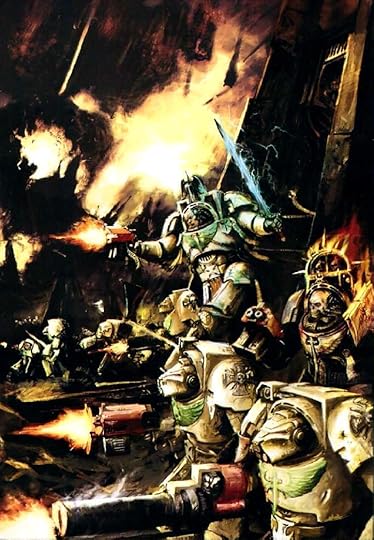
The Legacy of Caliban echoes down through the ages, and the secretive mission of the Dark Angels continues. Interrogator-Chaplain Asmodai sees treachery and deceit everywhere he turns – while this serves him well in his hunt for the Fallen, it also strains the Chapter’s relations with their Imperial allies. With their true quarry now seemingly within their grasp, Brothers Annael and Telemenus find themselves at the forefront of a new operation that could shake the Imperium to its very core.
Read it because The saga continues, with a focus on the Interrogator-Chaplains of the Dark Angels and their knowledge of the Fallen, along with the heroes of the first novel as they continue their indoctrination into the mysteries of the Chapter.
Gav spent 14 years as a developer for Games Workshop, and started writing novels and short stories in the worlds of Warhammer and Warhammer 40,000 when the Black Library imprint was launched in 1997.
He continues to write for Black Library, and his first 'homegrown' novel series The Crown of the Blood has been released via Angry Robot.
Currently living in Nottingham, Gav shares his home with his loving and very understanding partner - Kez, and their beautiful little boy - Sammy.
Vote: 4/5 if you've read "Angels of Caliban"and Gav Thorpe's other Horus Heresy Dark Angels novels
An excellent central part of the Legacy of Caliban trilogy that just blow up my mind... really not seen that ending coming. Enjoyed very much the power struggles of Sapphon and Asmodai, Chaplain Masters of Sanctity and Repentance, the character evolution of Annael and Telemenus, promoted from Ravenwing 2nd Company and 5th Battle Company to the Dark Angels elites of Black Knights and Deathwing First Company Terminators, a fan favourite of mine since my teen days playing Space Hulk GW tabletop game, their assaults on Nurgle Mansion on Daemon World of Ulthor was insane, and their final teleport assault on the enemy flagship 100% epicness ... and poor Telemenus' future is a grim one indeed. Meril Astelan, cunning manipulative Fallen, is just one of the best W40K villains ever (that "Belath" reference, you bastard!!! XD)and the surprise ending just left me wanting to read the final novel of the trilogy as soon as possible. No doubt Calas Typhon/Typhus, the Terminus Est and Death Guard are going to have much deserved screen time there.
An amazing series, just not for W40K "newbies" readers because of the lots of references to the Horus Heresy series... and now I have to re-read again Angels of Darkness and The Purging of Kadillus too... Damn you, mr Gav Thorpe... and thank you very much.
What an ending! Didn't see it coming and now I am anxious for the next book, The Unforgiven! But overall, the whole book was amazing, the attack on the world of Ulthor was... I don't know how to desrcibe it, shocking and hilarious in the same time. I have to admit that Ravenwing and The Purging of Kadillus, sure, great book, lots of action and so on, but a bit workmanlike, missing the special spark I love in Gav's works. But here he is back on top. Fantastic novel.
Gav Thorpe is rightly considered Black Library’s resident Dark Angels expert, for he has written more about them than any other author and he even had a hand in shaping their lore back when he worked in the Games Workshop Design Studio on the Dark Angels codex, among other things. Last year, he started a new Dark Angels series called Legacy of Caliban that followed on from one of Black Library’s best novels to date, Angels of Darkness, and continued the tale of the Knights of Caliban as they sought out their traitorous brethren from the days of the Horus Heresy itself and brought them to justice in the innermost deeps of The Rock. Ravenwing was an excellent novel in many ways, and the wait for the sequel was a long one for me, especially since I dropped off on my Black Library reading this year.
But I read Master of Sanctity earlier this month and the wait has been quite fruitful indeed. Gav made the long wait worth every moment since the novel is a brilliant follow-up to what he did in Ravenwing, giving a more thorough insight into the many mysteries of the Dark Angels and exploring their many secrets. The duality of the Dark Angels, in their oaths to the Imperium and to themselves to hunt down the Fallen wherever they may be found, is at the heart of this novel, and our primary lead-in this time is none other than the chapter’s Master of Sanctity himself, Grand Master Sapphon, and we even get a look at the fiercely conservative Chaplain Asmodai, with whom Sapphon clashes again and again in the novel.
Ravenwing focused primarily on the warriors of the Ravenwing, the Dark Angels’ elite Second Company that was tasked with hunting down the Fallen, acting as a metaphorical scouting force that corralled the enemy until the First Company, the Deathwing, could be called in to take the foe away. The Dark Angels operate by way of hierarchies of knowledge and this means that each successive rank of warriors knows more than the ones below them and that even among the elites of the Deathwing and the Ravenwing there are layers of these mysteries and knowledge withheld. The Dark Angels manifest one of the more famous quotes of the setting, that “Knowledge is power, guard it well”. They embody it and base their entire lives on these mysteries, to protect both their brothers from the temptations of falling to Chaos or treason, and to protect the Chapter itself.
Ravenwing came to an end by the titular warriors hunting down a Fallen Librarian and with the ascension of some of the battle-brothers. Annael and Sabrael were promoted to the ranks of the Black Knights, the elite warriors of Grand Master Sammael’s personal guard. On the other hand, Telemenus, Daellon and Menthus of the Fifth Company are promoted to the Deathwing under Grand Master Belial. These five warriors witnessed the Fallen on Thyestes and even heard his declaration that he was once a Dark Angel himself. Normally, the secret of the Fallen is jealously guarded by the Dark Angels’ senior cadre but since these five were witnesses and they could not be simply… taken care of… Belial and Sammael make the decisions they feel are necessary, both to harness the rage of their lower-ranked brothers and to give them direction and a greater purpose in the service of the Chapter.
And in Master of Sanctity we see what the results are.
The novel focuses primarily on Sapphon, as I’ve said, but it also deals with many other characters and in that it casts a much wider net than Ravenwing did. We see how the Deathwing, the Ravenwing and even the Dark Angels’ Inner Circle work and what mysteries, what secrets guide them all. When Annael and Sabrael undergo the Seventh Rite of the Raven and are told of some of the darker secrets of the Fallen, you can feel the characters’ anger and their determination to do right by the Chapter and its glorious ten thousand years of history, ten thousand years of hunting down each and every Fallen and bring him to account for his grave sins. When Telemenus, Menthius and Daellon are formally inducted into the Deathwing and undergo the special training necessary to operate as one of the Tactical Dreadnought-armoured brethren of the Chapter, you get to see how driven they are. The focus at all times in such scenes rests solely with Annael and Telemenus, but you do get a collective sense of what they are going through and what they want to achieve, which is where Gav excels.
But the heart of the novel belongs to Sapphon and he was my favourite character in the novel. As the Chapter’s Master of Sanctity, he is one of the most highly-placed within the Chapter and it is his task in the novel to break the Fallen Merir Astelan. Astelan is an old character, first introduced in Angels of Darkness and then introduced in the Horus Heresy series as well. In Angels of Darkness he portrayed himself as a loyal Dark Angel who was betrayed by the then-Legion’s Primarch Jonson himself, a fiction he has maintained in the long years of his confinement at The Rock. Much of Master of Sanctity navigates his truths and half-truths as Sapphon and Asmodai seek to learn what caused him to turn against the Primarch and the Emperor, and what plans he made with other Fallen who were responsible for destroying a contingent of the Chapter’s warriors on Piscina V and even how he could be used to bring in the most reviled Fallen of them all, Lord Cypher.
I really enjoyed this book. It was an excellent sequel. I did find the end a bit jarring as it ended very abruptly but the epilogue was excellent! I did find some parts a hard read. Not because it was bad but because it dealt with some chaos and the descriptions were graphic and gross. I can jot wait to read book 3 that im about to start!
A definite improvement on the last DA book - a lot less fighting and a lot more intrigue and uncertainty, with a decent helping of action mixed in with some classic spy novel stuff
Master of Sanctity is the second novel in Gav Thorpe’s epic The Legacy of Caliban trilogy. The book picks up after the first novel Ravenwing and follows the fate of three different Space Marines in the secretive Dark Angels chapter.
The first tale is that of Sapphon the newly chosen Master of Sanctity. Sapphon’s primary duty is to find and reform ‘The Fallen’, a group of ancient Space Marines that turned on their patriarch and their Emperor centuries before. Sapphon’s approach is unorthodox for a Dark Angels Chaplain as he uses his cunning to find and eliminate the traitor Space Marines. This is shown in his attempt to manipulate the 'Fallen' Astelan in the hopes of capturing even more powerful and corrupt soldiers. However, his task is made harder by his brother-in-arms Interrogator-Chaplain Asmodai whom contradicts Sapphon’s methods instead believing in older, more violent methods of manipulation.
Telemenus has being promoted high within the Dark Angels to the Death Squad, a group of elite Terminators who are the tip of the spear of the Dark Angels when hunting for Fallen. Telemenus has to adapt to his new armour and brothers as a member of the First Company of Dark Angels. As well as this, he has to overcome his own doubt in his abilities and his chapter to become the elite warrior everyone expects him to be. The new Terminator must do this quickly to assist the Master of Sanctity in his hunt for the fallen Space Marines!
Finally, Annael was the prominent character in Ravenwing and at the start of this novel is also promoted to Black Knight in the infamous motor cycle detachment of the Dark Angels. Having been promoted, Annael is introduced to horrific secrets from the Dark Angels’ past and has to evolve into his new role as one of Master Sammael’s chosen warriors.
Much like Thorpe’s other Dark Angels novels, this book blew my mind! From the first page I was hooked on the hunt for the Fallen and absolutely loved the character of Sapphon. His cunning and ingenuity really distinguishes him from other characters in the book making him unique in comparison to other Space Marines who shoot first and ask questions later. For me, this made his story the most enjoyable to read because he has to use trickery, lies and deceit to win over his more traditional Brothers.
As the reviewer from SFX states; Thorpe makes his characters ‘actually sound like real people’. I’d absolutely agree with this because he gives the Space Marines real problems like doubt and self-consciousness, which you wouldn’t expect a genetically modified super-soldier to have.
I thought Thorpe did an excellent job of describing the worlds on which the Space Marines visit, especially the world of Ulthor. However, I do kind of question why the story of Ulthor was in the book as it seemed to move away from the plot and in some respects seemed a little pointless. I thought what happens there was exciting and well written but if it hadn’t been in the book, I don’t think the story would be any worse off.
All in all this was a great read. Some people give a little giggle when you tell them you’re reading a Warhammer 40K novel. Nevertheless, I can honestly say they are some of my favourite Sci-fi reads and people who love Sci-fi should definitely check out The Legacy of Caliban trilogy!
The Book hooks any reader in its first chapters due to the intensity of the introduction and the realistic portrayals of the characters that seem like real life people, who think exactly the way you would, as the reader. The Setting is thick with descriptions from both sides of the protagonist (The Space Marines) and the antagonist (The Green-skins). The Story in itself has a great sequence of action and drama and a great plot however the actions of some characters is so predictable that it almost seems as if its just replaying previous parts in the story. Such as the character, asmodai, who apparently goes against anything saphon says and we can count on him to repeat the same argument in almost every chapter. Over all the book has a great story and plot aswell as awe-inspiring battles that leave you, the reader, in pure shock and nervousness as our protagonists fight through the endless horde of the green-skins led by Grukk Face Crusher.
Awesome narrative, mindblowing plot and realistic dialogue. In my opinion, this novel and Angels of Darkness are two of the best Dark Angels stories written to this day.
This novel had the elements that I expected of Ravenwing and, sad to say, because of that lack I was disappointed with the previous novel in the trilogy. Still, one should read all the books in order, starting with Angels of Darkness and continuing with this Legacy of Caliban trilogy.
Finally it looks like Gav Thorpe is getting back into producing a work that brings intrigue and satisfaction like he did in Angels of Darkness. While not as good as that book, this book is many times better than Ravenwing. The reader gets insight into the Dark Angels' inner circle and the conflicts and power struggles between them as they prosecute their mission for the Imperium, and their Chapter's mission for the Fallen. With the surprise ending, I am definitely looking forward to the next book in the series.
Pros: the Dark Angels are one of the more interesting Chapters, varying perspectives from four high-ranking soldiers, a less stale plot than most WH40k novels, and a great ending.
Cons: Asmodai almost seemed a caricature, and his arguments with Sapphon became repetitive and worthy of a good facepalm.
Good story, although I thought it did leave something to be desired by way of characters development. We get some insight into Asmodai's motivation, but not a ton. Great read and I will definitely be buying the third book!
2 points about this book....much better than the first one Ravenwing (not that I didn't like that book)and the last page made me shudder with girlish delight. cant wait for the next one.