

What do you think?

Umbrella #3
Phone
Meet Jonathan De'Ath, aka 'the Butcher'. The curious thing about the Butcher is that everyone who knows him - his washed-up old university lecturer father, his jumbling-bumbling mother, his hippy-dippy brothers, his so-called friends, his spooky colleagues and his multitudinous lovers - they all apply this epithet to him quite independently, each in ignorance of the others. He knows everyone calls him 'the Butcher' behind his back, but he also knows that they don't know the only real secret he maintains, encrypted in the databanks of his steely mind: Colonel Gawain Thomas, husband, father, highly-trained tank commander - is Jonathan De'Ath's longtime lover.
617 pages, Hardcover
First published May 25, 2017
About the author
Will Self
201 books1,031 followersWilliam Self is an English novelist, reviewer and columnist. He received his education at University College School, Christ's College Finchley, and Exeter College, Oxford. He was married to the late journalist Deborah Orr.
Self is known for his satirical, grotesque and fantastic novels and short stories set in seemingly parallel universes.
Self is known for his satirical, grotesque and fantastic novels and short stories set in seemingly parallel universes.
Ratings & Reviews
Friends & Following
Create a free account to discover what your friends think of this book!
Community Reviews
Displaying 1 - 30 of 57 reviews

July 9, 2017
The final implement in Self’s bludgeoning modernist trilogy, Phone is the longest at 617 pages, told as the others in one breakless paragraph, swimming in and out of two tumultuous narratives that address the impact of technology in relation to various mental afflictions. The first finds Dr. Busner, Self’s evergreen protagonist, in the throes of Alzheimer’s, placing his tackle in the breakfast buffet of a hotel. This blackly comic incident sets the tone for the hilarious, obscene, shocking and ruthless proceedings that follow, as Self unleashes the prevailing narrative: the secret affair between M16 spook Jonathan De’Ath and Colonel Gaiwan Thomas that takes us into the thick of the Iraq War. The centrepiece of the novel is an absurd masque-like farce in the heart of darkness, where Self’s talent for caustic satire is aflame, in a novel that contains his usual ruthlessly sharp observations of the madness of human life, with more misanthropic humour and burning political ire than a trillion youtube vloggers.

September 28, 2017
"Hang on to the phone - that's the thing to do. It's all in the phone: my itinerary, my train times, my medical information - the whole lot. Hang on to the phone - feel the smoothness of its bevelled screen ..... ....!.... ....! place your thumb in the soft depression of its belly button - turn it over and over .... a five-hundred quid worry bead - and all I worry about is losing the bloody thing .... ....!.... ....!”
Will Self’s experimental novel Umbrella was shortlisted for the 2012 Booker prize and the bookies’ pre-announcement favourite, only to lose out to the Hilary Mantel (https://www.theguardian.com/commentis...).
This photo of the shortlisted authors needs no comment:
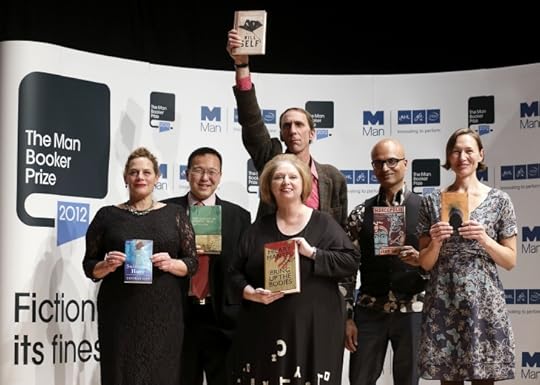
My review of Umbrella said:
Will Self packs a lot into the book - and one is faced with something of a dilemma as to whether to go with the flow, and end up missing the majority of the references and allusions, or to attempt to make sense of everything and end up with a rather painful reading experience. I ultimately opted for the former and there is no doubt that Self's use of language is exceptional, and many of the difficulties of the multiple voices and shifting time perspectives actually fall away when once gets into the flow of the text. However, this is by no means an easy - or even a particularly enjoyable read.
Many of the same comments apply to the 2017 Goldsmiths shortlisted Phone, the last in the trilogy started by Umbrella. Shark, which I’ve yet to read, was the 2nd - so I have managed to jump the shark, which is precisely what Self himself manages.
Compared to Umbrella, it almost feels as if Self has deliberately cranked up the idiosyncrasies to see how many more readers he can force to abandon ship. Indeed on the BBC ( http://www.bbc.co.uk/programmes/b08rp30m) Self acknowledged, almost boasted:
I've lost readers doing what I believe in.
Unfocused and spread over 600 pages, it is difficult to resist the feeling that Self’s authorial tics are meant to be annoying, albeit they also perhaps all say something about communication, one of his key themes:
- extensive use of ellipsis, exclamation marks and italics, which would normally be a sign of bad writing (but Self is certainly not a bad writer)
- narration that randomly jumps from one character to another every 30-50 pages but un-signalled and mid-sentence, forcing the reader to have to read back to see where the story switched
- acronyms spelt out phonetically ("Tee-elsie " from the "EssArrEnns" on the ward), which has the odd effect of being actually harder to read, forcing subvocalisation (which is perhaps Self’s point)
Each of the novels in the trilogy features:
- a technology - here the phone and, increasingly, bidirectional digital media
- a war, here the 2nd Iraq war
- a pathology, here autism and Alzheimer's
Phone focuses on two main plot streams:
In one Zack Busner, the trilogy’s main character, is now 78 and a pathetic superannurated psychiatrist.. “He fancies himself as a white-haired old Brahmin", complete with stick and a begging bowl. Although having bought a bowl from Heal’s, a "contratemps" resulted at the till when he was charged 79.99 on the grounds it was a "tribal salad bowl", one of an increasing number of such incidents that leads to an intervention from his large family, and which are an early sign of impending dementia.
The novel opens – and much of the narration of the Zack passages takes place during – with a later incident when he finds himself naked (at least his lower half) at a hotel buffet breakfast, his own "sad-little cocktail sausage" nestling amidst the meat selection (yes Self loves phallic humour). Busner thinks:
“Alzheimer’s itself may be a form of good mental heath – after all, what could be saner in a world in which every last particle of trivia is retained on some computer than to … forget everything. ”
The other main thread concerns Jonathan De’ath, nicknamed The Butcher, the third generation of De'aths featured in the trilogy, an intelligence agent with, in contrast to the ageing Busner, a prodigious memory. He is having an affair with Gawain Thomas, an army commander called up to Iraq post the overthrow of Saddam. This enables Self to bring in copious commentary on the abuse of locals perpetuated by British soldiers, Wikileaks and some gratuitous bashing of Britain's greatest Prime Minister of the last 60 years, TeeBee.
As mentioned in the excellent review from Jonathan (https://www.goodreads.com/review/show...), who appreciated the book rather more than I did, Self mixes in many things in his writing including pop lyrics. I'm not quite (emphasis on quite) from the right era to recognise many, but I was pleased to spot several references (e.g. "You turned me right round baby right round") to Dead or Alive's You Spin Me Round (also featured in the movie, The Wedding Singer). Unfortunately, in Self's novel, the Butcher sings the lyrics to Squilly, his lisping, talking penis, who features as a major character in the novel. As De'ath says:
“No self-respecting butcher ever undertakes a job without his chopper....”
And Squilly lisps back:
"What're you, weally, if not a typical sex-obsessed man who likes nothing better than talking to his own perthonified prick"
This new phallic narrative technique may perhaps have justified Phone's inclusion on the Goldsmiths Prize list, were it not for the fact (as pointed out in this well written and balanced review https://bookmunch.wordpress.com/2017/...) that the technique has been borrowed from that well known literary writer, Motley Crue's Tommy Lee in his autobiography Tommyland.
The link between the two threads, which comes only in the novels closing pages, arises from Busner’s autistic computer-hacker grandson Ben, who finds the secret of both De'ath and Thomas's affair and the evidence of the cover-up of the abuses perpetuated by Thomas's troops.
“however great the progress Ben had made in coping with his disability he remained ...profoundly palilaliac” - a description that rather fits the novel.
As the above may suggest, this is a book dominated by men and indeed their genitalia. The role of the women in the novel seems rather passive, without agency, and largely there to sexually service or tidy up after the male characters (or both).
This is most notable in Zach's daughter-in-law, forced to care both for Ben and also Zach's son and her husband, the schizophrenic Mark. “You've got males” is her rueful sigh and when Zach starts one of his theoretical lectures:
"All my career, he said, I've followed Ariadne's thread, followed it through a maze of conflicting theories, hoping it would lead me towards the clear light of understanding ... It had been a testimony to the respect Camilla had for him [that] she didn't throw back at him: Why don't you, for once in your pontificating life, take a bit of Ariadne's thread and sew a bloody button on with it - !"
She is reduced to cyber-stalking a famous author who she briefly met as a writer's retreat and even then apparently needs the assistance of Zach to facilitate a real-world introduction.
Self also falls foul of not-quite as-clever-as-he-thinks-he-is syndrome. For example, when one savant tells us about the enormous largest prime number yet discovered (2^57,885,161-1), and then boasts:
"I can factor that prime as easily as a teenage girl does French knitting"
Ummm .... public key cryptography (which was the context) does indeed rely on large primes but one essentially multiplies two large primes together and the code can only be deciphered if one can factorise the product, which is very hard. But factorising a prime number ... even a primary school child can do that, the factors are 1 and the prime itself!
Overall:
Self is an author who stretches language, and one can see why the trilogy as a whole is worthy of Goldsmith's consideration.
I was struck in the BBC interview how Self regards himself as an heir to Joyce, engaging with the impact of the modern age in the same way that Joyce incorporated the techniques of cinema into the modernist novel (a theme which links neatly to fellow shortlistee Playing Possum)
"Bidirectional digital media is wholly destructive of the novel form.
So if you are writing a novel seriously today, you need to engage with that, in my view.
Most novels being published look, to me, like museum pieces."
But even for Goldsmith's aficionados, I would strongly recommend starting with Umbrella before reading this, not so much as the books build on each other (they do, but there are so many unexplained references in these novels that a few more make little difference), but simply as it is both a better and more accessible book. Start there and if it to your taste, read Shark and then, if that suits, Phone.
Or if you want to sample the original model for the novel's innovation, have rather more fun into the bargain, and arguably a more balanced portrayal of women, try Tommy Lee instead!
Will Self’s experimental novel Umbrella was shortlisted for the 2012 Booker prize and the bookies’ pre-announcement favourite, only to lose out to the Hilary Mantel (https://www.theguardian.com/commentis...).
This photo of the shortlisted authors needs no comment:
My review of Umbrella said:
Will Self packs a lot into the book - and one is faced with something of a dilemma as to whether to go with the flow, and end up missing the majority of the references and allusions, or to attempt to make sense of everything and end up with a rather painful reading experience. I ultimately opted for the former and there is no doubt that Self's use of language is exceptional, and many of the difficulties of the multiple voices and shifting time perspectives actually fall away when once gets into the flow of the text. However, this is by no means an easy - or even a particularly enjoyable read.
Many of the same comments apply to the 2017 Goldsmiths shortlisted Phone, the last in the trilogy started by Umbrella. Shark, which I’ve yet to read, was the 2nd - so I have managed to jump the shark, which is precisely what Self himself manages.
Compared to Umbrella, it almost feels as if Self has deliberately cranked up the idiosyncrasies to see how many more readers he can force to abandon ship. Indeed on the BBC ( http://www.bbc.co.uk/programmes/b08rp30m) Self acknowledged, almost boasted:
I've lost readers doing what I believe in.
Unfocused and spread over 600 pages, it is difficult to resist the feeling that Self’s authorial tics are meant to be annoying, albeit they also perhaps all say something about communication, one of his key themes:
- extensive use of ellipsis, exclamation marks and italics, which would normally be a sign of bad writing (but Self is certainly not a bad writer)
- narration that randomly jumps from one character to another every 30-50 pages but un-signalled and mid-sentence, forcing the reader to have to read back to see where the story switched
- acronyms spelt out phonetically ("Tee-elsie " from the "EssArrEnns" on the ward), which has the odd effect of being actually harder to read, forcing subvocalisation (which is perhaps Self’s point)
Each of the novels in the trilogy features:
- a technology - here the phone and, increasingly, bidirectional digital media
- a war, here the 2nd Iraq war
- a pathology, here autism and Alzheimer's
Phone focuses on two main plot streams:
In one Zack Busner, the trilogy’s main character, is now 78 and a pathetic superannurated psychiatrist.. “He fancies himself as a white-haired old Brahmin", complete with stick and a begging bowl. Although having bought a bowl from Heal’s, a "contratemps" resulted at the till when he was charged 79.99 on the grounds it was a "tribal salad bowl", one of an increasing number of such incidents that leads to an intervention from his large family, and which are an early sign of impending dementia.
The novel opens – and much of the narration of the Zack passages takes place during – with a later incident when he finds himself naked (at least his lower half) at a hotel buffet breakfast, his own "sad-little cocktail sausage" nestling amidst the meat selection (yes Self loves phallic humour). Busner thinks:
“Alzheimer’s itself may be a form of good mental heath – after all, what could be saner in a world in which every last particle of trivia is retained on some computer than to … forget everything. ”
The other main thread concerns Jonathan De’ath, nicknamed The Butcher, the third generation of De'aths featured in the trilogy, an intelligence agent with, in contrast to the ageing Busner, a prodigious memory. He is having an affair with Gawain Thomas, an army commander called up to Iraq post the overthrow of Saddam. This enables Self to bring in copious commentary on the abuse of locals perpetuated by British soldiers, Wikileaks and some gratuitous bashing of Britain's greatest Prime Minister of the last 60 years, TeeBee.
As mentioned in the excellent review from Jonathan (https://www.goodreads.com/review/show...), who appreciated the book rather more than I did, Self mixes in many things in his writing including pop lyrics. I'm not quite (emphasis on quite) from the right era to recognise many, but I was pleased to spot several references (e.g. "You turned me right round baby right round") to Dead or Alive's You Spin Me Round (also featured in the movie, The Wedding Singer). Unfortunately, in Self's novel, the Butcher sings the lyrics to Squilly, his lisping, talking penis, who features as a major character in the novel. As De'ath says:
“No self-respecting butcher ever undertakes a job without his chopper....”
And Squilly lisps back:
"What're you, weally, if not a typical sex-obsessed man who likes nothing better than talking to his own perthonified prick"
This new phallic narrative technique may perhaps have justified Phone's inclusion on the Goldsmiths Prize list, were it not for the fact (as pointed out in this well written and balanced review https://bookmunch.wordpress.com/2017/...) that the technique has been borrowed from that well known literary writer, Motley Crue's Tommy Lee in his autobiography Tommyland.
The link between the two threads, which comes only in the novels closing pages, arises from Busner’s autistic computer-hacker grandson Ben, who finds the secret of both De'ath and Thomas's affair and the evidence of the cover-up of the abuses perpetuated by Thomas's troops.
“however great the progress Ben had made in coping with his disability he remained ...profoundly palilaliac” - a description that rather fits the novel.
As the above may suggest, this is a book dominated by men and indeed their genitalia. The role of the women in the novel seems rather passive, without agency, and largely there to sexually service or tidy up after the male characters (or both).
This is most notable in Zach's daughter-in-law, forced to care both for Ben and also Zach's son and her husband, the schizophrenic Mark. “You've got males” is her rueful sigh and when Zach starts one of his theoretical lectures:
"All my career, he said, I've followed Ariadne's thread, followed it through a maze of conflicting theories, hoping it would lead me towards the clear light of understanding ... It had been a testimony to the respect Camilla had for him [that] she didn't throw back at him: Why don't you, for once in your pontificating life, take a bit of Ariadne's thread and sew a bloody button on with it - !"
She is reduced to cyber-stalking a famous author who she briefly met as a writer's retreat and even then apparently needs the assistance of Zach to facilitate a real-world introduction.
Self also falls foul of not-quite as-clever-as-he-thinks-he-is syndrome. For example, when one savant tells us about the enormous largest prime number yet discovered (2^57,885,161-1), and then boasts:
"I can factor that prime as easily as a teenage girl does French knitting"
Ummm .... public key cryptography (which was the context) does indeed rely on large primes but one essentially multiplies two large primes together and the code can only be deciphered if one can factorise the product, which is very hard. But factorising a prime number ... even a primary school child can do that, the factors are 1 and the prime itself!
Overall:
Self is an author who stretches language, and one can see why the trilogy as a whole is worthy of Goldsmith's consideration.
I was struck in the BBC interview how Self regards himself as an heir to Joyce, engaging with the impact of the modern age in the same way that Joyce incorporated the techniques of cinema into the modernist novel (a theme which links neatly to fellow shortlistee Playing Possum)
"Bidirectional digital media is wholly destructive of the novel form.
So if you are writing a novel seriously today, you need to engage with that, in my view.
Most novels being published look, to me, like museum pieces."
But even for Goldsmith's aficionados, I would strongly recommend starting with Umbrella before reading this, not so much as the books build on each other (they do, but there are so many unexplained references in these novels that a few more make little difference), but simply as it is both a better and more accessible book. Start there and if it to your taste, read Shark and then, if that suits, Phone.
Or if you want to sample the original model for the novel's innovation, have rather more fun into the bargain, and arguably a more balanced portrayal of women, try Tommy Lee instead!

September 2, 2017
Over a ten year period through adolescence into early adulthood, (pop) songs and particularly song lyrics were a consuming interest of mine.
The legacy is that today my thoughts often return to song one liners, prompted by seeing something, hearing a phrase, or in conversation with friends.
Will Self grew up in the UK contemporaneously and his books (those that I've read) are studded with song lyrics as part of the general dialogue. The lyrics are not flagged as such and it's entirely a question of whether the reader knows that song and the individual lyrics (not just the title) to 'get' the reference.
And that sums up Will Self for me, and why I appreciate his writing, and read his work as a unique contemporary record of my times.
Though my examples are of music references, the same is true of other recurring themes in Phone
This third part of the trilogy (with Umbrella and Shark) visits
Autism
Dementia/ Alzheimer's
Iraq (Basra's occupation)
Big (large) Data
Homosexuality
Espionage
As with my pop lyric asides, each of Self's themes are written up in a mind and thought challenging style, each with subtle and academically correct references.
It's great stuff, even if exhausting for the most part!
Some lyrical inserts:
"There's no action! Every time I phone you, I just wanna put you down" (110)
"At the council crematorium while the other mourners huddled together, in a cloud of breathy commiseration he stood apart. I am the lineman for the County. He held his mobile phone so tightly"(291)
"The Butcher looks into the bod's eagerly exhausted face and says, You're beautiful. Fitzhugh laughs his little laugh;Heh-heh- the bod blushes- and the Butcher says, Just thinking of your chap with the hit single- hear it everywhere I bloody go" (529)
Will Self is not a commercial writer. It would be extraordinary if his Goodreads ratings were much above three star (it is notable that a new Self novel starts at a high average rating on a small number of reviews, then plummets as first time readers are drawn in).
The listing of Umbrella as a Booker shortlist in 2012 must have been a shock to the system.
Phone will surely be shortlisted for the Goldsmiths 2017 prize.
Given the prize charter "opens up new possibilities for the novel form", I cannot think of a better suited candidate (love or loathe it)
The legacy is that today my thoughts often return to song one liners, prompted by seeing something, hearing a phrase, or in conversation with friends.
Will Self grew up in the UK contemporaneously and his books (those that I've read) are studded with song lyrics as part of the general dialogue. The lyrics are not flagged as such and it's entirely a question of whether the reader knows that song and the individual lyrics (not just the title) to 'get' the reference.
And that sums up Will Self for me, and why I appreciate his writing, and read his work as a unique contemporary record of my times.
Though my examples are of music references, the same is true of other recurring themes in Phone
This third part of the trilogy (with Umbrella and Shark) visits
Autism
Dementia/ Alzheimer's
Iraq (Basra's occupation)
Big (large) Data
Homosexuality
Espionage
As with my pop lyric asides, each of Self's themes are written up in a mind and thought challenging style, each with subtle and academically correct references.
It's great stuff, even if exhausting for the most part!
Some lyrical inserts:
"There's no action! Every time I phone you, I just wanna put you down" (110)
"At the council crematorium while the other mourners huddled together, in a cloud of breathy commiseration he stood apart. I am the lineman for the County. He held his mobile phone so tightly"(291)
"The Butcher looks into the bod's eagerly exhausted face and says, You're beautiful. Fitzhugh laughs his little laugh;Heh-heh- the bod blushes- and the Butcher says, Just thinking of your chap with the hit single- hear it everywhere I bloody go" (529)
Will Self is not a commercial writer. It would be extraordinary if his Goodreads ratings were much above three star (it is notable that a new Self novel starts at a high average rating on a small number of reviews, then plummets as first time readers are drawn in).
The listing of Umbrella as a Booker shortlist in 2012 must have been a shock to the system.
Phone will surely be shortlisted for the Goldsmiths 2017 prize.
Given the prize charter "opens up new possibilities for the novel form", I cannot think of a better suited candidate (love or loathe it)

November 6, 2017
With Phone it’s pretty clear that Will Self isn’t trying to engage the reader. It’s a risky strategy but he’s Will Self and frankly, I don’t think he gives a shit. If you’re willing to consume what he’s serving, great, if you’re not, there are a bazillion other books out there you can read.
Or at least that’s what I assume is going on here because I can’t believe anyone would write a novel like Phone (and I assume Umbrella and Shark before it) and think it’s going to be digestible for a general readership. As much as it’s a book about men’s obsessions with their dicks, and sodomy, and the horrors or should I say… incompetence… of the Iraq War, and mental health, and autism and the fragmentary nature of memory, it’s also a novel about communication (the clue is in the title). And because communication nowadays is so wrapped up in our phones, so wrapped up in shortcuts and abbreviations and emojis Will Self has written a book that forces the reader to stop and concentrate and maintain their attention span beyond the thirty seconds we often give things these days. He does this by also introducing his own set of irritating acronyms and shortcuts as if he’s shouting to the Millenials for their unwillingness to spell things out
Did the book need to be 600 pages long? Did it need to be filled with italics, ellipses, point of view shifts in the middle of a sentence and any number of other literary quirks? No. Not really. But it is. And you either take the book on its merit or you put it down and move on. I should have put it down because while I can intellectualise what Self is doing any admiration I might have had was obscured but how I found myself irritated with the novel. Interspersed amongst the tricks and quirks are some magnificent passages, slivers of writing that show heart and compassion. Camilla (who I haven’t mentioned at all… this is a male dominated novel) is the most real and well-drawn character in the book. Her willingness to care for her autistic son and her schizophrenic husband is sad enough, but coupled together with her aspirations to be a great writer (she’s not very good) is heartbreaking. But she’s only a small portion of a very long, very frustrating and often opaque novel.
Or at least that’s what I assume is going on here because I can’t believe anyone would write a novel like Phone (and I assume Umbrella and Shark before it) and think it’s going to be digestible for a general readership. As much as it’s a book about men’s obsessions with their dicks, and sodomy, and the horrors or should I say… incompetence… of the Iraq War, and mental health, and autism and the fragmentary nature of memory, it’s also a novel about communication (the clue is in the title). And because communication nowadays is so wrapped up in our phones, so wrapped up in shortcuts and abbreviations and emojis Will Self has written a book that forces the reader to stop and concentrate and maintain their attention span beyond the thirty seconds we often give things these days. He does this by also introducing his own set of irritating acronyms and shortcuts as if he’s shouting to the Millenials for their unwillingness to spell things out
Did the book need to be 600 pages long? Did it need to be filled with italics, ellipses, point of view shifts in the middle of a sentence and any number of other literary quirks? No. Not really. But it is. And you either take the book on its merit or you put it down and move on. I should have put it down because while I can intellectualise what Self is doing any admiration I might have had was obscured but how I found myself irritated with the novel. Interspersed amongst the tricks and quirks are some magnificent passages, slivers of writing that show heart and compassion. Camilla (who I haven’t mentioned at all… this is a male dominated novel) is the most real and well-drawn character in the book. Her willingness to care for her autistic son and her schizophrenic husband is sad enough, but coupled together with her aspirations to be a great writer (she’s not very good) is heartbreaking. But she’s only a small portion of a very long, very frustrating and often opaque novel.

June 20, 2017
I enjoyed Phone. It is long, rather rambling and disjointed and full of distinctive style, all of which I would expect to combine to make me very grumpy, but it's very well done and I was surprised to find myself pleasurably immersed in it.
Phone is by turns funny, touching and full of sharp social observation. It's about…er…well, aspects of modern life, really. There are interweaving strands and we jump between stories and time periods. There is never any indication of the jumps, which happen in the middle of a paragraph, sometimes in the middle of a sentence, I think – you just become aware that suddenly he's talking about someone else in a different place and time. It sounds like the sort of tricksy, show-offy writing which generally puts me right off, but I found Will Self's style and his portraits of the minds of his protagonists so involving that I didn't mind that much. In particular, his depiction of a fine mind decaying into dementia is exceptionally good, I think, and he makes shrewd and witty comments on aspects of how we live now, too.
Some examples of Self's style may help to illustrate what I mean. This, about the workings of the mental health system, "..he'd passed all the required tests, and eventually gained a full-time position as a clinical depressive," or a description of nurse which I found witty and apposite, "..a hatchet-faced woman who wouldn't now what tenderness was…if you beat it into them with a meat tenderiser." Or this musing of the former psychologist succumbing to dementia, "…my brain is being choked in a convolvulus of neurofibrillary tangles…" If you like those, you'll probably like the book; if you don't, you won't.
I do like them, and although 600-odd pages at a stretch was too much for me and I had to take a few breaks and come back to it, I thought Phone was an engaging and rewarding read. Recommended.
(I received an ARC via NetGalley.)
Phone is by turns funny, touching and full of sharp social observation. It's about…er…well, aspects of modern life, really. There are interweaving strands and we jump between stories and time periods. There is never any indication of the jumps, which happen in the middle of a paragraph, sometimes in the middle of a sentence, I think – you just become aware that suddenly he's talking about someone else in a different place and time. It sounds like the sort of tricksy, show-offy writing which generally puts me right off, but I found Will Self's style and his portraits of the minds of his protagonists so involving that I didn't mind that much. In particular, his depiction of a fine mind decaying into dementia is exceptionally good, I think, and he makes shrewd and witty comments on aspects of how we live now, too.
Some examples of Self's style may help to illustrate what I mean. This, about the workings of the mental health system, "..he'd passed all the required tests, and eventually gained a full-time position as a clinical depressive," or a description of nurse which I found witty and apposite, "..a hatchet-faced woman who wouldn't now what tenderness was…if you beat it into them with a meat tenderiser." Or this musing of the former psychologist succumbing to dementia, "…my brain is being choked in a convolvulus of neurofibrillary tangles…" If you like those, you'll probably like the book; if you don't, you won't.
I do like them, and although 600-odd pages at a stretch was too much for me and I had to take a few breaks and come back to it, I thought Phone was an engaging and rewarding read. Recommended.
(I received an ARC via NetGalley.)

October 11, 2018
If you've read the two lead-up novels of Will Self's modern trilogy, and I have, you'll not be intimidated by either the length or style again on display here in what I'm assuming is the omega of this quixotic trek (several novels' worth) of Dr. Zack Busner's as here in "Phone," Self's possible 'self proclaimed' end of the novel, End? 'And' ??
'And'? being the ubiquitous rejoinder to virtually any question posed by others - by [one] of the many deranged characters throughout all Self's fiction. And 'again annagain' being another repeating stitch in this mosaic pattern along with several other motifs/tropes/jingles/mutterings etc., that sync up the familial handing down or baton passing of DNA distributed madness populating the character trees over generations that spiel across these pages in a scrum of streamed consciousness writing with nary a para break or attributed quote. "And" you can forget about hierarchal temporality 'cause it's bouncy about too. But *you* know that ya'll readers of Self's late work and in particular this trilogy.
Busner is in his twilight years slipping into dementia, preparing to be banished to some "Home" with care like setting by his grown children who can no longer care for him. Busner at 78 has just received his first smartphone given to him by his precocious and autistic grandson so that they can monitor his wellbeing as he (Busner) is off on one last trip to a kind of mind/body spa up near the Hebrides to see if it might help in his transition. "Phone" begins with Busner's midpoint stay in a fancy hotel en route where he has an encounter of forgetfulness that results in a comic and somewhat grotesque display of his deeply ingrained nuttiness built over time of his catering to the nuttiness of others. The book ends after his arrival at his destination (travelling with fellow loonies Simon & ('And'?)-Ann) with the foreshadow of doom and/or Buddhistic final release? The convergence here at the end, of the other half of this novel, where Jonathan D'eath aka "the Butcher" a truly sinister Machiavellian spook/homosexual/eidetic M16 operative (his Great Aunt "Audrey D'eath a central figure in "Umbrella" the 1st of trilogy). He's a twisted albeit uber-spy-dissembler who is himself on about the crack-up from a life's-worth too.
These books dazzle and like all really good experimental freeform fiction they are better served with a reread no doubt. I will probably go back and read my few "Busner holes" in my whole - reading the books he's in I missed. Then come back and reread this trilogy. 'And'? … then I might be done. Like Busner.
'And'? being the ubiquitous rejoinder to virtually any question posed by others - by [one] of the many deranged characters throughout all Self's fiction. And 'again annagain' being another repeating stitch in this mosaic pattern along with several other motifs/tropes/jingles/mutterings etc., that sync up the familial handing down or baton passing of DNA distributed madness populating the character trees over generations that spiel across these pages in a scrum of streamed consciousness writing with nary a para break or attributed quote. "And" you can forget about hierarchal temporality 'cause it's bouncy about too. But *you* know that ya'll readers of Self's late work and in particular this trilogy.
Busner is in his twilight years slipping into dementia, preparing to be banished to some "Home" with care like setting by his grown children who can no longer care for him. Busner at 78 has just received his first smartphone given to him by his precocious and autistic grandson so that they can monitor his wellbeing as he (Busner) is off on one last trip to a kind of mind/body spa up near the Hebrides to see if it might help in his transition. "Phone" begins with Busner's midpoint stay in a fancy hotel en route where he has an encounter of forgetfulness that results in a comic and somewhat grotesque display of his deeply ingrained nuttiness built over time of his catering to the nuttiness of others. The book ends after his arrival at his destination (travelling with fellow loonies Simon & ('And'?)-Ann) with the foreshadow of doom and/or Buddhistic final release? The convergence here at the end, of the other half of this novel, where Jonathan D'eath aka "the Butcher" a truly sinister Machiavellian spook/homosexual/eidetic M16 operative (his Great Aunt "Audrey D'eath a central figure in "Umbrella" the 1st of trilogy). He's a twisted albeit uber-spy-dissembler who is himself on about the crack-up from a life's-worth too.
These books dazzle and like all really good experimental freeform fiction they are better served with a reread no doubt. I will probably go back and read my few "Busner holes" in my whole - reading the books he's in I missed. Then come back and reread this trilogy. 'And'? … then I might be done. Like Busner.

March 5, 2021
This is the 3d novel in a trilogy begun with Umbrella and followed by Shark. It continues the story of Zack Busner and the De'Ath family. Busner, first met while treating catatonia during WWI and who later treats PTSD-suffering WWII veterans with LSD, is now in the early stages of dementia and mental breakdown. His grandson Ben gives him a smartphone in hopes it'll help slow his mental decline. What he actually does is uncover the secrets of Jonathan De'Ath. These novels need the De'Ath family. They run through a century of war. Some of Phone's more important events take place during the U. S./British invasion of Iraq. Jonathan De'Ath, grandson of Umbrella's Albert and son of Peter from Shark, is an MI6 operative having an affair with Gawain Thomas, a soldier in Iraq. Busner connects with Jonathan through Ben's uncovering an atrocity of the war. If Busner's story concludes here, my sense is that the De'Aths continue.
Like the 2 earlier novels, Phone is written as a single unparagraphed block of prose containing several stories and themes and time-shifts. It looks more intimidating than it is. Once involved with it, a reader easily sinks into the rhythmic prose and becomes comfortable with it. It's what I call a language novel, one that flows trippingly through the mind, a gentle current of sly jokes, puns, and literary references rippling with tempo and surprise. Even the abrupt shifts--from Lincolnshire to Iraq, say--offer no challenge diluting the fun. The fluidity and lyricism of Self's prose create an energy which hums continuously and compels one to read on. Will Self can write.
Like the 2 earlier novels, Phone is written as a single unparagraphed block of prose containing several stories and themes and time-shifts. It looks more intimidating than it is. Once involved with it, a reader easily sinks into the rhythmic prose and becomes comfortable with it. It's what I call a language novel, one that flows trippingly through the mind, a gentle current of sly jokes, puns, and literary references rippling with tempo and surprise. Even the abrupt shifts--from Lincolnshire to Iraq, say--offer no challenge diluting the fun. The fluidity and lyricism of Self's prose create an energy which hums continuously and compels one to read on. Will Self can write.

December 16, 2017
I feel weird and conflicted on making review for this one. It felt like I didn't really like the book, it didn't fully grabbed my heart yet after reading it, all 600+ pages of it, I can't say, I wasted my time because I didn't.
I haven't read any of Will Self's works and was even disappointed when I discovered this is the third in the series. But clearly, I read it anyway. Maybe it's the writing. Will Self is undeniably and undoubtedly a great writer.
Do you like theatrical plays?
Why am I asking this? Because I'm not overly fond of watching theatrical plays. I watch them though and everytime I watched one, I can always say who are the great actors who played or that if the writers and production staffs did a great job. Reading a Self's novel feels like that. I can say he did a good job, and that he is indeed a great writer, but his writing isn't just for me. I can give a high rating but that doesn't necessarily mean I liked it.
You get what I mean?
The plot points he chose was... how do I put it? It was incredibly... comical? I don't mean this as an insult or in any bad way. You must understand I didn't read any of the previous books in this series and this is the first book I've read in this author. I was culture-shocked?Maybe because all the while, I was amused of what I'm reading. I mean, I don't know what I'm reading. I was like...uh..."I should be reading a dystopian YA right now" and then...oh... "I just can't put this down. i'll just read more.".
Look at that I just used Will Self's one way of writing... There were too much ellipsis. :) Too much song references. Yep I am very proud that I'm 25 and got those references :) :)
I think, no matter what I say, I can't deny the fact that I somehow enjoyed reading. Phone talks about many things and they're all interesting things. Autism, Dementia/ Alzheimer's, Homosexuality and even Iraq war. Oh and modern life and how we are living now. The title is incredibly creative and smart. *Round of applause*
Also, I was truly engaged in the character's lives and their stories. Self has his own way of doing that to the readers. Though it sometimes confused me as to who the narration is talking about or what and where it's talking about, I usually found myself emerged in reading sentence after sentence.
Phone, overall, is an engaging novel that might not be appealing at first yet can be amazing in the end. To be able to enjoy this, one must be in the right mood for reading especially that this is incredibly long. :)
I must admit that Will Self earned my respect and love. It's very obvious and I thinks he knows this, his writing style and this kind of books don't have much readers but he writes them anyway. I consider this real creativity and real love for writing.
I received an e-arc from the publishers through Netgalley in exchang for an honest review.
I haven't read any of Will Self's works and was even disappointed when I discovered this is the third in the series. But clearly, I read it anyway. Maybe it's the writing. Will Self is undeniably and undoubtedly a great writer.
Do you like theatrical plays?
Why am I asking this? Because I'm not overly fond of watching theatrical plays. I watch them though and everytime I watched one, I can always say who are the great actors who played or that if the writers and production staffs did a great job. Reading a Self's novel feels like that. I can say he did a good job, and that he is indeed a great writer, but his writing isn't just for me. I can give a high rating but that doesn't necessarily mean I liked it.
You get what I mean?
The plot points he chose was... how do I put it? It was incredibly... comical? I don't mean this as an insult or in any bad way. You must understand I didn't read any of the previous books in this series and this is the first book I've read in this author. I was culture-shocked?Maybe because all the while, I was amused of what I'm reading. I mean, I don't know what I'm reading. I was like...uh..."I should be reading a dystopian YA right now" and then...oh... "I just can't put this down. i'll just read more.".
Look at that I just used Will Self's one way of writing... There were too much ellipsis. :) Too much song references. Yep I am very proud that I'm 25 and got those references :) :)
I think, no matter what I say, I can't deny the fact that I somehow enjoyed reading. Phone talks about many things and they're all interesting things. Autism, Dementia/ Alzheimer's, Homosexuality and even Iraq war. Oh and modern life and how we are living now. The title is incredibly creative and smart. *Round of applause*
Also, I was truly engaged in the character's lives and their stories. Self has his own way of doing that to the readers. Though it sometimes confused me as to who the narration is talking about or what and where it's talking about, I usually found myself emerged in reading sentence after sentence.
Phone, overall, is an engaging novel that might not be appealing at first yet can be amazing in the end. To be able to enjoy this, one must be in the right mood for reading especially that this is incredibly long. :)
I must admit that Will Self earned my respect and love. It's very obvious and I thinks he knows this, his writing style and this kind of books don't have much readers but he writes them anyway. I consider this real creativity and real love for writing.
I received an e-arc from the publishers through Netgalley in exchang for an honest review.

March 15, 2024
3.5 stars. An interesting, humorous, clever,satirical novel about four main characters. Zack, a 78 year old retired psychologist. Ben, his grandson. Jonathan De’Ath, an intelligence agent known as ‘the butcher’, and his boyfriend, military officer, Colonel Gawain Thomas. Jonathan and Gawain’s homosexual love affair over many years, is kept secretive. Gawain is married and a father.
Zack is heading down the road of dementia, though he is still can function and has good long term memory recall.
The narrative between Gawain and Jonathan takes place during the Iraq war.
A demanding read without a paragraph break! I particularly enjoyed the first one hundred pages where Zack inadvertently creates mischief walking naked in a classy hotel.
This book was first published in 2017.
Zack is heading down the road of dementia, though he is still can function and has good long term memory recall.
The narrative between Gawain and Jonathan takes place during the Iraq war.
A demanding read without a paragraph break! I particularly enjoyed the first one hundred pages where Zack inadvertently creates mischief walking naked in a classy hotel.
This book was first published in 2017.

January 20, 2020
Don't pick up this Phone—at least, don't pick it up, even if it's ringing (and what would that even sound like?), if you are just beginning your exploration of Self—author Will Self, that is. This massive novel, thicker than any phone book I ever saw, is very much an endpoint rather than a beginning, the culmination of a trilogy begun in Umbrella (which, I must confess, I have not yet encountered) and continued in Shark, which I read back in 2015.
Like Shark, Phone consists of a single undifferentiated paragraph, eschewing all of the breaks and chapters and even sections that would normally punctuate a book of this length. But where Shark's title and sheer momentum lent itself to metaphor—prose that had to keep moving or die—Phone just drops us into the middle of the conversation, without explanation or apology.
And that photograph of an old-fashioned rotary telephone on the dust jacket? Irrelevant—telephones like that don't show up much in the book itself. There are lots of phones in Phone, to be sure, but they're almost all present-day "malware squares" (the evocative phrase my son used for my ancient iPad, a phrase which is of course incorrect anyway... they're actually rectangular).
Phone made an interesting contrast for me with David Foster Wallace's The Broom of the System, which I reread earlier this month. Much of Phone is a meditation on aging and diminishing capacity—the once-eminent Dr. Zachary Busner, who was in his prime in Shark, is now in his seventies, going through increasing memory impairment and prone to "sundowning." Perhaps this undignified degeneration is part of what Wallace was so desperate to avoid.
Zack Busner is but one of two primary characters in Phone, though. The other is Jonathan De'Ath, also know as "The Butcher," and Self switches points of view between them several times, often midsentence... the book's not nearly so single-minded as Shark, and I had to stop and go back several times to figure out exactly where the transitions took place.
Whoever's front-and-center at the moment, Phone consistently wallows in its own filth. If you like descriptions of diarrhoea, to give that word its rightpondian spelling, then Phone will be your cup of, erm, weak tea (ugh... sorry)—I found myself thinking of William S. Burroughs or even SF author Kameron Hurley, both of whom fearlessly address the scatological and even coprophiliac too.
Also, though, Phone wallows in what I suspect Self sees as filth: the love affair between Jonathan De'Ath and Colonel Gawain Thomas, which is portrayed with precisely the same sort of fascinated revulsion that he brings to those oh-so-frequent defecations. This may be a realistic portrayal of an older homosexual British couple who've had to hide their love, but at times it rather set my teeth on edge, even so.
Fascination and repulsion play tug-of-war throughout Phone, in fact, and it's not at all clear which will win out. Ultimately, I could see why this book has garnered so much praise... but also why it may not be a book you'll want to rush right out and read.
On the plus side, Phone does contain one of the most succinct explanations for the appeal of conspiracy theories that I've ever seen:
And this passage seems as if it may be a bit of self-reproach on Self's part, although it's larded into Busner's interior monologue:
I did notice the same confusion as in Shark, between "ordnance" (military hardware of the 'splody kind) and "ordinance" (a rule with the force of law, often hazardous but not usually given to literal explosions)—most entertainingly on p.539, just before a reference to "Ordnance Maps" on p.543. Strange and wonderful are the ways of automated spell-checking, I guess.
And then there was this keen observation late in the book, when Jonathan muses on
And for myself... I remain both fascinated and repelled by Will Self's work in general, and—if I can avoid Zach Busner's fate, anyway—I'll probably read the next book of his I come across as well.
Like Shark, Phone consists of a single undifferentiated paragraph, eschewing all of the breaks and chapters and even sections that would normally punctuate a book of this length. But where Shark's title and sheer momentum lent itself to metaphor—prose that had to keep moving or die—Phone just drops us into the middle of the conversation, without explanation or apology.
And that photograph of an old-fashioned rotary telephone on the dust jacket? Irrelevant—telephones like that don't show up much in the book itself. There are lots of phones in Phone, to be sure, but they're almost all present-day "malware squares" (the evocative phrase my son used for my ancient iPad, a phrase which is of course incorrect anyway... they're actually rectangular).
Phone made an interesting contrast for me with David Foster Wallace's The Broom of the System, which I reread earlier this month. Much of Phone is a meditation on aging and diminishing capacity—the once-eminent Dr. Zachary Busner, who was in his prime in Shark, is now in his seventies, going through increasing memory impairment and prone to "sundowning." Perhaps this undignified degeneration is part of what Wallace was so desperate to avoid.
Zack Busner is but one of two primary characters in Phone, though. The other is Jonathan De'Ath, also know as "The Butcher," and Self switches points of view between them several times, often midsentence... the book's not nearly so single-minded as Shark, and I had to stop and go back several times to figure out exactly where the transitions took place.
Whoever's front-and-center at the moment, Phone consistently wallows in its own filth. If you like descriptions of diarrhoea, to give that word its rightpondian spelling, then Phone will be your cup of, erm, weak tea (ugh... sorry)—I found myself thinking of William S. Burroughs or even SF author Kameron Hurley, both of whom fearlessly address the scatological and even coprophiliac too.
Also, though, Phone wallows in what I suspect Self sees as filth: the love affair between Jonathan De'Ath and Colonel Gawain Thomas, which is portrayed with precisely the same sort of fascinated revulsion that he brings to those oh-so-frequent defecations. This may be a realistic portrayal of an older homosexual British couple who've had to hide their love, but at times it rather set my teeth on edge, even so.
Fascination and repulsion play tug-of-war throughout Phone, in fact, and it's not at all clear which will win out. Ultimately, I could see why this book has garnered so much praise... but also why it may not be a book you'll want to rush right out and read.
On the plus side, Phone does contain one of the most succinct explanations for the appeal of conspiracy theories that I've ever seen:
What did they want? Only certainty—any certainty: better the Elders of Zion or the Comintern—or even the autistic SeeEeOhs of Silicon Valley tech giants pulling the strings than... nobody.
—p.454
And this passage seems as if it may be a bit of self-reproach on Self's part, although it's larded into Busner's interior monologue:
You've flirted with madness, made a fetish of it, used it for your own ends—but even the psychosis Freud accorded everyman eluded you. Fond of 'em, aren't you?
—p.496
I did notice the same confusion as in Shark, between "ordnance" (military hardware of the 'splody kind) and "ordinance" (a rule with the force of law, often hazardous but not usually given to literal explosions)—most entertainingly on p.539, just before a reference to "Ordnance Maps" on p.543. Strange and wonderful are the ways of automated spell-checking, I guess.
And then there was this keen observation late in the book, when Jonathan muses on
{...}couples in their late fifties and early sixties—on the verge of retirement but still active, the sort of folk for whom sensible is a positive virtue, in shoes and people alike.It me...
—p.568, emphasis in original.
And for myself... I remain both fascinated and repelled by Will Self's work in general, and—if I can avoid Zach Busner's fate, anyway—I'll probably read the next book of his I come across as well.

May 19, 2017
Phone is the witty and fast paced new novel from Will Self, a side-eyed look at the modern worlds of intelligence, warfare, and technology. The main focus is on Jonathan De’Ath, a spy known as ‘The Butcher’ to all who and know him, and his secret longterm lover, tank commander Gawain Thomas. The other thread of the narrative follows the recurring Self character Zach Busner, an aging psychiatrist, and his family, particularly his daughter-in-law Camilla and autistic grandson Ben. Self creates a riot of a ride, darkly comic and reference-heavy, in this novel about technology and life in the twenty first century.
The narrative hurtles full throttle in one direction, narrated by one character without room for pause, then screeches suddenly into a new point of view. This style - not unexpected to anyone aware of Self’s work - is unlikely to be to everyone’s taste, but it creates an obsessively-echoing and detailed novel full of parroting phrases and cultural references. Acronyms are written phonetically, making the proliferation of them in the modern day very apparent. The Butcher is a fantastic creation, a meticulous and twisted spook who ends up with a glaringly obvious Achilles’ heel, and his sections make for the most exciting reading. How his story has any connection to Busner, Camilla, and Ben is not apparent for much of the novel, but becomes apparent by the end in a satisfyingly fitting yet somewhat ambiguous way.
Phone will not appeal to everybody. However, its blend of exposing military and intelligence cover-ups, political and societal satire, dark comedy, and strangely intriguing characters is a success, leaving a novel that is an intense and unrelenting read, one that pulls the reader into its style and idiosyncrasies. Despite being a spook adept at hiding, Jonathan De’Ath is not easy to forget.
The narrative hurtles full throttle in one direction, narrated by one character without room for pause, then screeches suddenly into a new point of view. This style - not unexpected to anyone aware of Self’s work - is unlikely to be to everyone’s taste, but it creates an obsessively-echoing and detailed novel full of parroting phrases and cultural references. Acronyms are written phonetically, making the proliferation of them in the modern day very apparent. The Butcher is a fantastic creation, a meticulous and twisted spook who ends up with a glaringly obvious Achilles’ heel, and his sections make for the most exciting reading. How his story has any connection to Busner, Camilla, and Ben is not apparent for much of the novel, but becomes apparent by the end in a satisfyingly fitting yet somewhat ambiguous way.
Phone will not appeal to everybody. However, its blend of exposing military and intelligence cover-ups, political and societal satire, dark comedy, and strangely intriguing characters is a success, leaving a novel that is an intense and unrelenting read, one that pulls the reader into its style and idiosyncrasies. Despite being a spook adept at hiding, Jonathan De’Ath is not easy to forget.

September 5, 2017
What a great book! I haven't read a lot by Will Self so far, but after this I will be dipping into his backlist. Don't be put off by the fact that it is written as a single paragraph as this builds an incredible momentum and makes it difficult to put down. There are four main characters, all of which are central to the narrative and become drawn together towards the end. Plot-wise it is a bit difficult to explain, as it is more about following the characters' experiences. Needless to say, phones and communication are key themes to the story. The language is inventive and compelling, funny and uniquely memorable. I wish I could do justice to Will Self's genius, but I can't so I won't try. If you enjoy out of the ordinary, maybe a little bit crazy, then this is for you. A traditional novel this is not!

August 6, 2018
The massive "modernist trilogy" that Will Self has engendered this decade at an awe-inspiring clip began masterfully with UMBRELLA and has managed to somehow improve with each of the subsequent two books, terminating in PHONE, which is truly one of most astonishing novels I have ever read. If UMBRELLA possessed a liability it was that its partial focus on post-encephalitic patients emerging from their protracted stupors set it on ground already exhaustively mined by Oliver Sachs in AWAKENINGS. It is commonplace for commentators to remark upon the modernist trilogy's debt -- it is a modernist trilogy after all -- to Virginia Woolf and James Joyce. If UMBRELLA was more Woolf, SHARK, with its atomizing lysergic entropy (LSD factors in) and comparative inhibition, would appear to be the more Joycean work. PHONE is the work that seems most married to the present moment and is by some measure the most forward-looking. While there were a few infrequent (and perhaps merciful) paragraph breaks in UMBRELLA, both SHARK and PHONE consist of one unbroken paragraph apiece. The novel-length paragraph was more or less pioneered by Thomas Bernhard, who deployed the form to create obsessional, incendiary, eddying works that endlessly backed-up on themselves. Other writers who have subsequently composed pieces built of single lengthy unbroken paragraphs (in some cases single lengthy unbroken sentences) have tended likewise to often ape the obsessional snake-endlessly-swallowing-its-own-tail methodology (with attendant rhythms). We may wish to think of László Krasznahorkai and of William Gaddis's AGAPĒ AGAPE, a short bilious novel explicitly inspired by Bernhard. Self's modernist trilogy owes little if anything to Bernhard. Far from being repetitive, miserablist, and meditative, these three novels are febrile, variegated, and, as film critics Manny Farber said of "termite art," "leave nothing in (their) path other then signs of eager, industrious, unkempt activity." Self's modernist trilogy is not comprised of inward-looking reflections but rather looking-all-over all-consuming pulsions. When these books aren't rhizoming, they are bulldozing. These unbroken paragraphs dazzlingly reach across space and time. The puncta occasioning transitions from one domain to another (sometimes bridging events separated by miles and decades) are instituted so craftily that we risk gliding over them wholly unaware. Reading SHARK I recall often realizing I had no idea when I slipped from one domain to another. This never happened in the comparatively sober PHONE. (The transitions here are uniformly terrific, and the one involving the chocolate soldier is one of the most extraordinary tour de force literary passages I have ever encountered.) The title of the third and final novel of the trilogy is ideal for a network novel about our current hyper-connected world. It is indeed the smartphone that is perhaps the central component of our perpetual, intractable connectedness (a wordly condition despite which most remain woefully spiritually disconnected). Just such a phone is introduced early on in the possession ex-psychiatrist / psychonaut Zack Busner (a central Will Self character who extends into the author's oeuvre beyond this particular trilogy), whose autistic grandson, in lieu of Zack's increasing senility, has helped supply him with a smartphone as a means of keeping him tethered to the world. PHONE takes the form of a stream-of-cosnciousness where the consciousness is that of the network. The phone, the cloud, the datastream. The brain itself (so often compromised in Self) is part of the network, itself part datastream. Self writes of the "neurofibrillary tangle," so germane to the domain of autism but perhaps also a metaphor for the modernist trilogy itself. While these books are additive (they build and are productive) we may also wish to frame them as subtractive, exclusionary (as Roland Barthes, were he still around, might emphasize). These novels are galloping data dumps, but implicit to the networks they traverse is the reality of all the human minds and human lives (and the encounters thereof) going full-on twenty-four-seven. In terms of the web (especially in relation to social media) it is customary to invoke the "hive mind," but Self's dip into the squall reminds us that the hive mind extends above and beyond (and predates) the World Wide Web as we popularly understand it. PHONE doesn't just tap into the datastream; it invents prodigiously and plays bravura literary games. It is often darkly hilarious. There are myriad approaches fielded and worked out. The novel even breaks into dazzling absurdist playlet at one point. These novels flow. Appropriate for appropriations of the datastream. They cascade. PHONE is a river among all the other things I have called it or intimated at, although sometimes it has to buffer, establish network connections, that little spinning disk literally materializing. How can you account for the fact that I read this daunting 617 page novel in four days? Flow, intensity, its grip. Nobody else I am aware of is writing like this. I suspect that you have to spend many, many years practicing your craft and making a name for yourself in order to get away with something like this trilogy. It is a culmination and a testament. Readers of UMBRELLA and SHARK will be aware that those books include disparate plot strands and offset narrative regimes. If such readers are wondering whether convergencies and confluences occur in PHONE, I will say simply that yes they do and it is flipping extraordinary. (One has to wonder how far into the conception and execution of the trilogy Self knew what the last line was going to be.) THE novel of Now. Dig it.

November 12, 2019
If Umbrella was a fascinating attempt to master a new stream-of-conciousness form of novel, and Shark was the pretty successful culmination of that. Then Phone was always going to be on the other side of that curve. Beautifully written, but ultimately feeling like the most self-indulgent of the three novels, this is the story of a much older Zack Busner, and Jonathan De'ath - the descendent of the De'ath patient in Umbrella - both characters tied to a phone (somewhat tenuously). Zack is starting to lose his own marbles, and needs his phone in order to be tracked by his grandson; Jonathan is a spook, fighting a couple of internal voices while intervening in the Iraq War. No matter the plots, it feels like Self was struggling between two goals: firstly to finish the trilogy, but secondly trying to write a novel about what a cock he thinks Tony Blair is.

August 21, 2017
Completely brilliant!!! THE novel for our times. 'Umbrella', 'Shark' and 'Phone', whilst not a series, or even sequels, are all linked, and read well in that order. They are challenging reads, made easier in audiobook, but are well worth the effort. SOOO GOOD!!!

January 3, 2018
Phone by Will Self is a stream-of-conscious tome about two men, Alzheimer's, technology, disassociation, war, and affairs.
Zack Busner "is a psychiatrist who has made his name through his unorthodox treatment of psychological damage, such as giving the controversial drug L-DOPA to patients ravaged by encephalitis, or administering LSD to World War II PTSD-sufferers. But now Busner’s own mind is fraying: Alzheimer’s is shredding his memory and his newest possession is a shiny smartphone given to him by his introverted grandson Ben."
Jonathan De’Ath "aka 'the Butcher,' is an MI6 man who remains a mystery even to those closest to him, be it his washed-up old university lecturer father, his jumbling-bumbling mother, his hippy-dippy brothers, his spooky colleagues or multitudinous lovers. All of De’Ath’s acquaintances apply the “Butcher” epithet to him, and perhaps there is only one person who thinks of him with tenderness, a man he keeps top secret, encrypted in the databanks of his steely mind: Colonel Gawain Thomas, husband, father, highly-trained tank commander, and Jonathan De’Ath’s long-time lover."
Written in a stream-of-consciousness style with no paragraph breaks or chapter breaks, Self is requiring a whole lot of concentration from his readers. In some ways he seems to be egging the reader on, deliberately trying to exasperate us and daring us to lose focus and interest. It is over 600 pages and includes an overabundance of ellipsis that can begin to annoy and distract even the most careful reader. Add to this the words and acronyms spelled phonetically (and thus must be sounded out) which, yeah, slows the reading down and began to grate on my nerves. The narration jumps from one character to the other with no break, no transition and mid-sentence. There is also a constantly ringing smart phone.
This is a love it/hate it book. Even with some rather brilliant and insightful passages (to which 2 stars gives a nod), Phone was overwhelming to read and not necessarily in a good way for me. Die-hard fans of Self's modernist trilogy that began with Umbrella and Shark will want to tackle Phone. If you aren't a loyal reader of Self, you may want to consider skipping this one. Finally, quit frankly, this novel is dominated by men and phallic discussions so I was never the target audience for it and in some ways resent the time I spent carefully reading it.
Disclosure: My review copy was courtesy of Grove Atlantic.
http://www.shetreadssoftly.com/2018/0...
Zack Busner "is a psychiatrist who has made his name through his unorthodox treatment of psychological damage, such as giving the controversial drug L-DOPA to patients ravaged by encephalitis, or administering LSD to World War II PTSD-sufferers. But now Busner’s own mind is fraying: Alzheimer’s is shredding his memory and his newest possession is a shiny smartphone given to him by his introverted grandson Ben."
Jonathan De’Ath "aka 'the Butcher,' is an MI6 man who remains a mystery even to those closest to him, be it his washed-up old university lecturer father, his jumbling-bumbling mother, his hippy-dippy brothers, his spooky colleagues or multitudinous lovers. All of De’Ath’s acquaintances apply the “Butcher” epithet to him, and perhaps there is only one person who thinks of him with tenderness, a man he keeps top secret, encrypted in the databanks of his steely mind: Colonel Gawain Thomas, husband, father, highly-trained tank commander, and Jonathan De’Ath’s long-time lover."
Written in a stream-of-consciousness style with no paragraph breaks or chapter breaks, Self is requiring a whole lot of concentration from his readers. In some ways he seems to be egging the reader on, deliberately trying to exasperate us and daring us to lose focus and interest. It is over 600 pages and includes an overabundance of ellipsis that can begin to annoy and distract even the most careful reader. Add to this the words and acronyms spelled phonetically (and thus must be sounded out) which, yeah, slows the reading down and began to grate on my nerves. The narration jumps from one character to the other with no break, no transition and mid-sentence. There is also a constantly ringing smart phone.
This is a love it/hate it book. Even with some rather brilliant and insightful passages (to which 2 stars gives a nod), Phone was overwhelming to read and not necessarily in a good way for me. Die-hard fans of Self's modernist trilogy that began with Umbrella and Shark will want to tackle Phone. If you aren't a loyal reader of Self, you may want to consider skipping this one. Finally, quit frankly, this novel is dominated by men and phallic discussions so I was never the target audience for it and in some ways resent the time I spent carefully reading it.
Disclosure: My review copy was courtesy of Grove Atlantic.
http://www.shetreadssoftly.com/2018/0...

July 16, 2017
A fantastic end to a daunting, but fascinating trilogy. It's fitting that this series centred on mind, memory and the technology that seeks to liberate/evolve us should end by touching on the zeitgeist: our singularity obsessed digital age. Umbrella remains my favourite of the trilogy, but Phone was a joy to read and left me with a lot of thinking to do, oddly enough, about thinking itself.
June 16, 2019
I quite enjoyed The Quantity Theory of Insanity, Will Self's 1991 collection of stories that dwell on the human mind and its ability to handle and manipulate reality. The stories were disturbing, depressing, satirical, and worth several re-readings. So I was quite enthusiastic about "Phone" since its cover claimed that it would consider some of the same topics.
True, the book sat on my shelf untouched for a while, but it's 617 pages long, and a tome of that weight needs a bit of space before you can approach it. But my determination to read it was undimmed, and finally I picked it up and set off into the stream of consciousness ramblings of the main characters. That was in October 2018, and it has taken me until June 2019 to complete it. "Determination" is the word I would still use: it took grim determination to complete the book and I almost gate up at a couple of points.
Frankly there are just too many words! We get the picture: people's minds ramble; our thought processes are aimless and easily distracted; lunacy touches everyone; dementia is a frightening thing. We also understand that the world around us is not perfect. It's good to have a book that makes these points. It's good to have an author willing to tackle these subjects and take us on a journey through the lives of characters at the same time both ordinary and dysfunctional. But 617 pages? That makes for really heavy work for the reader.
Ideally, when you read a book, you can focus on what you get out of it. You don't have to worry about what the writer's message was because you can concentrate on what the book tells you, that is, what your reading makes you think about and realise. This could be completely at odds with the author's intentions (if, indeed, the author had any intentions beyond amusing themself with the creative process). But with "Phone" I found I was just not getting anything from the book and resorted to wondering what message Will Self was trying to send me.
It's not that the book doesn't have its moments. Times when you get into the characterisation and want to know more. Times when the plot carries you along. And towards the end of the book I thought for a moment that it might have been worth the struggle and I would up my review to three stars. But then it drifted back into page after page of words.
Ironically, when I turned the final page of the book, I was confronted with Penguin's standard promotional advertisement that begins, "He just wanted a decent book to read..." How true. How disappointing.
Not all books are for all people, and that's OK: I'm not expecting Will Self to like my stories, and probably others will find "Phone" good enough. Certainly, the little snippets that the publisher has put on the jacket suggest that others either liked the book or thought they should say something nice (although I often wonder, does "Staggeringly ambitious" mean the book is any good; does "A novel of grand ideas" tell us anything about our likely experience as readers?). This review, then, is posted so that others who might agree with my tastes can know what to expect. Others who find themselves with different preferences may also think the review is useful because it will guide them to think the book a probable good read.
True, the book sat on my shelf untouched for a while, but it's 617 pages long, and a tome of that weight needs a bit of space before you can approach it. But my determination to read it was undimmed, and finally I picked it up and set off into the stream of consciousness ramblings of the main characters. That was in October 2018, and it has taken me until June 2019 to complete it. "Determination" is the word I would still use: it took grim determination to complete the book and I almost gate up at a couple of points.
Frankly there are just too many words! We get the picture: people's minds ramble; our thought processes are aimless and easily distracted; lunacy touches everyone; dementia is a frightening thing. We also understand that the world around us is not perfect. It's good to have a book that makes these points. It's good to have an author willing to tackle these subjects and take us on a journey through the lives of characters at the same time both ordinary and dysfunctional. But 617 pages? That makes for really heavy work for the reader.
Ideally, when you read a book, you can focus on what you get out of it. You don't have to worry about what the writer's message was because you can concentrate on what the book tells you, that is, what your reading makes you think about and realise. This could be completely at odds with the author's intentions (if, indeed, the author had any intentions beyond amusing themself with the creative process). But with "Phone" I found I was just not getting anything from the book and resorted to wondering what message Will Self was trying to send me.
It's not that the book doesn't have its moments. Times when you get into the characterisation and want to know more. Times when the plot carries you along. And towards the end of the book I thought for a moment that it might have been worth the struggle and I would up my review to three stars. But then it drifted back into page after page of words.
Ironically, when I turned the final page of the book, I was confronted with Penguin's standard promotional advertisement that begins, "He just wanted a decent book to read..." How true. How disappointing.
Not all books are for all people, and that's OK: I'm not expecting Will Self to like my stories, and probably others will find "Phone" good enough. Certainly, the little snippets that the publisher has put on the jacket suggest that others either liked the book or thought they should say something nice (although I often wonder, does "Staggeringly ambitious" mean the book is any good; does "A novel of grand ideas" tell us anything about our likely experience as readers?). This review, then, is posted so that others who might agree with my tastes can know what to expect. Others who find themselves with different preferences may also think the review is useful because it will guide them to think the book a probable good read.

January 29, 2021
I am wary about reviewing Phone by attempting to parody or copy or... crudely facsimile its style. Though if you've ever had a song going around and around annaround your head after hearing repetitive commercial radio... repetitive commercial radio...you'll likely also feel encouraged to use Will Self's version of modernist writing for your own... ends!
"Phone" is the third of Self's 'unintended' modernist trilogy, taking in "Umbrella" and "Shark". They are not easy reads. All three are, in essence, complete paragraphs without breaks, chapters, narrative conventions kept in tact, timelines left bent and twisted, and all manner of tangents and asides. Entire events can be deliberately split across hundreds of pages, the merest thought expanding into branches which expand into branches which expand ever further. And yes, they are hard work, and "Phone" perhaps the hardest of them all, from my perspective, to complete as an 'ordinary' reader.
Unlike the first two, "Phone" weighted itself around and I struggled more than once (and indeed more than a dozen times) to get to its eventual end. "Phone" takes a very typically Selfian view of our modern world - that of communication, the Internet, and various psychological, psychiatric, and medical attitudes towards both the young (with their Internet-enabled brains open to mental health problems) and the old (whose lives are co-opted into on-line avatars whether they have the capability to understand it or not.) Being Self, these topics are further compacted by the Iraq war, Tony Blair, how easy it is to score both drugs and men in Manchester's gay village, and plenty more besides.
I do recommend attempting "Phone". You may need the first two to get a feel. You certainly need James Joyce if you haven't already. You may abandon all hope, and I have done plenty of times. It's Self doing what he has always done - not trolling, as such, but being unapologetic in his megabrain showing off without much care about "readability". Check my profile, and I'm not ashamed to admit, but this has taken thee-and-a-bit-years to trawl through.
I am glad, in a way, to be free from this specific book and its wider trilogy. I may return to modernism and stream of consciousness novels in the future. For now, though, I will read much easier, and much more forgiving, novels than this.
"Phone" is the third of Self's 'unintended' modernist trilogy, taking in "Umbrella" and "Shark". They are not easy reads. All three are, in essence, complete paragraphs without breaks, chapters, narrative conventions kept in tact, timelines left bent and twisted, and all manner of tangents and asides. Entire events can be deliberately split across hundreds of pages, the merest thought expanding into branches which expand into branches which expand ever further. And yes, they are hard work, and "Phone" perhaps the hardest of them all, from my perspective, to complete as an 'ordinary' reader.
Unlike the first two, "Phone" weighted itself around and I struggled more than once (and indeed more than a dozen times) to get to its eventual end. "Phone" takes a very typically Selfian view of our modern world - that of communication, the Internet, and various psychological, psychiatric, and medical attitudes towards both the young (with their Internet-enabled brains open to mental health problems) and the old (whose lives are co-opted into on-line avatars whether they have the capability to understand it or not.) Being Self, these topics are further compacted by the Iraq war, Tony Blair, how easy it is to score both drugs and men in Manchester's gay village, and plenty more besides.
I do recommend attempting "Phone". You may need the first two to get a feel. You certainly need James Joyce if you haven't already. You may abandon all hope, and I have done plenty of times. It's Self doing what he has always done - not trolling, as such, but being unapologetic in his megabrain showing off without much care about "readability". Check my profile, and I'm not ashamed to admit, but this has taken thee-and-a-bit-years to trawl through.
I am glad, in a way, to be free from this specific book and its wider trilogy. I may return to modernism and stream of consciousness novels in the future. For now, though, I will read much easier, and much more forgiving, novels than this.

March 7, 2018
Initially I was drawn to this by its simplistic cover and title; its actually the third in a trilogy which I didn't realise it but a quick google suggested that not having read the previous books wouldn't be a massive issue; having finished it I'd agree in that you get quite a lot of character introduction and backstory in this book, perhaps people who've read the previous two may get more out of it but I didn't feel like I was missing out.
The layout is like nothing I've ever read before, essentially this is a 620 pages of continuous text; no paragraphs, no chapters - nothing. After ten minutes of reading I was fairly adamant I wouldn't be able to finish it but I actually pleasantly surprised as one of the benefits of the continuous-ness is that when I actually have time to read without distraction or the need of a 'I'll go until the end of the chapter' stopping point I actually found it quite easy to get lost in.
There's very little structure to the book, it rambles and tangents in all sorts of directions; Phone resolves around a handful of main characters, Dr Zack Busden, who's technology savvy, autistic grandson Ben has set him up with a new mobile which he's been firmly instructed not to lose; Ben's mother Camilla who finds herself stuck between her son and her schizophrenic husband relying on the support of her unusual father-in-law. MI6's Johnathan 'The Butcher' De'Ath and Gawain Thomas, army Colonel who is continuing to try and hide his long-term affair with Jonathan from his wife, three children and the rest of the army. Through these characters there are some fairly serious themes explored, obviously a main one is technology and how having mobile phones has both positively and negatively impacted our lives and how dependent we've become upon them. Others include, autism, dementia, paranoia, sexuality, war just to name a few.
This isn't a book I would generally recommend unless I knew someone well enough to judge whether they would a) get it or b) have the patience to get into it properly. After quite a bit of deliberation, I gave this 3 stars but I am glad I've read it as a bit of a personal challenge in trying something completely different.
The layout is like nothing I've ever read before, essentially this is a 620 pages of continuous text; no paragraphs, no chapters - nothing. After ten minutes of reading I was fairly adamant I wouldn't be able to finish it but I actually pleasantly surprised as one of the benefits of the continuous-ness is that when I actually have time to read without distraction or the need of a 'I'll go until the end of the chapter' stopping point I actually found it quite easy to get lost in.
There's very little structure to the book, it rambles and tangents in all sorts of directions; Phone resolves around a handful of main characters, Dr Zack Busden, who's technology savvy, autistic grandson Ben has set him up with a new mobile which he's been firmly instructed not to lose; Ben's mother Camilla who finds herself stuck between her son and her schizophrenic husband relying on the support of her unusual father-in-law. MI6's Johnathan 'The Butcher' De'Ath and Gawain Thomas, army Colonel who is continuing to try and hide his long-term affair with Jonathan from his wife, three children and the rest of the army. Through these characters there are some fairly serious themes explored, obviously a main one is technology and how having mobile phones has both positively and negatively impacted our lives and how dependent we've become upon them. Others include, autism, dementia, paranoia, sexuality, war just to name a few.
This isn't a book I would generally recommend unless I knew someone well enough to judge whether they would a) get it or b) have the patience to get into it properly. After quite a bit of deliberation, I gave this 3 stars but I am glad I've read it as a bit of a personal challenge in trying something completely different.

July 19, 2019
Disintegration is the focal point of Phone. The erosion of communication, relationships, and mental acuteness all waylaid by a constant barrage of information that seemingly causes one to lose footing on what reality is. Over the course of the "Umbrella" trilogy, Will Self guides us through the collective insanity that has clouded the world in the wake of Wars and technological progress and how its effected that floppy analog in our heads and caused us mass psychosis as it were, of becoming digital, without the fancy upkeep of cyberpunk and transhuman implants.
In Phone we are reconvened with Zack Busner who is beginning to experience the onset of dementia. Jonathan De'Ath, a spy who in the midst of crisis of having to cover up an atrocity his lover, an Iraq War commander, and others committed; as well his own homosexuality which plagues both men and their navigation of the world and needs to present a simulacrum of "Englishness", what with keeping wives and a healthy happy family. All flowing into one another, how a mind races and thinks of many diverging stories and thoughts in a day, the past present and future all in one.
The Disintergration is intentional, for the past decade or so erosion is being felt in many aspects of our society. Whether through political parties, break up of traditional modes of communication, and for the aging population in the West, an erosion of mental acuity with senility and Alzheimers becoming one of the biggest burdens soon to be added to the already generous gift Boomers are bequeathing to Millennials to take care of. As well the common threads of jingles by Joy Division and The Cure that tend to spring up in the text.
It is no doubt that this trilogy is probably the most important literary coup in recent years, at least in the English speaking world; for Self has a keen ear and nose for what has made our world what it is, and what exactly its doing to us.
In Phone we are reconvened with Zack Busner who is beginning to experience the onset of dementia. Jonathan De'Ath, a spy who in the midst of crisis of having to cover up an atrocity his lover, an Iraq War commander, and others committed; as well his own homosexuality which plagues both men and their navigation of the world and needs to present a simulacrum of "Englishness", what with keeping wives and a healthy happy family. All flowing into one another, how a mind races and thinks of many diverging stories and thoughts in a day, the past present and future all in one.
The Disintergration is intentional, for the past decade or so erosion is being felt in many aspects of our society. Whether through political parties, break up of traditional modes of communication, and for the aging population in the West, an erosion of mental acuity with senility and Alzheimers becoming one of the biggest burdens soon to be added to the already generous gift Boomers are bequeathing to Millennials to take care of. As well the common threads of jingles by Joy Division and The Cure that tend to spring up in the text.
It is no doubt that this trilogy is probably the most important literary coup in recent years, at least in the English speaking world; for Self has a keen ear and nose for what has made our world what it is, and what exactly its doing to us.

May 10, 2017
Look, I really did try to like Phone. I loved Umbrella, and Shark was on just the right side of OK. But Phone seems to be the same book told all over again, just without the plot. I gave up at a quarter of the way through.
Phone opens with Zack Busner, former psychiatrist, wandering around a hotel in Manchester with his undercarriage out. It seems he has dementia. The narrative – a third person stream of consciousness devoid of paragraphing – slips from the present situation into long (and I mean long) reminiscences/fantasies – never quite sure which. These reminiscences are sordid and salacious – drugs, prostitution, spies hanging around gay bars, unhappy families. They are also hopelessly disjointed, repetitive and don’t go anywhere.
This style was exciting in Umbrella where there was a unifying theme – the treatment of encephalitis lethargica. Umbrella had frequent social and cultural references to the 1960s and 1970s; it had wit and it had panache. Shark was a bit more of the same, but lacking a cogent story at its heart. But this, Phone, just has nothing to hold it together or hold the reader’s interest. It doesn’t have witty cultural references, it doesn’t have any obvious political statement to make. It doesn’t even have the novelty of an idiosyncratic narration since it has already been done twice before.
Phone is a step too far, still riding on Umbrella’s coat tails. We know Will Self has done highly original stuff – but is he like the Zack Busner of this text – a faded shadow of a once great man?
Phone opens with Zack Busner, former psychiatrist, wandering around a hotel in Manchester with his undercarriage out. It seems he has dementia. The narrative – a third person stream of consciousness devoid of paragraphing – slips from the present situation into long (and I mean long) reminiscences/fantasies – never quite sure which. These reminiscences are sordid and salacious – drugs, prostitution, spies hanging around gay bars, unhappy families. They are also hopelessly disjointed, repetitive and don’t go anywhere.
This style was exciting in Umbrella where there was a unifying theme – the treatment of encephalitis lethargica. Umbrella had frequent social and cultural references to the 1960s and 1970s; it had wit and it had panache. Shark was a bit more of the same, but lacking a cogent story at its heart. But this, Phone, just has nothing to hold it together or hold the reader’s interest. It doesn’t have witty cultural references, it doesn’t have any obvious political statement to make. It doesn’t even have the novelty of an idiosyncratic narration since it has already been done twice before.
Phone is a step too far, still riding on Umbrella’s coat tails. We know Will Self has done highly original stuff – but is he like the Zack Busner of this text – a faded shadow of a once great man?

May 14, 2019
Where to start? Where to end? I might as well begin at the conclusion and follow Self's infuriating detours through linear time. At one point I thought I was actually reading the first in this trilogy, Umbrella, again. There are passages that are taken almost verbatim from that tome. So not only does Self wilfully destroy any sense of linearity in this particular 'story', he does it too with his own trilogy. Fitting for what he himself describes as the 'end of the novel'. But the end of this novel? That's as mind-fizzingly brilliant, as breathtakingly audaciously astonishing as any ending, a traditional end in fact, a conclusion, with a plot twist - yes, plot - because there is a plot and there is a narrative and although Self makes it hard to follow it's there, all the time, hidden by the seamless segues into different narrative perspectives, clouded by the endless, book-long paragraph, obscured by the incandescent prose, but there all the same. So Self fails in his own self-professed task of writing the end of the novel, end of 'The' novel, in and end-of-Novel manner that would have most readers of novels running for cover? Course not. 'Cos he's an ape-man, he's an ape-ape-man, oh he's an ape-man!

March 8, 2018
Once again Self connects the personal, and what we are used to calling mental illness, and/or neurodiversity, and/or flat out dementia, with the public and political, especially the insanity of war (this time the second war in Iraq), but also the wider technological mediation and dissolution of self. What's nuts, in short, is all of us, and the way we organize ourselves, or rather, separate and dehumanize ourselves, though we try, and somehow sometimes partially successfully, to connect.
It's quite hard to follow. The viewpoint, the consciousness in whose stream we're swimming, switches unannounced. Toward the end, much of the storyline (I think) is an alternate history of the characters, and is heading toward an ambiguously apocalyptic (or millenarian?) conclusion. But the narrative confusion is essential to the rendering of confused people in a confused and bewildering society--and virtual world.
It's quite hard to follow. The viewpoint, the consciousness in whose stream we're swimming, switches unannounced. Toward the end, much of the storyline (I think) is an alternate history of the characters, and is heading toward an ambiguously apocalyptic (or millenarian?) conclusion. But the narrative confusion is essential to the rendering of confused people in a confused and bewildering society--and virtual world.

June 18, 2017
If Phone has an overall theme I think it's masculinity - homosexuality; being a lad; fighting in the army or on a computer console; relationships to each other and women. It doesn't really matter, however, what the theme is because the true delight is the prose and Self's constant word play. The narrative is a constant stream without any pause for 616 pages containing multiple male characters first person perspectives and even characters putting themselves inside other characters (both literally and figuratively). Self's insistence in spelling out every acronym phonetically does get a bit wearing depending on what frame of mind you are in but it just goes to highlight how this has become part of our standard language we take for granted.

January 24, 2018
Coming after the Booker-shortlisted Umbrella and its sequel Shark, this novel – one single surging paragraph – is the final part of a brain-blitzing 1,500- page riff on war, technology and consciousness (and very much else besides). The previous instalments intercut episodes from both world wars with the fractured thoughts of Zack Busner, a north London psychiatrist; this time, with Zack elderly and needing treatment himself, the sub-thread concerns the 2003 invasion of Iraq. Self’s stream-of-consciousness narrative hurtles encyclopaedically through his myriad interests, often channel-hopping mid-flow between Zack and gay MI6 agent Jonathan De’Ath, also known as the Butcher and Squilly. It’s taxing but thrilling – who else is writing with this much.

August 12, 2021
Phone is the last installment in a trilogy and like the other 2 books is written in one single paragraph through which 4 character narratives flow, ramble and distort. There's no clean break when the narrative shifts to a different character and I had to read parts again when I finally discovered someone else was talking. But the prose flows and keeps on flowing. It was hard to find the right moment to put away the book because he shifted so seamlessly from present moment to past tense and back again. At over 600 pages of continuous small print, this needs some time invested and the topics and literary quirks are probably not mainstream material.

October 27, 2022
Very impressively written, with a stream of consciousness style that goes from the mind of one character to another, with some unusual and effective imagery and characterisation. Not like anything I've read before. But I can't truthfully say that I enjoyed it, I was more just slogging through - and it's long for doing that, especially as there are no chapters or paragraphs. The second half was better as you at least know what's going on.
Just now found out that it was third in a trilogy. Not sure if it would have made more sense after reading the other two, but I definitely won't be doing that.
Just now found out that it was third in a trilogy. Not sure if it would have made more sense after reading the other two, but I definitely won't be doing that.

November 5, 2017
I haven't read Shark or Umbrella. So I am unsure that if I had read those first I would have read Phone differently. Without chapters or paragraphs, Phone's stream-of-consciousness moves through characters using italics and parentheses and objects (most notably a Mars bar) within the plot. Self's style can be difficult to become used to, and at times he left me wondering why he insists on using such an extensive vocabulary. However, I thoroughly enjoyed reading Phone and from now on will read anything by Will Self that I get my hands on.

May 12, 2018
And breathe out....Blimey if this book isn't actual genius it's damnably close, like a gorilla who's just missed out on last orders by three minutes. A masterful rambling, not not quite rambling stream of consciousness modernist catch up with Dr Zachary Busner and Jonathan D'Eath from the forerunners in this trilogy, Umbrella and Shark, the topic and viewpoint can change in the middle of the title is reflective of the role of phones and communication in the novel.
The whole trilogy is a stonking piece of literary ambition and I say bravo to it, though it may not be for everyone.
The whole trilogy is a stonking piece of literary ambition and I say bravo to it, though it may not be for everyone.
Displaying 1 - 30 of 57 reviews