This is a new translation of The Romance of the Rose, an allegorical account of the progress of a courtly love affair which became the most popular and influential of all medieval romances. In the hands of Jean de Meun, who continued de Lorris's work, it assumed vast proportions and embraced almost every aspect of medieval life from predestination and optics, to the Franciscan controversy and the right way to deal with premature hair-loss.
Guillaume de Lorris (fl. 1230) was a French scholar and poet, and was the author of the first section of the Romance of the Rose. Little is known about him, other than that he wrote the earlier section of the poem around 1230, and that the work was completed forty years later by Jean de Meun.
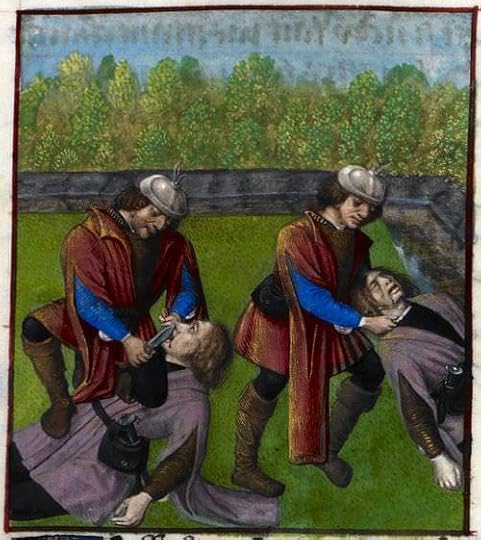
This poem is so goddamn weird I have no idea what to think of it. There are tons of manuscripts with interesting art so here's a few to give an idea.
It's a pretty wild ride. On its face, it's an allegorical account of courtly love in which various concepts are personified into actors who help or oppose the protagonist pursue his love, for example the Lover's greatest enemy, Rebuff, finds out from Evil Tongue that Fair Welcome helped the Lover kiss the Rose, so Rebuff has Jealousy lock Fair Welcome up in a fortress, and it's up to our hero's lord, Love, and conscripted allies such as Friend, Boldness, Pity, Wealth, Constrained Abstinence, and False Seeming to help him storm the fortress so Fair Welcome can reunite him with the Rose. Very quickly it gets bloated and ridiculous, and it's pretty funny when the action happens and these allegorical figures are physically fighting on the battlefield. However a large bulk of the poem consists of long monologues by figures such as Reason and Nature who are advising the Lover on how love should work. Boethius is Jean De Meun's model for these monologues, and quite a bit of the poem is a regurgitation of ideas in The Consolation of Philosophy. However these nearly always overstay their welcome, run down countless digressions, tend to be more boring than entertaining, and we know them to be farcical so it's as equally difficult to take them seriously. There are a few glimmers of fun in these, like Genuis' imperative to "put your minds to ploughing vigorously," Nature's account of an animal uprising, Reason's speech on why we should skip innuendo and just call testicles testicles, and Friend's exhaustive account of a jealous cuck wifebeater. But it's closer to exhausting a lot of the time, and Jean de Meun really had no idea how to contain his writing like the more reserved Guillaume de Lorris. If I'm to recommend this it's because for one it's pretty important for Medieval literature and historical perspectives of love if you're into that, and secondly it's such a strange unique poem that it's interesting even when it's boring.
This was a book C. S. Lewis taught in his medieval classes (he discusses it in The Allegory of Love):
“This is a point I would press on anyone dealing with the Middle Ages, that the first es-sential is to read the relevant classics over and over: the key to everything-- allegory, courtly love, etc. – is there. After that the two things to know really well are the Divine Comedy and the Romance of the Rose. The student who has really digested these with good commentaries, and who also knows the Classics and the Bible (including the apocryphal New Testament) has the game in his hands and can defeat over and over again those who have simply burrowed in obscure parts of the actual Middle Ages.” – C. S. Lewis (Letters of C. S. Lewis, pg. 156)
“Two kinds of symbol must surely be distinguished. The algebraic symbol comes naked into the world of mathematics and is clothed with value by its masters. A poetic sym-bol—like the Rose, for Love, in Guillaume de Lorris—comes trailing clouds of glory from the real world, clouds whose shape and colour largely determine and explain its poetic use. In an equation, x and y will do as well as a and b; but the Romance of the Rose could not, without loss, be re-written as the Romance of the Onion, and if a man did not see why, we could only send him back to the real world to study roses, onions, and love, all of them still untouched by poetry, still raw.” --C. S. Lewis
Update (6/14/17): We made it about 3/4 through the book and decided we had enough. We probably could have stopped with the first half of the book, i.e. the part by the original author. I love allegory and found useful material in here that led to discussions about dating, but in the end felt we needed to move on to other books on our reading list for homeschooling.
Le Roman de la Rose est l’œuvre commune de Guillaume de Lorris et de Jean de Meun, deux poètes du treizième siècle, et a définitivement détruit les préjugés qui me restaient sur la prétendue épaisseur de l’esprit des hommes de ce temps. L’abondance de ce poème, plus de vingt mille vers, n’est nullement un obstacle à l’attention du lecteur, laquelle est également soutenu du début à la fin. La première partie de Guillaume s’apparente au Livre du cœur d’amour épris du mélancolique et désabusé René d’Anjou : l’auteur anime autant de prosopopées que de mouvement du cœur humain lorsqu’il est la proie de l’amour : Jeunesse, Franchise, Bon Accueil doivent souffrir les persécutions de Honte, de Peur et de Jalousie. Les dialogues entres ces personnifications, exercice difficile sont d’une grande variété. Puis lorsque Jean de Meun prend le relai, le poème prend un tour plus ample : Raison se lance dans une tirade remarquable pour vanter ses charmes au narrateur, qui les estime justement bien inférieurs à ceux que Nature lui promet. Les critiques sociales fusent, les références à l’antiquité sont légions, non pas plaquées et récitées, mais bien mâchées et digérées, pour servir au fil du récit. La mythologie et l’histoire offre un réservoir intarissable d’anecdotes que l’auteur prodigue sans avarice, pour le plus grand plaisir du lecteur. La multiplicité des points de vue relance sans arrêt l’intérêt. Arrivé au bout, on constate avec émerveillement que l’auteur a réussi à épuiser le sujet le plus traité de la littérature, l’Amour. Seule réserve, l’appareil critique qui accompagne cette édition est étonnamment léger, et certaines notes de bas de page sont parfois effarantes de platitude.
In 1405 a French woman named Christine de Pizan had enough of all the misogynistic literature that was so popular in her time. She sat down and wrote The Book of the City of Ladies in which she defended womankind by pointing out all the admirable women of history and mythology up to and including the Virgin Mary. Along the way she (metaphorically) ripped several of the most misogynistic books to shreds, including The Romance of the Rose. I recall she called Jean de Meun out by name many times as one of the chief offenders in the war against women.
I've read City of Ladies quite a few times because I am a big huge giant nerd. I've often wondered about Romance of the Rose because of Pizan's hatred and also because it was such a popular work in the thirteenth and fourteenth centuries. Imagine my delight when I found it at the Big Used Bookstore in Tourist Trap, NC. I immediately handed over my debit card and brought it home where it rested on the Alluvial Plain of Mt. ToBeRead to mellow for a while until its time came to leave that hallowed peak. I was not disappointed in either the quality or the misogyny.
Well, I was disappointed by the misogyny but I am a Student of History and I know that's how things were back then. We can't change the past but we can learn from it.
There are two authors of Romance of the Rose. Guilliaume de Lorris started it, telling the story of a man who found the Garden of Pleasure, went inside, and discovered a party of allegories: Pleasure, Idleness, Courtesy, Pleasant Looks, Fair Welcome and the God of Love himself. He also found a beautiful rosebud which he immediately falls in love with. Fair Welcome tries to help him win the rose, but Jealousy, Evil Tongue, and Shame intervene and lock the rose and Fair Welcome away in a castle. Then Guilliaume de Lorris dies.
Jean de Meun comes along thirty years later and finishes the story, making sure to show off his rhetorical education at every turn. He takes the allegory and runs with it, introducing Nature, Genius, and Reason which all make loooooooooong speeches that cover everything from the art of seduction to the differences among the different monastic orders to how to properly drink wine. This is where the misogyny comes in. Many of the speeches denounce women as deceitful, lustful, and treacherous. “The Advice of Friend” is the biggest offender in this regard. That chapter includes instructions on how spouses should beat the everlasting out of each other. O tempora, o mores!
Despite all that the book is actually quite interesting and readable. That might be due to the translation I have. Part of being a big huge giant literature nerd is developing standards for which imprints will grace your shelves. Me, I go straight for the Penguin Classics or Oxford World Classics first because they have the best end notes and most readable translations. Barnes & Noble Classics are also good because they translate all the random foreign languages, especially French which I do not speak or read. Signets are right out! But all that aside, the Oxford World Classics edition of Romance of the Rose is a great book and if you find it you should get it. Please enjoy the extended sex metaphor in the final pages.
And if de Meun's chauvinism gets to be too much for you, I recommend following it up by reading the Penguin Classics edition of City of Ladies.
There are many things not to like about this poem. Allegories tend to feel stilted, and this book is populated almost entirely by allegories: embodied virtues, vices, emotions, and mythological deities. The poem itself is an expression of the tenets of the medieval ideal of courtly love - an ideal that tends to offend modern sensibilities on love and relationships. It's a concept of love that seems based in games and artifice. We find the god of love advising the narrator to stay well groomed and practice his horsemanship in order to succeed in love, but without mention of any sort of communication or human connection between two people.
Despite all this, The Romance of the Rose has its merits. Once I stopped expecting the many allegories to form a cohesive story and treated them instead as a puzzle of metaphors, I found it much more satisfying. Who can't relate to the idea of Jealousy building a massive castle to obstruct the potential lover? Not only is this work important in understanding the literature and mindset of its time, it sparked my interest with the maze of meaning hidden within its allegories. I also found the ending (or lack thereof) of the portion by Guillaume de Lorris to be intriguing. Ignoring the massively long (and much more bawdy) extension of this poem by Jean de Meun, it left me with the openness and puzzle of imagining how the tale might end.
The Romance of the Rose is worth reading mainly if you have an interest in medieval texts and particularly in those that express 'courtly love' (or fin'amours, whichever you think more accurate). It's one massive allegorical dream sequence, the work of two writers, and it was massively influential on later medieval writers.
This translation, by Charles Dahlberg, is very readable, though it is a prose translation. Obviously this isn't a modern novel, but I found it quite fun to read -- this translation, at least, captures a kind of energy and playfulness to it. At the same time, I can't say I was riveted, or that I'd read it if I wasn't so heavily involved in other courtly love texts.
Książka bardzo ciekawa. Gościowi chce się ten teges No wiesz co jest 5 więc się puszcza na lewo i prawo ale jak amor go złapał to postanowił ze przestanie się puszczać i będzie ten teges śmeges tylko tę jedną jedyną ogolbie fajne ale trochę zboczone i mama nie pozwala mi czytać takich rzeczy
Finished: 14.08.2018 Genre: novel courtly love Rating: A Conclusion: People have always been people. Cultures change, but humans don’t. Remember….. l’amour “The struggle is excessive and the joy is short-lived.” (pg 66) La peine est excessive et la joie de courte durée.
Seminal French Medieval text about man’s quest for gaining acceptance by the opposite sex. Tinged with Ovidian Playfulness and a surprising turn to Boethian contemplation later on.
On of Gilbert Highet’s 3 must read works of the Middle Ages along with Chaucer and Dante. Was surprised how much I enjoyed it, particularly in Gs latter stages - the work definitely picks up when Guillaume de Lloris is replaced as author by Jean de Meun (about 1/5th of the war through)
FRANÇAIS: Je n'ai lu que la première partie, celle de Guillaume de Lorris. Je laisse celle de Jean de Meung pour plus tard.
Il y a ceux qui disent que cette œuvre allégorique (l'une des plus lues au Moyen-Âge) représente l'amour courtois et aurait donc dû être interdite par l'Église. Je pense qu'ils ont tort. La meilleure critique de ce livre a été faite par C.S. Lewis dans The Allegory of Love: A Study in Medieval Tradition.
Je voudrais juste signaler un détail: si nos lois sur le droit d'auteur avaient été en vigueur au Moyen Âge, Jean de Meung n'aurait pas pu écrire la deuxième partie de ce livre. Nous aurions également perdu Orlando Furioso d'Ariosto et la plupart des pièces de Shakespeare.
Lorsque Cervantes a été offensé par la publication de Don Quichotte de Avellaneda, il n'a pas recouru aux tribunaux: il a écrit une deuxième partie meilleure que celle de son adversaire. À mon avis, c'est la bonne réponse au prétendu plagiat.
ENGLISH: I have only read the first part, authored by Guillaume de Lorris. I leave Jean de Meung's part for a later reading.
There are those who say that this allegorical work (one of the most widely read during the Middle Ages) represents courtly love, and therefore should have been prohibited by the Church. I think they are wrong. The best criticism of this book was made by C.S. Lewis in The Allegory of Love: A Study in Medieval Tradition.
I will just point out one detail: if our copyright laws had been in force in the Middle Ages, Jean de Meung would not have been able to write the second part of this book. We would also have lost Ariosto's Orlando Furioso and most of Shakespeare's plays.
When Cervantes had to suffer by the publication of Don Quixote by Avellaneda, he did not resort to the courts: he wrote a second part better than that of his opponent. In my opinion, that is the correct answer to alleged plagiarisms.
ESPAÑOL: Sólo he leído la primera parte, la de Guillaume de Lorris. Dejo la de Jean de Meung para más adelante.
Hay quienes dicen que esta obra alegórica (una de las más leídas durante la Edad Media) representa el amor cortés, y por tanto debería haber sido prohibida por la Iglesia. Creo que se equivocan. La mejor crítica de este libro la hizo C.S. Lewis en The Allegory of Love: A Study in Medieval Tradition.
Me limito a señalar un detalle: si en la Edad Media hubiesen estado en vigor nuestras leyes sobre los derechos de autor, Jean de Meung no habría podido escribir la segunda parte de este libro. También habríamos perdido el Orlando Furioso de Ariosto y la mayor parte de las obras de Shakespeare.
Cuando Cervantes se sintió ofendido por la publicación del Quijote de Avellaneda, no recurrió a los tribunales: escribió una segunda parte mejor que la de su contrincante. A mi juicio, esa es la respuesta correcta al supuesto plagio.
I only read the part by Lorris but if Jordan Stump says that’s the only part worth reading (and the other part is written by a completely different person!) then I feel fine marking this one as completed. It was SUCH a silly story. I genuinely laughed out loud reading it. Not because the author was trying to be funny, but probably because he wrote the strangest things without an ounce of intended humor. For part of the book Cupid just stalks the narrator around an orchard, and the narrator is TOTALLY freaked out by him but does nothing. Cupid then proceeds to shoot this guy multiple times, allowing him to somewhat heal and stand back up in between each arrow. It’s so funny. Really glad this was included on the medieval literature syllabus for this semester.
An interesting concept and could have been so much better if not for the incessant waffling and random tangents. Genuinely feel like this book could be half the length and still get the same message across. Despite wanting to give up after 900 pages, I did enjoy the hot takes on women and relationships. Key takeaway from this book: never trust women.
Da ne znam da je ovaj roman napisan u XIII vijeku, nikada ne bih pogodila! Zaista, i poslije hiljadu godina, on sadrži u sebi nešto savremeno. Izuzetno mi se dopala sama ideja, alegorični likovi, stil pisanja (koji je neočekivano pitak za djelo nastalo u srednjem vijeku) i ono što najviše začuđuje - poprilično napredno razmišljanje za to vrijeme. Zapravo, sve što odlikuje ovaj roman, čini mi se, tako odudara od srednjeg vijeka - ili samo nisam čitala dovoljno fin'amor literature? Prije će biti ovo drugo, ali to, na kraju krajeva, nije ni bitno; važno je da sam, zahvaljujući ovom romanu, po prvi put vidjela ljepotu u onome što sam do sad znala samo kao "Mračno doba". Naravno, sve ovo vrijeme govorim samo o prvom dijelu (jedinom pravom!) "Romana o Ruži", odnosno o onom dijelu koji je napisao Gijom de Loris. Ono što je Žan de Men učinio jeste, po mom mišljenju, sacrilège! Tako izopačiti jedno predivno djelo izrazito talentovanog mladića - djelo puno simbolike, nježnosti, mladalačkih ideala i dubine, i to izopačiti ga nastavljajući na njega mizoginične misli koje gaze po idealima postavljenim na samom početku romana, te nimalo se ne trudeći da se održi poruka i dosljednost likova, sasvim protivrječeći njegovoj osnovnoj ideji - ne može se nazvati nikako drugačije do svetogrđe! Zbog toga bi trebalo da se svi pravimo da taj drugi dio uopšte ne postoji, jer očigledno ne sadrži nikakvu umjetničku vrijednost. Uostalom, da de Men nije tako sramno povezao svoj rukopis sa djelom de Lorisa, on bi bio potpuno beznačajan, lišen svakog smisla, a s vremenom i zaboravljen. Prava je šteta što je ovo djelo ostalo nedovršeno, što je ko zna kakva zla kob zadesila mladog Gijoma! Ne znam šta se zbilo s autorom, da li je njegovo pisanje naglo prekinuo kakav bodež il' mač, pa on nije stigao da stavi ni zarez na kraju stiha, ali znam da će njegova ideja živjeti još dugo (a bezvremenost te ideje je zapravo ona "savremenost" koja se osjeća u romanu i koju sam pomenula na početku ovog prikaza).
Lorris starts a delightful allegory of courtly love. Meun adds philosophy, shifts to an earthy naturalism, and praises God and sex but not mendicants and women.
Reading this was just a process of "Guillaume de Lorris my beloved" for one-third and "shut up Jean de Meun" the rest of the time. Lorris wrote the beginning of the The Romance of the Rose and his sections are wonderful. He died without finishing it and Meun decided to write the conclusion. Unfortunately, Jean de Meun was not Guillaume de Lorris and The Romance of the Rose goes from being intriguing and dreamlike to 40-page sermons and diatribes. You finish one, get a little plot, and then another analogised figure enters to take begin another. My eyes glazed over, I lost track of who was speaking. The sermons are also famously misogynistic. Then, we reach the end with it's analogised pornographic conclusion and even there, it's like "I thrust my staff at the narrow aperture, feeling an inner barrier and-- (1-2 page long diversion)" before we get back to the porn.
Reread in the original French, I changed the rating from 3.5 to 5 stars.
A medieval poem written in Old French and presented as an allegorical dream vision. As poetry, The Romance of the Rose is a notable instance of courtly literature, purporting to provide a "mirror of love" in which the whole art of romantic love is disclosed. Its two authors conceived it as a psychological allegory; throughout the Lover's quest, the word Rose is used both as the name of the titular lady and as an abstract symbol of female sexuality. The names of the other characters function both as personal names and as metonyms illustrating the different factors that lead to and constitute a love affair. Its long-lasting influence is evident in the number of surviving manuscripts of the work, in the many translations and imitations it inspired, and in the praise and controversy it inspired.
I'm not sure where, but I vaguely remember C.S. Lewis mentioning this book as though it were distasteful. The man knows what he's talking about: this is a strange fourteenth-century allegory where Cupid and Venus help a man make war on a girl's Chastity and her attendants, Shame, Fear, and Jealousy (not making this up) while dodging the superfluity of marriage. The book ends when the guy finishes his pilgrimage and picks the rose in the center of the once-defended garden. There are some odd digressions by sanctimonious-sounding persons with names like Nature which chastize mankind for things like usury and sodomy, yet doesn't mention adultry whatsoever. Not recommended!
"thi brændt barn skyer ilden." og jeg tror, jeg er blevet brændt af Le Roman de la Rose...
vi begynder i Lorris' have locus amoenus, en drøm om kærlighed, natur og høviskhed — men ender så i De Meuns beskidte park, hvor alt, der før var ideal, bliver pillet fra hinanden. det føltes som at læse to verdener, to tider, to syn på kvinden – og på kærligheden – i direkte sammenstød. de to hænger sammen som olie og vand: de flyder i samme tekst, men de vil aldrig smelte sammen. det er virkelig jarring at læse, som om værket går i opløsning for øjnene af en.
Guillaume de Lorris skriver med blid hånd; han drømmer, han længes. Jean de Meun skriver med knytnæve. det er misogyni forklædt som filosofi, og det er too damn loud — næsten grotesk i sin vrede og intellektuelle arrogance. han ved alt...tror han.
men så læser man Christine de Pizan – og hendes stemme føles som ilt. som at blive taget i forsvar af en veninde på tværs af århundreder. hun spiser ham levende, med elegance og female rage.
“After all, something stated as an opinion and not dictated by Law can be accused of error without harm.” jeg læser hende som en hånd, der rækker ud gennem tiden. en påmindelse om, at man ikke skal acceptere det, bare fordi det er “klassisk.” hun insisterer på, at Jean de Meuns tekst ikke har autoritet som sandhed. det er bare en mandlig mening — og jeg har aldrig haft det bedre.
jeg gir den et sted mellem 3 og 4 stjerner — for hvordan vurderer man et værk, der både fortryller og frastøder én?
“12-00 tallets store allegoriske drøm om kærligheden og dens vildeveje” Vi hører det til stadighet. At leve i nuet. Hva vil det egentlig si? Kan 615 sider skrevet i høymiddelalderen ha relevans i dag ... Å komme med den påstanden virker nærmest aparte. I 2020 hvor algoritmer og tweets fra Trump gjennomsyrer vår hverdag. Svaret er et ubetinget JA. Det er store armbevegelser. Den høviske kjærlighet og kunsten å elske. Boken er regnet som et sentralt verk i den europeiske kulturhistorie - for første gang ble kjærligheten lyrikkens nærmest altdominerende tema. Hovedpersonen er håpløst forelsket. Han har kun en eneste tanke. Å erobre en liten rosenknopp.
Det er her hvor litteraturen er mest kraftfulll og tar deg med på en guddommelig reise. Roseromanen er et sjelsettende verk.
I want to start by saying this was an assigned reading for a Medieval Literature class I am taking. As a medievalist, I can appreciate the amount of work that went into this book. I understand the allegory and the massive amount of medieval ideas on love, god and courtly behavior. However, this book was quite possibly the absolute most difficult book I have ever read. It took me a week to get through "The Advice of Reason" and it was incredibly difficult to stay focused. I have to say, this is sad for me because I love the middle ages and I am currently working towards a degree in history with a minor in medieval studies. So, I wanted to like this book, I really did. But I just....couldn't. The thing is, the first part, which is written by Guillaume de Lorris, is not too bad. It wasn't until Jean de Meun took over that I started to struggle. There is a very distinct difference between their writing styles. I will say though that looking back, I can appreciate the not so subtle way that both Guillaume and Jean talk about sex and desire. I also loved the paragraph describing the death and rebirth of the Phoenix - it was beautiful. That being said, the book is not redeemed.
My rating is for the translation and front matter, not the content. Last 50 pages are a thinly veiled porno. Literally only read this so that I can see Christine de Pizan rip it to shreds. So up yours, Jean.
Honestly, it's a good thing to read for a student of medieval literature, especially one with an interest in the tradition of courtly love. Definitely do NOT skip the introduction and preface, because the roman gets dense and difficult to follow at times. It's also reassuring to read the other reviews and find that I'm not alone in finding this text difficult.