

What do you think?
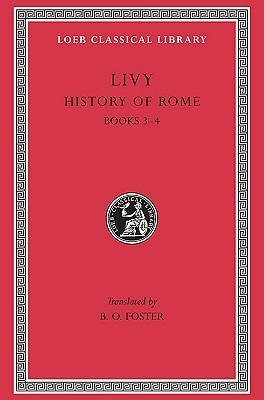
"The History of Rome" in Fourteen Volumes #3-4
Livy II: History of Rome, Books 3-4
Livy (Titus Livius), the great Roman historian, was born at or near Patavium (Padua) in 64 or 59 BCE; he may have lived mostly in Rome but died at Patavium, in 12 or 17 CE.
Livy's only extant work is part of his history of Rome from the foundation of the city to 9 BCE. Of its 142 books, we have just 35, and short summaries of all the rest except two. The whole work was, long after his death, divided into Decades or series of ten. Books 1–10 we have entire; books 11–20 are lost; books 21–45 are entire, except parts of 41 and 43–45. Of the rest only fragments and the summaries remain. In splendid style Livy, a man of wide sympathies and proud of Rome's past, presented an uncritical but clear and living narrative of the rise of Rome to greatness.
The Loeb Classical Library edition of Livy is in fourteen volumes. The last volume includes a comprehensive index.
Livy's only extant work is part of his history of Rome from the foundation of the city to 9 BCE. Of its 142 books, we have just 35, and short summaries of all the rest except two. The whole work was, long after his death, divided into Decades or series of ten. Books 1–10 we have entire; books 11–20 are lost; books 21–45 are entire, except parts of 41 and 43–45. Of the rest only fragments and the summaries remain. In splendid style Livy, a man of wide sympathies and proud of Rome's past, presented an uncritical but clear and living narrative of the rise of Rome to greatness.
The Loeb Classical Library edition of Livy is in fourteen volumes. The last volume includes a comprehensive index.
465 pages, Hardcover
First published January 1, 2
About the author
Livy
3,120 books280 followersTitus Livius (Patavinus) (64 or 59 BC – AD 17)—known as Livy in English, and Tite-Live in French—was a Roman historian who wrote a monumental history of Rome and the Roman people – Ab Urbe Condita Libri (Books from the Foundation of the City) – covering the period from the earliest legends of Rome before the traditional foundation in 753 BC through the reign of Augustus in Livy's own time. He was on familiar terms with the Julio-Claudian dynasty, advising Augustus's grandnephew, the future emperor Claudius, as a young man not long before 14 AD in a letter to take up the writing of history. Livy and Augustus's wife, Livia, were from the same clan in different locations, although not related by blood.
Ratings & Reviews
Friends & Following
Create a free account to discover what your friends think of this book!
Community Reviews
Displaying 1 - 8 of 8 reviews

February 22, 2017
"Oratory was invented for doubtful matters"
- Livy, Book III, lv 3

Book 3 (The Patricians at Bay)
&
Book 4 (War and Politics)
My second (of fourteen) Livy's History of Rome covers books 3 and 4 (467-404BC). It largely deals with early growing pains in Rome as its second census shows its population swollen beyond 100,000. The tensions between the plebs (represented politically by the tribunes) and the patricians (represented politically by the senate). My favorite parts of Book 3 dealt with Lucius Quintus Cincinnatus, the machinations of the decemvirs, and Appius Claudius claiming Verginius' daughter Verginia as a slave.
My favorite part of Book 4 was the debate over a law about marriage between patricians and plebeians and the right for plebeians to be consuls. Canuleius' speech from this section was brilliant, and could easily have been used 2000+ years later when debating a woman's right to vote, etc.. Here are some of his best lines:
'When we raise the question of making a plebeian consul, is it the same as if we were to say that a slave or a freedman should attain that office? Have you any conception of the contempt in which you are held? They would take from you, were it possible, a part of the daylight. That you breathe, that you speak, that you have the shape of men, fills them with resentment." (Book IV, iii 7-8)
"'But,' you say, 'from the time the kings were expelled no plebeian has ever been consul.' Well, what then? Must no new institution be adopted? Ought that which has not yet been done -- and in a new nation many things have not yet been done -- never to be put in practice, even if it be expedient?" (Book IV, iv 1).
"Finally, I would ask, is it you, or the Roman People, who have supreme authority? Did the banishment of the kings bring you dominion, or to all men equal liberty?" (Book IV, v 1).
- Livy, Book III, lv 3
Book 3 (The Patricians at Bay)
&
Book 4 (War and Politics)
My second (of fourteen) Livy's History of Rome covers books 3 and 4 (467-404BC). It largely deals with early growing pains in Rome as its second census shows its population swollen beyond 100,000. The tensions between the plebs (represented politically by the tribunes) and the patricians (represented politically by the senate). My favorite parts of Book 3 dealt with Lucius Quintus Cincinnatus, the machinations of the decemvirs, and Appius Claudius claiming Verginius' daughter Verginia as a slave.
My favorite part of Book 4 was the debate over a law about marriage between patricians and plebeians and the right for plebeians to be consuls. Canuleius' speech from this section was brilliant, and could easily have been used 2000+ years later when debating a woman's right to vote, etc.. Here are some of his best lines:
'When we raise the question of making a plebeian consul, is it the same as if we were to say that a slave or a freedman should attain that office? Have you any conception of the contempt in which you are held? They would take from you, were it possible, a part of the daylight. That you breathe, that you speak, that you have the shape of men, fills them with resentment." (Book IV, iii 7-8)
"'But,' you say, 'from the time the kings were expelled no plebeian has ever been consul.' Well, what then? Must no new institution be adopted? Ought that which has not yet been done -- and in a new nation many things have not yet been done -- never to be put in practice, even if it be expedient?" (Book IV, iv 1).
"Finally, I would ask, is it you, or the Roman People, who have supreme authority? Did the banishment of the kings bring you dominion, or to all men equal liberty?" (Book IV, v 1).

February 11, 2023
See my review of Volume I :)
November 7, 2020
The class war continues
One of the pleasures of reading Livy in the 21st century is that you can see how Marx got so much of it right. Well, strictly speaking, he was right about the problem, but perhaps not about the solution.
To explain, Livy was a conservative, traditionalist patriot who revered Rome as a goddess, a force of nature, a force for good, a champion of civilisation. In the early years of the imperial era he wrote a monumental history of the city in 142 books. Of these, only 35 survive entire (or almost entire), and at best only summaries survive of the remaining 107 books. Unlike some other ancient (and modern) historians, Livy doesn’t seem to have travelled anywhere in search of interviews or primary sources. He never visited battlefields, or cities. He sat at home or in a library somewhere and consulted earlier writers and chronologies. Occasionally he talks of ambiguities and contradictions in these earlier narratives and explains which version he favours and why. Generally, he supports any version of events that favours the ruling class, the patricians, and discredits the lower orders, the plebeians. However, there are instances where, try as he might, he cannot ignore the tyranny, hypocrisy and brutality of particular members of the ruling class. He then follows the “few bad apples” approach, contrasting the shameful behaviour of an Appius Claudius with the glorious patriotism and self-effacement of a Cincinnatus. More on them later.
This is Volume 2 of the Loeb edition and presents Books III and IV. These cover a period of about 60 years from 467 BCE. This is a fascinating period in Roman history (and a fascinating period in Greek history when you think about it). This is a time when Roman territory extends about a dozen miles beyond the city, when Rome’s enemies are towns a day’s march away. These enemies are clearly of the same ethnic/linguistic group, on the whole, and their politics often sounds very Roman (they have upper and lower classes too). Livy presents the conflicts between these towns as full-scale warfare, but Mary Beard has described them as over-grown cattle raids, and she’s probably closer to the truth. Although there are occasions where a town is besieged and captured, most of the campaigns seem to be aimed at grabbing farm animals and slaves, with the latter often treated worse than the former. It’s noticeable that the citizen soldiers don’t get paid for their military service (not even rations, apparently) and they have to pay for their own kit. In some instances a “war” only lasts a few days.
As an example of upper class arrogance, Appius Claudius is one of those tyrannical toffs who was elected a decemvir (lawgiver) and then refused to lay down his office. He takes a fancy to a beautiful young plebeian woman, Verginia. She is betrothed to another plebeian, but Claudius persuades one of his retainers to file a law suit claiming that she is one of his household slaves and always has been. The plan is that when the retainer has won his case, he will hand the girl over to Claudius to use as a concubine. Amazingly, it looks like they’re going to get away with it. However, messengers reach Verginia’s father, who is away at the wars. He returns to the city and when he realises that Claudius has the courts and the toffs behind him, he whips out his sword and kills his daughter to “save” her honour. Equally amazingly, he gets away with it, seemingly because Verginia is his property. It makes you realise that in ancient Rome there are two classes who are even worse off than the plebs: women and slaves.
In contrast with Claudius, Livy presents several examples of fine, upstanding toffs who display remarkable courage and leadership qualities. One such is Cincinnatus. He is appointed dictator (a temporary six month appointment only to be used in dire emergencies) by the senate in 458 BCE. The senators find him on his farm, ploughing a field. They tell him he’s been appointed dictator and must lead the army against the dreaded Sabines. Whereupon, he marches off to war, defeats the enemy in 16 days and promptly resigns and returns to his farm. In fact, there are examples in this volume of dictators resigning after a mere eight days in office, but good old Cincinnatus is the most famous example of how to use a position of leadership and power wisely and for the public good.
As well as endless wars against neighbouring towns, there is a lot of domestic politics in these books. Some of the issues covered include:
1. The appointment of the decemvirs and their production of the Twelve Tables, followed by their refusal to lay down their office.
2. Plebeian demands that they should be able to stand for the consulship, the highest elected office.
3. The appointment of military tribunes instead of consuls as a way of getting some plebeians into top jobs.
4. The role of the tribunes of the people and their use of “refuse the draft” to exert power over the toffs. Hell no, we won’t go!
5. The question of intermarriage between patricians and plebeians.
6. The role of a gang of young extremist patricians in the political conflicts. These are the sort of chaps who are looking forward to inheriting their fathers’ wealth and privileges and are determined to ensure that none of the moderates in the older generation give away too much – or any – power to the lower orders.
7. The first payment of a stipend to soldiers at the end of a campaign. That was extremely popular with the soldiers on that particular campaign, but not with the veterans of earlier wars who had had to serve at their own expense and were now forced to cough up to fund the stipend. It reaches the point where the tribunes of the people promise to defend anyone who refuses to pay the tax, although the tax will benefit the rank and file. Talk about divide and rule!
8. What’s not made entirely clear by Livy is that the Roman voting system was skewed to give greater weight to the votes of wealthy citizens, and the poorest men didn’t have a vote as they were barred from military service.
Whether you read the Latin or the facing English translation, if you’re interested in ancient history, politics, the class struggle or how the ruling classes cling onto power, I’d highly recommend this volume. And all the others available in the Loeb collection.
One of the pleasures of reading Livy in the 21st century is that you can see how Marx got so much of it right. Well, strictly speaking, he was right about the problem, but perhaps not about the solution.
To explain, Livy was a conservative, traditionalist patriot who revered Rome as a goddess, a force of nature, a force for good, a champion of civilisation. In the early years of the imperial era he wrote a monumental history of the city in 142 books. Of these, only 35 survive entire (or almost entire), and at best only summaries survive of the remaining 107 books. Unlike some other ancient (and modern) historians, Livy doesn’t seem to have travelled anywhere in search of interviews or primary sources. He never visited battlefields, or cities. He sat at home or in a library somewhere and consulted earlier writers and chronologies. Occasionally he talks of ambiguities and contradictions in these earlier narratives and explains which version he favours and why. Generally, he supports any version of events that favours the ruling class, the patricians, and discredits the lower orders, the plebeians. However, there are instances where, try as he might, he cannot ignore the tyranny, hypocrisy and brutality of particular members of the ruling class. He then follows the “few bad apples” approach, contrasting the shameful behaviour of an Appius Claudius with the glorious patriotism and self-effacement of a Cincinnatus. More on them later.
This is Volume 2 of the Loeb edition and presents Books III and IV. These cover a period of about 60 years from 467 BCE. This is a fascinating period in Roman history (and a fascinating period in Greek history when you think about it). This is a time when Roman territory extends about a dozen miles beyond the city, when Rome’s enemies are towns a day’s march away. These enemies are clearly of the same ethnic/linguistic group, on the whole, and their politics often sounds very Roman (they have upper and lower classes too). Livy presents the conflicts between these towns as full-scale warfare, but Mary Beard has described them as over-grown cattle raids, and she’s probably closer to the truth. Although there are occasions where a town is besieged and captured, most of the campaigns seem to be aimed at grabbing farm animals and slaves, with the latter often treated worse than the former. It’s noticeable that the citizen soldiers don’t get paid for their military service (not even rations, apparently) and they have to pay for their own kit. In some instances a “war” only lasts a few days.
As an example of upper class arrogance, Appius Claudius is one of those tyrannical toffs who was elected a decemvir (lawgiver) and then refused to lay down his office. He takes a fancy to a beautiful young plebeian woman, Verginia. She is betrothed to another plebeian, but Claudius persuades one of his retainers to file a law suit claiming that she is one of his household slaves and always has been. The plan is that when the retainer has won his case, he will hand the girl over to Claudius to use as a concubine. Amazingly, it looks like they’re going to get away with it. However, messengers reach Verginia’s father, who is away at the wars. He returns to the city and when he realises that Claudius has the courts and the toffs behind him, he whips out his sword and kills his daughter to “save” her honour. Equally amazingly, he gets away with it, seemingly because Verginia is his property. It makes you realise that in ancient Rome there are two classes who are even worse off than the plebs: women and slaves.
In contrast with Claudius, Livy presents several examples of fine, upstanding toffs who display remarkable courage and leadership qualities. One such is Cincinnatus. He is appointed dictator (a temporary six month appointment only to be used in dire emergencies) by the senate in 458 BCE. The senators find him on his farm, ploughing a field. They tell him he’s been appointed dictator and must lead the army against the dreaded Sabines. Whereupon, he marches off to war, defeats the enemy in 16 days and promptly resigns and returns to his farm. In fact, there are examples in this volume of dictators resigning after a mere eight days in office, but good old Cincinnatus is the most famous example of how to use a position of leadership and power wisely and for the public good.
As well as endless wars against neighbouring towns, there is a lot of domestic politics in these books. Some of the issues covered include:
1. The appointment of the decemvirs and their production of the Twelve Tables, followed by their refusal to lay down their office.
2. Plebeian demands that they should be able to stand for the consulship, the highest elected office.
3. The appointment of military tribunes instead of consuls as a way of getting some plebeians into top jobs.
4. The role of the tribunes of the people and their use of “refuse the draft” to exert power over the toffs. Hell no, we won’t go!
5. The question of intermarriage between patricians and plebeians.
6. The role of a gang of young extremist patricians in the political conflicts. These are the sort of chaps who are looking forward to inheriting their fathers’ wealth and privileges and are determined to ensure that none of the moderates in the older generation give away too much – or any – power to the lower orders.
7. The first payment of a stipend to soldiers at the end of a campaign. That was extremely popular with the soldiers on that particular campaign, but not with the veterans of earlier wars who had had to serve at their own expense and were now forced to cough up to fund the stipend. It reaches the point where the tribunes of the people promise to defend anyone who refuses to pay the tax, although the tax will benefit the rank and file. Talk about divide and rule!
8. What’s not made entirely clear by Livy is that the Roman voting system was skewed to give greater weight to the votes of wealthy citizens, and the poorest men didn’t have a vote as they were barred from military service.
Whether you read the Latin or the facing English translation, if you’re interested in ancient history, politics, the class struggle or how the ruling classes cling onto power, I’d highly recommend this volume. And all the others available in the Loeb collection.

August 1, 2018
It has been interesting to see what a fragile and shaky thing it was to abandon the kingship and pioneer a new political arrangement. The state nearly failed several times. The interplay between domestic struggles and nearly annual foreign wars is fascinating; the plebs and patricians have to work together to save the city, and often one side will hold the safety of the republic for ransom until it's almost too late.
There are a lot of interesting little things too. The Romans heard that Solon gave good laws to Athens, so they sent a delegation to copy them down. Livy expresses surprise at an execution by drawing and quartering deep in Rome's past, since everyone knows Rome is the most humane of nations when it comes to punishments (!). A commander throws the army's standard into the midst of the enemy, compelling his men to fight hard to recover it. There's a lot to enjoy here.
There are a lot of interesting little things too. The Romans heard that Solon gave good laws to Athens, so they sent a delegation to copy them down. Livy expresses surprise at an execution by drawing and quartering deep in Rome's past, since everyone knows Rome is the most humane of nations when it comes to punishments (!). A commander throws the army's standard into the midst of the enemy, compelling his men to fight hard to recover it. There's a lot to enjoy here.

January 20, 2024
467 – 404 BC
In this one the Romans suffer a complete breakdown of law and the functions of the state. For those of you that haven’t been paying attention, Marx was right – all history is the history of class struggle. The plebs and Senate are locked in a power struggle which has coalesced about the question of public land. The plebs want it assigned to them, but the senators are farming it and won’t give it up. They’re at an impasse, so they institute an entirely new constitution. Unfortunately, it’s ill thought out and lacks the necessary checks and balances, allowing ten men to assume tyrannical control, ruling through fear and death.
This whole sequence is just one of the finest pieces of writing I’ve ever come across, like a thriller embedded in the history. It all comes to a head in the tale of Appius and Verginia, and a Heavy Deed so shocking I won’t spoil it for you. What I will spoil is that the Roman Republic didn’t actually fall until 27 BC so you can be sure the naughty Appius is going to get his comeuppance. There’s a wonderful scene where he appeals against his doom to the very people to whom he denied the right of appeal.
What’s wonderful about this history is how applicable it is to our own times. The Tribunes… I’ve known a few Trade Union officials in my time and I can tell you that’s exactly what they’re like.
That scene with Appius made me think of the government’s currents moves towards abolishing the Human Rights Act. They might think it’s a good idea to class foreigners as non-human, but those are our rights too. I think we should deport Sunak, Patel, and Braverman to Rwanda and see how they like it.
In this one the Romans suffer a complete breakdown of law and the functions of the state. For those of you that haven’t been paying attention, Marx was right – all history is the history of class struggle. The plebs and Senate are locked in a power struggle which has coalesced about the question of public land. The plebs want it assigned to them, but the senators are farming it and won’t give it up. They’re at an impasse, so they institute an entirely new constitution. Unfortunately, it’s ill thought out and lacks the necessary checks and balances, allowing ten men to assume tyrannical control, ruling through fear and death.
This whole sequence is just one of the finest pieces of writing I’ve ever come across, like a thriller embedded in the history. It all comes to a head in the tale of Appius and Verginia, and a Heavy Deed so shocking I won’t spoil it for you. What I will spoil is that the Roman Republic didn’t actually fall until 27 BC so you can be sure the naughty Appius is going to get his comeuppance. There’s a wonderful scene where he appeals against his doom to the very people to whom he denied the right of appeal.
What’s wonderful about this history is how applicable it is to our own times. The Tribunes… I’ve known a few Trade Union officials in my time and I can tell you that’s exactly what they’re like.
That scene with Appius made me think of the government’s currents moves towards abolishing the Human Rights Act. They might think it’s a good idea to class foreigners as non-human, but those are our rights too. I think we should deport Sunak, Patel, and Braverman to Rwanda and see how they like it.

Read
November 19, 2021Kitabın Türkçe çevirisi rezalet seviyede. Birçok yer google translate ile çevrilse daha iyi sonuç verirdi. Ben okurken kolaylık olsun diye Türkçe çeviri almıştım, mecburen İngilizce'den devam ediyorum.
Read
December 12, 2023Read this in the Latin.

March 20, 2025
reading 500 years of Roman history, year-by-year can be a bit tedious. Livy is an easy read but there are times when things get a bit repetitive and monotonous. Two volumes down 11 more to go.
Displaying 1 - 8 of 8 reviews