Jump to ratings and reviews
Rate this book

From the Wreck

Rate this book
From the Wreck tells the remarkable story of George Hills, who survived the sinking of the steamship Admella off the South Australian coast in 1859. Haunted by his memories and the disappearance of a fellow survivor, George’s fractured life is intertwined with that of a woman from another dimension, seeking refuge on Earth. This is a novel imbued with beauty and feeling, filled both with existential loneliness and a deep awareness that all life is interdependent.

267 pages, Paperback

First published March 1, 2017

41 people are currently reading
2675 people want to read

About the author

Jane Rawson

14 books144 followers
Jane grew up in Canberra and travelled via San Francisco and Melbourne to Tasmania, where she works as a writer for a conservation organisation. Her first novel, A Wrong turn at the Office of Unmade Lists, won the Small Press Network’s Most Underrated Book Award and her second novel, From the Wreck, won the Aurealis Award and was longlisted for the Miles Franklin Literary Award. She is also the author of a non-fiction guide to surviving and living with climate change called The Handbook and a novella, Formaldehyde, which won the 2015 Seizure Viva La Novella Prize. You can read her essays in Living with the Anthropocene; Fire, Flood, Plague; and Reading like an Australian Writer.

Ratings & Reviews

What do you think?
Rate this book

Friends & Following

Create a free account to discover what your friends think of this book!

Community Reviews

5 stars
188 (18%)
4 stars
371 (36%)
3 stars
280 (27%)
2 stars
124 (12%)
1 star
42 (4%)
Displaying 1 - 30 of 232 reviews
Profile Image for James Tivendale.
339 reviews1,445 followers
May 24, 2019
I received an uncorrected proof and a finished version of From The Wreck in exchange for an honest review. I would like to thank Jane Rawson and Picador. This review is based on the final product. *Minor spoilers*

"But I, awakened from sleep, considered in my excellent heart whether to drop from the deck and die right there in the sea or endure, keep silent, go on being of the living." Homer - Odyssey

Rawson's Aurealis award-winning novel is a unique, intelligent and thought-provoking alternative history/ science fiction merger. This narrative begins with an incident set on the Admella, a real-life steamship that was wrecked on Carpenters Reach in 1859. George Hills, the main character is an alternative version of a gentleman who was actually Rawson's great-great-grandfather. He was on the aforementioned ship as it hit the reef and was one of the few survivors who lasted over a week at sea with very little substance. Naked, drifting, without any sort of nourishment on the wreck, in this version, George befriends - if you can call it that when freezing, close to death and having to make brutal life changing decisions - a young lady who he canoodles with whilst waiting for the inevitable watery end that awaits them all.

After many days, he is fortunately rescued by a lifeboat and the lady he was embracing named Bridget disappears. George tries to continue with his life and eventually gets married, has a decent job, and raises three children. But not a day passes where he doesn't suffer from a kind of post-traumatic stress disorder. Replaying the events in his mind. Having trouble breathing. Falling down. Having terrible dreams. And also feeling like he is no longer a human. That the human died during those days and he is part of the ocean. His storyline is mainly about how he handles reality and his life which on paper is flowing perfectly. There is always a part of his mind that wants to find out where and who the woman he was with on the wreckage is and what/if anything, she did to change him.

We follow George's 3rd-person point of view perspective, as well as his young son Henry's and a mysterious neighbour's. There is another, poetically written 1st-otherworldly-being, siren, wraith, shapeshifter, what on earth is the thing-perspective that although initially confusing has an ethereal and elegant quality. Haunting and dreamlike. This section that I have written may sound confusing and these sections initially do not seem to make much sense either. To the extent where I nearly put the book down after the second chapter. But, keep with it. It is definitely not nonsense and fits the story expertly.

It's really difficult with a story that is this original to discuss some of the events that happen without spoiling the plot, tone, and the unique directions that the narrative takes us. Some of the scenes are extremely emotional, especially when told from a child's perspective. How can a scene where someone talks about counting stones make me want to cry? There are twists, elements of utter sadness, horror, uncertainty, mental breakdowns, blood-drinking headless monsters, a birthmark that eats food, a cat that turns up when she wants to, a baby boy who lives in a drawer. It's a unique literature cocktail that reads like a classic work of fiction would if the author was warped on hallucinogenics - but focuses on family, heart and goodness as much as paranoia, uncertainty and wanting to cut a part off of a member of your own family - in a world where nobody quite knows what is happening to the ensemble we witness. The ending blew me away and I can confirm that this is one of the strangest, most original, intense, beautiful yet in someways hauntingly horrific books I have ever read.
Profile Image for T.D. Whittle.
Author 3 books212 followers
July 26, 2018
*** Plot spoilers alert ***

I had never read Jane Rawson until now, and I just love this book. From the Wreck weaves a tale based in a completely believable "real-world" Port Adelaide of the 1850s, but the net is shot through with luminous (or, rather, bioluminescent) threads of magic. The book keeps us floating in a sense of timeless wonder, drifting back and forth between the hard reality of life on land with the "boot stompers" and the beautiful world that simmers and shimmers beneath the ocean's waves.

Rawson's characters are immediately engaging and memorable. I especially appreciate that she avoids the common themes of so much Aussie fiction I have read, where every family is miserable, domestic violence is rife, everyone is marked by trauma, and there is no such thing as a happy or hopeful ending. Rawson treats her characters with compassion and allows them the chance for a good life. Even while they may not always behave admirably, we can understand that they are doing the best they can in very trying circumstances, with their own limited understanding of their situation.

My favourite parts of the book are the passages where the reader is allowed inside the alien-octopus' mind or inside Henry's or George's mind when they are seeing life through her eyes. These scenes are written with a light touch but a deep poetic serenity that is breathtaking:

. . . All of it, life.
The great joyous throb of it.
He plunged into the swarming ocean, felt its wriggling abundance. Slumped and lay soft on the currents of it, drifting. Henry sounded the ancient depths of his Mark ―like this today and yesterday and tomorrow and always. No shadows fell, no teeth snapped and there was a stillness amid the frenzy. Henry felt his place in it ― just to be this boy and never wonder why or who or how to be better, braver, otherwise. Just to be and to love. To notice it fresh every day.
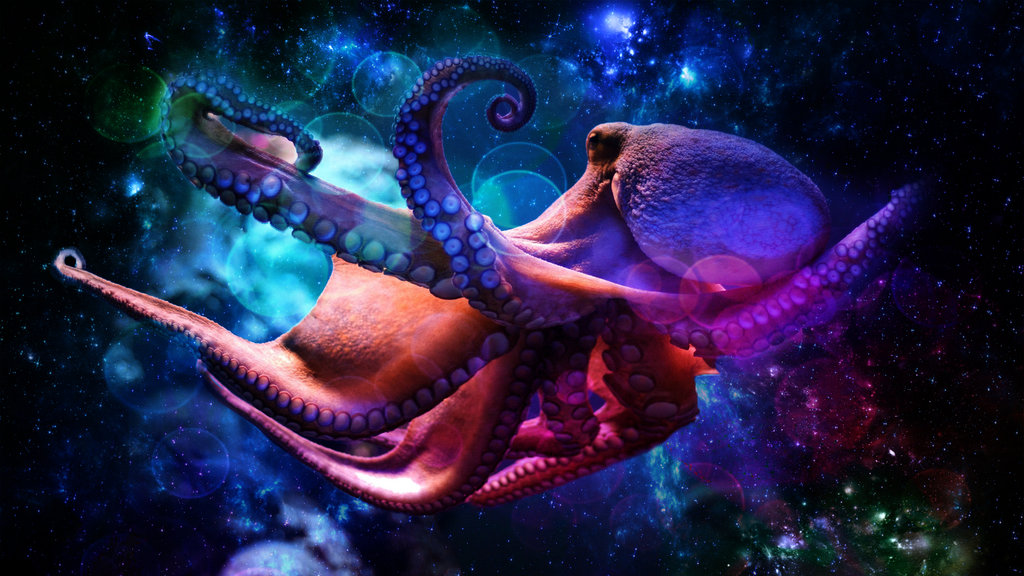


Image source: Liv at Deviant Art

Rawson is also funny, and From the Wreck is compulsively readable. Once I got going, I had difficulty putting it down to do other things (always a reader's dilemma, but some books make it more of a struggle than others). Here is an example of Rawson's humour. The alien creature, a giant blue octopus, has morphed herself into the shape of a woman so that she can once again confront her first human companion, George, whom she met and bonded deeply with when he was stranded at sea after the shipwreck. She hopes to set George straight, since he is rollicking around acting like an insane idiot believing that she has somehow cursed him and his boy, Henry. In fact, our shape-shifting cephalopod is not evil and is Henry's closest companion and most intimate friend. George seeks to sever that bond in a dangerous and potentially fatal way.

So, the alien, who calls herself Bridget when embodied as a woman, is sitting at a bar in a pub, trying to make small talk to get George's attention. She is unused to being in woman form these days. She is unused to speaking to others. She has never been in a pub and, trying to be like the locals, orders beer for the first time. After spewing the beer everywhere, here's what she says to the woman sitting next to her:

"It's a bundle of mysteries, isn't it, this world? . . . Always something else. Horses. Sandwiches ― have you tried those? Walking on two feet. Leather ― it's made out of the skin of other living creatures, I found out. Singing, and sometimes everyone knows the song and they all sing too. You can take the fat from a whale and put a flame to it and then you have a light to read. Or sew ― that's a thing people do. Well. And now beer."


The beauty of the book, besides the characters, the octopus' eulogies for her lost home and its people, and the elegant and luminous prose throughout, lies also in its eloquent themes: that we humans are easily frightened and fragile creatures who cling desperately to what we know and fear anything strange or different from ourselves; that we might live larger, freer, and much more wondrous and beautiful lives if we opened our hearts and minds to the great unknown, and told our fear to shut up now and then; that we, all of us, are a part of this net of life that spreads out to catch not only our planet, but the universe entire; that we all get lonely and need others, even if human need expresses itself differently from other life forms.

It's really a gorgeous, enchanting read and I would encourage you to pick it up yourself. The cover is beautiful, too, though I did wish the back had pictured Bridget in octopus form. But that's just me, being a cephalopod lover. I'll finish with my favourite quote, whereby George is getting a telling-off by the octopus:

"You didn't understand anything, George, . . . Why were you so angry? You lived, you fool! You got to have a whole wonderful life on a beautiful world and all you could do was rage against it. I should pull you under these pitiful waves and let you drown in three inches of water. You mean nothing ― nothing. None of anything that happened on that ship meant anything at all. You're a speck, a tiny speck in time, in space. Nothing. Look."

And then the voice showed him a story.

On a planet, all ocean, there was a small, happy person living small and happy and quiet in her own small niche, her own small place, her own quiet space. Born, grew, ate, grew, lived, loved, ate. The sun, that star, shining on her one happy face.
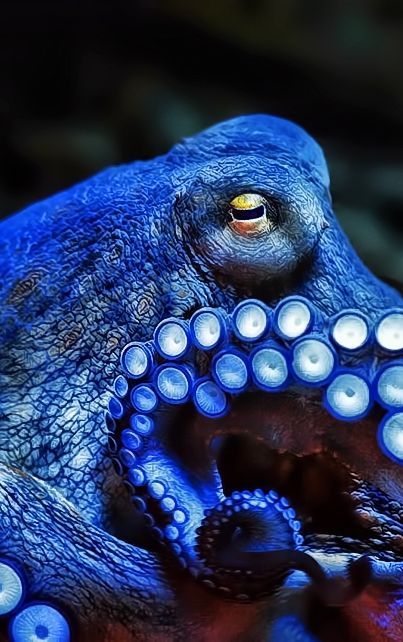

 
Image source:Klaus Wiese, I'm blue, at 500px
Profile Image for Nigel.
1,000 reviews145 followers
April 16, 2019
This is for me an unusual book. I don't think I've read anything quite like it before. George Hills is wrecked on the steamship Admella where he was a steward. He was one of very few who survived. The person who he survived with - female - disappeared shortly after they were rescued. Interesting anyway and more so as so far it is the story of an ancestor of the author. Then the story gets rather different!

The book follows George's life and that of his family. It also features the persona who vanished and appears again from time to time. What was it that George came across after the wreck and what are the consequences for him and his family?

I thought that the writing here was excellent. Evocative and mysterious it created a great atmosphere for this intriguing tale. It manages to be warm at times and quite chilling at others. There really is an other worldly feel to this sometimes. The characters are well worked and felt real to me.

This is not a long book and I think better for that. One of those cases where less really is more. There is room for the reader to think about this tale in the broadest way. It is quite a hard book to review without giving things away. I would prefer the reader to follow their own journey through this tale. For myself I thoroughly enjoyed reading it - it certainly deserves to won an award as a Sci Fi novel in my opinion.

Note - I received an advance digital copy of this book from the publisher in exchange for a fair review

http://viewson.org.uk/science-fiction...
Profile Image for 8stitches 9lives.
2,853 reviews1,724 followers
April 19, 2019
I wasn't sure what to expect when it came to multiple award-winning novel From the Wreck as right from the outset it felt unlike anything I had ever read before, but at the beginning, I wasn't entirely sure whether that was going to be a good or bad thing. Luckily, it turned out to be an unusual and very enjoyable story. This is one of the best fact meets fiction books I've picked up in recent years and cleverly raises the profile of a terrible tragedy that has sadly been long forgotten.

SS Admella was an Australian passenger steamship that was shipwrecked on a submerged reef off the coast of Carpenter Rocks in the early hours of Saturday 6 August 1859. Survivors clung to the wreck for over a week and many people took days to die as they glimpsed the land from the sea and watched as one rescue attempt after another failed. I must admit I hadn't heard of this incident which took place when Australia was a part of the British Empire and is described as one of the worst maritime disasters in modern Aussie history. It's a harrowing turn of events and had me completely engrossed after a few short chapters.

Main character George is one of the survivors who clings to life enduring the wrath of the sea in the hope of making it out alive, which, given the situation seems a little too optimistic. That is until a strange alien being in female form keeps him safe until he can be rescued. This is a haunting lyrical piece and is both evocative and profoundly moving. Discovering at the end that George was a real survivor of the catastrophe and that he was Ms Rawson's great-great-grandfather was touching; it's clear that an extensive amount of research went into producing this wonderful, one-of-a-kind part history, part supernatural story. A well deserved five stars. Many thanks to Picador for an ARC.
Profile Image for Neale .
358 reviews196 followers
January 13, 2019
3.5 Stars. For some reason this book just didn't click with me. Maybe my expectations were abnormally high, it was shortlisted for the Miles Franklin Award and has had many favourable reviews, but it never rose above the level of just being a nice entertaining read for me. I did enjoy it, especially the parts narrated by Henry. I think Rawson does a wonderful job of taking the reader into his head and experiencing the world and life through a young boy's eyes. inquisitive and questioning everything. For me, a decent read but nothing "out of this world".
Profile Image for Renee Godding.
855 reviews978 followers
Read
September 13, 2020
DNF at page 210

Mostly, this just wasn’t what I was expecting, and although I can see how this is an easily loved book by many, it didn’t quite click with me.
Objectively well written with a great many interesting ideas but overall a bit too disjointed and frankly “weird” for what I wanted from it.
Profile Image for Michael Livingston.
795 reviews291 followers
May 26, 2017
This is a beautiful and utterly unique book, about loneliness and belonging, trauma and recovery all with a shape-shifting alien thrown in. That makes it sound much wackier than it is - this is sad, lovely and deeply original.
Profile Image for Nils | nilsreviewsit.
439 reviews669 followers
May 2, 2019

‘I dream him a dream of the endless sky, the hum of the stars, I dream him a world all ocean.’
~
From the Wreck is a historical fiction fantasy novel by Australian author Jane Rawson. It is based upon the real shipwreck of the Admella steamship in August of 1859. Rawson’s great-great grandfather George Hills was on that ship and so her inspiration largely comes from his ordeal, although the events of the aftermath of that disaster are fictitious here.
🐙
First of all I have to mention how gorgeous the cover design of this book is! I love the vivid colours, and the 3D effect.
🐙
From the beginning of the book the plot managed to hook me in. We are presented with our main protagonist George Hills aboard the Admella, when he sees a mysterious woman, whom he long searches for after the shipwreck. Was she his saviour or was she the curse he believed was on him?
🐙
To be honest although the plot really intrigued me, I found the writing style extremely hard to get into. Each chapter switches from first person POV to the third person, and although I’m usually a fan of this change in narrative style, I found it too confusing here. When the chapter were in the first person, there were passages of stream of consciousness which completely jarred me. I had no idea what was going on. I also found the dialogue to be a bit forced and lacking in emotion. However as the novel progresses, I became accustomed to the dialogue and narrative style and eased into it more. I especially always loved the ending of the chapters, which often left a haunting tone.
🐙
In terms of characters, well, it took me a long time to warm up to them. I wanted them to be fleshed out a bit more, and have a bit more personality.
It was George’s eldest son, Henry, that I really felt for. He was a bit of an oddball child, with a macabre flair to him, and his scenes were often quite creepy but also sad. At his heart Henry was a lonely boy who longed for his parents to accept him for who he was.
~
‘Another brain in my brain, another me in me and I am... I don’t know.’ He could feel that brain in him now, squeezing out his thoughts.’
~
I also enjoyed the supernatural element of the story, as there was a shape-shifting entity. Although this POV was the one that initially confused me, I did appreciate the mystery behind what this being actually was, and was it as sinister as it seemed? It made for a very good ending!
🐙
Profile Image for Blair.
2,038 reviews5,860 followers
February 2, 2020
I didn't know this when I started reading it, but From the Wreck is based on a real incident: the shipwreck of the Australian passenger ship SS Admella in 1859. Several rescue attempts failed, leaving victims of the disaster clinging to wreckage for over a week, and 89 people died. One of the 24 survivors was Jane Rawson's great-grandfather, George Hills. The only female survivor was Bridget Ledwith, whose identity was disputed in the years after the shipwreck (two different women wrote to a newspaper claiming to be her).

In Rawson's reimagining of the story, George Hills becomes obsessed with Bridget Ledwith, believing her to be an 'evil spirit', a 'sea creature'. She helped him survive, but those days were a living nightmare. George has what we would now recognise as PTSD and is unable to stop reliving the wreck. His search for Bridget makes him increasingly unstable.

So this could simply be the sad story of a man undone by his memories of a traumatic experience, and by enduring this experience before the psychological impact of such events was properly understood. But we also have chapters told from the perspective of George's eldest son, Henry. As long as he can remember, Henry has had his 'Mark' – it looks like a birthmark to everyone else, but it whispers to him: 'Mark told him things no one else knew'. He has strangely detailed knowledge of life under the sea; memories of a different type of existence.

From the Wreck is an intriguing and enthralling combination of historical and speculative fiction. A well-written, authentic historical tale that occasionally spins into out-there SF and makes it work like a dream. I was just as interested in the world of the human characters – a South Australian town in the 19th century, the 'Sailors' Home' in which George and family live – as I was in the question of whatever 'Mark' was. Certainly more subdued than your average science fiction novel, and effective with it.

TinyLetter
Profile Image for Siobhan.
5,014 reviews597 followers
August 30, 2019
Jane Rawson’s From the Wreck is one of those books where I was first pulled in by the cover. I know you shouldn’t judge a book by the cover, but it was on the shelf in the library and every time I left, I passed it sitting there looking pretty. In the end, I gave in and investigated. It sounded interesting, if a little vague, so I decided to give it a try.

I feel this is one of those books where there was a lot of potential, but it failed to live up to it. Although I was curious, I was never invested. Thus, I was able to put the book down and forget about it a lot. I was ready for a science-fiction read that sucked me in deep, one that was filled with creepy goodness, but it wasn’t quite what I wanted.

It’s hard to say what the specific thing was that made it difficult for me to connect with this one, but I found myself at a distance throughout. I just wanted more, I wanted to go deeper, and we never truly touched upon the things I wanted.

Overall, I think this was just one of those cases where the book wasn’t for me.
Profile Image for Chris.
570 reviews202 followers
June 4, 2018
I had decided not to give star ratings this year, but couldn’t stop myself from giving this one 5 stars. It’s amazing. So rich and complex, yet a breeze to read. One of those novels I wanted to start reading again as soon as I finished it.
Profile Image for Lukasz.
1,825 reviews461 followers
May 2, 2019
4.5/5

The novel opens with SS Admella, an Australian passenger steamship, being shipwrecked on a submerged reef off the coast of Carpenter Rocks in the early hours of Saturday 6 August 1859. Survivors clung to the wreck for over a week, many of them died despite having the land in sight. Rescue attempts failed one after another because of the weather.  Of the 113 on board, only 24 survived, including Jane Rawson’s great-great-grandfather George Hills and a mysterious woman, Bridget Ledwith. 

The loss of 89 lives makes this tragedy rate as one of the worst maritime disasters in Australia’s history. From the Wreck follows the years-long aftermath of this horror through three perspectives, two human (George Hill and his death-obsessed son Henry), and one inhuman (a nameless shape-shifting creature from a different dimension). 

George suffers from PTSD (Rawson accurately illustrates its symptoms and the current state of knowledge about trauma at the time). Plagued by nightmares and obsessed with memories of a shape-shifting woman that helped him to survive the accident, George tries to find her at any cost, slowly isolating himself emotionally and hurting his family. In the meantime, the creature was never far away. It attached itself to George’s family taking different shapes, for example, of the birthmark on Henry’s back. It feels lost and lonely on Earth and tries to survive. 

I appreciate the way Rawson handled inhuman perspective. She did it with a poetic touch, sensibility, and imagination. The creature feels lost, lonely and confused. It doesn’t understand humans and doesn’t want to hurt them, but when it learns that others like it may still exist on Earth, it starts to influence Henry’s behavior. Despite its lack of malevolence, their bond has tragic consequences.
 
Blending facts with fiction, From the Wreck tells a touching story about loneliness, and the need of belonging. An excellent read.
45 reviews6 followers
February 24, 2017
Move over Kurt Vonnegut Jr’s Tralfamadorians, there’s a new alien in town.

In Jane Rawson’s fourth novel, From the Wreck, she takes her unique approach to historical fiction. Rawson is known for playing with form and function within narrative structures. Her first novel, A wrong turn at the Office of Unmade Lists, blended dystopian fiction with the motifs of a humorous road trip and was shortlisted for an Aurealis award. Her novel Formaldehyde cemented Rawson as an author known for their quirky shifting of narrative points of view and time just like any postmodern master. From the Wreck is true to Rawson’s distinct style.
Rawson’s take on historical fiction is akin to that of postmodern juggernaut, Julian Barnes. In his History of the World in 10 1/2 Chapters Barnes takes aim at Noah’s ark in his first chapter and concludes that redheads are the result of an unholy union between unicorns and one of the human members of the ark. Rawson, on the other hand, examines the sinking of the steamship off the South Australian coast in 1859 and concludes that there was possibly alien involvement. And what’s more, it is done in such a subtle and meticulous way that it doesn’t come across as being deliberately controversial or showy as elements of History of the World do.
At the enquiry, months later, he heard that some time on that first evening one of the horses had fallen, knocked from its feet by the rough seas. The racer’s owner had demanded a shift in course and the captain had turned the prow of the ship into the swell to ease its heaving. Had it brought about the wreck, this shift? Perhaps. It did not occur to George to stand and say that it was something other than the swell that had caused the horse to panic. He didn’t even believe it himself.
Rawson has taken on a postmodern master’s approach and won. The refusal to comment on the alien being is the logical reaction of a rational human to an impossible situation that would only lead him to be ridiculed should he dare utter it. The lack of commentary is just as powerful as what is said.
Now of course I can’t reference postmodernism and aliens without discussing how Rawson’s alien compares to Vonnegut’s famous, and much loved, Tralfamadorians. There are similarities, in that these aliens are both distinctly not human. Residents of Tralfamador are quite explicit in teaching humans that there are more than two sexes and there are more than five senses. They are quite active in their contact with people. Rawson’s alien is similarly different from humans. They are fluid, they are shape-shifting, they are confused by their surrounding on Earth because it is utterly alien to them.
I will sit slumping cold and starving here, in this cave, in this wet puddle of an ocean. Who would even mark my death? That crusty-shelled little nobody over there? That slippery piece of meat and teeth? I don’t think so. Weren’t we supposed to be a once-proud race of warriors? I flail at the memory of us and the hurt of it tears strips from me and I decide I can’t remember. Still, I am certain we were not the type whose deaths were marked by becoming passing food for some slippery piece of meat and teeth.
Where Tralfamadorians are willing to take action and do the odd human kidnapping, Rawson’s alien is a refugee on this planet, desperate for their people, wanting a connection, and trying to fit in. It is through this breaking from the butt probing stereotype of aliens that Rawson gives her novel real depth and again sets herself up as one of the greats.
The mood of the novel is intense. From the very first words the reader is sucked into this environment. We can feel the terror, sense the dampness, and recoil at the uncertainty.
He felt it first when the horses shifted and cried. They had been muttering among themselves all day, but this was different, a note of panic in it. The horses aren’t yours to care about, George, he reminded himself. He went from cabin to cabin and collected the crockery and cutlery smeared and encrusted with an early dinner, the passengers getting ready for bed.
The environment created is so vivid that it is hard to believe that this in anything short of real.
Rawson is undoubtedly a master of setting and atmosphere but she is no less a master of character and dialogue. Awkward family conversations crackle off the page.
‘And so cannibalism? What you’re saying is?’ asked George, wondering why William would always use ten words when one would do.
‘That should humans be the most widely available meat, eating the flesh of humans would be the best response to such availability.’
Oh, now he saw. George knew what William was poking at. The bubble solidified into something obsidian-cool, rubbed smooth and sharp-edged in the year after year. George weighed it in his palm, tested the blade, pocketed it. Said, instead, that this would be true, surely, only if you’d nothing else to eat, yes
We may not have been prodded over possible cannibalism but we’ve all been trapped with that family member who thinks that they are so clever and trying to push our buttons. It is through these utterly normal components of life that the elements becomes completely believable.
Overall From the Wreck is a gorgeous miasma of textures and time. It is quite simply sublime and a must read. It has replaced Patrick Süskind’s Perfume as my favourite book of all time. I suspect that this exceptional novel will not only be a contender for an Aurealis but also a Stella award. Just give Jane Rawson all the awards already.
Profile Image for ns510.
391 reviews
June 1, 2018
I feel like my more recent Australian fiction reading list has inadvertently featured bleak reads with young, vulnerable female characters at its centre. So it was refreshing to read this book!

A unique, imaginative blend of historical and speculative fiction, this is a story based on a real event; the sinking of the steamship Admella off the coast of South Australia in 1859. The author’s great great grandfather, George Hills, survived this shipwreck but not without residual trauma and survivor’s guilt. He is haunted by his memories of this event, seeking out a fellow survivor that disappeared into obscurity, perpetually struggling for answers to questions that may never be resolved.

I won’t spoil anything, but I loved how Jane Rawson’s fictionalised account added a whole other dimension to his experience, with general thoughts on evolution and loneliness, about families and life and this vast world we live in.
Profile Image for Lisa.
1,473 reviews20 followers
September 18, 2019
I finished this a week ago but can't formulate a coherent review for it... so i will just sum it up with four words and you will have to read it yourself to find out more...

Historical fiction
Aliens
Coming of age
Vivid imagery (especially of sea creatures)

How do these all come together?! I still don't really know...! It's good though.
Profile Image for Kirsty.
Author 80 books1,472 followers
December 22, 2019
So weird! So good! This book never went where I expected and I loved it. It's smart and strange and kept me totally engrossed throughout.
Profile Image for Debbie Robson.
Author 13 books178 followers
December 31, 2018
I knew from the start of this novel that From the Wreck was going to be something unique. I mean a famous Australian shipwreck and an alien, some sort of cephalopod? How intriguing is that? What I didn’t expect was the outcome of reading this marvellous book. But more about that later.
From the very beginning Rawson takes you to the heart of being on a ship and then soon after into the world of Australian life in 1859. Everything rings true from the conversations of the crew to the depiction of the wreck. But what Rawson is very skilled at, I believe, is evoking the aftermath of such a tragedy.
Here is one of my favourite passages as George Hills reflects on what happened to him:
“This was a new world he inhabited. He could not die, but would suffer on her for all eternity, visited by inhabitants of South Australia who would pull near in their boats to stare and to yell and then, as night fell, would return to their families and their homes and their sweet, rich existences. He would live here, always, in a world rimed in salt, his naked body chilled grey and swollen, his tongue cleaved forever to the roof of his mouth: the monstrous undead king of Carpenters Reef. He had been abandoned. He was not human anymore; he was no longer a part of God’s creation, but something outside it, undreamed of in God’s all-seeing consciousness. He was a creature of the devil.”
Soon after this passage George’s son Henry is born with a strange mark on his back. He believes his son is cursed but in fact the mark is the young boy’s companion, the alien living life through a small child. We learn about the cephapolod’s former home and all her lost family in beautiful haunting prose and we are reminded of our planet from a completely different perspective:
“And there it is, its tiny dot in the corner of my eye which turns out to be that warm, beautiful life-giver, the sun. That star. The sun. It is dot, it is shilling, it is saucer and then here it is in my eyes and ears, and all around me the breaking of the ocean on the shore.
Just me, here, on this world that maybe once was but certainly isn’t now all ocean, and I am filling my eyes with ships and boats and people and jetties and even look a horse there and a man and yes, it is: I am right back where I started.”
More than anything this book for me is about adjustment to change. Just as the alien shape-shifts to survive, so do we have to make adjustments to cope with whatever life throws at us - whether it be a shipwreck or a personal loss - the challenges of being a survivor coping with guilt, or a child that is different from others. We each have to learn how to be ourselves in a new world.

Profile Image for Lena.
1,216 reviews332 followers
May 28, 2021
That was odd.

An alien tries to connect with the world by saving a sailor from a shipwreck. It then keeps itself in his life until he has a mental breakdown. They then have a come-to-Jesus and he decides having an alien in their lives is fine.

Just to make it stranger the author used her real family, and other real people, as characters. But swears the family alien is not real.

Well, what else would she say?

From the Wreck was a special offering from Goldsboro Books. I received 23/150, signed by the author, with a bookmark.
Image and video hosting by TinyPic
Profile Image for Calzean.
2,770 reviews1 follower
November 21, 2017
The author recreates the shipwreck tale of her great-great-grandfather who survived 8 days on the sea before being rescued. It could have been a nice enough story but to provide some spice the author adds to the mix a shape-shifter alien marooned on Earth. The story moves from the third person when describing the human characters to a drifting complex of words when narrated by shape-shifter. Quite an accomplishment which worked for me.
Family history genealogies will never read the same again.
Profile Image for Knigoqdec.
1,182 reviews186 followers
April 1, 2023
Нелоша история, но не ми се видя достатъчно добре предадена. Във всеки случай по-скоро не ми беше увлекателна. Имаше и слаби похвати за насищане на случващото се, или иначе казано "и аз тръгнах надолу и надолу, и надолу, и надолу..." и подобни. Почти навсякъде, където човек трябва да усети нещо повече. Досадно и по-скоро скучно като за фантастика. Звучеше ми така, сякаш авторката няма достатъчно богат речник, за да ни накара да се "гмурнем", без да се налага да прави въртележки от повторения на една дума. Все пак - хващаща корица.
Profile Image for Ian Mond.
749 reviews119 followers
April 3, 2017
If the world was fair and just Jane Rawson’s From the Wreck would win numerous awards, both literary and genre. Not that shiny trophies are the arbiter of great fiction, but they do draw attention to the nominees and this a novel that's worthy of the hype and buzz regularly applied to lesser works. From the Wreck is an extraordinary piece of writing, in the way it blends genres, in the way its ambitions are matched by sublime prose, in the way it explores and questions life in all its varied states.

At first From the Wreck reads like a traditional historical novel. George Hills, a steward on the steamship Admella, is one of a handful of survivors when the hapless boat sinks off the South Australian coast in 1859*. A second survivor, who plays a significant hand in keeping George alive while they’re lost at sea for eight days, is Bridget Ledwith**. Years later and George who is married with children is haunted by what he and Bridget did to survive (which given they had no food or water should have been impossible). Bridget vanishes soon after reaching shore and George spends his free time trying to find her, hoping she will explain his fractured memories of those eight days at sea.

I'd rather not mention the primary genre element – though for your own safety KEEP AWAY FROM THE BLURB - not because it's a twist, it's introduced in the second chapter, but because the novel’s lens, so focussed on this one tragic sinking, abruptly widens its gaze, reminiscent of that famous final shot of Men In Black as the camera zooms out, in all its CGI glory, from a street on Earth to the Universe at large. And that zoom generates a giddy sensation, an indication that this intimate story about a man dealing with post traumatic stress is something so much stranger and wonderful and transcendent.

While the novel is always wonderful, it somehow finds another gear when Rawson’s discussion of the natural world bleeds into a meditation on mortality and the bounty of life. George’s son, Henry, is endlessly fascinated with the skeletons of dead animals, a collection of which he keeps hidden in the house. And this fascination with death isn’t expressed in a dark or creepy manner, but as something complex and layered – inevitable and joyful and frightening and numinous. Or as Rawson beautifully puts it:

[Henry] plunged into the swarming ocean, felt its wriggling abundance. […] Henry felt his place in it – just to be this boy and never wonder why or who or how to be better, braver, otherwise. Just to be and to love. To notice it fresh every day. Not to fear it leaving; to know it always was and always will be, and that when this body stops and rots and makes itself food that still it will all go on just like this, just like always. Tiny tragedies, tiny triumphs and none of it meaning a thing against the great still monstrousness of forever and always. This always ocean, this always world, these always stars, this stretching, boundless, eternal universe. This quiet space.

The ease in which Rawson articulates complex thoughts around mortality and eternity, the way she seamlessly slides the narrative between historical and science fiction and how her characters – especially George – are as complex and flawed and brilliant as the themes Rawson’s tackling is, simply put, a master-class of story-telling.

I'm not saying that reading From The Wreck was a spiritual experience – because there's only so much hype and I can slather on one book. But I truly doubt I'm going to read anything this year that as rich and deep and intelligent as this tremendous novel. And if I do it will be one helluva year.

* There was an Admella. It did sink in 1859. Of the 113 on the ship 24 survived.

** Also a real person and the only woman to survive the wreck. She even wrote a book about it.
Profile Image for Julia Tulloh Harper.
220 reviews32 followers
April 18, 2019
This was incredible. It's one of the strangest books I've ever read - and also one of the best, I'd say it's made it into my top 10 books EVER. A blend of historical fiction and spec fic (set in the 1800s; also has an alien in it as one of main characters) it was narrated in such an interesting way, and covers the effects of trauma, loneliness, relationships, how we fit into the world (in a sort of deep time sense). EXCELLENT. Don't want to say much more because it was such a joy to read a story that unfolded in ways I never would have expected, but that made perfect sense.
Profile Image for Cass Moriarty.
Author 2 books191 followers
March 28, 2017
From the Wreck (Transit Lounge Publishing 2017) is the new novel from author Jane Rawson and it is utterly, utterly strange and compelling. It's difficult to find the right words to even begin to describe this evocative hybrid of historical fiction and science fiction, this tale of grief and loss combined with playfulness, adventure and imagination. At its centre is the tragedy of the 1859 sinking of the steamship Admella, off the coast of South Australia, and the story of the survival of George Hills (based on Jane's great-great-grandfather), along with a mysterious woman named Bridget Ledwith. The wreck floundered for a week, with all but a handful of survivors slowly dying from hunger, thirst and exposure. This is a unique and brave reimagining of that catastrophe, with a completely unexpected addition: ghost? demon? alien life form? underwater creature? curse? You be the judge. To attempt to describe the narrative would only undermine its lovely eccentricity; you must experience it yourself to understand. The story constantly moves between grounding the reader in actual historical events that ring true with familiarity and detail, to outlandish flights of fancy that demand the reader open their mind to all manner of new ideas and possibilities. With this book you must expect everything - and you will still be surprised and delighted. But despite the depth of this story, and the multilayered existential ponderings on everything from loneliness and trauma to climate change and evolution, Jane still manages to keep a tight rein on the narrative, keeping us closely aligned to the characters, particularly George and little Henry, and fully engaged with the trajectories of their lives. Somehow this book manages to be both tender and chilling, both hopeful and frightening, both coarse and beautiful, both unbelievable and entirely plausible. It is a novel of opposites, a mind-stretching genre-bender that will have you questioning everything you thought you knew about skin, the sea, cats, hauntings, other life forms, the octopus, and small boys. It will cast its strange spell and compel you to keep reading, even while you wonder what sort of weird parallel world you have stumbled into. Its heartbreaking mystery and its tender portrayal of childhood, of grief and of vulnerability, will astonish you as often as its gut-wrenching, abrupt, crude and naked intensity. A very unusual book.
Profile Image for KW.
374 reviews8 followers
April 28, 2019
Loved the descriptions of the shapeshifting and squishy tentacles, and everything to do with birthmark. Got a bit lost by third trail of the story, but see why this is easily loved.
Profile Image for I'.
551 reviews291 followers
April 2, 2019
This book was so many thing I was not expecting but definitely loved and still think about them even though I have finished reading it.

It draws initial inspiration from an historical ship wreck in Port Adelaide, in the 1850s, but goes far and beyond to tell this story. I do have to warn you, it may be a bit confusing at the beginning. Some of the narrative lines threw me out a little bit at the beginning, but there is brilliance in them, and you’ll discover it as you read along. But at the same time, I thoroughly enjoyed how ambiguous can be with characters and the story itself leaving plenty of room for the readers theories.

I loved how the story goes from the life of a woman in charge of her baby grandson, the point of view of a little kid and his father to something completely different. It mixes the, so to say, simple life with totally different concepts but without loosing the essence of any of them. This is archived by a mastery with the different point of views that not only draws the characters in a very special light; it also encourages the reader to see their point of view, yo go deeper into their brains and to actively practise empathy as we all communicate in different ways.

A difficult thing for me would be how to make this book fit into a genre. It is science fiction, definitely, but it has a pinch of horror on it and a historical fiction background. I just loved how this book is, in a way, a very cool and enjoyable mix of pretty much everything what the author wanted without thinking if the book would fit. And that it’s part of what makes it work so well.

Beautifully written. The author manages to make all the characters come alive in your imagination, even those who are not so familiar to us. But then again, that would be another reason why it is so difficult to compare and describe how it is like. A definitely original, worth the read book!
Profile Image for Carolyn DeCarlo.
262 reviews19 followers
March 24, 2018
A great idea executed poorly. I enjoyed so much of the details of this book, from the Mark, to the giant blue octopus, to the relationship between Henry and Georgie. Overall, though, this book did not do it for me. The amalgamation of narrative voices could have been a good touch in a longer book, but made me feel held at a distance from both George and Bea, the two characters (besides, perhaps, Henry) we are supposed to understand the most. And I'm not sure this is the type of novel where hearing from the alien's perspective could add anything of value -- I feel like, once we know the Mark and Henry can hear it, everything that's said in the alien's chapters felt repeated and overdone.

I wanted a hell of a lot more time on the wreck, and more gruesomeness. If I'm to think George has been haunted his whole life for his cannibalistic acts on the boat and his illicit times with the alien, I want to know a whole lot more about them in the present tense -- not just from hearsay and in shamefully repressed retrospective. I don't want to be told to turn away, I want to do it myself. Don't spare me the cringe, make me. Otherwise, what's the point?

I feel disappointed when a writer shows their talent, their immense capacity for imagination, but hesitates to bring it fully to life for fear of the reader and their tastes or ability to stomach it. Give us a bit more credit! Most of us are here knowing an alien's going to lick the foam from a horse's mouth. Don't let that be the wildest thing that happens in the whole book.
Profile Image for Michaela.
283 reviews21 followers
June 10, 2024
From the Wreck was unique, consuming and fun. Historical fiction with a twist. The Admella sunk on a routine trip from Adelaide to Melbourne back in the 1850’s and the author’s ancestor, George Hill survives, while many don’t. Rawson serves this tale up with a dystopian twist: one of the survivors isn’t what they seem.
A blending of historical fiction and dystopian? Yes please. Rawson has written such a unique take on this story: a true historical event with added shapeshifting alien. It sounds bizarre but somehow it works perfectly. Even having this insight prior to reading this novel it was so different to what I imagined.
I couldn’t help being sucked into the story and the characters. I devoured the pages wanting to understand. From the Wreck is imaginative and fun. I loved each of the characters, particularly our loveable alien. Rawson has a gift with words and a remarkable ability to create perspective. From the Wreck is well worth picking up, particularly if you are a fan of historical fiction but want a fresh twist.
Profile Image for Justine Hyde.
10 reviews11 followers
April 10, 2017
Genre-bending, ambitious, wild and magical. I loved this novel. Rawson challenges the boundaries of historical fiction with a shape-shifting alien character. She takes us on a journey from dusty and dry 19th century Adelaide, drags us down into the deepest oceans, flings us out past the stars and into space and then reels us back to earth again. This tale of loneliness, trauma and grief is equal measures tender, dark and playful. This novel is original and deeply human. Rawson is masterful at stretching plausibility just enough, balancing a tricky line of believably that never tips too far over the edge and without ever becoming tricksy. I'm not sure if I would use the label scifi, fantasy or magical realism for the novel. It did remind me a little of Jeanette Winterson in books like The Passion, but then I also thought it was completely unique.
Displaying 1 - 30 of 232 reviews

Can't find what you're looking for?

Get help and learn more about the design.