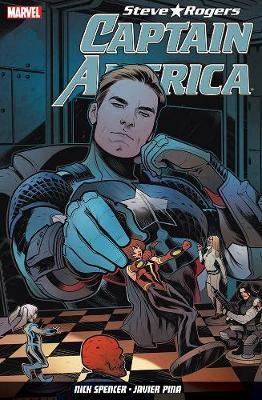
He’s a hero. An Avenger. A living legend. The Sentinel of Liberty. Mankind’s greatest threat? It’s the story that shocked the world — and you won’t believe where it’s going next. In the aftermath of war, Tony Stark and Carol Danvers turn to the one person they can trust: Steve Rogers, Captain America. Uh-oh! And when Zemo returns, can the new Masters of Evil be far behind? The secret story of Cap in World War II is told! The full extent of Madame Hydra’s string-pulling is revealed! But only one man can lead Hydra into a new age of dominance and superiority — and the Red Skull believes he is that man! But Captain America has other ideas — ideas that will change the landscape of the Marvel Universe! Collecting CAPTAIN AMERICA: STEVE ROGERS #12-16 and CIVIL WAR II: THE OATH #1.
Librarian Note: There is more than one author in the GoodReads database with this name.
Nick Spencer is a comic book writer known for his creator-owned titles at Image Comics (Existence 2.0/3.0, Forgetless, Shuddertown, Morning Glories), his work at DC Comics (Action Comics, T.H.U.N.D.E.R. Agents), and for his current work at Marvel Comics (Iron Man 2.0, Ultimate Comics: X-Men).
I am just so much more interested in seeing how they wrap this up than I thought I would be when it first came out. I'm pretty shocked, honestly. I'm still enjoying the way the flashbacks are written, and (to me) the political stuff was a bit less annoying this time around. No, I'm still not crazy about politics in my comics, but the other option is to stop reading Steve's Captain America title and I still like him too much to give up just yet.
I thought it was great that two losers like Taskmaster and Black Ant were the only ones who stumbled onto the video of Steve's Hail Hydra chant. And even if they managed to pass it on (for a price) to Maria Hill, who the hell is going to pay any attention to her?
And the stuff with Bucky?! Ohmygod. I'm all wrung out by that ending! I don't want to give anything away, but I absolutely loved that Steve really cared for and tried to protect him, you know? *sobs* Hail Hydra!
I know not all of you are loving this storyline, and even I'm not sure if I'll end up digging it when it's all over with, but this particular volume was (to me) a good one.
This really got me invested in what's happening with these characters, and I honestly cannot wait to see what happens next!
God, am I ready for this craptastic story to be over. It's so bad it makes me yearn for the days of CapWolf. The storytelling is just terrible. All of these major events are just glossed over in the leadup to Secret Empire. It almost feels like they actually happened in other books and are just being recapped here. And now we've retconned things so that Cap's adopted mom and Helmut Zemo fought during World War II, so along with Steve Rogers, the Red Skull and Bucky over half our cast should be over 85 years old. I'm surprised Spencer didn't find a way to get Nick Fury in the mix as well.
The art in this book is awful outside of the one issue drawn by Jesus Saiz. Most of the book looks like it was sketched on cocktail napkins and left for the colorist to try and clean up.
Captain America: Steve Rogers just continues to impress me. I love that we get a villain (Steve) who isn't just pure evil, that what he wants to do, and change, is almost admirable if not downright truthful to our days society in ways.
So this volume is a nice bridge before Secret Empire. As we know Cap has slowly been building towards the take over. However with Zumo by his side, with a certain villain out of his way, and heroes not paying attention, he begins to take over the world the way he knew he could. With the trust of the "people" it's easy to see how he'd be able to do so. Sounds familiar right? Prey on the fear of the people to win their loyalty.
Good: The opening Oath chapter is great. It's similar to the moment when Steve died and Tony sat by him speaking to him. This is a lot more sinister of course. For Steve could tell Tony who he truly is without worry of one of his friend ratting on him. Also the whole last two issues really build and shape up Secret Empire and the death (well maybe) of someone is shocking and fucked up.
Bad: The two chapters after the Oath are kind of slow paced and dragged some. It's a lot of building and as much as I do love the build up the mass amount of dialog can be overbearing at times. Also the art was kind of iffy at times.
I'd probably rate this around a 3.5 but I'll shoot it up to a 4 because I really do enjoy the story's ideas and excited to get into Secret Empire completely. Here we go!
This Steve Rogers: Captain Hydra story-arc has had its moments but, all things considered, I'll be glad when it's over. Secret Empire should close the book on this story, I hope...
3.5 stars. We get some more flash backs from where Kobik has rewritten Steve’s memory to make him believe he was raised Hydra. Also we see Elisa return to gather up the rest of the Army for Steve and they put all the planning into motion to take over as seen in the Secret Empire book. Although this isn’t the best Captain America story I’ve read, it’s unique and unlike any other Cap story and interesting enough to make me want to read the other 2 books that lead up to Secret Empire.
With a title like Empire Building, and a character like Steve Rogers: Captain America having recently been unmasked as a Hydra agent, you can guess what sort of calamity is in store here.
With Hydra forces on the rise across the world, and actively engaged in war to control the European country of Sokovia under the rule of The Red Skull, SHIELD has been looking to expand its powers. With Maria Hill ousted for her role in the Pleasant Hill fiasco, Rogers has been made the new director and just in time to be granted a frightening breadth of power by the US Congress with the passage of the SHIELD Act, a plan to make the security agency a bonafide ruler of a police state in the wrong hands. But hey, everyone trusts Captain America, so what could possibly go wrong?
I was a bit worried about this epic storyline when word first emerged of Nick Spencer’s plans for Rogers, but I’ve been enjoying this tale quite a lot. It’s a smart sci-fi political thriller that keeps you guessing, and Spencer is adept at ratcheting up the stakes, keeping the story turning and turning and turning.
My only real complaint is that, with this volume especially, we’re getting into crossover territory yet again. There are some pretty significant subplots running through the back half of this book that hinge on developments unfolding in other Marvel titles. Some, like certain events involving The Red Skull, are recapped well enough here that I didn’t feel like I was missing out. Other elements, such as a battle between the evil Baron Zemo and one-time Cap ally, Bucky Barnes, occur in an entirely different title. We see the head-scratching aftermath here, and there’s several blanks that need filling. I get these crossovers are a great way for Marvel to make some money, but Christ on a cracker is it ever annoying as a reader. I’m longing for some self-contained stories that don’t farm out important plot elements to five other comic titles. Still, it’s not as badly handled and mismanaged as Spider-Verse, so some Credit is due here at least...
I haven’t mentioned the flashbacks in my previous reviews, but we’ve been getting a lot of development on the rewritten history of Rogers. It’s good stuff, but the one thing I appreciate the most in these sections are the coloring. Told in black-and-white or the occasional sepia panels, colorist Rachelle Rosenberg uses some deft spot coloring techniques to keep the panels vivid and engaging. I love a good use of spot coloring, and these have been dynamic and fun to look at. She spices up these moments with some nicely deep reds or shocking greens, creating really cool visuals for the book’s art teams.
Now onto the penultimate volume and the Secret Empire storyline!
Collects Captain America: Steve Rogers issues #12-16 and Civil War II: The Oath issue #1
SMALL SPOILERS/REFERENCES FOR "SECRET EMPIRE":
I continue to enjoy the alternate universe flashbacks into Steve's past life, and it helps me understand more about where he is coming from. As I read this volume, I had already read parts of the "Secret Empire" event, and I like how Steve is characterized in his own title better. Here, he does bad things, but seemingly with a good heart. Eventually it feels like he has just become evil. I liked it better when he was torn up over making hard choices.
This volume sets the stage for "Secret Empire," and puts a lot of the important pieces into place.
[Read as single issues] I've been reading quite a few Secret Empire tie-ins, and most of them are good fun but not exactly essential to the overall story of the event. Meanwhile, Steve Rogers' solo series laid all the groundwork for what came about next, so you should probably read this before any of those tie-ins anyway >_>
Collected here are the Opening Salvo issues of Secret Empire, the ones that really show how Steve came to take power for Hydra, and the formation of his powerbase. First off is The Oath one-shot, which is, to be kind, pretty bad. I get what Spencer is trying to do here, but the dialogue feels REALLY forced, as Captain America talks to the 'dead' body of Tony Stark after the events of Civil War II; it's a nice parallel to the Civil War one-shot that had them the other way around, but it feels extremely sluggish and overly long for something that's basically a recap and a prologue all in one. Hard pass.
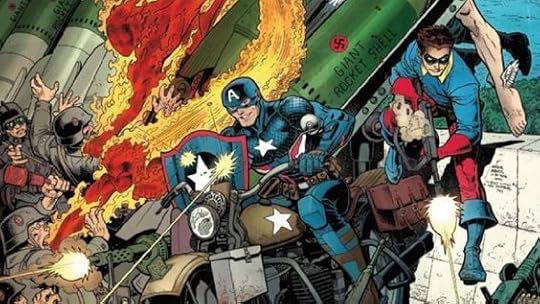
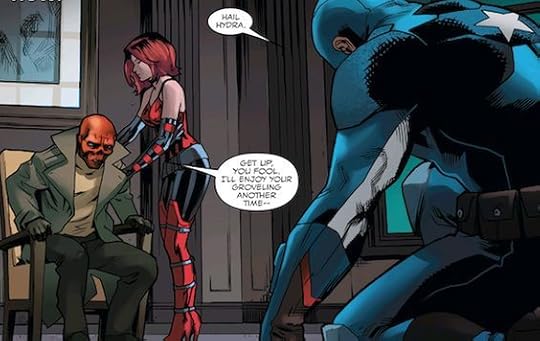
The other issues here are much more interesting. We get some background on Steve and Zemo's newfound friendship, the 'true' background of the Invaders during World War II, a semi-Thunderbolts tie-in, and Steve finally coming face to face with the Red Skull for a very final encounter. These issues are superbly done, and really give Secret Empire the impact that I think is lost if you only read the main series.
The art is, unfortunately, all over the place. Rod Reis turns in his first Marvel interiors (I think?) with the Oath, and his ethereal colour style is peculiar for more grounded stories, while the issues of Cap itself have an array of artists such as series regulars Jesus Saiz and Javier Pina, with assists from Kevin Libranda, Ro Stein & Ted Brandt, and Yildiray Cinar and Jon Malin. It's a hodge podge, and it just goes to show that Marvel were pumping this series out like crazy so that it all came out on time before Secret Empire really began.
If you're going to tackle Secret Empire, I'd say Steve Rogers is basically essential reading for the event, if you read nothing else.
A third volume of Hydra Cap stories which has three jobs to do: explain Cap's new history (particularly the whole "fighting Nazis" bit, though see below); move the pieces around to set up the Secret Empire crossover; and make it clear that Hydra are Definitely Not The Same As Nazis (they've got some kind of Cthulhu deal going on instead). Splitting the comic between present and past makes the book move slowly, but the wider problem isn't its pace. It's that of the three prongs, the first is going to be retconned, the second is going to be resolved in another comic, and the third feels like ass-covering for the benefit of angry commentators (eg Madame Hydra is peeved that the Red Skull has perverted a Hydra to his "sick ideals", but the work of explaining precisely the difference between his ideals and theirs is not at all done). Secret Empire may or may not be a good event - it's got off to a reasonable start - but its lengthy prologue feels laborious and pointless.
I read this in individual issues. The biggest complaint I have is poor storytelling. Or maybe incomplete storytelling is more accurate. The penultimate chapter of the Red Skull story is not in Captain America? It was oh yeah this happened but not here where the Skull started all of this and Capital is who he is because of the Skull. Why are we cheated of the conflict? This RUINED the resolution in issue 15. Picture hitting a World Series winning home run, but you don't actually hit the home run you just get to touch home plate.
The pacing on this story is horrible!! It is both plodding and lightening fast at the same time. It is unfortunate because I am finding the story interesting, but I am frustrated with the inconsistent storytelling.
Pretty damn awesome. It really sold the preposterous story of Steve Rogers becoming the leader of Hydra. In fact, by the end of the volume, it didn’t even seem preposterous.
There's an obvious desire here for the story to be "important", but I think it's more heavy in concept than execution.
Every turn of the plot is supposed to be a bang, but I just don't see the emotional gravitas. I mean, it's actually fine. I'm probably dragging it more than it deserves. However, I think the potential for some real original and inventive storytelling is right there, and they don't quite grasp it. So, I'd say more of a disappointment than a truly bad comic.
As much as I like the current storyline of both Captain America I felt this one was bit dull, or at least a bit awkward and too slow building.
A Hydra council is put into place and Cap finally locks horns with the Red Skull. Things speed up in the last two issues, giving a much needed sense of urgency and one B-list character is (at least apparently) killed. Good past sequences again even if a bit more confused. Oh, and apparently Hydra aren't nazi nuts but Cthulhu admirers. Eh, it figures when one takes a look at their logo!
Now Secret Empire can begin at last.
I could have lived with the slow storytelling, can't say it's much of a surprise with what happened in the previous volumes. No, what cost this one 1/2* I would have bumped up is the poor art direction: At least half a dozen different artists ranging from good (Jesus Saiz) to mediocre (Javier Pina, Ro Stein...). I'm not too keen on the multiple artists stunt to begin with so the lack of consistency/quality between them doesn't help me see it with a kindly eye.
No point dwelling on it anyway. You're on the course of Secret Empire? You can't skip this volume so make do with it.
Spencer's Cap book just teeters on the edge of greatness. There are moments of absolute genius subversion that grab me like nothing else, but there are also far too many dragging moments of over-written dialogue, muddled further by inconsistent art. It's very frustrating to have a book with such solid fundamentals trip up on itself so frequently.
I love the way Spencer elevates minor characters, such as his enlistment of Taskmaster and Black Ant in this book. He sees the whole toolbox before him as a content creator for Marvel, and reaches just a little deeper than most writers bother to go. This book is smart, and weird, and at its heart, more quintessentially Captain America than one might expect.
But the dark cloud of event-impermanence looms above, as it so often does in a Marvel book. Coupled with the troubled art and occasionally over-ambitious dialogue, Steve Rogers just can't seem to get a grip on its own greatness. I bounce back and forth between intrigued and bored pretty much every other issue. It's an exhausting experience, but I still want to see how Spencer brought it all together in Secret Empire.
Things are moving... but nothing is really happening here. Yes, Cap is now the head of all the organizations , but it sorta feels like this volume was redundant. Or maybe that volume 2 was redundant & that this story could have been told in two volumes (1 & 3) or less?
Anyway, I like Javier Pina's art in issue 12, but not for this storyline. Any other story & I would call this art gorgeous. Also, Cap is drawn to look a lot like Chris Evans here, which is funny.
Also, since Elisa is working as Lady Hydra to gather a Council of Hydra together (for Steve), does that mean she knows/remembers his fake Kobik Hydra history too?
Druhé přečtení: Úvodní sešit Oath je super. Spencer tu dá na pár stránkách Starkovi/Danversové víc charakteru, než Bendis v celé Civil War II. Zbytek je čistě build-up k Secret Empire, kdy se Stevilovi plány pomalinku blíží k cílí (a občas je to zbytečně natažené).
Když se budu tvářit, že nevím co přijde, tak ty 4* z prvního čtení dám. Pocit epičnosti a zásadnosti tu v závěru prostě je.
It's not a bad book to begin with. Unfortunately neither is it great. The flashbacks are interesting and we now know the Cosmic Cube is behind all this. However, the convenience soon took over despite the painstaking effort to build a credible plot.
The lead-ins to big crossovers can often be more satisfying than the events themselves – fewer cooks, less attention from marketing, more focus. And the basic ideas of Nick Spencer’s Cap run remain strong, not least because this collection includes the excellent ‘Oath’ one-shot in which the Kobik-warped Steve Rogers offers a terribly seductive account of his agenda – far more seductive, indeed, than the garbled, clownish versions for which the real America, and Britain, fell last year. And oh, it’s become even more topical since it came out, especially when a sinister lunatic gets control of a nuclear state, and starts making worrying threats. Though as so often lately, the fiction falls short of reality: say what you like about the Red Skull’s look, but at least he doesn’t have such a stupid bloody haircut as our own brinkmanship twins. The Skull, though, is also the fulcrum of the book’s biggest problem – the contortions into which it twists itself trying to dissociate Hydra from the Nazis. Apparently it’s fine to have Cap perverted into taking over the world on behalf of a fascist conspiracy, so long as they’re not racist fascists. So we get the whole faff about how it was only the Red Skull who perverted Hydra into that, and good honest Hydra types have disapproved all along, and now Cap is going to…make Hydra great again? It’s a silly compromise of the story’s full horrific potential, and serves only to make the rest of the villains sympathetic in the wrong ways.
This story just keeps getting better. I really went into this thinking I would hate it, but it's been so well executed it's turned out to be really good. They are just now pulling the trigger and we are about to see Hydra's plan to take over the world executed. There are a few elements that don't quite fit and you have to just accept, but overall this is good.
Spencerův Cap je dalším důkazem toho, že dobrý autor udělá výborný komiks z jakékoliv postavy. Zatím jsem příjemně potěšený až skoro nadšený. Teď to jen na konci nepokazit.
I have to admit, as much as it creeps me out to say so, this Steve as Hydra agent thing is growing on me a bit. Not that I want it to be true, not that I want to believe it, or replace Captain America/Steve Rogers, but Spencer is writing a story with incredible imagination and scope. He is playing with a reality warping device/power, which makes it a bit alt-worldy, and that has been done before, whether in the form of time-travel take backs or other cosmic cube stories.
In fact, Waid and Garney's classic cap run from the mid-nineties started off with an alternate reality cosmic cube story. All Spencer has done here is to use the cube to make an alternate Steve as part of his story. In fact it's mirror image, it's alternate Steve in the real world instead of real Steve in the alternate world.
Still the depths and thoroughness with which Spencer has imagined this alternate history and the Steve Rogers it produced is powerfully convincing. Horribly so. It's like watching a slowly-revealing nightmare. His dedication and thoroughness in developing his storyline has won me over to an extent. We'll have to see if he can stick the landing.
What a difference it makes when you understand the full context of things and have a clear view of the superstory being told here, of which this arc is a critical part. Having the full context of Avengers: Standoff, Civil War II and the Sam Wilson title (which I didn’t have the first time around), I understand now how this volume fits into the larger tapestry and have a greater appreciation of it as a result. A strong volume that leads into the Secret Empire event. Really absorbing.
ORIGINAL REVIEW
Ten tons of speechifying, heavily repeated exposition, a bunch of the action clearly taking place in another title (Thunderbolts, I assume), and inconsistent art make for a somewhat dissatisfying read. Some interesting character touches, a mild twist or two, and a few momentous events saved this from being a waste of time, but it’s the least of Spencer’s efforts thus far.
I have endured this for as long as I intend to, and this will be my last review of "Captain America", probably forever. I don't care what kind of Skrull shenanigans Marvel comes up with to fix this, but for over a year, they have made Captain America a villain. They have slaughtered his backstory and made this book unreadable. I no longer wish to participate in reading this trash, and wish to congratulate Marvel into now fully driving me into the arms of DC Comics.