Jump to ratings and reviews
Rate this book
Rate this book
Da più di mezzo secolo la Cina registra impetuose trasformazioni. Il paese è oggi il leader mondiale con cui Stati Uniti e Russia sono costretti a fare i conti. In un libro che raccoglie discorsi, interventi, articoli, lettere del presidente della Repubblica popolare cinese; le chiavi per decifrare un universo complesso e affascinante, verso il quale l'Occidente dimostra ancora una inspiegabile e colpevole miopia: il progresso della Cina ha avuto e continuerà ad avere un impatto formidabile sul resto del mondo. Il presidente cinese affronta le questioni economiche, sociali e politiche più rilevanti del momento e presenta la filosofa che ha guidato gli uomini di governo del gigante dell'Asia: il cambiamento nella continuità promosso da un partito centralizzato ma attento alle sfide della politica globale.

588 pages, Paperback

First published October 1, 2014

222 people are currently reading
2392 people want to read

About the author

Xi Jinping

209 books71 followers
Xi Jinping (simplified Chinese: 习近平; traditional Chinese: 習近平) is the General Secretary of the Communist Party of China, the President of the People's Republic of China, and the Chairman of the Central Military Commission. As Xi holds the top offices of the party and the military, in addition to being the head of state through the office of President, he is sometimes informally referred to as China's "paramount leader". As General Secretary, Xi is also an ex officio member of the Politburo Standing Committee, China's de facto top decision-making body.

Ratings & Reviews

What do you think?
Rate this book

Friends & Following

Create a free account to discover what your friends think of this book!

Community Reviews

5 stars
144 (29%)
4 stars
132 (26%)
3 stars
111 (22%)
2 stars
48 (9%)
1 star
61 (12%)
Displaying 1 - 30 of 83 reviews
Profile Image for Tom Shannon.
174 reviews4 followers
May 29, 2018
I don't think this book is 5 stars to everyone. As it is written by a political leader, there is a lot of repetition in the main ideas.

It is filled with footnotes and quotes from Chinese philosophers and the explanations of developing a socialist market is rare to find. The book is key to understanding China's development and solidarity with other countries as well as the reforms that they go through while combatting corruption.

I learned a lot about the Communist party of China's plans and goals through reading this text.
Profile Image for Tyler.
51 reviews6 followers
January 30, 2017
Chinese politics is not something I have studied in great depth so there is a part of me that feels very unqualified to review a collection of speeches given by the leader of the world's most populous country and second largest economy. In order to seriously critique this book one would need to compare what Mr. Xi said in these speeches with his actions. Since I can't read or speak Chinese and have never been to China I can't do that. I am sure there are plenty of reasonable people who would read this book and consider much of it Orwellian double speak. Even still, even if this book is all propaganda, it is still a convincing work of propaganda and much more inspiring than anything we read about in U.S. politics in 2017.

I wanted to read this book because there seem to be quite a few people who view China as some sort of Arch-Nemesis of the United States. Politicians in the United States have accused China of being a currency manipulator, a gross polluter, a expansionist military power and stealer of manufacturing jobs. Even if we were to believe that China poses any kind of threat to the world (which I do not), we would have to admit that China's ability to raise a million people out of poverty is quite impressive and worth studying.

So I enjoyed reading this book because it went a long way to enlighten me on how the Communist Party of China (CPC) views its role in China and the world. There is hardly anything to argue with in this book. Mr. Xi discusses protecting the environment ("ecological progress"), hard work, family values, and even support for unions. I especially like his goal of a "moderately prosperous society", as opposed to mindless accumulation of material goods and money. As someone who lives in a culture where crass consumerism runs rampant, it is refreshing to read Mr. Xi say “To meet our development goals, we must enrich ourselves not only materially but culturally and ethically as well.”

One thing that I think helped me understand this book was a little background in Chinese history. Besides the "5,000 years of Chinese culture" cited by Mr. Xi, there are three main events that most of his thinking seems to center around. The first events were the Opium Wars, The Cultural Revolution in China, and the "Great Opening" led by Deng Xiaoping. It is probably good to know about these events to understand Mr. Xi's book.

Finally, if I were again to take this book as a sort of sales pitch or propaganda I can at least say that Mr. Xi appeals to my better instincts. This book includes pictures of Mr. Xi riding a bicycle with his daughter, pushing his mother around on a wheelchair and casually chatting with farmers.
Profile Image for Robert II.
Author 5 books
March 23, 2024
An absolute snooze-fest of a book, whose only real accomplishment is paradoxically managing to repeat itself at least twice per page without having said anything in the first place.
I picked up this door-stop in October of 2018 wondering how I would feel reading it. Would I be angry? Inspired? Worried? The answer turned out to be "bored-to-tears."By the time I got through rolling my eyes on virtually every page and having to put it down to go fill my head with something more substantial (like watching paint dry), I managed to finally be done with it in late December. I would normally finish three books of comparable length in that time-frame.
Essentially, the book is an exercise in how many CPC catch-phrases ("Chinese Dream," "Great Rejuvenation of the Zhonghua Minzu," "moderately prosperous society in all respects," "_____ with Chinese characteristics" etc.) can be crammed into one place. The author frequently uses the phrase "we must" when describing what he thinks needs to improve about China (which, to his credit, is basically "everything"), and yet not once does he put forth any concrete ideas on how. Laced through every page is the absolutely laughably arrogant belief that a broken and ruined world lies humble and prostrated, waiting for the "Great and Glorious Central Nation (the latter two being a direct translation of the Chinese name for China)" to take its "rightful place" of benevolent leadership over a world of "barbarian vassals (who he seems to think are fawning over China the way Tang Dynasty poets mistakenly believed their neighbors did)."
The two segments on Taiwan read more like alternate universe science fiction than political commentary, as he routinely asserts (quite emphatically I might add) that the Taiwanese share his vision. Anyone who has been to Taiwan for more than a day or two is likely laughing themselves to a hyperventilative state upon reading that.
And yet I could probably have overlooked all that (after all, when one picks up a book that is a collection of a politician's speeches, one sort of expects a lot of hot-air and on that score Xi certainly delivers), were it not for the fact that the afterword (which, if you can believe this, is entitled "Man of the People") has the unfathomable gall to actually claim this princeling identifies with the common man. The stretch that the book has to go to to make this claim makes this insipid afterword one of the longest sections of the book.
If you want to get a really good look at what is happening in China's political environment these days, I would recommend "Opinion of China" translated by Yang Mifen (the author was too embarrassed to attach his name to that one) and if you want an honest glimpse of neocomm arrogance, I would recommend "China's Wisdom" by Jin Canrong, translated by Wen Jianxin.
If you need fuel for your fireplace, "Governance of China Vol. I" fits the bill.
I groan to think that there is actually a Volume II.
Profile Image for Zach Carter.
266 reviews241 followers
April 21, 2021
I chose this book because I wanted a better understanding of how the Communist Party of China relates the ideals of Marxism-Leninism to their present-day governing strategies after Mao, Deng Xiaoping, and others. And that's pretty much exactly what it did. To be fair, this is a book of stitched-together speeches given by Xi Jinping over a few years to different audiences, so there is A LOT of repetition and redundancies. I learned after 100 pages of diligent reading that you can actually just breeze through most of it as long as you're ready to catch the really good parts that are sort of buried in the "fluff." The sections I found most interesting were the ones on social programs (poverty, housing, education, etc), internationalism (in particular with Africa and the Belt and Road Initiative), the explanation of "reform and opening up", and Xi's analysis of the mass line and CPC leadership. So getting through the ~400 iterations of "developing socialism with Chinese characteristics" was totally worth it and presented really well Xi's vision for China and its growing role in the world. I also gained an appreciation for Xi through his mastery of China's 4,000 year history and his optimism that's centered in reality. The only thing that surprised me was that he really has no heat for the United States (or really any capitalist/imperialist nation--one of the only times he uses the term imperialism in the entire book was in an address in Tanzania where he related the imperialist/colonialist histories of China with Tanzania).
Profile Image for Ben.
2,737 reviews233 followers
September 19, 2022
An Honest Review Of Actually Reading It

This book could have been about 7x shorter. It was filled with lots of information, but a lot of it was repetitive or arbitrary.
It had some great enough outlooks, but I found them on the side of the "what" but it seemed to lack the "how" - one of the more important pieces.

You can tell the power and vigor in the writing, but it reads fairly simplistic at the same time - perhaps it was the translation.

Not particularly my type of content, but it was what it was.

1.7/5
Profile Image for Samran Salik.
16 reviews6 followers
April 17, 2018
Less about governance and more about state propaganda. Complete waste of time and money.
Profile Image for Kurt.
72 reviews
March 4, 2022
(Ctrl + C)
"We need to do a little reform and opening up, establishing a drive for socialist modernization with Chinese characteristics; this will make China a moderately prosperous society in all respects and realize the Chinese dream of national rejuvenation."
(Ctrl + V)
(Repeat until you have 450 pages of text.)

There is a relatively short section at the end about the life, trials and tribulations of Glorious God-Emperor Xi Jinping. Bet you didn't know that he reads books and his favorite sport to watch is ice hockey. Is he JUST like you? Huh?

If I suddenly disappear from this app, know it was this review and not the rest of my reading list.
Profile Image for Jong Kim.
150 reviews2 followers
January 11, 2015
An excellent book to understand China's governing policies, and Xi Jinping.
147 reviews80 followers
January 25, 2022
The work starts off strong. Chapter 1 has only a few signs of revisionism in it. Xi seems concerned with making China more democratic and such. But later he defines this “democracy” as “consultative democracy”. Under Mao lower level officials were directly elected and could be recalled by their constituents. The lower level officials elected the higher level ones etc. In a country as big as China this means that higher levels of government can become isolated from the people and that the power of the highest leaders is in large part based on their personal popularity as the chain of command removes them far from the implementation of policy. To combat elitism a system was set up whereby at least a third of representatives represented non-party and non-government organisations. Xi, when he writes about democracy, seems to mean specifically the system whereby representatives from various sections of the population are invited to advice the party, not to play an independent role in selecting officials or making policy.
He makes socialist sounding speeches about fighting bureaucratism and not to get isolated from the people. He makes only 2 real suggestions as to how not to get isolated in practice. 1: leaving one’s car during inspections and 2: allowing oneself to be criticised. He very consistently gives officials the permission to control their subordinates and urges them to exercise this power, however, when it comes to criticising the officials he merely recommends they not get angry when criticised and take criticism into account when evaluating themselves. He urges officials to behave well but does not support popular participation to achieve this, his own writings and various anti-corruption campaigns will take that role upon themselves.
This is emblematic of the entire book. Xi sees the party as the natural ruler of China, he wants traditional Chinese culture and values to dominate the intellectual scene. He particularly likes quoting Legalists, then constantly recommends people to familiarise themselves with Deng Xiaoping Theory, Three Represents and the Scientific Outlook on Development. This paints a pretty clear picture. He sees the higher ups as the natural superiors of the common people, it is only necessary to implement enough checks and balances to keep them from chasing personal power and they will work to create the best possible society for the common people. As per Deng Xiaoping Theory the party, which is supposed to be the most conscious part of the proletariat as a whole (not a special organisation of bureaucrats but one consisting of normal people devoted to working for society, even when not necessarily communists politically) does not merely take the role of a mere organiser of the people’s own organic movements but as the independent political force keeping the country on the Socialist path in the long run, despite capitalist influences in the short run. This new role of the party combines excellently with traditional Legalism. Xi does not support the creation of a political elite for its own sake but because he genuinely believes it to be good for the people. He envisions an expanded consultative system because it creates harmony between the party and the people, he supports mass line campaigns and anti-corruption campaigns for the same reason. He openly supports power structures that allow officials to spend millions on themselves, condemning the fact that they abuse it not for its own sake but because it creates a rift between people and party. He supports local self-governance for the same reasons, not because he is a democrat but because it harmonises state and people without threatening the power of the elite. He seems to genuinely support “peaceful development” because he genuinely hates international chaos.
The only reason I gave this book 2 stars instead of one is that before gaining a secure grip on a leading national position (November 2012) Xi wrote some fairly good and insightful stuff. After that date he became an increasingly open legalist, there’s even an entire chapter on the “rule of law”, a thoroughly anti-socialist concept.
Profile Image for Unnawut Leepaisalsuwanna.
29 reviews23 followers
October 27, 2017
I have no idea how much of this book reflects China as a whole, but it's definitely a good book to understand what the Chinese government wants to communicate out to their citizens as well as the international world (hence this English book), and this alone is useful enough to give it a read.
Profile Image for Carlos Martinez.
416 reviews436 followers
January 7, 2018
A bit repetitive in places, and I wouldn't recommend it as a 'general interest' book, but this is pretty much essential for anyone seriously wanting to understand modern China.
Profile Image for Khajiit J'jirra Roudhari.
172 reviews7 followers
December 21, 2021
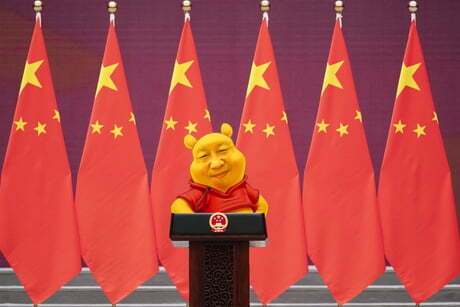
description


Up-Down-Up
When I up, down, touch the ground
it puts me in the mood
Up, down, touch the ground
in the mood (smacks lips) for food
I am stout, round and I have found
speaking poundage-wise
I improve my appetite
when I exercise
(ripping sound)
Oh stuff and fluff
(ties his back together again)

That's better
(reflection in the mirror talks back)
Thank you
Now, where was I?
(grumbling sound from stomach)
Oh, yes, I'm rumbly in my tumbly.
Time for something sweet
I am short, fat, and proud of that
and so with all my might
I up, down, up-down
to my appetite's delight
While I up, down, touch the ground
I think of things to chew
(Like honey, milk, and chocolate)
With a hefty-happy appetite
I'm a hefty-happy Pooh.
With a hefty-happy appetite
he's a hefty-happy Pooh.


description


description
Profile Image for Andrew.
96 reviews112 followers
July 28, 2018
The book is a collection of speeches and essays from Xi Jinping. As such, you can expect that it will paint a rosier picture of China's history, development, and plans for the future than is often manifest in their realpolitik. In this respect, one has to read "The Governance of China" with a grain of salt.

That being said, it is an essential read for anyone looking to understand and forecast China's growing geopolitical and economic role in the world. Say what you will about authoritarianism and socialism, there is clearly something unique about China's governance that has enabled them to achieve such rapid modernization in the last few decades. Among them are a professed commitment to "seeking truth from facts", scientific development, and a deep understanding of history and culture, including education, healthcare, employment, culture, technology, and so forth.

You may argue that none of these ideals are extant in Chinese society today, and you might be right. But that would bely the value of this book as a window into the mind of a foreign power on the rise. If only for that reason, "The Governance of China" is an important work.
Profile Image for Jap Hengky.
451 reviews9 followers
May 25, 2017
The book demonstrates the Chinese Dream, which, in essence, means making China prosperous and strong, rejuvenation of the Chinese nation, and happiness for the Chinese people. It is the dream of the country, of the nation, and of every Chinese, because it brings together the interests of the nation and of individual citizens. The book also emphasizes President Xi Jinping's strong confidence in socialism with Chinese characteristics, which consists of a path, theory and system. The path of socialism with Chinese characteristics is a way to reach the goal; the theory offers a guide to action; and the system provides a fundamental guarantee. He also believes that unique cultural traditions, historical experience, and national conditions determine that the Chinese must take a development path that suits Chinese characteristics.
Profile Image for Ivan.
52 reviews7 followers
January 24, 2022
Since China is playing more and more significant role in the world, I thought it worth looking at what the official propaganda has to say. Well... It wasn't worth the time after all. If you're interested in examining viewpoints different from the western liberal democratic ideology, skip this book.

It doesn't contain any thought whatsoever. Just brazen stupid nationalism, mantra-like chanting of keywords like "communist" and "the people", plus the usual corporate-speech stuffing.

What makes it so infuriating is the resignation on being consistent or intellectually honest in any way. The good old Soviets at least had the decency of postulating some universal principles, the working classes around the world, etc. Even the Nazis at least came up with some arguments for their nationalism. But here, it's just: Yeah, China über alles because screw you. Yuck.
Profile Image for Chet.
275 reviews45 followers
Read
January 21, 2024
This time I read the Chinese edition. Compared many passages side by side with the English. The English rendering is excellent and smooth, considering this is a difficult text to translate for readability. The man who headed this project is a Scottish expat named David Ferguson. He writes a lot about rural China and several of his works can be purchased at purpleculture.net He is unfortunately very obscure in the US and his work is difficult to find here. But he deserves more recognition for his trailblazing work in Chinese-to-English translation, especially in the field of political writing. I want to continue doing a lot of translation of political works, so Ferguson is an important figure to study.
Profile Image for Paty Berretta.
89 reviews
November 19, 2018
A really good book!!! It's really interesting to read the essays and speeches of Xi Jinping and how they change over time.
1 review
December 21, 2021
Should have been called " The Hitchhikers guide to running a country".
(NOTE: Author not open to criticism.)
My only complaint is the unavailability of a Kindle edition.
To all the digital readers, who are hesitant buy the paperback, don't worry I will summarize it for you:
China is awesome, everything is fine, no crimes. Taiwan is aggressive. Tennis is dumb.
Profile Image for Wilhemina.
60 reviews
April 14, 2015
This is an excellent book to read if you are interested in politics and would like to understand the governing philosophy as well as policies in mainland China. This is like an operation manual of how to run a country in the 21st century. Therefore, I think every head of state of every country in this world should produce one like this and make it generally available to the public. I prefer reading the original version in Simplified Chinese because that is where the essence of the governing philosophy comes through loudest.
Profile Image for Phillip.
982 reviews6 followers
October 31, 2018
3.75 / 5.0
Although the collection of speeches lacks in specifics, the constant theme is of a unified approach to balanced improvement in all facets of Chinese Society. Collective goals and responsibilities emphasized through out. Abundant historical references are conveniently foot noted. interesting insight into governing philosophy. What a different approach in comparison to Western individuality.
Profile Image for Enzo Casal.
27 reviews2 followers
October 28, 2021
It is very repetitive given that it is a compilation of Xi Jinping's speeches. What I found interesting is the more you read, you do pick up very consistent messaging that underlies the whole Chinese plan for development. You will have to learn to work past the fluff and get to the core of the meaning and may need to look up unfamiliar topics if this is your first dive into modern Chinese history.
Profile Image for Samaa Baloch.
18 reviews2 followers
May 10, 2023
Really enjoyed the first half of this book, then it got too repetitive.

I wanted to learn more about the Chinese government but this was just speeches mostly about topics I already had knowledge on.

Wouldn’t recommend it to anyone who wants to read about how china works, but to learn about their leader this is a good book.

Xi Jinping, What a man !
1 review
August 21, 2021
I was hoping to gain some insight into the thought processes that drive China's chairman for life from his essays and speeches over the years. After three attempts I just couldn't get myself to finish it. Bloviated propaganda at its finest, devoid of original thoughts.
2 reviews2 followers
April 2, 2015
Un livre absolument remarquable qui permet de mieux comprendre le socialisme aux caractéristiques de la Chine et donc le monde d'aujourd'hui en général.
143 reviews22 followers
November 22, 2016
A collection of speeches by Xi Jinping. Most of it reads in the style of sterile, nuanced propagandist speech peppered with "We shall"s and "We must"s. Hardly riveting and not really illuminating.
Displaying 1 - 30 of 83 reviews

Join the discussion

Can't find what you're looking for?

Get help and learn more about the design.