Babylon 5 creator and Amazing Spider-Man writer J. Michael Stracyznski presents a hard-edged, mature and deeply personal saga of a world about to give birth to its first generation of super heroes! This Mature Readers story follows the origins of these new heroes and anti-heroes including Dr. Spectrum, Nighthawk and the Blur from their birth through adulthood and examines how their lives and abilities change and shape the world around them.
Joseph Michael Straczynski is an American filmmaker and comic book writer. He is the founder of Synthetic Worlds Ltd. and Studio JMS and is best known as the creator of the science fiction television series Babylon 5 (1993–1998) and its spinoff Crusade (1999), as well as the series Jeremiah (2002–2004) and Sense8 (2015–2018). He is the executor of the estate of Harlan Ellison. Straczynski wrote the psychological drama film Changeling (2008) and was co-writer on the martial arts thriller Ninja Assassin (2009), was one of the key writers for (and had a cameo in) Marvel's Thor (2011), as well as the horror film Underworld: Awakening (2012), and the apocalyptic horror film World War Z (2013). From 2001 to 2007, Straczynski wrote Marvel Comics' The Amazing Spider-Man, followed by runs on Thor and Fantastic Four. He is the author of the Superman: Earth One trilogy of graphic novels, and he has written Superman, Wonder Woman, and Before Watchmen for DC Comics. Straczynski is the creator and writer of several original comic book series such as Rising Stars, Midnight Nation, Dream Police, and Ten Grand through Joe's Comics. A prolific writer across a variety of media and former journalist, Straczynski is the author of the autobiography Becoming Superman (2019) for HarperVoyager, the novel Together We Will Go (2021) for Simon & Schuster, and Becoming a Writer, Staying a Writer (2021) for Benbella Books. In 2020 he was named Head of the Creative Council for the comics publishing company Artists, Writers and Artisans. Straczynski is a long-time participant in Usenet and other early computer networks, interacting with fans through various online forums (including GEnie, CompuServe, and America Online) since 1984. He is credited as being the first TV producer to directly engage with fans on the Internet and to allow viewer viewpoints to influence the look and feel of his show. Two prominent areas where he had a presence were GEnie and the newsgroup rec.arts.sf.tv.babylon5.moderated.
J. Michael Straczynski's superb take on a Squadron Supreme reality giving it a much more realistic approach, to a world seeing its first generation of super powered beings emerge. Centred around the appearance of the Superman like, Hyperion, arriving as a baby on a crashed space craft, and how that event and America's clandestine reaction to it changed the world for ever! Four Stars, 8 out of 12. I read the comic books Supreme Power #1 to #18 covering the first three volume in this series that are in this book. 2017 read
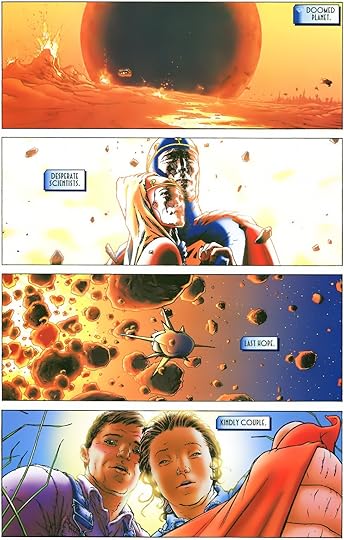
Life on Earth changes forever when a baby crash lands in a Midwest cornfield.
So Supreme Power Contact could easily be called Ma and Pa Kent's nightmare. The story is basically the warning Jonathan and Martha Kent gave Clark every day of his life. If people knew where Clark was from and his powers, people most specifically the government would come for him. That's exactly what happens to the inspecting child who is later named Mark Milton aka Hyperion. The government takes him, provides him parents to raise him, and they indoctrinate him to protect the United States.
This is a perfectly fine what if story for Clark Kent and the other members of the Justice League, but it feels kind of wrong for Marvel to so blatantly copy in order to tell the story. I imagine Marvel wouldn't be amused if DC made The Avengers, The X-Men, Spider-Man, or any other number of their characters with new names and slightly different personalities. I have read some other Squadron Supreme stories that were fun, but this felt way too much like copying to me.
Supreme Power would be a great what if story for DC, but it falls flat with Marvel doing it.
I guess you could consider J. Michael Straczynski’s _Supreme Power_ the bastard child (or perhaps grandchild) of books like Alan Moore’s Watchmen and Frank Miller’s Batman: The Dark Knight Returns in which the four-colour superheroes of old get a more ‘realistic’ make-over and are shown for the dangerous psychopaths they would all-too-likely be in our world. In this case we have Marvel’s Squadron Supreme coming under the deconstructive microscope. The Squadron is an interesting case even without the post-80’s Dark Age of comics lens being applied: back in the day they were Marvel’s thinly veiled version of DC’s League of Superheroes, thus Hyperion = Superman, Nighthawk = Batman, Doctor Spectrum = Green Lantern, Power Princess = Wonder Woman, etc. Also, the Squadron was brought to initial prominence (at least in my view) by Mark Gruenwald’s mid-80’s miniseries that has them trying to set-up a Utopia in their world by taking the reins of political power into their own hands. So now we have what was effectively an homage to another company’s flagship characters, who had already been used in a pre-Watchmen comment on the dangers of superheroes, turned into an even more deconstructed comment on the violence inherent in concept of the metahuman.
We start with a familiar scenario: an alien baby is put into an escape pod and sent on a trajectory that sends it to Earth where it will be met by a childless couple in their battered farm truck. Things diverge pretty significantly from the expected version from this point on. The government gets involved and what in the Golden Age of comics would have been a happy story of love creating a saviour for mankind, instead becomes a view into what happens when fear, greed, and hunger for power are allowed to raise a super-weapon under supposedly controlled conditions. Things do not turn out as anyone expected or hoped.
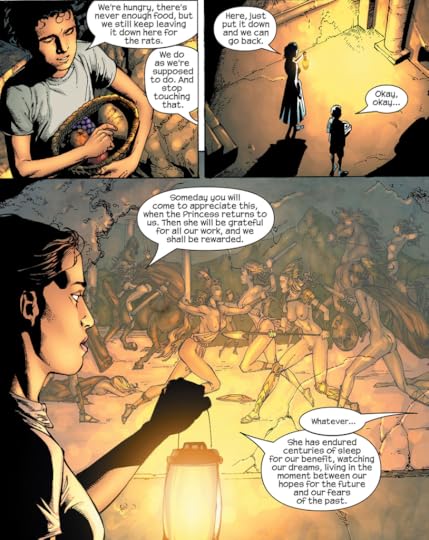
Suffice it to say that not only our alien baby (soon to be christened Hyperion by his handlers), but a plethora of others who are affected by the changes his ship introduced into our ecosystem begin to emerge and the world finds itself in the undesirable position of having to deal with uncontrollable people with unimaginable powers. This first volume centres on the defining moments of a handful of these: the aforementioned Mark Milton aka Hyperion around whom the story revolves and whose childhood as a government experiment lays the groundwork for everything that is to come; Joe Ledger, a military professional exposed to an alien power source that turns him into perhaps the second most powerful man on the planet; the Atlanta Blur, a mysterious and some think apocryphal speeding ghost; Amphibian, a strange aquatic human; Nighthawk, a young African-American boy who witnesses his parents murder and vows vengeance on all those responsible; and a mysterious myth that seems to live in the underground temple worshiped by a group of would-be Amazons.
I like this kind of alternate reality take on established characters since it gives the writer greater freedom than the powers-that-be at comic companies are likely to allow with their flagship properties, but the characters often still retain the resonance of their antecedents. There isn’t too much surprising here: it’s pretty much by-the-numbers deconstructionist superhero fare, but if you like that kind of thing take a look. Beware: there’s lots of violence and nudity.
This is basically JLA in Marvel universe and my god JMS does a great job of reimagining these characters and he makes it so much darker and well it all starts with Hyperion and we see how he grows up and all under military command and all-american and then the origins of Nighthawk, Whizzer, Dr Spectrum and others and wow its so well done and in the end how politics influences Hyperion's origins and well his revelation to the world and him meeting others like him and the world reacting to it.
It should be called SS: New world order the way its written and yep its JLA but so dark and you can see Mark's character as he has a weird but familiar journey of his own and its amazing the way JMS has a consistent tone for the book and promises it will get so much darker before the dawn and he also shows a realistic depiction of how the world looks like with heroes in them and the sudden emergence of all of them and threats to come plus the amazing art of Gary frank which is why you should pick this up like omg I am excited to read future volumes already!
This reader had high hopes for this book, the first volume of Supreme Power, a new take on the seminal Mark Gruenwald work, Squadron Supreme. I remember when this was launched way back; it was hyped tremendously by Wizard Magazine. It took me more than a decade, but when I finally got my copy of this hardcover, it turned out to be mild disappointment.
A mild disappointment would be like I expected this to be a four star read in enjoyment and quality. It ended as a barely three-star book on the strength of Gary Frank's art. The story has an interesting premise, drawing on the idea of a government funded super-being that broke ground on Alan Moore and Dave Gibbons' Watchmen and Frank Miller's The Dark Knight Returns. Interesting enough to draw those comparisons but not as well executed as its forebears. It reads like molasses; too slow that it elicited a few yawns. The slow development of the characters made this reader wonder why I even bothered reading it in the first place. Still, the beautiful art by Frank just about made this worthwhile.
(This is a review of the series) I was a big fan of Mark Grunwald’s Squadron Supreme series back in the ‘80s so I was curious to check out this reboot and for the most part it works. In many ways, this version can be traced back to Alan Moore who I believe was the first to give us an amoral Superman in his Marvelman (later changed to Miracleman) reboot. Since then we’ve had Maxxximortal, Homelander in The Boys and even Superman himself in the Snyderverse, all showing us What If™️ Superman was a senseless murderer. This book came out ages ago when the concept was only 20 years old so I’ll cut them a little slack and it’s still fun watching clever carnage The original series’ premise was what happens when a barely disguised JLA decide to stop fighting crime and instead reshape society into the kind of place crime wouldn’t happen. This version starts to hint at that but unfortunately the series ended before it (and many other dangling plot lines) could be explored further and, even worse, it ends on an unresolved cliffhanger!
Supreme Power centers on an interesting concept and it executes it well: What if Kal-El fell to Earth, but instead of being raised by Jonathan and Martha Kent, Kal-El, he was taken in and raised by the US government? And of course it's well executed, it's J. Michael Straczynski. I'm biased here, I've been a fan of his ever since Rising Stars, Vol. 1: Born in Fire and even though I haven't picked it up in years, I am still in love with Midnight Nation. And through his comics, I discovered his TV show, Babylon 5. My old college email's password hint was "The only Polish name you know how to spell correctly." (And now you know the password to my now defunct old college email.)
The story centers around an extra-terrestrial (human-looking) baby who landed in a cornfield in Middle America (and just from cultural osmosis, you know what to expect:
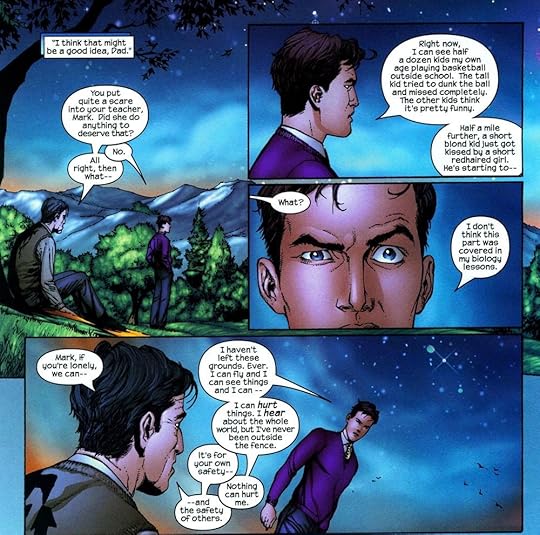
But we don't get Superman, we get Project Hyperion. The baby wasn't raised by the Kents. He didn't grow up in Smallville. Instead, he's taken from the couple who originally found him and assigned to be raised by carefully selected specialists. Instead of going to school and being around other children, Project Hyperion is instead raised in a sterile facsimile of a Norman-Rockwell-upbringing-by-committee. Everyone enters into the project with the best of intentions, the military doesn't jockey for power with the politicians and neither side ignores the concerns of the scientists and they take the utmost care to ensure no one is hurt and Project Hyperion has the best, most wholesome childhood possible; but it's not a family and that colors the rest of the book. Underneath Hyperion's carefully PR-trained facade, there's this underlying feeling that he's feeling unloved, isolated, and bitter. And of course, instead of being the ultimate immigrant upholding American ideals, in Hyperion we have the irony of him being raised by the American government to be the ultimate American symbol but instead he's completely alienated and disassociated from the culture and virtues that should've been his inheritance.
I also like the other members of this mirror universe Justice League. It's promising and does a good job setting up the Squadron Supreme. And I like the atmosphere of dread, I keep expecting our mirror-Superman to snap and go Homelander. J. Michael Straczynski knows his stuff and he's a pro. But I don't know why I don't like it. I don't find anything wrong with it, but I'm not just don't want to continue the story. (Maybe the characters here are a little too close to their DC counterparts and have entered the uncanny valley, suffusing the whole book with a sense of wrongness?)
It's good. It really is. But it's not for me. It might be for you, if you want to read what is probably the best "What If...?"/"Elseworlds" story that Marvel and DC never put out. And if, after finishing Supreme Power, you're not feeling it, there's always J. Michael Straczynski's Rising Stars, Vol. 1: Born in Fire series, his other, more original take on superheroes. It's what Supreme Power could have been with more soul.
JMS tries to turn a clone/homage/rip off of the Justice League into the Watchmen. Not a bad idea, but it moves at a snails pace and the heroes don't seem to do much more then not get along with each other and get mistrusted by the government. Nice art, but after awhile you start wishing a giant robot would attack or something more interesting than the heroes going on about how hard it is to be super powered.
When did it become considered unrealistic to have actual super villains in 'realistic' comic books? Now so many of them read like the 'Great Gatsby' with spandex.
JMS is very good at ideas, but needs to then pass them onto stronger writers or have an editor that tells him to trim the padding.
This was great. It's not a totally new concept, as we basically get to see superheroes presented in a more realistic way. This is like a much more straightforward Watchmen. We get to see what could have happened when "Superman" landed on Earth, and then other heroes start to show up. A totally new take on the Squadron Supreme, and much more realistic than usual.
I see what Straczynski is trying to do here. A little off-brand Justice League going on... (The real Presidents made me super awkward, also the fact that Mark's "parents" were just two 2D field agents with no backstory or relationship.)
The beginning was OK and slow with the ending picking up some speed. I feel like things are going to start to happen soon.
The original vol. 1: During the Carter administration, an alien space craft crashes on earth ... with a foundling inside. Carter gives the order that begins the top secret Hyperion Project.
"It's the law of this country that children orphaned without next of kin are to be wards of the state. I see no reason to make an exception in this case. "He's a child of the United States. "See to it he's raised like one."
The original vol. 2: Mark Milton, boy alien and the reason for the top secret Hyperion Project, attends only one day of school in his early teens. His super powers allow him to overhear gossip in the girls' bathroom.
"...and he's just so ... creepy." "I know ... my dad said I shouldn't get anywhere near him, 'cause he's dangerous." "There's ... something just wrong about him, y'know? Like he doesn't belong here. Can you feel it?" "I heard about this science experiment once, where they painted this one monkey the same colors as another group of monkeys, and put him in to see if they'd notice the difference even though he looked the same as they did." "And? What happened?" "They tore him to pieces. Because you just know, y'know?"
Sounds like middle school to me.
The original vol. 3: Reporter Jason Scott believes that the U.S. has a new secret weapon. He finally makes his own "Deep Throat" contact, only the stakes are a bit higher than with Watergate.
"You're swimming in some dangerous waters here, Jason. And you've been too blatant in asking questions. I know you've been followed on foot at times. Other times ..." "What? What is it?" "Maybe nothing. Maybe just a bird. Still ... Get in. We're too exposed out here." "What's got you so nervous? I've never see you like this before -" "Okay, get this straight. I'll tell you what you need to know, but that's all. The rest you'll have to dig out on your own. But understand: if my name ever surfaces in relation to this, if anyone finds out I talked to you ... I'll kill you. Without the slightest hesitation. Understood?"
This is a review of the full Supreme Power saga, including Supreme Power vol. 1, Squadron Supreme vols. 1 & 2, Hyperion, Nighthawk, Hyperion vs. Nighthawk, Supreme Power vols. 2 and 3, and Ultimate Power.
***SPOILERS***
The series starts out on an overall positive note. J. Michael Straczynski's re-imagination of the classic Squadron Supreme characters is quite interesting, and in a way, meta. The heroes are all created as a consequence of Hyperion (the Superman expy) landing on the planet, an obvious nod to the fact that Superman was the first hero, who inspired a whole generation of colorful Men/Women in Tights. The first 18 issued of Supreme Power are fantastic. They combine just the right amount of early 2000s edge, political criticism, and comic book action. The art, while not superb, is serviceable, and in some instances well-above average. Mark Milton's backstory, once again, an obvious nod to Superman is in equal parts disturbing and fascinating, and the story relatively slow start serves the characters' development quite well. However, it is that slow start that is the problem. Once Straczynski leaves the title, the books begin to meander. Every story starts and ends the same way: 1. Mark Milton has left the Squadron/Planet. 2. He is forced to return for whatever reason. 3. He finds out that, for some reason, the American government has cooked up some plot to betray him. 4. He beats the **** out of everyone, and once against leaves the planet. Rinse and repeat ad infinitum.
If this were an ongoing comic book series, I would somewhat understand the circular slog through the same story. However, the original Supreme Power comic established an endpoint of the story, towards we are supposed to be moving. However, the moment Straczynski left the title, it appears that no other writer read the run that came before.
The three tie-ins I read were Hyperion, Nighthawk, and Hyperion vs. Nighthawk.
Of the three, the only one that relates to the story is Hyperion, and indeed, the tie-in is quite well-written. The problem, once again, is that the story beats and character developments established in this story go nowhere. To the point that it made me wonder if any following stories were even related to this. Considering that characters and plot points are referenced, I would assume they are. Regardless, if you are interested in the story, the Hyperion tie-in is a must-read.
Nighthawk is unrelated, but also the best of the three. It is a self-contained story, which, in a way, is Supreme Power's version of the Killing Joke. As the Batman expy, Nighthawk must have his Joker. And in this case, the Clown is a serial killer whose main murder weapon is a fast-acting poison. Frank Quietly is on art duty in this one, and I find that his art is either deeply loved, or hated with a passion. For me, it worked in this particular story. The six issues also delve deeply into racial tensions and politics in the United States. However, be warned, the politics are quite dated.
Hyperion vs. Nighthawk is not only a bad series, but it is also unnecessary reading. It begins on an interesting note, addressing a real life political issue. However, none of the characters, except maybe Nighthawk are done any justice, and Mark Milton is particularly horribly done. He insists upon the idea that he is disinterested in human affairs (in this case, ethnic cleansing). However, this insistence completely contradicts his previous characterization. By the end of the comic, obviously, we find out that he does care. But, the problem is that he has no reason to deny his feelings, except for the contrivance of serving as a foil to Nighthawk. The story ends on a horrific note, with none of the issues resolved. Obviously, it is difficult to resolve issues that are actually happening in real life (think of the Reed Richards Can't Cure Cancer trope). However, if you are not going to offer a meaningful or satisfying conclusion, then simply don't include a real life issue. Or, better yet, have the balls to fix the issue in-story.
Finally, Ultimate Power is a crossover between Supreme Power and the Ultimate Marvel Universe...and it is horrific. I would say skip it, but it is necessary reading to understand the following volumes of Supreme Power and Squadron Supreme. Greg Land's artwork is terrible. Obviously, everyone has addressed the tracing, but even if we ignore the obvious artistic and moral bankruptcy of what Land does, the final product simply does not look good. Characters look like uncomfortable, Uncanny Valley caricatures of themselves. Not only that, but due to Land's style, the characters are not consistent in appearance from chapter to chapter. Story-wise, the comic is horribly paced, with a 4-issue story spread over 9-issues. Nick Fury is characterized as not only petty and untrustworthy (which tracks with his character), but also stupid (which does not). He gets into bed with Doctor Doom, even though he has no reason too, and unleashes the Hulk, even though it is counterproductive to the situation. But, it isn't just Nick Fury who acts a fool. Reed Richards, The Thing, Susan Storm, and Emil Burbank are all behaving in a manner that does not fit their character. Not only that, but at the end of the story, while the story gets resolved, none of the characters come out as different people at the end. The Thing is still a self-loathing mess, and still guilt trips Richards (despite his guilt tripping being the very thing that drove Reed to do what he did in the story). Reed Richards learns nothing as well, cause once again, the end has him be a self-loathing mess, whose guilt has neither bettered nor worsened. And all of the other characters might as well not be there. Finally, a pet-peeve on my part, but the comic completely mishandled Arcanna Jones' powers. Which directly leads to her powers becoming mishandled in any future stories. I would be fine with the retcon, if this story, and all future stories didn't insist upon the fact that her powers have not changed.
Overall, Straczynski's run is a solid 3/5 - 3.5/5. It loses a couple of points due to having no real conclusion. The tie-ins (Hyperion and Nighthawk) are also quite good. In fact, I would recommend the Nighthawk mini-series to any fan of Batman, Daredevil, or other gritty, street level, heroes.
Unfortunately, the runs following Straczynski are repetitive, tedious, and do not have a proper conclusion, which is why I can't, in good conscience recommend this to anyone.
What if Superman grew up in a government lab with a carefully curated upbringing through focus group research and government-contracted parents? Writer J. Michael Straczynski and Illustrator Gary Frank imagine just that in Marvel’s 2004 series (through its imprint, Max Comics), Supreme Power, Volume 1: Contact. Jon Sibal adds his beautiful ink to the imagining. But no matter how much you try to bring Kansas and Jonathan and Martha Kent to a lab, there’s no duplicating the real thing.
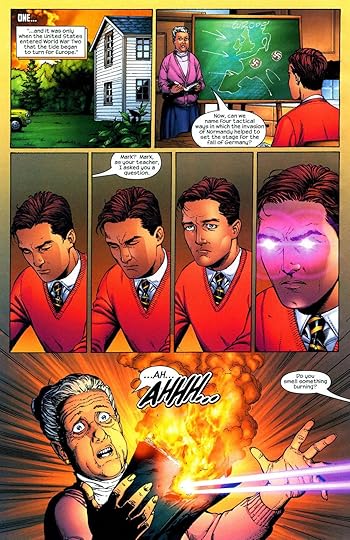
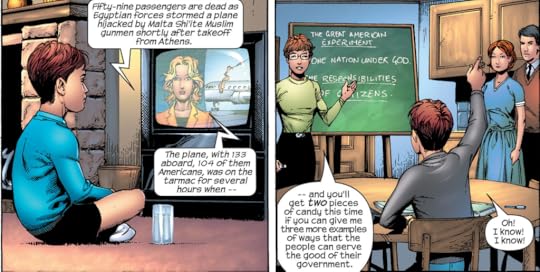
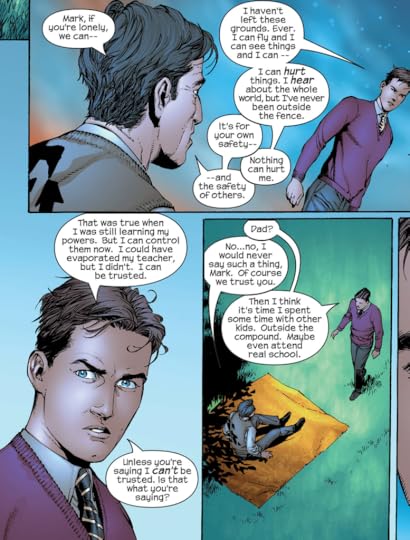
Just like the Superman origin story, in Supreme Power, a small child crash lands in his spaceship out in the country where a couple finds him — and hopes this is what will put their marriage back together. Instead, government agents quickly collect the child and warn the parents off of every telling the real story. They name it (the spaceship and the child) the Hyperion Project after the Titan god of heavenly light and watchfulness. They give the child his “day name” of Mark Milton, even being self-referential about Marvel’s penchant for alliterative names. Mark is then given two government-contracted agents as parents. He assumes, of course, they are his parents. Soon, though, he realizes not only does he have powers, but that he is being caged behind barbed wire fencing with soldiers on guard. His “dad” tries to explain that it’s for his and the rest of humanity’s protection. Mark wants interaction with real people, though, so they try school with other government agents’ kids, but it doesn’t work out. They know Mark’s different, even if they don’t see his powers on display.
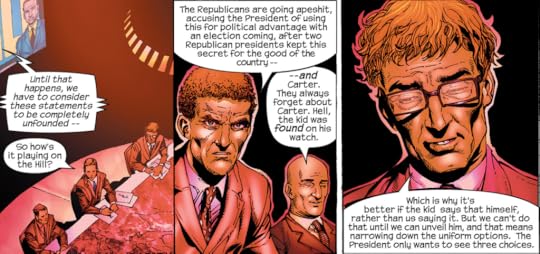
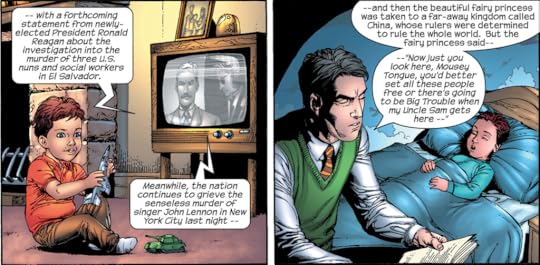
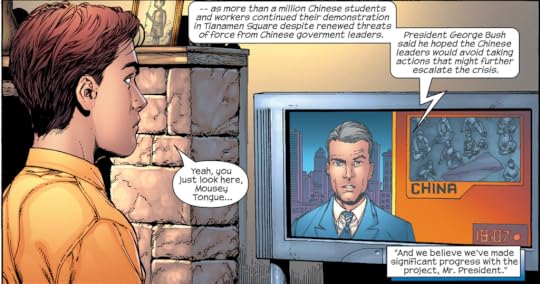
What’s fun about Supreme Power is that the Hyperion Project passes through four presidents over the course of Mark’s life. First is Jimmy Carter, when the ship landed (he’s the one that wants him to grow up with a Rockwellian upbringing). Second is Ronald Reagan, who didn’t get much play except for news stories during his administration is what Mark grew up watching and probably nurtured his sense of “right” more than his actual “parents.”. Third is George H.W. Bush, who Straczynski gives a pervy moment when, thanks to the energy crystal that powered the ship allowing someone to see what they are thinking, sees a data scientist as a scantily-clad warrior woman and quips that he needs to have Barbara try that out. But in more serious terms, H.W. Bush is the first president to meet Mark as a young man and start using him in the “field,” first through Desert Storm and then all manner of other American endeavors. Fourth is Bill Clinton, who is the one who makes Mark into a public-facing superhero with all the pomp and circumstance, including a costume. Clinton also did that because a reporter with the Washington Herald, Jason, was sniffing around the story. Even after learning the truth about Mark, Jason thinks there is something more the government isn’t saying, which is true, because they didn’t reveal the existence of the spaceship.
Similar to other classic comics — Supreme Power worked as a nice riff and homage to the classics — the government even “kills” Mark’s parents to help him become laser focused on his superhero mission. By kill, they actually just sent the government agents to Amsterdam. Also unlike Jonathan and Martha Kent, the two agents didn’t love each other and were excited to separate from each other once in Amsterdam. I found that rather sad! On the flip side, one scene made me chuckle. Mark wants to have a regular job and thinks wearing glasses would be the perfect disguise. Instead, the government agents scoff and immediately shoot it down. Ha.
Thanks to the incoming spaceship and some sort of bacterium that escaped from it, there are other superpowered beings in the world. One Mark quasi-befriends is Stewart Stanley (alliteration again, plus perhaps an ode to Marvel legend, Stan Lee, get it?), who is like the Flash, a speedster. Funny enough, in a nice bit of satire and absurdity reflecting what could happen if a superhero did exist in our midst, Stewart hooks up with “booking agents” to get sponsored by racing companies. He wears their logo on his suit, which was also created by them. Then, the government creates their own version of a Cyborg-like superhero by happenstance. They enlist a black ops soldier, Corporal Joe Ledger, to see what that aforementioned energy crystal from the ship can do. The government hopes to use Joe as their counterbalance, should Mark, an alien they don’t fully trust, go wayward. Joe fuses with the energy crystal and more than Cyborg perhaps, he becomes godlike. Maybe Doctor Manhattan is a better analog.
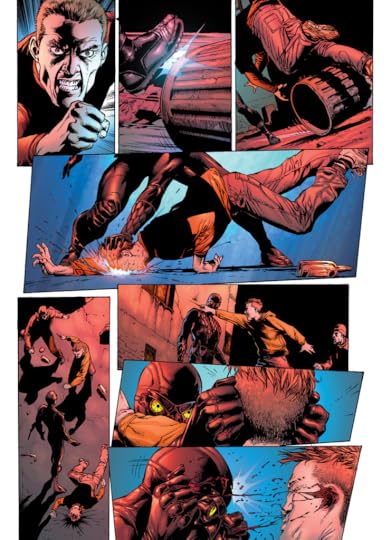
There is also Richmond, who goes by Nighthawk. He’s Batman — no superpowers, just money, superior training, and the angst of watching his parents gunned down in front of him. The wrinkle in the Batman analogy is that Richmond is Black and his parents were killed in a hate crime by racists. So, when he’s prowling the night going after criminals, he specifically defends Black people from racists and Nazi scum. Nighthawk is grislier than Batman, too. In one gnarly scene, he rips an assailant’s ears off. When Mark finds out about him, he actually gives Nighthawk a lecture about the virtue of color-blindness and protecting everyone. Where you could see the seed of Mark’s lecture being the flower of his undoing and/or turn to the dark side is when he tells Nighthawk, “Sometimes, I think that only somebody who was truly an alien could solve all the world’s problems. Because only an alien could be objective enough to get the job done.” That’s definitely not Superman thinking! Eek. (Additionally, there is an allusion to a princess warrior type woman who made me think of Wonder Woman. She wasn’t developed further in this first volume, however.)
Where this volume leaves us before Volume 2: Powers & Principalities, is the government unsure about Joe, the spaceship-imbued god, and Mark floating in space thinking about his “objective alien” line and putting his entire hand (from his distance in space, it appears so) over the earth. What a striking image that was.
I was quite taken in by the first volume of Supreme Power. Straczynski struck the right balance of homage to and satire of Marvel and DC Comics, and a sense of forlorn and foreboding about what the future holds in a world with “supreme power” beings. Frank and Sibal provided gorgeous imagery and ink to compliment Straczynski’s writing, including Nighthawk’s intimidating costume and the scenes with Joe going godlike. I’m excited to read the next volume!
This entire review has been hidden because of spoilers.
Very unique and some what modern take using the general Superman origin for Marvel equivalent Hyperion. Straczynski's poses the question "what if a super powered alien was captured by the U.S. goverment ?" With the series being under the Marvel Max imprint you expect swearing, violence, and nudity and during this series you get all of that. Gary Frank's art shines in this series as well. I know Frank's art mainly from his stint on the Hulk, but he does this book as much justice as Straczynski's writing. The guy can flat out draw. The only thing I found suspect as an artist myself were Frank's eyes on the characters. At times I thought they looked a bit weird, a tad cartoony, or just "flat" at times. But overall a very nice read that I will visit more times over the years.
This entire review has been hidden because of spoilers.
I guess you could consider J. Michael Straczynski’s Supreme Power the bastard child (or perhaps grandchild) of books like Alan Moore’s Watchmen and Frank Miller’s Batman: The Dark Knight Returns in which the four-colour superheroes of old get a more ‘realistic’ make-over and are shown for the dangerous psychopaths they would all-too-likely be in our world. In this case we have Marvel’s Squadron Supreme coming under the deconstructive microscope. The Squadron is an interesting case even without the post-80's Dark Age of comics lens being applied: back in the day they were Marvel... Read More: http://www.fantasyliterature.com/revi...
I tend to expect a bit more from graphic novels. The writing and artwork were quite good, but in a graphic novel spanning 6 issues I expected a bit more story. By the time we got to the end of this span all we had managed to do was introduce what will presumably be the major characters that will be seen throughout the series. I enjoy getting to know the characters, but I really expected a bit more than just character introductions. Will I look for the following collections? Yes, though I don't know that I would be willing to pay full price for them.
Book Info: This collection contains Supreme Power issues #1-6.
ABSOLUTE RATING: {3/5 stars} (Rounded [...])
STANDARDIZED RATING: <3/5 stars>
When a crashed UFO containing a young infant is discovered in a meadow by a sad couple, the US government – having surmised its alien origin and superhuman abilities – quickly seizes the baby and decides to have him raised instead as a ward of the state. After being adopted by undercover agents posing as working parents, the child is then named Mark Milton, and is raised in a guarded, isolated house in Middletown America. For safety and control purposes, Mark is physically cut-off from the rest of humanity, and his only exposure to the outside world comes from his "parents," his personal tutors, and TV news stations. And even when he's allowed to integrate with other kids his age in a secretly contrived public school setting, none of the other kids are willing to accept him into the fold. Mark leads a lonely life to be sure, but unbeknownst to him, there are several unexplained occurrences happening all over the country which could suggest that he's not exactly alone...
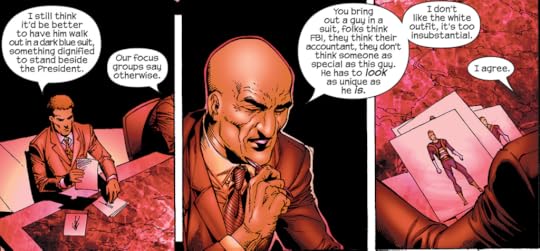
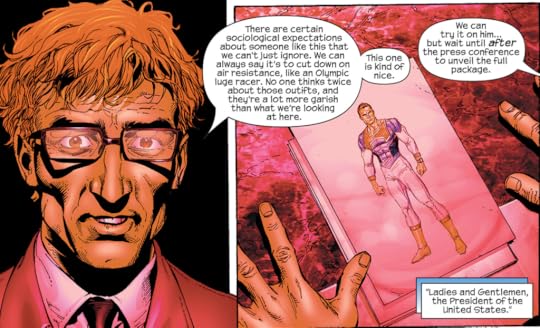
I suppose one can think of J. Michael Straczynski's Supreme Power as Marvel's R-rated take on the Justice League: there's plenty of sex, violence, and profanity, and the story introduces some pretty clear analogues of classic DC characters including Superman, Flash, Green Lantern, Batman, Wonder Woman, and Aquaman. And perhaps given the success and popularity of Mark Millar's Ultimates at the time, it also tries to apply a certain level of cynicism and politics toward these archetypes that is more uncommon for DC (at least at the time). For instance, there's a lot of clandestine government deliberation going on, and frequent considerations concerning marketing strategies, focus groups, as well as the pursuit and maintenance of military interests. (Also, did anyone else notice the startling likeness between the names "Mark Milton" and "Mark Millar?" Apparently, it's purely coincidental.)
[An ancient princess from a nation of warrior women? Hmm... I wonder who JMS was trying to spoof with this one.]
[I don't know about you, but I can envision a nearly identical scene in The Ultimates. Straczynski seems equally as competent and Millar when it comes to superhero public relations, but he's even better when he gets into the science fiction element behind this universe.]
But let me be clear: it would be a mistake to write this off as just a reskinned Justice League. Like I said before, the parallels to the JLA are unmistakable, but Straczynski also makes significant alterations to the characters' origins that allow for some very different implications on their personalities. For Mark (code name "Hyperion"), the interplay between his calculated media/education-borne nationalism and his cold and structured upbringing makes him quite distinct from Clark Kent in many ways. And for Kyle Richmond (aka "Nighthawk"), the brutal, racially-charged slaying of his parents invoked within him a deep-seated animosity against Whites, and – unlike Batman – he places special priority over rescuing certain victims compared to others. There also appears to be a similar (and promising) tension between the two (like between Superman and Batman), but instead of it being about a disagreement in appropriate vigilante methods, it's more a conflict between Mark's neat idealism and Kyle's jaded realism. Many other contrasts can be drawn here, but I'm sure you get the point. Besides, shouldn't it be more about the execution than it is about the degree of originality, anyway?
Other than the borderline literary theft, probably the biggest problem readers are gonna have with this is that Contact is largely an expositionary volume, and one that ends with many unanswered questions. While it does eventually explain the relationship between Mark's arrival and the coinciding appearance of other gifted individuals, the exact origin and power set of a couple key members of the cast remain unknown. And for those who feel the narrative fails to generate adequate momentum, or that it focuses its attention too exclusively on Hyperion, it's quite possible that the ambiguity will only compound the impression that this book doesn't really go anywhere at all. But aside from the big battle at the end of The Ultimates, Vol. 1, the two are actually fairly similar in this regard: they both had to devote a lot of time for preliminary characterization/worldbuilding, each lacked a driving conflict for most of their duration, and neither developed enough to end with more than a vague impression of where things were headed next. So I say all this to suggest that if you enjoyed one of these books, you could easily find yourself liking the other roughly as much.
And even though both works lacked the strongest of scripts, JMS did a better job than did Millar when balancing time spent on characterization against measurable plot progression. This meant that there were less opportunities for Straczynski's sometimes lackluster attempts at humor or pathos to be too overly pronounced. But since he moves at such a brisk narrative pace, and covers events spanning upwards of eighteen years, I couldn't help but feel cheated out of what should have been a deeper, more patient look into Mark's upbringing. Instead of seeing so much about his home-schooling lessons and those patriotic news segments he absorbed, I wish there was more time directed towards portraying his relationship towards his adoptive parents. Although he seems to love them very much, I never got a sense of their rapport, saw them independently play a part in shaping Mark's values, or witness a single intimate moment they shared together. And that's a shame, because the tense and uniquely contrived circumstances of that family's union could have lent itself to some very fascinating and poignant storytelling possibilities. Fortunately, though, Straczynski proves to be rather adept at using strategically limited character moments to make his cast leave a more lasting impression than one might expect.
[This is one of only two similar moments Mark privately shares with his parents, and it's the closest we come to an emotional discourse between them. It truly pales in comparison to some of the father-son moments I've seen in certain Superman stories (i.e. Secret Origin and Birthright), and I would have hoped to see a more extended portrait of the parents' fear and/or love for Mark playing out over time.]
But the main character here is Mark, and I do feel that he's written as a sympathetic and reasonably complex protagonist, and considerably moreseo than the typical Superman portrayal. At the same time that he's a decent kid who wants to do the right thing, it's obviously a constant struggle to suppress his pain and frustration, and this same dissatisfaction carries over into Mark's adult life. And as Hyperion, he still tries to uphold his values and serve a country that he begins to suspect is exploiting him for his power. This process of growing isolation and resentment is strikingly similar to Mark Waid's Irredeemable – which, I might add, turned out to be a huge disappointment – and it should be interesting to rediscover where it all leads, especially given the final page of the book.
When I first read this book years ago, I believe it served as my earliest exposure to Gary Frank's work. I recall finding it crisp and expressive – with some pretty cool fight scenes – just as I do now, but somehow it looks less refined this time around. More recently, his work on titles like Incredible Hulk and Superman both noticeably exceed this in quality, so it seems like the 4-6-year gap between publications really gave him the chance to distinguish himself a bit more and refine his approach. So again, there's still some great artwork here, but I just wish it didn't look so hauntingly similar to Steve Dillon's (God rest his soul). Look, I really do love Dillon and all, but there are times here when Frank's sketches look virtually identical to his! Something tells me they'll always be similar in style, but this was just a smidgen too close for comfort.
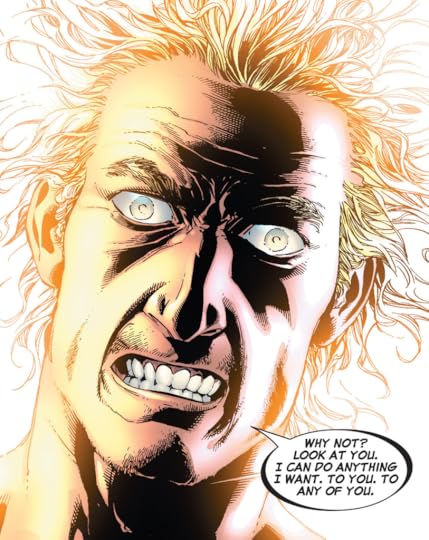
[If you can, take a moment and refer to one of the scenes in Preacher with Jesse Custer using the voice. *Any* scene. I really don't care. Then, I want you to picture Jesse without the red eyes, and with blonde hair instead of black. Now, can you see the resemblance?]
While Supreme Power: Contact may not exactly be the action-packed 4-5 star masterpiece I remember, it's still a decent read, and kicks off a story I think has much potential to grow in later volumes. And it's clear that much of the secondary cast has yet to be explored, so it's kinda cool not to know (or recall) exactly where this is heading. So really, the worst thing about that 1-2 star decrease is that – along with my recent and more unpleasant reread of Superman: Earth One – it has plainly bumped JMS *way* off my pantheon of favorite comic book writers. The only truly fond memories I have of him now are from Thor, and even *those* now are being called into question! Funny how tastes really do mature over time, isn't it? Wow.
The Ultimate Universe always seemed to be a universe in decay and moral decline. The Wildstorm seemed to be one marching towards a utopian future. Supreme Power seemed to be the most mean-spiritied and unsure what it was going for. This review covers;
Squadron Supreme #1-12 Supreme Power #1-18 (JMS and Gary Frank) Supreme Power: Hyperion #1-5 (Melded Squadron Supreme and Supreme Power together) Supreme Power: Nighthhawk #1-6 (Daniel Way and Steve Dillon) Squadron Supreme: Hyperion vs. Nighthawk (Guggenheim and Gulacy) Ultimate Power #1-9 _________________________________________________ Reboot—Squadron Supreme: #1-7
Omitting the Chaykin and Higgins arcs and including the attempt to reboot.
Squadrom Supreme #1-12 was a phenomenal run. It was pre-Watchmen and had a bit of a Authority vibe to it. Still it's ultimately a fairly simple tale.
So, JMS started off an extremely well-established regarded line that was essentially a darkened version of the Justice League. Essentially a militant Superman, a"racist" Batman and a sexualized Wonder W0man (Blur=Flash, Doctor Spectrum=Green Lantern). "Realistic superheroes" that were broken and kind of assholes. It's similar to the Ulimates as they are part of the military industrial complex--but the government lies in this one. It's a bit more of an apocalyptic ending. The failure of this notion as absolute power corrupts absolutely. However at the end of the 18-issue run, nothing much is resolved.
Supreme Power: Nighthawk is essentially a more mature take on the Batman vs. Joker paradigm without really saying anything new other than making it more Millar/Ennis-like.
Supreme Power: Hyperion is essentially Supreme Power Vol. 4; and ties Grunewald's mythology a tad into it.
Supreme Power: Hyperion vs. Nighthawk--probably the last bastion of quality. It's basically a Superman vs. Batman story about the responsibility and efficacy of superheroes inserting themselves in the political landscape.
In the end, Supreme Power was a noble failure, mainly let down by JMS' lack of commitment. Squadron Supreme (The Pre-War Years) ends prematurely with a whimper (JMS just walked off, and it's not touched again other than a few panels of "What Happened" in Ultimate Power.
Howard Chaykin's run was a misfire as it was basically about the missing Squadron Supreme team and focusing on new characters. Hyperion finally takes over the world but it's quickly resolved with a Deus Ex Machina.
Kyle Higgins tells the final Supreme Power story-arc which is a bit of a redemption tale for Hyperion (after his previous actions) as her fights Doctor Spectrum.
Then the line was unceremoniously killed off by Jonathan Hickman during his Avengers run leading up to Secret Wars. The characters are killed quite gratuitously and largely effortlessy by the Sinister Squadron.
Marvel then attempted to incorporate the characters into the Marvel U, piece mail to very poor effect. It felt to anachronistic and forced. Hyperion was a vaguely weird series about Hyperion visiting small town America. Nighthawk (the most successful) integration was essentially a "black vigilante" story about a guy who has a chip on his shoulder regarding race (understandably so!). Squadron Supreme by Robinson was an attempt make a more proactive team (Avengers who had revenge on their minds since they were all survivors of destroyed universes).
The line petered out, and was resurrected, literally with a Marvel Zombie aspect and then fell apart in the Marvel Universe. A sad, unfinished ending that was shoved its way into relevancy until the Universe (i.e. customers whispered "No!") and it fell apart.
Supreme Power è stato un altro tentativo, da parte della Marvel, di rivedere in chiave moderna e realistica il mito di Superman in primis e della JLA. J.M. Straczynski è stato il fautore e coordinatore di questo tentativo, che inizia riscrivendo come parte di un universo alternativo del multiverso Marvel lo Squadron Supreme creato nei primi anni '70 da Roy Thomas ed altri.
Gary Frank ai disegni se la cava molto bene come al solito, anche se ha il difetto di una scarsa differenza tra i visi dei personaggi, ma ci sono i capelli ed il colore a rimediare. La storia di Strac parte dall'arrivo del bimbo alieno in Kansas a inizi anni '80, ma qui, molto più realisticamente e cinicamente il governo interviene e secreta il tutto, affidando ad una coppia "militare" la crescita del bambino e preparando, appena si iniziano a sviluppare i superpoteri, un progetto. Il progetto è quello di crescere come un super uomo fedele alla nazione, alla bandiera, allo stato ed ovviamente ai suoi capi. Il giovane Mark Milton, che già prima di iniziare a camminare rivela una vista termica che incenerisce il suo cucciolo, cresce così. Niente Krypto il supercane in questo universo. Però Mark ama davvero i suoi presunti genitori, e soffre dell'isolamento a lui inflitto, anche perché col suo super udito si accorge di molte cose.
Mark non è l'unico elemento alieno giunto su questa Terra. In Gracia, fin dall'antichità, una famiglia lascia offerte in una tomba per una dea. Un cristallo recuperato dalla nave aliena trasformerà un caporale dei marines con una certa predisposizione per la violenza in un "super eroe". Una coppia darà vita ad una bambina mezza pesce. Un ragazzino afroamericano scoprirà di poter correre velocissimo. Infine un bambino afroamericano, senza nessun potere, inizierà un sentiero di vendetta contro i razzisti che gli uccidono i genitori sotto gli occhi.
Nulla di nuovo in realtà perché siamo a livello di un grande "What If", ma è il taglio estremamente cinico e con un realismo moderno a rendere intrigante questo volume che raccoglie i primi sei albi della serie. 4 stelle
I enjoyed this graphic novel. Given that the MAX imprint came out in the same decade as much of the Ultimate Universe, and even some comic book fans at that time commentating how All Star Superman was DC's equivalent of Ultimate Superman, I always felt that Hyperion from this graphic novel was the closest thing to what "Ultimate Superman" would have been like, more or less.
Supremen Power's Hyperion is nowhere the saint Superman is, and not much different from Mark Millar's Ultimate Captain America, in the vibe that he gives out. And many have said before that this was like a more mature darker version of the DC's JLA, in terms of nudity, violence and language, as well as other more mature themes, dimension-wise, not to mention some of the crudest dialogue I have come across. One can say that the idea that he worked for the US government and military, makes him something like a (Superman + Jason Bourne) character.
Over the years, there had been many ripoffs and copycats of famous superheroes like Superman, Batman, Wonder Woman, Captain America, Hulk, Spiderman, Wolverine and many of these other well-known superheroes, and I enjoy reading many of them, which was one the reasons why I thought of reading this particular graphic novel.
I'm a sucker for these gritty, meta-superhero stories, going all the way back to Watchmen and DKR. I've read 'em all--Millar, Ennis, Ellis, Morrison, Simone (her less-gritty but excellently written Tranquility series). I am not familiar with Squadron Supreme and so was tickled by the unabashed Justice League ripoffs these superheroes turned out to be. It reminded me of Planetary's many and brilliant references to both Marvel and DC superheroes. That said, I find it curious that the Justice League seems to be the primary model to base such stories on. I wonder if it's because JLA superheroes are more iconic than Marvel's and easier to use as templates for other stories. It's hard to imagine an evil version of the Avengers for some reason. I mean, Spider-Man's body got taken over by a super-villain and he still managed to have a bit of a conscience, warped as it was. Still, whether Supreme Power is good or bad storytelling, I couldn't tell you, because I'm enjoying reading it too much.
I really am having a rereading surge on at the moment. Next on my list is the JMS Squadron Supreme reinvention and wow this is even better than I remember it being. While being a superhero comic/story this is anything but your usual Marvel (or DC) fare. This is intelligent storytelling complemented by some incredible art (though Gary Franks eyes on some background characters are weird!).
This is creating a whole world from scratch, bringing in new interpretations of classic Marvel characters (albeit ones that were riffs/parodies of the Justice League originally) in an almost believable way. This is almost JMS bringing ideas from his Rising Stars series to a mainstream publisher.
This first volume is a real treat and I am really hoping that the rest of the series still stands up as well as this one does
Back in 1985 or so, Marvel blatantly copied the origin stories of DC's Justice League members to create a group called Squadron Supreme. Twenty years later, Straczynski and Co. made this book, which is a sort of retelling of the origins of the members - but under the MAX imprint, so there's more cussing and violence.
Hyperion is the Superman-like character, and much of this first volume focuses on him. It's an interesting look at what would have happened if Jon and Martha Kent had been forced to give Clark over to the government. Which would have been cool if this was an Elseworlds book published by DC. But not so cool when it's an idea stolen by DC's main competition.
How Marvel was able to force DC to rename Captain Marvel to Shazam because copyright infringement, when Squadron Supreme is a thing, blows my mind.
Story was decent. Artwork was... ok, if a little pedestrian.
I thought this was good, but it was a complete and utter knock off. A child crashes into the ground in a ship from outer space, and has to hide their powers until they’re ready. Wanna guess what Hyperion’s powers were? Super speed, super strength, laser vision, and he can fly. Superman? No. Hyperion. Here’s another character, a rich guy who is a vigilante at night. Batman? No. Vigilante. Another guy interacts with an alien object and then gets super powers. Green lantern? No. Doctor Spectrum. The other two heroes also had characteristics of people from the justice league. One of them lived in the ocean, but we are unaware of there powers as of now. (I’ve only read vol 1-2, and am reading doctor spectrum currently). Aquaman? No. Fish monster. (They don’t have a name so far). The last hero is someone with super speed. No it’s not the flash, it’s the Atlantic blur.
The world of superhero comics is full of dark deconstructions of the genre. While "Watchmen" will always be the best in my view, I do have fond memories reading a copy of "Supreme Power" that I found in my college library. Personally I think this did a much better job at combining political/social commentary and superheroes than "The Boys" ever did because it wasn't obscene and actually wrote its Justice League stand-ins to be more than just a$$holes (I mean some of them are, but they feel more realistic). If Marvel ever adapts Squadron Supreme for the MCU, I think they should draw heavily from this.
Re-read after finishing Daniel Way's Supreme Power: Nighthawk. MJS's deconstructions are still in a league of their own, and I was really impressed with how well this book has aged. I wish MJS had finished it off as strongly as he started it, but the first volume is still fantastic, cover-to-cover.
I'm sure this is nostalgia talking, but Supreme Power feels like a truly important book that wasn't given the credit due because it was released during a renaissance when Marvel's output was redefining the tone and tenor of mainstream superhero comics.