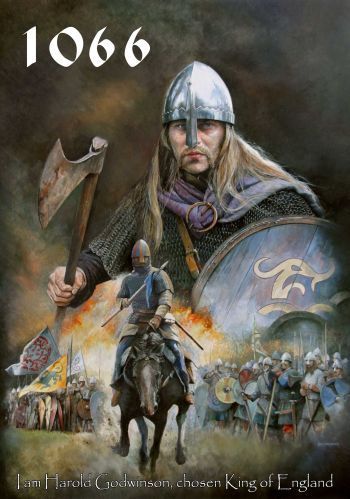
William the Bastard, base-born son of the Duke of Normandy, must fight the King of France to regain his Duchy. Spurned in love by the Princess Matilda, the fighting Duke dares to take a whip to her in her own father's palace, before making her his bride. William the Conqueror sails to England to claim the Saxon King's crown and sceptre for his own.
Georgette Heyer was a prolific historical romance and detective fiction novelist. Her writing career began in 1921, when she turned a story for her younger brother into the novel The Black Moth.
In 1925 she married George Ronald Rougier, a mining engineer. Rougier later became a barrister and he often provided basic plot outlines for her thrillers. Beginning in 1932, Heyer released one romance novel and one thriller each year.
Heyer was an intensely private person who remained a best selling author all her life without the aid of publicity. She made no appearances, never gave an interview and only answered fan letters herself if they made an interesting historical point. She wrote one novel using the pseudonym Stella Martin.
Her Georgian and Regencies romances were inspired by Jane Austen. While some critics thought her novels were too detailed, others considered the level of detail to be Heyer's greatest asset.
Heyer remains a popular and much-loved author, known for essentially establishing the historical romance genre and its subgenre Regency romance.
This was always my favourite of GH's historicals (although GH did slip in a romance between two of the fictional characters - she just can't help herself :D ) but this time I enjoyed my read more than ever before.
Being older now the romance isn't so important to me and watching William develop as both a strategist and warrior was fascinating.
As I said above, there is romance a less than PC one between William & Matilda - I worry that some of the violence may have reflected GH's own views- & a more tender one between fictional characters Raoul & Elfrida. But a far more compelling secondary theme is male friendship between both real and fictional characters and this was by far the most interesting part of this tale for me. I found - unlike the heavy handed symbolism GH uses in wrapping up Raoul & Elfrida's story. But this is an early GH book and she hadn't developed the deft hand she showed in most of her later books.
It is important to remember that this is fiction and that GH may have omitted some facts or they may not have been available to her. But she certainly captures the gruesome reality of hand to hand contact and I do recommend this account - especially this year, the 950th anniversary of the Battle of Hastings.
If this had been my first Heyer, it would also have been my last. This novel was written in 1927, and reissued in 1966 when the 900th anniversary of the Norman Conquest was celebrated.
They shoulda left it on the shelf. It's boring.
I leave all issues of historical accuracy to the anal-compulsive yammerers who think fiction should obey the laws of fact, contenting myself only with the observation that there are a scant number of primary sources from 900-plus years ago, so just unpucker and leave it alone. That said....
The book starts with imagining the life of William's mother, Herleva, in the tannery town of Falaise. This is usually a bad sign that we're going to pretend we were there, but tell our story in third person omniscient PoV. The auguries were correct. Bleeearrgh! Nobody knows if William's mother was named Herleva for a fact; nobody knows when he was born; nobody knows much about Falaise and its townspeople; so QUIT PRETENDING WE DO! Using this narrative voice gives the book a spurious air of knowledge imparted instead of speculation and storytelling indulged in; far better to use limited or even first person narration, which make plain the separation of fiction and fact.
And then there are the generational complaints...the silly formality of language (how should we represent the voices of people from the past? It's a good question, but one I think the bygone writers always answered wrong, giving the men and women who came before us the silly faux gravitas of Formal Speech) which makes Every Utterance A Statement, instead of giving a character a voice we can accept and believe in.
Oh well. It was a nice idea to read one of Mrs. Heyer's historicals. I won't do it again. Regencies or nothing at all. NOT recommended.
The Conqueror is one of six historical novels written by Georgette Heyer, who is best known for her Regency Romances, and if this is an indication of the other five - then sign me up!
Heyer brings us back to 11th Century Normandy and introduces us to William, Duke of Normandy, (a.k.a. William the Bastard) through the eyes of Raoul de Harcourt - a knight in Duke William's retinue.
Raoul began his service to the Duke as a young knight and he quickly rose to be one of William's most trusted friends. Loyalty is a running theme throughout the novel - loyalty from a knight to his lord. Raoul may not have agreed with a lot of the tactics used by William, but he trusted and respected his lord enough to comply. Don't get me wrong, Raoul was no pushover - he voiced his opinions when it was warranted, but in the end he knew his role and played the part.
Duke William was a very intriguing man - ambitious would be putting it lightly. He valued brain over braun and cunning over might. Once he saw something he wanted, he got it. Doesn't matter how, but he got it. Which leads me into a great scene with William and his future wife, Mathilda....but I'll leave that for you to read! Let's just say it's not a good idea to call William a bastard!
One aspect of why I love historical fiction is the educational factor. I know I'm a total dork, but it's true - I've learned so much history through all the historical fiction novels I have read. I take some of it with a grain of salt cause it's historical fiction after all, but for the most part I know a lot more than I did a few years ago. While reading The Conqueror I learned a great deal more about the difference between an Englishman (or Saxon) and a Norman and the Battle of Hastings scene was not put-down-able!
I enthusiastically recommend this novel! Heyer's writing is impeccable and her research is without a doubt one of the best. Character development is awesome and dialogue excellent. The Conqueror keeps you enthralled during and wanting more when you're done...which is how every good book should be!
I have no idea what Georgette Heyer had in her mind while writing this book. In my opinion, the plot is totally disconnected, there is a lack of link relating the main charters as well as the corresponding historical facts. Undoubtedly there are much better books describing the Battle of Hastings.
Certainly this subject deserves better readings and some interesting research at Wikipedia and The Battle of Hastings-1066 which includes facts and full story.
Before I explain how the book did it I want to warn some possible readers. You will be disappointed:
1. if you expect from this novel that kind of witty, funny stories like you can find in her Regency romances. There is some humour in a few scenes and characters. You can feel this Heyer sometimes, but it is like a light wind, comes and goes away almost before you notice it.
2. if you believe in some descriptions of the book which suggest that it is mostly a historical romance. Yes, there is a love story. As a matter of fact, there are two love stories, the two kinds that you can find in Heyer's other books: one between two strong characters, which struggle with each other, the second sweet and kind love (and characters) which fight with circumstances. But love stories are a small part.
In these two cases your expectations will not meet.
If you expect a great historical fiction you will not be disappointed.
The history of William the Conqueror is written with a passion of a historian. I don't know too well his history from other sources, but what I know and what I have verified now, shows me that there is a big historical accuracy. I think that Heyer should have written more historical fiction books. Simon The Coldheart (my review), An Infamous Army (my review), The Conqueror are evidence. She mixed perfectly significant historical facts, happenings with descriptions of every day life (such as clothes, food, buildings, concerns, rules of society, law). So you feel as you lived in those times. And you will learn more thanks to reading this book.
An action, a narration is engaging. I was neither bored nor tired.
I love Raoul and Edgar and their history, their friendship. It was so moving. For me it is the book about Raoul and William (in this order).
There is more friendship between men, it is one of the best parts of the book. I envy those men such kind of friendship.
This is also the book about ambitions, choices, beliefs. The last conversation between Raoul and Gilbert about old and new times/ways of life (but also many talks between Raoul and Edgar) is remarkable and memorable. It shows how a writer can speak to a reader through his pages, through his stories.
I am grateful to Heyer for a wonderful time with her book (but I am also a little sad because I have only her one historical fiction to read: My Lord John)
All through his life men were to fear him and find it hard to meet the direct stare he bent upon them. Thus early the French were made aware of the ruthless strength of his will. The truth was he never swerved from his purpose, and would go to any lengths to achieve it.
History tells us that William of Normandy was born a bastard, held off multiple assassination attempts, became Duke of Normandy, repelled the French and invaded England to become it's King.
This is the same story that Georgette Heyer tells here only it is told very thrillingly indeed.
She begins her story with the birth of William and a prophetic dream of his mother who foresees him as a great tree spreading it's branches over both England and Normandy. As others whisper that he is bastard, she calls him king. The story ends with his coronation in London, Christmas 1066 after the bloody, hard fought battle of Hastings.
In between these two milestones is a wonderful story of a charismatic, often enigmatic, man of towering self confidence and will. It is told mainly through the eyes of one his closest knights, Raoul de Harcourt. Because of his birth William had to pretty much subdue Normandy to accept his rule. Raoul is an idealistic youth who is sure that William will bring peace and prosperity to Normandy. Because of this he runs away to court to swear service to William. While there he manages to help thwart an assassination plot and is at William's side from that point on.
Although I was very familiar with Heyer's writing through her Regency romances and her modern mysteries, this book was a complete revelation. I had always loved her stuff and had always held her as an example of a very elegant and witty writer. But reading this, my respect for her abilities has ratched way up.
First the storytelling was excellent. What could have been a dry or even overly romantic catalog of events of a real person's life, instead was an exciting story that sucked me in and never once let me go. This was more a character study than anything. Sure the events were there, but each assassination attempt, each usurpation attempt, each war was a set piece to draw a picture of a superb war strategist, a merciful and very wise ruler, a shrewd judge of character and a person who inspired men to follow him.
Second was the language. It was simply luxurious. Heyer used french derivations, archaic words and even the archaic meanings of common words to really create a sense of time and place. Her descriptions of places, people, clothing and food were rich and involved. One passage for a banquet reads:
"Gisela began to eat of a Lombardy leach, flourished and served with a sober-sauce, but she did not eat much of it because her quick eye had observed all manner of delicate dishes on the board, and she meant to taste as many as she was able. She glanced around her and wondered aloud whether the Lady Adeline would instruct her in the way to make appulmoy, and whether it were well to put a dash of cubebs in a blank desire. One of the scullions had just brought in a dish of curlews. Gisela finished up what was left on her platter in a hurry. The curlews were served with chaldron, and Gisela was occupied for some time in trying to make up her mind whether this was flavoured with canelle or powder-douce.
Third were the scenes of battles. I admit I am not a keen reader of battle descriptions and probably would have tended to skim or skip them. But each battled was prefaced by a strategy session. Invariably William would think of some new, unorthodox strategy that flew in the face of conventional thinking and his advisors and vassals would strongly argue against it.
Warfare, as the barons understood it was a matter of chivalry charging to sound of tucket and drum; strategy was of the roughest order: one chose one's ground, one laid ambushes, or made surprise attacks, but while the battle raged there could be nothing to it than hand-to-hand fighting in a tight pack. But the Duke bent over his miniature battlefields, and moved his pawns this way and that, slowly evolving a more intricate way of war than his captains could understand.
William is credited with introducing archers as part of war rather than just for sport. And during his first battle with Henry of France, where he allows the French to advance deep into Norman territory, on unfamiliar ground, to a place of swamp land and uncertain footing so that the poachers and farmers could pick off the unwary, speaks of nascent guerilla warfare. To read these scenes and see his strategy come alive and prove its merit to his naysayers is fun and thrilling stuff.
And finally, it isn't all war and mayhem. History has by all accounts noted that the marriage of Williams and his wife Matilda was a strong, fruitful and loving one. Indeed, their courtship in this book is quite a stormy and passionate one. And in her way, Matilda is just as implacable and fierce as her husband.
Loved this book and am now looking to read more Heyer historicals.
I first read this novel many years ago and enjoyed it this time as much as I did the first time. The language is not dated and the tale of William the Conqueror and Raoul de Harcourt nicknamed The Watcher gripped me from beginning to end. Here is the drama of William's rough wooing of Matilda, of Harold Godwinson breaking his oath to accept William as king after Edward the Confessor's death. Of Raoul's friendship with a Saxon hostage and Raoul's love for the hostage's sister Elfrida. Whether or not that love will survive the Norman conquest adds poignancy to the novel.
Despite it's subtitle ("A Novel of William the Conqueror The Bastard Son Who Overpowered a Kingdom and the Woman who Melted His Heart"), there is very little in this novel that relates to the relationship between William and his wife Matilda. Though there is a chapter devoted to his determined "conquering" of her (including his beating of her when at first she refused to marry him), it's not a love story nor a romance. The story begins in 1028 with William's birth and continues to his coronation Christmas Day 1066, though most of the book is taken up with the battles for and around Normandy.
William is portrayed as a hard man molded by his dubious beginnings, his relentless determination to have his will carried out and his ambition for the crown of England (ostensibly to secure Normandy's future). He was a brilliant strategist in war, which he was about most of his days, and he could be exceedingly cruel when it served his purposes. He valued courage and loyalty. In this story he says that Harold Godwinson is the only man he (William) respects. But that didn't stop William from using Harold, forcing him to give an oath of fealty (or face a gilded imprisonment in Normandy), the breaking of which he used against Harold to secure the Pope's backing for the planned invasion of England. The author does a good job of showing how William always served his own needs and any good he did for others was motivated by what it could gain him. Perhaps that is what it took to gain a country like England but the author suggests there was something lost in the man for the effort as echoed in the reservations uttered by the men who served him. For that Heyer has done an excellent job of bringing to the picture of the real Conqueror.
The history presented here is interesting and entertaining, though I felt like I needed a dictionary, a map of France in the 1050s and 60s and a notepad for all the names and places thrown at me, particularly when so many men around William had the same first name. Such things also slowed down the reading of the tale in places and made it difficult at times to understand just what was going on or who the men were behind all those names.
In large part (perhaps the best part), this is the story of a friendship between one of William's closest knights, Raoul de Harcourt, and a Saxon, Edgar, who held lands under Harold Godwinson and who was the hostage of the Duke of Normandy. And, if there is a romance here, it's the love story between Raoul and Edgar's sister, Elfrida.
Quite possibly Heyer at her worst. The two heroines are so horrid that I could believe they were written by a misogynist. Matilda: a ice-queen bitch who might seem strong-willed but really she just wants the right man to come along and force her submission. Elfrida: spineless moron just waiting for the right man to tell her what she really wants. I wish all the romance had been left out so I could've enjoyed the battle scenes in peace.
I love Georgette Heyer's historical romances, and while I really enjoyed the history portion of this story, there was little compelling "romance" or even character conflict to keep me pushing through to the end (I did get there, though, and did actually enjoy the last few chapters once I got there). I had to force myself through several middle sections that had a lot of names and details, but not a lot of plot movement. I was mostly interested in the story of the - whom I, unfortunately, suspect to be fictional - "Watcher" and William's closest friend, Raoul de Harcourt. I loved him, his relationship with the Saxon, Edgar, and Edgar's younger sister, Elfrida. Since they are all probably fictional, it was disappointing for me that the more historically accurate aspects of the story weren't more engaging. I do feel that I have more of a grasp on where and how William the Conqueror happened, and I'm always very interested in British and European history, but will probably stick to Heyer's more romantic, less history-as-info-dump novels in the future.
Georgette Heyer takes us back to the Middle Ages, into the world of William the Conqueror all the way to the Battle of Hastings and his coronation in Westminster Abbey. I liked the addition of (fictional) Raoul de Harcourt, through whose eyes a lot of the story is seen, a man of honour, who, besides being Duke's man, is also a close friend to a Saxon hostage. There is some romance, but the friendships and loyalties among the men form a much more important part of the story altogether in this. Read this a few decades ago, glad to have rediscovered it.
This is the first Georgette Heyer book that I have stopped reading about 1/4 of the way. It is more a war history chronicle with some personal stories hidden between battles. I will keep it and maybe pick it up again when I am desperate for something to read, but for now I am moving on. Too many books so little time.
Overall, the second half was better than the first, but at this moment, I just do not have the patience for glorious tales of domination, death, and destruction resulting from the stupid pride of ambitious men. I say this fully in the knowledge that I have a chunk of the Bayeux tapestry reproduced on my wall.
The Conqueror is a novel depicting the life of William "The Conqueror," Duke of Normandy, from birth until his coronation as King of England in 1066. While I normally love historical fiction (unable to put a book down), this novel had a hard time keeping me interested. There were sections that did have me wanting to shut out the world and keep reading, but there were just as many boring storylines that had me looking at my bookshelf longingly.
Well-researched and portrayed for the time period, I have no complaints in that department. Heyer used great descriptive detail to portray the culture and history. The war-torn battlefields especially were very in-depth.
However, Heyer's writing style thoroughly annoyed me. As an editor, I wanted to go through the book and correct the punctuation with a big, red pen. Written in 1931, perhaps this is just a style of the times, or the style of some genre I've never read before, but I found the break in my reading flow quite distracting.
Another letdown for me was that the book was told from the viewpoint of Raoul, William's right-hand man. Not quite biography, not quite historical fiction, I was disappointed that the novel didn't let me inside William's head. Personally, if I can't be inside the historical character's head, then I'd rather read a biography of the person than fiction.
Lastly, William's relationship with Matilda was so talked up on the book cover and everywhere else, but in truth, it was just a small piece of the novel and seemed to be missing too much of the real storyline to make sense. In contrast, the relationship between Raoul and his friend, Edgar, had much more romance and love portrayed. I kept wondering when the two of them would become more than friends, but then Raoul fell in love with Edgar's sister, Elfrida, putting that pondering to rest.
In closing, it wasn't an altogether bad book. It just wasn't for me, and I'm doubtful I'll read anymore of Heyer's books.
The blurb on the book jacket suggests that this is a novel about William the Conqueror and his queen, Matilda. Although a small portion of the book deals with their tumultuous courtship and her role in his court, it is only a small portion. If you are looking for a romance along the lines of Georgette Heyer's Regency books, you may be disappointed. It is really, after all, a book about William, Duke of Normandy, a man of complex character and ruthless ambition, whose magnetism, self-confidence, and powerful leadership compelled the loyalty and service --if not the love-- of virtually everyone around him. The military strategies, political and religious scheming, and battle sequences are really fascinating and thrilling, and if you are interested in military history, especially regarding the Norman conquest of England, then you will probably enjoy this book. It is excellently, thoroughly researched, and written in Georgette Heyer's inimitable style, though without the sardonic humor that is so prevalent in her regency novels. The attention to detail (uniforms, weapons, styles of warfare, food, architecture, geography, etc.) is a bit overwhelming, but so rich and vibrant that I appreciated it. I found the in-depth exploration of the character of William, Duke of Normandy, and the juxtaposition of William and England's King Harold, together with the contrasting but thoroughly humanizing views of the Saxons and the Normans as manifested in an enormous cast of characters, to be especially fascinating. The author's technique of presenting observations of William through the eyes of his loyal knight, Raoul, was especially compelling and ingenious.
I should actually put it on a shelf of half-read book. Could not finish it, since it turned out to be only a maze of conspiracies and wars, presented in very complex language of the era that made the reading weary.
This book is story of William the bastard, the Duke of Normandy (who used to sign as Bastardus' who became King of England after winning the battle of Hastings. Book features Raoul as his favorite and trusted man servant - I believe this was as much Raoul's story as it was William's. For my part, most interesting or rather shocking part of the book was where Matilda, a widow when presented with William's marriage offer refuses him in public court saying, 'she can not marry a base born'. William rides to her father's house in rage and whips her in her own father's house. Second time he proposes (he dares), Matilda marries him! I searched, Matilda and William are said to have a very productive marriage with about 10 kids who dd carry legacy. It is also said Matilda added a reason and reined in his cruelties, as is evident in increased cruelty under William the bastard's rule after death of his wife.
But God, after 10 days too, I had not finished the book. Do not regret it.
Raoul de Harcourt is an idealistic young man who wants to make the world, (or eleventh century Normandy at least), a better place. He joins the household of the young Duke of Normandy, William the Bastard and becomes one of his most trusted men. Ultimately he fights at the Battle of Hastings and watches as his lord is crowned King of England.
I can see why this book would not be a favourite for many Georgette Heyer readers. The setting is medieval as opposed to Georgian, the prose is not her best and the main relationships in the novel are all between men - principally Raoul de Harcourt and William the Conqueror, and Raoul and a Saxon hostage Edgar. While there is romance featured - William and his bride Matilda and Raoul himself and Edgar's sister Elfrida - it is the interactions of the men in the book that forms the novel's focus. However one of Georgette Heyer's strengths is her description of battles and this is definitely shown in "The Conqueror". I recommend "An infamous Army" to anyone who particularly likes this aspect of her novels. Overall the Conqueror is the best of Georgette Heyer's pre-Georgian novels.
First book of Ms Heyer that I ever read so this book holds a special place in my heart. Little did I know that the sad little forgotten book in my school library would open a whole new world of romance novels and Ms Heyer in particular. Thank you !!
First sentence: There was so much noise in the market-place, such a hubbub of shouting and chaffering, that Herleva dragged herself to the window of her chamber and stood peeping down through the willow-slats that made a lattice over the opening.
Premise/plot: The Conqueror is a historical novel about William the Conqueror. It begins with his birth and ends with his coronation in December of 1066. It is not told from his perspective; it is told from the perspective of one of his loyal men--servants, warriors--Raoul.
My thoughts: Would The Conqueror conquer me or would I conquer The Conqueror? I knew from the start it would be a close call. Indeed it was. If I have biases, I thought they would work in favor of The Conqueror. I love history. I love historical fiction. I often enjoy novels about 'the royals.' It was also written by Georgette Heyer. I love and adore her, right?!?! (I can honestly say that if this was the first Heyer novel I picked up, I would never pick up another one.)
I didn't care about the characters for the most part. I don't blame Raoul, not really. One developed character cannot make a good novel. And essentially that's what we get. We may learn enough about Raoul to find him believable as a human being, but, the other characters not so much. Duke William, aka William the Conqueror remains distant, disconnected, unknowable, unlikable. Scenes vary--alternate--from battle scenes to groups of his men sitting around talking about how distant the Duke is. And perhaps that is how it should be. He's the ruler of Normandy. He's an illegitimate son. He's not overly liked or popular in some circles. Every person is a potential threat, a potential enemy, a potential betrayer. Raoul has proved himself loyal where other men had failed him. Raoul is easily part of his inner circle, but Raoul isn't necessarily an equal-equal either.
The one relationship I liked was between Raoul and Edgar.
Duke William has one thing--possibly two--on his mind. He's an ambitious, greedy man who lusts for the throne of England from a relatively early age. I'm not convinced that Heyer wants us to like him. Actually, I'm not sure of what Heyer intended. I doubt her intentions were to put readers to sleep. I doubt her intentions were to make a 470 page novel feel like 2,000 pages. Were we supposed to be cheering William on throughout the novel? Were we supposed to find the battle scenes thrilling? And his quest to be the next king of England noble and admirable?
This is a good book, one well worth reading, even though it took me quite a while to work through it. Rating it for fun, I'd lean more 3, due to some pacing issues (IMO). But there's more to this novel than entertainment. For historical scholarship, its finely crafted setting, its welcome complexity, and a very educational narrative, I'd give it a 4 at least.
I know Heyer mostly from her Regency romances, the books I was sent to when I asked other lovers of Jane Austen what author they thought wrote most like Austen. Since then, I've read maybe 9 or 10 of them, and I've enjoyed them collectively more than I originally expected. I've also read a mystery or two of hers, and I'd say those were okay; I'm not a huge fan of country estate murder mysteries, though I'll read one here and there. What I didn't know until now was that Heyer wrote straight-up historical novels. That's what this is. There's no more than a touch of romance here, and there's no mystery at all. There are women, and lovers, and love stories found in these pages, but this is book is closer to a biography of William the Conqueror. Told mostly from the perspective of Raoul, one of his closest supporters, the book covers about 20 years of William's life, ending shortly after the invasion of 1066.
(Hope that's not a spoiler.)
The beginning wasn't what I expected. Grimmer, maybe. The focus seemed odd. (This was all my fault, btw.) Even 50 or 100 pages in, I started to think the book would turn out to be a romance (of the bodice-ripping, chest-heaving, raven-haired tresses sort that I don't have much interest in), with a melodramatic tone and low stakes. But no. This is a no-nonsense historical novel with a very serious tone and heavy themes. It's about war and battles and strategy and putting down rebellions. It's about friendship and trust and honor and keeping one's word. It's about a man driven to make his mark on history and the people who gradually learned to believe in him, trust him, and follow him, helping him go from a beleaguered warlord to the leader of a stable regional power to the sovereign of a whole nation.
It was pretty fun to read, but not super fun. I didn't relish every page. However, there is nothing I could point to and say should have been edited out or abridged, and overall I'm glad I read it. Yes, I wish it moved a little quicker or varied in tone a bit more, but maybe it's better this way--leaning more toward an educational work of scholarship. This is no textbook, though; it's a novel, and I think a good one. Perhaps the greatest pleasure I've gotten from it is having a fuller picture of the historical setting and the Norman Invasion, filling in a picture that has been very sketchy most of my life.
The blurb doesn’t mention that this is actually mostly from the pov of Williams friend, Roaul. I have to say I am glad. I enjoyed it much more I think than had it been exclusively William. Wow! It portrays the attitudes of the time, the lengths conquerors go in their ruthlessness to gain power sometimes. The blurb also mentions “the woman who melted (William’s) heart” (like it’s a main draw when it really didn’t strike me as a pivotal point) but I enjoyed Roaul’s romance more. I did like how the author incorporated legends of William and Matilda’s “courtship” and leading up to their marriage. There is especially one doozy that apparently actually made the difference in Matilda finally accepting him that was slightly horrific(though she knew she kinda deserved too). The details and how the author made the characters seem so real!! Incredible. And I learned so much about the history, the battles, the kingdoms. Even understood more about several references I hadn’t before about the Normans and the Saxons. Thinking about the progression of Englands hierarchy and how things changed throughout history(especially in view of the other books of hers I’ve read) really struck me. I liked Simon the Coldheart better in some ways for knightliness and his standards of conduct but this was a heck of a story! Definitely a good one for recuperation from being sick!
It is not like her well-known Regency novels, however one of her historical novels featuring William The Conquerer. As Before I read this, I had no idea who was William the Conqueror or where was the Normandy itself. (I’m woefully ignorant in history and among other things. Yet, there’s still some time to understand the world history, I hope.) However, I believe this is good book to wet one’s interest in Saxony history. What could one ask more from fiction especially historical? Eh.
Georgette Heyer is witty with sharp retort in her regency novels, but I noticed her wit in small doses in this book. (Delightful) And her characters didn’t disappoint, they always develop, no fear on that score.
I will recommend every and each single book of Georgette Heyer (I haven’t finished all, but I stand by it)
If you love all things about Great Britain, you will love this historical novel. The character development was good and the book was fast paced.
I located maps on Google from 1028-1066 and used them alongside the novel as I read. I have been to Normandy in France, Brugge in Belgium, and London, Dover, Canterbury, and Cornwall in England. Historic maps as well as my travels really brought this story to life.
I felt that Duke William was presented as multifaceted as was his wife Matilda. Raoul was brilliant. This novel truly brought to life an amazing time in English history. I highly recommend this read.
A fantastic piece of historical fiction that brings characters to life and keeps the history interesting throughout. I learned a lot and enjoyed doing it!
Georgette Heyer's The Conqueror tells the story of the enigmatic William the Conqueror. Written in the mid-1930s, the Conqueror's language is a bit heavy handed at times. But it is clear that Heyer did a lot of research before writing the novel. A prolific romance novelist, the story was light on romance but heavy on the story of how the conquest of England came to be. Heyer's battle scenes are as well done as Sharon Kay Penman's - culminating in an intensely moving and passionately written account of the Battle of Hastings at the end of the novel.
The novel is told through the eyes of the fictional Raoul de Harcourt, a noble son from Normandy who becomes a loyal and intimate friend and supporter of William from the early days of his Dukedom. Throughout the novel, William never ceases to be an enigma. The only character that seems real to me is the fictional Raoul. I don't think Heyer fully conveys Williams motivation to establish himself as King of England. While she does a great job of showing how Williams illegitimacy likely motivated him throughout his life, it is unclear why William would undertake his seemingly foolhardy conquest to take the throne from the beloved Saxon Harold Godwineson.
Heyer's approach to this novel reminded me of Sharon Kay Penman's approach in When Christ and His Saints Slept (I would say the reverse because Heyer's novel was written earlier, but I read SKP's novel before I read Heyer's novel). Raoul reminded me of SKP's Ranulf both in his role as a storytelling device and in personality. Like Ranulf, Raoul is fiercly loyal but not blind to the faults of the person to whom he binds his loyalty. Raoul also is capable of seeing "both sides" of an issue, like Ranulf. Like Ranulf, he turns down earldoms and gifts, offering his loyalty for the sake of loyalty itself and not for material gain. Finally, both Raoul and Ranulf are separated from their loves due to political divisions. Both SKP and Heyer probably created Raoul/Ranulf because of the gap-filled, spotty history surrounding the main historical figures of the time and the desire to stick with known history while avoiding a history book feel - in this case, William the Conqueror and in SKP's case Empress Matilda and King Stephen.
I felt that Heyer was less successful than SKP in bringing the main historical characters to life. As noted above William remained wooden, as did Harold Godwineson, the Duchess (later Queen) Matilda, and other figures. Also, surprisingly for a romance novelist, Heyer does not create a compelling romance in this novel. The romance between Matilda and William is virtually lifeless (except for William's initial infatuation and Matilda's rebuff of his proposals). Similarly, the romance between Raoul and Alfrida is dull. It is hard to see what attracts Raoul to Alfrida beyond her beauty and I found the reunion between Raoul and Alfrida in the last chapter to be dull. I wish the novel had ended a bit earlier.
That said, The Conqueror was "pretty good." I would not hesitate to pick up another Georgette Heyer novel. But I'm still on the lookout for an even better take on William the Conqueror. 3.5 stars.
"The Conqueror" reflects the true genius of this talented historical author. I have read nearly all of Georgette Heyer's books, and was particularly drawn to her Regency era novels, but I believe this historical depiction of William the Conqueror is her greatest masterpiece!
Let me re-phrase ... I was never interested in Medieval historicals, and never particularly drawn to that era in history either. Heyer's novels, however, drew me steadily back in time, century by century, until she involved me and gripped me through all periods of British history. Here was I, a lover of historical fiction, who detested warfare and violence, but who became ever so unexpectedly engaged in love of battle. She brought William, Duke of Normandy, to vivid life. She molded him skilfully into this engaging, though fearsome, character with whom any person across the centuries could identify. She then created the perfect foil in Raoul de Harcourt, the endearing, sensitive contrast to his master, the fighting Duke. Her skilful use of period language is unparallelled. This biographical novel is, all told, a magnificent tapestry woven with immense skill. I could not put the book down and I could not have enough of it!
"Simon the Coldheart" was the first of Heyer's Medieval novels to clinch my interest. Anyone who fell in love with "The Conqueror" would also swoon over "Simon the Coldheart". I do not hesitate to recommend it.
This author deserves the highest accolades that no words of mine can hope to express. I wish she were still alive so I could have conveyed my tribute to her in person. But since I cannot, I hope instead to entice others to appreciate the true genius of this writer. She has the power to teach love of history as no other author I've read. It is a great pity that Georgette Heyer does not receive the same kind of adulation as a period author as, for instance, Jane Austen does. In my view, she is not only in her league, but actually better. Jane Austen wrote from personal knowledge of a life she knew intimately. Georgette Heyer writes with better wit and skill from posterity. And in her writing goes a depth of research that not even Austen would have matched.