A fictionalized account of one of the greatest rodeo bucking horses of all time told in first person from the point of view of each of the three men who knew him best.
This is a classic I read as a horse-obsessed girl in the 60s. Sam Savitt is one of the most awesome, greatest, incredible horse illustrators of all time, up there in the Hero to Horsey Kids Club with Wesley Dennis (who illustrated the Marguerite Henry books). These guys knew horses. They knew their anatomy, their colors, their tack, how horses moved; walked, trotted, cantered, and on what lead, how they leaped, bucked, spooked and their many expressions and body language. There are very very few modern illustrators who come to the Horse with this much knowledge and insight (most modern artists are completely clueless about horses).
This book is worth the price just for the Sam Savitt illos. And Savitt, as a horseman, knows how to tell the story of a great, real, historical horse.
Like Marguerite Henry, he has fictionalized bits of it (to make a story that flows better, and to fill in the missing blanks), which only serves to enhance the history and facts. Back in the day, stories were told, not with an eye to historical accuracy and scientific fact, but to the deep truths the tale revealed. This is quite a tail! I remember the book as a fine adventure, a great story about a great horse, a peek inside classic rodeo, and western life, and cowboys, and the deep respect they have for the creatures that are part of their world.
It also added fuel to my desire, as a kid, for The Wild Black Horse (aided and abetted by others like Fury and the Black Stallion). I did get my wild black horse, as an adult; a mustang I adopted in 1985 from the BLM's Adopt-A-Horse program. She'd run wild for eight years before being "kidnapped by aliens" (I figured it must have seemed to her like the Martians scooped her up and dropped her in PA). She taught me, and some young riders, quite a lot. She was calm and sweet and unflappable. She never bucked, not once, except when turned out into the big pasture, when she galloped and leaped and bucked with glee.
A tip of the riding helmet to you, Mr. Sam Savitt. And to Midnight. Perhaps this book will inspire some other young dreamers.
I am surprised by how much I enjoyed this short little non-fiction book about a Midnight, the Champion Bucking horse that never was tamed. I didn't know that he was actually buried by a Colorado Senator (I live in Colorado so that has a personal touch for me).
Midnight's life and times are narrated by three different famous cowboy figures: Jim McNab, Verne Elliot, and Pete Knight. I grew up in the country in Idaho surrounded by modern-day cowboys and even herding cattle myself. I never enjoyed the Rodeo because I had heard how badly some of those poor animals are treated. That gets contested in this book, but by a rodeo insider so who knows.
It was interesting to see how a single horse could make such a big difference in these men's lives. Jim's story actually made me sad as we learn how Midnight became the wild bucker that he was. Verne's story is almost like a brag session and kind ends suddenly (if the rest of the book had been like that I would have given it 2 or 3 stars). Pete's story was the one I enjoyed the most despite the tangents that he goes on it was the closest to a character journey that this book contained.
The illustrations that are in this book are really enjoyable. Detailed and yet somewhat scratchy, it was the perfect pairing for the story and times that were presented. I am curious now to see if Midnight's grave is still visitable. I might have to make a day trip.
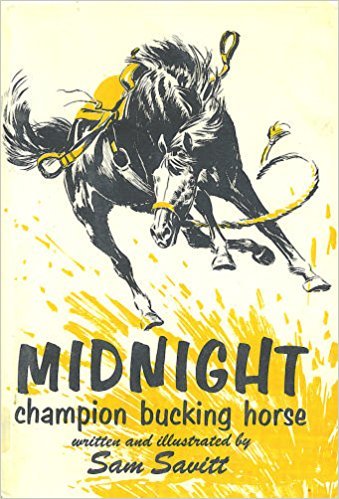
I read this book back in the 60s too. Savitt’s patent was 1957. When my daughters were little they were horse nuts. I told them the story about Midnight, the horse no man could ride. They thought it interesting, (ok for 10 and 12). Then at a short lived Western museum in Cochran Alberta, we came across a display about Midnight. A story, Savitt’s cover illustration (4’ high), a saddle, a hang on for dear life rope, and a few more artifacts. For a half hour I was 9 again and in the same place as the girls. Then … last week my wife comes home and gives me a 1969 printing 5th edition she found in a little free library. Identical to the edition I read in 1964, except the price had increased to 35 cents. A wonderful story and stunning drawings. Still, one of the best books I’ve read.
Sam Savitt was an underrated equine artist - who also did incredibly realistic and yet graceful images of cowboys. Savitt could portray movement well his 2-D work. This book focuses on Midnight, a legend in American rodeo. (Not to be confused with a majorly influential stallion in the Quarter Horse breed OR another famous bucking horse named Five Minutes to Midnight.)
The book concentrates on Midnight's character, unlike many other so-called "horse books" where the horses are merely act as stage props. Great black and white illustrations. I wish I hadn't lost my copy. Here is the cover:
Another one I saved to read to the boys. I have to sprinkle these horse books in so they don't get tired of them. This is the story of a bucking horse that gets sold to the rodeo and the many men who owned him and who tried to ride him. The boys enjoyed it.
I love a good horse book. I have read National Velvet so many times that I have memorized large parts of it, and I think of the Brown family as distant cousins. When I was in fifth grade, we had a Bookmobile two blocks away from my house. I read every horse book it carried, and then moved on to science fiction. So, while attempting to clean out my extensive library so that I can sell my house, I came across this paperback. It sold for 35 cents in 1957, and was offered through Scholastic Book Services, so I guess that means it was meant for young adults. It is a true story, set in Canada in the twenties and thirties. Sam Savitt broke the book into three parts, and each section is told by someone who knew Midnight well. First is Jim McNabb, Midnight's first owner. Jim intended to make a cow pony out of the horse, but although Midnight would follow Jim around, allow himself to be groomed, petted and saddled, the second a rider mounted him he would go ballistic. Midnight made a name for himself as a 'bucking bronco," and started his career. The second man telling Midnight's story is Verne Elliot. Verne's job was to locate buckers for the rodeo circuit. He relates Midnight's time on the circuit in fine detail. One of the many riders who never stuck the required ten seconds was Pete Knight, and he tells the last part of the book. Midnight retired unbeaten. I really enjoyed my re-read of Midnight. Savitt's prose and illustations are superb. I have been gifting and donating books left and right, but I am sorely tempted to hang onto this one.