Jump to ratings and reviews
Rate this book

Gloire et déchéance des grandes puissances

Rate this book
Tooly Zylberberg, propriétaire d'une petite librairie dans la campagne galloise, passe le plus clair de ses journées à lire. Mais un récit essentiel continue à lui échapper, tapi dans l'obscurité: celui de sa propre vie. Enfant, elle a été arrachée à son foyer, puis trimballée en Asie, en Europe et aux États-Unis. Mais pourquoi l'enlever - et l'élever - si c'était pour ensuite l'abandonner ?
Aussi, quand un message au sujet de ''son père'' lui parvient soudain, c'est sans hésiter que Tooly se lance dans une course-poursuite à la recherche de la vérité. En route, elle percera les secrets de Paul, l'informaticien errant qui préfère les oiseaux aux humains; d'Humphrey, ce vieux grincheux qui lui a transmis l'amour des livres dont nul n'est le héros; et de Sarah, flamboyante bohème aux humeurs changeantes... mais surtout de Venn. Venn, meneur charismatique qui a modelé Tooly à son image et lui a fait vivre les plus folles aventures. Jusqu'à ce que, sans crier gare, il disparaisse.

608 pages, Paperback

First published January 1, 2014

306 people are currently reading
10802 people want to read

About the author

Tom Rachman

8 books591 followers
Tom Rachman is the author of four works of fiction: his bestselling debut, The Imperfectionists (2010), which was translated into 25 languages; the critically acclaimed follow-up, The Rise & Fall of Great Powers (2014); a satirical audiobook-in-stories Basket of Deplorables (2017); and an upcoming novel set in the art world, The Italian Teacher (March 2018).

Born in London and raised in Vancouver, Tom studied cinema at the University of Toronto and journalism at Columbia University in New York. He worked at The Associated Press as a foreign-news editor in Manhattan headquarters, then became a correspondent in Rome. He also reported from India, Sri Lanka, Japan, South Korea, Egypt, Turkey and elsewhere. To write fiction, he left the AP and moved to Paris, supporting himself as an editor at the International Herald Tribune. His writing has appeared in The New York Times, The Washington Post, The Wall Street Journal and newyorker.com, among other publications. He lives in London.

Ratings & Reviews

What do you think?
Rate this book

Friends & Following

Create a free account to discover what your friends think of this book!

Community Reviews

5 stars
1,595 (20%)
4 stars
2,889 (37%)
3 stars
2,220 (29%)
2 stars
697 (9%)
1 star
226 (2%)
Displaying 1 - 30 of 1,177 reviews
Profile Image for Rebecca.
4,190 reviews3,450 followers
May 23, 2016
(4.5) A novel that requires – and rewards – patience. The story of plucky bibliophile Tooly Zylberberg and her cast of wildly unsuitable parental figures, spanning more than two decades and ranging from Brooklyn to Bangkok (with stop-offs at a musty bookshop in rural Wales), takes its time revealing major secrets. We don’t learn who her real parents are until over two-thirds of the way through, for instance.

The fact that her parentage is just by the by, though, forms a central point of the book: family is who you make it, and one’s essential self is always the same, despite the passage of years and changes in outward circumstances. This is perhaps the greatest lesson Tooly has to learn: your location in time and space do not determine who you are. “She found herself inhabiting a new character, uncertain whether this edition was more or less true, and whether there was a pure state of Tooly-ness at all…People manifested so many selves over a lifetime. Was only the latest valid?” And again: “‘Does it feel,’ she asked, ‘when you’re telling these stories, does it feel like it’s you? Or does it feel like a different person back then?’” As two of her blithe guardians reply: “I’m the same as I was. Only later” (Humphrey) and “Nobody changes! At heart everyone’s the same at eight as at eighty” (Sarah).

Rachman skewers two main symptoms of the modern condition: rootlessness and purposelessness. In this way the novel strikes me as being very relevant and contemporary. As in The Imperfectionists, the expatriate experience is a major element here, and one that resonates strongly with me. “It don’t matter how long you been overseas,” a brash U.S. Marine opines. “We’re always Americans, wherever we end up. And you’ll move back sooner or later.” Luckily, Rachman’s conclusions are a lot more nuanced than that.

Characterization and humor are a couple of the novel’s greatest strengths. All of the father figures are wonderful in their own way. I love how Rachman can convey so much about a character in one compact line: “Paul was a pair of red spectacles with a man behind, arms tucked close to his body, as if to occupy as small a portion of the planet as possible.” I also loved Duncan & Co.’s random downstairs neighbor and his pet pig: “Gilbert was a composer of harpsichord music, his latest self-released album...having sold eight copies worldwide, including those purchased by his aunts.” All through the novel, the banter is just fantastic, especially in the passages from 1988 when Tooly is nine and ten. But, speaking of the pig:

“Here’s something: I saw a pig downstairs.”
“Not running wild, I hope.”
“Some guy was taking it back from a walk. A huge fat potbelly.”
“The guy?”
“The pig.”

(And, later, “Ham remained doggedly, or perhaps piggedly, in place.”)

There’s an adventurousness with language and form here that I really admire. If I could critique one thing, I’d say I would have preferred more of Tooly’s interiority, something we don’t really get because all the narrative strands are third-person. (Well, if I could critique a second thing, I’d also say the title is a bit grandiose and espouses Duncan’s ‘declinist’ perspective in a way that the rest of the book doesn’t.) I found myself thinking of the novel as Dickensian, with Tooly as the pseudo-orphan who has to tumble up as best she can. (In fact, in an Oliver Twist framework, you might cast Sarah as Nancy, Venn as Fagin, and Humphrey as Mr. Brownlow.)

In any case, it’s appropriate to think about the literary context of The Rise & Fall of Great Powers, because this is very much a book about books – not just about the impact that individual volumes can have (such as Nicholas Nickleby for Tooly or Hume and J.S. Mill for Humphrey), but also, in a sort of metafictional sense, about how books are composed, paced and structured:

“The world was far more fascinating than anyone could imagine. In made-up stories, he contended, life narrowed into a single tale with a single protagonist, which only encouraged self-regard. In real life, there was no protagonist. [Humphrey’s cod-Russian dialect] ‘Whose story? Is this my story, with my start and finish, and you are supporting character? Or this is your story, Tooly, and I am extra? Or does story belong to your grandmother? Or your great-grandson, maybe? And this is all just preface?’”
Yet the novel is also about real, paper books; it begins and finishes at World’s End, a secondhand bookstore Tooly runs, at a loss, in rural Wales. (This is not quite Hay-on-Wye, the first and best Book Town and one of my favorite places on earth, but it almost is. Rachman made up the Welsh town of Caergenog, and is careful to emphasize that Tooly is slightly too far from Hay to benefit from the annual Festival trade.) I loved the random inherited classification system in her store (sections include “Artists Who Were Unpleasant to their Spouses; History, the Dull Bits; and Books You Pretend to Have Read but Haven’t”) and the wry commentary on Britain’s weather (“No rain this morning. There are miracles, yes, even in Wales”).

Determined bibliophiles will love this “great jigsaw-puzzle of a book,” as Sam Leith calls it in his Guardian review. It can take a while to get into, but it’ll be worth your effort.

I was delighted to win a copy in a Goodreads First Reads giveaway.
Profile Image for Jareed.
136 reviews290 followers
July 14, 2014
“He allowed himself to be swayed by his conviction that human beings are not born once and for all on the day their mothers give birth to them, but that life obliges them over and over again to give birth to themselves.”
―Gabriel García Márquez

And indeed life has been this constant making and remaking of who we are, it is, the uncompromising search of meaning and truth. We all go out in the world, frantically searching for something, something we may feel only in vague stirrings, and sometimes, in our definite inevitable folly, something we don't know of. Whether we seek something that exist or something we have subconsciously created out of a desperate need to define ourselves has never been the question, for the search itself has always been the answer, hasn't it? And we never really come out of it do we? Then in some seemingly random manner which has always been forthcoming, we stand in retrospection, an inquisitive outside observer of our very own lives.

description

The Rise & Fall of Great Powers tells us of Tooly Zylberberg’s cathartic odyssey, a journey that spanned decades and crossed continents, a journey that did not only defy time and space, but masterfully that too of the traditional linear narrative form. The story is sequentially divided into three periods – 1988, 1999, and 2011 – corresponding to pivotal moments in Tooly’s life, moments that would define, and haunt her. Hand in hand with Tooly’s sojourns is the milieu of the decade including the technological advancements, political demographics and prevailing family dynamics.

To employ words in this case would, however definitely lead to failure, for the reader must be left to his/her own devices. One must know Tooly in a personal manner and not some insufficient words fraught with verbosity. So go, and read!

“Consistency in character is a form of tragedy.” (330)

Arguably some of the best characters live in this exquisitely written piece. I won’t mind loosing valuable time over a cup of coffee with any of the personas Rachman has brought to life. Their philosophies, their choices from life decisions to their dictions had me enamored. These exceptionally captivating characters left me in a daze, for their story is not of the everyday kind and yet I found myself in a corner sufficiently drunk in empathy. Rachman created universal and unusually personal characters that have necessarily, at the same time, relegated readers as outside observers and yet made them part of the narrative itself, for sublimely, one will come to realize that Tooly’s search is existent in every reader's life.

I enjoyed the candid humor;

“You don’t like sweet-and-sour, do you?”
“No,” he confirmed. “I want food that can make up its mind.”
(57)


the crisp philosophically-charged conversations;

“I hate trivial beings.”
“I hate them also. But be careful; it is trivial beings that run the world.”
(254)


and most of all, the universal (well it should be) love for books.

“People kept their books, she thought, not because they were likely to read them again but because these objects contained the past-the texture of being oneself at a particular place, at a particular time, each volume a piece of one's intellect, whether the work itself had been loved or despised or had induced a snooze on page forty.” (334)


The prose is unique, lyrical and beautiful and conclusively ties this story in impeccability. The tone is always warm and tender.

Those who find difficulty in novels written in a nontraditional form may easily find this book’s delivery as fragmented and disjointed. My prayers go to you for such stifling preference or inopportune incapacity. The structure itself reflects Tooly’s ordeal, and in many instances, ours. We are battered with inconsistencies and unending questions, white lies and lies that have become truths, truths that have been lost in obscurity. But as Tooly unravels the cryptic nature of her life, we are reminded that people whom we call family are not defined by pieces of paper or definitive blood relations, they are those who stay, long after we have left.

My copy was provided by Random House Publishing via Netgalley.


This review, along with my other reviews, has been cross-posted at imbookedindefinitely
Profile Image for Angela M .
1,458 reviews2,115 followers
May 21, 2014


How can you not love someone named Tooly Zylberberg, who loves to read and won't finish a book because she doesn't want the people she meets in books to end with "a blank space at the bottom of the final page”? We first meet Tooly when she is in her early 30’s and is the owner of a failing bookshop in in Caerfenog ,Wales
The novel takes place in three different decades and we get to know Tooly at 9, in her early 20’s as well as in the present day. We follow Tooly around the world to Sydney, Bangkok, New York, Wales and none of it is in in chronological order. Sound confusing? Surprisingly, it wasn’t, as long as I paid attention to the year on the chapter and then I just got into where Tooly was, at what age and who she was with. You want to know just how she got there as much as she does, and her journey to find out about her past becomes yours.

I love Tooly at 9. She's smart and bold and independent because she's learned to be that way after a vagabond life with her father, Paul. They run from city to city and school to school and it seems as if she really needs more looking after than Paul manages
Enter Sarah, Tooly's irresponsible mother who can barely look after herself. Who are these people that Tooly stays with Humphrey, the loveable old Russian (?) who gives her cola for breakfast, reads to her from philosophical and political tomes. He collected books. “This was less a library than an orphanage. His stated plan was to read everything.”
There’s the mysterious scammer, Venn who Tooly idolizes and wants to please. In the meantime, Sarah comes and goes in and out of Tooly’s life. At 21, she meets Duncan who in her mind is the mark that will help her get Venn to do a “project” with her. Duncan actually turns out to be the friend that Tooly never really had.

The sad story of Tooly's childhood unfolds in these chapters but it is not until the end that Tooly discovers and remembers who it was that really cared about her. Maybe it was a little too neatly tied up in the end, but this didn’t take away from how moved I was by Tooly’s story.

Definitely recommended!
Thanks to Netgalley and Random House for the opportunity to read this book.
Profile Image for Barbara .
1,844 reviews1,521 followers
January 13, 2024
Witty and deeply moving, this novel is chick-lit with social commentary. When the reader meets Tooly Zylberberg, she is an adult who owns a bookstore in Wales in 2011. The novel is divided into three important times of Tooly’s life: adulthood, young adult, and childhood. Thus, the reader knows who Tooly basically is as an adult. The next chapter is her young adulthood in 1999, and she seems a bit quirky. The following chapter is in 1988, when we meet nine year old Tooly and get a sense that she is a unique child. It took a bit of time for me to get into the rhythm of the different times of Tooly’s life. The reader learns bits and pieces of Tooly’s life and falls in love with Tooly while simultaneously feeling dread for Tooly. The adult Tooly realizes she’s never come to terms with her unusual upbringing.....who really were Tooly’s parents? Why did she move so much? Why was she the pawn in adult games? Once you get into the rhythm of switching time periods, the story flows. At the end, it’s heart wrenching and sweet. Adult Tooly realizes the adults in her life were not the people she thought they were. As she unravels the truth of her upbringing, she sees the touching beauty that she missed and the ugliness of which her youth allowed her to be unperceptive. It’s fast paced, but you do need to pay attention; not a beach read. I adore this story.
Profile Image for Diane S ☔.
4,901 reviews14.6k followers
June 16, 2014
This book has some of the best characters in it, one could look far and wide and never find such an interesting character as Humphrey. He quite won me over, wish I knew a person just like him. I would spend hours with him, drinking instant coffee, which I do not like but he did, discussing thoughts and philosophers with him. Playing chess and ping pong. This story though is about Tooley, we meet her when she is nine, and then in alternating chapters, when she is nineteen and then when she is grown and owns her own book store at Kings End. Such a life she has had, totally dysfunctional but oh so interesting, but a story she feels the need to piece together and find out the truth behind her life.

So she sets out on a journey, taking the reader with her. A journey that is at times humorous, the young Tooley is formidable, filled with scenes that made me cringe, such a young child exposed to so much dysfunction. Yet, in many ways she thrived, although she never attended school after the age of ten, moving from place to place, she was taken care of in a very unorthodox way. No surprise, nor a spoiler, she finds many of the things she remembers were not as they appeared.

So many book references, thoughts and opinions on the history taking place during this period, and a well written and entertaining read. A homage to the people who raise us and care about us, whether they are family or not.

ARC from Net Galley.


Profile Image for Karen·.
682 reviews902 followers
December 27, 2014
Look! STARS! Five of them, no less.

This may well be my book of the year. I wondered, after The Imperfectionists, I wondered how Mr. Rachman would follow that, where he would go from there. He went EVERYWHERE. A quarter century of this planet's history, an intriguing puzzle to be solved, narrated through characters that steal your heart, told with wit and laugh-out-loud funny dialogue, built in a dizzying architectural marvel that follows the dictate of the fonction fabulatrice referenced therein, picking up a speed and dynamic towards the end that leaves you breathless, and it's serious too! BIG themes, Communism and Capitalism and Rootlessness and Connectedness and What Makes Us Human, and Right and Wrong and Common Decency and, and, and I just love it when books talk to each other, Humphrey gives Tooley a copy of The World of Yesterday yay! AND there's a ukele too! What more could you want? Loved it. Loved it loved it loved it.

So good I read it twice. Happily.
Profile Image for Abby.
207 reviews87 followers
August 10, 2016
You know that thing that happens when you love a writer's first effort -- a debut novel or maybe short stories -- and you look forward with great anticipation to what he or she will do next only to be disappointed? Yeah, that.

"The Imperfectionists" was a delight -- wry, witty, tightly and cleverly constructed. "The Rise & Fall of Great Powers," Tom Rachman's second novel, is more ambitious, a lot longer and a lot flabbier. Tooly Zylberberg is called to New York from her quaint, failing bookshop in an impossibly quaint town in Wales to tend to her failing father. Curmudgeonly Humphrey Osterpol isn't really Tooly's father and it takes many, many pages and jumps between three eras in Tooly's life to unravel her tangled past. There are some interesting (and, it goes without saying, quirky) characters and well-wrought set pieces along the way but I was ready well before the end to see it wrapped up and for Tooly to figure out her place in the world. When she does, there's a "so what?" quality to the whole endeavor. Rachman is still a writer to watch but he is reaching here for big ideas about life and learning and loyalty and sometimes the reach exceeds the writer's grasp.
Profile Image for Shelby *trains flying monkeys*.
1,748 reviews6,571 followers
October 26, 2014
I hate giving up on a book. HATE it. My eyes keep glazing over reading this one though. I should love it. I mean Tooley owns a bookstore! Which I haven't heard her mention much of yet in the book.
I think this might be one of those love or hate books and of course here I am hating. I can't figure out what the hell is going on in it.
DNF at 30%

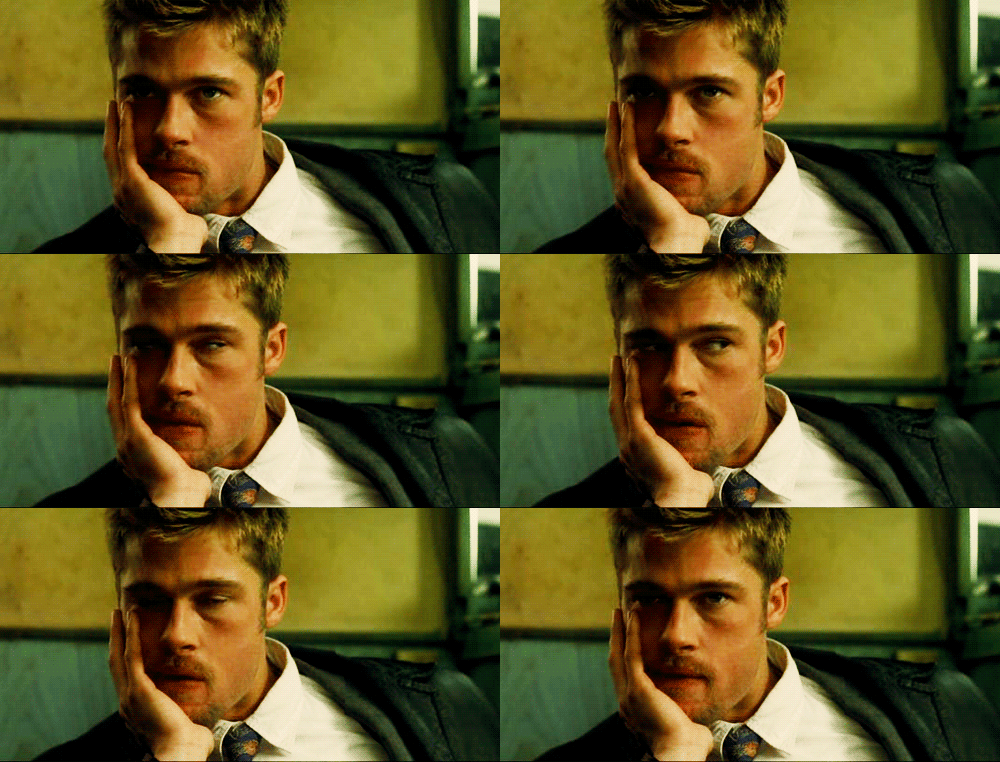
But look! I'm using Brad Pitt...so it's not all bad.


I received an ARC copy of this book from Netgalley in exchange for an honest review.
Profile Image for Patrice Hoffman.
563 reviews279 followers
June 8, 2014
The Rise & Fall of Great Powers by Tom Rachman, can be summed up entirely by stating it's a great read. For most, that simple statement isn't enough so... here's my review:

Tooly Zylberberg has found it much easier to live in a world of solidarity with the characters she meets along the way in the many books she's read. It's only befitting that she owns a bookstore where she can cultivate this love of the written word. She has little interaction with any outsiders besides Fogg, her employee, but doesn't seemed too worried about it. That is until a man from her past informs her that he's been looking for her. Something's happened to her father.

The Rise & Fall of Great Powers shifts between three distinct periods in Tooly's life that offer readers a glimpse into her past, even more distant past, and her present. Almost immediately it is obvious that Tooly isn't being raised as most children are. She travels the world with a man named Paul. Never staying in one place longer than a year. It is age ten, during their stay in Thailand, where Tooly's life goes in a completely different direction and she makes a decision that leads her to question everything that's ever happened before and since.

I enjoyed reading every page of this book. Rachman is one helluva writer... for lack of better words. I'm no master lyricist. His writing is poetic, eloquent, and alluring. There wasn't one moment I wasn't completely interested in this novel, nor did I feel the need to race ahead in an effort to get past the boring parts. Don't even get me started on the depth of each character introduced in this novel. Rachman is one helluva writer.

At the very heart, most basic part, of this novel is a mystery. Who is this woman Tooly? Where did she come from? Why was she with this man Paul only to end up with another strange hosts of guardians? There's Sarah who is one disappearing act after another. The enigmatic Venn that Tooly is completely entranced with. Last, the funny talking russian old man Humphrey who seems to have a new story about his past each time he's asked. Paul, and this band of misfits all had a hand in raising the now introverted Tooly.

It has been a long time since I've read a book that made me want to laugh and cry all on one page. I don't mean to imply that this novel is sad, but my heart really goes out to some of these characters. They were all bonded to each other because of Tooly. Content to playing the background, to blend in as much as possible, she never realized the importance of her role in the lives of the ones she found the least exciting and that made me sad. I admit I'm sensitive like that.

The Rise & Fall of Great Powers is the journey of a woman who's trying to decipher the cryptic nature of her past and in turn finds herself. As she pieces her life together, sorting through the lies and the truth, between the past and the present, Tooly find that maybe the ones who loved her most, were the ones always there.

Copy provided by Random House Publishing via Netgalley

Profile Image for Julie.
Author 6 books2,305 followers
July 16, 2014
Three and a half stars.

"... the other side of original is gimmicky. As much as I enjoyed this clever, sharp debut, I hope the next trick Rachman pulls out of his pen is completely different. The magic works only the first time."

Is it odd to quote oneself in a book review? Odd or not, I just did. This was the closing comment to my review of Tom Rachman's novel, The Imperfectionists. Did the magic work a second time?

Once again, Rachman upends conventional structure with a novel that flings itself around time and geography with a cast of rich, outrageous and endearing characters. The constant is Matilda "Tooly" Zylberberg, a young woman whose peripatetic life we follow in zigzag fashion from 2011 in the Welsh village of Caergenog, 1988 in Bangkok, and 2000 in New York. This is a novel about the search of self, the meaning of home, and what makes a family. It is also a reflection of the historical events that shaped the writer, and this reader, who are of an age. Beginning at the waning of the Cold War, through the bombing of the Twin Towers and the subsequent wars, to the hyper-connectivity of the Internet Age, The Rise & Fall of Great Powers gives plenty of elbow room for philosophical commentary.

It is also the story of loneliness. Despite its vast time frame and globetrotting setting, The Rise and Fall of Great Powers is claustrophobic in affect. Tooly belongs nowhere and to no one, for even those who claim her do so only to further their own agendas, a skill Tooly learns and employs when her time comes to survive on her own. Her world is small because she is so very alone. She is a prisoner who travels freely, but who is dependent upon the largesse of her captors. To whom she belongs, how she was captured, and why, and how she sets herself free are the mysteries that propel the narrative forward through time and place.

Only reading--that beautiful physicality of books, the feel and smell and look of a real book--provides Tooly with a sense of comfort and belonging. This is the second novel I've read this year which uses literature as an emblem of refuge and healing--Niall Williams's tender History of Rain being the first--and once again, Charles Dickens is the author's hero-writer.

Rachman sometimes runs afoul of his own whimsy and cleverness. The Rise & Fall of Great Powers oozes with quirkiness that makes me twitchy and creates an emotional distance that renders the characters on the other side of plausible. It's not the suspension of disbelief that I mind-not in the slightest. But at times the tricky structure, writer-y writing, and the sheer volume of words diminishes the novel's strength. Sometimes it feels like Rachman is hiding behind his own big words and big ideas. I admit to eyes glazing over at the characters' many moments of pontificating, because they felt too much like the author's own.

There is much to admire and adore in The Rise & Fall of Great Powers, Tooly being a character I will not soon forget. But I end this review with the same sentiment as I started: "... the other side of original is gimmicky. As much as I enjoyed this clever, sharp debut, I hope the next trick Rachman pulls out of his pen is completely different. The magic works only the first time."


Profile Image for Sue.
1,439 reviews652 followers
June 21, 2014
All of life is a search for the truth of ourselves. Each of us undertakes this quest in his/her own way. Tooly has quite a unique odyssey which becomes more engrossing as the pages pass. The story is told in multiple parts --- 1988, 1999 and 2011 ---as Tooly moves in and out of various "lives" from the time she is 10 years old. Her childhood, her life, in fact, is not the stuff of everyday reading. We readers wonder along with her.

But enough about that. Too much said would be too spoil the story.

Initially, to be honest, I wasn't sure if this novel was for me. Who was I to care for and about? What setting would grab my attention? What in blazes was going on? But gradually the pieces emerge as they do for Tooly. If you are put off by a broken up narrative, moving back and forth in time, this book is not for you. However, if you have patience with the format, the story may just catch and hold you as it did me.

There were two quotes having to do with books that caught my attention while reading. Books do play an important role throughout.


"Books," he said, "are like mushrooms. They grow when
you are not looking. Books increase by rules of compound
interest: one interest leads to another interest and this
compounds into third. Next you have so much interest there
is no space in closet."

"At my house, we put clothes in the closets."

He sneered at this misapplication of furniture. "But
where you keep literature?"
(loc 4723)


In contrast at another of Tooly's "friend's" homes,


Books lined the walls, each volume identically bound in
Bordeaux leather, silver letters imprinted on the spine,
gold paint on the page edges. Classics, poetry, essays.
They didn't have the smell of reading books; they were
furniture.
(loc 5163)


One of these people nurtured Tooly.

Recommended for a patient reader.


I received an ecopy of this book from the publisher through NetGalley for the purpose of review.
Profile Image for Ron Charles.
1,166 reviews50.9k followers
September 8, 2016
In 2010, Tom Rachman published a witty novel about a failing newspaper based in Rome that charmed a great number of people, particularly journalists, who wished their failing newspapers were based in Rome. Proving himself a clever ringmaster of quirky, ink-stained hacks, Rachman constructed “The Imperfectionists” as a series of character studies intricately snapped together to produce unexpected moments of tragicomedy.

His new novel, “The Rise & Fall of Great Powers,” is weightier, more focused and considerably more melancholy, but it still exhibits the author’s impish wit and his fondness for tangled stories. In fact, untangling is the central action of this plot, so beware diligent summaries that might suffocate its pleasures.

The heroine is Tooly Zylberberg, a peripatetic young woman who appears to have no connections to anyone or any place. We meet her soon after she has purchased a moldy bookstore covered with cat hair in a tiny Welsh village. “She considered bookselling to be a terminal vocation,” Rachman writes, revelling again in his romantic attraction to doomed literary endeavors. Tooly’s shop features shelves labeled “Artists Who Were Unpleasant to Their Spouses,” “History, the Dull Bits” and “Books You Pretend to Have Read but Haven’t.” No matter how worthy these used tomes may be, “they lived as did the elderly — in a world with little patience to hear them out.”

Except for spying on old acquaintances on the Internet — “nostalgic prowling” — Tooly seems like someone out of time, wholly divorced from the world. She has only one employee: a “touchingly buoyant” young man who always appears “as if recently awakened by a fire drill.” These two misfits might have continued lugging books and swapping quips until the shop inevitably failed. But one day Tooly receives a note from an old boyfriend informing her that her father is gravely ill.

“Her father?” she wonders. “Whom could he mean?”

“The Rise & Fall of Great Powers” pursues that question in a languid, self-consciously convoluted manner. The novel’s chapters rotate through three time periods about a dozen years apart: 1988, when Tooly is 10 years old in Bangkok; 1999, when she’s living with college friends in New York; and 2011, when she sets off to find her father in America.

Mingling these time frames and withholding explanations about characters’ relations to each other, Rachman raises the stakes of this minor mystery somewhat higher than the novel can ultimately afford. But that structure reflects the peculiar, dizzying life that Tooly led for 30 years. “Her past cohered so poorly,” Rachman writes. “All she heard was inconsistencies, blank patches, and . . . questions.” Now, she must confront “not just the muddle of her past, but the muddle of her present.”

Constantly shuttled around the world under false pretenses, she was cradled in deception, raised in lies, schooled in fraud. Years later, thoughts of her adolescence “stirred up such disquiet, all the puzzles as upsetting as ever.” When she finally steps off that merry-go-round to settle in a little Welsh town, she has no idea who she really is or to whom she belongs. Her spirit, so long cramped into a crouch of deceit, is both wary of others and desperate for true affection.

Honestly, I found it impossible not to fall in love with shape-shifting Tooly. As an adult, she sports an ironical sense of humor and an attraction to dusty old books. As a child, her straight-faced mirth and wordplay are break-your-heart irresistible. Rachman works at that confluence of poignancy and sentimentality popularized by “Little Miss Sunshine.” If you know Elizabeth Kelly’s wonderful novel “Apologize, Apologize!,” you already have some familiarity with the kind of precocious preoccupations that young Tooly engages in. For instance, struck by the word “shall” while reading “Nicholas Nickleby,” she anticipates the thrill of impressing her classmates: “May I go with you?” they will ask, to which Tooly will reply, “You shall!” Later, seeing something called “Unique Leg of Camel” on the restaurant menu, she objects, “Isn’t every camel leg one of a kind?”

Just as resilient as her weird circumstances demand, she’s always willing to construct a home and family from the scraps at hand. Among the novel’s most charming scenes are her interactions with Humphrey, a “Marxist, non-practicing,” who claims he escaped from the U.S.S.R. after six years of detention. Chaotic wordsmiths separated by half a century, the girl and the old Russian relish their private banter — “conversation and debate.” From Humphrey, Tooly receives a scattered and highly impressionistic education in science, history and philosophy:

“You have read Spengler yet, darlink?”

“What is Spankler?” she asks.

“You are ten years old, and you not read Osward Spengler? How is this possible?”

He’s a fantastical character, full of faux fury and outrageous pronouncements that would enchant any bright, lonely 10-year-old. “While speaking, Humphrey gesticulated wildly, as if skywriting the names of his idols,” Rachman writes. “He was of the firm opinion that, had the Great Thinkers been around, had they stumbled across this house, they’d have become his personal friends. ‘Sir Isaac Newton and I, we are like two peas in a pond.’ ” But the real peas in this pond are Humphrey and Tooly. “You open up whole new world for me,” he tells her, and from this crazy old man she absorbs a love of books, which will be her most dependable friends in the tumultuous years ahead.

“The Rise & Fall of Great Powers” eventually lays out the whole trajectory of Tooly’s life and shines light on the dark mysteries of her scrambled childhood. But those improbable revelations are never really the point in this novel. Tooly has been the victim of a sustained act of abuse and neglect, the dimensions of which she can hardly comprehend. Now beyond resentment or blame, she just wants a usable past and someone worthy of her tender heart. Rachman is certainly such a person, and in these pages, you may discover that you are, too.

From The Washington Post:
http://www.washingtonpost.com/enterta...
Profile Image for Jenny (Reading Envy).
3,876 reviews3,711 followers
June 15, 2014
I knew if this book was anything like The Imperfectionists, which I loved, that I would read it quickly. I did read this in under 24 hours, at least a fourth between 3 and 6 am when I couldn't sleep. It is fast paced and contains a mystery that the different stories and time periods intertwine to expose by the end of the book, so that kept me reading, but the author didn't make me feel the deep compassion I had for the characters in The Imperfectionists. Some, but not all, in fact I felt more for less major characters like Humphrey than for Tooly herself.

Tooly's story is told in three parts - 1988, when she is a child in Thailand; 1999 when she is dating a law student in New York City, and 2011 when she is the owner of a failing used bookstore on the border of England and Wales. Tooly is a loner, partly because she did not have a normal upbringing (to say the least, but I won't say more as that is what is unveiled through the novel), but also because it makes life easier.
"Friends required a life story. Your past mattered only if others sought to know it - it was they who demanded that one possessed a history. Alone, you could do without."
And Tooly has managed most of her life this way, until something happens that makes her curious to really nail down what exactly happened when she was younger. And there the novel begins.

In another author's hands, these characters would have been more contrasted, more obviously conniving or evil when needed. I was thinking of what would have happened if Patricia Highsmith had written it, in particular. There are fewer deaths than a Highsmith novel, and you have to read more in between the lines, but I think in the end I liked this somewhat nebulous noncommittal treatment. Almost every character was a bit unsettling and that helped move everything forward to the end.

Other bits I liked, behind a spoiler since some are a bit spoilery:
Profile Image for Mona.
542 reviews393 followers
November 12, 2019
Fun, but Contrived and Cutesy-Poo


Some people are just gonna love this book. I'm afraid I'm not one of them, although I did find the story and characters engaging and entertaining at times.

Besides, it was yet another novel that's a love story to books, book stores, and readers. How could I resist?

The book was something of a mashup. It was a sort of contrived, pseudo-postmodern crazy quilt. Ok, I'm exaggerating. There was a method to this madness. It was planned (sort of). It just didn't entirely work for me.

Penelope Rawlins' audio reading style didn't help matters. All the characters were SO EXAGERRATED. The upper class British/colonial women (Sarah and Harriet) sounded exactly the same (hysterical, breathless, etc.) Young Tooly could have been wearing a sandwich board sign reading "I am a wittle kid! Aren't I cyooot?" I really prefer more understated readings. I don't think the reader's personality should get in the way of the text being read.

That said, I did finish the book and it was a fun read, although not a great one.

The central character is Matilda ("Tooly") Zylberberg, a rootless, freewheeling globe trotter. We see Tooly at various stages of her life: 1988, when she is a child;
1999, when she is in her early twenties (I think---I was never entirely certain); and 2011, as an adult. Timeslices from these three stages are interspersed, so we cut back and forth between them.

1988 takes places mostly in Thailand, where Tooly is attending school in Bangkok and lives in a place called "Gupta Mansions", evidently a fancy apartment building. She lives with someone called Paul, a computer specialist for a U.S. firm that does government contracts. Sometimes she thinks Paul is her father, sometimes not.

1999 takes place mostly in New York, where Tooly hangs out with Columbia students (although she herself is a school dropout) and lives in Brooklyn with Humphrey, an old and comical Russian emigre who is quite fond of her.

2011 takes place in a variety of places---New York, Brooklyn, Connecticut, Maryland, Wales, and Ireland, among others, as Tooly bounces around the world attempting to solve the mystery of her origins.

Some of the characters are amusing. I particularly liked Humphrey, with his humorous Russian accent and comical spoonerisms. Here's a sample of a mildly funny conversation between him and Tooly:

"You look like bear hyperbating for winter".

"A bear doing what?"

"Hyperbating".

"What is 'hyperbating'? Sounds like a bear that can't stop masturbating".

"Don't be disgusting pervert".


Tooly travels through the world relatively unscathed and unaffected in spite of her mysterious/unknown parentage and other setbacks. Everyone is always throwing money, love, and care at her. She is carefree and most people like her. People (mostly) forgive her failings and overlook her tendency to be scathing. After Tooly rails at Humphrey, telling him he is accomplishing nothing, he replies "You so sweet, darlink". It's kind of an adolescent's rose colored view of life, and a bit shallow. And the book ends with---guess what??? A romance. Surprise, surprise. Young females always have to be defined by the type of man they can catch. Yawn..

The cast of characters is large and strange, although we don't get to know any of them very well (except Tooly---sort of). Tooly seems to know many petty criminals and people on the outskirts of society. There is the introspective and rule-bound Paul (already mentioned). He's American but travels around the world with Tooly in tow, rarely staying more than a year in any one place. We gather that Tooly was abducted as a child, but by whom and for what reason? There is Shelly, Paul's quiet and efficient Thai housekeeper. There is Sarah Pastore, who drops in and out of Tooly's life, reappearing and disappearing here and there with no rhyme or reason. Sarah is very pretty (although her beauty seems to be fading in the 2011 timeline). She is also extremely narcissistic, histrionic and superficial. She doesn't seem to have any particular profession. We've already mentioned Humphrey Ostropoler, the aging Russian. There's the mysterious Venn, jack of all trades, club bouncer and manager, manager of a tech cooperative, butcher, farmer, scam artist, etc. Most of the main characters are not what they appear to be.

Then there are the minor characters.When Tooly acquires a bookstore called "World's End" in a small Welsh town, eccentric, pontificating Welshman Fogg is her only employee. Then there's the Columbia crowd, which includes Duncan, Tooly's law student boyfriend; Xavi (pronounced "Savvy"), a handsome African MBA student with an idea for an internet startup; Emerson, an obnoxious literature graduate student; and Noeline, his professor girlfriend. And there are many additional characters in the different timelines and locations.

The multiple characters and locations add interest and color and there's a lot of pseudo-introspective philosophizing, but ultimately, as Shakespeare would say, it's "full of sound and fury, signifying nothing". Perhaps this could have worked better as a YA novel, but it's not, it's supposed to be a book for adults.
Profile Image for switterbug (Betsey).
936 reviews1,499 followers
April 22, 2014
There are unforgettable female protagonists in novels, such as Anna Karenina, Jo March, and Scarlett O’Hara, distinguished figures of fiction. Regarding more recent novels (of the 21st century), no heroine has enchanted me quite so much as Teresita Urrea of THE HUMMINGBIRD’S DAUGHTER (even if she is from a different century). That is, until Rachman’s Tooly Zylberberg. All my favorite fictional females are inimitable, and destined to be copied by later writers —iconoclasts that in later years become icons.

Tooly possesses that natural charisma and disarming independence that distinguishes an unforgettable character—a woman that desires love, but dares to live outside its chambers. Too smart to dumb down, she’s a titanic presence in a diminutive frame, who often feels there’s no niche where she belongs. She concedes that she doesn’t know where she’s from; she’s on a journey to discover who she is-- literally.

At 32, Tooly (Matilda) lives above the money-losing bookshop business that she owns in a centuries old former pub (which she rents) in a tiny mountainside village in Wales. There are so few people who live in this isolated berg that it would be all but impossible to keep it afloat with customers. Her one employee is Fogg, his name an obvious ironic allusion to Phileas Fogg in Verne’s AROUND THE WORLD IN EIGHTY DAYS. Rachman’s Fogg, who travels thousands of miles in books, never leaves this miniscule village, but develops an imaginary parallel life as a globe-trotting academic and Francophile. He’s a contemplative fellow who feels a kinship to Tooly.

“We’re like a lost tribe, people like us…No traditions, no birthright…All of us have an acorn of sadness…You notice our tristesse, only in passing, like a door to a small room in a house where outsiders may not enter.”

Other than Fogg, and a music teacher that coaches her in ukulele lessons, Tooly’s link with other people are limited to those in the literature that she reads. She is largely an autodidact, who received a boost in education as a child, when she met an aging Russian, a poor and hermetic scholar and consultant for wealthy book collectors named Humphrey, whose English is full of charming malapropisms. Humphrey introduced her to the finest minds on the printed page.

Tooly’s life was an aggregation of never-ending voyages-- a disrupted childhood of itinerant adventures with alternate caregivers and one enigmatic, and increasingly apparitional, avuncular figure named Venn. Venn was all-points latitude and longitude, the vortex on which all her emotional life was conveyed. But, for a decade now, he seemed to have dropped off the earth. The one constant companion in her life was literature, especially Dickens’ Nicholas Nickleby, which she had read countless times.

Rather than lay out the entire plot and all the juicy characters, I would rather persuade you to just open this book and travel back and forth in diverse countries and various decades—1988, 1999, 2000, and 2011, including several chapters headed with beginnings, middles, and ends in backwards order. All this anarchic time is not without purpose, however. The story develops as the pieces and people influential in Tooly’s life are revealed in measured moments and junctures. Tooly mines the seminal events in her life, delving into her biological heritage and her inclination to repeatedly uproot.

Rachman’s prose is nothing less than delicious, with quotable passages and phrases and superbly captured settings. The tone and voice is warm, wry, tender, and even scalding at times. It is tied together organically, not one disingenuous moment in this story. Even as Tooly is beguiled, she is the most beguiling of all. Her artless social skills are offset by a learned ability to cross thresholds, both mental and physical.

“It was intoxicating, the unholy control of another human…--engineering another’s fate was not necessarily destructive.”
Profile Image for Dana.
440 reviews304 followers
June 1, 2014

That reveal...that ending...my poor heart. This is such a beautifully written novel, although I am not sure if I loved it or hated it to be honest. I spent majority of the novel completely confused as to what was happening and I hated all of the characters. This sentiment might make you think that this leans me more towards disliking this but...I don't know! If anything can be gleamed about this novel from my sorry ramblings be it that this novel is a cruel beauty.


Note: I received this book for free in exchange for an honest review.
Profile Image for Debbie "DJ".
365 reviews510 followers
June 8, 2014
I received this early copy from NetGalley in exchange for an honest review.
Thank you NetGalley!

I loved the way this book was written. It follows the main character, Tooley, in three different time periods. First from a child beginning around age six, then into her pre-teen and teen years, and lastly into her current life, early to mid twenty's. Just as I was getting completely enthralled in one time period, the author would switch to another. Each chapter gave me a little slice of her life, leaving me with so many questions. In her early years, who are her birth parents, and why is she she being moved to different countries by a single male? Could he be her father? In her teen years why is she living with strange characters? Is one of them her mother? Why does she have such a deep connection to another older male? And in her current life how did she become a bookstore owner, and why is she traveling to another country in search of childhood answers?

I felt this book uses these very questions to explore deeper topics. The first being what makes a family. What if you could choose your own family at an early age? How would your life unfold if you stuck to the people you truly wanted to be around, rather than your birth parents, or "normal" family. The author uses one of his characters to state, "in normal families everything needs explanations and apologies. You end up shackled to people you have nothing in common with."

Another area the author explores is who are we as people. Tooley was told at age 10 to invent whatever kind of person she wanted to be. The question being, is one's personality defined at birth, leaving us at our core essentially the same person, or can we truly invent whatever kind of person we want to be. The author cleverly shows us through different characters what each side of this philosophy looks like. One states, " consistency in character is a form of tragedy."

My favorite was the authors take on books and their meaning and impact in our lives. Tooley believes people keep their books not because they will read them again, but because they contain pieces of our past. Who we were at a particular time and place. I loved how the author was able to teach us something about ourselves and the books we read through the very medium of a book. My favorite quote regarding books was "Books are like mushrooms, they grow when you are not looking. Books increase by rules of compound interest: one interest leads to another interest, and compounds into a third. Next, you have so much interest there is no closet space left in closet." One awesome read!
Profile Image for Susan.
3,019 reviews570 followers
May 10, 2014
Matilda (Tooly) Zylberberg runs a small bookshop in Wales, spending much of her time attending various evening classes, while her only employee, Fogg, tidies the shelves and goes to fetch coffee. However, this quiet and bookish way of life is not representative of most of Tooly’s experience. When an old acquaintance, Duncan McGrory, contacts her from New York to say that he urgently needs to talk to her about her ‘father,’ she is forced to reconsider her past.

It is difficult to really explain this wonderfully imaginative and original read, without giving away the plot and I have no wish to do that. What evolves is that we are taken backwards and forwards through Tooly’s life – a rootless child with a work obsessed father, an unreliable hippie mother, the elderly Humphrey, who is totally unable to care for a child, but does give her some stability and the enigmatic, slightly sinister Venn. Nothing, and nobody, are who Tooly imagines them to be, as she rediscovers her childhood through the eyes of an adult. Who were these people who ‘cared’ for her and why did she spend her life travelling throughout the world; constantly on the move. You really feel such sympathy for Tooly, who is desperate for answers to the mysteries of her life and why she imagines her current life is simply another waiting post on the way to another, as yet unknown, scenario.

I cannot recommend this novel highly enough. Absolutely charming, with unforgettable characters and a real poignant sadness – yet also much life affirming warmth – within its pages. This would really make an ideal choice for book clubs too, with lots to discuss and I think it would have a wide appeal to many readers.

Lastly, I received a copy of this book from the publishers, via NetGalley, for review.

Profile Image for Chris.
387 reviews31 followers
March 24, 2014
This was originally published here.

Sad to say, since I received this for free from Goodreads, but this is just not a very good book. The characters are two-bit stereotypes, the sense of place and setting is unconvincing, the writing is dull, and I came to find myself zoning out on the bus, listening in to other peoples’ conversations — addiction, rental prices, who’s dating who — rather than return to this novel’s overpowering blandness.

Tooly, an American running a nigh-insolvent bookstore in rural Wales, is suddenly thrust back into the mystery of her past, which involved several irresponsible adult caretakers she was on a first-name basis with as a ten year old, and no “Mom” nor “Dad” in sight. The novel is split between 1988, 1999, and 2011, across Wales, New York City, Bangkok, Greece, and a few other minor locales, all of which are largely indistinguishable (but more on that later).

Tooly ends up searching for an explanation of her real parents, and for another character from her convoluted past: a predatory Canadian hipster named “Venn”. Venn has been transparently playing and manipulating Tooly since her childhood, though she is oblivious to this and worships the ground he walks on. Here is where the poor characterization takes hold. Incredibly charismatic but terribly manipulative people do exist — and thrive. But Venn, with all his high-minded speeches and beard-splitting grins, is entirely unconvincing. We have to rely on Rachman to tell, instead of show, how charming Venn is. The result is that we find Tooly foolish to trust him since there’s no reason for us to find Venn particularly compelling.

The Tooly-Venn relationship also ties into a troubling theme that runs through the novel; there’s multiple women who seem to be staying with/pursuing men who are awful to, or terrible for them. This includes a college professor whose boyfriend and later husband happens to be a student whose every element of description is used to accentuate how much of a giant asshole he is. Which is a problem unto itself. And a common one at that — several characters are just types, not people. The overworked lawyer who ignores his family. The washed up cougar who now hates young women prettier than she. The unbelievably cruel principal who authenticates our protagonist as true outsider.

The thing about these globetrotting novels, even the ones that don’t even get the locations right, is that they need a stellar handle on setting. You need to feel like you’re there. Or at least be awed or fearful of this strange locale. The Rise and Fall of Great Powers fails spectacularly. Each city is dull and flavorless and might as well be the same blank urban void. Bangkok has prostitutes, I guess*. And Wales has horses. New York city is established by name dropping locations everyone knows (Oh look, it’s the Empire State Building!). Minor details are misses as well. Describing the squalor of a college boy’s NYC apartment, it’s mentioned that the roommates avoid the shower and wash in the “basin”, which is an immediate tell that the author is not American, and it’s kind of baffling that this wasn’t caught in editing**. For any non-American wondering, we call it a sink.

Towards the very end, I did get somewhat invested in the story and came to care for Tooly, which is why this is two stars and not one. And by “the very end”, I mean the last 20-30 pages and not the last page itself which involved an unfortunate and silly change of perspective.

The writing itself is unremarkable and tedious. Despite the crux of the novel being a mystery, the prose might as well be breaking into your house and drawing maps on your face for how little it leaves to the imagination. It does not even allow you to come to the most basic conclusions by yourself. In 2011, we are told Tooly is in her 30s and when the chapter swaps to 1999, we have to be told she is 21, and then again in 1988, that her exact age is 10. No basic math for you. There is a character that starts or ends every obvious thing he says with “to be brutally honest”. Despite the fact that this speech tic is itself obvious, Rachman has to laboriously explain to the reader that this character, Fogg, likes to pre-empt or end every obvious thing he says with “to be brutally honest”. This may sound like mere pedantry on my part, but it permeates the entire novel. The prose is how we are communicated this story, after all. When the basic sentence structure is so uninspiring and flat, it is no surprise when the book itself turns out to be so.

*Blogger Requireshate has mentioned in the past that when white people write of Thailand, if you look at the acknowledgements, the people thanked for Thailand-specific info on that section will inevitably have Anglo-sounding names (in other words, they’re expats) instead of any Thai names. I checked and this is indeed the case for Tom Rachman’s acknowledgements.

**The advanced reader copy warns: “THESE ARE UNCORRECTED PROOFS. PLEASE DO NOT QUOTE FOR PUBLICATION UNTIL YOU CHECK YOUR COPY AGAINST THE FINISHED BOOK”. So I suppose you ought to take this part with a grain of salt.
Profile Image for Chrissie.
2,811 reviews1,421 followers
June 14, 2014
Here is a book that flips between three different times 1988 (Tooly is nine), 1999-2000(Tooly is twenty and then twenty-one) and finally 2011. Here finally is a book that profits from time-switches, a modern fad typical of so many contemporary books. This construction turns the story into a mystery. It couldn't and shouldn't be written any differently. This book is perfect for you, if you want to solve a puzzle. You will solve that puzzle along with Tooly, the main character. Tooly is in her thirties and she cannot piece together what has happened to her. Why has she moved so often and who really has had her interests at heart….if anybody?

I liked the book because it gives depth to its characters. By the book’s end you finally discover who they really are. Some disappoint and some you will love. My heart fell for Humphrey; I liked this book because Humphrey is in it. It is him I love, even with all his faults. Read the book to find out about him. You are early on told he is from Russia...... He is wise. For a while he raised Tooly. That is all I will say.

Here follow a few of his lines though:

"Half your life is decided by morons."

and

Give "me smashed-potato pizza......or sandwich."

And he so loves coffee with not one heaping spoonful, not two, but at least five heaping spoonfuls of sugar!!!!! I do love Humphrey.

Otherwise, what happens to Tooly is not acceptable. It is shocking. Talk about bad parenting.

Another bit I love is the importance of books and learning found in these pages.

Current events of these times are stated, so some day this will be considered a book of historical fiction.

I like the ending. It is both realistic and not without hope. This is also a book about growing up and our behavior at different stages in our life. The author’s ability to capture the behavior of each age is spot-on. That is another reason why I call it realistic.

What shall I say about the narration by Penelope Rawlins? She tries so hard. Sometimes it works and sometimes it doesn't. Given the time-switches, it helps to know from the voice who is speaking and what the date is, even though the text itself clarifies this. Each chapter begins with a date. Tooly grows from a nine-year-old to young woman in her thirties, and this should be reflected in her voice. It isn’t always so; sometimes she still sounds like a little kid when she is an adult. In addition, the men, ALL of them, sound like they are hoarse and have something in their throat. Seriously, ALL the men couldn’t have this strange sound! This is a very hard book to narrate, and I suppose she is trying her best.

I liked this book because of Humphrey. Read it to meet Humphrey…..or maybe you like solving puzzles!

Profile Image for Britany.
1,166 reviews500 followers
July 19, 2014
1988, 2000, and 2011. Three different times in Tooly Zylerberg's life that we the reader go through over and over again.

At first the structuring of the chapters in that way was confusing and hard to follow, then I recognized the pattern, and it became easier to figure out. Tooly grew up with the weirdest life I've ever heard about. For this creativity alone, it's worth a read. You read this book, constantly trying to figure out what's real and what is made up. My favorite parts of this were of "World's End" the little old bookshop that Tooly runs now, and Fogg, her single employee and only friend in the world.

This book was a little too long and tried too hard to accomplish something that didn't quite work... Tough to keep picking back up, and stay connected to the storyline.

ARC provided by Goodreads Firstreads Program.
Profile Image for Roger Brunyate.
946 reviews742 followers
July 14, 2016
Life Stories

Captured instantly by the delicious opening chapter of this book, with its warm characters and intelligent humor, I wanted nothing more than to plunge into the rest. It says something that my interest never flagged, even though circumstances forced me to spread it out over six days. Indeed, I may even have benefited by having time to let the intriguing protagonist get into my bloodstream, and ponder the gradually unfolding mystery of her life story.

When we first meet her, Tooly Zylberberg is the owner of a run-down second-hand bookstore in the Black Mountains of Wales, hoping to profit from spillover trade from nearby Hay-on-Wye. It is clear that this is never going to be a money-making proposition, but her book-inspired conversations with her impulsive young assistant Fogg seem compensation enough. At this point, we know little of Tooly, save that she is in her early thirties and bought the bookstore on a whim. The year is 2011.

The rest of the novel will flip between short chapters set in three periods: 1988, when Tooly is a child in Bangkok, 1999–2000, which sees her as a young adult in New York, and 2011, which has a number of other settings as well as Wales. We will meet her in the company of at least three men, any one of whom might be her father, although none quite seems to fill the bill, and in occasional contact with one charismatic but unstable woman who may or may not be her mother. What is her family background? Has she perhaps been abducted? Who is paying the admittedly small amounts necessary for her to live her lifestyle as a questing free spirit? We discover the truth only gradually, each chapter in one decade providing a nugget of information to illuminate our reading of the next. This is no mere authorial contrivance—Tooly herself does not know all the answers; the essential action of the book is her search for her own heritage.

Rereading my summary above, I see that the novel might come over as unduly fanciful, with Tooly as a Holly Golightly figure, or female Holden Caulfield, who never sets foot on solid ground. And I have to admit that, in maintaining the mystery of his supporting characters, especially the three men, Rachman must avoid giving them the solidity that would serve as an anchor for Tooly's high-flying kite. He will bring them all into focus by the end of the book, but the strategy is indeed a risk. But it matters less than you would think, because Tooly herself is her own anchor, rooted by her warmth, her intelligence, her autodidact's curiosity, and her willingness to do anything to preserve a friendship. The publisher calls Tooly "one of the most engaging heroines in contemporary literature." From the enchanting beginning to the delectably understated ending, I totally agree.

======

I mentioned Salinger and Capote as possible godfathers for Tooly Zylberberg, and I am sure there are many others. But I was also haunted by hints of big novels from the last year or so: Kate Atkinson's Life After Life, for the way one section alters our perspective on the one before; Donna Tartt's The Goldfinch, for the young protagonist, benevolent older mentor, and several episodes on the fringes of legality; Bob Shacochis' The Woman Who Lost Her Soul, for its view of a character reinventing herself each decade; and Marissa Pessl's Night Film, for the intricacy of its New York adventures. But Rachman is more real than Atkinson, more sympathetic than Tartt, less political than Shacochis, and far more believable than Pessl. He is only himself, in a novel that is far more integrated than his previous book, The Imperfectionists, and whose warm heart promises even more to look forward to in the future.
Profile Image for Dianne.
678 reviews1,227 followers
August 10, 2014
So many authors now use the gimmick of jumping back and forth in time in their narrative. I don’t have a strong opinion either way, as long as the technique doesn’t diminish from the flow of the story. Most of the time, it seems to be a wash – I think that the story could have been equally effective told in a linear fashion. Once in a while, though, an author uses the alternating timelines so masterfully that I can’t imagine the story unfolding in any other way – this is one of those books.

At its heart is Tooly Zylberberg, who is a precocious child in 1988, a nomadic con-artist in 1999 and an adult searching for answers about her past in 2011. Christopher Buckley said this book was assembled like a Rubik’s cube, and that is a very astute observation. The book unfolds in small, discrete chunks – click, click, click – and slowly, you begin to solve the mystery of who Tooly is and what has happened in her life to lead her to where she is. What a story – at the end I couldn’t turn the pages fast enough to discover what happened next, even though it broke my heart.

The only criticism I have is that Tooly is overly quirky and “precious,” especially as a child. At the beginning, she irritated me so much I almost put the book down. So glad I didn’t!

Intelligent and complex, this book requires focus and is not one to be lightly skimmed. Highly recommend.
Profile Image for Faith.
2,229 reviews678 followers
April 16, 2021
I loved Mr. Rachman's first book, "The Imperfectionists" and was really looking forward to reading his new book. Ultimately, my high expectations were satisfied, but I did find this book a little hard to get into. The book switches among three time periods in the nomadic life of Tooly, starting when she is 9 in 1988 and ending in 2011. At first, I found the time shifting and the ambiguity of Tooly's situation jarring. However, I grew to love the time shifts and the slow reveal of the story.

The characters are a vivid group of opinionated, intelligent people, some with highly eccentric life styles and secretive lives. I wouldn't want to spend time with many of them, but I enjoyed reading about them and their reinventions. The book is also an entertaining commentary on the various time periods and places that Tooly visits. There are melancholy portions of the book dealing with aging, deceit, greed, loneliness and people who are together, but not connected. There is also a great deal of strength, humor and hopefulness in Tooly, in spite of her strange, peripatetic life.

Mr. Rachman has written two terrific books in a row and I look forward to his third.

I received a free copy of this book from the publisher.
Profile Image for Sandra Deaconu.
802 reviews128 followers
October 12, 2020
Încă o dovadă a faptului că nu înțeleg oamenii, în general vorbind. De ce ar fi cineva emoționat de cartea asta?! Nu am înțeles exact care este subiectul, dar scopul pare a fi tentativă de ucidere prin plictiseală. Agonizantă, pur și simplu, dar am terminat-o pentru că nu m-am putut concentra deloc zilele astea la nimic mai complex decât un ambalaj de biscuiți.

Avem o tipă care deține o librărie și susține că iubește să citească, dar replicile ei sunt atât de ieftine și slabe, încât sunt convinsă că minte. Și asta e tot. Toată cartea e despre cum a fost ea crescută ba de unul, ba de altul, cum s-a culcat cu diverși tipi, dar nu și-a găsit locul lângă niciunul etc. Nu se întâmplă absolut nimic, dar nici nu m-ar fi interesat nimic din ce ar fi putut face personaj atât de șters.

Se presupune că personajele sunt diferite și excentrice, dar sunt doar penibile. Ea cică nu își pierde cu timpul cu frivolități, așa că nici nu își ia tenișii la fel, îmbracă orice haine nimerește și nu știe cum să folosească balsam pentru rufe. Un prieten de-ai ei vine la serviciu cu cămașa încheiată strâmb sau descheiată pe porțiuni. Se pare că așa e moda printre inteligenți: să fii nespălat, neîngrijit, să arăți ca un aurolac și să le fie oamenilor silă să stea lângă tine. Una dintre cele mai inutile și plictisitoare lecturi din anul ăsta. Câteva citate aici: https://bit.ly/3iOt9e4.

,,Ne făceam de lucru în trupuri de copii, așteptând ca timpul să rectifice greșeala."
Profile Image for Andrew.
Author 24 books63 followers
June 25, 2014
“Fogg, it’s pointless. The only person in there who’s relevant is someone I’m not dealing with. If I trusted her to say anything useful, I’d have tried ages ago.”

“Go on—give us a name.”

“Even if you got her, she’s never saying anything by phone. And I’m not taking a pilgrimage to wherever she is now. She’d make me, for sure. Keep in mind that whatever I spend on travel comes straight out of World’s End—you know that, right? Its funds are mine. If I go broke, that’s it for the shop. This isn’t worth it.”

But that was untrue. The mere prospect of meeting someone from that time had already brought her rushing out here. And this visit with Humphrey—even speaking aloud the name Venn again—had stirred up such disquiet, all the puzzles as upsetting as ever. And Sarah had been there for all of it.

“Let’s find the lady,” Fogg proposed. “Then you can decide what’s to be done.”

“You must be enjoying it alone,” Tooly said. “Doing everything you can to keep me away.”

“Not at all,” he said. “Only, it’s a bit of a mystery story now.”


***

You know that feeling you get when you find a book that really sings to you? Great, then you probably also know what it’s like to eagerly dive into an author’s follow-up, only to find it seems to have either lost or jettisoned all that joy and wonderment that made their first book so���I hate this word but it fits—unputdownable. Such is my experience with Tom Rachman’s The Rise & Fall of Great Powers, his second book following 2010’s gloriously offbeat The Imperfectionists.

The Rise & Fall of Great Powers is the story of Matilda “Tooly” Zylberberg, owner and operator of the World’s End—a failing bookstore located in Caergenog, a small village of only a few hundred souls just across the Welsh border. She lives a relatively quiet existence alongside her co-worker Fogg, until an ex-boyfriend from more than ten years earlier contacts her about her ailing father, back in New York, which gives her reason to up and cross the pond in order to attempt to fill in some of the holes in her past.

Except it’s not that simple. From 2011, where the novel opens, Rachman jumps us back to 1999/2000 and 1988, opening additional windows on Tooly’s life in Manhattan near the turn of the millennium at age twenty, and diving all the way back to her childhood as she moves with her father Paul from Australia to Bangkok, Thailand. The novel continues in this fashion, tripping chapter by chapter between these three time periods as the narratives in each unfold linearly. Along the way, we’re given slow glimpses into Tooly’s past as her life in each time period unfolds like an iris gradually widening. In Manhattan, we meet Duncan (the aforementioned ex) and his roommates Xavi and Emerson; in Bangkok, we first get to know Paul, Tooly’s is-he-or-isn’t-he father, and then the flighty and unreliable Sarah, Venn the mastermind, and the lovely, loving Humphrey, a Russian ex-pat with a penchant for chess and the literature of great thinkers.

According to the book’s description, the strange odds and ends of Tooly’s youth “mystify and worry her still.” One of the larger problems with this novel is that at no point does this statement ring true. Yes, Tooly attempts to uncover pieces of her past she’d either forgotten or not entirely understood, but in no way does she seem especially bothered by any of it. She feels rather empty for most of the novel, a seemingly emotionless slate spurned to uncover the truth of her past more because the novel requires her to do so and not because she genuinely wants to investigate.

This apparent apathy and lack of momentum feeds into the second problem I had with the novel: that by the 130-page mark the mystery felt entirely in the narrative’s deliberate patchwork structure, and not at all in the characters or the actual details of Tooly’s life. One gets the impression that were the novel to be written in a linear fashion it would lose much if not almost all of its manufactured mystery. It’s only really when Fogg announces on page 144 that the narrative is indeed a mystery that one gets the impression they’re working hard to figure anything out.

But the worst offender, the thing that ultimately killed this title for me and made it a hell of a slog to get through, is that only Humphrey is at all likable, and most of the other characters feel like surface-level approximations of characters from a Wes Anderson film, oozing quirk for quirk’s sake; several times while reading I had the uneasy feeling that I was watching an author attempting to mimic the aesthetic of another without ever fully understanding what it is or why it works.

There’s a great deal of pontificating and long explanations at work in The Rise & Fall of Great Powers. Rachman’s narrative, at once sprawling (over time and place) yet confined and rather small in emotional scope, is populated by frauds and false intellectuals that feel manufactured specifically for a book, in order to craft a strange and magical beast, but only so far as the reader doesn’t slice it open and look beneath the skin to its clockwork interior. On a similar note, the novel’s most interesting stories—Humphrey and Sarah’s backstories—are dictated to us, but not shown, not experienced in any meaningful way other than as content with which to fill in the gaps.

When all is said and done, The Rise & Fall of Great Powers is about a chance for Tooly to not only explore her strange and all over the place childhood in the company of grifters, thieves, and bullshitters, but to discover for herself her own definition of family, and how the men in her life—Paul, Venn, Duncan, and Humphrey—have all in some way embodied the idea of the father figure, though not one of them has been or could be what she really needed.

Whereas The Imperfectionists was a collection of short stories that formed the mosaic of a novel through the strength of its characters, The Rise & Fall of Great Powers is more akin to a series of scenes strung together by plot more than by character—a disjointed and too quiet narrative about one woman’s incredibly eventful yet somehow utterly mundane upbringing.
Profile Image for Joy D.
3,139 reviews331 followers
October 23, 2022
The story follows protagonist Tooly through three periods of her life. In 1988, she is a nine-year-old child living with her father in Bangkok. In 1999, she is living in New York and dating a law student. In 2011, she owns a failing bookstore in Wales. The plot involves Tooly’s quest for identity. Who are all those odd people that raised her? Who are her parents? Did anyone really care for her?

The book is structured in an unusual way. At heart, it is a mystery that jumps forward and backward to the three timelines, doling out pieces and parts that the reader needs in order to figure it out. By the end, the mystery is solved, and the pieces come together. It is slow in developing and bogs down in the middle. In the end I was unsure if the payoff was worth it. I loved Rachman’s The Italian Teacher, so I thought I would try another. I think this is a case where the complex structure got in the way of the story.
Profile Image for Larry H.
3,069 reviews29.6k followers
August 1, 2014
I'd rate this 2.5 stars.

Full disclosure: I received an advance readers copy of this book from NetGalley in exchange for an unbiased review.

Matilda "Tooly" Zylberberg is an American living in Wales, the owner of a struggling bookshop. She lives a relatively solitary life, as her only companion (since the shop has so few customers) is Fogg, the rumpled employee she inherited when she bought the store. In 2011, Tooly is a bit of an anachronism, as she lacks the desire or the means to connect with the outside world virtually, except through the shop's beat-up computer.

But when curiosity gets the best of Tooly, and she cyberstalks former friends on the internet using an alias, she is contacted by an ex-boyfriend, pleading with her to get in touch with him about an important figure from Tooly's past. This reconnection reminds Tooly of her childhood and young adulthood, a mysterious period of time even she doesn't quite understand to this day.

Taken from the life she knew as a young girl, she was raised around the world by a motley crew of people—Humphrey, the grumpy-but-cuddly Russian with a passion for chess, reading, and ping-pong; tempestuous, flighty Sarah; and Venn, the enigmatic leader of the group, who inspired their capers. Tooly learned early on to live a life of mystery and obfuscate the truth from those who sought to know her better, even if that hampered her ability to form long-lasting relationships.

"Friends required a life story. Your past mattered only if others sought to know it—it was they who demanded that one possessed a history. Alone, you could do without."

Hearing from her ex-boyfriend propels Tooly on a journey around the world, desperate to understand the secrets about her childhood that had eluded her for so long. Is anything in her life the way she thought it was? Is her identity predicated on the truth about her life, or is it based on those who raised her? Tooly is both desperate for and afraid of the answers she will find.

I enjoyed Tom Rachman's first novel, The Imperfectionists, but at times I felt as if the characters kept me at arm's length and I never felt fully engaged in their stories. I felt the same way with The Rise & Fall of Great Powers. Told in chapters that shift back and forth through time, from the late 1980s, Tooly's childhood and her first encounters with her abductors; to the late 1990s and early 2000s as she tries forming relationships but keeps running into the truth; to 2011, as she tries to understand who she really is, I felt the book was a little disjointed.

Tooly is an interesting character herself, but I wasn't particularly enamored of many of the characters who surrounded her. I felt as if, much like Tooly did herself with those in her life, Rachman tried to hide the truth about her from the reader, when in reality, the truth was pretty obvious, and I really had trouble getting into the narrative.
Profile Image for Katherine.
405 reviews167 followers
June 16, 2014
This is a hard book to review. Why is it so much harder to discuss a book that strikes you down so unexpectedly? Within the first two pages I knew I was going to like, maybe even love, this one. It just had that effect almost instantly. And it turned out to be love.

Tooly Zylberberg is an inspired protagonist. Already worldly by her early thirties, she's nearly settled in Wales with a small used bookshop that she runs with her one associate, Fogg. But as we learn more about her vague history, and it's confusing turns, a complex story is told. Tooly has no home, only an idea about herself, but even this has to change. With her changing companions and locations, a lush and heartbreaking history is told. Yet through the most frustratingly cruel moments, I never once felt bad for Tooly, that was never felt to be the point of each beguiling reveal. Tooly continues to find her way, and each step is enchanting.

The chapters jump between three different timeframes in Tooly's life, each time revealing a new facet of her story. Her perspective changes with her age, and how she perceives the adults around her. In some later circumstances, she's not given the direct answers she wants, which was frustrating as a reader, but perfect all the same. Sometimes things don't work out, sometimes they do.

The story is also a portrait of how our culture has changed with technology and other advancements in the last few decades. Tooly isn't just a quiet loner. She begrudgingly gets her first real cellphone in 2011, still owns actual mix tapes (that she hardly listens to), and barely knows how to use a computer. This transcends her loner lifestyle into something far more isolated. The people around her are changed, or lead totally different lives, and can hardly move backwards, which is how her disinterest is perceived. In this sense Tooly is an inspiring character for me. While I found some of her choices frustrating, I loved them. I still want to know her, I want her to be happy-- and to forget the unjust occurrences in her life so far. This is a special story. And I want to read more! (especially about Fogg, couldn't get enough of him!)

Highly recommended.

I received my copy for free through the Goodreads First Reads Giveaways in exchange for an honest review.
Profile Image for Rebecca.
447 reviews1 follower
March 2, 2014
I was excited to receive an advance copy of this novel and really wanted to love it but it unfortunately it did not live up to my expectations. It took me more than half of the novel to figure out a part of the plot and a few of the characters and by then I didn't even much care. I wanted to be able to follow characters enough to care what happened and never got to that stage. There was so much happening in the late twentieth century more history would have at least given me a blueprint to follow but the settings, characters nor plot gave me much to focus on. I am ready to move on.
Displaying 1 - 30 of 1,177 reviews

Can't find what you're looking for?

Get help and learn more about the design.