Reveals how the only hard evidence that dates the Great Pyramid--the quarry marks discovered by Colonel Vyse in 1837--was forged • Includes evidence from the time of the discovery of the Vyse’s private field notes, surveys, facsimile drawings, and eye-witness testimony • Explains why Vyse was driven to perpetrate a fraud inside the Great Pyramid • Examines recent chemical analysis of the marks and high-definition photos to reveal errors and other anomalies within the forged Khufu cartouche Despite millennia of fame, the origins of the Great Pyramid of Giza are shrouded in mystery. Believed to be the tomb of an Egyptian king, even though no remains have ever been found, its construction date of roughly 2550 BCE is tied to only one piece of the crudely painted marks within the pyramid’s hidden chambers that refer to the 4th Dynasty king Khufu, discovered in 1837 by Colonel Howard Vyse and his team. Using evidence from the time of the discovery of these “quarry marks”--including surveys, facsimile drawings and Vyse’s private field notes--along with high definition photos of the actual marks, Scott Creighton reveals how and why the marks were faked. He investigates the anomalous and contradictory orthography of the quarry marks through more than 75 photos and illustrations, showing how they radically depart from the established canon of quarry marks from this period. He explains how the orientation of the Khufu cartouche contradicts ancient Egyptian writing convention and how one of the signs is from a later period. Analyzing Vyse’s private diary, he reveals Vyse’s forgery instructions to his two assistants, Raven and Hill, and what the anachronistic sign should have been. He examines recent chemical analysis of the marks along with the eye-witness testimony of Humphries Brewer, who worked with Vyse at Giza in 1837 and saw forgery take place. Exploring Vyse’s background, including his electoral fraud to become a member of the British Parliament, he explains why he was driven to perpetrate a fraud inside the Great Pyramid. Proving Zecharia Sitchin’s claim that the quarry marks are forgeries and removing the only physical evidence that dates the Great Pyramid’s construction to the reign of Khufu, Creighton’s study strikes down one of the most fundamental assertions of orthodox Egyptologists and reopens long-standing questions about the Great Pyramid’s true age, who really built it, and why.
Interesting book. Great evidence and research. However a bit dry and textbook like. Could’ve gotten to the points of each position a lot quicker and with less words. A bit repetitive at tones, a theory was made and explanation as to why, but then subsequently repeated about twice at least on each point in each chapter as if we needed convincing or might forget the first time you mentioned it.
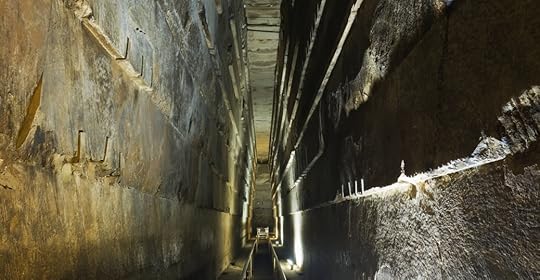
The Great Pyramid of Giza was back on the news this past month because a bunch of scientists discovered, through modern technology, an enormous void running parallel to the Grand Gallery, pictured below.
I'm guessing the Egyptian authorities will spend, publically at least, years figuring out what the void means and how it fits into the narrative, instead of organizing some public event in which a bunch of people would dig into it while filming it for the world. But we are dealing with people that have denied that passages into the Sphinx exist, although the entries have been photographed and even Egyptologists have been photographed going into them; that claimed that no digging can be done to reach the chambers found under the Sphinx, yet now there's a wooden passageway covering the front of the monument where they have dug into. Geologists that studied the erosion in the monument and in the bedrock the blocks came from say that no such water erosion could have happened in the last 8,000 years, with much earlier dates being even more likely. There are also alternate passages both in the great Pyramid and underground in the whole complex that the authorities have never allowed anyone else into. A robot with a mounted camera was used to investigate a very narrow passage that ended in a door with corroded metallic handles; the Egyptian authorities said that nobody had entered it since, yet the next time a robot attempted the same thing, the handles were broken and the pieces gone. The authorities have also been notoriously dismissive of scientific attempts to get some hard data on the monuments, arguing that "[radar/carbon dating/geologic erosion/etc.] lies". Independent scientific teams carbon dated the mortar joining blocks in the exterior structure of the Great Pyramid and they got dates as far back as 3,900 BC. While they can't say whether that belongs to the original construction or one of the many restorations, 3,900 BC is predynastic times, and the official story is that Khufu, a dynastic pharaoh, ordered it built. Obviously Khufu couldn't have done it if it was already built. The Egyptian authorities made a fuss, and promptly declared that a private study had rendered dates that didn't contradict the Khufu attribution.
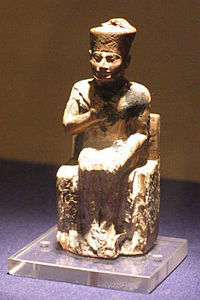
The story as it is told goes as follows: Khufu, a rather unliked pharaoh, ordered the Pyramid to be constructed because his ego was so huge that otherwise only the following statue, one that would fit in a shelf, was found bearing his image:
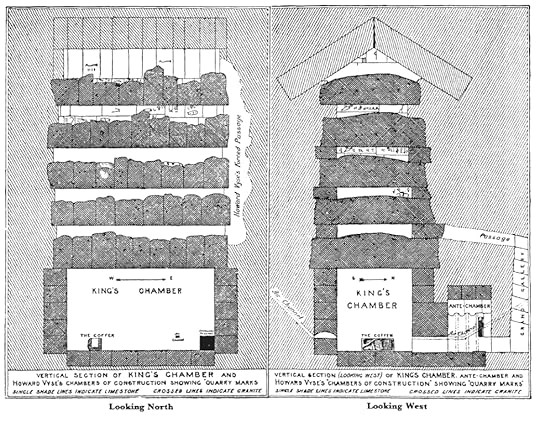
The only empiric evidence found of this was discovered inside a few relief chambers situated above the so called King's Chamber (called like that because the Great Pyramids were supposed to be tombs, although no mummies have ever been found inside):
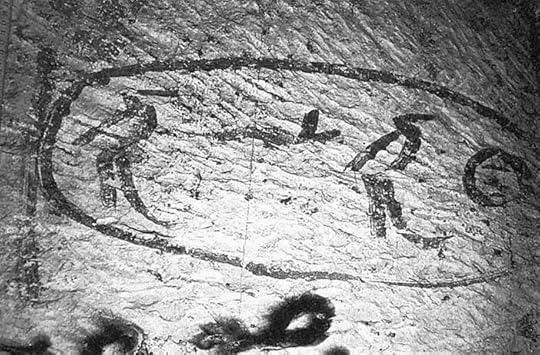
One of the relief chambers had been opened already but there was nothing of note inside. Along comes a certain Howard Vyse in the 19th century, blasts open the remaining relief chambers and finds gang marks and cartouches bearing Khufu's name. The cartouches were Egyptian writing structures that identified a person.
If on the blocks of those relief chambers are hieroglyphs identifying Khufu, and the chambers were sealed, then surely Khufu was involved in constructing the monument. That's the most reasonable assumption to make, if it wasn't because all the references to Khufu "found" inside those chambers were most likely inscribed by Vyse and his team.
Some time ago, notorious author Zecharia Sitchin, notorious more often than not for messing things up in the archaeological world, argued that the cartouche didn't identify Khufu because there was a spelling mistake; it didn't say "Khu", but "Rhu". That was a mistake due to the quality of the photographs taken. Sitchin also "mistranslated" plenty of texts belonging to the Sumerian civilization, and it's from his translations that most if not all of the Annunaki, Nibiru, ancient astronaut stuff comes from. The correction regarding the Khufu cartouche tends to be brought up when the subject of a forgery comes up, but there are many evidences that point to the gang marks and the cartouches having been forged.
Howard Vyse's character (the guy who "found" the hieroglyphs) is questionable. He was a rich aristocrat, a deeply religious person and a politician who was proven to have committed electoral fraud. He was also an amateur archeologist that spent around a million of today's dollars organizing an expedition into the Great Pyramid of Giza, where he expected to find, without much reason (because no similar features had been found in the others), hieroglyphs identifying Khufu, who was thought to have built them. He blasted into the chambers and found what he was looking for. That's where the discrepancies start.
The hieroglyphs were supposed to have been painted in the quarry prior to moving them to the Giza complex. That's where the work gangs would have inscribed their signs and the allusions to Khufu. However, some of the hieroglyphs "found" span more than one block, blocks that wouldn't have been together in the quarry. The orientation of the hieroglyphs is anomalous, too deliberately random, while probability would also have suggested that most of them would have landed on the sides hidden by the rest of the blocks. The hieroglyphs also hug the available space where one could inscribe them while standing in the chambers: the interior floor is slanted, and no hieroglyph disappears under the slanted part. There are malformed hieroglyphs, and repeated in that way, that aren't found anywhere else, suggesting Vyse's team having copied them incorrectly from the original source. Some of the hieroglyphs also belong to a much later evolution of the Egyptian language, suggesting as well that the original belonged to that era. The builders used a lime slurry to reduce friction when placing the blocks together. That could only have happened during construction, and not in the quarry. However, there are no hieroglyphs painted where the hardened coat of slurry is more evident (because the forgery would have been evident otherwise). During the process of moving the blocks, the weight caused plenty of pebbles to get embedded into the rocks. That is unlikely to have happened in the quarry, and yet the hieroglyphs are found painted over them. The Egyptian authorities forbid taking samples of the cartouches for scientific analysis. A team of german scientists did it anyway, were found out and driven out of the country after being branded agents of Israel and Zionists (a reminder that Egypt was conquered by Arab muslims in the 7th century during the initial relentless imperialistic expansion. The original people were subdued and their customs persecuted to near extinction, and the area has remained occupied ever since). The sample taken was unfortunately too small for carbon dating, but they found that behind the paint there was invisible slurry (meaning it was painted in situ), and intriguingly, that the stone block itself was worked with steel tools. Egypt was supposed to be a bronze age culture.
Additionally, Vyse's public and private journals tell a different story. The public journal says that he blasted the chambers open, found "marks" he didn't recognize and left the identification of the cartouche to others. In his private journals he shows he not only recognized Khufu's cartouche, but different forms of it found in the area, and could very well distinguish between quarry marks and hieroglyphs. He recorded meticulously what he found, yet didn't mention anything resembling hieroglyphics when talking about the chambers he blasted into. At a later date he mentions Khufu's cartouche having been found inside, yet the drawing differs from what is actually on the wall; the journal presents a progress of figuring out which of the different forms of the cartouche is the right one (it wasn't known then that Egyptians actually painted the same cartouche in different ways), and the paint on the final cartouche on the chamber evidences that someone worked on it in different occasions. More damningly, he orders for a couple of his colleagues to inscribe the cartouche on any of the slanted blocks, where it can be seen today. I don't know why he would order to inscribe something if he had found it there. It also surfaced from a journal of the era, belonging to a young guy that worked briefly for Vyse, that he argued with a couple of the guys because they were "repainting marks and making new ones". They booted him off the expedition. He also mentions siding with a contemporary Egyptologist of note that considered Vyse to be a fraud.
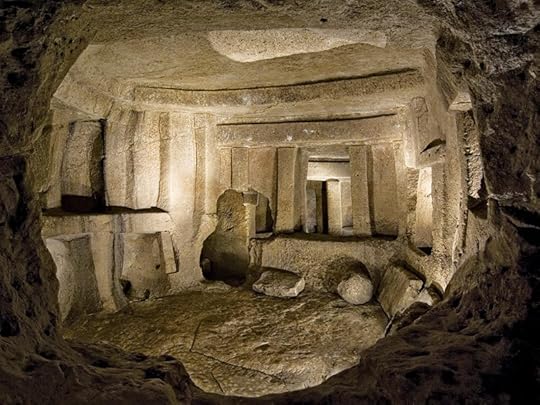
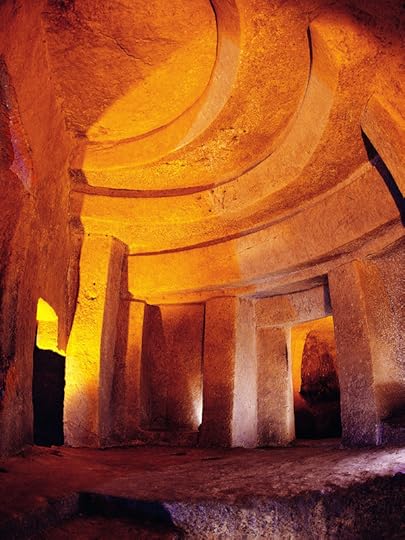
Göbekli Tepe, a buried astronomical site carbon dated unambiguously to as early as twenty years after the last Ice Age ended, forced the mainstream to push back the beginnings of complex societies. But we have existed in this current form for about 200,000 years, experiencing two or three Ice Ages spanning dozens of thousands of years, with no particular reason to believe that we would have just started becoming sophisticated twenty years after the last freezing period ended. There are plenty of submerged cities and monuments out there that flooded around 11,000-12,000 years ago, and many of the monuments and cities we recognize could have been misattributed to any of the cultures that inhabited the area afterwards. But surely we can expect the governments that rule those areas today to seek and release information that would contradict or endanger the ruling political and religious ideologies, right? Like when, to mention two examples, a group of archeologists found a very sophisticated megalithic wall in New Zealand dating to at least 2,000 years ago, but the authorities said that wasn't possible, because the native Maoris didn't arrive for another thousand years, and it's politically incorrect to mess with the natives, so the government dispatched a team of their scientists to explain how an obviously man-made wall formed naturally. Or like when it became evident that a painting in the Hypogeum of Malta represented an extinct species that existed during the Upper Palaeolithic (more than 20,000 years ago), the establishment refuted it saying that they "knew" the building was around 5,000 to 6,000 years old (belonging to the Neolithic) because nobody had the advanced architectural and organisational abilities to build such a place before.
To silence the issue, the director of the National Museum ordered the painting to be scrubbed off the fucking walls. Because that's the kind of abysmally stupid species we are.
Scott Creighton's work uncovering the “Great Pyramid Hoax” is destined to go down in history. Very clearly shows how the official Egyptological theory about the "young" age of the Great Pyramid is based on a forgery, and that the GP is likely thousands of years older and far more mysterious that we thought! We had a great interview with Scott, which you can find here: http://www.21stcenturyradio.com/audio...
“The Great Pyramid Hoax – Conspiracy to Conceal the True History of Ancient Egypt” is a title that immediately rivets one’s attention and that is title Scott Creighton has given to his book on The Great Pyramid’s date of construction.
The origins of the Great Pyramid of Giza are still shrouded in mystery. When was it constructed and by whom? Believed to be the tomb of an Egyptian king, no remains or funerary articles have ever been found. Its construction date of roughly 2550 BCE was accepted in 1837 and is tied to only one piece of evidence: the crudely painted marks within the pyramid’s hidden chambers that refer to the 4th Dynasty king Khufu. This crudely painted marks were discovered in 1837 by the British explorer Colonel Howard Vyse and his team.
Using evidence from the time of the discovery of these “quarry marks” -- including surveys, facsimile drawings and Vyse’s private field notes -- along with high definition photos of the actual marks, Scott Creighton reveals how and why the marks were faked. He investigates the anomalous and contradictory orthography of the quarry marks through more than 75 photos and illustrations, showing how they radically depart from the established canon of quarry marks from this period. He explains how the orientation of the Khufu cartouche contradicts ancient Egyptian writing convention and how one of the signs is from a later period. Analyzing Vyse’s private diary, he reveals Vyse’s forgery instructions to his two assistants, Raven and Hill, and what the anachronistic sign should have been. He examines recent chemical analysis of the marks along with the eye-witness testimony of Humphries Brewer, who worked with Vyse at Giza in 1837 and saw forgery take place. Exploring Vyse’s background, including his electoral fraud to become a member of the British Parliament, he explains why he was driven to perpetrate a fraud inside the Great Pyramid.
Howard Vyse belonged to the landed gentry and was an orthodox Christian. It is within the context of this much-less- connect- world where the power and authority of the church held sway that his actions at Giza must be judged. As per the Old Testament book Genesis there was a great deluge in which entire human race barring Noah and his family were wiped out. Vyse himself was indeed a man of faith and seems to have accepted the Bible as literal fact; the biblical deluge, in Vyse’s view, really did take place and appears to have been regarded by him as a matter of historical truth. But not only that, Vyse seems to have also held the view that the pyramids themselves were constructed “certainly at no long time after the deluge.” Given his apparent certainty of the biblical Flood, it is not unreasonable then to conjecture that Vyse would also likely have accepted, unquestioningly, the biblical Creation story and thus that the pyramids must have been built some time after the year 4004 BCE, the date that was accepted in Vyse’s time (by the calculations of the sixteenth-century Archbishop James Ussher) to have been when the Creation occurred. After all, how could the pyramids or Egyptian writing possibly be older than the Creation? From Vyse’s strong religious convictions we may begin to perceive a possible motive for fraudulent activity at Giza. In 1828 the Catholic Church funded Champollion’s first (and only) trip to Egypt on the condition that he would never reveal anything that would contradict the teachings of the church. It is not inconceivable that such anxiety might have been rekindled in the church with Vyse’s ongoing discoveries. What if he discovered in those hitherto secret chambers a language never before seen, a language that was not Egyptian and that might be shown to predate the biblical Flood? What if something were discovered in those chambers that could challenge the accepted chronology and truth of the Bible, and possibly even predate the Creation itself? What might such a discovery do to the authority of the church and, of course, to Vyse’s personal beliefs? If, on the other hand, Vyse could find a known cartouche of an Egyptian king from the known historical period in one of these newly discovered chambers, an Egyptian king from the known Egyptian king lists, written in known Egyptian text, then that would effectively prove that the pyramid could never have existed prior to the Flood or the Creation; an outcome that the church would, undoubtedly, have found most satisfactory.
From Vyse’s writings it seems clear that he did not consider his discovery of these hidden chambers to be important, for he kept opening them in hopes that in one of these hidden chambers he would find the true sarcophagus of Suphis / Khufu. (The sarcophagus in the main King’s Chamber had long been known to have been entirely devoid of any trace of a human burial, leading some to believe that the King’s Chamber was perhaps a decoy burial chamber.) In the end, Vyse was destined to be somewhat disappointed. After discovering and opening a total of four hidden chambers inside the upper reaches of the Great Pyramid, his great hope was not to be realized; he found no burial chamber, and he certainly did not find the mummified remains of any ancient Egyptian king (or any treasure that would normally have been buried with a king). By the time his operations were completed at Giza, Vyse had spent something in the order of ten thousand British pounds of his personal wealth, which, accounting for inflation, would be equivalent in today’s terms to around one million pounds.
Proving Zecharia Sitchin’s claim that the quarry marks are forgeries and removing the only physical evidence that dates the Great Pyramid’s construction to the reign of Khufu, Creighton’s study strikes down one of the most fundamental assertions of orthodox Egyptologists and reopens long-standing questions about the Great Pyramid’s true age, who really built it, and why.
Step by step Crieghton builds a strong case that the cartouches and quarry marks found in Campbell’s and three other relieving chambers discovered and opened by Colonel Howard Vyse were fake and painted by his assistants Raven and Hill. The red ochre paint used to make these marks was made from iron oxide ochre mixed into water, sometimes with fish oil, gum, egg, or honey added to act as a binding agent. This simple paint, known as moghra, was still being made and was still available in Egypt in 1837. By presenting such evidence Scott Creighton has proved that there likely was a historic fraud perpetrated in the Great Pyramid by Vyse and his team in 1837.
Let us take a look at the evidence presented by Scott Creighton, suggesting the painted marks in the relief chambers of the Great Pyramid are nineteenth-century fakes. We have Vyse, contrary to its implied discovery in his published account, making no mention in his private journal of finding the gang name and cartouche in Wellington’s Chamber (later painted by his assistants J. R. Hill and John S. Perring), a find that would have been historically momentous and would have given Vyse the important discovery he was clearly desperate to make; we have Vyse finding Old Kingdom hieratic number signs that are different from the hieratic number signs found in the small shaft chamber, which is strange considering that the two chambers would have been built around the same time; we have the odd absence of any painted hieratic signs in Davison’s Chamber when, from a statistical perspective, we should surely have found some; there’s the written instruction in Vyse’s private journal to his assistants Henry Raven and Hill “to inscribe” (future tense) a Khufu cartouche at a specific location (a low trussing) in Campbell’s Chamber; we have the Khufu cartouche with just a plain disc drawn twice in Vyse’s private journal; we have what appears to be an “artist’s scaling grid” drawn with the Khufu cartouche in Campbell’s Chamber; we have Vyse bizarrely copying two dots under the snake sign in the cartouche when all the other paint spots in and around this cartouche on the roof block would surely have told him that the two paint spots he elected to copy were no more significant than any of the many other random paint spots on the roof block; we have traces of paint runnels on the roof block at the bottom right of the cartouche where the paint was thickest and appears to spread laterally along the wall joint; we have Vyse visiting the Tomb of Iymery with the specific purpose of checking the spelling of the Khufu cartouches in this tomb (made known to him by Perring) against a version he had drawn in his journal and labelled “in Campbell’s Chamber,” and yet Vyse apparently fails to accurately draw the cartouche on his journal page (there are no stacked lines in the disc), and we have to wonder why this would be as accuracy of this particular drawing would have been crucial to his objective of making a comparative spelling analysis at the Tomb of Iymery; we have the series of edits in Vyse’s diary as he realized the disc within the Suphis / Khufu cartouche needed to be changed; we have the various sets of quarry marks in the chambers scaled perfectly to fit into the available space between floor and ceiling blocks, indicating in-situ painting; we have markings following the contours of the chambers’ floor blocks, again indicating in- situ painting; we have these same marks having seemingly been written onto a stone block in such a way as to prevent the inclusion of the cartouche element of the gang name, demonstrating a total lack of understanding of ancient Egyptian writing convention; one of the gang names appears to have been painted (sideways) across two adjacent wall blocks; we have gang names painted (ostensibly at the quarry) in a horizontal fashion, when this arrangement only became the norm around the Eleventh Dynasty, long after the pyramids were built; we have the inconsistency of Hill’s signature on the Khufu gang name facsimile sheets, indicating that this gang name with its associated cartouche was copied from a horizontal original; we have signs oriented against normal ancient Egyptian writing convention, having been rotated perpendicular to the known top end of a gabled roof block; we have a dubious drill sign apparently copied incorrectly eight times; we have signs whose best hieratic match occurs sometime between Dynasties Eight and Eleven, long after the Great Pyramid was built and these chambers sealed; we have the eyewitness account of Humphries Brewer regarding Raven and Hill repainting faint marks and painting new marks; we have Vyse confirming Raven’s involvement in painting marks in his private account, an involvement that is absent from his published account; we have a painted cartouche on a block that, in reality, should have been smeared with lime slurry that “cemented” small pebbles onto the surface of the block, indicating more in-situ painting; we have chemical analysis showing marks painted sideways onto a surface of plaster, again suggesting in-situ painting; we have lime slurry running down the wall blocks that magically manage to avoid coating any of the painted quarry marks; we have Vyse giving the impression in his published account that he had no idea that he had discovered any cartouche among the quarry marks found, an impression that is entirely false as it is entirely contradicted by his private account.
The Establishment – the scholars and classical Egyptologists have led no evidence to refute any of these claims. But then the Establishment suffers from a superiority complex. Time and again they have succeeded in silencing the rebels or ostracising the non-conformists, but not having addressed the question, it comes back again – a few decades later much stronger – leading usually to the acceptance of the new view, maybe a century or so after it was first propounded.
Having proved Zecharia Sitchin’s claim wrong, the Establishment did not seriously pursue the investigation to its logical conclusion, leaving the field open to Scott Creighton and other alt-Egyptologists to mount a much stronger and sustained campaign against the claims of classical Egptologists and Colonel Howard Vyse.
Genuine or fake — these painted marks within the Great Pyramid have become part of our common history and heritage. The world deserves to know the truth of them.
Eminently readable, extremely informative and well written, I enjoyed the book and have no hesitation in recommending it as a good read for further enlightenment on Ancient Egyptian History.
I thoroughly enjoyed reading The Great Pyramid Hoax: The Conspiracy to Conceal the True History of Ancient Egypt by Scott Creighton. The book was both entertaining and eye-opening, as it delves into the idea that mainstream academia often perpetuates certain narratives while dismissing alternative viewpoints. It’s fascinating to see how such "hoaxes" have shaped the history of Egyptology and how similar patterns can be observed in other academic disciplines. Creighton’s work invites readers to question established narratives and encourages critical thinking, which I find both refreshing and necessary. It is for anyone intrigued by history’s hidden truths and academic controversies.
This is a fascinating book about the lengths an aristocrat and his team went to in order to gain notoriety for a discovery at the Great Pyramid of Giza but the writing feels very dry owing to the fact that it must lay down such detailed facts in order to prove the point. It is a compelling story that builds on prior documentation and publications that call foul on the discoveries but were either debunked or shrouded in counter claims, but Creighton (and his wife) go to painstaking lengths to lay down the case for a forgery and subsequent cover up. What you decide to believe by the finish is up to you ….
Amazing detective work, fascinating, compelling, and utterly convincing. Of course, mainstream archaeology will never act upon the momentous information presented here...
The Great Pyramid Hoax by Scott Creighton is a fantastic piece of work. He painstakingly works his way through the history of the discovery of the marks in the relieving chamber above the King’s Chamber, and how they were likely hoaxed. Now, this is an old theory put forth by Zachariah Sitchin, and he was wrong about his evidence. However, Scott digs through journals not investigated thus far, and assembles a host of evidence to show that in all likelihood, the most of the markings that are used to date the Great Pyramid, were created in the 19th century by Howard Vyse. This is not a collection of unsubstantiated theory, but relies on overwhelming facts and evidence that supports the idea that those markings were hoaxed, and if that is the case, the one identifier we have for the creator and age of the Great Pyramid is gone. This is an important piece of work.
Fun to read and filled with interesting stories & data. The current problem is the graffiti seems to be genuine, that is, placed while the pyramid was being constructed. The writing, deemed by experts as original and genuine, goes behind blocks placed at the same time. Unfortunately, this puts the entire argument about the writing being fake into the bin. At this point, the debate is over unless new information comes into the discussion.