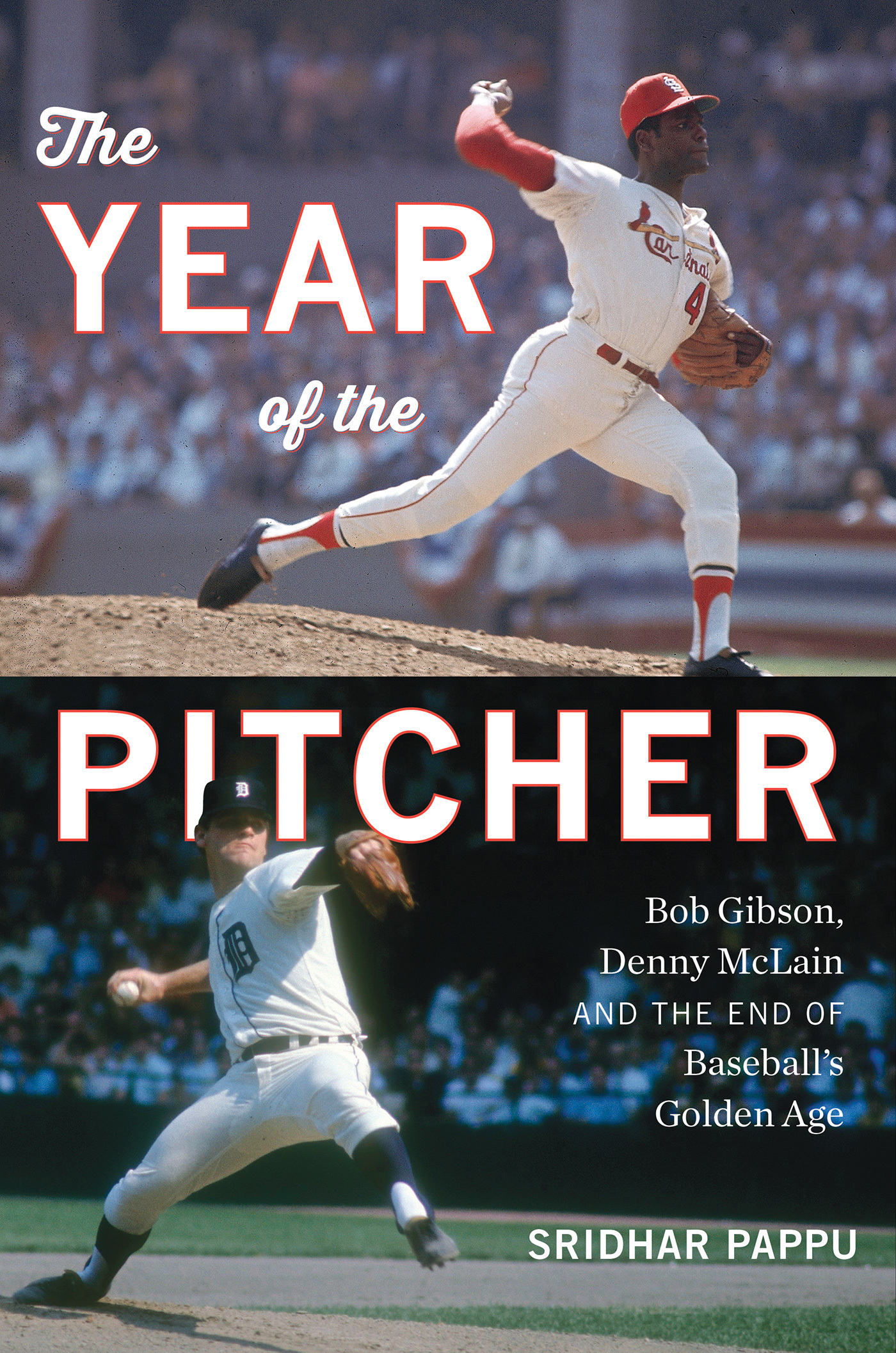
The Year of the Pitcher is the story of the remarkable 1968 baseball season, which culminated in one of the greatest World Series contests ever, with the Detroit Tigers coming back from a 3-1 deficit to beat the Cardinals in Game Seven of the World Series. In 1968, two remarkable pitchers would dominate the game as well as the broadsheets. One was black, the other white. Bob Gibson, together with the St. Louis Cardinals, embodied an entire generation's hope for integration at a heated moment in American history. Denny McLain, his adversary, was a crass self-promoter who eschewed the team charter and his Detroit Tigers teammates to zip cross-country in his own plane. For one season, the nation watched as these two men and their teams swept their respective league championships to meet at the World Series. Gibson set a major league record that year with a 1.12 ERA. McLain won more than 30 games in 1968, a feat not achieved since 1934 and untouched since. Together, the two have come to stand as iconic symbols, giving the fans "The Year of the Pitcher" and changing the game. Evoking a nostalgic season and its incredible characters, this is the story of one of the great rivalries in sports and an indelible portrait of the national pastime during a turbulent year--and the two men who electrified fans from all walks of life.
Sridhar Pappu is the author of The Year of the Pitcher: Bob Gibson, Denny McLain and the end of Baseball's Golden Age set for publication by Houghton Mifflin Harcourt, October 2017.
Pappu currently writes "The Male Animal" column for The New York Times. He began his award-winning career as a feature writer for the Chicago Reader and has served as a columnist at The New York Observer and as a correspondent for The Atlantic. In addition he worked as a staff writer at Sports Illustrated and The Washington Post.
A native of Oxford, Ohio, and graduate of Northwestern University, he currently lives in Brooklyn.
The year 1968 marked a turning point in American society. Marked by the assassinations of key political figures, the war in Vietnam, and a generational clash of cultures, the year is viewed by many as a key moment in history. Not even baseball could escape this clash of cultures as football was making inroads to rival it as the national sport. In 1968, baseball had been played in some iteration for over one hundred years, yet in 1968, just as in society as a whole, baseball seemed different. Sridhar Pappu writes in Year of the Pitcher how in 1968 this clash of cultures between the owners rooted to yesterday and the players with an eye on the future played one last season of baseball’s golden age.
It had been twenty years since Jackie Robinson broke baseball’s color barrier and a good ten since he walked away from a game that had given him so much. In the ten years away from baseball, Robinson had become a political activist, supporting whichever candidate in a given year he felt would do the most for the black community. Although the civil rights act had finally been enacted, for a large part it was in name only. African Americans, Robinson included, were still stopped for driving and standing in hotel lobbies as many Caucasian in the older generation still detested blacks making inroads in society. Race relations came to a head in 1968 on April 4 with the assassination of Dr. Martin Luther King, Jr; after all the good Dr King did, he was still shot down, setting off a wave of rioting in cities across the country. The start of baseball season would be delayed for three days out of respect for Dr King, and due to the fact that twenty years after Robinson broke baseball’s color barrier, a large number of baseball’s stars were black. Even the backward thinking commissioner predicted a fallout if the season started as planned.
The season did not start on time for baseball players who were members of the National Guard, who had been asked to patrol the streets to help quell rioting. One notable player was Detroit Tigers pitcher Mickey Lolich, who had lead his team to just short of the pennant the year before. The Tigers believed that 1968 was their year, and Michigan’s governor had hoped that a pennant and hopefully a World Series victory would galvanize a city marred by frayed race relations. Led by franchise leader Al Kaline and an improbable thirty game winner Denny McClain, the Tigers looked to be the team to beat. Tutored by expert pitching coach Johnny Sain and a manager who did nothing in Mayo Smith, the Tigers looked to be on their way to avenging the sting of the previous year’s just falling short. Yet, they would have to beat a formidable foe in order to do so.
No team in the late 1960s embodied the black athlete more so than the St Louis Cardinals. Led by ace pitcher Bob Gibson and star outfielders Lou Brock and Curt Flood, African Americans saw this team as one who they could cheer for. At the time, black athletes in all sports had began to mobilize politically, led by boxer Muhammed Ali and Olympic sprinters Tommy Smith and John Carlos. Gibson suffered many indignities in life due to the color of his skin, losing out on college scholarships and endorsement deals. He was often misconstrued by the media who saw him as an angry black man. Gibson may have been angry but during his playing career chose not to get involved politically. He was an ace pitcher rivaling Dodgers star Don Drysdale and Giants ace Juan Marichal for the title of best pitcher in baseball. In 1968, all three men were deserving: Drysdale for 58 2/3 scoreless innings, Marichal for his 25 wins, and Gibson for his 1.12 ERA and leading his team to back to back pennants. With a lineup boasting future Hall of famers, the Cardinals looked to be the team to beat in the World Series.
Pappu writes that 1968 was the year of the pitcher. It was a year that saw pitchers put up numbers that will probably never be broken. Yet, 1968 will also be remembered as the last year of baseball’s golden era where hall of fame players stayed with their own team for entire careers. Baseball realized that football was a threat. With a dynamic commissioner, glitzy star players, and a new title game called the Super Bowl, football looked to be America’s sport of the future. Starting in 1969, baseball would expand by four teams and have a league championship series leading up to the World Series. Not only would pennant races become more exciting, but there would be more revenue generated by television. Yet, even in 1968, all World Series games were played during the day when kids were at school and their parents at work. Televising all the games would be meaningless if few people watched, and baseball would lose revenue in favor of football. Pappu briefly mentions the Cardinals’ Curt Flood and his fight against the reserve clause. Although not resolved in 1968, Flood’s stance would lead to free agency and player movement, making baseball in 1970s starkly different than the game played during its golden age.
Following the 1968 season, baseball lowered the pitching mounds to compensate for pitchers’ dominance. Gibson continued to put up hall of fame credentials but McClain faded and got into trouble with money laundering schemes. By 1972 there were still no African American managers, and Jackie Robinson called out baseball to break down more racial barriers going forward in order for it to truly remain as America’s game. Sridhar Pappu maintains that the racial tensions along with the stellar pitching came to a head in 1968, a year marked by death’s of prominent Americans, a war, and Nixon’s first election victory. The year would be known in baseball circles for remarkable pitching, the likes of which will probably not be seen again, and the end of baseball as a wholesome game cemented as the one sport that all Americans believed to be its national pastime.
I have been fortunate in my baseball reading as of late - this and Luke Epplin’s “Our Team” I found excellent. What both authors do extremely well is place the “baseball story” within the context of the times while telling the stories/biographies of the main players - pardon the pun.
This book centers on 1968, (Epplins’ two decades earlier - 1948), and the World Series that year between Detroit and St. Louis with Bob Gibson and Denny McClain serving as our guides. There is a lot of baseball here - on and off the field - as well as history - to put it mildly 1968 was not a quiet year.
And to repeat myself the author does an excellent job in priming the reader for that Series as well as brilliantly capturing the “cast”.
"The Year of the Pitcher: Bob Gibson, Denny McLain, and the End of Baseball's Golden Age", (now that's a mouthful!) is a book about baseball that encompasses so much more than the game and the players. Author Sridhar Pappu looks at the year 1968 - already justifiably famous for non-sports events - as the St Louis Cardinals' Bob Gibson, and the Detroit Tigers' Denny McLain tear up major league pitching. McLain, still a "bad boy" years after his retirement from Major League Baseball and Gibson, who rose from poverty on the basis of his all-around abilities at sports, met in the 1968 World Series. The series went seven games, with Detroit winning the title.
Sridhar Pappu does an amazing job comparing and contrasting Gibson and McLain that year while looking at other societal factors at work that year. The book is extremely well written and would be a great choice for a sports fan and an armchair historian.
For those who want sports in a vacuum and believe the players should simply go to work and not have any interest nor say in the wider world around them, this isn't for you.
For those who want to be reminded once again of how divided this country really was in the mid- to late-60s and have that division interwoven with the simplicity of a kids' game, this book is excellent.
With 2018 spring training gearing up I decided to read this baseball book hoping that it would provide a good biography of pitchers Denny McLain and Bob Gibson. The author provided a historical perspective, but I was not seeking to read a political book too, as the book jumped around covering not only the pitchers fastball movement but also the 1968 civil rights movement. During the 1968 World Series I was a colorblind high school junior when it came to baseball players.
Baseball is about scores, so for those keeping scores and statistics, Gibson, Willie Mays, Hank Aaron and many others were not vocal during the civil rights movement. McLain was neither democrat nor republican. During the 68’ summer Olympics two African American medalists stood side by side during the National Anthem with heads bowed in defiance and fists in the air. Olympic great Jesse Owens did not like this, but baseball legend Jackie Robinson was in favor. During the 68’ presidential elections Jackie Robinson, who hated the Kennedy’s, backed republican Nelson Rockefeller in the primaries and then switched to democrat Hubert Humphry. These are not spoilers but rather an insight to a pattern. I half expected the author to fast forward to the NFL players kneeling during the National Anthem.
I’m also not certain as the title states“...The End of Baseball’s Golden Age”, that there ever was a defined “Golden Age”. However in conclusion parts of the book were well worth reading.
Laughing so hard at how the book was just about how everyone hated Denny McLain and then the author was like "yeah he sucked, but he was good at pitching that one year." Also the ending being the author too star struck to speak to Bob Gibson who he wrote an entire book about. Not sure what that was meant to add, but it was there. Anyway this book made me really interested in American politics during 1968 and not so much the baseball. Matt Andrews, I refuse to believe that this was the best baseball book about the 1960s. I was entertained, but I don't want to write an essay about it. :(
Mr. Pappu's book is superbly researched and acutely portrays the transition of baseball and the country in 1968. I found the book made me feel melancholy: not nostalgic, but rather sad. It was a year of immense racial tension in the country especially after the 1967 riots in Detroit. There remained racial divides among players and their managers.(Solly Hemus was palpably a racist). The war in Vietnam sowed hatred among different classes of Americans. There were horrifying and traumatic assassinations of MLK and RFK that reflected the chaos of the times. Perhaps the best example of a torn country in 1968 took place during game 5 of the World Series when Jose Feliciano sang his own personalized version of the Star Spangled Banner which caused an uproar around the nation especially from veterans and Vietnam soldiers. It almost cost Detroit broadcaster Ernie Harwell his job because Jim Campbell the GM was furious that Harwell had chosen Jose Feliciano to sing the anthem. (Marvin Gaye had been directed not to sing a soulful version that he later made famous at the NBA event). In baseball the assassinations brought players together for a collective effort to speak out about playing on days of mourning and which allowed for Marvin Miller to capture the will of the players to unite for a fairer financial split of ownership's monopoly. But the book focuses on two major players in that year of the pitcher, Bob Gibson and Denny McClain for obvious reason. One line captured the personality of Bob Gibson that stuck with me: "He was comfortable being disagreeable." Gibson comes across as an angry, bitter and reclusive ball player who never felt appreciated in his early years and especially from racial slurs he had endured in the south while in the minors. Pappu suggests that, contrary to popular belief, Gibson didn't want to be a head hunter or deliberately hit opposing batters. he suggests that he wanted to brush batters off to protect the corners, but the duty to retaliate fell upon him as a matter of consensus from his teammates. Interestingly, Pappu related a story that Gibson lost respect for Lou Brock once because he felt Brock was stealing bases just to pad his statistics. When a Reds' pitcher hit a Cardinal batter because of Brock piling up the score, it fell to Gibson to retaliate. But another story contradicts the notion that Gibson was a reluctant deterrent. When Tommy Agee came over from the White Sox to the Mets, in one spring training game, Gibson hit Agee in the head so hard that players thought he would die from a skull fracture. Teammate and catcher for Gibson Johnny Edwards years later claimed that when he hit Agee, Gibson yelled,"Welcome to the National league." Unlike Gibson, McClain is portrayed, and there is plenty of evidence to prove it, as a megalomaniac, petty, jealous, reckless, a liar, and as we know a multi-faceted criminal. McClain unlike Gibson or the other dominant pitcher of 1968 Don Drysdale, cared more about how baseball could be a stepping stone for his next career as an entertainer playing the organ and singing. To gain celebrity and fame, he went on a quest to win thirty games in 1968 even at the risk of ruining his shoulder and arm. Both Gibson and McClain pitched with horrendous pain but McClain did it by taking cortisone shots through out the season. Of course, ownership looked the other way. McClain was a commodity. As a result, his career was short lived. There are many interesting moments of the pennant races and especially the 68 World Series that all fans will enjoy. They include the turning point in game five when the Cards were up three games to one and Lou Brock failed to slide into home but rather tried to score standing up into Bill Freehan and was easily out. Then the play that would haunt Curt Flood's career forever when he misplayed a fly ball by Jim Northrup that went for a triple and allowed Detroit to win it all. I was intrigued by Pappu's assertion that the 68 Tigers win in the series brought the city back together and decreased racial tensions. I had always bought into that narrative, but Pappu sites authorities and common sense that label such legends as pure myth.I also found fascinating a discussion of how poor the attendance was at games in 1968 as well as the low TV ratings for the World Series. The same arguments as causative factors used then are applicable to the ones blamed for today's malaise in the game; namely that low scoring games are boring, lack of excitement, football has more action and violence. But baseball survived 1968 and it will survive again.The one thing that bothered me is that the author never really explains what made 1968 the year of the pitcher. Yes he refers to the high mound and the large strike zone, but that had been the case for six seasons. So why did the bats collectively falter in 1968? Why would Yaz win the batting title hitting .301 and be the only player in the AL to hit .300? Pappu doesn't offer much to explain it. Still, it's an excellent book and an historical reference point for the beginning of a revolution in baseball. The mound would be lowered to ten inches, the strike zone diminished, and a players union would forever change the game.
This is one of the best baseball books of the year. It focuses on (of course) 1968, the greatest season for pitchers in the last century.
The book's main focus is on the two pitchers who had the most sensational seasons on the year - and who would meet in the World Series: Denny McLain and Bob Gibson. In fact, the book takes a good chunk of time going over their lives and careers prior to 1968, giving us background.
But it isn't just about those two. Other people make appearances. Don Drysdale? A little bit. Sure, he's famous for his scoreless inning streak that occurred in '68, but it was just a great streak, not as much as great season. No, the main non-Gibson/McLain characters here are Johnny Sain and Jackie Robinson. Though Sain had long since retired, he was the pitching coach for the Tigers and Denny McLain that year, and an interesting person in his own right.
Jackie Robinson is a bit of an odder choice as he was out of baseball - and largely disinterested in baseball - by 1968. But he helps open the door to other avenues.
You see, while this book is on the Year of the Pitcher in baseball, it isn't just about baseball. It's constantly related baseball to the wider world of America - and Lord knows there was plenty going on in America at that time. Some ins are easy. Moments before his assassination, RFK congratulated Don Drysdale on another shutout win. The sport had to decide what to do during after the assassinations of MLK in April and RFK in June. The Tigers played in Detroit, where the giant '67 race riot occurred, and Mickey Lolich was a national guard reservist for it. But Jackie Robinson helps tie the game to matters as well. In that season, Robinson endorsed Hubert Humphrey for president - and even attended a World Series game alongside Humphrey. Robinson's son had serious legal problems that year - he'd come back from Vietnam all messed up.
I really like how the book handles incorporated the non-baseball stuff. It gives the baseball some context. Bob Gibson's persona was tied to his race, for instance - even though Gibson himself was never that political. (But, as the old saying goes, sometimes the personal is political). Pappu manages to avoid any false/easy equivilances between baseball and society as a whole.
My favorite thing about how he handles the intersection of baseball and the real world: he really attacks easy, cheap, and largely meaningless feel good narratives. That's key, because the 1968 Tigers have historically been the subject of just that. The narrative: the city burnt in 1967 but the Tigers brought the city back together in 1968. Pappu castigates this as pure rubbish. Or, more accurately, he acknowledges that people across the city did feel good about the Tigers.....but that didn't change damn. White flight still happened. Mayor Coleman Young came to power. The burnt up areas by Tiger Stadium didn't recover. The feel-good story wants you to think that the Tigers allowed the city to put it all behind them, but look at Detroit history - the hell it did.
Oh, and Pappu does a good job telling his story. You never get too lost in the weeds of game accounts. The whole thing is nice and easy to read.
Criticisms? Nothing to severe. There a series of drive-by insults of Tigers manager Mayo Smith that aren't really earned. I mean, maybe he was a terrible manager, but Pappu never really explains why other than to say he didn't get along with Johnny Sain. (Actually, given Sain's track record, I've always had the sense he was the problem. I mean, he's a great pitching coach, but he can't get along with his managers. If a pattern keeps repeating, that's on him). Also, at the very end Pappu buys into Denny McLain's narrative that "I never woulda embezzled from that company's pension fund if my daughter hadn't died." I mean, McLain has a track record of his own. And while his daughter's death is very tragic, rumor has it that the overwhelming majority of people who have a child die on them don't end up embezzling.
[I was looking for a good baseball book on a St. Louis cardinal player and was recommended this one]
This was an exceptionally well written and researched twin bio about Bob Gibson and Denny McClain in 1968, the year of the pitcher. The mound in 1968 was 5 inches higher and the strike zone was two inches wider and taller than today. The modifications had come about in the mid 1960’s in response to 1961, the Year of the Home Run. Despite the pitching advantages of that era, these were phenomenal pitchers, Gibson had been dominant nearly his whole career, by then 32, and a young McClain had just arrived on the scene. So in 1968, Gibson set the modern day record for lowest E.R.A. for a season and McClain became the only 30 game winner in the past 86 years of baseball.
So we see a bio of two men whose fathers had passed away while they were children (technically Gibson’s dad died in the days preceding Gibson’s birth) and both lost their surrogate dads, their influential pitching coaches to old age. They were each on their own and had demons to exercise and took their anger to the mound as both were excessively competitive, Gibson more than McClain. Eventually Gibson became a wiser, mellower man while McClain never grew up, and was repeatedly imprisoned for fraudulent business schemes.
The book culminates with the ‘68 World Series between Gibson’s Cardinals and McClain’s Tigers. Ironically it was Mickey Lolich, neither Gibson nor McClain, who won three games in the Series for the victorious Tigers. It was the greatest post season pitching performance of the last fifty years.
4.5 stars. Too much coverage of Jackie Robinson, obviously not a pitcher and had been out of baseball for a decade. Otherwise a five star sports book in my view.
I found this to be a well-written, well-researched book about baseball and life during the turbulent late 1960s. Author Sridhar Pappu focused on the personal lives and careers of two very different pitchers, Detroit Tiger Denny McLain and Bob Gibson, who played for the St. Louis Cardinals. Pappu revealed the struggles that the two players faced as they rose through the minor leagues to the major leagues. As an African American playing in the South in the early 1960s, Bob Gibson clearly had a much different experience than Denny McLain did.
In addition, Pappu highlighted the post-baseball public life of Jackie Robinson, who was heavily involved in politics and race relations in the 1960s. The race riots of Detroit were also significant in Pappu's timeline of events leading up to the culmination of the book, which was the coverage of the 1968 World Series. Pappu ended the book, rather sadly in my opinion, by detailing the post-baseball lives of the two pitchers. McLain, who had questionable gambling ties as a player, made quite a few mistakes in his latter life.
I am glad that I had the opportunity to read this book as the Baseball Book Club's book of the month for August. I appreciate all of Pappu's efforts to interview witnesses, read old articles and watch videos of 50-year-old baseball games frame by frame. I'm not sure I agree with his final assessment of baseball and what it means to Americans, especially the people of Detroit. Maybe he is correct but as a fan, I find it hard to accept, even if it is true. People say similar things about reading books - actual hard cover or paper back books - and here we are, reading books about baseball.
The first professional ballgame I went to was September 14, 1968, when the Tigers won in dramatic fashion to secure Denny McClain's 30th victory that season. I picked up this book with the hope of reliving that remarkable year and series. I also have been fascinated by Bob Gibson and what seemed to drive and posses him. Pappu paints an interesting portrait of him and the racism he had to endure but Gibson wasn't simply that one dimensional. Pappu also puts McClain in his plane but maybe is a bit too generous? From a Tiger perspective him seems pretty down on the team--he is driven to destroy the "myth" that the '68 Tigers "saved the city" the year after the riot. He also gets some of his "facts" wrong particularly on describing the Detroit sports writers and their relationship with McClain. He does sing the praises of Johnny Sain--an overlooked fellow-- and is pretty down on Mayo Smith, depicting him basically as "a drunk" who got lucky in moving Micky Stanley to shortstop in the series to keeping Lolich in and allowing him to bat in Game 5 of the series as well as having him pitch Game 7 on two days rest.
My biggest complaint with the book is that Pappu uses a haphazard approach in describing things that seeming had nothing to do with "the year of the pitcher"--most notably going on and on about Jackie Robinson and his own seemingly inconsistent views on racism and politics. there is however one remarkable chapter taking about how the owners in 1968 feared that baseball was in decline with the then fast pace world and technological advances it was on its way out. football was king. it echoes the same concerns about the game today.
the book also highlights the over emphasis we place on sports and celebrities. they may not all be as nice as you think they might be simply because they play on your team. Basebook books should be fun. I found this one to be more of a homework assignment. Cruel but fair.
As a fan and student of this era not only in sports but culturally, I was really looking forward to this book. I learned some new things that I appreciated, such as the Player's Association internal struggles with how to honor/recognize RFK's assassination and Pete Richert's role of visiting veterans at the Washington VA hospital.
Ultimately though, Pappu's role as a fan of the Cardinals and Gibson in particular clouded his opinions and writing style, which he may or may not have intentionally divulged in his retelling of a story of trying to meet Gibson present day.
He seemed as if he relished in taking shots at Tiger manager Mayo Smith, calling him "oafish" and "lucky" to be given the Tiger managing job. I can understand trying to de-constructed the myth of Smith's brilliance with the Mickey Stanley-to-shortstop maneuver, but it seemed unnecessary.
There were also many areas where the writing was sentimental and factually flawed. Dick McAuliffe, for example, did not ground into only one double play in 1967; Pappu continued the tale of an incorrect myth. He also says that Yaz "refused to give Gibson his due" during the 1967 World Series, when the quote was not that biting ("he throws hard, others throw hard too").
Also, Pappu's list of 'experts' were similarly fan's either with common opinions or included for the sake of convenience. Gary Gillette? George Vecsey? Their contributions didn't really add to the thesis and if anything left the reader questioning their supposed authority. Similar the inclusion of Gerald Early's remembrances. Wouldn't it have made more sense to take to players on the Houston Astros who were in Chicago and smelled the tear gas during the 1968 Democratic National Convention? Not sure where Pappu was going with some of those thoughts.
Sridhar Pappu may not be a friend of mine. Not a fan of his picture on the back of this book. Not a fan of his voice in this book. I think the material was interesting. Denny McLain was not a man I knew much about but got a fair description in this book. Seems like he was a piece of shit and that is ok. Fair seems like a good word. It was a fair book. I knew more about Bob Gibson coming into this book and found his portrayal to be validating and enlightening. A giant shrug. 3 stars. If I had 10, I would give a 6, HHYFD?
While reading this book, I was reminded of what Kurt Vonnegut said about art and the Vietnam war: "Every respectable artist in this country was against the war. It was like a laser beam. We were all aimed in the same direction. The power of this weapon turned out to be that of a custard pie dropped from a stepladder six feet high."
Sridhar Pappu approaches the story of 1968 in baseball--one of the more consequential years in the sport's history--from a social historical perspective, setting the sport against the broader historical context in which it existed. In particular, he looks at how the sport is affected by the riots in Detroit, the assassination of MLK and Bobby Kennedy, and the upheaval in American politics. He reaches the conclusion that despite what many stories have tried to claim, sports have very little effect on larger historical circumstances and they especially can't act as a healing balm to an ailing society, at least not in any meaningful way. I think that this is an important position to understand if you're interested in how sports fit into society--many narratives can overblow the noble perseverance of athletes in times of strife. While I think Pappu can be sometimes be overly dismissive in his analysis of how athletes can be advocates for social change, I am glad that this perspective is present.
I was very interested to learn more about the post-baseball life and political activism of Jackie Robinson. This is something that I have not seen discussed anywhere else and it adds a new depth to the man. His story usually ends at the end of his first season with the Brooklyn Dodgers, without even covering the rest of his playing career.
My gripe with this book is maybe one of marketing more than anything, but when a book has "the end of baseball's golden age" in its subtitle, I am looking forward to learning about some significant changes in the sport. While things like the formation of the player's union, the rule changes to end pitchers' dominance, and the advent of free agency are gestured at, they aren't considered in the depth that I would have liked. It felt that Pappu was more invested in making the point of how baseball affected society (or not) that the inverse of how society was impacting baseball at the time was left underdeveloped.
Did anyone read “Summer of ‘68” by Tim Wendel? It covered the intersection of baseball and current events in the Summer (and Fall) of 1968. The focus was on the key pitchers of the time, Denny McLain and Bob Gibson, and the racial issues prevalent in the country. Wendel’s book was published in 2012. Fast forward 5 years to 2017. That’s when “The Year of the Pitcher” was published. And it’s about…the same things. I recall writing in my review of Wendel’s book that it mentioned the encroachment of football onto the stage, vying to replace baseball as “America’s sport”. I remember thinking this was an unexpected bit of history to share in a baseball book. Strangely, the same thing popped up in “The Year of the Pitcher”. The authors seem to have used some of the same sources. I’d guess these two books have about 80% overlapping topics, and perhaps 2/3 overlapping anecdotes. The obvious takeaway is that 1968 was a highly interesting year for baseball and American society. I’m not sure you need to read two pop-history/sports books on it. “Summer of 68” covered the fall as well. “Year of the Pitcher” talks a lot about Jackie Robinson, who was not a pitcher, nor was he facing pitchers at the time. Both titles were a little misleading. Having read both, I’d say both are good, with “Summer of 68” taking the nod based on a better cover and seniority.
A very good book on the year 1968 in baseball, which was dominated by pitchers, especially Bob Gibson, Denny McClain and Don Drysdale. The book talks about the entire season as well as a little bit from the 1964 and 1967 season's since the Cardinals won the World Series those years and were in the Fall Classic in 1968. Also discussed in this book were world events that occured during the year such as the Vietnam War, MLK and RFK being killed and the Detroit Riots. Very well written and the research is great. Baseball fans and history fans will enjoy this one. Looking forward to reading more books by Sridhar Pappu.
The 1968 Detroit Tigers baseball team were the joy of my not very happy childhood, a marvelous escape and distraction. For that, and for the absolute thrill of their victory, I will love them forever. However, as an adult, I am well aware that my childhood heroes were just men, with all the strengths and flaws that go with being human, especially in such a volatile time as 1968 was.
Sridhar Pappu does a wonderful job of revealing stuff that went on behind the scenes as that season--and American life--unfolded. As close to my heart as this subject is, I learned a number of things I hadn't known before. That said, there are a number of inaccuracies here. Pappu has Charlie Dressen quoted as saying something to Denny McLain in spring training 1963--the only problem is, Bob Scheffing was the manager in 1963, not Dressen. He says Miguel Cabrera's triple crown was the first since Frank Robinson's in 1966, when it was actually Carl Yastrzemski in 1967. There are several examples and i won't nitpick them all, but it seems as if these things should have been fact checked.
The main focus of his book is the two stand-out pitchers in "The Year of the Pitcher", when scores were at a historic low and pitching was dominant. One is Bob Gibson, the ferocious competitor of the National League champion St. Louis Cardinals, whose 1.12 e.r.a. that year will never be approached again. Neither will Denny McLain's 31 pitching victories for the Tigers. Pappu illustrates how two disparate men--one focused and angry, the other full of himself and reckless, both rose to greatness almost like mythic heroes. And like tragic heroes of myth, they both fought demons.
Pappu does write quite a lot about Jackie Robinson, by then long retired. I understand that he was trying to illustrate the history of race in baseball and in the nation, as well as showing the difficulty of being a former athletic star dealing with physical infirmity, family tragedy, and political disillusion, but I wearied of the narrative constantly shifting back to Robinson. This was not that story, except in passing, and the author passed that way a time or two too often, in my view. He also constantly refers to the thoughts and statements of New York sports writers George Vecsey and Phil Pepe. It was irritating because although the author is a New York journalist himself, this is not a New York story, and while I knew of Pepe from "Ladies and Gentlemen: The Bronx Is Burning", the account of the 1977 Yankees and the city's trials, I had never heard of Vecsey and got tired of the author's assumption that I cared what these outsiders--essentially--thought and said. Pepe did ghost write for Gibson, so his inclusion made more sense, but Vecsey? Who cares? I felt throughout that, while he tried to portray Detroit, and succeeded when he stuck to the team and its fans, and the newspapermen covering the team, when Pappu opined about larger issues I felt it was hit and miss. Sometimes he got it right and other times I felt he was talking about what he don't know, so to speak.
Almost 4 stars, for when he stuck to the subject. Down a star for when he didn't, or when he got it wrong. It's an admirable effort, mostly well researched, and worth the read. I especially liked the "epilogue" where we see the bittersweet latter years of the two main figures. But he wasn't there. I was, and I remember.
Sridhar Pappu has chosen an interesting topic, and has clearly read widely and done a lot of legwork in tracking down interviewees. There are threads of this story that are really interesting, but this book suffers badly from a lack of organization.
Both across and within chapters, Pappu jumps across time in ways that repeatedly disoriented me, and made me wonder if I had missed his account of a key game, or if he simply wasn't going to tell a piece of that story. There seemed to be no clear strategy for why he'd tug on a particular thread of his book when he did, and the resultant lack of coherence was really jarring. In the end, he mentions a number of ways in which 1968 marked the "end of baseball's golden age", but he never built those reasons into a more meaningful argument.
Relatedly, Pappu also struggled with deciding which characters to elevate in importance in his story. Just as a story was developing, he'd devote three paragraphs to a player's upbringing, only to discard that character after a single game or at bat. When new characters are still being introduced in chapter 16, I had tired of the approach.
Finally, Pappu draws lots of comparisons between the changes roiling the country in 1968, and the changes in baseball. This isn't a new approach for good sports writing, certainly, but he pairs it with a (probably accurate) assessment of the game, pegging its societal importance as much lower than some would have us believe. The juxtaposition between the two ideas is hard to sort out.
Pappu can be a good storyteller, but I'd love to find a book that more persuasively lays out an argument for how and why baseball changed, and how and why its changes mirrored larger changes in society.
As a lifelong Tigers fan who was 14 in the summer of '68, I expected this book to be another rehash of stories that I already knew along with some new insight gained by the passage of time. Instead, the author gives us much more than a simple baseball story. In fact, I would say that this book belongs equally to the cultural history genre as to sports. Further, I enjoyed the depth of background in fitting the baseball season into the perspective of race relations, politics, and the troubles experienced by the city of Detroit. For the record, I found the author to be very good about keeping his personal biases (whatever they might be) out of the story.
The cover of the book makes it quite clear that Bob Gibson and Denny McLain are the focal characters in the story, but there is so much more here than just them. People who also play major parts here include Johnny Sain, Jackie Robinson, and Mickey Lolich, and there are many more who are woven in and out of the narrative.
On a personal note, my family moved from Michigan to Wisconsin in the summer of '68, so I had to listen to the second half of the season on an often faint signal beaming from Detroit's WJR radio station across Lake Michigan to a Milwaukee suburb. Having to go sit in the car at night to hear the end of many close games added to the feeling of witnessing something special. But it was the following summer when I had my up close and personal interaction with the Tigers.
In the summer of '69, the Chicago White Sox decided - due to poor attendance - to move one home game against each opponent up to Milwaukee's County Stadium. I was able to get chosen as one of a crew of 12 batboys/ballboys who would rotate into those games. The joy of my life (up to that point) was being able to serve as the batboy for the visiting Detroit Tigers!
The experience with the Tigers was ... interesting. Right off the bat, due to my size, I couldn't fit into their normal batboy uniform, so I had to wear a warmup jacket for the whole game. Still, it was fun to run around and get so many autographs before the game (Al Kaline - my baseball hero!) until Bill Freehan asked me if I was getting my work done. (Spoiler alert - there was no work to do yet. Crank.) But something was amiss. Where is the starting pitcher for the game - Denny McLain? I'm not sure how late he turned up, but I do know that the coaches were concerned.
Fortunately, Denny showed up in time, and I was able to get his autograph in the clubhouse before he came out. You'd think that running late would make him surly or uncooperative, but he said "Sure", drew his D----- M-L------ (literally, those were just lines) and went out to warm up. My other interaction with Denny McLain came when he walked in his second plate appearance, so I had to run over to the dugout to get his warmup jacket and then run it out to him while he stood at home plate. I knew I was taking too much time, so I tried to casually flip it to him, but it got caught on my finger and flopped down on home plate. With laughter ringing in the stands, I quickly snatched it up, said "Sorry", and handed it to Denny. He was very kind as he took it from me and headed down to first base. I felt very embarrassed by the whole sequence, but he thought nothing of it. My point is that both times that I interacted with Denny McLain were situations where another athlete might have been put off or exasperated by my request and my faux pas, but this young man - the reigning Cy Young Award winner and on his way to another that year - was very nice to me. To tie this back to the book, my view of Denny McLain fits very well with how the author portrays him.
There is no doubt that the 1968 baseball season was one of the most influential and talked-about in the history of the sport. Besides covering the "main attractions" of that year (Bob Gibson & Denny McClain), author Sridhar Pappu weaves into the story the fabric of U.S. culture itself at the time, especially as it pertains to race relations. Some of it doesn't work (feeling a bit out of place and dragging the story down at times), but for the most part it does work and produces a story about individuals, the team sport, and society as a whole in the summer of '68.
The highlight of this read is Pappu's coverage of the personal lives and overall personalities of Gibson & McClain. Going beyond their statistical and in-game highlights (which are indeed also covered in great enough detail, though), Pappu really compares and contrasts the two off the field, giving an in-depth look (which I had not read before) of how they conducted themselves while not playing baseball. So much I've read before about that '68 season is always laser-focused on the eye-popping statistics (1.12 ERA, 30 wins, etc) and why they occurred, and both of those topics are covered here as well. But Pappu really digs deep into the personalities of the stars and what made them tick as both players and people.
Pappu also widens the tale considerably by taking on the big social issues of the day (race, the Detroit riots of the previous year, Vietnam War, etc.). On one hand, I appreciate the attempt to give much-needed context to the era. On the other, Pappu's tone often feels a bit strange, as if he wanted to write a social studies book first and stumbled into a baseball tale rather than the other way around. I don't think this was the reality of the situation, but that is how it sometimes plays out within the text, what with Pappu sometimes downplaying the "baseball talk" in favor of long stretches dealing with Jackie Robinson (a focus which seems a bit puzzling even upon the book's conclusion).
For the most part, though, "The Year of the Pitcher" still "works" as a solid book because of the fascinating look at the personalities of Gibson and McClain. That angle alone was enough for me to keep turning the pages. The socio-cultural sections are a bit more hit-or-more, but like I said I do appreciate the effort (at times) to widen the tale "beyond the white lines", if you will. Overall, a solid read for baseball historians (or those who lived it).
I enjoy almost all nonfiction baseball books, either because I’m interested in the subject matter or they provide a measure of nostalgia. This one, not so much. It had so much promise, a story of the last MLB season (1968) before divisional play was introduced in 1969. It’s title, “Year of the Pitcher,” indicates it might have perspectives from many pitchers and hitters about why it was a pitchers’ year. But the author chose to make it largely Detroit Tigers vs. St. Louis Cardinals, Denny McLain vs. Bob Gibson, white vs. black, racial tolerance vs. racial intolerance. Instead of viewing the year and the era for what they were, he appears to look at the year through 21st-century eyes. He seems to start with what is a false premise — that the Tigers’ ‘68 World Series title somehow eased racial relations in the once great city, a fact he seems to admit late in the book. But the title could only do what all titles do — lift a city and its fans for a short time. It doesn’t change lives, right racial wrongs or make people who they are not. In the story he sets up, the black Bob Gibson is the hero, the man who grew up poor and was mistreated in the racist South, the man who never got his due or appreciation by advertisers. But Gibson is the reluctant hero, angry with sports writers, angry with life and, through handlers, refuses the author an interview. I could go on and on about the problems, but the book does touch on some other individuals (Don Drysdale, Johnny Sain and Jackie Robinson primary among them), with Sain’s loved/hated coaching most interesting and Robinson’s lack of interest in the game and his indecision about political realities the most pathetically sad. I like this type of book — that places the players in what else was happening in the country — but the author delivers a product that, finally, doesn’t explore enough angles of the baseball “year,” and tries to falsely tie baseball to the tragic year that 1968 was for the U.S. Baseball is and always will be just baseball, and that’s why we love it.
Denny McLain won 131 games during his spotty, often brilliant baseball career. In 1968, he won 31 of those games, pitching 28 complete games, earning the rare honor of a Cy Young and MVP award in the same year. Over in the National League, future Cardinals’ Hall-of-Famer Bob Gibson matched McLain in some respects (Cy Young and MVP), surpassed him in others (an E.R.A of 1.12), yet failed to win game 7 of the World Series against McLain’s Tigers. This unlikely rivalry seems to provide the basis for Sridhar Pappu’s “The Year of the Pitcher.” But Pappu doesn’t want to limit himself to these characters, their teams, and the sport during a turbulent year. And that’s disappointing; it would have been more impressive (and enjoyable) if Pappu stayed true to the book’s title, and resisted the temptation to give airtime to so many late-1960s headliners (name one that comes to mind; he or she probably makes at least a cameo in the book).
I can understand the counterargument that it’s impossible to ignore what was happening in the country and the world around that time. But Pappu himself – on several occasions – acknowledges that the notion of baseball as a symbol/microcosm/salve/etc. is trite, and overused. Had Pappu spent more time on the main subjects, it might have even illuminated what he left unsaid about the socioeconomic/geopolitical state of things. I wanted more than what he offered, and I guess by that I mean, I wanted less.
This book chronicles the 1968 MLB season aka The Year of The Pitcher. It was focused on Bob Gibson and Denny McClain who were the dominant pitchers on the two World Series teams, the St. Louis Cardinals and the Detroit Tigers.
This book was a little bit misleading as it really dives deep into the racial tensions of the era not just the baseball season. This wasn’t an issue in my enjoyment of the book. I actually found it very interesting how he used Bob Gibson and Denny McClain, a black man and a white man, to help tell his story of racial tensions. I found the amount of time he devoted to Jackie Robinson in the book a little confusing. I know he was using Jackie Robinson as tie into the race issue, but I found it unnecessary to what he was trying to accomplish.
My main reason for only giving this book a 3 star rating was the slow build up. Almost half the book covered times before the 1968 season. I wanted to hear more about the season itself and the pitcher’s domination. While he did an excellent job covering Gibson and McClain, all other pitchers from 1968 got very little time. Adding the race element was interesting and important to the book, but he spent too much time on background.
Overall a solid three stars. If you are a fan of baseball in the late sixties or interested in race relations from that time, it is worth a read.
Anyone who enjoys baseball will want to read this book. It focuses on the 1968 season when Denny McLain won 31 games for the Detroit Tigers and Bob Gibson finished the season with an amazing 1.12 ERA, a statistic that will probably never be seen again in baseball history. The story talks about how pitching dominated that season with Don Drysdale pitching 58 2/3 innings as just another side note in the dominance of pitching that year. Everything culminated with the World Series when Gibson and McClain would face off against each other. Although Gibson dominated the Tigers in his first two starts, he faltered in the final game and Detroit starter Mickey Lolich, pitched the better game to give the Tigers the championship and earn his MVP award. The book also looks at how baseball played out amidst the turbulent changes that were happening in the country such as the assassinations of Martin Luther King and Robert Kennedy. Peripheral individuals such as Tigers pitching coach Johnny Sain, Cardinals outfielders Lou Brock and Curt Flood as well as Roger Maris, and Jackie Robinson help to show how 1968 was truly the "year of the pitcher" I highly recommend this book to anyone who misses baseball right now as well as anyone who just loves history and wants to look at a small part of our history through the lens of baseball.
Being an old guy, I was attracted to a book written about my favorite team the Detroit Tigers winning the 1968 World Series against St. Louis. At age 12 in 1968, I had grown up in an era of race riots, assassinations and war protests. Baseball was another world away from that. As I grew older, I understood, thanks to books such as "Ball Four" and others like that that baseball was also experiencing an upheaval on race, employee-employer confrontations and conservatives versus the less conservative. Sridhar Pappu's book uses this strange year to fully retell the story of Bob Gibson, a powerful black icon of the 1960s, and Denny McClain, also an icon but for all of the wrong reasons. Jackie Robinson's story also makes its impact. Pappu tells their story as the story of the 1960s. This is a well researched and very somber. To paraphrase one reader, the book, 'sure sucked all of the joy from my childhood.' Example: Taking about Al Kaline, a Tiger icon who was voted into the Hall of Fame. Though the author compliments Kaline's World Series performance, when describing his career, Pappu talks about lost opportunity because of an injury-plagued career. That's it. Kaline was supposed to be the 'next DiMaggio' but wasn't. Small complaints, however. Overall, I did learn a few new details, so it was worth the read.
This book has been on my bookshelf for a while, just waiting for a time when I might read it.
Mr. Pappu takes the reader through the lives and times of two of the best pitchers of the 1968 season, but this book is way more than that.
This book is a gateway to times that may seem long ago, but really could be today, in some parts of the country, and shows the reader how baseball can be a distraction to some, including the players themselves, but the world still awaits you when you leave the park.
I grew up on stories of the 1960's baseball players and teams and this book brought back all the times my dad showed me pictures or told me these stories. I can remember meeting some of the men mentioned in this book at card shows when I was younger, knowing they were important in a time before me, but not able to really see the dominating athletes they were in their prime, but Mr. Pappu brings all that back and then some.
This is a book for baseball fans, young and old alike, as well as anyone that enjoys looking back at our country's past just to see how much, or little, has changed in 50-60 years.
A knockout of a baseball book and social history of the game of baseball and the United States in the mid to late 1960's. Pappu threads the narrative of his story through multiple perspectives, and as a result of this brilliant series of lenses, the reader is transported through vibrant entry points into the lives of Bob Gibson, Denny McLain, Jackie Robinson, and the pitching coach Johnny Sain. The book jacket invokes the work of David Halberstam as a comparison point to Sridhar Pappu's prose, and I have to say, much to my awe and delight, that the comparison is a more than appropriate one. Pappu writes with such grace, while never forgetting to expose the rancor, bone, sinew, and humor that can arise around men in stressful moments of competition. I began reading The Year of the Pitcher as the first log thrown on my wintertime Hot Stove fire, and found myself transported into 1968, invariably weighing the politics and baseball of our modern times to the events Pappu's book shares so impressively. I can not recommend this book enough.
1968 was a fascinating and tragic year in America. This wonderful book somehow captures the tragedy and glory and just plain strangeness of that year in a singular manner. No other book captures the essence of the year in sport and politics the way, "The Year of the Pitcher" captures it.
Against a backdrop of a country on fire, Pappu gives us deep insight into the two best clubs that year and compares and contrasts the great Bob Gibson (1.12 ERA) vs the 31 game winner the kooky Denny McClain. Along the way, we look at how the owners were handling the politics and impending changes to the structure of the leagues and the decline of major league baseball that everyone was predicting (yep - even then).
What I particularly enjoyed about this book was the "real" story of what went on behind the scenes. The research that the author must have completed in order to tell such an insightful and thorough story is mindboggling. It is so darn entertaining! In the last several years I cannot remember a sports/history book more than this gem. Highly, highly recommended.
If this isn't a shoe-in for a Casey Award, I want to track down the book that beats it. This is simply one of the best books on baseball out there, with a bonus of local interest for Tigers' and Cardinals' fans. There's a self-reflexive passage near the end about writers struggling to imbue sports with more significance than "just a game," and the remarkable achievement of this book is its clear demonstration that, yeah, baseball is just a game, but what happens on and off the field is still intimately woven into the fabric of American society, even when that fabric unravels as it did in the late 1960s. Without a single mention of today's controversies in sporting world, Pappu nevertheless shows that we've been here before, and the several stories that are told alongside those of McLain and Gibson powerfully illustrate that thesis. This is a great companion read to Nixonland in the scope of its cultural and political discussion.
This is more than a baseball book. It's a history book about changing times that weaves around two great pitchers in 1968.
Here's some misc thoughts about 1968 that stuck with me:
The pitching mound was heightened after Roger Maris broke Babe Ruth's home run record in 1961. Both Martin Luther King and Bobby Kennedy were assassinated during the baseball season. MLB office mishandled the mournings bringing the player union to life. The pitching mound was lowered because of Bob Gibson's 1.12 ERA in 1968. Both McClain and Gibson regularly pitched way more than 100 pitches per game. In one game, Gibson lost in ten innings 1-0 and threw 179 pitches.McClain routinely had cortisone shots to keep on pitching during the season. Denny McClain wanted to make $100k per year; after winning 31 games he settled for $60k.