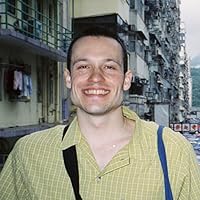
John Patrick Byrne was a Scottish playwright, screenwriter, artist and designer. He wrote The Slab Boys Trilogy, plays which explore working-class life in Scotland, and the TV dramas Tutti Frutti and Your Cheatin' Heart. Byrne was also a painter, printmaker and scenic designer.
Mmm. The older Scots among us will recall that The Slab Boys trilogy was once regarded as an icon of Scottish culture back in the 1970s full as it is of [alleged] Scottish wit in the Glasgow vernacular. The story centres on the irreverent back-chat of two lads working in the colour-mixing room (the slab room) of a carpet factory and how their lives pan out over the three plays.
I remember seeing the first and most famous of the plays when I was a youngster and finding it a bit boring in spite of all the hype that surrounded it. Turns out my youthful instincts were right. It’s not just that it isn’t actually that funny, or that has become very dated, it is that the two lead characters are a couple of nasty bullies who are cruel to and make fun of people with mental health problems. I disliked them intensely and by the end of the third play still didn’t care what happened to them.
I hope these plays are never revived as I would be appalled if anyone thought for a minute that they represented Scottish culture past or present. One to be consigned to the archives and, hopefully, forgotten.
I had the great pleasure of seeing the production of The Slab Boys, the first in John Byrne’s amazing trilogy of plays, at the Citizens Theatre in Glasgow with my daughter Ruth a few years ago and was therefore delighted to receive a copy of The Slab Boys Trilogy book from her for my birthday this year. Reading the three plays has been an absolute delight and every page has examples of the brilliance of John Byrne’s writing.
The Slab Boys trilogy is a genuine masterpiece and should be essential reading for anyone who has yet to discover why it has been described as ‘one of Scotland's defining literary works of the twentieth century’. If you’ve been fortunate to have enjoyed seeing stage productions of the plays, the book is the perfect way of reliving the theatrical magic you have witnessed. The wonderful humour of the pieces, particularly from the ‘double act’ exchanges between the two main characters, Phil and Spanky, are in brilliant evidence throughout but there is also poignancy, sadness and real senses of regret, especially in the latter two plays, Cuttin’ a Rug and Still Life.
John Patrick Byrne, both as a writer and a painter and artist, still somehow isn’t fully recognised or appreciated in his own country as the actual genius he undoubtedly is. If he had been born in France or Italy he would be lauded and loved in those countries with proper ‘national treasure’ status. This is reflected in the unbelievable struggles he had to endure to get Underwood Lane, his latest theatrical work, into production. We had tickets for this in July and had been really looking forward to it but sadly it has had to be postponed until next summer due to the current pandemic.
I will very much look forward to revisiting The Slab Boys trilogy book many times again in the future as the brilliance of John Byrne’s writing will continue to provide so much enjoyment and I would have no hesitation at all in giving the book the highest possible recommendation.
A heavy focus on characterisation within the context of comedy is the name of the game in all three plays, the first two especially.
Language is handled carefully and neatly - the author applying a bent on the inherent caricature through a kid gloves approach.
Still, what is often a land-locked literature in itself also features, here, in 2018, a snippet of a social past entirely common but never thoroughly nomenclated.
As such, the brand of comedy (launching from misnomers, puns, non-sequiturs and gentle farce) could prove inaccessible to international audiences; and tired to contemporary Scottish audiences currently acclimated to a different brand of working-class Scottish comedy.
Despite the focus on characterisation, I would have liked to have saw more character depth in The Slab Boys and Cuttin’ a Rug. The boys are nineteen; hidden passions are whispered but never shouted, even at the end of both plays.
However... a sudden curve ball: the third and final play, Still Life, has a noticeable maturity in its writing from the opening scene! The characters are different: Spanky from Act One; Phil from Act Two.
Not just different but have become developed, which along with the morphed (evolved...?) setting create a neat-but-slight holistic perspective. It’s an engaging end to the trilogy.
Overall I felt these plays showed up the artistic versatility of John Byrne well. And beyond that, a comfortable little seat in the canon of contemporary/modern Scottish literature.
Right I don’t want to cheat but I’ve not read Still Life and I couldn’t find a singular entry on Goodreads go Cuttin’ A Rug - consider this a Cuttin’ A Rug only review.
It was a pleasure to step back into the Slab Boys world. I’d have loved to see this live for the fact that it builds on the physical comedy of the first; you can really feel Byrne honing his craft as a playwright. This was great fun.