Gracias a Macrobio (c. 400 a. C.), el occidente europeo conoció el relato con el que Cicerón concluía la República. El Sueño de Escipión de Cicerón (según Ellémire Zolla, la Bhagavad Ghita de occidente) es un breve tratado de impronta pitagórica en el que se presenta a un Cornelio Escipión que, antes de la destrucción de Cartago, visita en una visión/sueño, como si de un vuelo chamánico se tratara, a Escipión el Africano. Éste le muestra la composición del universo y le insta a afrontar la guerra con ánimo místico, a practicar las virtudes y a desapegarse de la gloria terrena.
Un denso enigma invade la figura de Macrobio. Su comentario filosófico del relato ciceroniano se inscribe dentro del neoplatonismo propio de su tiempo, siendo Platón, Plotino y Porfirio los autores más citados.
Una cuidada estructura rige su comentario, ordenado a partir de las citas literales del relato de Cicerón, que contienen unos dos tercios de la obra.
En un sentido semejante a los cultos mistéricos y a los oráculos caldeos, Macrobio concibió las almas individuales como espíritus caídos desde las esferas superiores en la materia.
Macrobius, fully Macrobius Ambrosius Theodosius, also known as Theodosius, was a Roman provincial who lived during the early fifth century, at the transition of the Roman to the Byzantine Empire, and when Latin was as widespread as Greek among the elite. He is primarily known for his writings, which include the widely copied and read Commentarii in Somnium Scipionis ("Commentary on the Dream of Scipio"), which was one of the most important sources for Platonism in the Latin West during the Middle Ages, the Saturnalia, a compendium of ancient Roman religious and antiquarian lore, and De differentiis et societatibus graeci latinique verbi ("On the Differences and Similarities of the Greek and Latin Verb"), which is now lost.
Macrobius is one of the so-called encyclopedists. Calcidius and Cassiodorus are also often included in this list. Their works often dealt with an assortment of philosophical subjects. They were not often all that original and were dependent on works of other philosophical writers, but they did offer in rather concise form a broad analysis of popular philosophical topics.
Macrobius has two existing works: a commentary on Cicero's Dream Of Scipio and the Saturnalia. Both works are philosophical in nature and are compendious in subject matter. In the Commentary, his Neo-Platonist bent is evident and his familiarity with Platonist and Neo-Platonist thought is clear. His main dependence seems to be Plotinus and Porphyry. There seems to have been some scholarly debate as to which one Macrobius was more dependent on, but it is safe to say that he was well acquainted with both. The translator holds that Macrobius had probably never read the actual works of Plato, but I find this difficult to accept. Even though he was a Latin writer, he was certainly familiar with Greek and could read it. This is made pretty clear in this book. I can see no reason why he would have not been well read in Plato's writings.
Originally, the Dream Of Scipio was only a small section of Cicero's Republic. Cicero was evidently inspired by Plato's own dialogue of the same name. Like Plato, Cicero decried the abuses of democracy and the horrors of tyranny in his own Republic; and just like Plato, he ends his work with a mythic parable that dealt with cosmology, immortality and various other metaphysical subjects. Macrobius used this section of Cicero's Republic as a jumping off point to discuss an array of subjects that are Platonist in nature.
It is thanks to Macrobius that this section of Cicero's Republic is even extant. At a certain point, copyists started including this section of the Republic with Macrobius' commentary. This commentary was incredibly popular during the Middle Ages. For many scholars at that time, this was their main source for Neo-Platonist thought. With the dawning of the age of Christendom, came also the proliferation of the Latin language and it becoming the lingua franca of the Holy Roman empire. The encyclopedists not only wrote in Latin, but their works were broad in subject matter. Both of these factors contributed to them being very popular sources of knowledge to scholastics and others. The amount of copies and quotations attest to the popularity of the Commentary on Scipio's Dream.
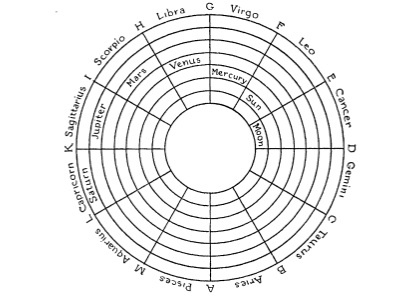
One of the more popular aspects of this work during the dark ages was the astrological/astronomical discussions. I found the various treatments of Zodiacal lore and traditions quite interesting. It was something that also caught my attention in Porphyry's Cave of The Nymphs. I included a cosmological diagram found in here. It is supposedly the original layout of the planets and zodiac at the creation of the universe. This tradition certainly predates Macrobius.
I have to say that reading the introduction reminded me of what is often said of Plutarch. I feel they are both unfairly maligned as being unoriginal. I think that really does their merits as philosophical writers a disservice and it trivializes and marginalizes them. Like Plutarch, Macrobius was a Platonist that helped keep Platonism current during a seminal and paradigmatic period and also provided his own contributions to it's literature. I found this commentary incredibly engaging. How quickly I read it should attest to my interest. I didn't read Aristotle's Nichomachean Ethics anywhere near as quickly.
I can honestly say that this book is to be recommended as an important work of Neo-Platonism. Macrobius is not devoid of errors, but his strengths are more notable than his weaknesses. I think a book like this does serve as a good introduction to Neo-Platonism. One should, of course, read Plotinus, but Macrobius' language is not as prolix as other Neo-Platonists and can be more readily understood by the average reader.
Ever wonder what people used to think about the how the universe was physically organized before the emergence of modern science?
If so, then this is THE book for you!
When I finally worked up the courage and commitment to read it, I discovered that it explained — quite literally — hundreds of individual works of art that I had been curious about over the course of the last thirty years. From the iconography of medieval architectural sculpture and illuminated manuscripts to the conceptual programs of major Renaissance and Reformation artistic enterprises, Macrobius' Commentary on the Dream of Scipio is nothing less than an "intellectual skeleton key" to the visualizations of the world and the universe for a thousand years of Western art and literature. I wish I had not waited so long; it was a delight to read.
Macrobius provides a stunning summation of the state of Western science by the time of late Antiquity, and allows you to peer into the conceptual model of the laws of nature that shaped the collective imagination of the West from the time of the Sack of Rome to the discoveries of Kepler, Brahe, Galileo and eventually Newton.
This is a great book to open your mind about the history of how we have, as a species, understood (and just as importantly, misunderstood) the order and operations of the universe — a book best encountered as early in your life as possible, as a worthy antidote to the passing spectacles of scientism, pseudo-science and political pieties that parade as science that still seem to saturate our lives as late as the second decade of the 21rst century. It also led me back to rereading Cicero's "Dream of Scipio," an appendix to his De Re Publica, and from thence to the so-called "myth of Er" from Book X of Plato's Republic, which I had read under entirely different circumstances years before. In a way, Macrobius helped me tie up dozens upon dozens of loose threads that had been dangling in my consciousness for many years.
Upon finishing the Commentary, which had been on my to-read shelf, untouched for twenty years, I was immediately moved to acquire and dive into the newly released, three-volume Loeb Classical Library edition of the Saturnalia, which was a good move. It's a dizzying and dazzling compendium of all the knowledge worth knowing at the time, an encyclopedia in the form of a party dialogue. Entertaining and enlightening it certainly is, but be warned, it is not something you want to read if you're looking to entertain anything more than your prefrontal cortex. In other words, it is neither a thriller nor a page-turner. But it does offer a wonderful backdrop to the Commentary, and its dedication to Macrobius' son, alone, made it worth the additional effort. The Saturnalia, in turn, led me to the Attic Nights of Aulus Gellius — but that's another story. All of this wonderful, cultural backstory triggered by the Commentary! And to think that one can be considered an "educated" person without even knowing who these people were, what they wrote and thought! A damning indictment of our pathetic institutions of "higher" learning...
Highly recommended, but not for the feint of mind. But if you have even a modest curiosity of what is meant by the Harmony of the Spheres, you owe it to yourself to pick it up and dive right in; I regret that I had a copy on my desk for over a decade before I finally mustered the courage to dive in. Don't wait!
This is a curious little text from late antiquity. Ostensibly, the book is a fifth century commentary on part of Cicero's De re publica. In reality, Macrobius uses the passage from Cicero (a charming dream sequence starring Scipio Africanus) as a jumping off point to discuss the nature of the universe and the soul. Macrobius was not an original thinker - he borrows most of his ideas and concepts from philosophical and scientific predecessors - and his knowledge of Plato and Aristotle appears to be solely secondhand. But he is a committed Neoplatonist in the tradition of Plotinus, and his summary of Neoplatonic doctrine is a very good distillation of the dense and difficult texts that came before him.
As an introduction to Neoplatonism, which can be quite complex (at least for this reader), this book has value. It should also interest medievalists, as this was a surprisingly popular text in the Middle Ages and was heavily influential during that era. 3.0 stars.
estoy loqueando y tengo examen mañana y ni siquiera me he acabado esta mierda y en todo lo que puedo pensar es que lo único peor que Cicerón es un fan de Cicerón como vas a leer tremenda mierda y pensar q ese ególatra subnormal necesitaba que le subieran más el ego y aún encima esta bazofia solo se preserva por tu puta culpa macrobio no podías estarte quieto me come los cojones pq el número siete es perfecto pq ayer te sacaste siete mocos y el orden de los planetas q te has sacado del culo todo lo q dices es mentira y te crees guay por citar a Platón voy a quemar todos tus libros q no van a recuperarte ni en un palimpsesto de esos
To one disposed to Augustine’s judgment in his City of God on pagan Roman virtue as the epitome of arrogance and lust for power, Scipio’s dream, recounted in the final book of Cicero’s dialogue De re publica, must appear a rather curious document of Latin literature. From the vantage point of the Milky Way, high up in the heavens, Scipio looks down to earth and sees the Roman empire reduced to but a dot in all this vast space and military glory (such as he was about to win over Carthage) as ephemeral, when measured in terms of the great cosmic year, a humbling prospect, indeed! As the oracle at Delphi tells us, know yourself! Gnothi seauton! This was to be the conventional Christian interpretation of the Delphic maxim, yet it does not, by a long shot, account for the appeal Macrobius’ late fourth-century commentary on Scipio’s dream would exert throughout the Middle Ages. A glance at the topics Cicero treats incidentally in retelling Scipio’s prophetic dream, however, will show beyond doubt their attraction to the medieval mind: classification and interpretation of dreams, Pythagorean number theory, astronomy, geography, the virtue of justice, the fate of the soul after death and its immortality. Macrobius himself was scarcely an original mind, but one of the more illustrious representatives of the late antique encyclopedic tradition, who infuses his materials with the Neoplatonic worldview common to pagans and Christians of the period alike (the content of his commentary is strictly pagan, but this need not mean he could not have been a Christian, given the convention among literate Christians of his generation to speak in pagan idiom when writing for the public; this convention would persist as late as Boethius’ Consolation of Philosophy somewhat over a century later). Reading Macrobius convinces one how the western Christians of the early Middle Ages could have been in command of a rather sophisticated grasp of ancient pagan literary and philosophical culture, even though they had access to almost none of the original sources, particularly those written in Greek (from the sixth century up to the recovery that got underway in earnest during the twelfth century, an unimaginable expanse of time). As to the specific contents, three items provoke this recensionist’s interest: first, a fairly complete treatment of number theory and symbolism (comparable to Nicomachus of Gerasa’s summarized in Iamblichus’ Theology of Arithmetic); second, Macrobius’ extensive argumentation with Aristotle over Xenocrates’ doctrine of the soul as a self-moving number; and third, the advanced ideas surrounding the concept of the limit in late Neoplatonic philosophy of mathematics, which would stand scrutiny even yet today. In this recensionist’s opinion, they anticipate the modern concept of the Banach dual, such as forms the ground of the discipline known as geometric measure theory. This latter deals with the so-called de Rham currents, which are nothing but elements of the dual space to the space of differential forms on a smooth manifold (topologized with the metric deriving from the Hodge star).
This is the second work of Macrobius, dedicated to his son Eustathius, that I have read. It offers profound astralistic-astronomical insights, virtue-centered pneumatological elucidations, and ethical frameworks for the commonwealth—modeled after Cicero’s Dream of Scipio. Drawing from the Egypto-Hellenic, Platonic, and Neoplatonic traditions, I have sifted through its contents for essential knowledge pertinent to my personal development, while also engaging in meticulous research into the history of ideas.
What I have affirmed is that many metaphysical convictions expressed in antiquity still hold true—despite the limitations of early observational and speculative astronomy. My pursuit has been one of reconciling these ancient insights with the modern understanding of physical astronomy.
With this body of knowledge now integrated into my perspective, I may pause, reflect, and embark upon a new literary journey—one that continues to broaden my vision and reaffirm the odyssey of my soul and spirit: as a mortal, a god, and a humble intellectual who refuses to lay down his sword or wit before the grave.
An excellent volume on an arcane philosophy. The basic philosophy that Macrobius relates details a system of thought in which the souls of men are identified with the stars of the Milky Way. They travel down the planetary spheres, gaining ever denser bodies, before finally being born upon earth. Strung around this general theme, Macrobius explores a great many aspects of ancient philosophy - numerical and geometric symbolism in particular. Some of his discourses do tend to ramble a bit but compared to other ancient writers on similar subjects Macrobius comes out pretty well. This edition by W H Stahl has all the notes, comments and references you could hope for. Very helpful if you want to delve deeper into the origins and sources used by the Roman author.
That was certainly an interesting read! Amazing how he could categorize dreams in that manner, and how logical his organizations were. This is also quite different in that it didn't critique a religious text, which was something more prevalent during his time.