Jump to ratings and reviews
Rate this book

Eric Gill

Rate this book
Fiona MacCarthy's ground-breaking biography of the artist-craftsman, typographer, and lettercutter, master wood-engraver, and sculptor: Eric Gill.

Eric Gill was the greatest English artist-craftsman of the twentieth century: a typographer and lettercutter of genius and a master in the art of sculpture and wood-engraving. He was a devoted family man and key figure in three Catholic art and craft communities: yet he also believed in complete sexual freedom. In her controversial, landmark biography, originally published in 1989, celebrated biographer Fiona MacCarthy delves into the complex, dark, and contradictory sides of the man and the artist for the first time - and the result is his definitive portrait.

338 pages, Paperback

First published January 1, 1989

15 people are currently reading
241 people want to read

About the author

Fiona MacCarthy

29 books39 followers
Fiona MacCarthy was an English biographer and cultural historian best known for her studies of 19th- and 20th-Century art and design.

MacCarthy began her career on The Guardian in 1963 initially as an assistant to the women's editor Mary Stott. She was appointed as the newspaper's design correspondent, working as a features writer and columnist, sometimes using a pseudonymous byline to avoid two articles appearing in the same issue. She left The Guardian in 1969, briefly becoming women's editor of the London Evening Standard before settling in Sheffield.

She later became a biographer and critic. She came to wider attention as a biographer with a once-controversial study of the Roman Catholic craftsman and sculptor Eric Gill, first published in 1989. MacCarthy is known for her arts essays and reviews, which appeared in The Guardian, The Times Literary Supplement and The New York Review of Books. She contributed to TV and radio arts programmes.

Ratings & Reviews

What do you think?
Rate this book

Friends & Following

Create a free account to discover what your friends think of this book!

Community Reviews

5 stars
20 (16%)
4 stars
52 (43%)
3 stars
33 (27%)
2 stars
10 (8%)
1 star
4 (3%)
Displaying 1 - 19 of 19 reviews
Profile Image for Lizzie.
562 reviews22 followers
April 30, 2008
Biography of the type designer (maybe you’ve heard of Gill Sans) and sculptor. Besides his endless creative energy, he seems to have a hyperactive libido. He had numerous affairs and had sex with his sisters and daughters, as detailed in his diaries. He was a zealous convert to Catholicism but found ways to justify all this.

This biography led to a controversy about whether his sculptures of the Stations of the Cross in Westminster Cathedral should be removed, given his history as a pedophile. The Church refused. (I think art should be judged on its own merits, but I love his art and I wasn’t sexually abused as a child, so it’s not my ox being gored.)

He died of lung cancer at only 50, from smoking and years of carving stone with no protection. I liked this biography; he's an interesting guy and this showed him warts and all.

I didn’t mind his hypocrisy because, unless they oppress others with their beliefs, I’m not offended by individuals saying one thing and doing another, and he didn’t do that. I think that kind of disconnect is human nature.
Profile Image for Christopher.
73 reviews7 followers
December 29, 2014
Interesting enough biography of a very talented man (stone cutter, typographer, sculptor, controversialist, pervert). This is the book that first revealed to the world (on the basis of an autobiographical manuscript) that the man was having sex with his sisters, his daughters and (not sure whose) dog. It's interesting to see how differently such material was treated only 25 years ago. While this bizarre piece of information is by no means concealed, not too much is made of it, and it seems to be treated like a defect in something you're trying to sell on eBay: you have to acknowledge the fault, but you try your best to downplay it. Nowadays, such information is likely to give rise to calls to have his body dug up for posthumous burning as a heretic and for the shunning of his work by all decent individuals (and I gather that there actually is a website dedicated to the boycotting of his Gil Sans font).

The work is arranged chronologically, which impedes any sort of analytical evaluation of aspects of his life that span a number of years (say, his development as a sculptor, or his work as a font designer). Some aspects that seem pertinent to me (like designing coins, banknotes and stamps) are pretty much ignored. In effect, this is a biography of the man's life, with merely incidental notice of his artistic activities. While his life is interesting, myself I'd prefer a bit more analysis. Also, you have to be pretty familiar with the artistic/intellectual life of early 20th-century England to figure out what's going on at times. If you don't already know about the Bloomsbury set, the author doesn't cut you too much slack.
Profile Image for Mick Kelly.
Author 2 books5 followers
November 12, 2015
Another excellent biography by Fiona MacCarthy. Gripping and informative - only marred by the appalling presence of Gill himself. I love his sculpture, his woodcuts and his typefaces - but the man himself is just awful.
In many ways he appears like the leader of many religious sects - adulterous, incestuous, paedophilic - he used religion as a front and a justification for a lifetime of sexual gratification.
I guess many artists are a little transgressive, but Gill - as Fiona MacCarthy demonstrates in an undramatic fashion - was really a monster.
Profile Image for Jeremy.
29 reviews1 follower
October 30, 2021
Eric Gill was a force of nature, of that there seems to be little doubt. Though that is not the lingering feeling I am left with after reading this book a couple of days ago. The feeling - and it is a very sharp one - is that he was a man of contradictions. This is, to an extent, the central theme that runs throughout the book, and one which MacCarthy evidences expertly. This might explain the effort Gill put into expounding his theories of integration:
"Life and work and love and the bringing up of a family and clothes and social virtues and food and houses and games and songs and books should all be in the soup together."

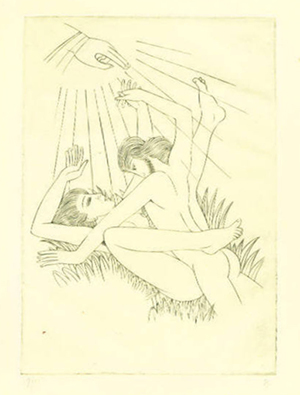
Gill, it seems, is speaking more to himself than to others. Perhaps the most eye-catching contradiction is Gill’s obsession with sex and religion, two aspects of life which most people like to keep separate, and which are sometimes seen to be mutually exclusive; the image of the heathen hedonist or the devout celibate. Gill puts these two things in a blender, and the result is refreshing but inconsistent, brave but confused. These two interests seem to have been kept separate in his early life, eventually being brought together in a confluence of ideas in his later years. The resultant imagery is visually interesting (as ever with Gill) but eccentric:

Nuptials of God, wood engraving, 1922

Nuptials of God, wood engraving, 1922


Earth Receiving, copper engraving, 1926<br />

Earth Receiving, copper engraving, 1926


These two ideas do not only overlap in his art. MacCarthy’s carefully selected diary excerpts show us that the overlap was part of Gill’s everyday life. In one instance, at a time when Gill was living in a monastery and signing his letters Eric Gill OSD (as a lay member of the Order of St. Dominic), he asked his new secretary to measure his penis. Two days prior, his diary notes that he was busy carving her a rosary bead. Was Gill aware of these contradictions? The prevailing feeling I got was that his efforts were channeled almost exclusively into convincing himself and others that they were not contradictions at all. In a letter, he writes:
“Joining the Church is…like getting married and, speaking analogically, we are fucked by Christ, and bear children to him."

It was a challenging and interesting experience for me to read about a man who (in his own mind, at least) had managed to integrate these two ideas. The only thing that sex and religion have in common in my own life is the vehemence with which I support the former and loathe the latter.

In my review of Hughes’s The Shock of the New, I noted how prominent sex has been in modern art. For Gill sex was one of, if not the, central themes of his life. It is present in his description of the cathedral at Chartres:
“Oh taste and see how gracious the lord is. I did taste. I did see. And though when I first went there in 1907, I was not aware of such things in these words, I was inebriated with more than a sensual delight; for my sensual delight was, as a sensual delight should be: an attraction to the truth”

…and his description of his discovery of sculpture:
“And so, just as on the first occasion when, with immense planning and scheming, I touched my lover's lovely body, I insisted on seeing her completely naked (no peeping between the uncut pages so to say), so my first erotic drawing was not on the back of an envelope but a week or so's work on a decent piece of hard stone...Lord, how exciting! - and not merely touching and seeing but actually making her. I was responsible for her very existence and her every form came straight out of my heart."

Contradictions aside, Gill’s depictions of sex and the female figure are sublime, and show his familiarity with both. The sinuous, energetic ‘Votes for Women’, or the intimate ‘Ecstasy’ (originally titled ‘Fucking’) are images which are both familiar and idealised, which I feel is the hallmark of good art which focuses on sex.

Votes for Women, Portland stone, 1911

Votes for Women, Portland stone, 1911


Ecstasy, Portland stone, 1910-1

Ecstasy, Portland stone, 1910-1


Gill’s art theories are much more consistent than his views on sex and religion. Gill promoted a theory of art being found in everyday things, as opposed to the idea of Art with a capital “A”, confined to museums and galleries. This MacCarthy calls his view of the “necessity” of art, and “it’s relation to the sanctity of everyday activities.” A challenging concept, I think, but one which is worth considering. There is also a very telling vignette in the book of Gill turning down an opportunity to be the French sculptor Aristide Maillol’s apprentice, despite Gill very much looking up to him. He justifies this decision in a letter in which he struggles to hide his embarrassment:
“The similarity in our ideas, if I may so presume to speak would be so seductive (Oh! this is an awfully difficult point!) that I should cease to oppose.”

This sheds some light on the importance of opposition to Gill’s creative process, and may give us a clue as to why contradictions were so important to him.

MacCarthy handles the sensitive topic of Gill’s more disturbing sexual deviances with care. Gill’s incestuous relationships with his daughters is especially abhorrent and challenging and his incestuous relationships with his sisters later in life is bizarre. Both evidence his possessiveness over the females in his life. The fact that his daughters are the subject of his art and are depicted in such a sensuous manner prompts the reader to consider the implications of the abuse on the aesthetic value of the resultant art. What is the relationship (if any) between the subject matter and the aesthetic qualities of a piece of art? Does the viewer’s knowledge of the inspiration of these drawings change his view of the value of the drawings themselves? Should it? Would Picasso’s Guernica retain its value if it was based on, say, one of the artist’s nightmares as opposed to the bombing of Guernica? This is not the first time I’ve asked these questions, but in reading this book I felt compelled to come to some conclusion, to resolve this tension. The conclusion I (tentatively) came to is that the aesthetic quality of art is not affected by the context which inspired it. The context is however of both cultural (in Picasso’s case) and moral (in Gill’s case) import.

MacCarthy scrupulously paints a picture of a complicated man who lived a full life. The portrait seems to me to be a fair and sympathetic account of the man. Despite his clear genius, he is presented to us a complex and flawed character.
Profile Image for Bill Wells.
204 reviews1 follower
March 5, 2013
I was not all that familiar with Eric Gill outside of his work with type design and wood engraving, so this book came as quite a surprise. His religious and political pursuits (not to mention his wild sexuality)were new to me, as was his notoriety during his day. Fiona MacCarthy makes no apologies for Gill, but tries to understand him in the context of his times. I liked the book, but it is one of those books that would be hard to recommend due to Gill's perverse obsession with sex. That being said, the man did know how depict women with a lovely, simple line in his wood engravings and drawings.
Profile Image for Karla Huebner.
Author 7 books96 followers
Read
November 27, 2010
After rereading, I hold to my original assessment that the author manages to present a coherent account of a complex and contradictory character. This makes me consider rereading the Malcolm Yorke biography, which I recall grappled valiantly with the problem but didn't quite pull it off (maybe because Yorke was more circumspect?)
Profile Image for Andy.
37 reviews
September 20, 2017
I knew very little about Eric Gill (sculptor, designer, typographer, child molestor, etc etc), a fact I realised visiting Guildford Cathedral where his statue of John the Baptist is. This biography is well regarded so I decided to read it.

Despite being the book which dished the dirt on Gill's more reprehensible side, MacCarthy does a great job of painting a very well rounded, non sensational and sympathetic portrait of this complex man
Profile Image for A.M. Steiner.
Author 4 books43 followers
December 1, 2020
A diligent but workmanlike biography of the artist, which focuses on all the wrong things, but is saved from dullness by the bizarre antics of its endlessly fascinating subject.

Eric Gill is probably best known to readers as the creator of several typefaces (Gill Sans, Perpetua etc), but in his time he was also considered a world-class sculptor, and many of his works remain on prominent display in the UK. Upon its release, this biography shocked the art world with its revelations of incest within the Gill family, and so received a great deal of attention. Unfortunately, if you look beyond the scandal, what remains is a biography which revels in trivia while failing to attempt to answer any of the burning questions that Gill's life raised, or investigate his mind in any depth.

It is a chronicle rather than an examination, and even as such, is hampered by the author's narrow Upper Class/ Oxbridge/ Arts establishment perspective. Other than when dealing with Gill's sexual transgressions, MacCarthy relentless focuses on irrelevant trivia such as modes of transport, home décor, and the names of passing-through apprentices, while glossing over Gill's many debates and interactions with leading figures of the day. And as if the choice of focus wasn't bad enough, the author lazily repeats a limited number of stock phrases. I think I read the line "x was almost certainly the most perceptive examiner of Gill" used in relation to ten different people over the course of the text.

Of course a lot of people will come to this book for the scandal, and in that respect it does not disappoint. To say that Gill had a lively sex life would be the understatement of the millennium. The biography, in a refreshingly non-judgemental way, notes how over the course his life he shagged, at a minimum: his wife, his sister, his teenage daughters, most of his models, a ton of prostitutes, his sister's dog, his wife, a statue of his wife, most of his friends' wives, and some of his male friends. I think there are strong indications that he was abused by his own father, which may have contributed to his obsession with anuses, phalluses, and his theory of Catholicism as being f***ed by Christ (which he meant as a compliment). And Gill was no ordinary night-creeping, drunken abuser. This was a man who wrote in diaries in pedantic detail about the spiritual implications of the contractions of his daughter's anus while he made her orgasm. All of this bonkers transgression was expressed in his art, and wrapped in an ever shifting philosophy of free love and sexual ecstasy as a religious act. The book does a great job of leaving it up to the reader to see Gill as either a selfish predatory monster wrapped in an incoherent bundle of deluded self-justifications, or a man with such sincerely held alternative-morality beliefs that he was beyond all ordinary moral codes. Like the author, I tend towards both narratives being true.
Profile Image for Ecstasy.
25 reviews
March 5, 2022
Writing a biography is the most difficult endeavor in writing. It is in many ways the antithesis of good writing. Good writing takes experiences and condenses them into a form whose intensity makes up for the fact that no experience is possible. Good writing is a drug. A average day can be bliss, but to write merely that it was a average day means very little.

In a biography, however, one must reasonably include the average days, and there are quite a number of them. A good biography therefore requires exceptional skill, not only as a historian, but also as a writer.

MacCarthy does a serviceable job in each aspect. The prose flows smoothly, but doesn't say much at all. The information is largely surface moments in Gill's life. There is no analysis of his art or his character, which is surprising because of what kind of a man Eric Gill was. He was clearly a famous sculptor, but there's very little examination of why beyond mentioning sharp angles, as if that was a revelation. He clearly had a satyric deposition, but there will be a mention of a lifelong incestuous affair in a sentence, and then it will be never mentioned again.

I picked up this book knowing nothing of Eric Gill. I was curious how a sculptor could be controversial, and now I see, but I do not understand. I do not understand Eric, and I do not understand his art. This book, while sometimes enjoyable, could be summarized by a list of dates without any meaning lost.
Profile Image for Margaret.
Author 1 book
May 30, 2020
What a wacko. Talented, for sure, and made beautiful work, but oh his poor family, especially his daughters. Again brings up the hard topic of whether you can separate the person from the artistic legacy.
Profile Image for Catherine.
13 reviews
December 12, 2025
What I found amazing was that Fiona MacCarthy wasn't more perturbed by Eric Gill sleeping with his sisters and daughters. It was a very interesting book mostly because Eric Gill was incredibly weird.
293 reviews8 followers
August 4, 2020
A very talented and creative man, well presented. He could be the archetype for the expression "thinks with his little head instead of his big head"
Profile Image for Ryan.
1,182 reviews64 followers
October 22, 2022
First-rate biography about a man you would merrily push down the stairs.
Profile Image for Erica Chambers.
54 reviews8 followers
March 31, 2013
Good solid autobiography - MacCarthy deals well with the unconventional nature of Gill's sexual activities and doesn't let it overshadow Gill's work. Gill's contribution to modern culture can still be seen everywhere. Be it Gill Sans or the Stations of The Cross at Westminster Cathedral; his work is still totally relevant today.
Profile Image for Harald.
484 reviews10 followers
February 19, 2016
An engrossing biography of an artist with modern artifacts presented in a medieval setting. His type font Sans Gill is still widely used, but he designed and carved in stone many other masterpieces. His private life was full of contradictions.
9 reviews1 follower
July 16, 2013
Mind boggling! What an extraordinary man. Superb biography that I found difficult to put down.
Displaying 1 - 19 of 19 reviews

Can't find what you're looking for?

Get help and learn more about the design.